Japan to decide coronavirus stimulus next week, may use deficit covering bonds

    Japan Economy Minister Yasutoshi Nishimura said that the government is targeting to decide on the coronavirus economic response package in the early half of next week. He added that Prime Minister Shinzo Abe gave him the instruction to compile the measures in 10 days on March 28.

    Separately, Finance Minister Taro Aso noted that the government will consider issuance of deficit-covering bonds to fund the massive stimulus package. The government would also make use of crisis credit lines to support airlines hit by the coronavirus pandemic.

    Oil price jumps as Trump said Saudi and Russia will cut production, pressing key resistance

      Both oil price and stocks rebound strongly after US President Donald Trump said Saudi Arabia and Russia will be “cutting back approimately 10 Million Barrels” of oil production to ease pressure on price.

      Twitter

      By loading the tweet, you agree to Twitter’s privacy policy.
      Learn more

      Load tweet

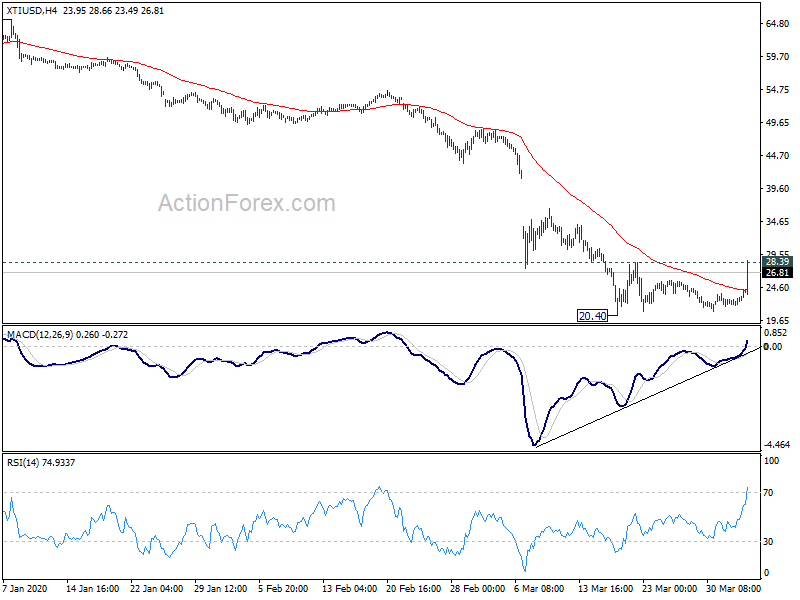
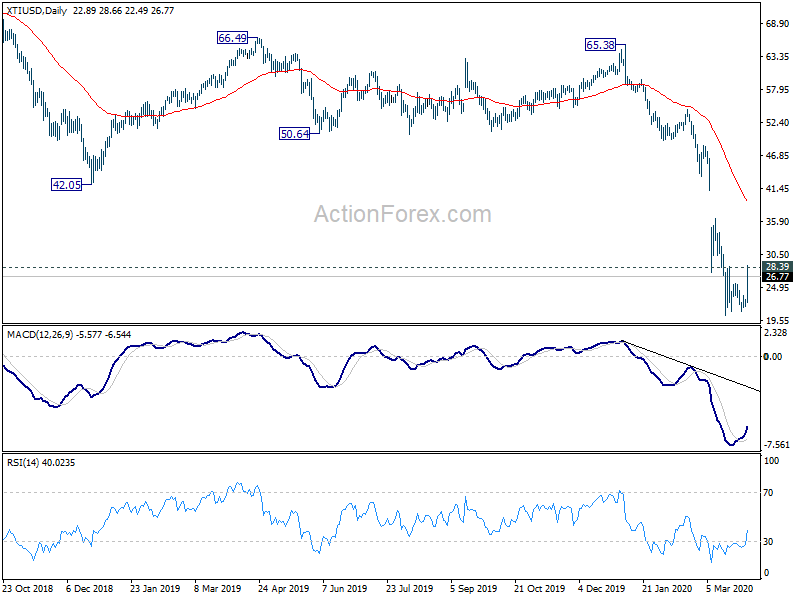
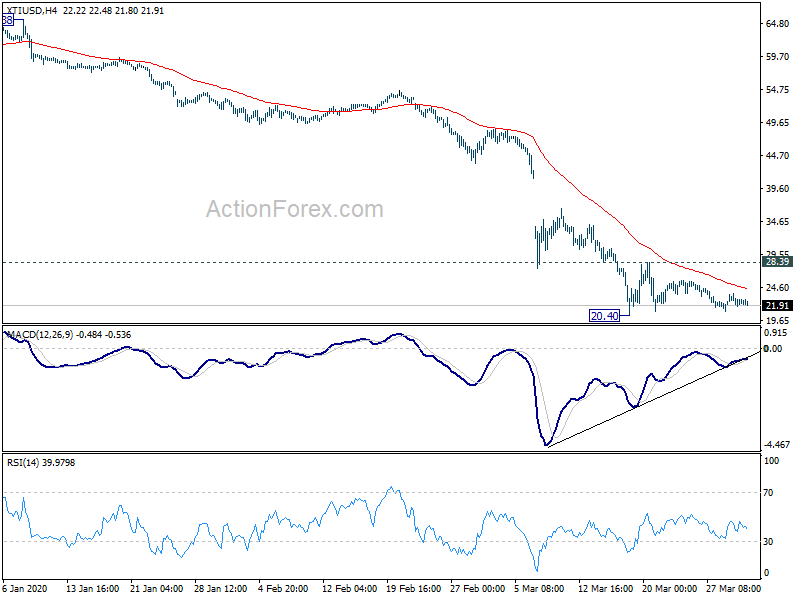
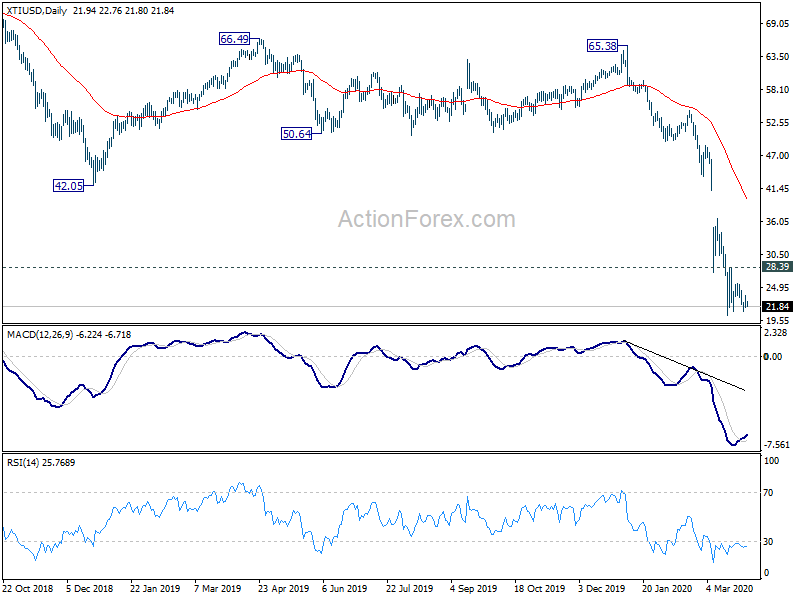
      WTI crude oil hit as high as 28.66 but retreated back quickly, gyrating around 26 handle. Technically, we’d maintain that firm breka of 28.39 resistance is needed to confirm short term bottoming at 20.40. in that case, stronger rebound would be seen back to 55 day EMA (now at 39.26) which is inside prior gap. Failing to sustain above 28.39 will bring down trend resumption through 20.40 sooner rather than later.

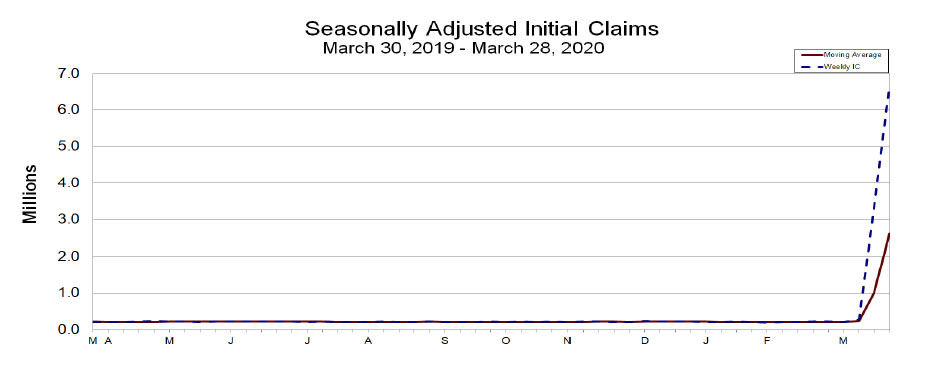
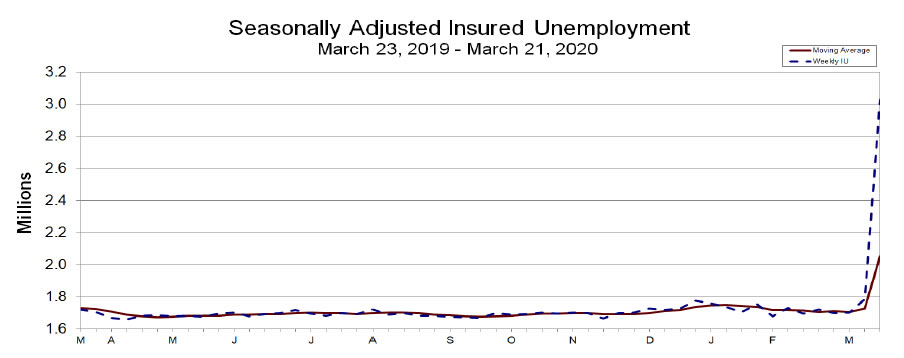
      US initial jobless claims doubled to 6.6m, another record high

        US initial jobless claims jumped 3341k to 6648k in the week ending March 28, making another historical high. Four-week moving average of initial claims rose 1608k to 2612k.

        Continuing claims rose 1.245m to 3.029m in the week ending March 21. That’s the highest level since July 6, 2013. Four-week moving average of continuing claims rose 327k to 2.054m, highest since January 2017.

        Full release here.

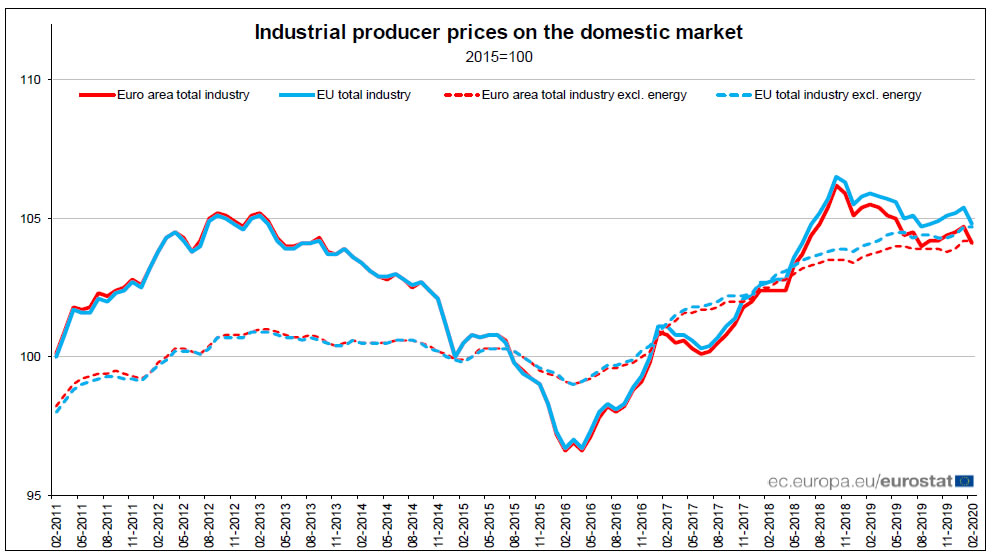
        Eurozone PPI at -0.6% mom, -1.3% yoy in Feb

          Eurozone PPI came in at -0.6% mom, -1.3% yoy in February, versus expectation of -0.1% mom, -0.6% yoy. Looking at some details, energy decreased -2.3% mom, intermediate goods dropped -0.2% mom. Capital goods rose 0.1% mom. Durable and non-durable consumer goods rose 0.2% mom.

          EU PPI came in at 0.6% mom, -1.0% yoy. The largest decreases in industrial producer prices were recorded in Denmark (-2.2% mom), Spain and Portugal (both -1.3% mom), while the highest increases were observed in Slovakia (2.2% mom), Ireland and Cyprus (both 0.2% mom).

          Full release here.

          EU Gentiloni: Italy losing 3% GDP for each month of lockdown

            EU’s Commissioner for Economy Paolo Gentiloni warned that each month of lockdown in Italy would cause a -3% annualized GDP decline. But for now, there is no discussion on an Italian bailout. Confirmed coronavirus cases in Italy surged pass 110k this week while death tolls broke 13k. There is tentative signs of slowing after rigorous measures but no end in sight yet.

            Earlier in the week Gentiloni a mentioned the absolute need to have coordinated European actions, which is growing already in the healthcare side and border management. EU members have taken measures of around EUR 270B and the efforts should be strongly coordinated in the new weeks and months. The suspension of fiscal rules is sufficient for a first immediate reaction. But there is a need to finance a general European recovery plan for the months ahead.

            Australia NAB business confidence dropped to -11 in Q1

              Australia NAB Business Confidence dropped from -2 to -11 in Q1. Current Business Conditions dropped from 6 to -3. Conditions for the next 3 months dropped from 8 to -4. Conditions for the next 12 months dropped from 16 to 7.

              Alan Oster, NAB Group Chief Economist: “While the bulk of the survey was collected prior to the introduction of the more significant containment measures, the spread of the coronavirus and international developments has clearly impacted confidence. Business conditions were also weaker – and this was before activity saw a significant disruption”.

              “Unsurprisingly, the forward indicators point to ongoing weakness in the business sector. While there was clearly a large amount of uncertainty at the time of the survey, it was clear that looming lockdowns and an escalation in social distancing measures would materially impact economic activity”.

              Full release here.

              Trump warned of very painful weeks, Fauci said vaccine on track

                US President Donald Trump warned of “very, very painful two weeks” ahead for Americans. “I want every American to be prepared for the hard days that lie ahead,” Trump said at the White House. “We’re going to go through a very tough two weeks. This is going to be a very painful, very, very painful two weeks.”

                White House health advisor Dr. Anthony Fauci said that the first human trial testing a potential vaccine is “on track”. “It’ll take a few months to get the data to where we’ll feel confident to go to the phase two, and then a few months from now we’ll be in phase two and I think we’re right on target for the year to year and a half,” Fauci said.

                Fed Rosengren: CARES Act a good start but we have to do more

                  Boston Fed President Eric Rosengren said yesterday that Fed has “acted quickly to address spillovers from the economic disruption” caused by coronavirus pandemic. But “we are probably going to have to do more than what was jut in the CARES Act, but I think it was a very good start in trying to mitigate some of the costs”. He referred to the recently passed USD 2T Coronavirus Aid, Relief and Economic Security (CARES) Act.

                  Rosengren also added “we’re witnessing the pandemic’s stark effects on public health. Meanwhile, the necessary response – social distancing – has stilled our strong economy, disrupting countless lives and livelihoods.” Social distancing practices are also “distorting the credit and liquidity flows that underpin our economy, threatening the greater pain of a full‐blown financial crisis.”

                  US oil inventories 1.38m barrels, WTI staying in range above 20

                    US commercial crude oil inventories rose 1.38 million barrels in the week ending March 27, well above expectation of 3.7 million. At 469.2 million barrels, oil inventories are near the five year average for this time of year.

                    WTI crude oil is staying in tight range above 20.40 for now, as consolidation continues. Outlook remains bearish and break of 20.40 will resume larger down trend. nevertheless, break of 28.39 resistance will now indicate short term bottoming, and bring strong rebound back to 55 day EMA (now at 39.70).

                    ISM manufacturing dropped to 49.1, weak orders, production, employment, and supply problems

                      ISM Manufacturing PMI dropped -1.0 from 50.1 to 49.1, above expectation of 44.3. Looking at some details, new orders plunged -7.6 from 49.8 to 42.2. Production dropped -2.6 from 50.3 to 47.7. Employment dropped -3.1 from 46.9 to 34.8. Supplier deliveries was the main component that kept headline PMI down slightly, up 7.7 from 65.0 to 57.3.

                      It should be noted that supplier deliveries is the only ISM index that is inversed. That is, a reading of above 50 indicates slower deliveries. The high reading was primarily a production of coronavirus related supply problems.

                      ISM also said: “Comments from the panel were negative regarding the near-term outlook, with sentiment clearly impacted by the coronavirus (COVID-19) pandemic and energy market volatility… “The coronavirus pandemic and shocks in global energy markets have impacted all manufacturing sectors.”.

                      Full release here.

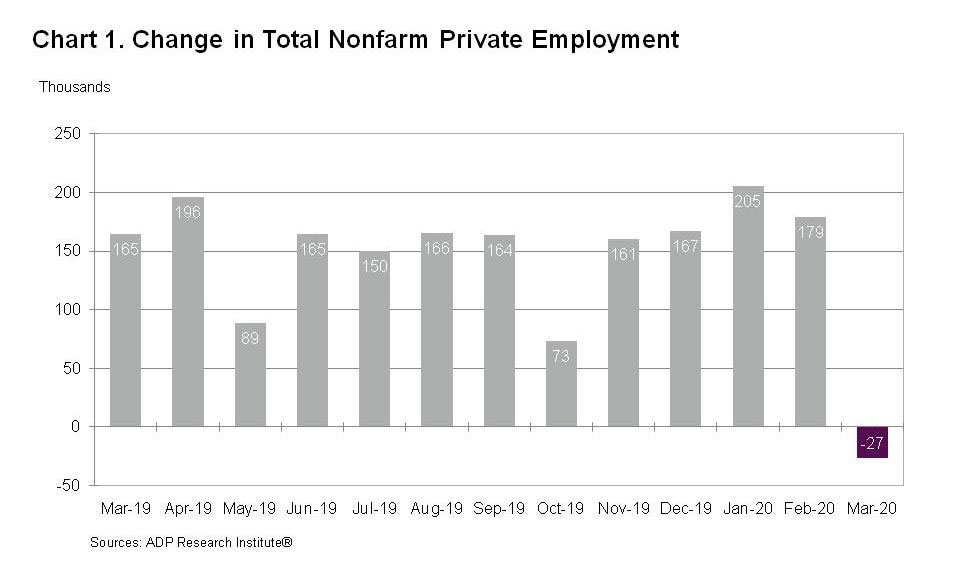
                      US ADP employment dropped only -27k, but coronavirus impact not fully reflected

                        US ADP report shows only -27k job loss in the private sector in March, well better than expectation of -150k. By company size, small businesses lost -90k, medium businesses grew 7k, large businesses grew 56k. By sector, good-producing jobs dropped -9k while service-providing jobs dropped -18k.

                        “It is important to note that the ADP National Employment Report is based on the total number of payroll records for employees who were active on a company’s payroll through the 12th of the month. This is the same time period the Bureau of Labor and Statistics uses for their survey,” said Ahu Yildirmaz, co-head of the ADP Research Institute. “As such, the March NER does not fully reflect the most recent impact of COVID-19 on the employment situation, including unemployment claims reported on March 26, 2020.”

                        Full release here.

                        Eurozone unemployment dropped to 7.3% in Feb, EU unchanged at 6.5%

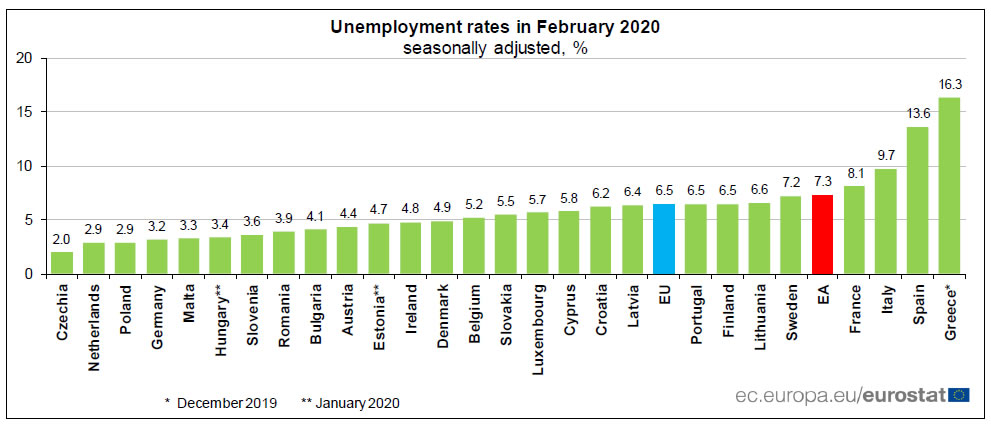
                          Eurozone unemployment rate dropped to 7.3% in February, down from 7.4%, beat expectation of 7.4%. That’s the lowest level since March 2008. EU unemployment was unchanged at 6.5%, lowest since the start of the series in 2000.

                          Among the Member States, the lowest unemployment rates in February 2020 were recorded in Czechia (2.0%), the Netherlands and Poland (both 2.9%). The highest unemployment rates were observed in Greece (16.3% in December 2019) and Spain (13.6%).

                          Full release here.

                          UK PMI manufacturing finalized at 47.8, business optimism slumped to a series-record low

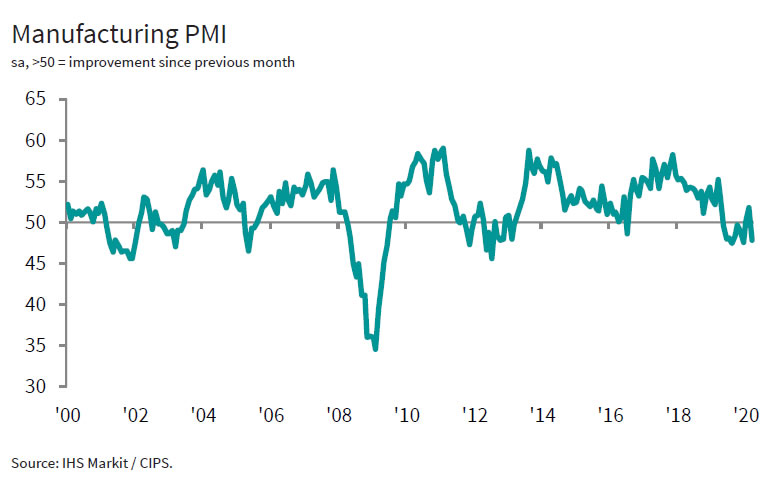
                            UK PMI Manufacturing was finalized at 47.8 in March, down from February’s 48.0. Business optimism slumped to series-record low and supply chain disruption intensified.

                            Rob Dobson, Director at IHS Markit, which compiles the survey:

                            “The latest survey numbers underscore how the global outbreak of COVID-19 is causing huge disruptions to production, demand and supply chains at UK manufacturers. Output and new orders fell at the fastest rates since mid- 2012, while supplier delivery times lengthened to the greatest extent in the 28-year survey history as shortages grew more widespread. The resulting job losses took the rate of decline in employment to its highest since July 2009.

                            “The effects were felt across most of manufacturing, with output falling sharply in all major sectors except food production and pharmaceuticals. The transport sector, which includes already-beleaguered car-makers, suffered the steepest downturn.

                            “With restrictions aimed at slowing the spread of the virus expected to stay in place for some time, expectations of further economic disruption and uncertainty meant business optimism slumped to a series-record low. However, on a slightly more positive note, manufacturers still expect to see output higher in one year’s time.”

                            Full release here.

                            Italy Gualtieri: 6% GDP contraction realistic, but there will be vigorous rebound

                              Italy’s Economy Minister Roberto Gualtieri said the forecasts of -6% GDP contraction this year are “realistic”. Though, he insisted the economy can “aim at a vigorous rebound” after the coronavirus pandemic.

                              Meanwhile, he said a new stimulus package is set to be approved this month. That would be “significantly larger” than the measures of EUR 25B passed in March. The package would include extensions of state-backed guarantees for businesses, unemployment benefits and low incomer support.

                              Gualtieri also reiterated the push for a coordinated, shared fiscal response within EU, rather than using the European Stability Mechanism. He added, “new solutions are need to grant parity of conditions and to define an adequate shared and responsible response.”

                              Eurozone PMI manufacturing finalized at 44.5, still some way off peak decline

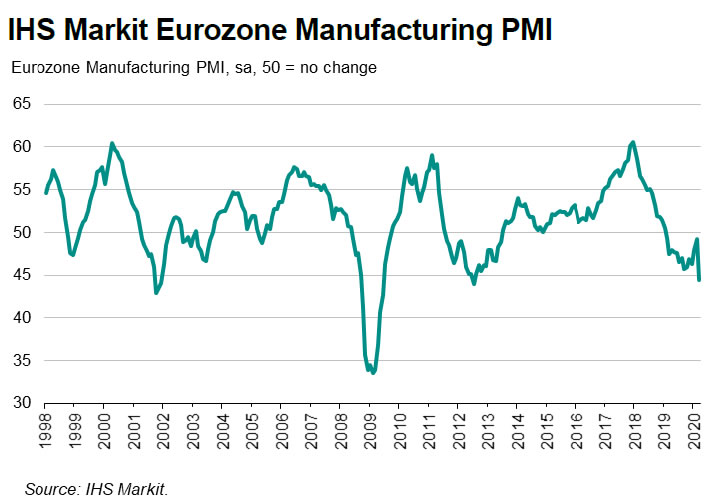
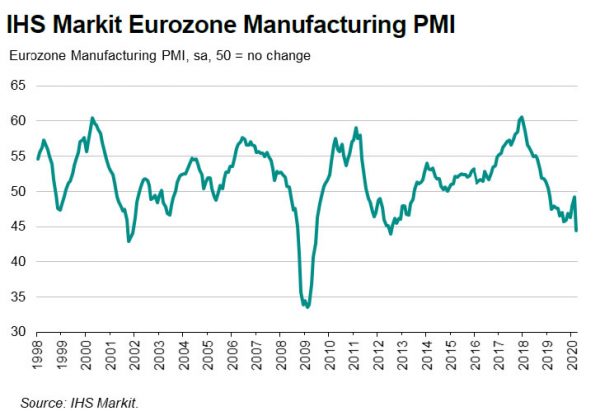
                                Eurozone PMI Manufacturing was finalized at 44.5 in March, down from February’s 29.2. Markit noted that coronavirus related shutdowns drove output and orders lower. There was record deterioration in supplier delivery performance.

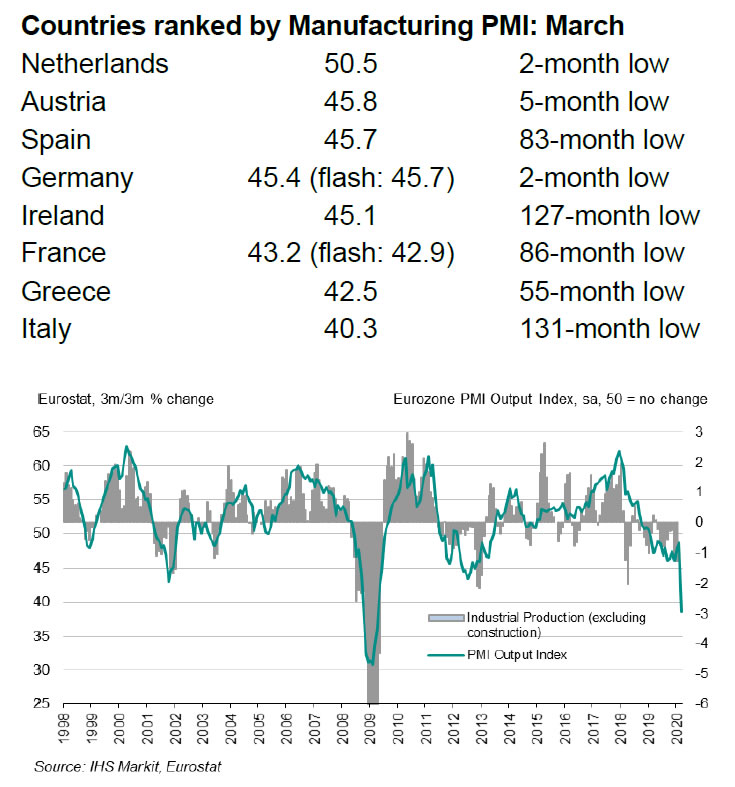
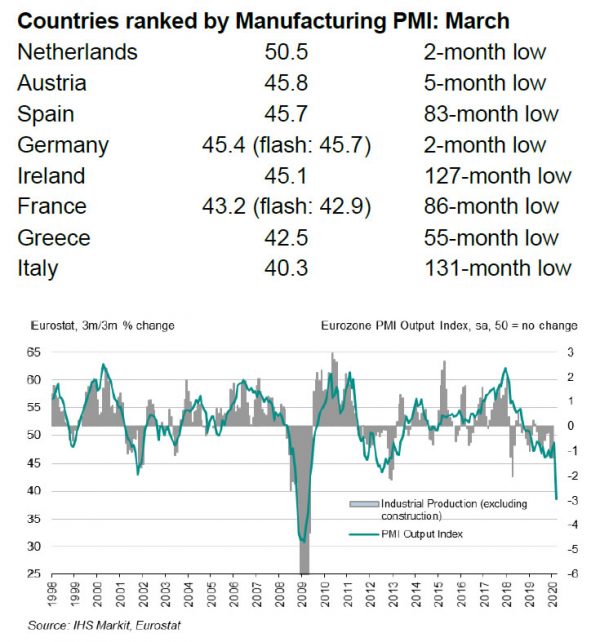
                                Among the member states, Italy hit 131-month low at 40.3. Greece hit 55-month low at 42.5. France hit 86-month low at 43.2. Ireland hit 127-month low at 45.1. Germany hit 2-month low at 45.1. Spain hit 83-month low at 45.7. Austria hit 5-month low at 45.8. Only the Netherlands stayed in expansion, at 2-month low of 50.5.
                                Chris Williamson, Chief Business Economist at IHS Markit said:

                                “Even the slide in the PMI to a seven-and-a-half-year low masks the severity of the slump in manufacturing as it includes a measure of supply chain delays, which boosted the index. Supply delays are normally seen as a sign of rising demand, but at the moment near-record delays are an indication of global supply chains being decimated by factory closures around the world.

                                “We need to look at the survey’s output and new orders gauges to get a better understanding of the scale of the likely hit to the economy that will come from the manufacturing sector’s collapse, and these indices hint at production falling at the sharpest rate since 2009, dropping an annualised rate approaching double digits.

                                “The concern is that we are still some way off peak decline for manufacturing. Besides the hit to output from many factories simply closing their doors, the coming weeks will likely see both business and consumer spending on goods decline markedly as measures to contain the coronavirus result in dramatically reduced orders at those factories still operating. Company closures, lockdowns and rising unemployment are likely to have an unprecedented impact on expenditure around the world, crushing demand for a wide array of products. Exceptions will be food manufacturing and pharmaceuticals, but elsewhere large swathes of manufacturing could see downturns of the likes not seen before”

                                Full release here.

                                China Caixin PMI manufacturing rose to 50.1, but sector under double pressure

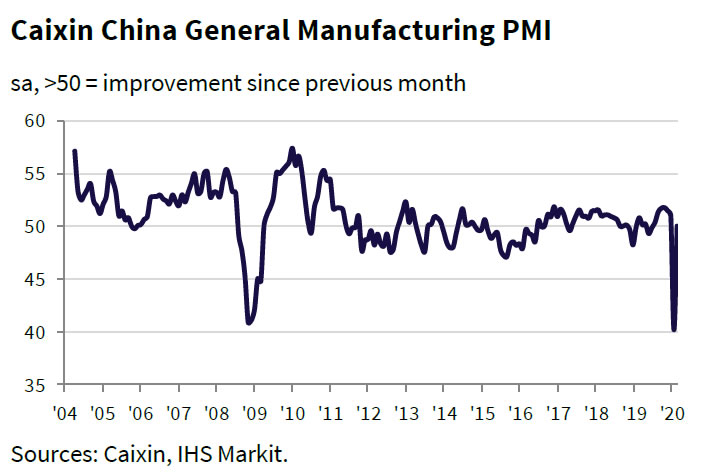
                                  China Caixin PMI manufacturing rose to 50.1 in March, up from 40.3, above expectation of 45.8. However, demand conditions remained fragile, as highlighted by a second monthly fall in total new business. A number of panel members also mentioned delay or cancellation in orders. New export work declined solidly sue to global spread of coronavirus. Employment data also signalled further headcounts reduction.

                                  Dr. Zhengsheng Zhong, Chairman and Chief Economist at CEBM Group said: “To sum up, the manufacturing sector was under double pressure in March: business resumption was insufficient; and worsening external demand and soft domestic consumer demand restricted production from expanding further. Whereas, business confidence was still high and the job market basically returned to the pre-epidemic level, laying a positive foundation for the economy’s rapid recovery after the epidemic.”

                                  Full release here.
                                  Japan Tankan large manufacturing dropped to -8, worst since 2013

                                    Japan’s Tankan large manufacturing index dropped to -8 in Q1, down from 0.That’s the first negative reading in seven years, lowest since March 2013, and the fifth straight decline. Large manufacturing outlook dropped from 0 to -11. Large non-manufacturing index also dropped from 20 to 8 while outlook dropped from 18 to -1. Large all industry capex rose 1.8%, better than expectation of -1.1%.

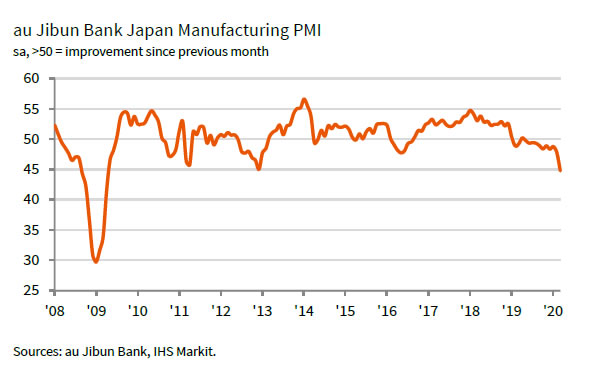
                                    Also from Japan, PMI manufacturing was finalized at 44.8 in March, down from February’s 47.8. Manufacturing output contracted at the sharpest rate since aftermath of 2011 tsunami. Production volumes slumped at the fastest rate for almost nine years, with sharpest drop in demand since April 2011. Supply chain issues also intensified further.

                                    Joe Hayes, Economist at IHS Markit said, “the cascading impact of COVID-19 on the global economy is diminishing the chances of a V-shaped recovery.”

                                    Australia AiG manufacturing surged to 53.7, somewhat surprising expansion

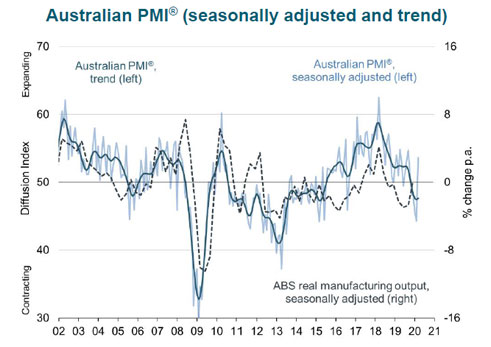
                                      Australia AiG Performance of Manufacturing Index jumped to 53.7 in March, up from 44.3. The reading indicates a return to growth after four months of contraction in the sector.

                                      AiG said: “This somewhat surprising expansion – in the midst of the escalating COVID-19 pandemic and emerging recession – is almost entirely due to a huge surge in demand for manufactured food, groceries and personal care items, as shoppers stock up on processed food, toilet paper, cleaning products and other household essentials”.

                                      Also from Australia, building permits rose 19.9% mom in February, much higher than expectation of 4.5% mom.

                                      RBA Minutes: Very material contraction in economic activity across Q1, Q2 and potentially longer

                                        In the minutes of March 18 meeting, RBA said that Australia would likely experience a “very material contraction in economic activity, which would spread across the March and June quarters and potentially longer.”. The size of contraction would depend on the “extent of the social distancing requirements, and potential lockdowns” for containing the coronavirus. Also, there will be “significant job losses over the months ahead”. Economy is expected to recover following containment of the coronavirus, “but the timing of this was uncertain”.

                                        At the meeting, RBA decided to roll out a package a measures of four elements. Cash rate was lowered to 0.25%. Purchase of government bonds to keep 3-year yield at 0.25%. Launched a term funding facility to support credit to businesses, and adjustment of interest rate on ES balance held by financial institutions.

                                        Full minutes here.

                                        Fed Mester expects some really bad economic numbers, but it’s not a typical recession

                                          Cleveland Fed President Loretta Mester told CNBC it’s “not unrealistic” to see some “really bad economic numbers” in terms of unemployment and economic activity declining. However, she added that the current downturn is “not a typical recession” as it happened in an otherwise healthy economy brought to a near standstill to fight the coronavirus.

                                          “Part of the goal now is to offer the kind of lending and making sure the financial markets stay liquid and making sure they stay on a firm foundation and then bridging people from the economy, which in February looked very good … so that when we get to the other side of this … the economy and economic activity can come back,” Mester said.

                                          “One of the things that makes us in a better spot than some other countries is that our banking system was strong coming into this,” she said. “One of the other actions the Fed has taken is to really encourage the banks to continue lending.”