China PMI manufacturing dropped in April, no upward turning point

    China’s April PMIs came in all weaker than expected. The results raised much doubt on the case of recovery in the economy. And, they suggested that even the post lunar new year seasonal rebound in Mach couldn’t sustain. Hong Kong stocks trade lower after the release but China Shanghai SSE is steady so far. In the currency markets, Australian Dollar is clearly knocked down by the releases.

    The official PMI manufacturing dropped to 50.1, down from 50.5 and missed expectation of 50.6. Official PMI non-manufacturing dropped to 54.3, down from 54.8 and missed expectation of 55.0.

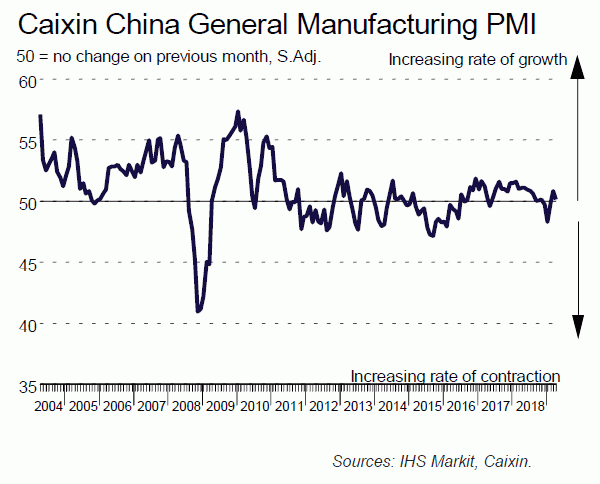
    Caixin PMI manufacturing dropped to 50.2 in April, down from 50.8 and missed expectation of 50.2. Looking at the details, output and total new work both rose slightly, but with margin fall in overseas new work. Relatively subdued demand conditions led firms to remain reluctant to expand their inventories. Overall inflationary pressures softened. On the positive side, one-year outlook for production improved to an 11-month high.
    Commenting on the China General Manufacturing PMI™ data, Dr. Zhengsheng Zhong, Director of Macroeconomic Analysis at CEBM Group said:

    “The Caixin China General Manufacturing Purchasing Managers’ Index eased to 50.2 in April, down from a recent high of 50.8 in the previous month, indicating a slowing expansion in the manufacturing sector.

    1) The subindex for new orders fell slightly despite remaining in expansionary territory. The gauge for new export orders returned to contractionary territory, suggesting cooling overseas demand.

    2) The output subindex dropped. The employment subindex returned to negative territory after hitting a 74-month high in March. According to data from the National Bureau of Statistics, the surveyed urban unemployment rate remained at a relatively high level despite edging down in March, suggesting that pressure on the job market remained.

    3) While the subindex for stocks of purchased items returned to contractionary territory, the measure for stocks of finished goods fell more markedly. The gauge for future output edged up, pointing to manufacturers’ desire to produce and stable product demand. The subindex for suppliers’ delivery times rose further despite staying in negative territory, implying improvement in manufacturers’ capital turnover.

    4) Both gauges for output charges and input costs edged down. There were only small changes in upward pressure on industrial product prices. We predict that April’s producer price index is likely to remain basically unchanged from the previous month.

    “In general, China’s economy showed good resilience in April, yet it stabilized on a weak foundation and is not coming to an upward turning point. The Politburo meeting signalled that in the first quarter of this year China had adjusted its countercyclical policy marginally. As pressure on the economy remains in the second quarter, we expect that there will be minor adjustments to the policy but not a turnaround.”


    Fed to hold the cards of tapering to chest

      FOMC is widely expected to keep monetary policy unchanged today. Without new economic projections, the focus will be on the policy statement and press conference. In particular, Fed Chari Jerome Powell would likely just reiterate that the Committee is in talks of QE tapering. Yet, it is premature to make any conclusion.

      Also, more information about policy changes will be revealed at the Jackson Hole symposium in late August, followed by the September meeting. The formal announcement of tapering could indeed be made in December.

      Some suggested readings on Fed:

      An update on AUD/JPY short after strong rebound

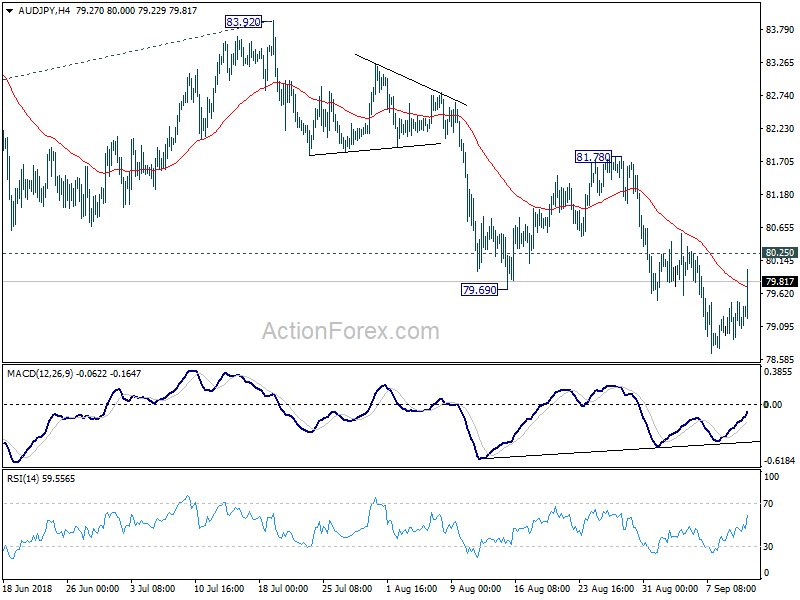
        This is a follow up to our AUD/JPY short trade, entered at 80.25, stop at break even 80.25. Last updated in our weekly report.

        AUD/JPY rebound strongly today on news that the US is trying to restart trade talk with China. And Trump intends to postpone the announcement of 25% tariffs on USD 200B in Chinese goods after that. Public hearing on the tariffs ended last week.

        While the rebound is strong, our strategy is… don’t panic. Firstly, at the time of writing, both he Treasury Department and Commerce Department declined to comment. So, it could be another piece of “fake news”. Secondly, at the time of writing too, there is no follow through buying above 4 hour 55 EMA yet.

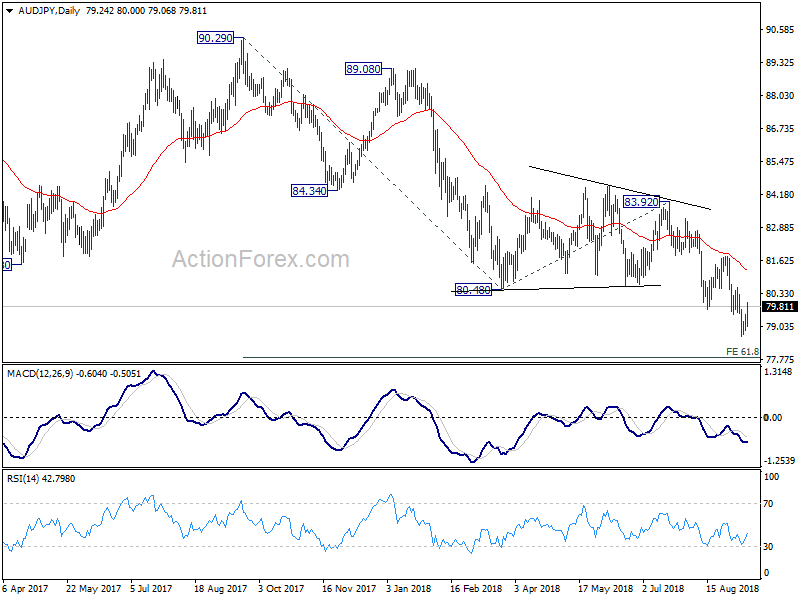
        Technically, 4 hour technical doesn’t look very promising, with bullish convergence condition in 4 hour MACD. But there is no confirmed reversal yet. Hence, we’d hold on to the short position, with stop unchanged at 80.25 (break even). But the chance for us to exit slightly above 61.8% projection of 90.29 to 80.48 from 83.92 at 77.85 has increased. We’ll still not rigid exit there yet, as we’d like to give the cross a little breathing room on the news (real or fake).

        And, after all, it’s trading. Sometimes you win, sometimes you lose. Even if we’re stopped out, it’s not a loss!

        Trump called for dropping all tariffs ahead of meeting with EU Juncker

          European Commission President Jean-Claude Juncker’s visit to the US and meeting with Trump is an highly anticipated event today. Ahead of that Trump continued to play victim with his provocational tweets and said “tariffs are the greatest! Either a country which has treated the United States unfairly on Trade negotiates a fair deal, or it gets hit with Tariffs. It’s as simple as that – and everybody’s talking! Remember, we are the “piggy bank” that’s being robbed. All will be Great!”

          And he added later that “the European Union is coming to Washington tomorrow to negotiate a deal on Trade. I have an idea for them. Both the U.S. and the E.U. drop all Tariffs, Barriers and Subsidies! That would finally be called Free Market and Fair Trade! Hope they do it, we are ready – but they won’t!

          According to European Union trade commissioner Cecilia Malmstrom, who’s in the visit too, the meeting is to seek to ” de-escalate the present situation and prevent it from worsening”. Commission spokesman Margaritis Schinas said yesterday that ” there are no offers.”

          WTI oil tumbles on surprised inventory build, heading to 57 fibonacci level

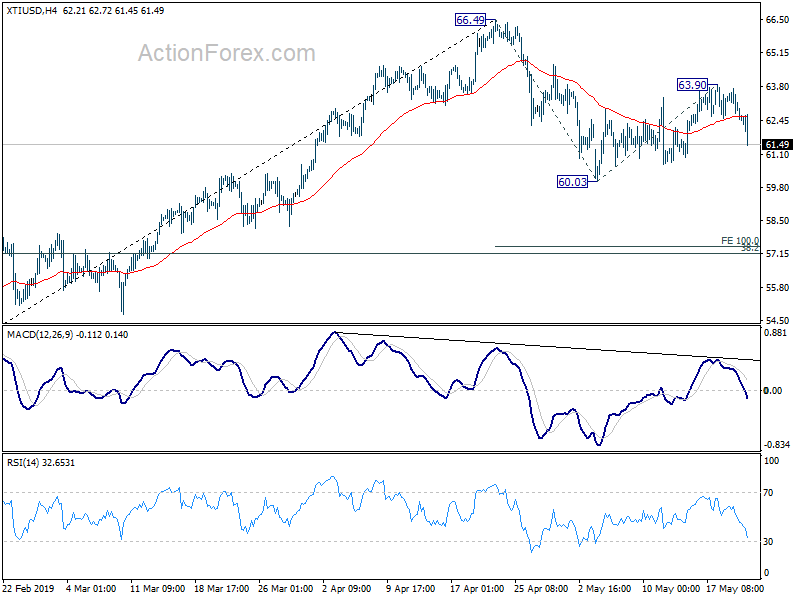
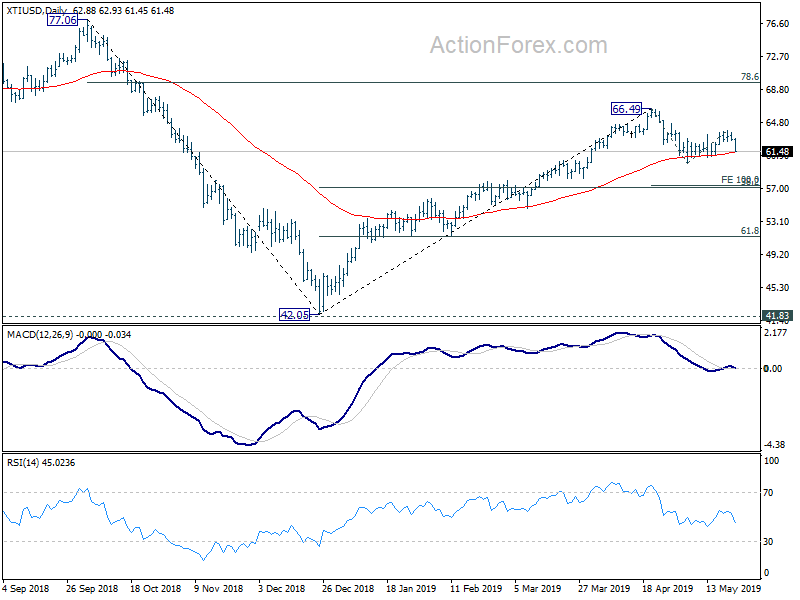
            WTI crude oil drops sharply today as crude inventory unexpectedly rose 4.74M barrels in the week ending May 17, versus expectation of -1.2M barrels decline. Current development suggests that recovery from 60.03 has completed at 63.90 already. And the fall from 66.49 might be ready to resume.

            Deeper decline should be seen to 60.03 first. Break will confirm this bearish case and target 100% projection of 66.49 to 60.03 from 63.90 at 57.44.

            Nevertheless, fall from 66.49 is seen as a corrective move so far. Downside should be contained by 38.2% retracement of 42.05 to 66.49 at 57.15 to bring rebound.

            China’s Caixin PMI composite rises to 51.9, policy impact begins to show

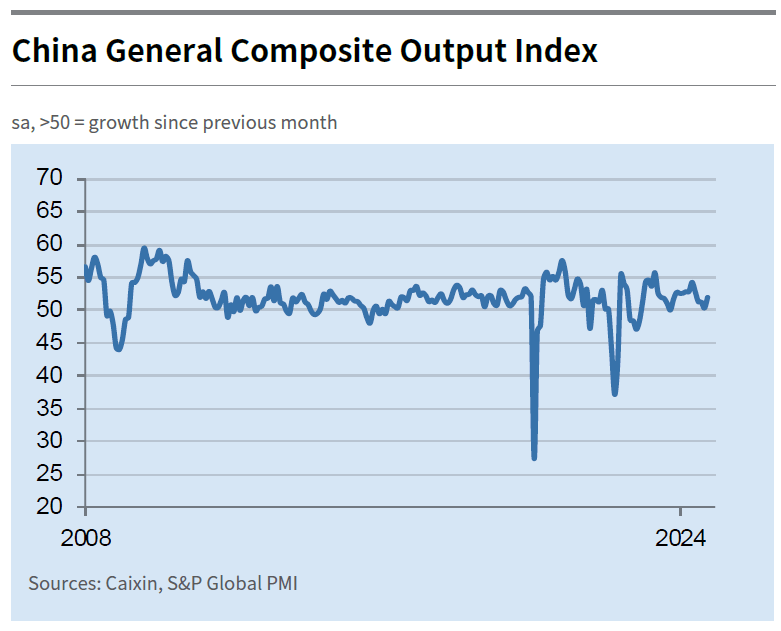
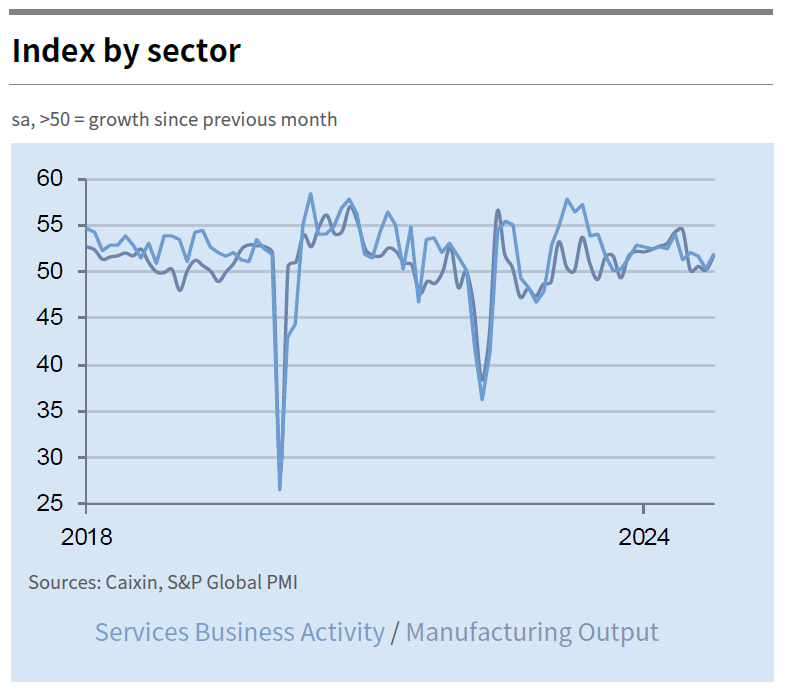
              China’s Caixin Services PMI rose to 52.0 in October, surpassing expectations of 50.5 and marking the highest rate of growth in three months. The services sector continues its expansionary streak that began in January 2023. PMI Composite also increased from 50.3 to 51.9, its highest level in four months, maintaining expansion for the 12th consecutive month, driven largely by service-sector resilience.

              Wang Zhe, Senior Economist at Caixin Insight Group noted that challenges noted that a range of supportive policies has since been introduced by the Politburo since September. The recent Caixin PMI readings for both manufacturing and services suggest that “market demand stabilized and optimism improved,” signaling early effects of the new policies.

              Full China Caixin PMI services release here.

              WTI crude oil resumes recent free fall

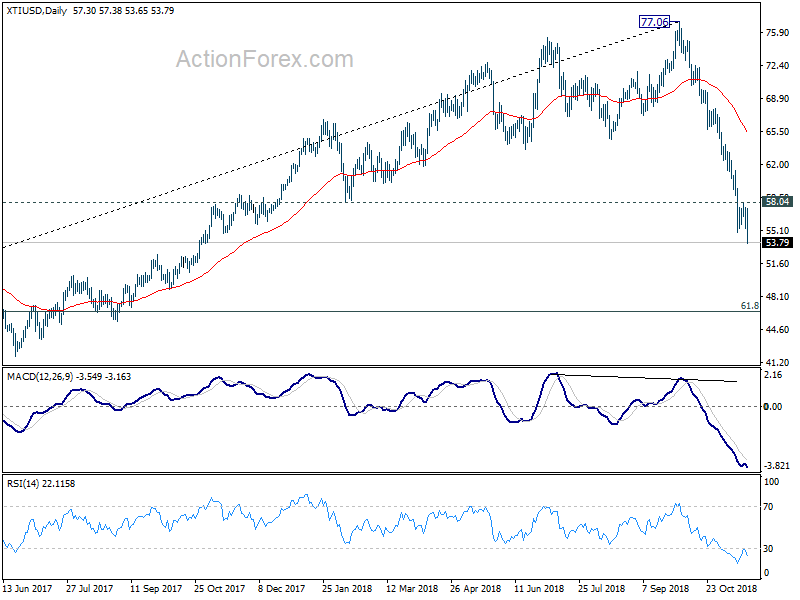
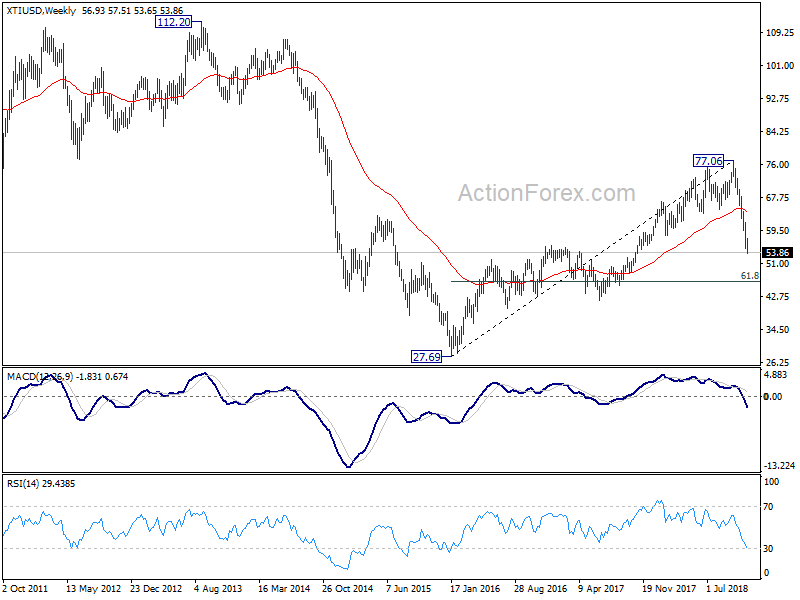
                WTI crude oil’s recent free fall resumes today by taking out 54.84 low and reaches as low as 53.65 so far. Near term outlook will now stay bearish as long as 58.04 resistance holds even in case of recovery.

                Fall from 77.06 is at least correcting the up trend from 27.69 to 77.06. Based on current momentum, it could indeed be an impulsive move rather than a corrective move. In either case, deeper decline should be seen to 61.8% retracement of 27.69 to 77.06 at 46.54 in medium term.

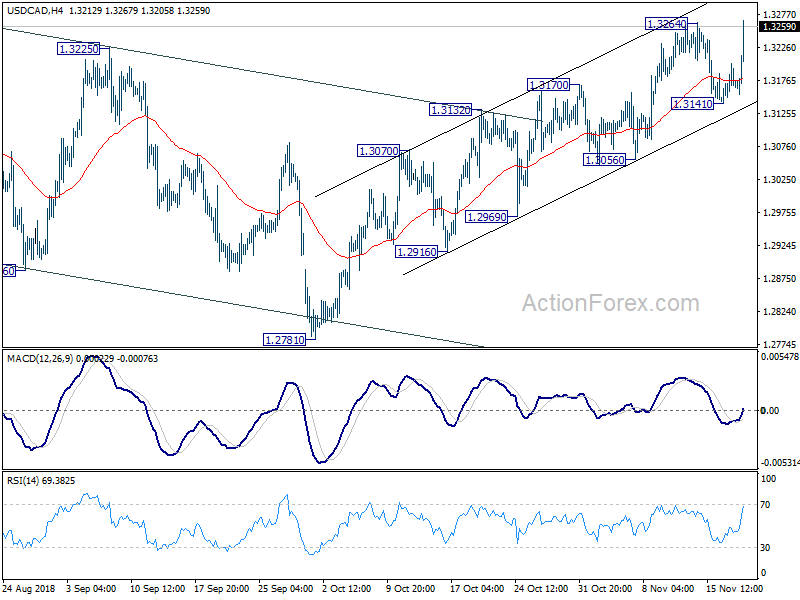
                Also, a net effect in the currency markets is a drag on the Canadian Dollar.


                Trump: EU has been brutal to us

                  Trump counter-attacked on EU’s criticism on his steel and aluminum tariff. He tweeted again during the weekend that the European Union has been “brutal to us”. And he warned that “if the E.U. wants to further increase their already massive tariffs and barriers on U.S. companies doing business there, we will simply apply a Tax on their Cars which freely pour into the U.S.”

                  That was in reaction to European Commission President Jean-Claude Juncker’s statement that “we will not sit idly while our industry is hit with unfair measures that put thousands of European jobs at risk.

                  EU Katainen to US: No concession to get permanent exemption from steel tariffs

                    European Commission Vice-President Jyrki Katainen said they’re “open for improving our trade relations” with the US. But he warned that “it’s not a concession in order to get a permanent exemption from higher steel and aluminium tariffs.”

                    Katainen emphasized that “there’s no reason for those tariffs… It wouldn’t be logical to give up under pressure that is unjustified. We don’t negotiate under any kind of threat.”

                    Fed Bullard wants to be nimble on rates, but Daly and Barkin may not

                      St Louis Fed President James Bullard said yesterday’s inflation report “shows continued inflationary pressure in the US” and is “concerning for me and for the Fed.” He added, “you have got the highest inflation in 40 years and I think we are going to have to be far more nimble and far more reactive to data.”

                      “I’d like to see 100 basis points in the bag by July 1,” Bullard added. “I was already more hawkish but I have pulled up dramatically what I think the committee should do.”

                      However, San Francisco Fed President Mary Daly said a half-point rate hike “is not my preference. “”Markets have already priced in the withdrawal of accommodation, and that is them hearing what the Fed is clearly communicating.”

                      Richmond Fed President Thomas Barkin said “I’m open to it conceptually”, regarding a half point hike. “Do I think there’s a screaming need to do it right now? I’d have to be convinced of that,” he added.

                      Japan GDP ended expansion streak… temporarily

                        Japan GDP contracted -0.2% qoq in Q1, worse than expectation of 0.0% qoq. On annualized basis,GDP contracted -0.6% versus expectation of -0.1%. The contraction marked the end of eight straight quarters of growth. And that was the longest streak since 1989. GDP deflator, however, rose 0.5% yoy, beating expectation of 0.3% yoy.

                        But it’s generally believed that the contraction is temporary. In particular, a relatively weaker Yen at 100 against Dollar and global recovery, export led Japanese economy remains on solid footing for expansion.

                        Also from Japan, industrial production was revised up to 1.4% mom in March, from first estimate of 1.2% mom.

                        Fed’s Mester: Monetary policy well-positioned following discernible progress on inflation

                          Cleveland Fed President Loretta Mester, in her remarks at a conference overnight, acknowledged that while inflation remains above Fed’s 2% target, there has been “discernible progress” in controlling it, even as the “overall economy has remained relatively strong”.

                          Mester expressed confidence in the current stance of monetary policy, stating, “Monetary policy is in a good place for policymakers to assess incoming information on the economy and financial conditions.”

                          Highlighting the need for flexibility, Mester described the central bank’s rate policy as needing to be “nimble,” and she believes that “the current level of the funds rate positions us well to do that.”

                          Mester did not rule out the possibility of further rate hikes, emphasizing that the decision to increase rates further and the duration for which the rate target remains high “will depend importantly on whether the economy is evolving as expected, how the risks are changing, and the progress being made on our dual mandate goals of price stability and maximum employment.”

                          EU Tusk and Irish Varadkar await proposals, UK May to seek Brexit extension

                            European Council President Donald Tusk met Irish Taoiseach Leo Varadkar in Dublin today to “confirm full EU unity on Brexit”. After that they issued a joint statement emphasizing that “we must now see what proposals emerge from London” in advance of the summit in Brussels on Thursday. Also, they noted “preparations continue in Ireland and across the European Union for a no deal scenario, which would have serious consequences for all concerned.

                            Meanwhile, UK Prime Minister Theresa May’s spokesman said she is going to writing a letter to Tusk asking for Brexit delay. But it’s not clear that how long a delay she’d seek. Some Eurosceptics in May’s Cabinet emphasized that that they’re rather leave without a deal than have a long Article 50 extension. But there seems to be no agreement in the Cabinet meeting yet.

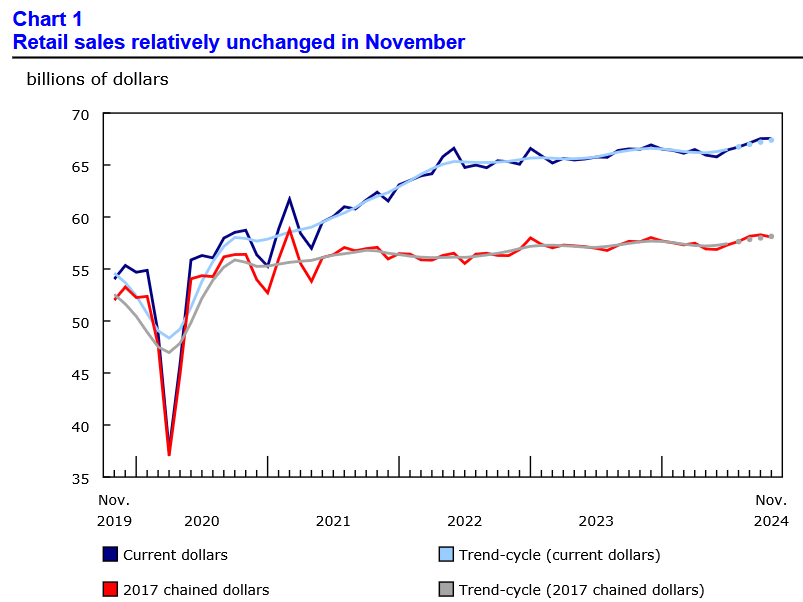
                            Canada’s retail sales stagnate in Nov as core sales down -1% mom

                              Canada’s retail sales were flat in November, falling short of the expected 0.2% mom increase. The data revealed mixed performance across sectors, with declines in six out of nine subsectors.

                              Sales at food and beverage retailers dropped by -1.6% mom, driving much of the weakness in the report. However, gains in motor vehicle and parts dealers (+2.0% mom) and gasoline stations and fuel vendors (+0.7% mom) helped offset the broader declines, preventing an outright contraction in overall retail activity.

                              Core retail sales, which exclude the more volatile categories of motor vehicles and gasoline, declined by a notable -1.0% mom.

                              Full Canada retail sales release here.

                              AmCham survey showed US China trade war already negatively impacting US companies

                                A joint survey by AmCham China and AmCham Shanghai showed that over nearly two-thirds of survey respondents experienced negative impact from US-China tariff war. Moreover, for additional US tariffs, 74.3% expected negative impact and 47.2% expected “strong negative impact. For additional China tariffs, 67.6% expected negative impact and 38.2% expected “strong negative impacts”. Increased cost of manufacturing (47.1) and decreased demand for products (41.8%) were the to most significant downside of the tariffs.

                                William Zarit, Chairman of AmCham China said “the White House has threatened to fire the next barrage of tariffs at $200 billion more Chinese goods, expecting with this onslaught, or subsequent ones, China will wave a white flag. But that scenario risks underestimating China’s capability to continue meeting fire with fire.”

                                Eric Zheng, Chairman of AmCham Shanghai warned that “tariffs are already negatively impacting U.S. companies and the imposition of a proposed $200 billion tranche will bring a lot more pain”. And “if almost a half of American companies anticipate a strong negative impact from the next round of U.S. tariffs, then the U.S. administration will be hurting the companies it should be helping.”

                                The survey was conducted between August 29 and September 5, 2018. Over 430 companies responded.

                                Press release here and survey results here.

                                US stocks in free fall but Fed is not to blame

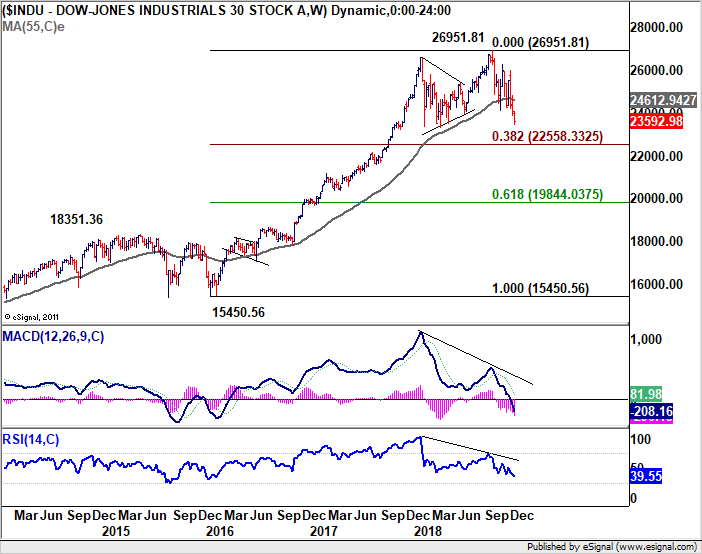
                                  US equities dived for another day overnight and risk aversion spreads to Asia today. DOW dropped -507 pts or -2.11% to 23592.98. S&P 500 declined -54.01 pts or -2.08% to 2545.94. NASDAQ lost -156.93 pts or -2.27% to 6753.73. At the time of writing, Nikkei is down -1.64%, Singapore Strait Times is down -1.81%, Hong Kong HSI is down -0.90% and China Shanghai SSE is down -1.09%.

                                  In bond markets, US 10 year yield dropped -0.034 to 2.857. Yield curve is inverted between 2-year (2.696) and 3-year (2.683). 5-year yield is not far away at 2.692. Japan 10 year JGB yield is down -0.006 at 0.030, after hitting as low as 0.026 earlier today.

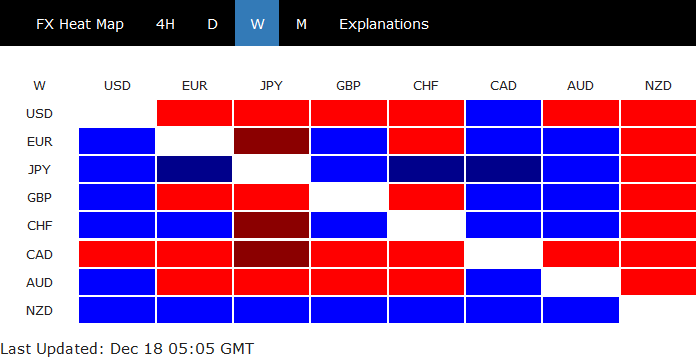
                                  In the currency markets, New Zealand Dollar continues to walk its own path and is the strongest one for the week. Yen follows on risk aversion, then Swiss Franc. Canadian Dollar is the weakest as WTI crude oil is back below 50 as recent decline resumes. Dollar second weakest.

                                  White House trade advisor Peter Navarro said Fed shouldn’t raise interest rate, even this week. He said it’s “not because the economy’s slowing down, but because the economy’s growing without inflation”. Trump also blast Fed for “even considering yet another interest rate hike”. Whether Fed should or shouldn’t continue with rate hike is one question, they’ve got enough seasoned economists there to make their own judgement. But noting that Dollar and yield declined, there is apparently no linkage between Fed’s hike to the stock market crash.

                                  Additionally, the relatively small reaction in Hong Kong and China stock markets suggested that US-China trade truce has been sentiment supportive. Instead, the global rush from stocks to bonds, including US, Japan and Germany, suggested that there is deep lying concern over slowdown, which in large part, was due to Trump’s tariffs and tariffs threats.

                                  Anyway, DOW is medium term correction that started back at 26951.81. We’d reiterate such correction should head to 38.2% retracement of 15450.56 to 26951.81 at 22558.33 before completion. We’d see the reaction from there before judging how deep the correction would develop into.

                                  ECB Lane explains three conditions for rate hike

                                    ECB Chief Economist Philip Lane explained a a blog post the three key conditions for lifting interest rates, as reflected in the latest forward guidance.

                                    The first condition “until we see inflation reaching two per cent well ahead of the end of our projection horizon” provides reassurance that the convergence of inflation towards the new target should be sufficiently advanced and mature at the time of policy rate lift off. It helps to “hedge monetary policy against the risk of reacting to forecast errors”.

                                    The second condition expects inflation to stay at 2%  “durably for the rest of the projection horizon”. It “telegraphs that reaching the inflation target should be lasting.”

                                    The third condition  “progress in underlying inflation is sufficiently advanced to be consistent with inflation stabilising at two per cent over the medium term” signals that policy rates should not be lifted unless underlying inflation is also judged to have made satisfactory progress towards the target.

                                    Lane further explained that “underlying inflation” is a broad concept and refers to the persistent component of inflation that filters out short-lived, reversible movements in the inflation rate and provides the best guide to the medium-term inflation developments

                                    Also, the sentence that the forward guidance “may also imply a transitory period in which inflation is moderately above target” makes explicit that rate forward guidance that is committed to avoiding premature tightening.

                                    Full blog post here.

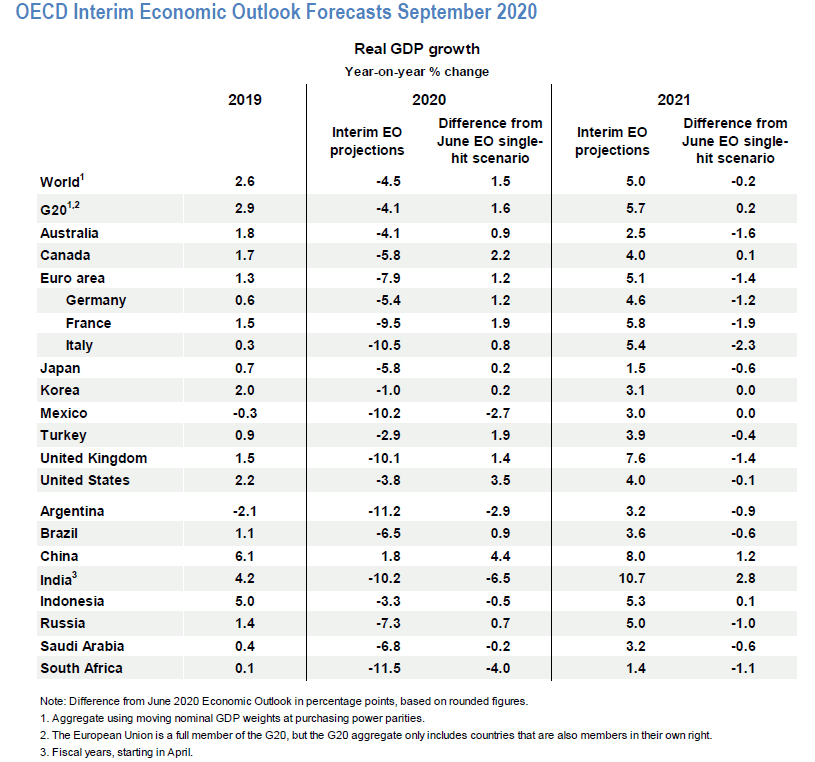
                                    OECD expects just -4.5% global contraction this year, US and China outlook revised up sharply

                                      OECD revised up 2020 global GDP forecast, expecting to contract -4.5%, 1.5% higher than June’s single hit scenario. Both economic projections of US and China are revised up sharply higher. US economy is expected to contract -3.8% only, up by 3.5% from June. China is expected to grow 1.8%, up by 4.4% from June. Eurozone (at -7.9%, up by 1.2% from June), Japan (at -5.8%, up by 0.2%), UK at -10.1% (up by 1.4%) are just revised up slightly.

                                      OECD said: “After collapsing in the first half of the year, economic output recovered swiftly following the easing of measures to contain the COVID-19 pandemic and the initial re-opening of businesses. Policymakers reacted rapidly and massively to buffer the initial blow to incomes and jobs. But the pace of recovery has lost momentum over the summer. Restoring confidence will be crucial to how successfully economies can recover, and for this we need to learn to safely live with the virus.”

                                      Full report here.

                                      Fed Bostic hopeful for asset holding recalibration this year, as progress made

                                        Atlanta Fed President Raphael Bostic said in a Reuters interview he’s “hopeful” that moving into 2021, “signals for weakness start to dissipate and the conversation turns consistently and robustly to sort of steady and broad-based growth.”

                                        “If we determine things have strengthened appreciably, that we have made significant progress, then we will think about the next appropriate action,” he added.

                                        That is, if enough progress were made, Fed could start to bring its asset holdings back to a level “more inline” with the pre-pandemic levels. “I am hopeful that in fairly short order we can start to recalibrate.”

                                        Gold extends decline on Dollar strength, breaks 1190

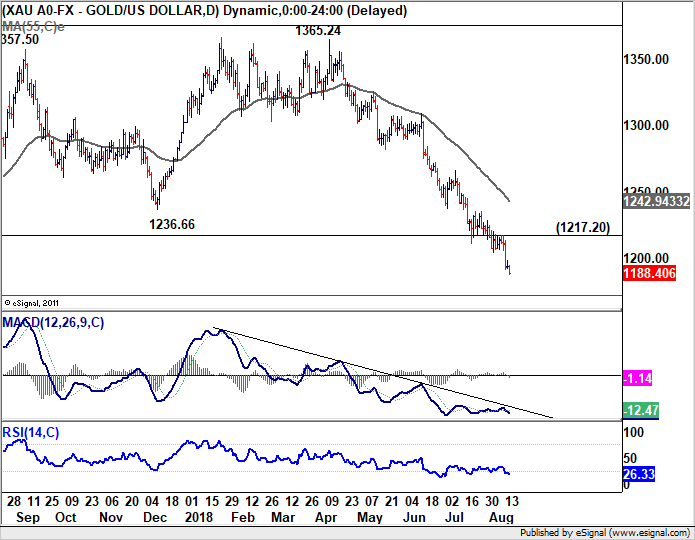
                                          On the back of broad based strength in Dollar, Gold’s decline continues today and breaks 1190 handle to as low as 1188.42 so far. The down trend from 1365.24 is on track for 1172.06 fibonacci level. Daily RSI may indicate Gold is in oversold condition again. But based on current acceleration, RSI indeed suggests solid downside momentum. 1172.06 could be taken out without much hesitation and the next real hurdle is probably 1122.81 support. And in any case, near term outlook will remain bearish as long as 1217.20 resistance holds.

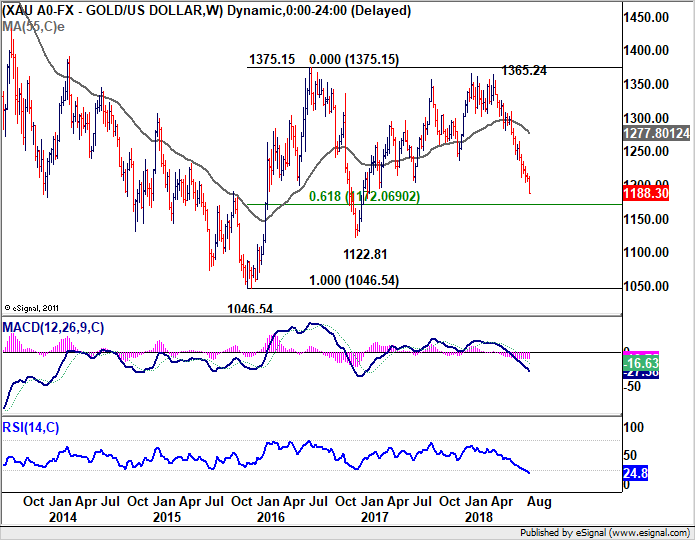
                                          In the bigger picture, currently decline from 1365.24 is viewed as part of the long term sideway pattern from 1046.54 (2015 low). Sustained break of 61.8% retracement of 1046.64 to 1375.15 at 1172.06 will pave the way to 1046.54/1122.81 support zone. At this point, we’re not expecting a break there to resume long term down trend yet. Hence, we’ll look for bottoming signal below 1122.81.