Sample Category Title

USD/JPY Daily Outlook

ActionForex

Daily Pivots: (S1) 159.79; (P) 160.14; (R1) 160.79; More...

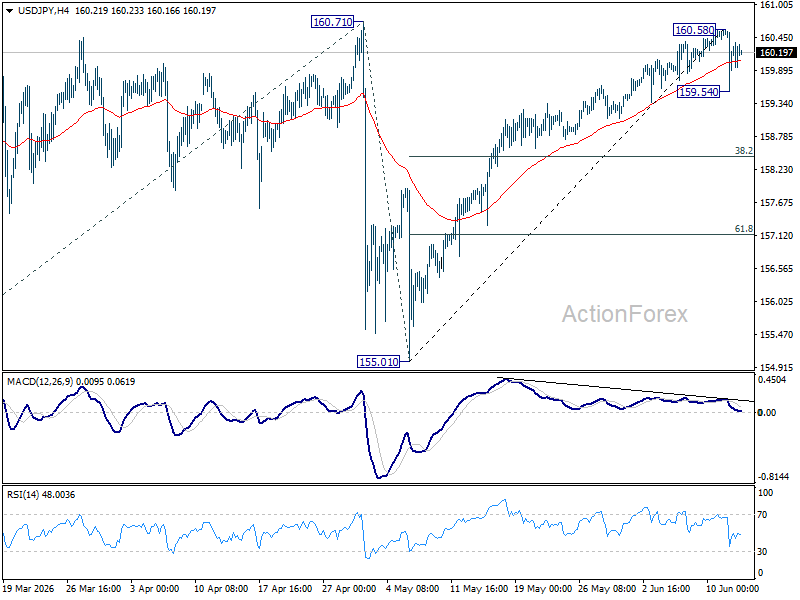
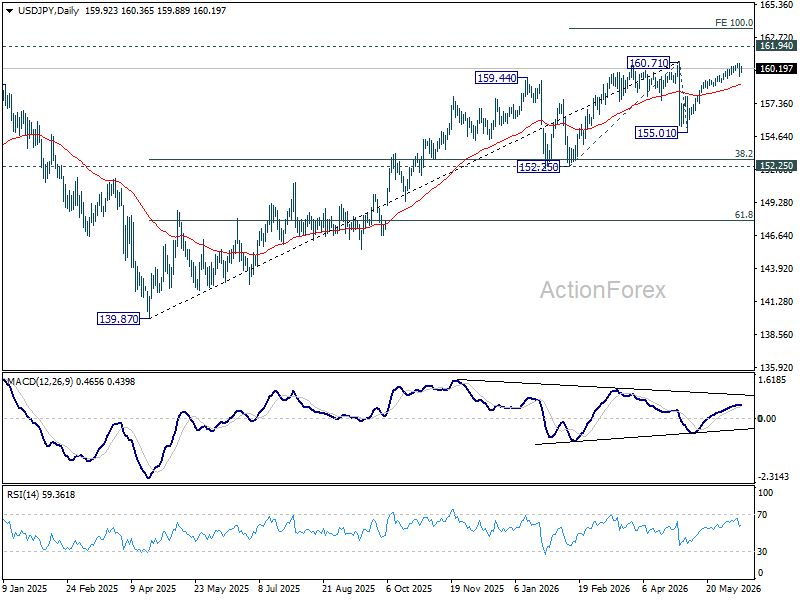
USD/JPY's break of 160.45 resistance confirms resumption of rally from 152.25. Intraday bias is on the upside for retesting 161.94 high. Decisive break there will target 61.8% projection of 139.87 to 159.44 from 152.25 at 164.34 next. On the downside, below 159.83 minor support will turn intraday bias neutral first. But downside of retreat should be contained well above 157.58 support to bring another rally.
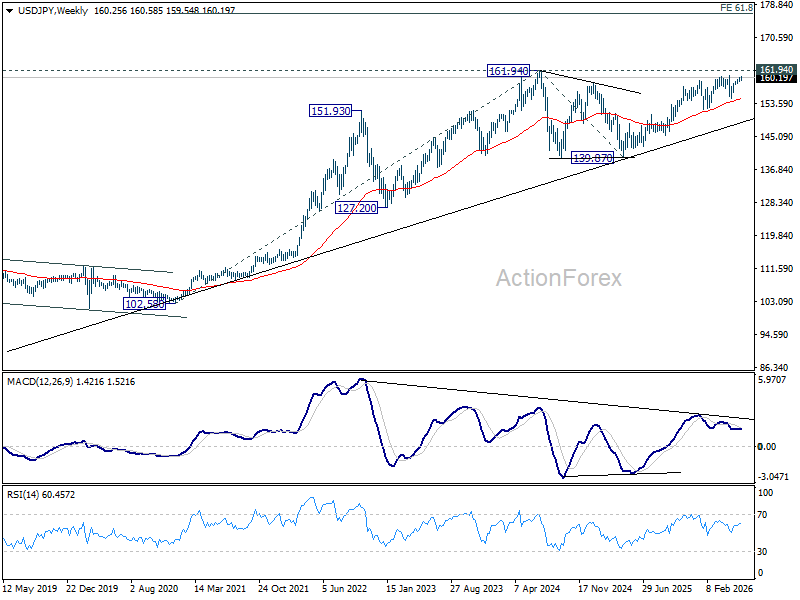
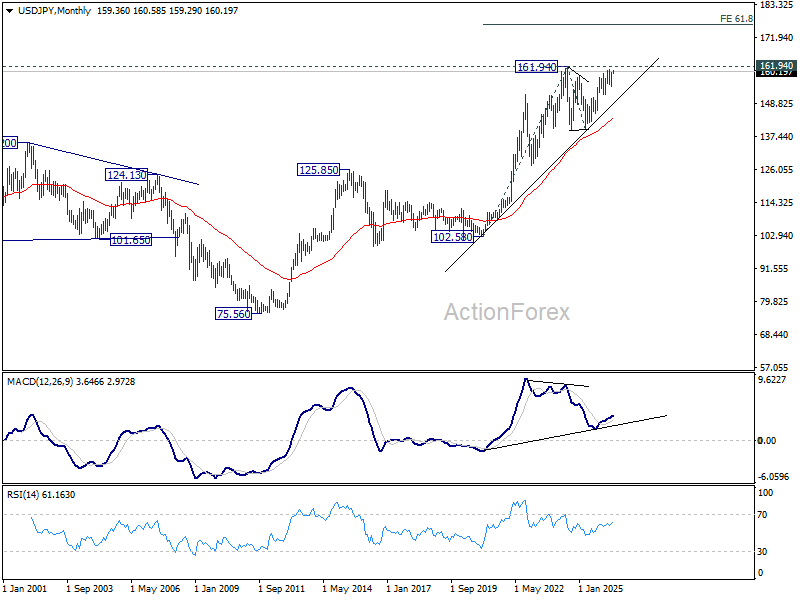
In the bigger picture, outlook is unchanged that corrective pattern from 161.94 (2024 high) should have completed with three waves at 139.87. Larger up trend from 102.58 (2021 low) could be ready to resume through 161.94. This will remain the favored case as long as 55 W EMA (now at 153.81) holds. Firm break of 161.94 will pave the way to 61.8% projection of 102.58 to 161.94 from 139.87 at 176.75.

Oil Surge Above $120 Drives Markets as BoE, ECB and Key Data Take Back Seat

Today’s calendar is packed with major data releases including GDP and inflation from Eurozone and the US, ECB and BoE rate decision, and escalating geopolitical risks all converging. But markets are not struggling to find direction. Oil is doing that job. Brent crude has surged above the key $120 psychological level, hitting a four-year high, forcing markets to reprice inflation, policy expectations, and currencies simultaneously.

The trigger is a clear escalation in rhetoric and positioning. Reports that U.S. Central Command will brief President Donald Trump on potential military action against Iran have rattled markets. Additionally, the messaging from Washington has turned more aggressive. Trump’s public statements, including a stark “No More Mr. Nice Guy” stance, are being interpreted by markets as a shift from “maximum pressure” to “active deterrence.” This raises the risk that current tensions could evolve into a more direct confrontation.

Traders are now moving away from a “resolution” mindset and toward a “prolonged standoff” scenario, with risk of re-escalation in conflicts. The break above $120 is more than a technical move. It signals that markets are beginning to price in further prolonged supply disruption. If tensions escalate further, this level could quickly become the new baseline rather than the peak.

This oil surge is feeding directly into inflation expectations and, by extension, central bank policy outlooks. That is particularly relevant today as both the Bank of England and the European Central Bank are set to announce rate decisions.

For the Bank of England, a hold at 3.75% remains the overwhelming consensus. However, the focus will be on the vote split and forward guidance. After a unanimous hold in March, there is now a possibility of hawkish dissent in favor of a rate hike, especially as policymakers assess the risk of second-round effects from rising energy prices on wages and services inflation.

Governor Andrew Bailey’s commentary will be closely watched, particularly for any indication that the BoE sees the oil shock as more persistent. If policymakers signal concern about inflation becoming embedded, market expectations for further tightening could firm quickly.

At the European Central Bank, a hold at the 2.00% deposit rate is also almost certain. However, the meeting carries significant forward guidance risk. Markets are currently pricing in two 25bps hikes for the remainder of 2026, with June seen as the “live” meeting for the first move.

The key question is whether President Christine Lagarde will signal that timeline more explicitly. Any hint toward a June hike would effectively validate market pricing and could push European yields higher, reinforcing the broader tightening narrative.

At the same time, a heavy data calendar looms. U.S. GDP and PCE inflation, alongside Eurozone GDP and CPI, would normally drive markets. But today, their role is secondary. Instead, they will be filtered through the oil narrative. Strong inflation data will reinforce the current trajectory, while weaker growth may be overlooked unless it becomes severe enough to challenge the tightening bias.

In currency markets, Dollar is the strongest performer so far this week, supported by safe-haven demand and a subtle shift in Fed expectations following the latest decision. With three policymakers opposing even an easing bias, markets are now pricing less than a 5% chance of a rate cut by year-end.

Canadian Dollar is the second strongest, benefiting from the surge in oil prices. Australian Dollar also remains firm, as higher energy costs reinforce expectations that the RBA will proceed with a rate hike in May and more thereafter.

At the other end of the spectrum, Swiss Franc is the weakest performer. The widening interest rate gap is weighing heavily, as other central banks lean toward tightening while the SNB is expected to remain on hold.

Yen remains under pressure despite the risk environment. USD/JPY has surged beyond the 160 intervention red line, but Japanese authorities are unlikely to act decisively in the current volatile environment. Instead, the currency is continuing to reflect the impact of higher global yields and energy costs.

With so many moving parts, markets are navigating a complex maze. But the hierarchy is clear—oil and geopolitics are setting the direction, while central banks and data are being forced to react.

In Asia, at the time of writing, Nikkei is down -1.32%. Hong Kong HSI is down -1.20%. China Shanghai SSE is up 0.16%. Singapore Strait Times is up 0.61%. Japan 10-year JGB yield is up 0.058 at 2.523. Overnight, DOW fell -0.57%. S&P 500 fell -0.04%. NASDAQ rose 0.04%. 10-year yield rose 0.06 to 4.42.

Gold Hit by Double Whammy, Heading Back Toward 4,000

Oil and yields are squeezing Gold from both sides. With downside momentum building, the 4,000 level is coming back into view. Read More.

Japan Industrial Output Falls -0.5% as Petrochemical Weakness Dominates

Japan’s factory output is slipping as energy-linked sectors are hit by supply disruptions, even as retail sales rebound and consumption holds up. Read More.

NZ ANZ Business Confidence Slumps to -10.6, Inflation Expectations Highest Since Feb 2024

Cost pressures are surging in New Zealand, driving inflation expectations higher and pushing business confidence back into negative territory. Read More.

China PMI Signals Modest Growth as Services Slip and Cost Pressures Build

China’s PMI data shows resilient output but growing divergence and rising inflation pressures within the economy. Read More.

USD/JPY Daily Outlook

Daily Pivots: (S1) 159.79; (P) 160.14; (R1) 160.79; More...

USD/JPY's break of 160.45 resistance confirms resumption of rally from 152.25. Intraday bias is on the upside for retesting 161.94 high. Decisive break there will target 61.8% projection of 139.87 to 159.44 from 152.25 at 164.34 next. On the downside, below 159.83 minor support will turn intraday bias neutral first. But downside of retreat should be contained well above 157.58 support to bring another rally.

In the bigger picture, outlook is unchanged that corrective pattern from 161.94 (2024 high) should have completed with three waves at 139.87. Larger up trend from 102.58 (2021 low) could be ready to resume through 161.94. This will remain the favored case as long as 55 W EMA (now at 153.81) holds. Firm break of 161.94 will pave the way to 61.8% projection of 102.58 to 161.94 from 139.87 at 176.75.


Economic Indicators Update

GMT CCY EVENTS Act Cons Prev Rev
01:30 AUD CPI M/M Mar 1.10% 1.30% 0.00%
01:30 AUD CPI Y/Y Mar 4.60% 4.80% 3.70%
01:30 AUD Trimmed Mean CPI M/M Mar 0.30% 0.30% 0.20%
01:30 AUD Trimmed Mean CPI Y/Y Mar 3.30% 3.30%
01:30 AUD CPI Q/Q Q1 1.40% 1.40% 0.60%
01:30 AUD CPI Y/Y Q1 4.60% 4.10% 3.60%
01:30 AUD Trimmed Mean CPI Q/Q Q1 0.80% 0.90%
01:30 AUD Trimmed Mean CPI Y/Y Q1 3.30% 3.50% 3.40%
08:00 CHF UBS Economic Expectations Apr -30.3 -35
08:00 EUR Eurozone M3 Money Supply Y/Y Mar 3.20% 3.10% 3.00%
09:00 EUR Eurozone Economic Sentiment Indicator Apr 93 95.5 96.6 96.2
09:00 EUR Eurozone Industrial Confidence Apr -7.7 -8 -7
09:00 EUR Eurozone Services Sentiment Apr 0.9 3.8 4.9 4.1
09:00 EUR Eurozone Consumer Confidence Apr F -20.6 -20.6 -20.6
12:00 EUR Germany CPI M/M Apr P 0.60% 0.70% 1.10%
12:00 EUR Germany CPI Y/Y Apr P 2.90% 3.00% 2.70%
12:30 USD Goods Trade Balance (USD) Mar P -87.9B -86.3B -83.5B
12:30 USD Wholesale Sales Inventories Mar P 1.40% 0.30% 0.80% 0.90%
12:30 USD Durable Goods Orders Mar 0.80% 0.50% -1.30%
12:30 USD Durable Goods Orders ex Transport Mar 0.90% 0.40% 0.90%
13:45 CAD BoC Interest Rate Decision 2.25% 2.25%
14:30 CAD BoC Press Conference
14:30 USD Crude Oil Inventories (Apr 24) 0.3M 1.9M
18:00 USD Fed Interest Rate Decision 3.75% 3.75%
18:30 USD FOMC Press Conference


Strong Big Tech Earnings Overshadowed by Oil Price Spike

We had a busy after-hours news flow, with Meta Platforms, Microsoft, Amazon and Alphabet reporting their Q1 earnings after the bell. The results were overall solid—except for Meta.

Microsoft, Amazon and Google posted strong growth in their cloud divisions as they continue to back multiple AI models, effectively diversifying individual risks. Amazon, for example, delivered its fastest cloud growth in more than three years, with spending rising above analyst expectations. The share price fluctuated between gains and losses before bulls took control, driving a nearly 3% jump.

Google shares surged around 7% in after-hours trading after beating expectations. Microsoft’s Azure posted 39% growth, reinforcing the idea that massive AI spending is now translating into revenue. Its after-hours price action remained mixed, leaving the stock roughly flat.

Meta, however, slumped sharply after announcing higher spending, now projecting between $135–145bn! Shares slumped more than 7% in the afterhours.

The issue is positioning: Meta is essentially a single bet, investing heavily in its own ecosystem, whereas the other three are supplying infrastructure—offering computing power and chips to benefit from the broader expansion of AI. At this stage, Meta looks like a more concentrated and riskier play, especially as competition intensifies.

Overall, the trend remains positive for AI-exposed stocks. Strong cloud revenue growth continues to validate the AI adoption story, which in turn supports demand for chipmakers.

In Asia, the Kospi rose to a fresh all-time high before giving back gains, even as Samsung Electronics reported striking results. Fasten your belt: revenue rose 69.2% year-on-year, net profit jumped 474%, and operating profit surged 756%. All of this was driven by the rebound in memory chip prices amid ongoing supply constraints.

Alas, despite encouraging tech news, Nasdaq futures are down around 22% this morning, overshadowed by a fresh rally in oil prices.

WTI crude oil is being aggressively bought since yesterday after the US insisted to maintain the naval blockade in place preventing Iran from coming to the negotiation table. Prices surged nearly 9% and continue to extend gains above $113 per barrel, while Brent crude is also pushing above $113 this morning.

High and rising energy prices are pushing inflation expectations higher and making central banks increasingly uncomfortable. The Federal Reserve (Fed) left rates unchanged, as widely expected, but noted that developments in the Middle East are ‘contributing to elevated uncertainty around the economic outlook’. Nothing surprising.

What was unusual, however, is that three Fed members opposed the post-meeting language suggesting the central bank would eventually resume cutting interest rates. They argued that it was too early to signal easing while the inflation outlook remains uncertain. This divergence could complicate the Fed’s communication under the new Chair, particularly as policy expectations evolve.

Following the Fed decision and the spike in oil prices, Fed funds futures have stopped pricing in any rate cuts this year. The probability of a December cut is now around 4%. The US 2-year yield has risen to 3.94%, pushing the 10-year yield to 4.43%.

Today, the European Central Bank (ECB) and the Bank of England (BoE) are expected to leave policy unchanged. However, rising inflation risks could keep the possibility of rate hikes on the table, unless growth slows sufficiently to offset the pressure from higher energy prices—the so-called ‘demand destruction’ as oil becomes too expensive for consumers and businesses.

Meanwhile, the US dollar is strengthening alongside oil prices, as more dollars are needed to purchase increasingly expensive energy.

Over the longer term, however, the dollar’s outlook is weakening. The broader issue is fiscal: the Iran war has already cost $25bn to the US government and, given the current trajectory, that figure is likely to rise. At the same time, US debt is increasing alongside expansive fiscal policies. Total US debt is approaching the $40 trillion mark.

More importantly, in fiscal year 2025, out of $10.3 trillion in total federal spending, $1.4 trillion went to national defense and $1.3 trillion to interest payments on the debt—meaning interest costs are now rivaling defense as one of the largest spending categories, behind only Social Security and Medicare. This dynamic increasingly weighs on growth outlook.

It’s a serious issue. Debt held by the public is now close to 100% of GDP, and projections from the Congressional Budget Office suggest it could rise to 120% within a decade—and potentially 131% if tax cuts are extended.

As a result, global investors are gradually shifting away from US Treasuries, potentially in favour of alternatives such as gold. In that context, dips in gold remain attractive buying opportunities. According to the World Gold Council, central banks purchased a net 244 tonnes of gold in Q1 2026—the fastest pace in over a year.

China PMI Signals Modest Growth as Services Slip and Cost Pressures Build

China’s official PMI data for April showed the economy maintaining modest expansion, but with a clear divergence between sectors. PMI Manufacturing edged down slightly from 50.4 to 50.3, staying in expansion for a second month. PMI Non-Manufacturing dropped from 50.1 to 49.4, the lowest since January and slipping into contraction. PMI Composite also eased from 50.5 to 50.1, indicating overall growth is continuing but losing momentum.

NBS noted that within manufacturing, conditions remain relatively resilient. Output and new orders stayed in expansion territory, and firms’ willingness to purchase inputs improved, pointing to steady demand. Business expectations also strengthened, with confidence rising for a third consecutive month. However, this recovery is being accompanied by rising price pressures, as both input and output price indices remain elevated amid volatile commodity markets.

Indicator March April Change
PMI Manufacturing 50.4 50.3 ↓ -0.1
PMI Non-Manufacturing 50.1 49.4 ↓ -0.7
PMI Composite 50.5 50.1 ↓ -0.4

Private survey data painted a stronger picture. The RatingDog PMI Manufacturing rose from 50.8 to 52.2, the highest since late 2020, marking a fifth consecutive month of expansion. Strong demand, improved operations, and new product launches drove output and orders higher, while cost pressures intensified. Input prices rose at the fastest pace in over four years, with firms passing these costs through to customers via higher selling and export prices, highlighting a growing inflationary impulse within the manufacturing sector.

GBP/USD Defends Support, Focus Shifts To US GDP And BOE

Key Highlights

  • GBP/USD corrected gains and tested the 1.3450 support.
  • A declining channel is forming with resistance at 1.3560 on the 4-hour chart.
  • Gold prices are moving lower below the $4,650 support.
  • The US GDP could grow by 2.3% in Q1 2026 (Preliminary).

GBP/USD Technical Analysis

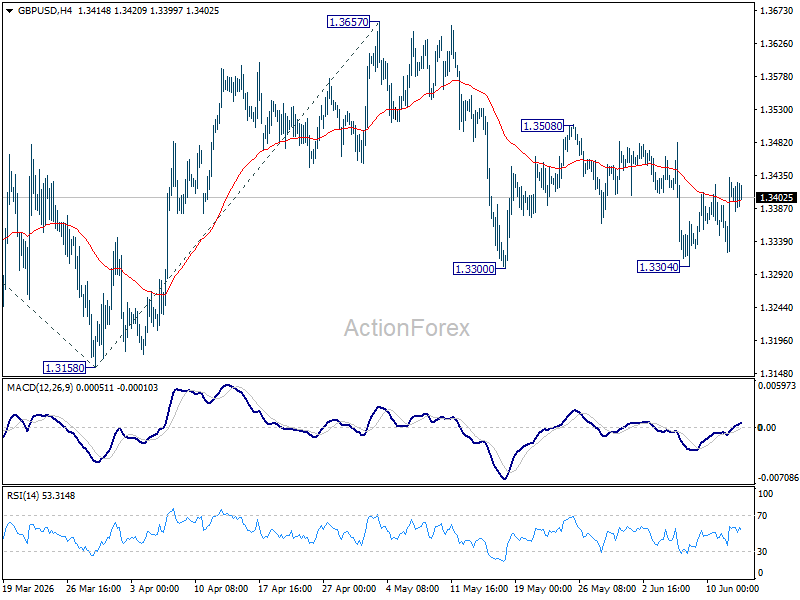
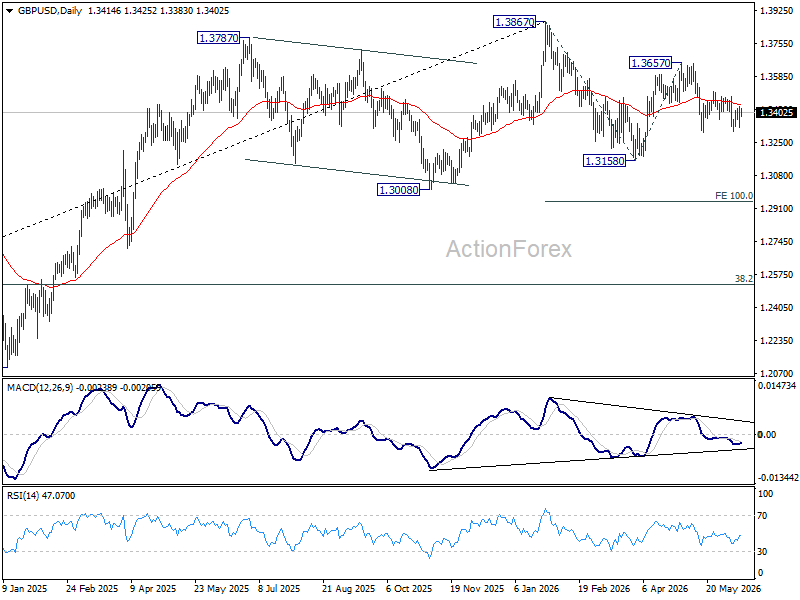
The British Pound started a downside correction from 1.3600 against the US Dollar. GBP/USD dipped below the 1.3560 and 1.3550 levels.

Looking at the 4-hour chart, the pair declined toward the 38.2% Fib retracement level of the upward move from the 1.3177 swing low to the 1.3599 high. However, it is still stable above the 100 simple moving average (red, 4-hour) and the 200 simple moving average (green, 4-hour).

Besides, there is a declining channel forming with resistance at 1.3560. On the upside, the pair faces resistance at 1.3540. The first major resistance sits at 1.3560.

The main resistance could be 1.3600. A close above 1.3600 could open doors for gains above 1.3620. In the stated case, the bulls could aim for a move to 1.3750.

Immediate support is seen near 1.3470 and the 100 simple moving average (red, 4-hour). The next support could be 1.3385 and the 200 simple moving average (green, 4-hour). It coincides with the 50% Fib retracement level of the upward move from the 1.3177 swing low to the 1.3599 high.

A close below 1.3385 might push the pair toward 1.3330. Any more losses could initiate a fresh move to 1.3250 in the coming days.

Looking at Gold, the bears seem to be in action, and they could aim for a move toward the $4,420 level in the coming days.

Upcoming Key Economic Events:

  • BoE Interest Rate Decision - Forecast 3.75%, versus 3.75% previous.
  • US Initial Jobless Claims - Forecast 215K, versus 214K previous.
  • US Gross Domestic Product for Q1 2026 (Preliminary) – Forecast 2.3% versus previous 0.5%.

Japan Industrial Output Falls -0.5% as Petrochemical Weakness Dominates

Japan’s industrial production declined -0.5% mom in March, falling short of expectations for a 1.1% increase. The drop was broad-based, with output declining in 8 of 15 sectors.

The downturn was led by petroleum-related products, where output of polyethylene plunged 27% and polypropylene fell 15%. Domestic fuel production also weakened sharply, with gasoline down 7.3% and diesel falling 14.3%. The scale of the decline likely reflects supply disruptions and input constraints linked to the effective closure of the Strait of Hormuz, which has tightened the flow of crude and refined products into the region.

Despite the weak headline figure, the Ministry of Economy, Trade and Industry maintained its assessment that production “fluctuates indecisively.” Forward-looking indicators offer some support, with manufacturers expecting output to rebound by 2.1% in April and 2.2% in May, led by machinery, electronic components, and transportation equipment.

On the demand side, retail sales provided a positive offset, rising 1.7% yoy after a 0.1% decline in February and beating expectations of 0.8%. The rebound suggests that consumption remains resilient.

Indicator Latest Notes
Industrial Production (MoM) -0.5% Miss vs +1.1% expected

Sector Breakdown (Industrial Production)

Sector / Item Change
Polyethylene -27%
Polypropylene -15%
Gasoline Output -7.3%
Diesel Output -14.3%
Sectors Declining 8 / 15

Forward Guidance (METI Survey)

Month Expected Output Change
April +2.1%
May +2.2%

NZ ANZ Business Confidence Slumps to -10.6, Inflation Expectations Highest Since Feb 2024

New Zealand business confidence deteriorated sharply in April, with ANZ’s headline index plunging from 32.5 to -10.6, highlighting a rapid shift in sentiment amid rising cost pressures. Firms’ own activity outlook also fell significantly from 39.3 to 19.6. One-year ahead expectations, meanwhile, jumped from 3.08% to 3.81%, the highest since February 2024.

Cost pressures have intensified again. Cost expectations rose from 84.7 to 90.4 in net terms, reaching the highest level since January 2023. On a three-month horizon, cost expectations surged from 2.99% to 4.57%, the highest since May 2023. This reflects a renewed wave of input cost pressure hitting firms, reinforcing the inflation impulse from external shocks.

Pricing behavior is firm but not accelerating as sharply. Pricing intentions edged down from 60.3 to 57.7, led by strong retail pricing at 78, while services at 51 dragged the overall measure lower. Short-term pricing expectations rose slightly from 2.37% to 2.41%, with manufacturing firms showing stronger pass-through at 3.4% compared to just 2.0% in services. This divergence suggests uneven ability to pass costs on.

Importantly, the underlying picture is not uniformly negative. ANZ noted that many activity indicators improved relative to late responses in the prior month, indicating that some of the initial confidence shock has eased. For the RBNZ, the challenge is clear: rising cost pressures and inflation expectations increase the risk of persistence, even as pricing and wage behavior remain relatively contained for now.

Indicator March April Change
ANZ Business Confidence 32.5 -10.6 ↓ Sharp drop
Own Activity Outlook 39.3 19.6 ↓ Significant decline
Inflation Expectations (1yr) 3.08% 3.81% ↑ Highest since Feb 2024


Full ANZ Business Confidence release here.

Gold Hit by Double Whammy, Heading Back Toward 4,000

Gold’s selloff is accelerating as a powerful macro combination weighs on the metal. Instead of acting as a safe haven, gold is being squeezed by rising oil prices and higher bond yields. A retest of the March low is now in sight, with 4,000 emerging as the next key level. How quickly it gets there will depend on the path of oil and yields.

Oil has taken the lead. Brent is now pressing the key $120 psychological level after reports that US President Donald Trump has instructed aides to prepare for an extended blockade of Iran. At the same time, the Strait of Hormuz effectively closed to most tankers. Markets are pricing a sustained supply shock, which reinforces inflation risks globally.

The transmission into financial markets has been swift. Rising oil prices are feeding into higher inflation expectations, lifting US 10-year yields above the 4.4% level.

At the same time, the Federal Reserve’s latest decision overnight has reinforced a hawkish tilt. The Fed may have held rates, but the details mattered. The three hawkish dissenters (Hammack, Kashkari, and Logan) didn't just want to hold rates; they specifically voted against the "easing bias. For markets, the takeaway is clear: a dovish pivot is not imminent.

This creates a clear “double whammy” for Gold.

Technically, Gold’s extend decline suggests that rebound from 4,098.45 low has already completed at 4,889.24. Further fall is expected as long as 55 4H EMA (now at 4,681.60) holds, back towards 4,098.45 low, and possibly further to 4,000 psychological level.

The speed and depth of the decline will depend on developments in related markets. Brent’s behavior around the $120 level is critical. A clean break higher would likely reinforce inflation fears and push yields further up through 4.5%, accelerating Gold’s decline.


Fed Review: Not Quite Done Yet

The Fed maintained its policy stance unchanged, as widely expected. Stephen Miran dissented in favour of a rate cut, while three participants dissented against maintaining an easing bias. Powell announced he continues as a Fed Governor past his term as Chair but did not specify for how long.

Powell flagged that growing number of participants are seeing current stance as neutral but did not suggest rate hikes were in the cards for now. Neither the statement nor Powell discussed the Fed's balance sheet operations.

UST yields moved higher, with markets erasing earlier bets for rate cuts this year and instead pricing in around 50% probability of a hike in H1 2027. We maintain our relatively dovish call, and still expect two cuts in Sep and Dec.

Jay Powell's final press conference as the Fed chair was as much about guidance during a difficult time for policy setting, as it was about his personal choice. Powell continues as a Fed Governor also after his term as the Chair ends 15 May, though he intentionally did not specify for how long. The decision is hawkish on the margin, as it blocks Trump from nominating a new and potentially more dovish replacement.

It also means Stephen Miran, who was the only participant voting in favour of a cut, will not continue as a Governor in June when Kevin Warsh takes his seat. Powell tied his future exit to DoJ's criminal investigation being 'well and truly over', but we also flagged in RtM USD, 28 April, that staying beyond midterms could complicate Trump's task of replacing him with a dove like Miran if Democrats manage to flip the Senate.

Three participants - Logan, Kashkari and Hammack - dissented against the Fed's current easing bias. That said, all three have been firmly in the FOMC's hawkish camp for a while, as they vocally opposed the latest rate cut already last fall. Powell specified that no one in the committee argued for a hike, and majority did not want to send a signal that a hike would be equally likely as a cut. On the other hand, Powell emphasized that the committee will not be even thinking about cutting for the next few months, as it waits to see both the effects of the energy supply shock and whether tariff-driven inflation begins to fade.

We still think the Fed will eventually resume its easing cycle with two final cuts in September and December. The war in Iran hurts the economy where we see it as already vulnerable to setbacks - in private consumption via lower disposable income, and in non-AI investments via higher interest costs. Bond yields continued to rise during the press conference, and not just because inflation expectations are following oil prices. The 10y real swap rate is even above its pre-war levels (chart 2). The bottom line is that tighter financial conditions are already weighing on the growth outlook even without explicit policy stance tightening.

Neither the statement nor Powell touched upon the Fed's balance sheet, but we expect further guidance on the T-bill Reserve Management Purchases in the minutes. Earlier guidance suggests purchase amounts will continue to decline sharply in May.

The FOMC Favours a Steady Hand

The FOMC kept the stance of policy and their outlook unchanged in April as expected, at Powell’s last meeting as FOMC Chair.

As expected, the FOMC kept the stance of policy unchanged at its April meeting and, broadly speaking, portrayed a balanced baseline and risk outlook. This is despite not explicitly stating a hike is as likely as a cut – language the dissenters Hammack, Kashkari, and Logan arguably would have preferred. This outcome is consistent with our and the market’s expectations as well as the degree of uncertainty evident in financial markets – the price of Brent crude rising circa 7% today to USD120 per barrel while US equities held near record highs.

The Committee’s take on economic activity was sanguine, with GDP characterised as “expanding at a solid pace” and the unemployment rate “little changed in recent months” even as job gains “remained low”. Members’ views on the price outlook showed caution but not overt concern, with inflation simply characterised as "elevated". "The Committee is [also] attentive to the risks to both sides of its dual mandate", and Chair Powell noted in the press conference that, in his view, policy is in a good place to take time to monitor conditions, being at the "high end of neutral”, “perhaps mildly restrictive".

We have been more concerned than the FOMC over domestic inflation stemming from capacity constraints and, in such an economic state, believe outsized and/or persistent second-round effects of energy and tariff inflation are meaningful risks. Still, with growth below trend in Q4 2025 and Q1 2026, and likely through mid-2027, there is no urgency to take a hawkish stance, let alone hike. Per Chair Powell’s remarks and current market pricing, the best course is to hold and continue assessing current conditions and uncertainties.

Like all other major central banks, the road ahead for the Federal Reserve is challenging. The domestic and international risks the economy and Committee face are disparate and could persist for some time. The FOMC will also have to navigate considerable US fiscal uncertainty over the year(s) ahead. A continued uptrend in the US 10-year yield, and consequently the 30-year mortgage rate, will limit the breadth of growth across the economy and weigh on household and financial market confidence. In time, it will also restrict the Government’s capacity to act against a meaningful deterioration in economic momentum as the interest burden grows. As such, we cannot discount policy rate cuts entirely, though they are more likely to be a topic of conversation in 2027 or 2028 than 2026.

Finally, with Kevin Warsh's nomination for FOMC Chair advancing from the Committee stage to a full vote in the Senate, it is important to recognise this meeting was Powell’s last meeting as Chair. In the press conference though, Powell made clear he still intends to stay on as a Federal Reserve Governor, and consequently a member of the FOMC, until the investigations into the Federal Reserve are “well and truly over with finality and transparency”. The Department of Justice dropping their criminal investigation into the organisation and Chair Powell are a decisive step in that direction, but the Supreme Court decision in Lisa Cook’s case is still to come, and the Federal Reserve’s own investigation into construction costs has to be completed to rule out the Department of Justice re-opening its investigation. Powell remaining in place as a Governor over the period will provide continuity while these uncertainties are resolved.