Sample Category Title
WTI Oil: Regains Levels Above $60 as Signals of US-China Trade Talks Ease Tensions
WTI Oil regains levels above $60 as signals of US-China trade talks ease tensions.
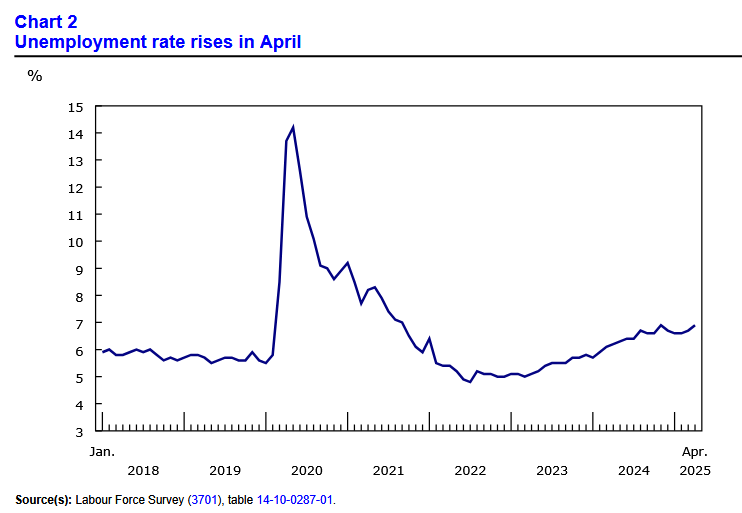
WTI oil keeps firm tone and attempts to hold gains above pivotal $60 barrier (psychological / Fibo 50% retracement of $64.70/$55.14 bear-leg).
The price rose around 4% on Thursday, inflated by fresh optimism after US and China announced start of trade talks over the weekend.
The contract is also on track for the weekly gain of slightly over 7% (the biggest weekly advance since the last week of September 2024).
Easing fears of potential escalation of trade conflict between two world’s biggest oil consumers brightened demand outlook and partially offset threats of oversupply after the OPEC+ announced the third consecutive output increase from June 1 (total of 960K bpd).
Thursday’s strong rally which broke above psychological $60 resistance and cracked $61.05 (Fibo 61.8% generated initial bullish signal, although technical picture on daily chart is still lacking firmer signals as studies are mixed.
We look for weekly close above $60 to keep near-term action biased higher, with violation of $61.05 to confirm bullish signal.
Meanwhile, the action is likely to remain quiet and await news from US-China talks for direction signals.
Res: 61.05; 61.79; 62.09; 62.44.
Sup: 59.92; 58.98; 58.69; 57.40.
Canadian Dollar Shrugs After Mixed Employment Numbers
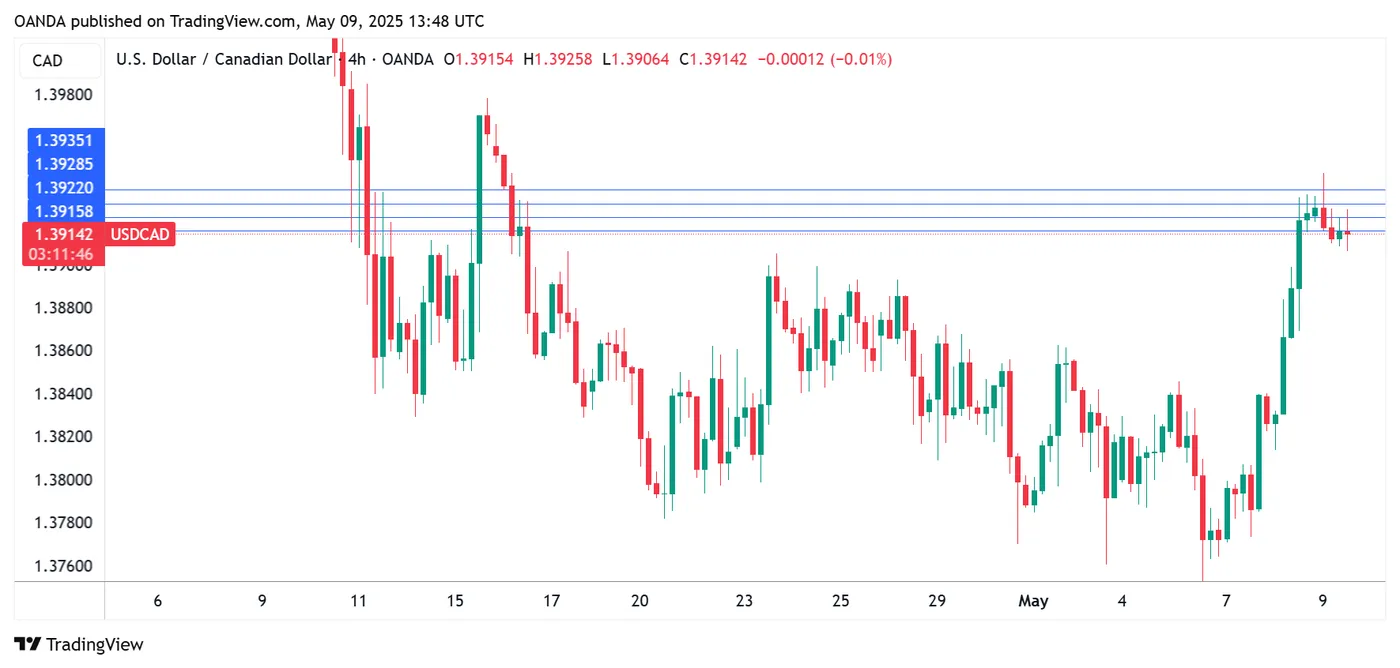
The Canadian dollar is steady on Friday, after a two-day slid in which the loonie declined by 1%. In the North American session, USD/CAD is trading at 1.3911, down 0.09% on the day. On the data calendar, Canada released the employment report and there are no US economic releases.
Employment posts small gains, unemployment rate jumps
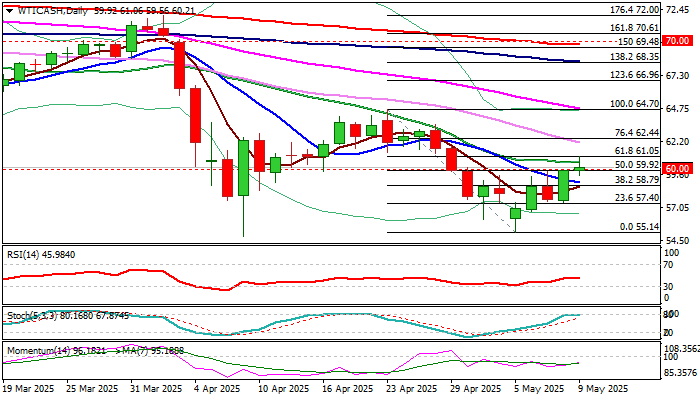
The April employment report didn't show much change and the Canadian dollar has shown little reaction. The economy added 7.4 thousand jobs, rebounding from the loss of 32.6 thousand in March and above the market estimate of 2.5 thousand. At the same time, the unemployment rate climbed to 6.9%, higher than the market estimate of 6.8% and above the March reading of 6.7%. This was the highest level since Nov. 2024.
The rise in unemployment is likely a reflection of the US tariffs. Canada's exports to the US were down in March, hurting businesses that export to the US. If the tariffs remain in place, weaker demand from the US could significantly damage Canada's economy.
BoC: US tariffs pose threat to financial stability
The Bank of Canada released its Financial Stability Report on Thursday. The BoC said that the financial system was strong but warned that a prolonged trade war between Canada and the US could lead to banks cutting back on lending, which would hurt consumers and businesses and damage the economy. The report said that the unpredictibility of US trade policy could cause further market volatility and was a risk to financial stability.
The Federal Reserve maintained rates earlier this week and Fed Chair Powell said the Fed was in a wait-and-see-stance due to the uncertainty over the US tariffs. We'll hear from seven Fed members on Friday and Saturday, who may provide some insights on where rate policy is headed. The markets have priced in a rate hike in June at only 18%, down sharply from 58% a week ago.
USD/CAD Technical
- USD/CAD is testing resistance at 1.3928. Above, there is resistance 1.3935
- 1.3922 and 1.3915 are the next support levels
USDCAD 4-Hour Chart, May 9, 2025
Sunset Market Commentary
Markets
There were no important data in the US and in EMU today. This allowed investors to make up their mind on recent and upcoming events. In a weekly perspective both US and European yields confirmed a tentative bottoming out pattern. US yields compared to last Friday’s close rose about 3.5 bps (2-y) to 6.0 bps (10-y). German yields in a similar way added between 1.5 bps (2-y) and 5.0 bps (30-y). Initially, in the run-up to Wednesday’s Fed meeting, markets mostly focused on the what would be needed for central banks to move to a more stimulative stance. However, the Fed’s assessment basically went the other way. Powell and Co took notice of the high level of uncertainty. This elevated uncertainty combined with for now still decent hard data caused the Fed to confirm a reactive rather than a pre-emptive approach to further easing. This assessment was basically also joined by other central banks as they left rates unchanged (Riksbank, Norges Bank) or as they moved to cautious/hawkishly tilted rate cuts (BoE, CNB). For now, the focus/narrative on European interest rate markets is still rather on the potential deflationary impact of tariffs on the EMU economy (illustrated by comments for the likes of ECB Rehn and Simkus today). However, given current market pricing of a trough in ECB depot rate <1.75%, maybe rate talk in Europe at some point also might move to a more balanced approach as appeared with the likes of the BoE and the Fed this week. Aside for CB assessments, the focus since yesterday turned to potential progress in trade talks between the US and some of its trading partners after reaching a first (framework) deal with the UK. Markets this morning apparently hoped that the US at least would also try to capture some short-term wins in a first round of trade talks with China scheduled for this weekend in Switzerland. Too stretched hopes on this, if any, were tempered as president Trump today aired that an 80% tariff on China seems right. Even so, it leaves the idea/hope on some de-escalation intact. Balanced comments from German Chancellor Merz after a call with present Trump might be interpreted in a similar way. Talks will be difficult, but they are at least on speaking terms. EMU equities still trade with a 0.6% gain. German DAX even touched a new all-time record intraday. US indices also opened in green (S&P 500 +0.45%). In FX markets, the dollar this week similarly showed some further signs of bottoming. The trade war & the subsequent ‘Sell-America trade’ weighed heavily on the US currency last month. Signs of some de-escalation and the Fed not in a hurry to withdraw interest rate support bought the dollar some time. However, for now any USD gains develop at process/pace of two steps forward and one step back. Today was again a small step backward (DXY 100.3 from 100.65, EUR/USD 1.125 from 1.123). EUR/USD this week tested the 1.1235 support area (23% retracement YTD low/YTD top). For now, no clear break occurred yet (1.126).
News & Views
Canadian employment grew by 7.4k jobs in April, a little more than the 5k expected and offsetting some of the 32.6k jobs that were lost during March. Details showed full-time employment (+31.5k) compensated for a decline in part time jobs (-24.2k). The small uptick was carried by the public administration, coinciding with the hiring of temporary workers for activities related to the recent federal election. Other segments adding to the number were finance, insurance, real estate & rental while manufacturing and wholesale and retail trade shed jobs. The employment rate eased to 60.8%, matching a recent low recorded in October last year. The unemployment rate rose 0.2 ppts to 6.9%, returning to the November 2024 level, which was the highest since January 2017 excluding 2020-2021 pandemic years. The participation rate, however, picked up as well, to 65.3%. The Canadian Loonie barely budged on the release with USD/CAD hovering just north of 1.39. CAD levels are still among the strongest in seven months.
The Swedish government cut its growth forecasts for this year and the next to 1.8% and 2.3% respectively (from 2.1% and 2.8%), its finance minister Svantesson announced today, referring to global trade frictions darkening the picture and creating uncertainty. Risks remain tilted to the downside, she added, but also suggested fiscal policy could weigh in if needed. Sweden’s low debt level (around a third of GDP) allows for a budgetary response potentially even before the autumn. The forecast cut came after the central bank kept the policy rate steady yesterday while keeping the door ajar for more easing later this year. The Swedish crown trades a tad stronger at EUR/SEK 10.90.
Canadian Employment Little Changed in April
The Canadian labour market basically tread water in April, adding only 7k net new positions (+0.0% month/month). The modest gain was driven by public sector hiring (23k) and self-employment (11k), while the private sector shed jobs (-27k). Cut another way, solid gains were seen in full-time jobs (32k), which were partly offset by losses in part-time jobs (-24k).
As a result, the unemployment rate rose two tenths to 6.9% in April as Canada's labour force expanded by 47k workers (+0.2% m/m). Growth in the labour supply was mostly due to population growth and a slight rebound in labour force participation (65.3%).
Modest hiring in April was boosted by the federal election, which contributed to 37k gain in public administration jobs. Trade-exposed sectors lost jobs. The manufacturing sector was down (-31k or -1.6% m/m), as was the wholesale and retail trade sector (-27k or -0.9% m/m). Ontario alone lost 33k manufacturing jobs.
Lastly, total hours worked made a solid 0.4% m/m gain, continuing to recover from weather-induced drop in February. Meanwhile wage growth continued to slow. Average hourly wages rose 3.4% versus a year ago, down from 3.6% year-on-year in March.
Key Implications
Canada's economy added jobs in April largely thanks to temporary work for the federal election, but scratch beneath the surface and Canada's labour market continued to soften. The impact of trade tariffs appears to be working their way through the economy with job losses in trade exposed sectors. Month-to-month job numbers in the labour force survey are always a bit volatile, but on a three-month average basis Canada has lost jobs. The unemployment rate continues to drift higher, and wage gains are cooling.
In April, the Bank of Canada opted to wait and see how tariffs and Canada's response shake out before lowering interest rates any further. The economic evidence continues to mount that the Canadian economy is slowing in the face of U.S. tariffs. We think more interest rate cuts are warranted, with the next 25 basis point cut on June 4th.
USD/JPY Mid-Day Outlook
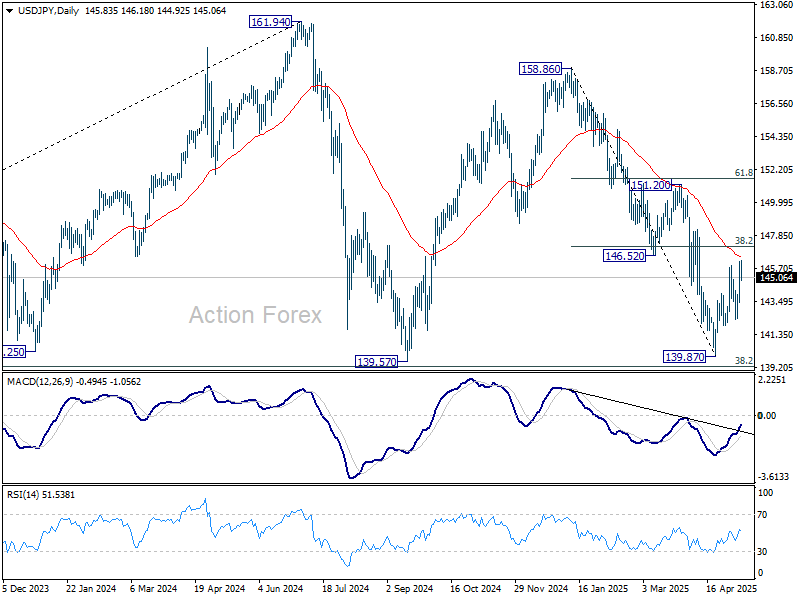
Daily Pivots: (S1) 144.18; (P) 145.18; (R1) 146.91; More...
Intraday bias in USD/JPY stays mildly on the upside at this point. Rise from 139.87 is resuming for 38.2% retracement of 158.86 to 139.87 at 147.12. Rejection by 147.12 will retain near term bearishness. Break of 142.34 support will bring retest of 139.87. However, sustained break of 147.12 will indicate near term reversal, and target 61.8% retracement at 151.60.
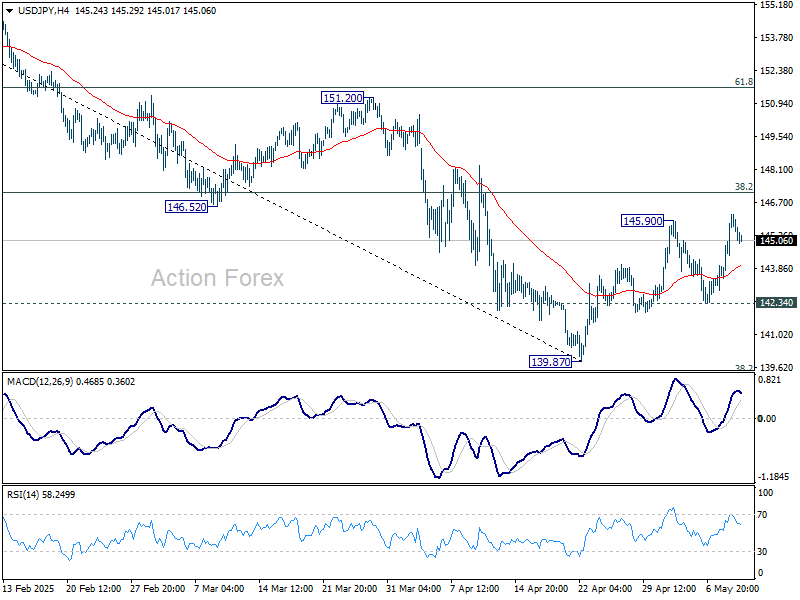
In the bigger picture, price actions from 161.94 are seen as a corrective pattern to rise from 102.58 (2021 low), with fall from 158.86 as the third leg. Strong support should be seen from 38.2% retracement of 102.58 to 161.94 at 139.26 to bring rebound. However, sustained break of 139.26 would open up deeper medium term decline to 61.8% retracement at 125.25.
USD/CHF Mid-Day Outlook
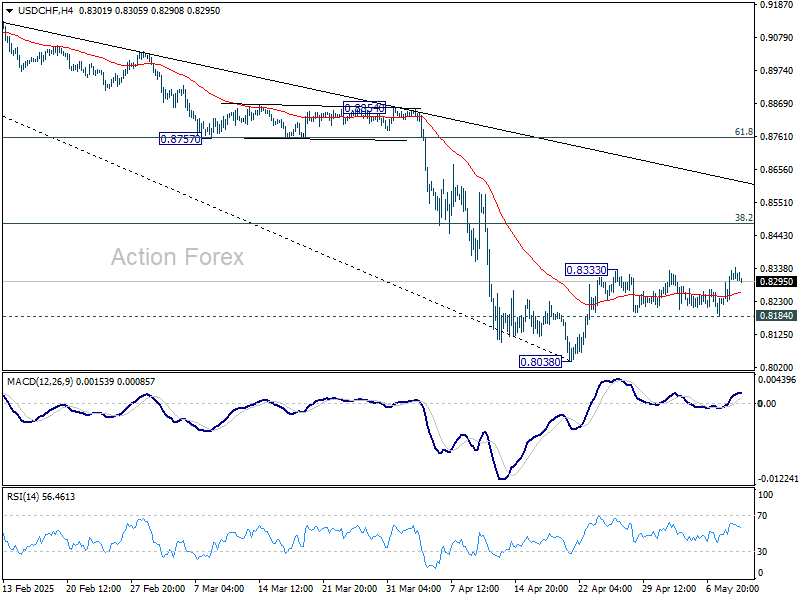
Daily Pivots: (S1) 0.8250; (P) 0.8292; (R1) 0.8359; More….
Intraday bias in USD/CHF remains neutral for the moment. On the upside, firm break of 0.8333 will resume the rebound from 0.8038 to 38.2% retracement of 0.9200 to 0.8038 at 0.8482. But strong resistance should be seen there to limit upside. On the downside, sustained break of 0.8184 will bring retest of 0.8038.
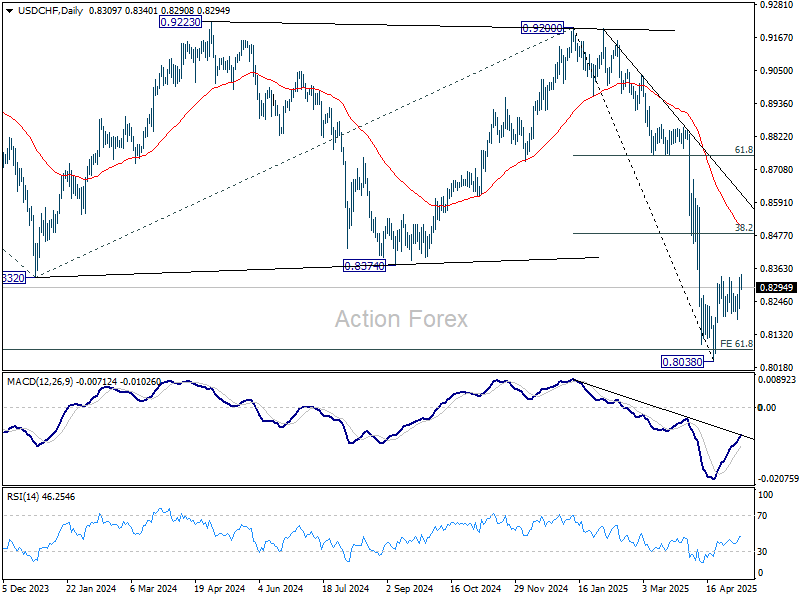
In the bigger picture, long term down trend from 1.0342 (2017 high) is still in progress and met 61.8% projection of 1.0146 (2022 high) to 0.8332 from 0.9200 at 0.8079 already. In any case, outlook will stay bearish as long as 55 W EMA (now at 0.8763) holds. Sustained break of 0.8079 will target 100% projection at 0.7382.
GBP/USD Mid-Day Outlook
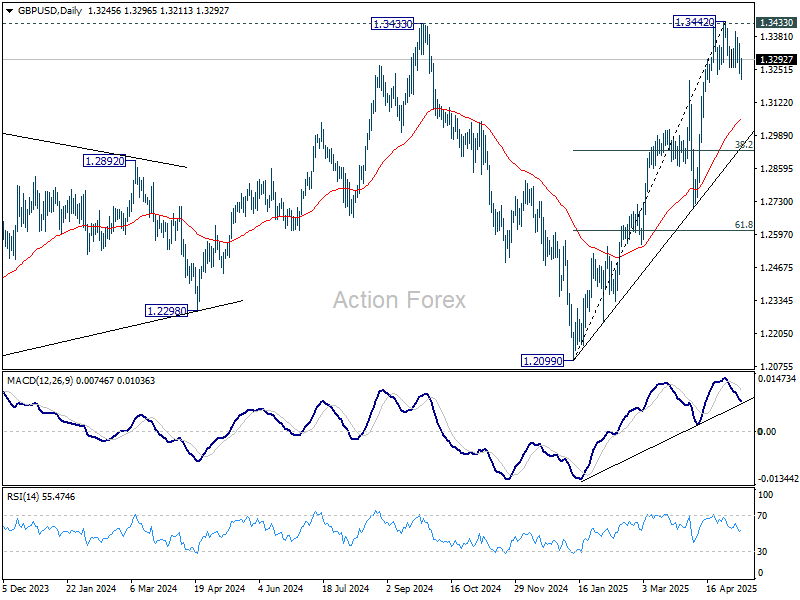
Daily Pivots: (S1) 1.3204; (P) 1.3280; (R1) 1.3324; More...
Intraday bias in GBP/USD stays mildly on the downside at this point. Fall from 1.3442 is in progress to 55 D EMA (now at 1.3056). Firm break there will target 38.2% retracement of 1.2099 to 1.3442 at 1.2929. For now, risk will stay on the downside as long as 1.3442 resistance holds, in case of recovery.
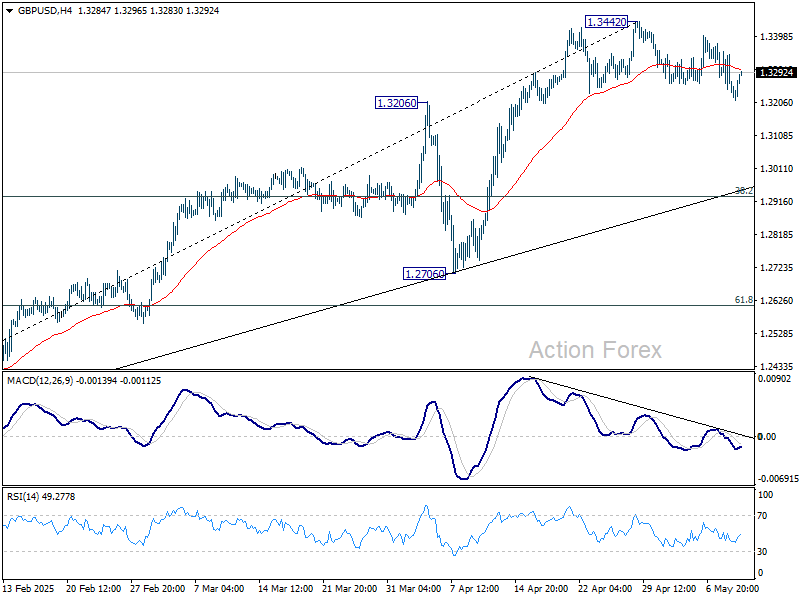
In the bigger picture, price actions from 1.3433 are seen as a corrective pattern to the up trend from 1.3051 (2022 low). Rise from 1.2099 could either be resuming the up trend, or the second leg of a consolidation pattern. Overall, GBP/USD should target 1.4248 key resistance (2021 high) on decisive break of 1.3433 at a later stage.
EUR/USD Mid-Day Outlook
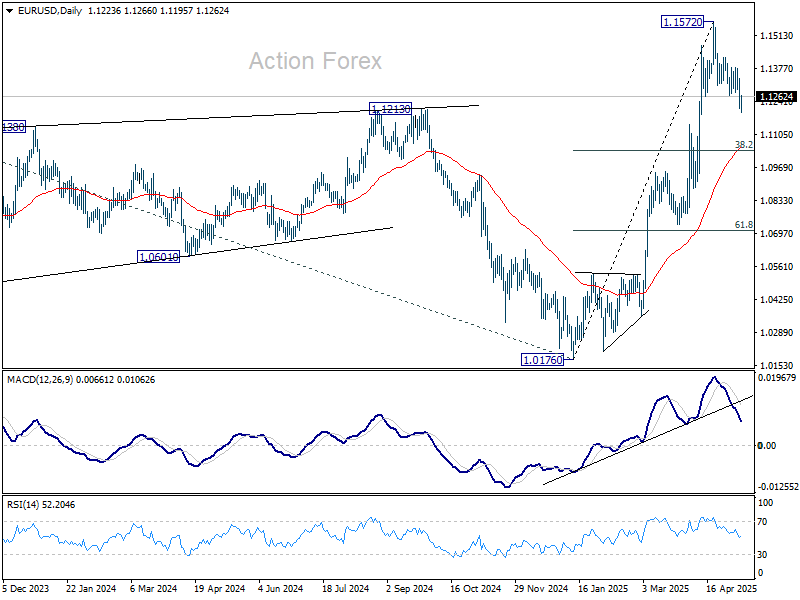
Daily Pivots: (S1) 1.1181; (P) 1.1259; (R1) 1.1305; More...
Intraday bias in EUR/USD remains mildly on the downside for the moment. Corrective fall from 1.1572 is still in progress to 38.2% retracement of 1.0176 to 1.1572 at 1.1039. But strong support should be seen there to bring rebound. On the upside, break of 1.1380 will suggest that the correction has completed, and bring retest of 1.1572.
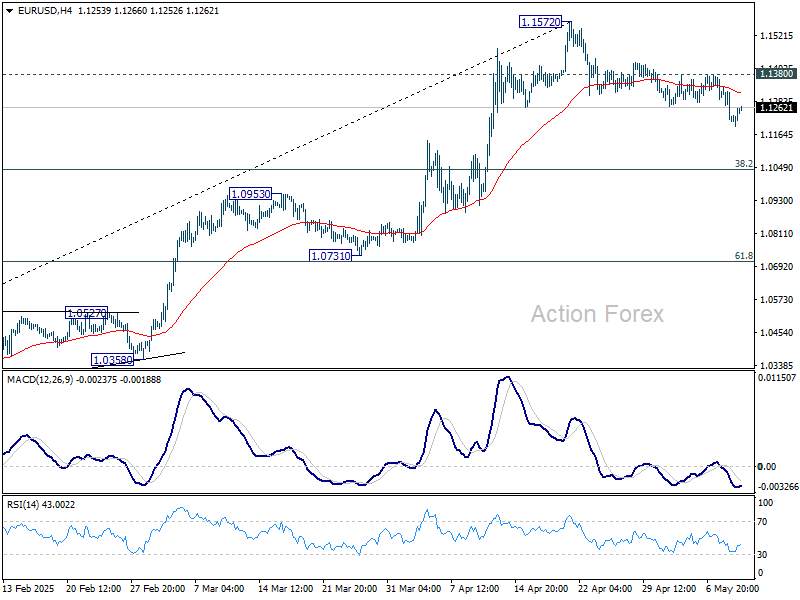
In the bigger picture, rise from 0.9534 long term bottom could be correcting the multi-decade downtrend or the start of a long term up trend. In either case, further rise should be seen to 100% projection of 0.9534 to 1.1274 from 1.0176 at 1.1916. This will now remain the favored case as long as 55 W EMA (now at 1.0808) holds.
Markets Turn Cautious Again Ahead of US-China Talks in Switzerland
The forex markets are quiet today, with major pairs largely consolidating after yesterday's modest directional movement. Dollar and British Pound remain the strongest performers overall, bolstered earlier in the week by the announcement of the US-UK trade agreement. However, both currencies are now struggling to extend their momentum. Canadian Dollar continues to lag after today's mixed employment report. European equities are trading slightly higher, and US futures are also edging up, but the broader market mood is subdued.
Attention is now shifting to the upcoming meeting between US and Chinese trade representatives in Switzerland this weekend. Caution is in the air after President Trump suggested in a social media post that tariffs on Chinese goods could be cut from 145% to 80%—a comment that sparked tentative optimism. While some economists are hopeful for at least partial tariff relief, expectations remain low for any immediate breakthrough.
History tempers optimism. The last major US-China trade deal took two years of negotiations following the initial tariff escalation in 2018, and that process was marked by repeated false starts and reversals. As such, the meeting in Switzerland is widely viewed as a tentative first step rather than a venue for concrete outcomes. Any signals of goodwill or further dialogue would be welcome, but markets are unlikely to price in significant progress until more substance materializes.
For the week so far, Dollar remains the top performer, followed by Sterling and Yen. On the weaker end, Kiwi has underperformed, trailed by Loonie and Aussie. Euro and Swiss Franc sit in the middle.
In Europe, at the time of writing, FTSE is up 0.34%. DAX is up 0.74%. CAC is up 0.86%. UK 10-year yield is up 0.024 at 4.576. Germany 10-year yield is up 0.031 at 2.573. Earlier in Asia, Nikkei rose 1.56%. Hong Kong HSI rose 0.40%. China Shanghai SSE fell -0.30%. Singapore Strait Times rose 0.73%. Japan 10-year JGB yield rose 0.029 to 1.354.
Canada’s jobs grow 7.4k, unemployment rate jumps to 6.9%
Canada’s labor market posted a modest gain of 7.4k jobs in April, slightly above expectations of 4.1k, following a sharp loss of -33k positions in March and a flat February. While the headline number suggests some stabilization, broader labor indicators point to underlying weakness.
Unemployment rate rose from 6.7% to 6.9%, above expectations, and is now back at its November 2024 level, the highest since January 2017 excluding the pandemic years.
The employment rate slipped another 0.1 percentage points to 60.8%, matching a recent low seen in October 2024.
Wage growth also showed signs of easing, with average hourly earnings increasing 3.4% yoy, down from 3.6% yoy in March. Meanwhile, total hours worked rose by 0.4% mom and 0.9% yoy.
Fed’s Barr: Tariffs to push inflation higher, job losses also a major concern
In a speech today, Fed Governor Michael Barr acknowledged that the US economy began the current quarter from a “relatively strong position,” describing overall conditions as “resilient.” However, he cautioned that this solid foundation is being increasingly overshadowed by rising trade policy uncertainty, particularly from the recent wave of tariffs.
Barr expected "tariffs to lead to higher inflation" in the US and “lower growth” starting later this year. He explained that the new tariffs—unprecedented in size and scope in the modern era—could disrupt global supply chains and exert lasting upward pressure on prices. At the same time, he is “equally concerned” that the resulting economic drag could lead to job losses.
Despite these risks, he emphasized that monetary policy is in a “good position” to adjust as needed once the full effects of the tariffs become clearer.
Fed’s Kugler: Labor market stable, likely near maximum employment
In a speech today, Fed Governor Adriana Kugler described the U.S. labor market as “stable,” noting that key indicators such as the unemployment rate, currently at 4.2%, have remained within a narrow and consistent range.
She highlighted that temporary layoffs have returned to pre-pandemic levels, and both job vacancies and quit rates have plateaued, indicating a moderation in labor market churn.
Kugler further stated that the economy is likely “close to maximum employment,” referencing model-based estimates of the natural rate of unemployment (u*) that align with the current 4.2% level.
BoE's Bailey highlights asymmetric risks: Demand weakness warrants sharper monetary response
In a speech following BoE's Monetary Policy Report released yesterday, Governor Andrew Bailey elaborated on the two alternative scenarios laid out alongside the baseline forecast.
The first scenario envisions that heightened global and domestic uncertainty could suppress UK demand more than currently expected, "easing inflationary pressures".
In contrast, the second scenario assumes that recent energy price increases could trigger renewed second-round effects in domestic prices, with tighter supply conditions "increasing inflationary pressures".
Bailey emphasized that these scenarios are not simply stylized upside or downside risks to inflation but are meant to illustrate the underlying mechanisms that could shift the inflation path.
He stressed, "it matters whether inflation differs from the baseline because of demand or supply". And, the size of the required monetary policy response might be different.
From a monetary policy standpoint, Bailey explained that a demand-driven downside scenario would likely warrant a stronger policy response than a supply-driven upside shock. That's "simply because there is more of a trade-off to balance when inflation and activity move in different directions," he added.
ECB's Simkus and Rehn warn of growth risks
Comments from ECB Governing Council members today reinforced expectations for a rate cut in June, while also highlighting growing concern over the deteriorating macro environment.
Lithuania’s Gediminas Šimkus acknowledged that geopolitical developments since the start of the year have been negative for the economy, adding that inflation is now under "downward pressure". He noted that June projections "may be a little bit worse" and warned of the risk the central bank will undershoot its inflation target.
He also pointed to the risk of China re-routing goods to Europe in response to rising US trade barriers—a trend that could weigh on European industry and import prices.
Šimkus indicated that a June rate cut is needed but remained non-committal on the pace of further easing, saying it’s still unclear whether the next move after June would come in July or September.
Separately, Finland’s Olli Rehn struck a similar tone, citing pervasive uncertainty and reaffirming that the Governing Council will retain "full freedom of action" to meet its price stability mandate.
While Rehn noted that progress has been made in bringing inflation toward the 2% target, he cautioned that global trade tensions pose a meaningful downside risk to growth.
Japan wage growth slows while Real incomes shrink, but spending rebounds
Japan’s wage data for March showed a softening trend. Nominal total cash earnings rose 2.1% yoy, below expectations of 2.4% yoy and down from February’s 2.7% yoy. This marked the 39th consecutive month of nominal wage growth, but the pace is clearly losing momentum.
More concerning was the continued decline in inflation-adjusted real wages, which fell -2.1% yoy, down for a third straight month, highlighting the squeeze on household purchasing power as consumer prices remained elevated at 4.2% yoy, particularly for food staples like rice.
Base salaries (regular pay) grew 1.3% yoy, unchanged from February, suggesting underlying wage trends remain stable but not accelerating. However, overtime pay, often viewed as a proxy for labor demand, fell -1.1% yoy, marking its first decline since September and the sharpest drop since April last year.
Despite the income pressures, household spending surprised to the upside. It rose 2.1% yoy, far exceeding the expected 0.2% yoy and marking the first increase in two months. On a seasonally adjusted month-on-month basis, spending climbed 0.4%. The increase was largely driven by higher electricity bills and rising education-related expenses.
China’s exports surge 8.1% yoy in April, ASEAN shipments jump 20.8% yoy, US slide -21% yoy
China’s exports surged 8.1% yoy to USD 315.7B in April, far exceeding expectations of 1.9% yoy. However, the headline strength masks key shifts in trading patterns.
Exports to the US tumbled by -21% yoy, a sharp reversal from March’s 9.1% yoy gain, reflecting the drag from elevated tariffs. In contrast, shipments to the ASEAN bloc jumped 20.8% yoy, with Vietnam, often seen as a transshipment route for Chinese goods, seeing a 22.5% yoy rise.
Yet, with the US now eyeing a steep 46% tariff on Vietnamese imports and imposing a 10% baseline levy, this channel for China could soon come under pressure.
Elsewhere, exports to the European Union also improved, rising 8.3% yoy.
Imports dipped just -0.2% yoy, a much smaller contraction than the expected -5.9% yoy. As a result, trade surplus narrowed from USD 102.6B to USD 96.2B, above the expected USD 94.3B.
EUR/USD Mid-Day Outlook
Daily Pivots: (S1) 1.1181; (P) 1.1259; (R1) 1.1305; More...
Intraday bias in EUR/USD remains mildly on the downside for the moment. Corrective fall from 1.1572 is still in progress to 38.2% retracement of 1.0176 to 1.1572 at 1.1039. But strong support should be seen there to bring rebound. On the upside, break of 1.1380 will suggest that the correction has completed, and bring retest of 1.1572.
In the bigger picture, rise from 0.9534 long term bottom could be correcting the multi-decade downtrend or the start of a long term up trend. In either case, further rise should be seen to 100% projection of 0.9534 to 1.1274 from 1.0176 at 1.1916. This will now remain the favored case as long as 55 W EMA (now at 1.0808) holds.
Canada’s jobs grow 7.4k, unemployment rate jumps to 6.9%
Canada’s labor market posted a modest gain of 7.4k jobs in April, slightly above expectations of 4.1k, following a sharp loss of -33k positions in March and a flat February. While the headline number suggests some stabilization, broader labor indicators point to underlying weakness.
Unemployment rate rose from 6.7% to 6.9%, above expectations, and is now back at its November 2024 level, the highest since January 2017 excluding the pandemic years.
The employment rate slipped another 0.1 percentage points to 60.8%, matching a recent low seen in October 2024.
Wage growth also showed signs of easing, with average hourly earnings increasing 3.4% yoy, down from 3.6% yoy in March. Meanwhile, total hours worked rose by 0.4% mom and 0.9% yoy.