Sample Category Title
NFP Preview: February 2025 Jobs Report and US Dollar Impact
- The US Bureau of Labor Statistics will release the non-farm payroll (NFP) and jobs data for February 2025 on Friday, March 7th, 2025.
- Economists are predicting 170,000 jobs added and the unemployment rate holding steady at 4.0%.
- Key factors influencing February’s jobs report include potential federal job cuts, changes in trade policies, a strong services sector, and mild weather conditions.
- Technical analysis of the US Dollar Index (DXY) shows it at a crossroads, where to next?
The US Bureau of Labor Statistics is set to release the non-farm payroll and jobs data for February 2025 on Friday, March 7th, 2025.
Job Market Expectations for February
Economists predict 170,000 jobs were added in February, showing some improvement from January’s weaker result of 143,000 jobs. The unemployment rate is expected to stay at 4.0%, which is considered a healthy level given the current economic situation.
However, private payroll data raised concerns by showing only 77,000 new jobs, which fell short of expectations. This might mean the overall jobs report could also disappoint.
Average hourly earnings are expected to grow by 0.3% compared to the previous month, continuing the steady increase seen before. Wage growth is an important factor for policymakers because it shows how much pressure there is on inflation in the economy.
There are challenges ahead with concerns that tariff uncertainty and growth worries may lead to a cautious approach toward hiring in the first part of 2025. It will be interesting to see if these concerns come to fruition and we see any cooling of the labor market and a drop in hiring.
Key Influences on February’s Jobs Report
Federal Job Cuts
The Department of Government Efficiency (DOGE) recently announced plans to cut 10,000 federal jobs. However, because of the timing, these cuts may not fully show up in February’s jobs report but could have a bigger impact in future months.
Changes in Trade Policies
New trade tariffs on goods from Mexico, Canada, and China are affecting how businesses hire. Some industries are benefiting, but others, like manufacturing, are facing challenges as they deal with higher costs and supply chain adjustments.
Strong Services Sector
The services industry continues to grow. The ISM’s non-manufacturing PMI rose to 53.5 in February from 52.8 in January. This is a good sign for jobs in areas like healthcare, hospitality, and professional services.
Mild Weather’s Impact
Warmer-than-usual weather in February likely boosted jobs in construction and other outdoor industries. This seasonal factor might slightly raise the overall job numbers for the month.
Potential Impact and Scenarios
Here’s how the market might respond to different outcomes in February’s job numbers:
Stronger-Than-Expected Job Growth
If the report shows more than 195,000 jobs added, we could see these effects:
- Higher Bond Yields
A strong labor market might make the Federal Reserve less likely to cut rates soon, pushing bond yields up.
- A Stronger Dollar
The U.S. dollar (USD) could strengthen against currencies like the euro (EUR) or the British pound (GBP) as traders expect less rate-cutting from the Fed.
- Stock Market Weakness
Oddly, good job numbers might hurt stock markets. With less chance of rate cuts, investors could shy away from riskier assets like stocks.
Weaker-Than-Expected Job Growth
If the report shows fewer than 135,000 jobs added, the market may react this way:
- Risk-Off Reactions
Investors might move to safe-haven assets like gold or currencies such as the Japanese yen (JPY) or Swiss franc (CHF), fearing wider economic troubles.
- Talk of Rate Cuts
A weak report could raise expectations that the Fed might cut rates later in 2025, lowering the value of the USD.
Neutral or Expected Job Numbers
If the data is close to projections, around 170,000 jobs added, reactions might depend on smaller details, like:
- Revisions to Old Data
Changes to previous job numbers could shape market responses.
- Pay Growth
Wages growing faster than expected might revive concerns about inflation.
- Services Sector Strength
Solid growth in services jobs could provide some optimism for markets.
How the market reacts will greatly depend on these scenarios and the finer details of the report.
Potential Impact on the US Dollar Based on the Data Released
Source: LSEG, TradingEconomics. Table Created by Zain Vawda
Markets will be paying close attention to US labor data following a string of underwhelming data releases. The data of late has been one of a slowing economy, coupled with tariff uncertainty sets a perfect mixture for a potential recession.
This will have a knock on effect globally which makes US data and the performance of the economy key in the months ahead.
Technical Analysis – US Dollar Index (DXY)
Looking at the US Dollar Index and it is now trading at the levels it did before the US election.
Any gains made since the election of President Trump has been wiped away with the DXY peaking at 110.176 on January 13 before beginning its descent. Tariff announcements and chatter have attempted to push the Dollar higher but follow through has not been forthcoming as concerns linger about the impact tariffs may have on the USD as well.
This leaves the US Dollar Index (DXY) at a crossroads with a break below the swing low at 103.37 likely opening up further downside.
The silver lining may be that the DXY has lost a significant amount of value this week and could be due for a pullback. Potential profit taking ahead of the NFP release could also help.
If a move higher comes to fruition, initial resistance rests at 105.00 which houses the 200-day MA and could prove to be a tough nut to crack. A move above 105.00 opens up a retest of 105.63 and the previous swing low (Feb 26) at 106.130.
US Dollar Index (DXY) Daily Chart, March 6, 2024
Source: TradingView (click to enlarge)
Support
- 103.65
- 103.37
- 103.17
Resistance
- 105.00
- 105.63
- 106.13
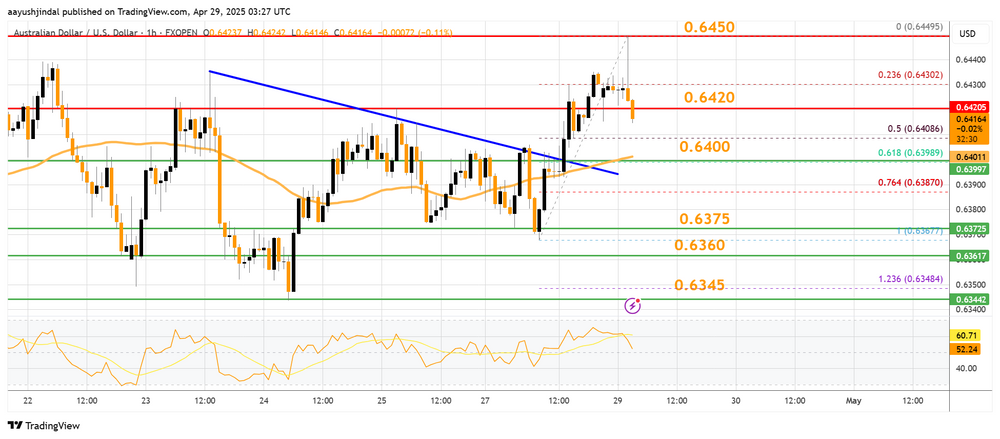
AUDUSD Rallies Ahead of NFP Report
Key Fundamental Factors:
- US Trade Policy:
- President Trump temporarily exempts automakers in Mexico and Canada from tariffs for one month.
- He is also considering removing tariffs on certain agricultural products from both countries.
- Australian Economic Data:
- Trade surplus rose to 5,620 million in January (higher than expected).
- Exports increased 1.3%, reaching an 11-month high, while imports fell 0.3%.
- Building permits surged 6.3%, marking the second month of growth.
- GDP growth in Q4 2024 was 0.6% (higher than expected).
- US Economic Factors:
- The US Dollar (DXY) is at 104.30, struggling due to concerns about slowing growth.
- US job market slowdown: ADP reported 77K new jobs in February (far below the 140K forecast).
- Traders await Friday’s Nonfarm Payrolls (NFP) report, showing 160K job gains.
- US Manufacturing PMI dropped to 50.3 (slightly below expectations).
- China’s Economic Impact:
- China’s Services PMI rose to 51.4, signaling steady economic activity.
- China cleared $530 billion in bad loans and plans to prioritize real estate recovery in 2025.
- China targets 5% economic growth for 2025 while stabilizing the stock and property markets.
- Geopolitical Risks:
- China threatens a strong response to Trump’s tariff hikes, which may affect the Australian dollar due to Australia’s trade reliance on China.
- RBA Deputy Governor Andrew Hauser warns that global trade uncertainty is at a 50-year high, which could impact business and investment confidence.
Key Takeaway for Traders:
- AUDUSD shows short-term bullish momentum but faces resistance near 0.6380 and 0.6408.
- The US Dollar remains under pressure, but economic data (NFP report) could shift sentiment.
- Keep an eye on China’s trade policies and US tariffs, as they could influence AUD’s strength.
AUDUSD – D1 Timeframe
The price recently broke below the previous lows on the daily timeframe chart of AUDUSD, followed by a quick retracement. The retracement has now reached the supply zone and is expected to come under bearish pressure soon. Let’s take a look at the price action on the lower timeframe, though.
AUDUSD – H4 Timeframe
The price action on the 4-hour timeframe chart of AUDUSD falls perfectly in line with the bearish sentiment already described above. In addition to the supply zone occurring at the 88% Fibonacci retracement level, there is also a confluence from the SBR pattern, as highlighted in the 4-hour timeframe chart attached above.
Analyst’s Expectations:
- Direction: Bearish
- Invalidation- 0.64109
- Target- 0.62313
EURUSD Continues to Trend Higher, on Track for the Biggest Weekly Gain in Five Years
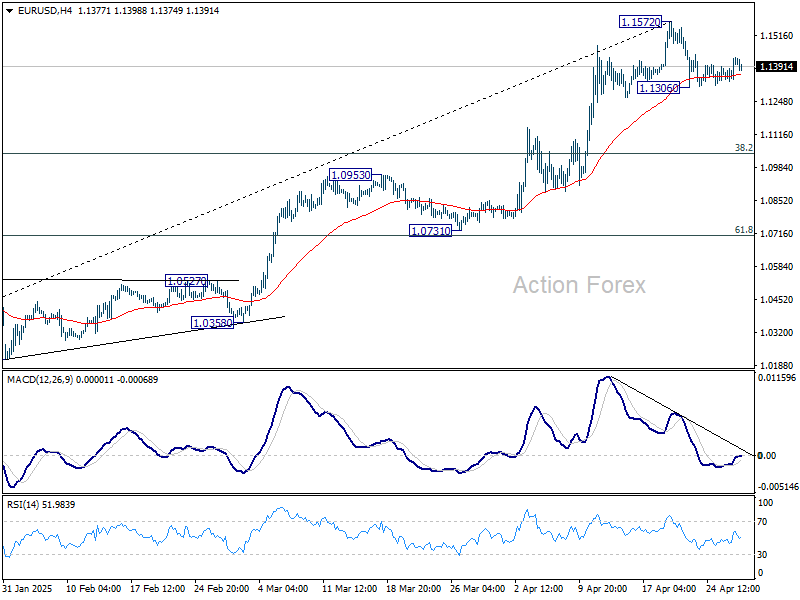
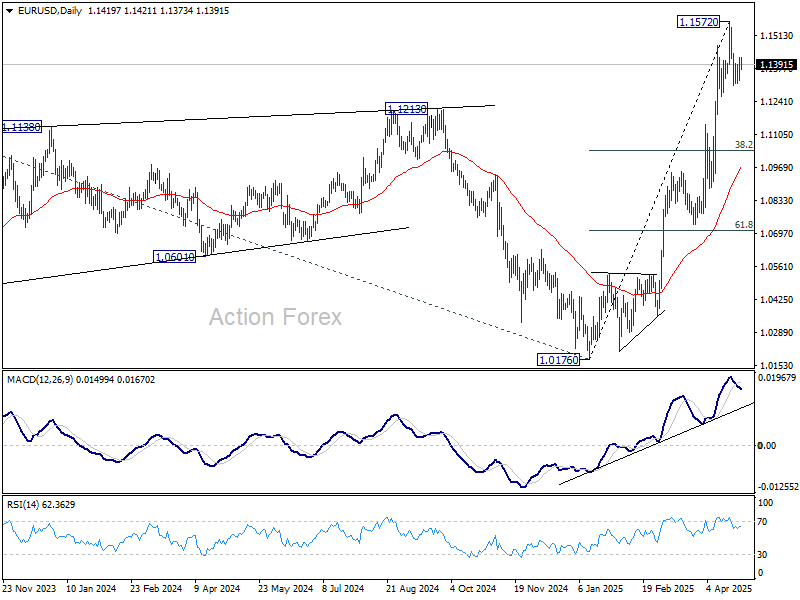
The Euro rose above 1.08 level and hit the highest in four months on Thursday after ECB’s widely expected decision to cut interest rates by 25 bp to 2.5%, in its sixth rate cut since June.
The central bank stated that monetary policy is becoming meaningfully less restrictive and left the door open for further easing, repeating their standard phrase that future action will be depending on the incoming economic data.
The single currency holds in sharp bullish acceleration for the fourth consecutive day, underpinned by weakening dollar and the most significant factor, signals that Germany’s next government is to create a 500 billion euro fund to boost military and revive economic growth of the EU’s largest economy which is in recession for the second year.
The latest sharp rally (EURUSD is on track for the biggest weekly gain since the third week of March 2020) has significantly improved technical picture on daily chart however, overstretched momentum and stochastic indicators suggest that bulls may start losing traction, which would prompt partial profit-taking.
Near-term outlook is expected to remain positive, as the action is underpinned by strongly favorable fundamentals and bullish technical studies, with likely scenario of limited dips (to be ideally contained by 200DMA / broken Fibo 50%) to offer better levels to re-join bullish market for extension towards 1.0872 (200WMA) and 1.0969/1.1000 targets (Fibo 76.4% of 1.1214/1.0177 / psychological) in extension.
Res: 1.0853; 1.0872; 1.0900; 1.0969
Sup: 1.0800; 1.0725; 1.0695; 1.0630
USDJPY Wave Analysis
- USDJPY under bearish pressure
- Likely to fall to support level 146.00
USDJPY currency pair is under bearish pressure after the earlier breakout of the support zone between the support level 148.60 (the former monthly low from December) and the 50% Fibonacci correction of the upward impulse from September.
The breakout of this support zone accelerated the C-wave of the active ABC correction (2) from the start of January.
Given the strongly bullish yen sentiment seen today, USDJPY currency pair can be expected to fall to the next support level 146.00, the target for the completion of the active ABC correction (2).
EURCAD Wave Analysis
- EURCAD broke multi-year resistance 1.5100
- Likely to rise to resistance level 1.5770
EURCAD currency pair is rising sharply after the earlier breakout of the powerful multi-year resistance 1.5100, which has stopped all upward impulses from the start of 2021.
The breakout of the resistance 1.5100 accelerated the short-term impulse wave 3 of the longer-term upward impulse sequence (3) from the end of 2024.
Given the clear multiyear uptrend, EURCAD currency pair can be expected to rise to the next resistance level 1.5770, the former major price barrier from 2020 and the target for the completion of the active weekly impulse wave 3.
ECB Review: ‘Meaningfully Less Restrictive’
- Today the ECB decided to cut the policy rate by 25bp, so the deposit rate now yields 2.50%. The most important part of the decision was its assessment of the restrictiveness of its monetary policy stance. The ECB now sees that monetary policy is ‘becoming meaningfully less restrictive’, which means it assesses that the current rate level is closer to the terminal rate than previously.
- Given the strong uncertainty, Lagarde clearly guided that the data-dependent approach is probably higher than ever, thus there was no guidance or commitment to an April cut. Today’s decision was a consensus, with none opposing, but Holzmann abstained.
- The staff projections lowered the growth forecast for 2025 to 0.9% y/y (down from 1.1%) and 2026 to 1.2% y/y (down from 1.4%). Inflation was revised higher in 2025 to 2.3% from 2.1% due to energy prices, but as futures have since declined, we do not interpret that as a hawkish signal, also reflected by the core inflation forecast being revised down to 2.2% from 2.3%
- Markets have repriced the ECB expectations in recent days, not least following the change to the German fiscal position and spending package. Currently there are almost two additional cuts from the ECB until year-end priced, which is about one cut less than earlier this week.
Disinflation remains on track and the economy faces challenges
Lagarde noted that the disinflation process remains well on track and that the upward revision to the staff 2025 inflation forecast from 2.1% y/y to 2.3% y/y reflected stronger energy prices in January. Energy prices have since declined and the ECB staff also revised down the core inflation forecast for 2025 to 2.2% y/y from 2.3% y/y, so we do not interpret the higher headline forecast as a hawkish signal. The ECB continues to communicate that most measures of underlying inflation and inflation expectations suggest inflation will settle around the 2% target. Thus, for 2025 and 2026 the forecast changes to inflation were minor (see table to the right).
The ECB emphasised that the economy continues to face challenges, leading staff to lower their growth forecasts once more – to 0.9% for 2025 (down from 1.1%), 1.2% for 2026 (down from 1.4%), and 1.3% for 2027. The reductions for 2025 and 2026 are attributable to reduced exports and ongoing weakness in investment, partly due to high trade policy uncertainty and broader policy unpredictability. Increasing real incomes and the gradually fading impact of previous rate hikes remain the key factors underpinning the expected rise in demand over time.
Fiscal easing in Germany and rising EU defence spending not affecting current monetary policy stance
Lagarde noted that most recent data shows that manufacturing activity continued to decline in the first two months of 2025, despite improvements in surveys.
Meanwhile, services are resilient, and a robust labour market supports a gradual rise in consumption, although demand for labour has moderated, and surveys indicate a slowdown in employment growth in January and February. Overall, the risks to the growth outlook are tilted to the downside and Lagarde added tariffs as a downside risk and defence and infrastructure spending as a new upside risk. Lagarde says that impact of German fiscal plans and EU defence spending will depend on the details and that they have not incorporated any impact yet in their monetary policy. She does note, however, that it will be positive growth.
No guidance for April
With the high uncertainty around the near-term risks, Lagarde refrained from committing to any policy decision at the upcoming meetings; in fact, it was not clear whether the ECB intends to cut or halt at the upcoming April meeting based on today’s information. The repetition of the ECB’s data dependence, and probably being more than ever as Lagarde phrased, leads to an increased focus on incoming data and the inflation outlook. Markets took the guidance as marginally hawkish and now price the ECB April meeting at 12bp.
Based on today’s information, we are not as confident about the outlook for the April cut as we were previously. While it remains our baseline scenario, we also point to the significant inflation and activity data (e.g. PMI) as key points. Also, Lagarde’s speech next week at the Watchers conference will be key in our view.
Sunset Market Commentary
Markets
The ECB cut its policy rate as expected by 25 bps with the deposit rate hitting 2.5%. The decision wasn’t unanimous, but there was no opposition neither. Hawkish Austrian ECB governor Holzmann did abstain. In its monetary policy statement, the central bank for the first time emphasizes that monetary policy is becoming meaningfully less restrictive. Updated growth and inflation forecasts are little changed compared with December. The central bank expects inflation to average 2.3% this year, 1.9% in 2026 and 2% in 2027 compared to a 2.1%-1.9%-2.1% path three months ago. The prognosis for core CPI stands at 2.2%-2%-1.9%. The December growth path of 1.1%-1.4%-1.3% was slightly downgraded into 0.9%-1.2%-1.3%. High uncertainty is holding back investments and exports, but services remain resilient. Risks remain tilted to the downside. Throughout the official statement, it was remarkable that the ECB/President Lagarde only mentioned the German U-turn on fiscal spending and European efforts being negotiated on defense spending as an upside inflation risk, not mentioning its potential positive impact on growth. Lagarde stressed the data-dependent and meeting-by-meeting approach from the central bank going forward, not pre-committing to any specific rate path. She acknowledges though the impact of the previous (150 bps) rate cuts and admitted for a first time that if data suggest it, the ECB will pause (in April). EMU money market remain split on the outcome of the next meeting, with our preferred scenario being a skip in the cutting cycle. EUR/USD attempted to sustainably take out 1.0804 resistance around the time of the ECB meeting, but the move lacked strength following earlier gains this week. The USD-side of the equation remains weak though with speeches by Fed Waller (tonight) and Powell (tomorrow) together with US payrolls as wildcards to come. Lack on any specific guidance implied that moves on interest rate markets were still subject to yesterday German fiscal whatever-it-takes pledge by chancellor-to-be Merz. The German yield curve bear steepened again yields rising by 2.7 bps (2-yr) to 10 bps. The German 10-yr yield currently trades at 2.9%, closing in on the 2023 top at 3.03%. Changes on the US yield curve vary between -3 bps (2-yr) and +1 bps (30-yr). US eco data showed a bigger-than-hoped setback in weekly jobless claims (221k from 242k vs 233k expected) and the feared widening of the trade deficit (to a record -$131.4bn) as US companies imported goods before tariffs came into effect. European stock markets still opened positive, but in general slightly return part of yesterday’s impressive gains. US stock markets open up to 2% lower for Nasdaq.
News & Views
Swedish inflation accelerated more than expected. The monthly pace picked up from 0.4% m/m in January to 0.9% in February. The yearly (CPIF) figure print rose from 2.2% to 2.9%. Inflation excluding energy rose by 0.9% m/m to hit 3% on a yearly basis. All of the readings were higher than expectations, including those from the central bank. They help settle the debate whether or not the Riksbank has reached the end of a 175 bps easing cycle. Governor Thedeen has been pretty vocal about the current rate being at an appropriate level of 2.25%. This is also what the latest Riksbank projections show. The Swedish krone extended a recent rally in the wake of the publication before paring the gains later on. In a broader perspective, EUR/SEK (10.96) is trading at the lowest (SEK strongest) level since December 2022. Due to Sweden’s large military capacity, the Swedish crown emerged as the market’s darling since Europe and especially Germany’s turned towards massive defense spending.
The Turkish central bank (CBRT) as expected cut the policy rate from 45% to 42.5% today. Annual headline inflation eased from 42.1% to 39% in February. The underlying gauge of inflation resumed its decline in February after picking up in January. Based on domestic demand measures, the central bank is confident this disinflationary trend will continue. The CBRT is paying close attention to still elevated inflation expectations though, saying they continue to pose risks to the disinflation process. As a result, “the tight monetary stance will be maintained until price stability is achieved via a sustained decline in inflation.” The CBRT refrained from official guidance and sticks to a meeting-by-meeting approach instead. The Turkish lira trades little changed in a daily perspective, both against EUR (39.41) and USD (36.42).
Canadian Trade Surplus Widened Significantly in January
Canada's merchandise trade balance widened from a revised $1.7 billion in December to $4.0 billion in January. This marked the largest surplus since May 2022.
Merchandise exports jumped 5.5% month-on-month (m/m), following a 6% monthly gain in December. Exports of motor vehicles and parts (+12.5% m/m) jumped, while shipments of energy products (4.8% m/m), consumer goods (+7.8% m/m) and industrial machinery, equipment and parts (12.6% m/m) added to the headline gain.
Merchandise imports also moved higher in January (+2.3% m/m), bolstered by a surge in imports of aircraft and other transportation equipment and parts (23.6% m/m). Imports of electronic and electric equipment and parts (+5.8% m/m) and energy products (+8.5% m/m) also made significant contributions.
In volume terms, merchandise exports rose by 4.5% m/m while imports increased by 1.5% m/m.
Canada's merchandise trade surplus with the United States widened to $14.4 billion in January from $12.3 billion the month prior. Amid the threat of tariffs, exports to the U.S. surged 7.5% m/m while imports increased 4.5% m/m.
Key Implications
The strength in exports shown in January reflected companies attempting to stockpile inventories ahead of the imposition of tariffs. This dynamic could lift exports in February as well but may fade thereafter.
Trade data is often subject to heavy revisions, and we only have hard data for the first month of the quarter. That said, January's stronger growth in export volumes compared to imports points to a significant contribution (of 1 ppt or more) to Q1 real GDP growth from net trade.
Canada's export outlook has soured amid the Canada-U.S. tariff war and the recent 30-day pause on auto sector tariffs does little to remove uncertainty for this industry. Indeed, the negative impact on U.S. bound shipments will be one of the primary channels through which Canada's economy is harmed. A weak Canadian dollar could provide some offset, although would add to tariff-related inflation pressures for Canadians.
Euro Holds Gains After ECB Cut, Yen Rallies on Higher JGB Yields
Euro remained firm following ECB’s decision to cut interest rates, a widely anticipated move. During the subsequent press conference, President Christine Lagarde emphasized a shift to “more evolutionary approach” to policy, now that monetary conditions have become “meaningfully less restrictive.” She also acknowledged the high levels of uncertainty, noting that “risks are all over.”
Lagarde welcomed Germany and the EU’s proposed defense and infrastructure investments, highlighting that they could offer broad support for European growth. However, she also cautioned that increased government spending might push inflation higher via rising aggregate demand. At the same time, ECB recognizes downside risks to the economy, particularly if trade tensions escalate, thereby dampening exports and threatening global growth.
Meanwhile, Yen resumed its recent rally against Dollar and recovered against European majors. Support for Yen came from an upswing in Japan’s 10-year JGB yield, which briefly touched 1.515%, its highest level since June 2009. Expectations of another BoJ rate hike this year have fueled speculation, while Germany’s surging benchmark yield also exerts upward pressure on Japan’s yield.
In contrast, U.S. yields are struggling under the weight of growing worries about a “Trumpcession.” Investors fear that the administration’s trade policies could tip the economy toward recession, softening expectations for robust growth and keeping Treasury yields in check. This dynamic contrasts sharply with Europe and Japan, where yields jumped notably this week.
Against this backdrop, Yen stands as the strongest performer for the day so far, followed by Swiss franc and then Euro. Canadian Dollar has taken the opposite position, emerging as the worst performer, trailed by Sterling and Dollar. Australian and New Zealand Dollars are in the middle of the pack.
In Europe, at the time of writing, FTSE is down 01.05%. DAX is up 0.63%. CAC is down -0.30%. UK 10-year yield is up 0.008 at 4.656. Germany 10-year yield up 0.101 at 2.892. Earlier in Asia, Nikkei rose 0.82%. Hong Kong HSI rise 2.47%. China Shanghai SSE rose 0.78%. Singapore Strait Times rose 0.66%. Japan 10-year JGB yield rose 0.053 to 1.499.
US initial jobless claims fall to 221k, vs exp 236k
US initial jobless claims fell -21k to 221k in the week ending March 1, below expectation of 236k. Four-week moving average of initial claims rose 250 to 224k.
Continuing claims rose 42k to 1897k in the week ending February 22. Four-week moving average of continuing claims rose 3k to 1866k.
ECB cuts 25bps as expected, not pre-committing to rate path
ECB cut its deposit rate by 25bps to 2.50% as expected. It maintains a data-dependent stance and stressing it is “not pre-committing to a particular rate path” amid rising uncertainty.
ECB noted that disinflation process remains on track, with inflation upgrade reflects stronger energy prices. Growth forecasts for 2025 and 2026 were downgraded due to weaker exports and investment, driven partly by trade and broader policy uncertainty.
In the new economic projections:
- Headline inflation to average 2.3% in 2025, 1.9% in 2026, and 2.0% in 2027.
- Core inflation to average 2.2% in 2025, 2.0% in 2026, and 1.9% in 2027.
- GDP to grow 0.9% in 2025, 1.2% In 2026, and 1.3% in 2027.
Eurozone retail sales fall -0.3% mom in Jan, EU down -0.2% mom
Eurozone retail sales volume dropped by -0.3% mom in January, missing expectations of a modest 0.1% mom increase. The decline was driven by weaker demand for non-food products, which fell -0.7% mom, while sales of automotive fuel also slipped by -0.3% mom. In contrast, spending on food, drinks, and tobacco rose by 0.6% mom, offering a slight offset to the overall decline.
Meanwhile, retail sales across the broader EU fell -0.2% mom on the month. Among individual EU, Slovakia saw the sharpest contraction, with retail trade volume plunging -9.0%, followed by Lithuania (-4.8%) and Cyprus (-2.2%). On the other hand, Slovenia (+2.3%), Hungary (+2.2%), and the Netherlands (+1.6%) recorded the strongest increases.
USD/JPY Mid-Day Outlook
Daily Pivots: (S1) 148.12; (P) 149.15; (R1) 149.91; More...
Intraday bias in USD/JPY is back on the downside with break of 148.08 temporary low. Fall from 158.86, as the third leg of the corrective pattern from 161.94 high, has resumed. Sustained break of 61.8% retracement of 139.57 to 158.86 at 146.32 will pave the way back to 139.57 low. On the upside, 149.32 minor resistance will turn intraday bias neutral and bring consolidations again, before staging another fall.
In the bigger picture, price actions from 161.94 are seen as a corrective pattern to rise from 102.58 (2021 low). In case of another fall, strong support should be seen from 38.2% retracement of 102.58 to 161.94 at 139.26 to bring rebound. However, sustained break of 139.26 would open up deeper medium term decline to 61.8% retracement at 125.25.