Sample Category Title
USD/JPY Daily Outlook
Daily Pivots: (S1) 140.44; (P) 141.05; (R1) 142.22; More...
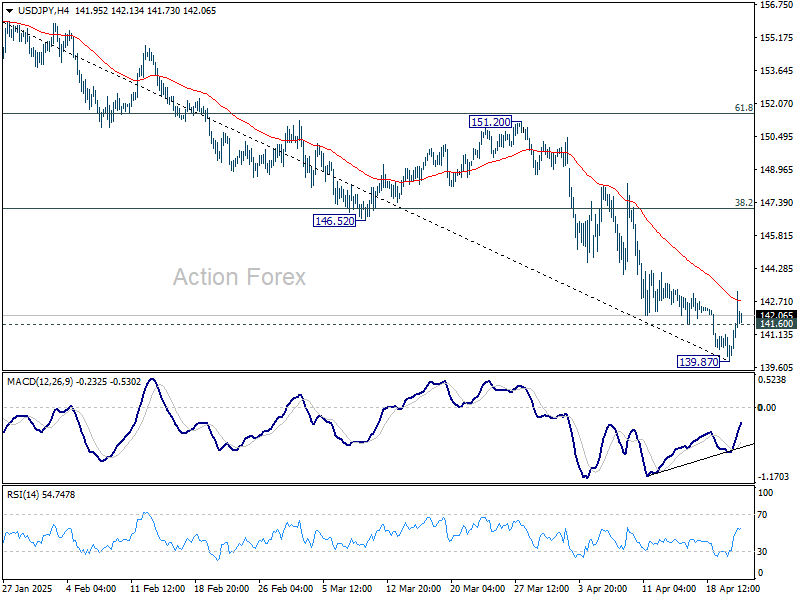
USD/JPY's break of 141.60 minor resistance suggests short term bottoming at 139.87, on bullish convergence condition in 4H MACD, ahead of 139.26/57 key support zone. Intraday bias is back on the upside for stronger rebound. However, risk will stay on the downside as long as 38.2% retracement of 158.86 to 139.87 at 147.12 holds. On the downside, decisive break of 139.26 will carry larger bearish implications.
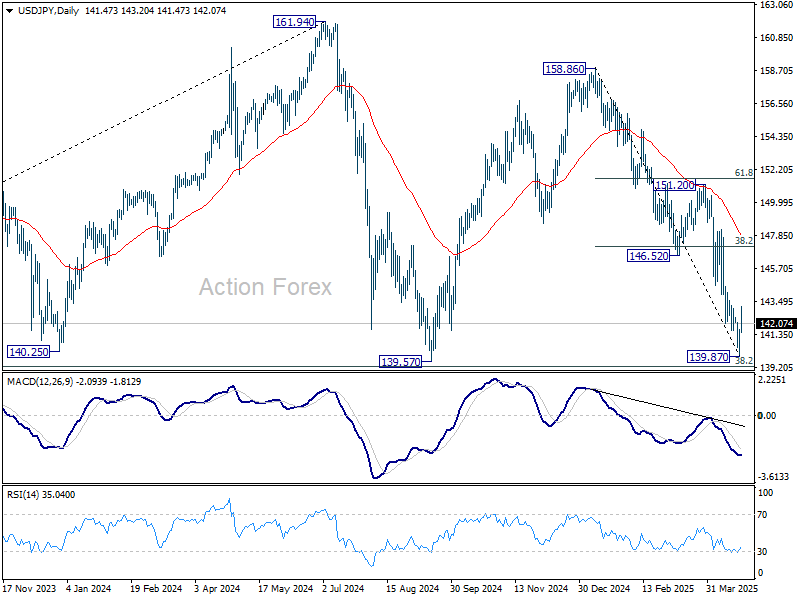
In the bigger picture, price actions from 161.94 are seen as a corrective pattern to rise from 102.58 (2021 low), with fall from 158.86 as the third leg. Strong support should be seen from 38.2% retracement of 102.58 to 161.94 at 139.26 to bring rebound. However, sustained break of 139.26 would open up deeper medium term decline to 61.8% retracement at 125.25.
USD/CHF Daily Outlook
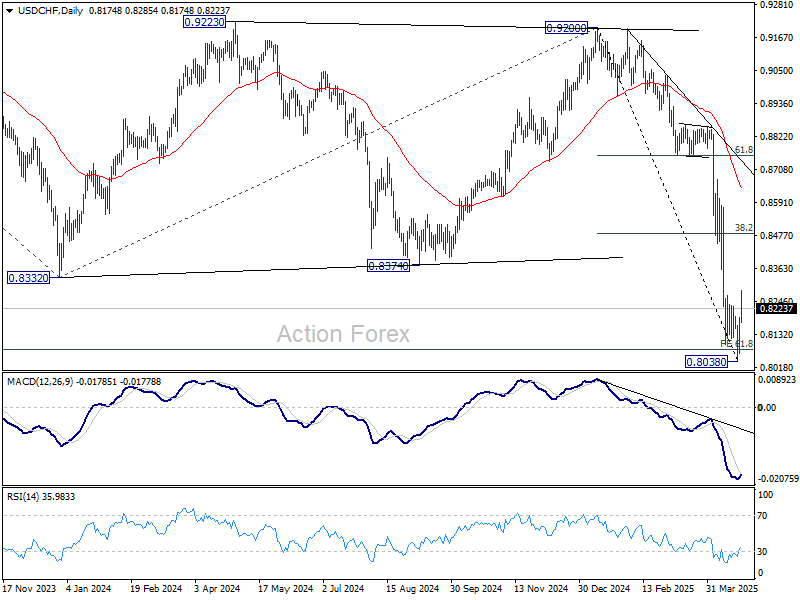
Daily Pivots: (S1) 0.8106; (P) 0.8149; (R1) 0.8233; More…
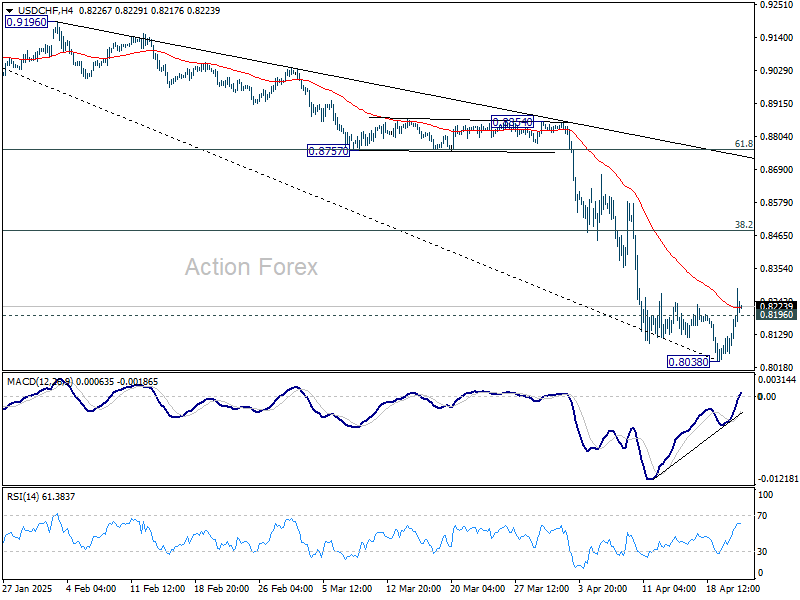
USD/CHF's break of 0.8196 minor resistance suggests short term bottoming at 0.8038, on bullish convergence condition in 4H MACD. Intraday bias is back on the upside for stronger recovery to 38.2% retracement of 0.9200 to 0.8038 at 0.8482. Strong resistance should be seen there to limit upside. On the downside, break of 0.8038 will resume larger down trend.
In the bigger picture, long term down trend from 1.0342 (2017 high) is still in progress and met 61.8% projection of 1.0146 (2022 high) to 0.8332 from 0.9200 at 0.8079 already. In any case, outlook will stay bearish as long as 55 W EMA (now at 0.8794) holds. Sustained break of 0.8079 will target 100% projection at 0.7382.
Markets Rebound as Trump Softens on Tariffs and Powell, Risk Sentiment Regains Ground
US stock staged a strong rebound overnight, erasing all of Monday’s steep losses as risk sentiment recovered on signs of potential de-escalation in US-China trade conflicts. The sharp reversal in equities was driven by multiple headlines suggesting a thaw in relations, including comments from US Treasury Secretary Scott Bessent and President Donald Trump that tariffs may soon come down. The recovery extended into Asian markets, with relief spreading after Trump also backed away from threats to fire Fed Chair Jerome Powell.
In a closed-door meeting with investors, Bessent reportedly said he expects “a de-escalation” in the trade standoff with China in the “very near future,” acknowledging that the current tariff regime—now as high as 145% on Chinese goods—is unsustainable. “We have an embargo now, on both sides, right?” he added, highlighting the urgency to reach a deal. Trump echoed that tone during a press conference in the Oval Office, stating that the current tariff rates “won’t be that high” and expressing optimism that an agreement with Beijing could be reached “pretty quickly.” He also pledged not to “play hardball” during the negotiations, a marked shift in tone from recent weeks.
In another positive turn for market stability, Trump publicly backed off from his threat to remove Fed Chair Powell. “No, I have no intention of firing him,” he told reporters, although he reiterated his preference for interest rate cuts. The reversal comes just days after sharp market losses partly triggered by growing concerns over Fed independence. Markets took the remarks in stride, viewing them as a sign that political pressure may ease for now, and that the central bank will retain the space to operate without further direct confrontation from the White House.
In currency markets, Swiss Franc is currently the week’s weakest performer, followed by the Euro and Sterling. On the stronger side, Kiwi leads, with Aussie and Loonie also firming. Dollar, which rebounded notably, and Japanese Yen are holding in the middle of the pack.
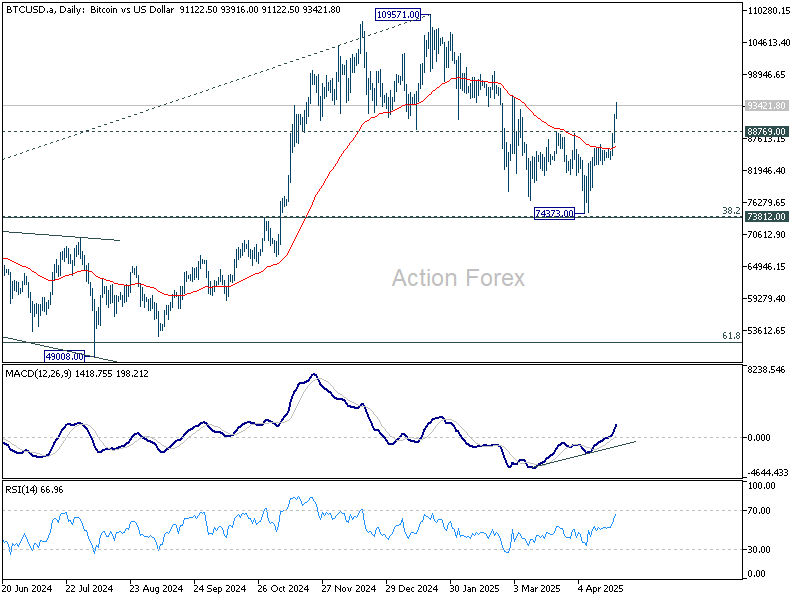
Technically, Bitcoin’s rebound from the 74,373 level gathered momentum a decisive break through 88,769 resistance. This move suggests that the correction from the 109,571 high may have already completed at the 73,812 cluster support area. While it's still early to confirm a full resumption of the long-term uptrend, the rally may signal an early return of risk-on sentiment. A retest of 109,571 peak appears likely as bullish momentum rebuilds.
Looking ahead, Eurozone will release PMI flash and trade balance. UK will also release PMI flash. Later in the day, US will release PMI flash and new home sales, as well as Fed's Beige Book economic report.
In Asia, at the time of writing, Nikkei is up 1.72%. Hong Kong HSI is up 2.61%. China Shanghai SSE is up 0.10%. Singapore Strait Times is up 1.05%. Japan 10-year JGB yield is up 0.012 at 1.324. Overnight, DOW rose 2.66%. S&P 500 rose 2.51%. NASDAQ rose 2.71%. 10-year yield fell -0.016 to 4.389.
Japan’s PMI composite rises to 51.1, service leads while manufacturing drags
Japan’s flash PMI data for April signaled a return to growth in the private sector, with Composite PMI rising from 48.9 to 51.1. The recovery was driven primarily by a rebound in the services sector, where activity rose to 52.2 from 50.0. Meanwhile, manufacturing remained in contraction, though the pace of decline eased slightly, with the PMI inching up from 48.4 to 48.5.
According to S&P Global’s Annabel Fiddes, the divergence between sectors reflected subdued factory output versus strengthening service demand.
A closer look at new business trends revealed further divergence. Manufacturers reported the sharpest drop in new orders in over a year, driven by falling foreign demand and persistent concerns over tariffs and client spending. In contrast, service providers saw their strongest rise in new work since January.
Still, inflationary pressures were strong across the board, with input costs rising at the fastest pace in two years, prompting firms to pass on those costs to customers via higher selling prices.
Overall optimism for output over the next year fell to its lowest level since August 2020, during the early phase of the COVID-19 crisis.
Australia’s PMI composite dips to 51.4, cost pressures emerge
Australia’s flash PMI data for April showed continued, albeit slower, expansion in the private sector, with Manufacturing PMI slipping from 52.1 to 51.7 and Services PMI easing from 51.6 to 51.4. The Composite PMI also declined slightly from 51.6 to 51.4.
Despite the modest pullback, S&P Global’s Jingyi Pan noted that domestic demand remained a "strong proponent" of business activity, supporting further job creation across sectors. The data suggests a solid start to Q2, underpinned by internal momentum, even as external headwinds mount.
However, the impact of US tariffs are starting to show. Export performance weakened, and manufacturers reported "intensification of cost pressures" due to currency fluctuations.
In response, many firms passed on higher costs to clients, pushing overall selling price inflation to a nine-month high.
Fed’s Kugler stresses caution amid tariff shock and inflation risks
Fed Governor Adriana Kugler said in a speech that she supports holding interest rates steady as long as upside inflation risks persist, provided that economic activity and employment remain stable.
Kugler noted that the current policy stance is "well positioned" to adapt to evolving macroeconomic conditions, but emphasized the need for caution given the increasing complexity of the outlook.
She highlighted a significant rise in uncertainty, pointing to a dual threat: upward pressure on inflation and downside risks to employment.
The recent escalation in tariffs, described as "significantly larger" than previously expected, has heightened concerns about both growth and price stability.
Kugler warned that "the economic effects of tariffs and the associated uncertainty are also likely to be larger than anticipated."
Fed's Kashkari warns of policy dilemma amid tariff tensions and market strains
Minneapolis Fed President Neel Kashkari said overnight that it's "too soon" to determine the future path of US interest rates. While he acknowledged that tariffs alone may not necessarily reignite persistent inflation, he emphasized that Fed cannot dismiss the risk, especially given the still-elevated price levels in recent months.
At the same time, Kashkari noted that tariffs are likely to weigh on growth, creating a policy dilemma: Fed cannot simultaneously counter rising inflation and rising unemployment without making difficult trade-offs.
Kashkari highlighted that the growing uncertainty surrounding US trade policy is compounding the challenge. While resolution could come quickly if negotiations succeed, the current lack of clarity is already deterring both consumer and business activity.
Adding to the complexity, Kashkari pointed to additional pressure from a weakening dollar and rising Treasury yields, as global investors begin to question the attractiveness of US assets.
“If we're no longer the economy that investors around the world say, hey, this is the preeminent competitive economy,” he cautioned, “then we probably have less runway.”
USD/CHF Daily Outlook
Daily Pivots: (S1) 0.8106; (P) 0.8149; (R1) 0.8233; More…
USD/CHF's break of 0.8196 minor resistance suggests short term bottoming at 0.8038, on bullish convergence condition in 4H MACD. Intraday bias is back on the upside for stronger recovery to 38.2% retracement of 0.9200 to 0.8038 at 0.8482. Strong resistance should be seen there to limit upside. On the downside, break of 0.8038 will resume larger down trend.
In the bigger picture, long term down trend from 1.0342 (2017 high) is still in progress and met 61.8% projection of 1.0146 (2022 high) to 0.8332 from 0.9200 at 0.8079 already. In any case, outlook will stay bearish as long as 55 W EMA (now at 0.8794) holds. Sustained break of 0.8079 will target 100% projection at 0.7382.
Japan’s PMI composite rises to 51.1, service leads while manufacturing drags
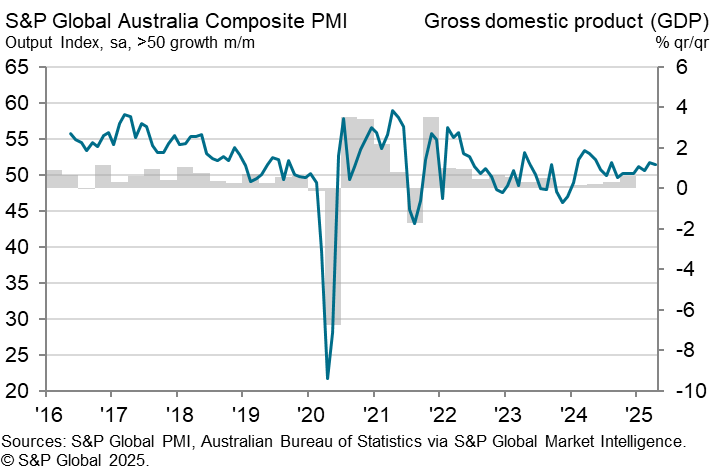
Japan’s flash PMI data for April signaled a return to growth in the private sector, with Composite PMI rising from 48.9 to 51.1. The recovery was driven primarily by a rebound in the services sector, where activity rose to 52.2 from 50.0. Meanwhile, manufacturing remained in contraction, though the pace of decline eased slightly, with the PMI inching up from 48.4 to 48.5.
According to S&P Global’s Annabel Fiddes, the divergence between sectors reflected subdued factory output versus strengthening service demand.
A closer look at new business trends revealed further divergence. Manufacturers reported the sharpest drop in new orders in over a year, driven by falling foreign demand and persistent concerns over tariffs and client spending. In contrast, service providers saw their strongest rise in new work since January.
Still, inflationary pressures were strong across the board, with input costs rising at the fastest pace in two years, prompting firms to pass on those costs to customers via higher selling prices.
Overall optimism for output over the next year fell to its lowest level since August 2020, during the early phase of the COVID-19 crisis.
Australia’s PMI composite dips to 51.4, cost pressures emerge
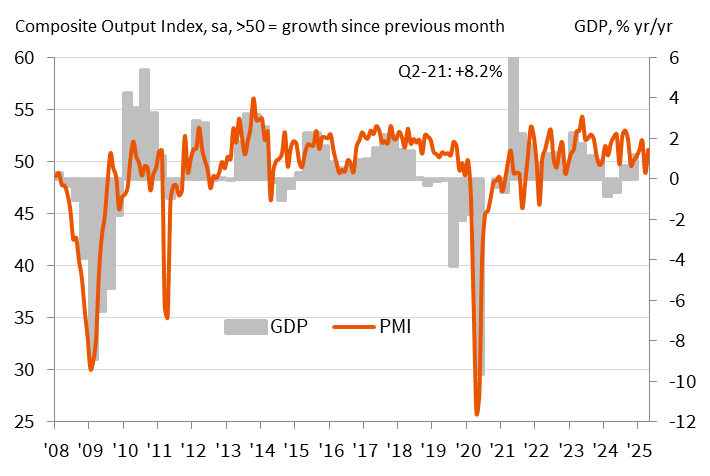
Australia’s flash PMI data for April showed continued, albeit slower, expansion in the private sector, with Manufacturing PMI slipping from 52.1 to 51.7 and Services PMI easing from 51.6 to 51.4. The Composite PMI also declined slightly from 51.6 to 51.4.
Despite the modest pullback, S&P Global’s Jingyi Pan noted that domestic demand remained a "strong proponent" of business activity, supporting further job creation across sectors. The data suggests a solid start to Q2, underpinned by internal momentum, even as external headwinds mount.
However, the impact of US tariffs are starting to show. Export performance weakened, and manufacturers reported "intensification of cost pressures" due to currency fluctuations.
In response, many firms passed on higher costs to clients, pushing overall selling price inflation to a nine-month high.
Fed’s Kugler stresses caution amid tariff shock and inflation risks
Fed Governor Adriana Kugler said in a speech that she supports holding interest rates steady as long as upside inflation risks persist, provided that economic activity and employment remain stable.
Kugler noted that the current policy stance is "well positioned" to adapt to evolving macroeconomic conditions, but emphasized the need for caution given the increasing complexity of the outlook.
She highlighted a significant rise in uncertainty, pointing to a dual threat: upward pressure on inflation and downside risks to employment.
The recent escalation in tariffs, described as "significantly larger" than previously expected, has heightened concerns about both growth and price stability.
Kugler warned that "the economic effects of tariffs and the associated uncertainty are also likely to be larger than anticipated."
Fed’s Kashkari warns of policy dilemma amid tariff tensions and market strains
Minneapolis Fed President Neel Kashkari said overnight that it's "too soon" to determine the future path of US interest rates. While he acknowledged that tariffs alone may not necessarily reignite persistent inflation, he emphasized that Fed cannot dismiss the risk, especially given the still-elevated price levels in recent months.
At the same time, Kashkari noted that tariffs are likely to weigh on growth, creating a policy dilemma: Fed cannot simultaneously counter rising inflation and rising unemployment without making difficult trade-offs.
Kashkari highlighted that the growing uncertainty surrounding US trade policy is compounding the challenge. While resolution could come quickly if negotiations succeed, the current lack of clarity is already deterring both consumer and business activity.
Adding to the complexity, Kashkari pointed to additional pressure from a weakening dollar and rising Treasury yields, as global investors begin to question the attractiveness of US assets.
“If we're no longer the economy that investors around the world say, hey, this is the preeminent competitive economy,” he cautioned, “then we probably have less runway.”
Bitcoin Ignites Upside Push – Can It Blaze Past $95K?
Key Highlights
- Bitcoin price started a steady increase above the $90,000 resistance.
- BTC cleared a key contracting triangle with resistance at $85,300 on the 4-hour chart.
- Ethereum price rallied over 10% and must clear the $1,800 resistance to continue higher.
- Gold surged to set a record high at $3,500 before it corrected some gains.
Bitcoin Price Technical Analysis
Bitcoin price started a recovery wave above the $80,000 zone against the US Dollar. BTC was able to surpass the $82,000 and $85,000 resistance levels.
Looking at the 4-hour chart, the price settled above the $90,000 level, the 100 simple moving average (red, 4-hour), and the 200 simple moving average (green, 4-hour). It cleared a key contracting triangle with resistance at $85,300.
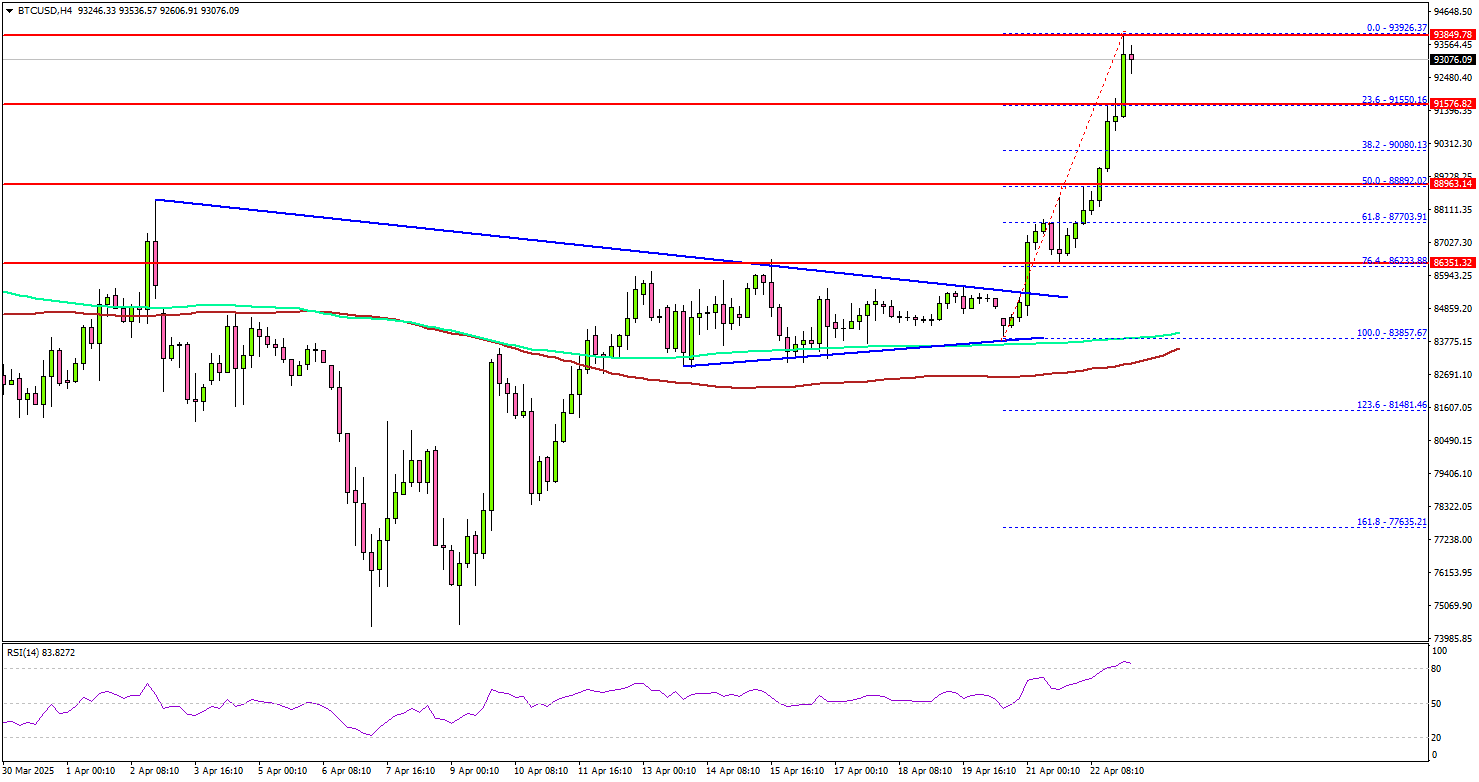
The bulls even pumped BTC above the $92,000 resistance zone. On the upside, the price could face resistance near the $94,200 level.
The next key resistance is $94,500. The main resistance could be $95,000. A successful close above $95,000 might start another steady increase. In the stated case, the price may perhaps rise toward the $98,000 level. Any more gains might call for a test of $100,000.
Immediate support is near the $91,500 level. The next key support sits at $90,000. A downside break below $90,000 might send Bitcoin toward the $88,000 support. Any more losses might send the price toward the $86,200 support zone.
Looking at Ethereum, there was a recovery wave, but ETH must settle above the $1,800 resistance zone to move into a short-term bullish zone.
Today’s Economic Releases
- Euro Zone Manufacturing PMI for April 2025 (Preliminary) – Forecast 47.5, versus 48.6 previous.
- Euro Zone Services PMI for April 2025 (Preliminary) – Forecast 50.5, versus 51.0 previous.
- US Manufacturing PMI for April 2025 (Preliminary) – Forecast 49.4, versus 50.2 previous.
- US Services PMI for April 2025 (Preliminary) – Forecast 52.8, versus 54.4 previous.
ETHUSD Elliott Wave : Forming the ((c)) Leg of a Potential Zig-Zag Pattern
Hello fellow traders. In this technical article, we are going to present another Elliott Wave charts of Ethereum ETHUSD. The crypto ended cycle from the 2104.3 peak and now correcting it. In the following sections, we will delve into the specifics of the Elliott Wave pattern.
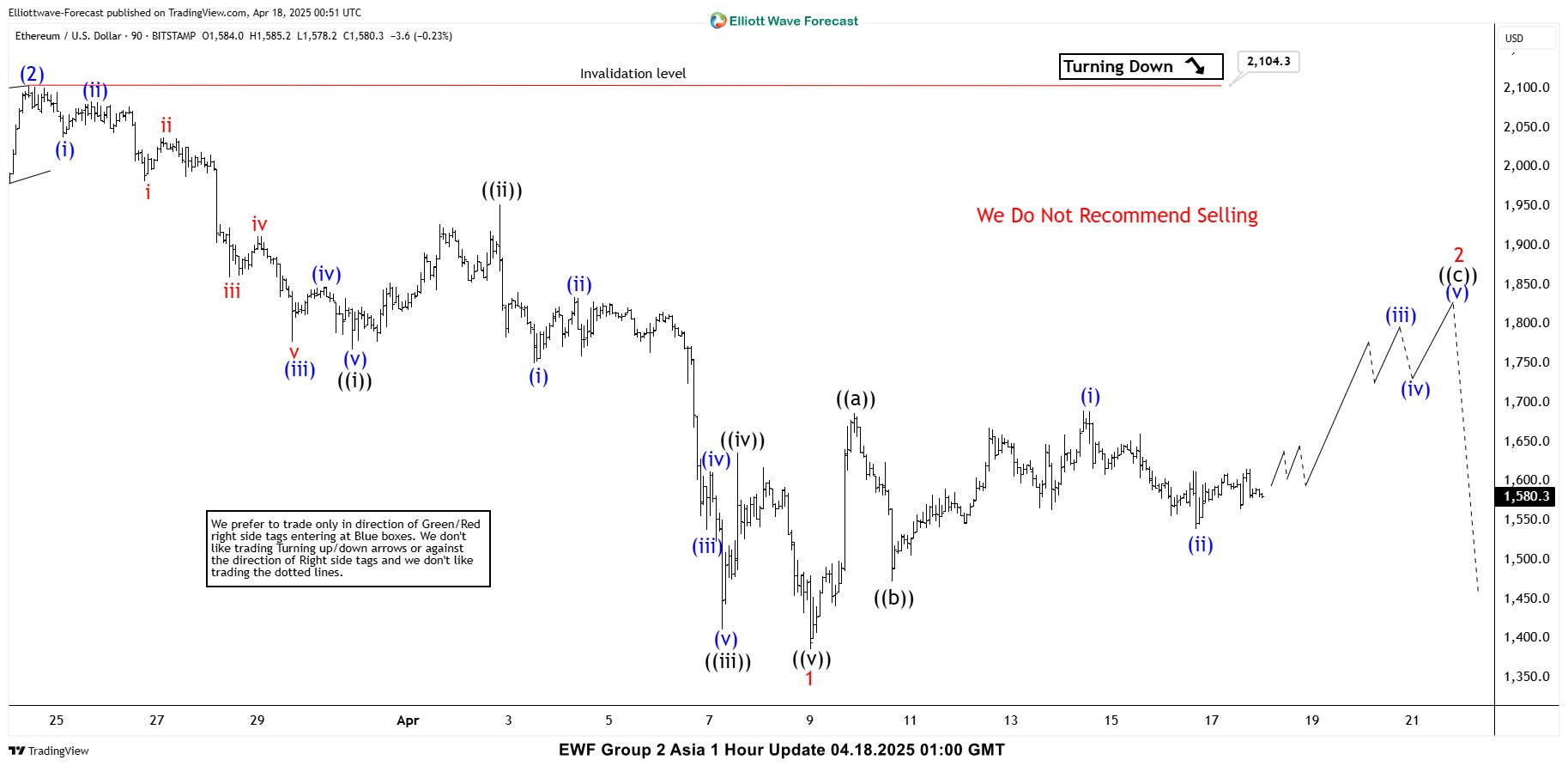
ETHUSD Elliott Wave 1 Hour Chart 04.18.2025
The current analysis suggests that ETHUSD is forming a wave 2 red recovery. The correction is incomplete at the moment, we expect another leg up. As far as the price stays above 1537.8 low toward 1775 -1847 area .
90% of traders fail because they don’t understand market patterns. Are you in the top 10%? Test yourself with this advanced Elliott Wave Test
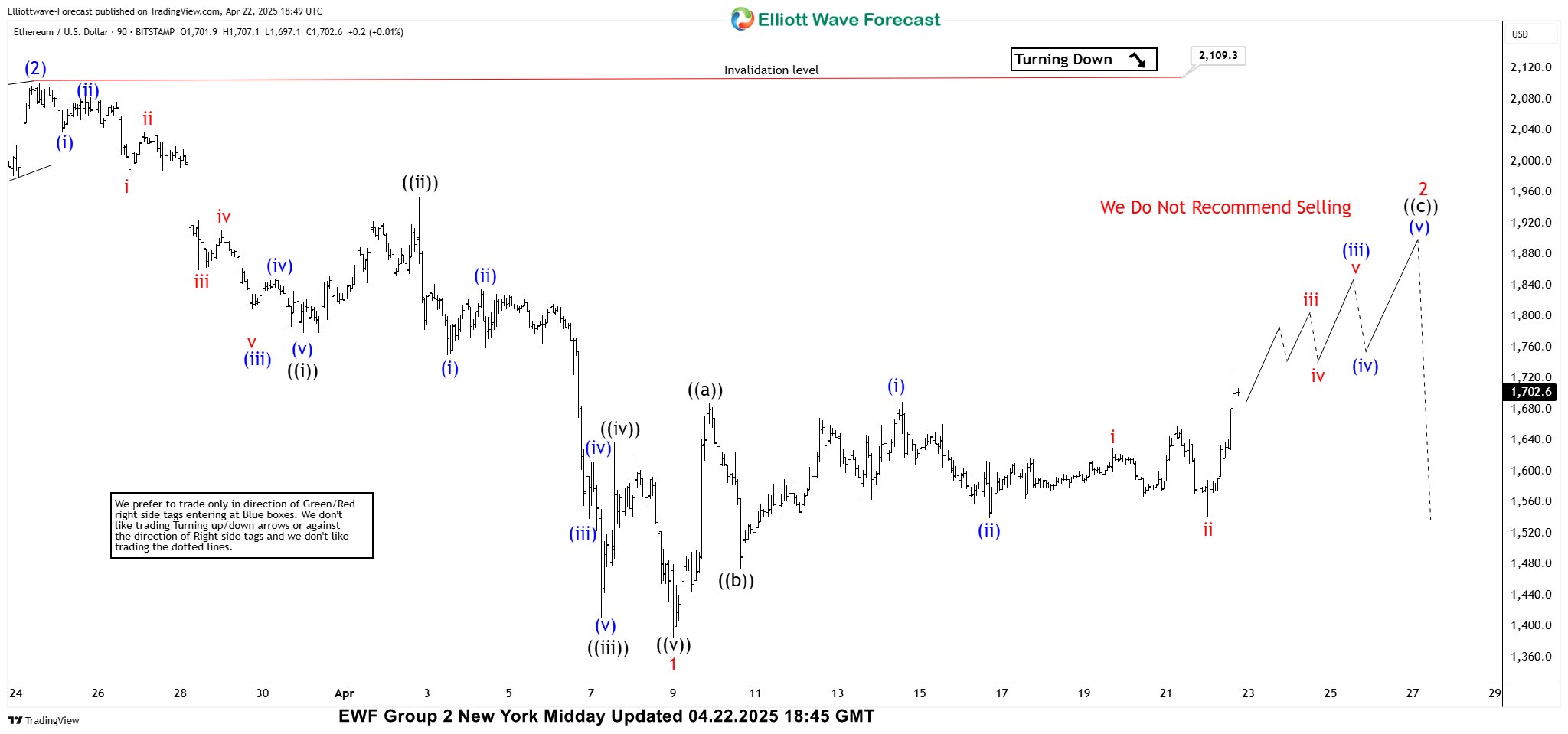
ETHUSD Elliott Wave 1 Hour Chart 04.22.2025
The crypto held above the 1537.8 low and continued to rally, as expected. The price is ideally heading toward our first target area at 1775. We do not recommend selling the crypto at this time. However, keep in mind that the cycle from the December 2024 peak still appears incomplete. Therefore, as long as the 2105 pivot holds, further downside could follow once the current correction is complete.
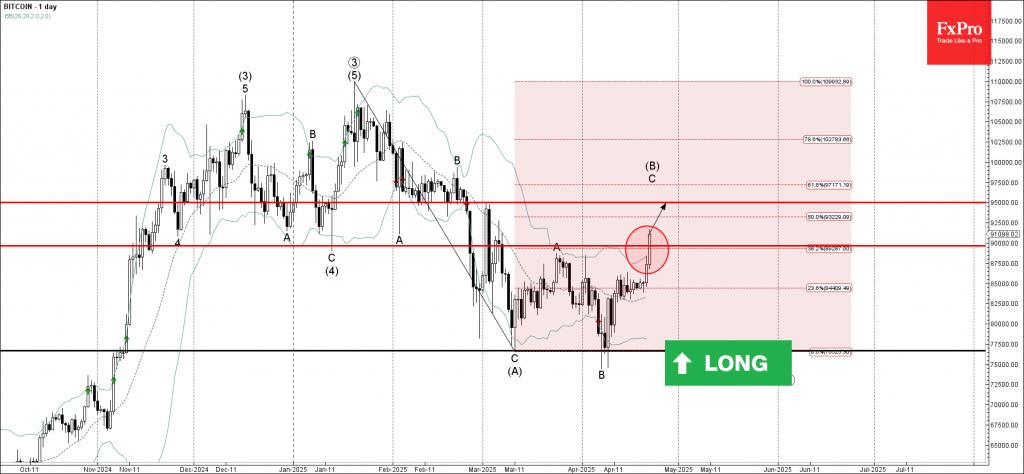
Bitcoin Wave Analysis
Bitcoin: ⬆️ Buy
- Bitcoin broke round resistance level 90000.00
- Likely to rise to resistance level 95000.00
Bitcoin cryptocurrency today broke the resistance area between the round resistance level 90000.00 and the 38.2% Fibonacci correction of the downward wave (A) from January.
The breakout of this resistance area should accelerate the C-wave of the active ABC correction (B) from March.
Bitcoin cryptocurrency can be expected to rise in the active C-wave to the next resistance level 95000.00 (former strong resistance from the start of March).