Thu, Apr 09, 2026 18:35 GMT
More

    Sample Category Title

    US: Retail Sales Decline in January  

    TD Bank Financial Group

    Following a string of strong gains in the prior three months, retail and food services sales declined 0.9% month-on-month (m/m) in January. This was worse than the consensus forecast, which called for a decline of 0.2% m/m. However, December's figures were revised higher to 0.7% m/m (previously 0.4% m/m).

    Vehicle and parts sales were a substantial a drag on the headline (-2.8% m/m), with sales shifting in reverse following a string of strong gains at the end of last year. Sales at gasoline stations advanced by 0.9%, largely due to higher prices at the pump. Sales at building materials and equipment stores fell 1.3% m/m, posting a fourth consecutive monthly decline.

    Sales in the "control group", which the excludes volatile components above (i.e., gasoline, autos and building supplies) and is used in the estimate of personal consumption expenditures (PCE), also fell (-0.8% m/m), following a 0.9% gain in December.

    Sales were weak across most brick-and-mortar retailers, with the largest declines seen in furniture and home furnishing stores (-1.7% m/m) and sporting goods and hobby stores (-4.6% m/m). Only general merchandise stores (+0.5%) and miscellaneous retailers (+0.2%) bucked the trend and posted small gains.

    In contrast, sales in bars and restaurants fared better, rising 0.9% after a soft reading in December.

    Key Implications

    It appears that consumers hit the pause button on shopping in January. Auto sales weighed heavily on the headline, following a jump in demand late last year. This was likely driven by an increase in replacement demand following the Hurricanes Helene and Milton. However, the breadth of pullback in sales activity suggests that inclement weather and the wildfires in California could have also contributed to the slower pace of spending in January – suggesting we should see some giveback in the months ahead.

    Broadly speaking, households balance sheets remain healthy, supported by a large pile of household wealth and some nascent signs that delinquencies on credit cards and auto loans are levelling off. However, inflation remains a hot button for consumers, not helped by the ongoing uncertainty on the potential implications of the looming tariffs. While one month doesn't make a trend, the slower start to the year suggests Q1 spending could be closer to 2.5% annualized (down from our prior estimate of 3.0%).

    Swiss Franc Soars as Trump Pushes Off Tariffs

    The Swiss franc has steadied on Friday after sliding 1.1% a day earlier. In the European session, USD/CHF is trading at 0.9016, down 0.16% on the day.

    The US dollar beat a hasty retreat against the major currencies on Thursday, after the White House announced that the US would not impose reciprocal tariffs before April 1. There had been fears that Trump would impose the levies on Feb. 13 and the announcement brought relief to the financial markets and raised risk sentiment, sending the US dollar sharply lower.

    Switzerland’s inflation rate falls to 0.4%

    Switzerland’s inflation rate dipped to 0.4% y/y in January, down from 0.6% in December and in line with the market estimate. This was the lowest annual inflation level since April 2021, as key sub-categories posted a decrease in prices, including food, clothing and services. Monthly, CPI remained at -0.1% for a fourth consecutive month and matched expectations. The Swiss National Bank is watching with concern as inflation continues to decline. The Bank’s target band is between 0% and 2% and it could hike rates in March if inflation falls closer to 0%.

    In the US, the Producer Price Index showed little change in January. PPI rose 0.4% m/m after an upwardly revised 0.5% gain in December. This was higher than the market estimate of 0.3%. Annually, PPI rose 3.5%, unchanged from an upwardly revised 3.5% gain in December and above the market estimate of 3.2%.

    The US wraps up the week with the January retail sales report. The markets are bracing for a soft release, with a market estimate of -0.1%, after the 0.4% gain in December. Annually, retail sales are expected to dip to 3.7%, after a 3.9% gain in December.

    USD/CHF Technical

    • USD/CHF is testing support at 0.9026. Below, there is support at 0.9004
    • 0.9041 and 0.9063 are the next resistance lines

    NZ Dollar Extends Gains After Strong Mfg. Data

    The New Zealand dollar continues to rally on Friday. NZD/USD is trading at 0.5702 in the European session, up 0.43% on the day.

    Manufacturing PMI unexpectedly expands

    New Zealand’s Manufacturing PMI rose to 51.4 in January, up sharply from the December reading of 45.9 and above the market estimate of 46.0. This was a milestone reading as it marked the first expansion in almost two years and was the highest level since September 2022. All key sub-categories posted growth, including new orders, production and employment.

    The manufacturing sector has started the year on a high note but the outlook for 2025 remains cloudy. Global demand has been weak and China, New Zealand’s largest export market, is experiencing a bumpy post-Covid recovery. Still, there are some bright spots which should provide a boost to manufacturing. The weak New Zealand dollar is good news for exports and interest rates are falling, with the central bank widely expected to lower rates next week.

    The Reserve Bank of New Zealand meets on Feb. 19 and a rate cut is fully priced in, with the probability of a quarter-point or half-point cut at around 50/50. This should make for an interesting meeting and the New Zealand dollar could take a hit if policy makers chop rates by a half-point.

    In the US, the PPI release showed little change in January. PPI rose 0.4% m/m, after an upwardly revised 0.5% gain in December. This was higher than the market estimate of 0.3%. Annually, PPI rose 3.5%, unchanged from an upwardly revised 3.5% gain in December and above the market estimate of 3.2%.

    The US wraps up the week with the January retail sales report. The markets are bracing for a soft release, with a market estimate of -0.1%, after the 0.4% gain in December. Annually, retail sales are expected to dip to 3.7%, after a 3.9% gain in December.

    NZD/USD Technical

    • NZD/USD is testing resistance at 0.5698. Above, there is resistance at 0.5717
    • 0.5660 and 0.5641 are the next support levels

    EUR/USD Significantly Rises as Risks Diminish

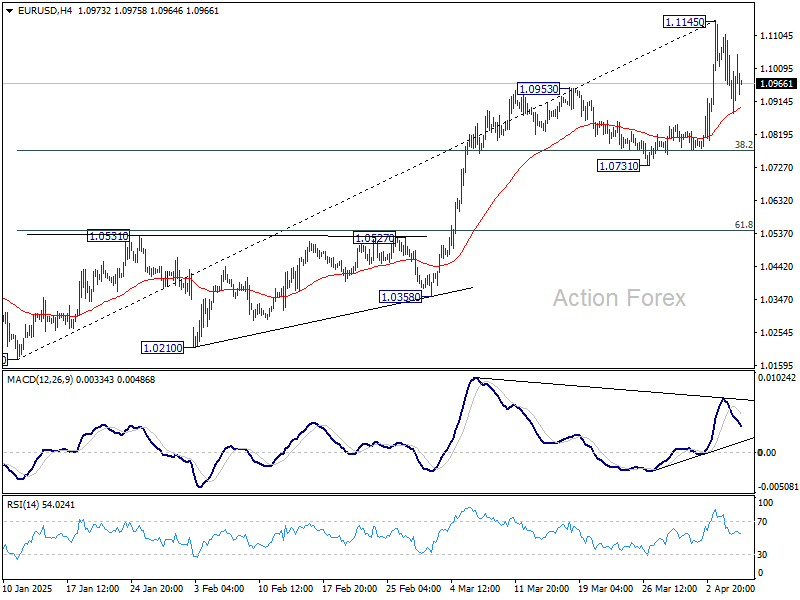
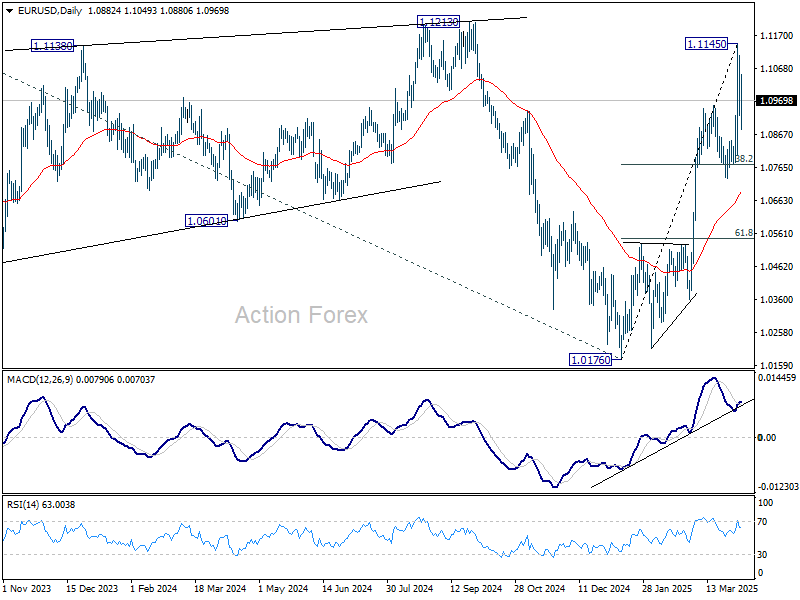
    EUR/USD climbed to 1.0453 on Friday, reaching a two-week high and maintaining stability.

    Key drivers behind EUR/USD movement

    The euro’s gains accelerated after US President Donald Trump signed a memorandum to review retaliatory duties without immediately imposing new tariffs. This decision eased investor concerns, reducing fears of an aggressive US response that could have added to inflationary pressures. With no immediate trade retaliations, markets view inflation risks as stabilising, reducing uncertainty around the Federal Reserve’s monetary policy.

    Additionally, geopolitical tensions appear to be easing, lowering the risk premium in the currency market and further supporting EUR/USD.

    However, doubts remain regarding the monetary policy divergence between the Federal Reserve and the European Central Bank (ECB). While the Fed continues to be cautious, showing little urgency to cut interest rates, the ECB is actively considering rate cuts. This policy mismatch is expected to weigh on the euro in the long term.

    Technical analysis of EUR/USD

    On the H4 chart, EUR/USD extended its growth wave towards 1.0466 before forming a consolidation range below this level. The pair has now broken downward from this range, opening the potential for a decline towards 1.0372. Once this target is reached, a corrective move towards 1.0416 is likely. The MACD indicator supports this scenario, with its signal line at high levels, suggesting an imminent pullback to lower lows.

    On the H1 chart, EUR/USD completed its growth wave to 1.0466 and is now consolidating in a narrow range. A downward breakout is expected, initially targeting 1.0420, followed by a potential correction towards 1.0444. In the longer term, another downward wave will likely develop, targeting 1.0394 and extending towards 1.0372. The Stochastic oscillator confirms this bearish outlook, with its signal line positioned below 50 and trending towards 20, indicating growing downside pressure.

    Conclusion

    While EUR/USD has gained on reduced trade war risks and stabilising inflation fears, the pair is now facing a short-term correction. The monetary policy divergence between the Fed and ECB remains a key factor that could limit further upside for the euro. Technically, a pullback towards 1.0372 is likely in the short term, with potential corrective bounces towards 1.0416 and 1.0444 before the next downward wave. Market participants will continue monitoring US trade policy updates and Fed rate expectations for further direction.

    Yen’s Roller-Coaster Ride Continues

    The Japanese yen continues to take investors and traders on a roller-coaster ride. After climbing 1.2% on Wednesday, USD/JPY gave almost all of those gains on Thursday, declining 1.05%. The yen has taken a breather today and is trading at 152.63 in the European session, down 0.19% on the day.

    Japan’s PPI keeps accelerating

    Producer prices in Japan climbed 4.2% y/y in January, up from an upwardly revised 3.9% in December and above the market estimate of 4.0%. PPI accelerated for a fifth consecutive month and posted its highest level since May 2023. The gain was driven by higher food prices. Monthly, PPI eased to 0.3%, down from 0.4% in December and in line with the market estimate.

    The hotter-than-expected PPI report reflects persistent inflationary pressures and follows the core CPI reading for December, which hit 3%, its highest annual level in 16 months. With inflation moving higher, expectations are growing that the Bank of Japan will raise interest rates further in the near term.

    The Bank has signaled that it will raise rates if wage growth increases and keeps inflation sustainable at the BoJ’s 2% target. In anticipation of higher interest rates, Japan’s 10-year bond yields have been rising and are close to a 15-year high.

    In the US, the PPI release showed little change in January. PPI rose 0.4% m/m, after an upwardly revised 0.5% gain in December. This was higher than the market estimate of 0.3%. Annually, PPI rose 3.5%, after an upwardly revised 3.5% gain in December.

    The US wraps up the week with the January retail sales report. The markets are bracing for a contraction, with a market estimate of -0.1%, after the 0.4% gain in December. Annually, retail sales are expected to dip to 3.7%, after a 3.9% gain in December.

    USD/JPY Technical

    • USD/JPY is testing support at 152.73. Below, there is support at 152.29
    • 153.00 and 153.44 are the next resistance lines

    Dollar Has Rolled Back to Local Lows

    The US dollar has retreated to the lower levels it has visited multiple times since the end of January. The decline at the end of last week was driven by reports that US ‘retaliatory’ tariffs have been postponed until April, allowing time for negotiations and potential easing of terms. This development proved more significant for the dollar than the Federal Reserve’s further hawkish stance and the unexpected rise in inflation.

    Data released mid-week indicated that consumer inflation accelerated to 3.0% year-over-year, marking a six-month high and a notable increase from September’s low of 2.4%. Core inflation remained stable at 3.3% over the past eight months. Additionally, the producer price index, a leading indicator of inflation, rose to 3.5% year-over-year, the highest rate since early 2023.

    An inflation rate above the target compels the Federal Reserve to adopt a restrictive approach, maintaining the key interest rate above inflation to suppress it. This strategy may present a bullish scenario as other major central banks signal their intent to ease policy.

    Narket Reaction to Tariff Announcement Muted

    Markets

    US yields easily returned most of Wednesday’s rise incurred after stronger than expected January CPI data. The move is telling on the current market positioning/assessment. The ‘correction’ started after and despite higher than expected US January PPI data. Markets apparently concluded that the bar is extremely high for the Fed to consider raising rates from current levels (economically and politically). With no more than one Fed rate cut discounted toward the end of this year, markets risk/reward see some value in US bonds after Wednesday’s sell-off. Treasuries started a comeback to finish the day between 4.8 bps (2-y) and 9.5 bps (30-y) lower. A $25bn 30-y US Treasury auction tailed, but after all didn’t hamper the intraday rally. German yields followed the US move with yields declining between 4.9 bps (2-y) and 6 bps (5-10y). Interesting/remarkable: the EMU yield move decoupled from an impressive rally in European equities. This is at least partially inspired by market hope that (US-led) negotiations on the war in Ukraine might at least remove one of the uncertainties for the region’s ailing economy. The Eurostoxx 50 index closed just a whisker away from the March 2000 all-time record! After the close of European markets, US president Trump announced a wide-ranging plan to impose reciprocal tariffs on the US’s trading partners. The system will work on a country-by-country basis. It will not only take into account tariffs, but also non-tariff barriers including regulations that are seen as unfavourble for US trade, subsidies and domestic taxing policy e.g. VAT and sales taxes that are applied by some trading partners. Trump also indicated that he intends to put in place additional taxes on autos, chips and pharmaceuticals on top of the reciprocal system. The market reaction to the announcement was muted. As it can take until April (or maybe later) for the system to be operational, markets conclude that there is still time to negotiate. US equity gains accelerated even after the announcement with major US indices closing between 0.7% (Dow) and 1.50% (Nasdaq) higher. The broad risk-on and sharp decline in US yields put the dollar on the backfoot. The DXY index dropped to 107.31 (from 107.87). USD/JPY almost fully reversed Wednesday’s jump higher (close 152.8). EUR/USD closes at 1.046.

    Risk sentiment remains constructive in Asian dealings this morning. Later today, the calendar contains details of EMU Q4 GDP growth (0% Q/Q) and US retail sales. Headline retail sales are expected to decline by 0.2% M/M (weather-related). Control group sales are expected at 0.3% M/M. Considering this week’s price action, (FI and FX) markets might be a bit more sensitive to a weaker than to a stronger than expected figure. We also keep an eye at EUR/USD. The 1.0533 January top is the next reference on the technical charts. Both euro strength and USD softness might be in play. DXY also nears key support just below 107.

    News & Views

    Swiss National Bank board member Tschudin showed willingness to return to sub-zero interest rates if necessary to achieve price stability (inflation between 0% and 2%). “It allows us to steer the rate differential also in a low-interest environment in a way that the franc becomes less attractive than other currencies and therefore doesn’t appreciate excessively.” The key Swiss policy rate currently stands at 0.50%. The comments came after Swiss data yesterday showed inflation easing further in January (-0.1% M/M & 0.4% Y/Y). While not a fan, SNB president Schlegel earlier kept the option of negative policy rates open as well. Tschudin added that the SNB will continue to intervene in FX markets to prevent a too strong Swiss franc even as it risks being labeled a currency manipulator by the US. The EUR/CHF 0.92-0.93 bottom is becoming stronger with the pair testing first resistance in the 0.95 area.

    The European Commission’s vice-president in charge of digital policy told the Financial Times that the EU wanted to help and support companies when applying AI rules. Virkkunen wants to cut back tech regulation: “we are committed to cut bureaucracy and red tape”. The EC has this week withdrawn a planned AI liability directive and an upcoming code of practice on AI, expected in April, will limit reporting requirements to what is included in the existing rules. Virkkunen insisted that the deregulatory push in an EU-initiative and not dependent on the US.

    Anxious Optimism

    The US is planning to impose tit-for-tat tariffs globally, but studying tariffs case by case requires time and the tariffs won’t be effective until April. I don’t know if you could call it good news, but the markets’ reaction suggests that the latter has been perceived as good news and helped keeping appetite afloat yesterday. The US dollar index was sharply sold despite the broadening tariff war, despite the rising worries about the US/Russian negotiations about Ukraine – which do not involve Ukraine nor the Europeans, and despite the mix of stronger-than-expected US PPI and better-than-expected weekly jobs figures.

    One of the reasons that could explain the weakness of the yields and the dollar on normally dollar-supportive inflation and tariff news is the fact that some of the components in that PPI report that feed into the PCE index – the Federal Reserve’s (Fed) favourite gauge of inflation – pointed at weakness (these items include healthcare and airfares). But given that Jerome Powell, himself, told US politicians this week about his concerns about inflation and how the progress has stalled since last year, I believe that a part of yesterday’s selloff has to do with investors closing the crowded long dollar positions, rather than a meaningful shift in the macroeconomic dynamics.

    In Europe

    The final German inflation figures released yesterday printed negative monthly numbers in January. The Spanish figures will likely point at slowing price pressures in Spain as well, while the Eurozone’s GDP will confirm a no growth in Q4. The combination of slowing inflation and zero growth could only back the idea of further rate cuts from the European Central Bank (ECB) at a time the bets for Fed rate cuts are being kicked down the road. Therefore, the weakness of the US dollar will likely remain limited and the strength of the euro against the dollar will likely be topped. But in the short run, a soft looking retail sales data from the US could keep the USD under pressure, letting the dollar rally lose some more steam. This being said, many traders may chose not to go short the US dollar into the weekend. You never know, two days is a long time with Donald Trump.

    In equities, though, the European stocks continue to ignore the tariff threats and chose to surf on the rotation trade. The Stoxx 600 rallied to a fresh ATH yesterday, while FTSE 100 also hit a fresh high but gave back gains and closed in the negative. Robust earnings and favourable ECB expectations support the positive move. On the individual front, the German champion Siemens – which generously contributes to the Stoxx 600 gains – jumped more than 7% yesterday after announcing a set of better-than-expected Q4 results, while encouraging earnings from Michelin boosted mood among carmakers. Stellantis for example gained 4.5% yesterday. They will report their earnings on February 26th, but they had announced a 27% decline in last quarter sales – to say that the convergence rebound is interesting but the upside will likely remain limited by the gloomy fundamentals of the continent – that could, on top of all the financial struggles of the moment – may need to find a way to increase their military spending in accordance with the US demands that warns that the transatlantic partner is no longer willing to offer security to its old friends for free. No wonder the BAE systems rose more than 3% yesterday. The European defense stocks are certainly stepping into a new era...
    China

    The S&P500 flirted with its ATH levels and Apple added nearly 2% yesterday on news that the new low-price iPhones will be out as early as this month and that the company will use Alibaba’s AI to boost the iPhone sales in China. Alibaba, on the other hand, extended rally to the highest levels in three years in Hong Kong on nascent AI optimism in China. Overall, the Hang Seng index this week has extended gains to nearly 20% since mid-January on optimism that the inflowing Chinese AI models could be pivotal for the Chinese technology stocks that have been heavily battered since 2021. If you ask me, I'm less concerned about government interference in tech (at least negatively). With a worsening demographic and property crisis, alongside deteriorating trade and geopolitical relations, Beijing can hardly afford another crackdown on its tech champions—the last card Xi has left to play.

    Trump Takes First Steps Towards Implementing Reciprocal Tariffs

    In focus today

    In the US, January retail sales and industrial production data will be released. Especially the former will be interesting for the markets given that private consumption remains by far the most important driver of economic growth in the US.

    In the euro area, the focus shifts to employment data for 2024 Q4, which we expect to show a 0.1% q/q increase, mainly driven by Spain. It will be interesting to see if employment continued to rise, as the labour market remains crucial for the growth outlook this year.

    Economic and market news

    What happened yesterday

    In the US, like the CPI print, the annual PPI was higher than expected in January, with the final demand excl. food and energy measure coming in at 3.6% y/y (cons: 3.3%). Conversely, the monthly measure was more in line with consensus at 0.3% m/m (cons: 0.3%) relative to the CPI counterpart. Decomposing the details indicates that components such as the financial and healthcare services sectors were to the lower side, which feed into the estimates of the upcoming PCE release, explaining the downtick in yields following the release.

    President Trump has started devising plans for the reciprocal tariffs, he mentioned earlier in the week. Though no tariffs have been implemented yet, he signed a memo ordering his team to start calculating duties that match those other countries charge the US and to counteract non-tariff barriers. He also emphasised that tariffs would target countries with high VAT, a move that appears to be aimed at the EU. Trump, who campaigned on a pledge to bring down consumer prices, acknowledged that prices could go up in the short term because of the tariffs. The news triggered risk-on sentiment, resulting in lower US yields, a weaker USD, and higher equities.

    In an interview with the Wall Street Journal, Vice President JD Vance mentioned the US could impose sanctions or take military action against Moscow if Russia does not agree to a peace deal ensuring Ukraine's long-term independence. Meanwhile, Trump stated that Ukraine would participate in peace talks with Russia - following Wednesday's opening for such discussions. Attention now turns to this weekend's Munich Security Conference for possible new signals towards ending the war, although Kyiv emphasized it would be premature to speak with Moscow at the conference.

    Additionally, Trump said he would "love" to have Russia back in G7 (which would become the G8 with Russia), while also eyeing a summit with Putin and Xi Jinping, during which, among other things, he would propose to discuss cutting the countries' military budgets in half.

    In the euro area, industrial production was lower than expected at 1.1% m/m in December (cons: 0.6%), primarily attributing to capital goods, likely reflecting the continued low appetite for investments in the euro area amid low capacity utilization. We expect the weakness in the industry to continue the coming six months before falling interest rates and rising real incomes should help stabilise the manufacturing sector.

    In the UK, data showed a stronger than expected GDP growth of 0.1% q/q in Q4 2024 (cons: -0.1%) with December coming in significantly stronger than expected at 0.4% m/m. For December, the topside surprise was broad-based with industrial production, services and manufacturing production offering positive contributions while construction contracted. More broadly, in Q4 private consumption was weaker than expected posing no growth and net exports posed a drag. We expect private consumption to pick up the coming quarters.

    In Switzerland, January inflation surprised to the topside in core terms at 0.9% y/y (cons: 0.6%), while headline inflation stood at 0.4% y/y (cons: 0.4%). In their latest set of forecasts from the December meeting, the Swiss National Bank (SNB) forecasted inflation at 0.3% y/y in Q1 2025. We get another inflation print before the next SNB meeting on 20 March.

    In Norway, the oil investment survey confirmed our expectations of a gradual slowdown in oil investments during 2025 and a drop next year, which is important as this leaves room for a stimulus to the rate sensitive parts of the economy.

    The annual address from Norges Bank's governor Ida Wolden Bache contained no new policy signals. Instead, she reflected on Norway as a small, open economy heavily reliant on trade and stressed the importance of international cooperation and flexible economic policies.

    Equities: Risk-on was back in fashion on Thursday. US rebounded, driven by big tech as yields dropped. VIX dropped to 15 as Trump unveiled his reciprocal tariff plans, which is the lowest level in three weeks. Growth cyclicals leading the gains, taking both the S&P 500 and Stoxx 600 up 1.1%. Increased risk appetite still not benefitting small caps which performed in line with markets yesterday. Futures are unchanged this morning.

    FI: Global bond yields declined and shrugged off most the rise from Wednesday after the stronger than expected US CPI data. Furthermore, the stronger than expected US PPI data better than expected Jobless Claims did not have much impact on global bond markets. The rally was driven from the long end of the curve and there was a solid bullish flattening.

    FX: Big swings in FX as Trump's announcement to impose reciprocal tariffs initially sent EUR/USD below 1.04 before retracing towards session highs as the open-ended tariff process sent US yields lower across the curve. The Sterling found support in stronger-than-expected growth data and the CHF had a strong session on the back of a topside surprise to Swiss inflation. After a brief setback on Wednesday, the SEK had yet another strong run yesterday, with EUR/SEK tracking lower towards 11.20.

    Cliff Notes: Resilience Offers Promise

    Key insights from the week that was.

    In Australia, the Westpac-MI Consumer Sentiment Index was broadly unchanged in February, nudging just 0.1% higher from 92.1 to 92.2. Though, this ‘cautiously pessimistic’ tone marks a material improvement from the last two-and-a-half years of deep pessimism, aided by more constructive views on future conditions. Indeed, the constituent sub-indexes tracking the one-year and five-year economic outlooks have both moved above their long-run averages, and the year-ahead outlook for family finances is also within striking distance. Views on current conditions are still weak however, both the ‘family finances vs. a year ago’ and ‘time to buy a major household item’ indexes notably below historic averages. This composition emphasises the weak starting point of consumers, having been battered by cost-of-living pressures and real income declines over 2022-24. That said, moderating inflation (as discussed by Chief Economist Luci Ellis this week) and the ‘Stage 3’ tax cuts combined with imminent interest rate relief are expected to support a recovery in time.

    Businesses’ perspective on the economy looks to be broadly aligned with the consumer view. The latest NAB business survey confirmed business conditions continue to track the steady decline in place since 2022. This trend, alongside our own evidence from card activity and the Westpac-DataX Consumer Panel, is consistent with lingering downside risks concentrated in consumer spending. Business confidence meanwhile remains broadly neutral but extremely volatile month-to-month. With the combination of building expectations for rate cuts, a Federal Election, and an extremely fluid global backdrop, this is likely to remain the case for some time.

    A final note for Australia on housing. The latest batch of loan approval data, now released on a quarterly frequency, revealed a softer finish to the year. The total value of finance approvals (excl. refinancing) rose 1.4% in Q4 despite fewer loans being approved (–0.4%qtr) owing to higher average loan sizes – a dynamic responsible for more than half the growth in total housing finance value since Q2 2022. Indeed, despite pulling back from a stellar annual pace of +25%yr in September, total housing finance values are still tracking +16%yr, reflecting the backdrop of robust house price growth over 2023/24 and stretched affordability.

    Before moving further afield, this week our New Zealand economics team released their latest quarterly Economic Overview, detailing in depth their baseline expectations for New Zealand and the key risks.

    Over in the US, last Friday’s January nonfarm payrolls print was solid at 143k and came with a +100k revision to the prior two months. Annual revisions in contrast cut 589k jobs from the level at March 2024. The average pace of nonfarm payrolls growth is now estimated to have slowed from 380k in 2022 to 216k in 2023 then 165k since the beginning of 2024. Arguably, gains since the beginning of 2023 are consistent with a labour market in balance.

    Adjustments were also made to the level of household survey employment at January; as such, the December 2024 and January 2025 employment outcomes are not comparable. The ratios are unaffected however and provided a positive update, the unemployment rate edging down from 4.1% to 4.0%, a rate also consistent with a balanced labour market. January's strong average hourly earnings gain of 0.5% is likely a one-off given the series has, on average, increased 0.3% per month since the beginning of 2024 and the Employment Cost Index also continues to point to a trend deceleration in wage and compensation growth.

    January’s CPI subsequently printed above expectations, total prices up 0.5% and the core sub-set 0.4%. Annual headline and core inflation edged higher as a result to 3.0% and 3.3% respectively. On the services side, transport and recreation services both reaccelerated, pointing to capacity constraints. Shelter inflation was also a touch stronger in the month and the annual rate, while slowly trending lower, is still materially above its long-run average. As we begin to consider the potential implications of US tariffs on domestic inflation, it is important to recognise that the highly-beneficial deflationary trend for core goods looks to have come to an end, with three of the past five readings positive and the annual change now just -0.1%. The PPI also came in stronger than expected at 0.4%mth and the history was revised up. However, components that feed into the calculation of PCE inflation, the FOMC's preferred consumer inflation gauge, were favourable, health care costs and airfares both down in the month.

    Reflecting on the latest employment and CPI readings, during testimony to Congress, FOMC Chair Jermone Powell reaffirmed the FOMC is in no hurry to ease monetary policy further. He noted that “reducing policy restraint too fast or too much could hinder progress on inflation” and characterised the labour market as “broadly in balance” and “not a source of significant inflationary pressure”. When questioned on tariffs, Chair Powell kept his comments apolitical, but did note they could impact monetary policy’s stance. Overall, it is clear the FOMC is confident in the underlying health of the US economy and believe they have time on their side to judge the persistence of inflation and the consequences of the new administration's policies.

    On government policy, this week saw US President Donald Trump announce a 25% tariff on steel and aluminium imports into the US, with no immediate exceptions. The pathway to implementing reciprocal tariffs is also to be studied. Reciprocal tariffs would arguably have the greatest impact on emerging markets, in particular countries such as India and Thailand where tariffs have been put in place to protect the development of critical domestic industry, including the supply of everyday essentials to household sectors with limited financial means.