Thu, Apr 09, 2026 19:54 GMT
More

    Sample Category Title

    Eco Data 2/14/25

    ActionForex
    GMT Ccy Events Actual Consensus Previous Revised
    21:30 NZD Business NZ PMI Jan 51.4 45.9 46.2
    07:30 CHF PPI M/M Jan 0.10% 0.10% 0.00%
    07:30 CHF PPI Y/Y Jan -0.30% -0.90%
    10:00 EUR Eurozone Q/Q Q4 P 0.10% 0.00% 0.00%
    13:30 CAD Manufacturing Sales M/M Dec 0.30% 0.60% 0.80%
    13:30 CAD Wholesale Sales M/M Dec -0.20% 0.40% -0.20% 0.00%
    13:30 USD Retail Sales M/M Jan -0.90% -0.20% 0.40% 0.70%
    13:30 USD Retail Sales ex Autos M/M Jan -0.40% 0.30% 0.40% 0.70%
    13:30 USD Import Price Index M/M Jan 0.30% 0.50% 0.10% 0.20%
    14:15 USD Industrial Production M/M Jan 0.50% 0.30% 0.90% 1.00%
    14:15 USD Capacity Utilization Jan 77.80% 77.80% 77.60% 77.50%
    GMT Ccy Events
    21:30 NZD Business NZ PMI Jan
        Actual: 51.4 Forecast:
        Previous: 45.9 Revised: 46.2
    07:30 CHF PPI M/M Jan
        Actual: 0.10% Forecast: 0.10%
        Previous: 0.00% Revised:
    07:30 CHF PPI Y/Y Jan
        Actual: -0.30% Forecast:
        Previous: -0.90% Revised:
    10:00 EUR Eurozone Q/Q Q4 P
        Actual: 0.10% Forecast: 0.00%
        Previous: 0.00% Revised:
    13:30 CAD Manufacturing Sales M/M Dec
        Actual: 0.30% Forecast: 0.60%
        Previous: 0.80% Revised:
    13:30 CAD Wholesale Sales M/M Dec
        Actual: -0.20% Forecast: 0.40%
        Previous: -0.20% Revised: 0.00%
    13:30 USD Retail Sales M/M Jan
        Actual: -0.90% Forecast: -0.20%
        Previous: 0.40% Revised: 0.70%
    13:30 USD Retail Sales ex Autos M/M Jan
        Actual: -0.40% Forecast: 0.30%
        Previous: 0.40% Revised: 0.70%
    13:30 USD Import Price Index M/M Jan
        Actual: 0.30% Forecast: 0.50%
        Previous: 0.10% Revised: 0.20%
    14:15 USD Industrial Production M/M Jan
        Actual: 0.50% Forecast: 0.30%
        Previous: 0.90% Revised: 1.00%
    14:15 USD Capacity Utilization Jan
        Actual: 77.80% Forecast: 77.80%
        Previous: 77.60% Revised: 77.50%

    U.K.: Slow Growth, Lingering Inflation, Gradual Rate Cuts

    Summary

    • After experiencing solid growth during the first half of last year, the U.K. economy essentially came to a standstill in the second half of 2024, including just a 0.1% quarter-over-quarter gain in Q4 GDP. Subdued sentiment suggests a continued slow pace of economic growth in the near term, and we would also argue fiscal policy dynamics are turning less supportive of the growth outlook as well. We have lowered our 2025 U.K. GDP growth forecast to 0.8%, from 1.5% previously.
    • The news on the inflation front is mixed. While inflation slowed more than expected in December, the Bank of England (BoE) still expects a further rebound of inflation on the back of higher energy prices and regulated price increases, and attributed the slowing in services inflation to some volatile price categories. Wage growth has picked up recently and remains elevated, especially given the U.K.'s recent underwhelming productivity performance.
    • Against this backdrop of slowing growth and mixed inflation trends, the BoE lowered its policy rate 25 bps to 4.50% last week. We view the BoE announcement as decidedly mixed, with the central bank forecasting slower growth but faster inflation. The BoE said there has been substantial progress on disinflation, but also that a “gradual and careful” approach to easing remains appropriate, and that monetary policy will need to remain restrictive for sufficiently long.
    • We view these mixed BoE comments as very much consistent with a once-per-quarter rate cut pace. Our view remains for 25 bps rate cuts in May, August, November and February, with the policy rate expected to reach a low of 3.50% by early 2026. We also view steady rate cuts and weak U.K. economic growth as consistent with moderate weakness in the pound versus the U.S. dollar over the medium term.

    U.K. Economic Growth Shifts To A Lower Gear, Inflation Signals Remain Mixed

    After enjoying solid growth through the first half of 2024, the United Kingdom's economic performance softened though the second half of last year. The latest U.K. GDP report confirmed an economy that was essentially at a standstill through the second half of 2024, as Q4 GDP edged up by just 0.1% quarter-over-quarter, following a flat Q3 GDP outcome. The details of the report were also underwhelming, as consumer spending was unchanged in the quarter and business investment fell 3.2%, contributing to an overall decline in final private domestic demand of 0.4%, while exports also fell 2.5%. Instead, U.K. growth was driven by an increase in government consumption and public investment spending. December GDP figures offered perhaps a modest bright spot, as GDP rose 0.4% month-over-month, with gains in both services activity and industrial output.

    That said, signs of economic softness are apparent across different sectors of the economy. The labor market, for example, appears to be losing some momentum. Payroll employment fell by an average of 16,000 per month during the fourth quarter although, admittedly, this series can be subject to large revisions. The unemployment rate has trended moderately higher during the past several quarters, reaching 4.4% in the three-months-to November. Meanwhile, corporate profitability still appears to be under some pressure. U.K. gross entrepreneurial income for non-financial corporates, as reported by the OECD, fell by 2.9% year-over-year in Q3-2024, a fourth straight quarter of decline. The sluggish corporate environment combined with still restrictive monetary policy could remain a restraining influence on investment spending in the period ahead.

    Looking ahead, sentiment surveys are consistent with a continued slow pace of economic growth in the near term. The U.K. manufacturing PMI rose in January but, at 48.3, remained in contraction territory for the fourth consecutive month. Perhaps more importantly, the services PMI softened to 50.8 in January, a level historically consistent with only moderately positive growth. And finally, another area which seems to be turning less supportive of the U.K. economic outlook is fiscal policy. After an expansionary fiscal policy approach in the U.K. Autumn Government Budget delivered last year, Chancellor of the Exchequer Reeves now has only a limited £9.9B of headroom to stick within the government's self-imposed fiscal rules. With U.K. yields having risen moderately since, and economic activity (and thus likely tax revenues) slowing, that headroom may have narrowed further. Media reports suggest the U.K. Treasury is telling several government departments to prepare for a budget freeze, which given inflation trends would imply significant spending cuts in real terms. The government's next Economic and Fiscal Outlook is scheduled for late March. At this stage, we doubt fiscal dynamics will be as supportive of the economic outlook as they were late last year and, if anything, they could even be a mild headwind. Assessing recent developments, including softer economic activity, subdued sentiment, and less supportive fiscal dynamics, we have made a significant downward adjustment to our U.K. growth outlook. We now forecast U.K. GDP growth of 0.8% in 2025 (compared to 1.5% previously), while our GDP growth outlook for 2026 is unchanged at 1.7%.

    While economic activity growth is clearly decelerating, the news on the inflation front is more mixed. To be sure, the latest CPI report (for December) was encouraging. Headline inflation eased to 2.5% year-over-year while, more notably, core CPI inflation slowed to 3.2% and services inflation slowed to 4.4%. Despite that good news, the Bank of England still expects a further rebound of inflation on the back of higher energy prices and regulated prices increases, while it also attributed the slowing in services inflation to some volatile price categories. Moreover, and despite some softening in the labor market, pay growth remains elevated, especially given the U.K.'s recent underwhelming productivity performance. Wage growth for the three-months-to November picked up, with average weekly earnings rising 5.6% year-over-year, and average weekly earnings excluding bonuses also rising 5.6%. Average weekly earnings excluding bonuses for the private sector, a measure monitored by BoE policymakers, also quickened to 6.0%.

    Bank Of England Continues With Gradual, Careful Approach to Monetary Easing

    It is against this backdrop of slowing growth and mixed inflation trends that the Bank of England (BoE) delivered its latest monetary policy decision last week. The BoE voted 7-2 to lower its policy rate another 25 bps to 4.50%, with two policymakers dissenting in favor of a larger 50 bps reduction. In its accompanying announcement, the BoE said:

    • There has been substantial progress on disinflation over the past two years. That progress has allowed the central bank to gradually withdraw some degree of policy restraint, while maintaining the policy rate in restrictive territory so as to continue to squeeze out persistent inflationary pressures.
    • Higher global energy costs and regulated price changes are expected to push up headline inflation to 3.7% in Q3-2025, even as underlying domestic inflationary pressures are expected to wane further. Inflation is expected to fall back thereafter.
    • GDP growth and productivity growth have both been weaker than previously estimated, and thus the recent slowdown in demand is judged to have led to only a small margin of economic slack opening up.
    • A gradual and careful approach to the further withdrawal of monetary policy restraint is appropriate. Monetary policy will need to continue to remain restrictive for sufficiently long until the risks to inflation returning sustainably to the 2% target in the medium term have dissipated further.

    The BoE also published updated economic forecasts. Those forecasts envisage slower GDP growth than previously projected, at 0.75% in 2025 (down from 1.5%), while 2026 growth is forecast at 1.5% (previously 1.25%). Moreover, in addition to the near-term jump of inflation forecast by the BoE, the central bank's medium-term inflation forecasts were also revised moderately higher. The BoE projects CPI inflation at 2.4% in Q4-2026, with inflation not reaching the 2.0% inflation target until Q4-2027. Keep in mind also these forecasts are based off market implied interest rates that anticipated only a modest further reduction in the policy rate, to a low of around 4%.

    Overall, we view the Bank of England's commentary and projections as decidedly mixed. On the one hand, the BoE acknowledged progress on disinflation and the weak economic growth environment, while the dissents in favor of a more aggressive rate cut also attracted some attention from market participants. At the same time, the central bank raised its medium-term inflation forecasts, indicative of lingering inflation risks. We view these mixed comments from Bank of England policymakers as very much consistent with a “gradual and careful” approach to monetary easing. Given the slower U.K. growth momentum and being cognizant of downside risks to growth, even with a mixed inflation picture our view remains the BoE will continue with a 25 bps per quarter rate cut pace. We expect 25 bps policy rate reductions in May, August, November and February, with the policy rate expected to reach a low of 3.50% by early 2026. Our outlook for Bank of England rate cuts is only moderately more aggressive than currently expected by market participants. However, combined with weak U.K. economic growth, we still view that as consistent with moderate weakness in the British pound versus the U.S. dollar over the medium term.

    RBNZ Preview: Another Large Step Towards the Neutral Zone

    • We think it highly likely that the RBNZ will cut the OCR by 50bps to 3.75% next week but project a slower pace of easing after February.
    • The RBNZ’s near-term CPI forecasts will likely be revised slightly higher due to the weaker TWI and higher commodity prices balanced by weaker non-tradable inflation.
    • We think the RBNZ will retain confidence that medium-term inflation will remain close to 2%.
    • We see the RBNZ projecting an end 2025 OCR of around 3.25% and an unchanged terminal rate of about 3%.
    • The Bank’s short term economic growth projections may be revised down while the medium-term growth path may be revised up modestly with the lower exchange rate.
    • The RBNZ will likely note significant risks associated with global trade policies, although few conclusions will be drawn given the significant uncertainties.
    • The most likely dovish scenario is the RBNZ signals the intention to move the OCR to neutral more quickly by signalling a 3% OCR by mid-2025. This would signal a high chance of a further 50bp cut at the April review.
    • An outside chance is the RBNZ cuts the OCR by more than 50bps to try and bring the OCR to neutral more quickly.

    RBNZ decision and associated communication – our baseline scenario.

    Our baseline scenario (65% probability) is that the RBNZ cuts the OCR by 50bp to 3.75% next week. We expect the RBNZ to revise down their OCR forecast profile to be consistent with the OCR reaching around 3.25% by the end of 2025 (compared with 3.55% in the November MPS). The ultimate endpoint for the OCR beyond 2025 is expected to remain unchanged at around 3%.

    Developments since last year’s November Monetary Policy Statement are likely to be interpreted by the Monetary Policy Committee as giving them sufficient confidence that a further large step towards the RBNZ’s assessment of the neutral OCR remains appropriate. The RBNZ foreshadowed a 50bp cut in the OCR to 3.75% and we doubt the data would have swayed them from that view.

    Messages in support of this move are likely to include:

    • Inflation remains close to the middle of the 1-3% target range, with most available indicators giving confidence that inflation will remain in the target range over the medium term.
    • Risks to the economic and inflation outlook are twosided and imply the best course of action is to continue to move the OCR towards a neutral setting.
    • Upside risks to headline inflation remain prominent, especially from the recent significant fall in the New Zealand dollar and waning tradable goods price disinflation. The RBNZ is likely to note that inflation expectations appear well contained at this stage despite those upside inflation risks.
    • Non-tradable inflation is continuing to ease and is allowing continued downward adjustment of the OCR towards neutral. The revisions to past GDP data better explain why inflation was persistent through 2023 and early 2024 but also give confidence that core inflation will remain close to 2% over the foreseeable future.
    • There are mixed signs of a return to economic growth, which is normal at economic turning points. Easier financial conditions and the strong terms of trade seem likely to underwrite a return to trend growth later in 2025. The labour market will likely be judged as evolving as expected and continue to lag developments in GDP growth.
    • Significant risks are coming from the global geopolitical and trade environment that have the potential to negatively impact NZ export incomes, growth and medium-term inflation. However, the extent to which these risks are tangible remains unclear, as is the extent to which the exchange rate may buffer NZ from these external shocks. The MPC likely will not draw strong conclusions but maintain a watching brief.

    This 50bp cut will leave the OCR just 25bps above the RBNZ’s 2.5-3.5% estimated range for the neutral OCR. With re-entry to the RBNZ’s neutral rate range now imminent, and two-sided risks to the evolution of growth and inflation, we expect the RBNZ to signal a return to a slower pace of easing for the balance of 2025. We don’t think the RBNZ will be looking to move interest rates into stimulatory territory but would certainly acknowledge there are scenarios that might require that.

    Alternative scenarios.

    Around that baseline scenario, we see two other potential outcomes at next week’s policy meeting:

    • Hawkish scenario (5% probability): 25bp cut. The RBNZ elects to cut the OCR to 4% and signal ongoing 25bp cuts from then. This would likely be associated with an end 2025 OCR path in line with that projected in the November Monetary Policy Statement around 3.5%. Concerns around the higher forecast headline CPI through 2025 from the weaker exchange rate, higher oil prices and firm commodity/food prices and associated costs and expectations pressures might drive this scenario.
    • Moderately dovish scenario (20% probability): 50bp cut with a strong chance of another at the April Monetary Policy Review. The MPC signals an intention to move more quickly to 3% by indicating a strong chance of a further 50bp cut in April and a 3% OCR by mid-year. This would be signalling an intention to move more quickly to the mid-point of their neutral range estimate of 3%. The year end target could be 3% with no clear bias shown in the OCR profile after May 2025.
    • Dovish scenario (10% probability): 75 to 100bp cut. The MPC decides to rapidly move the OCR to the mid-point of its neutral range estimate. Worries about a near-term lift in headline inflation due to a weaker exchange rate would be dominated by concerns about the weak growth impulse seen in GDP over Q2-Q3 2024. A significant downward revision in Q4 and Q1 GDP from the 0.3% and 0.6% forecasts in November might drive this scenario. As also might the MPC taking a view that the coming geopolitical shocks are likely to significantly undermine export incomes even after any exchange rate adjustment. Having adjusted the OCR to the middle of the neutral range, the MPC might indicate readiness to take the OCR into stimulatory territory should data suggest that appropriate.

    Key developments since the November Monetary Policy Statement.

    Key economic developments since the RBNZ’s last policy statement in November are noted below.

    • Inflation: December quarter inflation was fractionally firmer than the RBNZ forecast (2.2%y/y vs forecast 2.1% y/y) due to higher than forecast prices for tradables. Non-tradables inflation was slightly lower than forecast (4.5%y/y vs forecast 4.7%y/y), and key measures of core inflation moved lower.
    • Inflation expectations/pricing indicators: Pricing indicators have been mixed, with the QSBO survey measure remaining softer than pre-Covid norms but the ANZ survey measure firmer than pre-Covid norms. Explicit measures of inflation expectations have drifted higher, possibly due to recent increases in fuel prices. The ANZ’s 1-year ahead business measure has increased 14bps to 2.67%.
    • BThe latest GDP report included revisions that lifted GDP through 2022 and 2023 but pointed to a much deeper downturn through the middle quarters of 2024. On net, the level of GDP in the September quarter was 0.6% higher than forecast in the November MPS. We currently estimate that the economy grew 0.3% in the December quarter, in line with the RBNZ’s November estimate.
    • The output gap: The upward revisions to GDP in 2022 and 2023 imply that productivity growth was not as weak as previously estimated. This should cause the RBNZ to slightly lift its assessment of potential output.
      The size of that revision relative to the 0.6% lift in the level of actual GDP will govern whether the RBNZ’s estimate of the output gap is larger or smaller than that estimated in November. We suspect the RBNZ will conclude that the output gap is slightly more negative than estimated previously.
    • Sentiment indicators: Year-ahead sentiment indicators in the ANZ business survey remain near historic cyclical highs. Westpac’s measure of consumer confidence has improved in recent months but remains weaker than average. Indicators of current and near-term economic performance from the QSBO and Business NZ surveys also remain subdued, possibly suggesting some downside risk to the RBNZ’s nearterm growth forecasts.
    • Labour market: The unemployment rate increased to 5.1% in the December quarter, in line with the RBNZ’s forecast. Monthly filled jobs data appears consistent with the RBNZ’s forecast that employment will stabilise around current levels, but that the unemployment rate will lift modestly further for a period given ongoing growth in the labour force. Wage growth continued to moderate in the December quarter (albeit slightly less than the RBNZ expected) and business surveys continue to point to further moderation ahead.
    • Housing market/population growth: Anecdotes and developments in mortgage applications suggest that lower interest rates are triggering more buyer enquiry. However, amidst a plentiful supply of dwellings – the most in a decade – house prices have continued to track sideways. Migrant inflows appear to be tracking slightly below the RBNZ’s November forecasts.
    • Commodity prices: Export commodity prices have continued to improve in recent months, especially in the dairy sector. However, the overall terms of trade (measured on a National Accounts basis) appear to be evolving broadly as the RBNZ had forecast in the November MPS.
    • Exchange rate: The trade-weighted exchange rate index (TWI) is currently around 2.6% below the 69.5 assumption made in the November MPS. The TWI assumption will modestly boost the RBNZ’s growth forecasts and add around 0.3ppts to the RBNZ’s forecast of annual inflation over the coming year.
    • Global developments: The main development since November has been confirmation that President Trump plans to implement tariffs. Those measures could affect some of our key trading partners, like China. In addition, some New Zealand exporters could be directly affected (such as exporters of metal products). However, the final form of those tariffs, any retaliation that might ensue, and the exchange rate’s response, remains uncertain, so the RBNZ’s central assumption for trading partner growth is likely to be little changed from November.

    Sunset Market Commentary

    Markets

    President Trump once again took center stage today. It started off with a call with Russian president Putin which blindsided both European and Ukrainian officials. Trump and Putin agreed that talks about ending the war should begin immediately and plan to meet each other in person. It’s the start of a most likely bumpy and long process, but it’s the biggest step so far towards a truce and eventually peace. The news sparked a broad risk-on move in which CE currencies, due to their geographical proximity, profited in particular. EUR/HUF was moving towards the symbolical 400 barrier & the zloty hit a new multi-year low against the euro. The common currency itself was better bid against the US dollar, supported by growing hope for reduced geopolitical uncertainty and European growth picking up on lower energy prices & the need to rebuild Ukraine. EUR/USD strengthened towards 1.0440. European stock markets gained well above 1%, supported amongst others by the industrial sector. Core bond yields were the odd ones out, easing a few basis points in early trading. It makes some sense for the US, where some cooldown was due after a sharp >10 bps rise in the CPI aftermath. For Europe it’s not as obvious, although potential truce talks do bring about conflicting market forces of lower energy prices (e.g. 10% decline EU gas price, reducing LT inflation expectations) and a reduced geopolitical risk premium vs more upbeat growth narrative (higher LT real yields).

    “THREE GREAT WEEKS, PERHAPS THE BEST EVER, BUT TODAY IS THE BIG ONE: RECIPROCAL TARIFFS!!! MAKE AMERICA GREAT AGAIN!!!” That’s coming from the same person that’s trying to broker a peace deal, mere hours after the telephone call. In split seconds, most of the above described moves reversed. EUR/USD turned south back to opening levels just below 1.04 and CE currencies give back most if not all of their previous gains. Core bond yield losses deepened, leading to net daily changes varying between -4 and -6 bps in Germany. US Treasuries outperform, shedding 4-6.8 bps. Second-tier PPI data and jobless claims barely moved a needle, even though both were strong. Equities … don’t care. The EuroStoxx50 holds on to its 1.4% gains and is less than a percent away from the record high seen in 2000.

    News & Views

    Inflation in Switzerland eased further in January. Prices declined 0.1% M/M easing the Y/Y measure from 0.6% to 0.4%, the slowest yearly pace since April 2021. The Swiss Statistical Office analyses that the 0.1% decrease is due to several factors including lower prices for electricity and supplementary accommodation, air transport & clothing and footwear (seasonal sales). Core inflation (ex. food, energy, tobacco and seasonal goods) also eased -0.1% M/M. The Y/Y measure rebounded from 0.7% to 0.9%. Aside from lower energy bills, disinflation/deflation mainly was due a further decline of goods prices (-0.8% M/M and -1.8% Y/Y). Services prices rose 0.4% M/M and 1.8% Y/Y. At the December policy meeting, SNB forecasted inflation at 0.3% Y/Y both for Q1 2025 as for the yearly average. The SNB defines price stability as price rises within the 0.0%-2.0% range. Today’s data cement expectations for the SNB to further reduce the policy rate from 0.5% to 0.25% at the March 20 meeting. In recent comments, SNB governor Schlegel indicated that, while SNB doesn’t like to return to negative rates, it remains an option if inflation would stay too low for too long. For now, we expect SNB to keep some room of maneuver if data (and the franc) allow to do so. After weakening earlier this week (European risk-on), the Swiss franc regained modest ground post the inflation data (higher core). At EUR/CHF 0.946, the pair still is some distance away from the key 0.9250/00 area (cycle lows) which probably is also an important reference for the SNB.

    The Statistical Office of Poland today published preliminary GDP growth data for Q4 of last year. Activity in the country in Q4 rebound 1.3% Q/Q to be 3.2% higher compared to the 4th quarter of the previous year. It also was a materially improvement compared to a near stand-still in the previous quarter (0.1% Q/Q). No details on the composition were announced. They are expected February 27. CE currencies, including the zloty, recently performed well, amongst others, as markets started the ponder the potential positive impact on the region from an end of the war In Ukraine. EUR/PLN yesterday touched the lowest levels (top for the zloty) since April 2018, but fell prey to some profit taking today (EUR/PLN 4.173).

    EUR/USD Mid-Day Outlook

    Daily Pivots: (S1) 1.0309; (P) 1.0345; (R1) 1.0398; More...

    Intraday bias in EUR/USD remains neutral as consolidation from 1.0176 is still extending. Outlook will remain bearish as long as 38.2% retracement of 1.1213 to 1.0176 at 1.0572 holds. On the downside, break of 1.0176 will resume whole fall from 1.1213. However, decisive break of 1.0572 will raise the chance of reversal, and target 61.8% retracement at 1.0817.

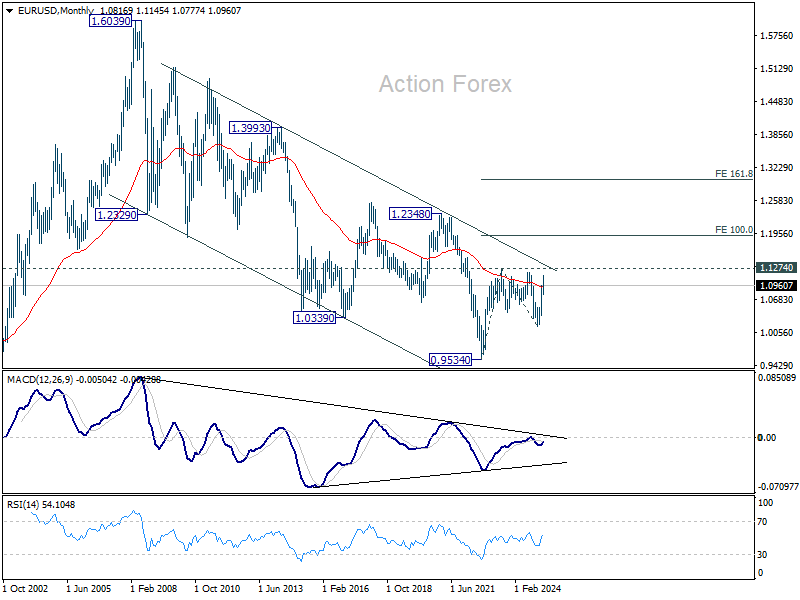
    In the bigger picture, immediate focus is on 61.8 retracement of 0.9534 (2022 low) to 1.1274 (2024 high) at 1.0199. Sustained break there will solidify the case of medium term bearish trend reversal, and pave the way back to 0.9534. However, reversal from 1.0199 will argue that price actions from 1.1274 are merely a corrective pattern, and has already completed.

    USD/CHF Mid-Day Outlook

    Daily Pivots: (S1) 0.9107; (P) 0.9132; (R1) 0.9160; More

    Intraday bias in USD/CHF remains neutral as consolidation from 0.9200 is still extending. Outlook stays bullish with 0.8956/64 support zone intact. On the upside, firm break of 0.9200/9223 will resume the whole rally from 0.8374 and carry larger bullish implication. However, sustained break of 0.8964 will be a sign of reversal and turn bias back to the downside.

    In the bigger picture, decisive break of 0.9223 resistance will argue that whole down trend from 1.0342 (2017 high) has completed with three waves down to 0.8332 (2023 low). Outlook will be turned bullish for 1.0146 resistance next. Nevertheless, rejection by 0.9223 will retain medium term bearishness for another decline through 0.8332 at a later stage.

    USD/JPY Mid-Day Outlook

    Daily Pivots: (S1) 152.92; (P) 153.86; (R1) 155.35; More...

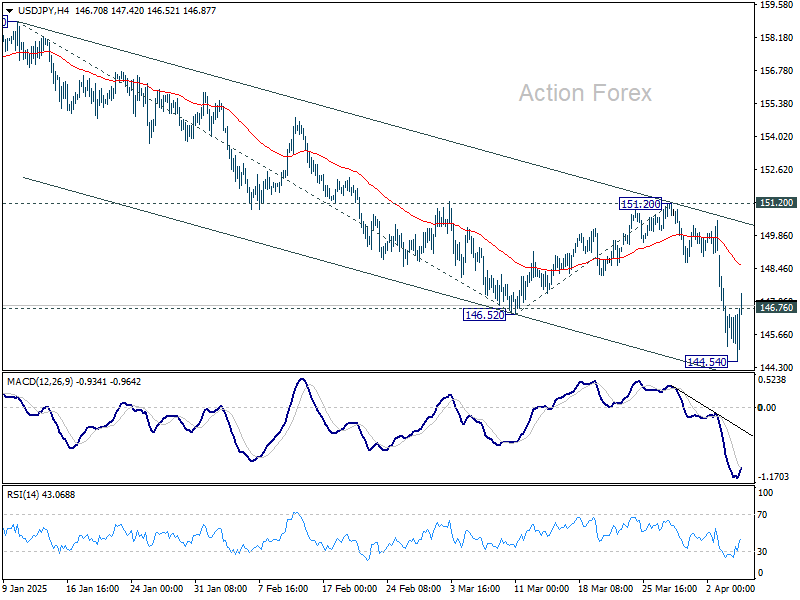
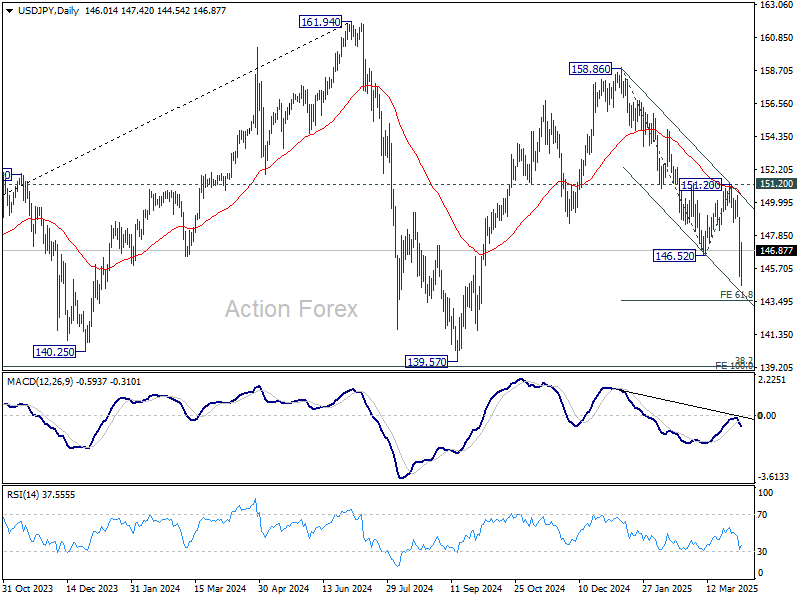
    USD/JPY retreated after hitting 154.79 and intraday bias is turned neutral first. Outlook is unchanged that corrective fall from 158.86 should have completed at 150.92 already. Risk will stay on the upside as long as 150.92 support holds. Above 154.79 will target a retest on 158.86 first. Firm break there will resume whole rally from 139.57 to retest 161.94 high.

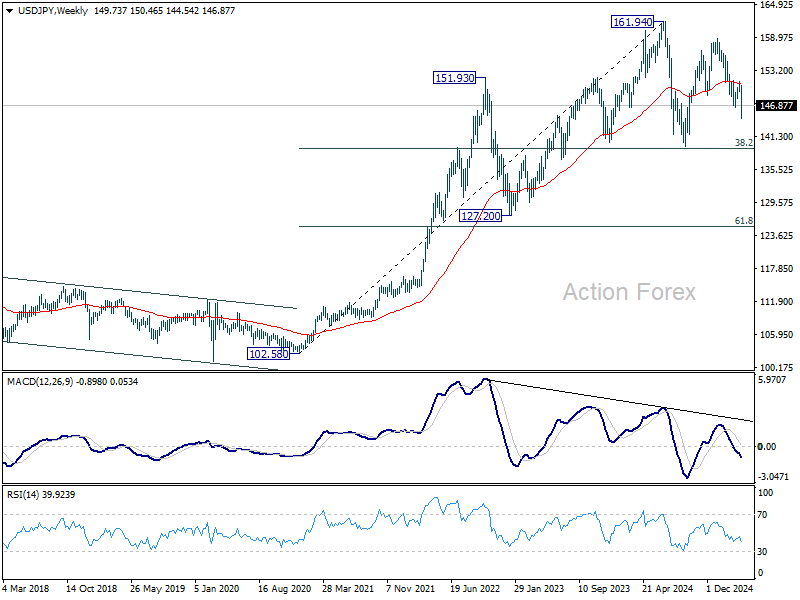
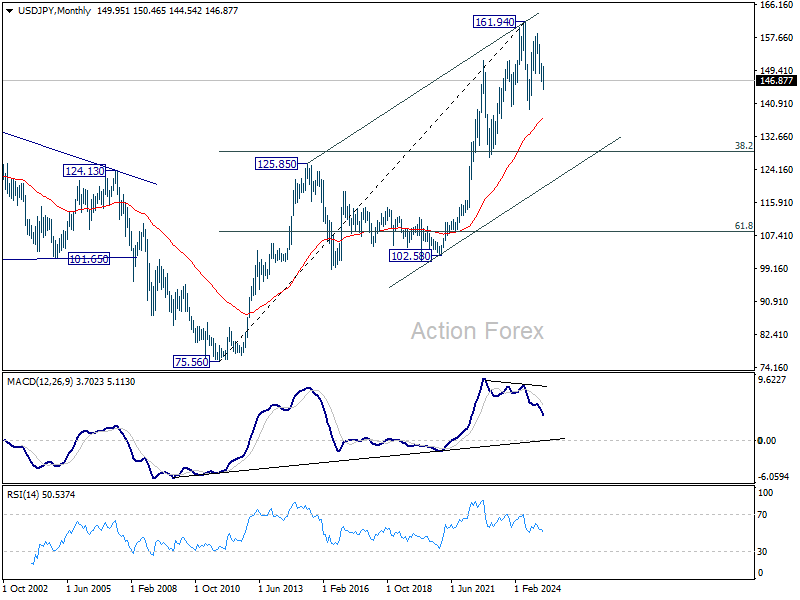
    In the bigger picture, price actions from 161.94 are seen as a corrective pattern to rise from 102.58 (2021 low). In case of another fall, strong support should be seen from 38.2% retracement of 102.58 to 161.94 at 139.26 to bring rebound. However, sustained break of 139.26 would open up deeper medium term decline to 61.8% retracement at 125.25.
    GBP/USD Mid-Day Outlook

    Daily Pivots: (S1) 1.2387; (P) 1.2435; (R1) 1.2493; More...

    Outlook in GBP/USD is unchanged and intraday bias stays neutral. Corrective rebound from 1.2099 could still extend higher. But upside should be limited by 38.2% retracement of 1.3433 to 1.2099 at 1.2609. On the downside, below 1.2331 minor support will turn bias to the downside for 1.2248 support. Firm break there will argue that the correction has completed and bring retest of 1.2099 low. However, decisive break of 1.2609 will raise the chance of near term reversal, and target 61.8% retracement at 1.2923.

    In the bigger picture, rise from 1.0351 (2022 low) should have already completed at 1.3433 (2024 high), and the trend has reversed. Further fall is now expected as long as 1.2810 resistance holds. Deeper decline should be seen to 61.8% retracement of 1.0351 to 1.3433 at 1.1528, even as a corrective move. However, firm break of 1.2810 will dampen this bearish view and bring retest of 1.3433 high instead.

    Dollar Muted Despite Strong PPI, Awaits Reciprocal Tariffs

    The currency markets are treading cautiously, with traders showing little reaction to stronger-than-expected US PPI data and a better-than-anticipated jobless claims report. Despite these inflationary signals, Dollar has struggled to gain further traction, as market participants hold their positions ahead of a highly anticipated announcement on US "reciprocal tariffs" from President Donald Trump. The announcement, expected later today in a news conference at the Oval Office, could provide a clearer picture of how US trade policy will evolve and its impact on global markets.

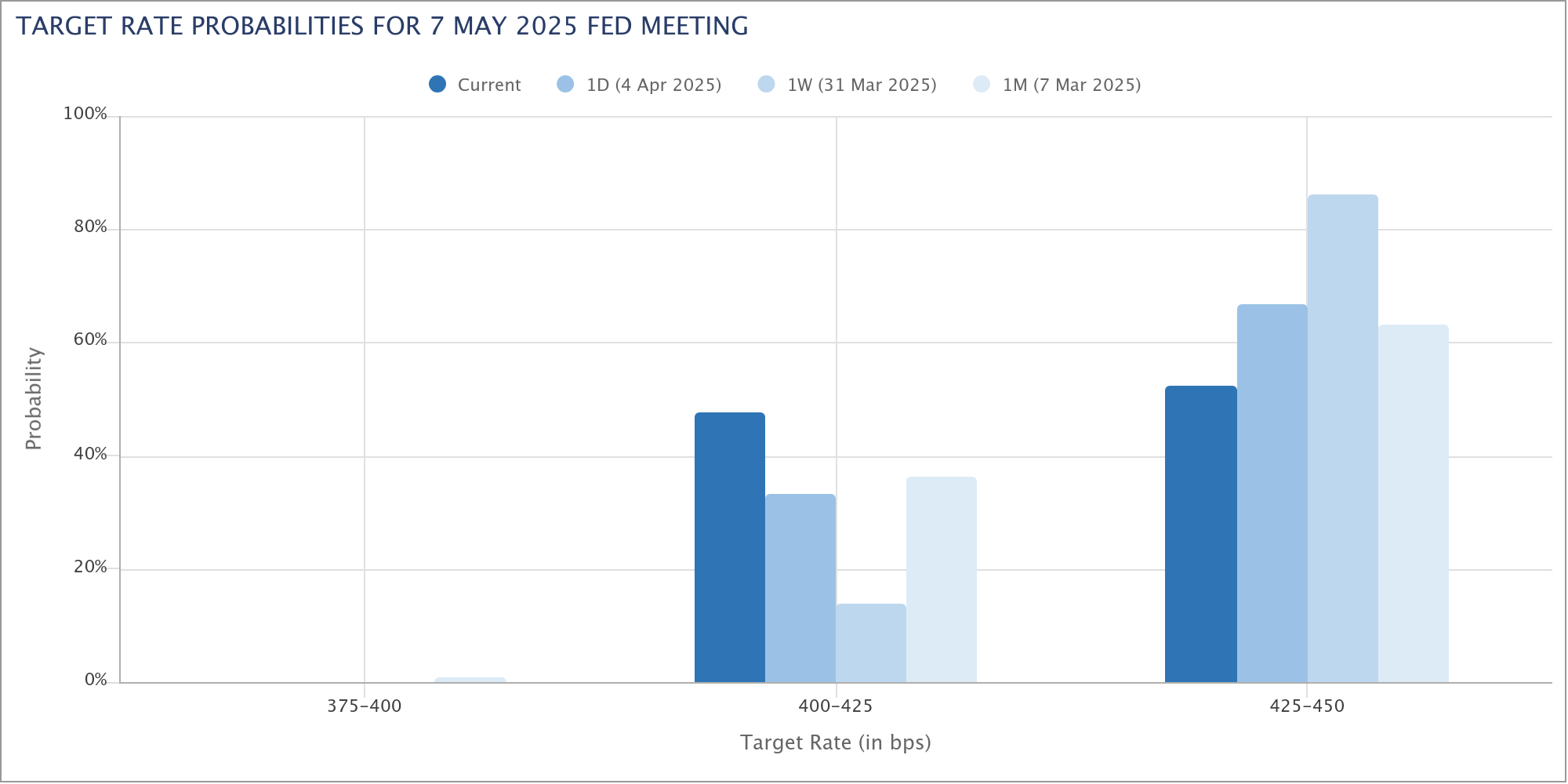
    While Fed’s restrictive stance on interest rates remains intact, this week's hot CPI and PPI data suggest that inflation is proving more persistent than policymakers had hoped. Chair Jerome Powell has already reinforced that Fed is in no hurry to cut rates, and expectations for rate reductions in the first half of the year have now diminished. Market focus will now shift to upcoming US retail sales figures and additional comments from Fed officials, as traders assess how these data points might influence the central bank’s next policy moves.

    Sterling briefly found some boost after stronger-than-expected UK GDP data, which helped ease immediate concerns over a recession. However, the currency’s gains were short-lived, as investors remain cautious about the country’s sluggish economic outlook. While BoE has signaled a path of gradual easing, the market are more conservative than BoE guidance, with traders still pricing in just two rate cuts before year-end. Given the uncertainty around inflation and growth, the pace of BoE rate cuts will remain a key point of debate in the coming months.

    For the day, Swiss Franc leads currency gains as Japanese Yen follows behind, while Sterling holds firm too. On the weaker end, Australian and New Zealand Dollars are struggling. Dollar, despite its inflation-fueled rally earlier in the week, has lost momentum, as traders await further trade policy developments. Euro and Canadian Dollar are stuck in the middle of the pack.

    In Europe, at the time of writing, FTSE is down -0.56%. DAX is up 1.64%. CAC is up 1.40%. UK 10-year yield is down -0.045 at 4.493. Germany 10-year yield is down -0.050 at 2.431. Earlier in Asia, Nikkei rose 1.28%. Hong Kong HSI fell -0.20%. China Shanghai SSE fell -0.42%. Singapore Strait Times rose 0.21%. Japan 10-year JGB yield rose 0.0028 to 1.350.

    US PPI up 0.3% mom, 3.5% yoy in Jan, above expectations

    US PPI for final demand rose by 0.4% mom in January, exceeding market expectations of 0.2% mom.

    Final demand services increased by 0.3% mom, while final demand goods rose by 0.6% mom. Core PPI measure, which strips out volatile food, energy, and trade services, climbed 0.3% mom.

    On an annual basis, headline PPI accelerated to 3.5% yoy, surpassing forecasts of 3.2% yoy. Core PPI followed closely, advancing 3.4% yoy.

    US initial jobless claims falls to 213k vs exp 221k

    US initial jobless claims fell -7k to 213k in the week ending February 8, below expectation of 221k. Four-week moving average of initial claims fell -1k to 216k.

    Continuing claims fell -36k to 1850k in the week ending February 1. Four-week moving average of continuing claims fell -1k to 1872k.

    Eurozone industrial production falls -1.1% mom in Dec, EU down -0.8% mom

    Eurozone industrial production fell by -1.1% mom in December, significantly worse than the market expectation of -0.6% mom. The decline was driven by sharp contractions in intermediate and capital goods, while non-durable consumer goods provided some offset.

    Breaking down the data, intermediate goods production declined by -1.9% mom. The production of capital goods fell even further, down -2.6% mom. Durable consumer goods also posted a modest decline of -0.7% mom. On the other hand, energy production rose by 0.5% mom, and non-durable consumer goods surged by 5.1% mom.

    At the broader EU level, industrial production contracted by -0.8% mom, with Belgium (-6.8%), Portugal (-4.4%), and Austria (-3.3%) suffering the steepest declines. Meanwhile, Ireland (+8.2%), Luxembourg (+6.7%), and Croatia (+6.3%) posted strong rebounds.

    Swiss inflation softens again as CPI slows to 0.4% in Jan

    Switzerland’s CPI declined by -0.1% mom in January, in line with market expectations. Core CPI, which excludes fresh and seasonal products, energy, and fuel, also dropped by -0.1% mom. While domestic product prices ticked up by 0.1% mom, the steep -0.7% mom decline in imported product prices suggests that external factors continue to exert deflationary pressure on the Swiss economy.

    On a year-over-year basis, headline inflation eased from 0.6% yoy to 0.4% yoy, also matching expectations. However, core CPI edged higher to 0.9% yoy from 0.7% yoy. Domestic product inflation slowed from 1.5% yoy to 1.0% yoy, reflecting weaker demand and subdued price pressures in the local economy. Meanwhile, imported product prices remained in deflationary territory, improving slightly from -2.2% yoy to -1.5% yoy.

    UK GDP surprises to the upside, services lead the growth

    The UK economy outperformed expectations in December, with GDP expanding by 0.4% mom, significantly stronger than the 0.1% growth forecast. The services sector led the way, posting 0.4% monthly growth, while production output also rebounded, rising by 0.5%. However, the construction sector remained weak, contracting -0.2% mom.

    For Q4 as a whole, GDP increased by 0.1% qoq, defying expectations for a -0.1% contraction. Services grew by 0.2% in Q4, maintaining its position as the primary growth driver, while construction saw a moderate expansion of 0.5%. However, industrial production was a notable drag, shrinking by -0.8%.

    For full-year 2024, GDP increased by 0.8% compared to 2023, a modest but better-than-feared outcome given the economic uncertainties. Services expanded by 1.3%, cushioning the economy, while production sector contracted by -1.7%, and construction grew slightly by 0.4%.

    RBNZ survey shows rate cut expectations firm up

    The latest RBNZ Survey of Expectations showed a mixed shift in inflation forecasts, with short-term price pressures edging higher but long-term expectations trending lower. The survey, nonetheless, reinforces anticipation of further rate cuts.

    One-year-ahead inflation expectation rose from 2.05% to 2.15%, marking a slight uptick. However, two-year-ahead inflation expectations dipped from 2.12% to 2.06%, while five-year and ten-year expectations both declined by 11-12 basis points to 2.13% and 2.07%, respectively.

    RBNZ's Official Cash Rate currently stands at 4.25% following 50bps reduction in last November. Survey respondents broadly expect another 50-bps cut to 3.75% by the end of Q1. The one-year-ahead OCR expectation also moved lower, falling 10bps to 3.23%, reinforcing the view that RBNZ will continue easing policy at a measured pace.

    GBP/USD Mid-Day Outlook

    Daily Pivots: (S1) 1.2387; (P) 1.2435; (R1) 1.2493; More...

    Outlook in GBP/USD is unchanged and intraday bias stays neutral. Corrective rebound from 1.2099 could still extend higher. But upside should be limited by 38.2% retracement of 1.3433 to 1.2099 at 1.2609. On the downside, below 1.2331 minor support will turn bias to the downside for 1.2248 support. Firm break there will argue that the correction has completed and bring retest of 1.2099 low. However, decisive break of 1.2609 will raise the chance of near term reversal, and target 61.8% retracement at 1.2923.

    In the bigger picture, rise from 1.0351 (2022 low) should have already completed at 1.3433 (2024 high), and the trend has reversed. Further fall is now expected as long as 1.2810 resistance holds. Deeper decline should be seen to 61.8% retracement of 1.0351 to 1.3433 at 1.1528, even as a corrective move. However, firm break of 1.2810 will dampen this bearish view and bring retest of 1.3433 high instead.

    Economic Indicators Update

    GMT CCY EVENTS ACT F/C PP REV
    23:50 JPY PPI Y/Y Jan 4.20% 4.00% 3.80% 3.90%
    00:00 AUD Consumer Inflation Expectations Feb 4.60% 4.00%
    00:01 GBP RICS Housing Price Balance Jan 22% 27% 28% 26%
    02:00 NZD RBNZ Inflation Expectations Q1 2.06% 2.12%
    07:00 EUR Germany CPI M/M Jan F -0.20% -0.20% -0.20%
    07:00 EUR Germany CPI Y/Y Jan F 2.30% 2.30% 2.30%
    07:00 GBP GDP Q/Q Q4 P 0.10% -0.10% 0.00%
    07:00 GBP GDP M/M Dec 0.40% 0.10% 0.10%
    07:00 GBP Industrial Production M/M Dec 0.50% 0.30% -0.40% -0.50%
    07:00 GBP Industrial Production Y/Y Dec -1.90% -2.10% -1.80%
    07:00 GBP Manufacturing Production M/M Dec 0.70% 0.10% -0.30%
    07:00 GBP Manufacturing Production Y/Y Dec -1.40% -1.90% -1.20% -1.10%
    07:00 GBP Goods Trade Balance (GBP) Dec -17.4B -18.3B -19.3B -18.9B
    07:30 CHF CPI M/M Jan -0.10% -0.10% -0.10%
    07:30 CHF CPI Y/Y Jan 0.40% 0.40% 0.60%
    09:00 EUR ECB Economic Bulletin
    10:00 EUR Eurozone Industrial Production M/M Dec -1.10% -0.60% 0.20% 0.40%
    13:30 USD PPI M/M Jan 0.40% 0.20% 0.20% 0.50%
    13:30 USD PPI Y/Y Jan 3.50% 3.20% 3.30%
    13:30 USD PPI Core M/M Jan 0.30% 0.30% 0.00%
    13:30 USD PPI Core Y/Y Jan 3.60% 3.30% 3.50%
    13:30 USD Initial Jobless Claims (Feb 7) 213K 221K 219K 220K
    15:30 USD Natural Gas Storage -90B -174B


    US initial jobless claims falls to 213k vs exp 221k

    US initial jobless claims fell -7k to 213k in the week ending February 8, below expectation of 221k. Four-week moving average of initial claims fell -1k to 216k.

    Continuing claims fell -36k to 1850k in the week ending February 1. Four-week moving average of continuing claims fell -1k to 1872k.

    Full US jobless claims release here.