Thu, Apr 09, 2026 17:07 GMT
More

    Sample Category Title

    USD/JPY Daily Outlook

    ActionForex

    Daily Pivots: (S1) 151.83; (P) 152.49; (R1) 152.96; More...

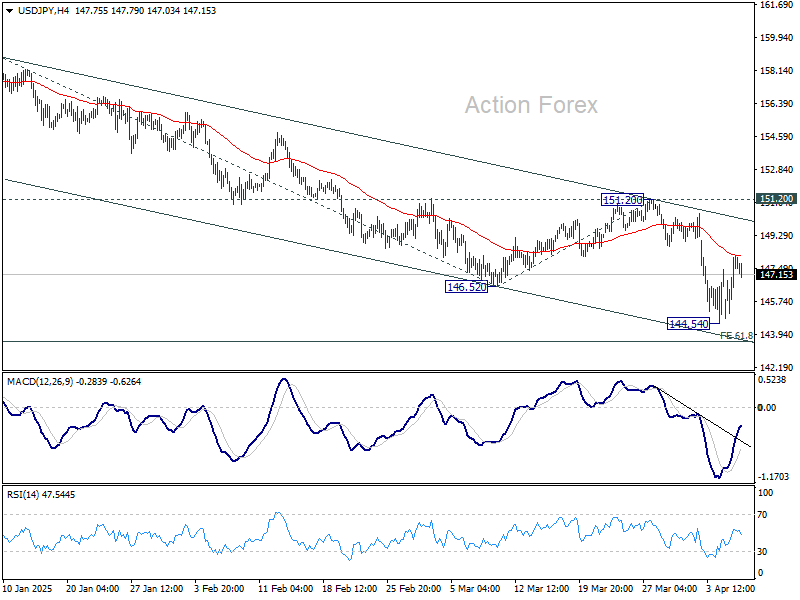
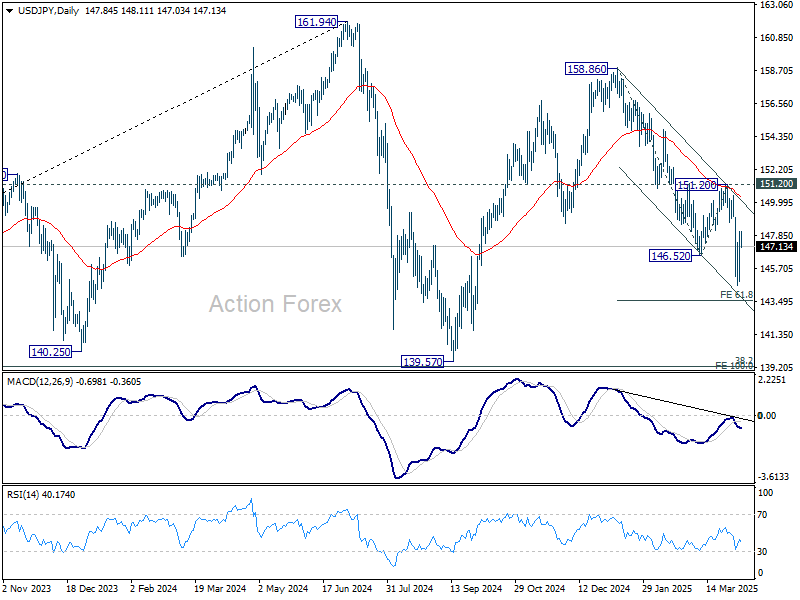
    Intraday bias in USD/JPY stays neutral first. Strong support from 38.2% retracement of 139.57 to 158.86 at 151.49 would maintain near term bullishness. On the upside, break of 154.79 will revive the case that correction from 158.86 has completed at 150.29. Further rise should be seen to retest 158.86 high. However, break of 150.92 and sustained trading below 151.49 will raise the chance of trend reversal, and target 148.64 support instead.

    In the bigger picture, price actions from 161.94 are seen as a corrective pattern to rise from 102.58 (2021 low). In case of another fall, strong support should be seen from 38.2% retracement of 102.58 to 161.94 at 139.26 to bring rebound. However, sustained break of 139.26 would open up deeper medium term decline to 61.8% retracement at 125.25.
    Yen Rallies as Strong GDP Fuels BoJ Rate Hike Speculation

    Yen gained strength across the board after Japan’s Q4 GDP growth exceeded expectations, with both private consumption and capital investment rebounding. This development supports BoJ’s decision to hike in January and has fueled speculation that another rate increase could arrive sooner than expected.

    It's now seen by some economists that the timing of the next BoJ move will largely hinge on the outcome of the Shunto wage negotiations, with markets eyeing a hike as early as May if wage growth matches 2024 levels.

    Beyond Japan, Aussie and Kiwi have maintained their footing, benefitting from a mildly positive risk-on sentiment, even as both the RBA and RBNZ are expected to cut interest rates this week. Meanwhile, Dollar continues to struggle, extending its losses from last week. Euro and Swiss Franc are also on the softer side, while Loonie and Sterling trade mixed.

    AUD/NZD would be a pair to watch this week with some bearish risks. Technically, choppy recovery from 1.0940 is likely just a corrective move. Hence, in case of another upside, upside should be limited by 1.1177 resistance. On the downside, firm break of the near term rising channel support (now at 1.1023) will argue that the recovery has already complete at 1.1141. Deeper decline should be seen back towards 1.0940 support as the third leg of the pattern from 1.1177.

    In Asia, at the time of writing, Nikkei is down -0.01%. Hong Kong HSI is down -0.45%. China Shanghai SSE is down -0.44%. Singapore Strait Times is up 0.49%. Japan 10-year JGB yield is up 0.0114 at 1.368.

    Japan’s Q4 GDP beats forecasts with 0.7% qoq growth

    Japan’s economy expanded by 0.7% qoq in Q4 2024, surpassing market expectations of 0.3% qoq and improving from the previous quarter’s 0.4% qoq rise. On an annualized basis, GDP grew 2.8%, significantly above 1.0% forecast and accelerating from Q3’s 1.7% pace.

    Private consumption, which accounts for over half of Japan’s economic output, edged up by 0.1% qoq, defying expectations of a -0.3% qoq contraction. However, it slowed sharply from the 0.7% qoq increase recorded in Q3, reflecting a cautious spending environment.

    Capital spending improved by 0.5% qoq, reversing the -0.1% qoq decline in Q3, but fell short of the anticipated 1.0% qoq rise.

    Price pressures continued climbing, with the GDP deflator inching up from 2.4% yoy to 2.8% yoy.

    Despite the strong Q4 performance, full-year 2024 GDP growth slowed sharply to 0.1%, a steep decline from the 1.5% expansion in 2023.

    NZ BNZ services rises to 50.4, stabilization rather than elevation

    New Zealand BusinessNZ Performance of Services Index climbed from 48.1 to 50.4 in January, marking a return to expansion after four consecutive months of contraction. While this signals some improvement, the index remains below its long-term average of 53.1.

    A closer look at the components reveals a mixed picture. Activity/sales saw a notable rebound, rising from 46.5 to 54.0, while new orders/business ticked up slightly from 49.4 to 50.0. Stocks/inventories also edged into expansion territory at 50.1, up from 48.9. However, employment continued to struggle, slipping from 47.4 to 47.1. Supplier deliveries showed minimal improvement, moving from 47.7 to 47.8.

    Despite the headline figure turning positive, sentiment remains weak. The proportion of negative comments rose to 61.9% in January, up from 57.5% in December and 53.6% in November. Respondents cited economic uncertainty and broader downturn concerns as key issues.

    BNZ’s Senior Economist Doug Steel noted that the PSI reflects “stabilization rather than elevation,” highlighting that while the upward move is a positive sign, the sector is far from robust growth.

    RBA, RBNZ rate cuts, FOMC minutes, and more

    The upcoming week is set to be highly eventful for global markets, with two major central bank meetings and a packed economic calendar. RBA and RBNZ are both expected to lower interest rates. Additionally, investors will scrutinize Fed’s January FOMC minutes to gauge the timing and conditions for policy shifts. Meanwhile, key economic indicators from the UK, Eurozone, Canada, and Japan will provide further insights into their economic trends.

    RBA is widely expected to cut interest rates by 25 bps to 4.10%, marking its first rate reduction in this cycle. The decision follows the latest Q4 trimmed mean CPI, which revealed stronger-than-expected disinflation. Market participants will closely analyze the accompanying Statement on Monetary Policy for clues on the outlook. Some analysts anticipate a steady quarterly pace of 25 bps cuts, which could bring the cash rate to a neutral level of 3.35% by the end of the year.

    RBNZ is expected to move more aggressively, with a 50 bps cut to 3.75%, as it seeks to transition its policy stance toward a neutral level of 2.50%-3.50%. However, with the rate approaching this estimated range, the central bank may soon opt for smaller rate cuts moving forward. Investors will carefully assess the updated Monetary Policy Statement to determine whether RBNZ signals a slowdown in its pace of easing and to gauge expectations for the terminal rate of this cycle.

    Fed’s January FOMC meeting minutes will provide additional insights into policymakers’ discussions on the policy outlook. It is well understood that Fed is in no rush to resume policy easing, given persistent inflation and other risks. However, investors will be looking for answers to key questions: What conditions would trigger a resumption of rate cuts? When does the Fed expect this to happen? Is a rate hike completely off the table?

    BoE's rate path has been relatively uncertain in recent weeks. The stronger-than-expected Q4 UK GDP data has significantly reduced the likelihood of a back-to-back rate cut in March. However, this week’s UK employment, wage growth, CPI, retail sales, and PMI reports will be critical in shaping market expectations. If these indicators show resilience in the economy and inflation remains sticky, markets will likely fully revert to pricing in a gradual, one-cut-per-quarter approach.

    For Euro and DAX, German ZEW Economic Sentiment and Eurozone PMIs will be particularly important. If these data points confirm that Germany’s sluggish economy is finally starting to turnaround, it would provide a significant boost to investor sentiment and strengthen the case for continued DAX and Euro gains. Apart from central bank decisions, inflation data from Canada and Japan will also be closely watched.

    Here are some highlights for the week:

    • Monday: New Zealand BNZ services; Japan GDP; Eurozone trade balance.
    • Tuesday: RBA rate decision; UK employment; German ZEW economic sentiment; Canada CPI; US Empire state manufacturing, NAHB housing index.
    • Wednesday: New Zealand PPI; Japan trade balance, machine orders; Australia wage price index; RBNZ rate decision; UK CPI, PPI; Eurozone current account; US building permits and housing starts, FOMC minutes.
    • Thursday: Australia employment; Swiss trade balance; Germany PPI; Canada IPPI and RMPI; US jobless claims, Philly Fed survey.
    • Friday: New Zealand trade balance; Australia PMIs; Japan CP, PMIs; UK Gfk consumer confidence, retail sales; PMIs; Eurozone PMIs; Canada retail sales; US PMIs, existing home sales.

    USD/JPY Daily Outlook

    Daily Pivots: (S1) 151.83; (P) 152.49; (R1) 152.96; More...

    Intraday bias in USD/JPY stays neutral first. Strong support from 38.2% retracement of 139.57 to 158.86 at 151.49 would maintain near term bullishness. On the upside, break of 154.79 will revive the case that correction from 158.86 has completed at 150.29. Further rise should be seen to retest 158.86 high. However, break of 150.92 and sustained trading below 151.49 will raise the chance of trend reversal, and target 148.64 support instead.

    In the bigger picture, price actions from 161.94 are seen as a corrective pattern to rise from 102.58 (2021 low). In case of another fall, strong support should be seen from 38.2% retracement of 102.58 to 161.94 at 139.26 to bring rebound. However, sustained break of 139.26 would open up deeper medium term decline to 61.8% retracement at 125.25.

    Economic Indicators Update

    GMT CCY EVENTS ACT F/C PP REV
    21:30 NZD Business NZ PSI Jan 50.4 47.9 48.1
    23:50 JPY GDP Q/Q Q4 P 0.70% 0.30% 0.30% 0.40%
    23:50 JPY GDP Deflator Y/Y Q4 P 2.80% 2.80% 2.40%
    04:30 JPY Tertiary Industry Index M/M Dec 0.10% 0.20% -0.30%
    04:30 JPY Industrial Production M/M Dec -0.20% 0.30% 0.30%
    10:00 EUR Eurozone Trade Balance (EUR) Dec 15.0B 12.9B
    13:15 CAD Housing Starts Jan 250K 231K


    EUR/USD Picks Up Steam—Will It Break Key Resistance?

    Key Highlights

    • EUR/USD started a fresh increase above the 1.0400 resistance.
    • A key bullish trend line is forming with support at 1.0380 on the 4-hour chart.
    • GBP/USD climbed higher above the 1.2450 and 1.2500 resistance levels.
    • Gold prices started a downside correction from the $2,940 resistance zone.

    EUR/USD Technical Analysis

    The Euro formed a base and started a fresh increase against the US Dollar. EUR/USD surpassed the 1.0400 and 1.0420 resistance levels.

    Looking at the 4-hour chart, the pair settled above the 1.0420 level, the 100 simple moving average (red, 4-hour), and the 200 simple moving average (green, 4-hour). However, the bears are still active below the 1.0520 and 1.0535 resistance levels.

    On the downside, immediate support sits near the 1.0420 level. It is near the 38.2% Fib retracement level of the upward move from the 1.0273 swing low to the 1.0514 high.

    The next key support sits near the 1.0400 level. There is also a key bullish trend line forming with support at 1.0380 on the same chart. It is close to the 50% Fib retracement level of the upward move from the 1.0273 swing low to the 1.0514 high.

    Any more losses could send the pair toward the 1.0340 level. On the upside, the pair seems to be facing hurdles near the 1.0520 level. The next major resistance is near the 1.0535 level. The main resistance is now forming near the 1.0550 zone.

    A close above the 1.0550 level could set the tone for another increase. In the stated case, the pair could even clear the 1.0620 resistance.

    Looking at GBP/USD, the pair started a strong increase above the 1.2450 resistance and might aim for more gains above the 1.2620 level in the near term.

    Upcoming Economic Events:

    • Fed's Harker speech.
    • Fed's Bowman speech.
    • Fed's Waller speech.

    Japan’s Q4 GDP beats forecasts with 0.7% qoq growth

    Japan’s economy expanded by 0.7% qoq in Q4 2024, surpassing market expectations of 0.3% qoq and improving from the previous quarter’s 0.4% qoq rise. On an annualized basis, GDP grew 2.8%, significantly above 1.0% forecast and accelerating from Q3’s 1.7% pace.

    Private consumption, which accounts for over half of Japan’s economic output, edged up by 0.1% qoq, defying expectations of a -0.3% qoq contraction. However, it slowed sharply from the 0.7% qoq increase recorded in Q3, reflecting a cautious spending environment.

    Capital spending improved by 0.5% qoq, reversing the -0.1% qoq decline in Q3, but fell short of the anticipated 1.0% qoq rise.

    Price pressures continued climbing, with the GDP deflator inching up from 2.4% yoy to 2.8% yoy.

    Despite the strong Q4 performance, full-year 2024 GDP growth slowed sharply to 0.1%, a steep decline from the 1.5% expansion in 2023.

    NZ BNZ services rises to 50.4, stabilization rather than elevation

    New Zealand BusinessNZ Performance of Services Index climbed from 48.1 to 50.4 in January, marking a return to expansion after four consecutive months of contraction. While this signals some improvement, the index remains below its long-term average of 53.1.

    A closer look at the components reveals a mixed picture. Activity/sales saw a notable rebound, rising from 46.5 to 54.0, while new orders/business ticked up slightly from 49.4 to 50.0. Stocks/inventories also edged into expansion territory at 50.1, up from 48.9. However, employment continued to struggle, slipping from 47.4 to 47.1. Supplier deliveries showed minimal improvement, moving from 47.7 to 47.8.

    Despite the headline figure turning positive, sentiment remains weak. The proportion of negative comments rose to 61.9% in January, up from 57.5% in December and 53.6% in November. Respondents cited economic uncertainty and broader downturn concerns as key issues.

    BNZ’s Senior Economist Doug Steel noted that the PSI reflects “stabilization rather than elevation,” highlighting that while the upward move is a positive sign, the sector is far from robust growth.

    Full NZ BNZ PSI release here.

    Gold Wave Analysis

    • Gold reversed from resistance zone
    • Likely to fall to support level 2860.00

    Gold today reversed down the resistance zone between the key resistance level 2940.00 (which formed daily Doji earlier this month), the resistance trendline of the daily up channel from January and the upper daily Bollinger Band.

    The downward reversal from this resistance zone will most likely form the daily Japanese candlesticks reversal pattern Bearish Engulfing – if the price closes today near the current levels.

    Given that both daily Stochastic and RSI indicators are high in the overbought areas, Gold can be expected to fall to the next support level 2860.00.

    NZDUSD Wave Analysis

    • NZDUSD broke the resistance zone
    • Likely to rise to resistance level 0.5800

    NZDUSD currency pair recently broke the resistance zone between the key resistance level 0.5700 (which stopped the earlier waves iv, 2 and ii), the resistance trendline of the daily down channel from November and the 38.2% Fibonacci correction of the downward impulse from December.

    The breakout of this resistance zone stopped the previous minor impulse wave iii of the higher order impulse wave 1 from last October.

    NZDUSD currency pair can be expected to rise to the next resistance level 0.5800 (former monthly low from November).

    GBPUSD Wave Analysis

    • GBPUSD broke resistance zone
    • Likely to rise to resistance level 1.2720

    GBPUSD currency pair recently broke the resistance zone between the key resistance level 1.2530 (which has been reversing the price from the start of January) and the 61.8% Fibonacci correction of the downward impulse from December.

    The breakout of this resistance zone accelerated the active medium-term impulse wave (C) from the end of January.

    Given the strongly bearish US dollar sentiment seen today, GBPUSD currency pair can be expected to rise to the next resistance level 1.2720.

    EURNZD Wave Analysis

    • EURNZD reversed from long-term resistance level 1.8495
    • Likely to fall to support level 1.8200

    EURNZD currency pair recently reversed down from the major long-term resistance level 1.8495, which has been reversing the price from the middle of 2023, as can be seen below.

    If the pair closes today near the current levels it will form the weekly Japanese candlesticks reversal pattern Shooting Star – a strong sell signal for this currency pair.

    Given the strength of the resistance level 1.8495 and the bearish euro sentiment seen today, EURNZD currency pair can be expected to fall to the next support level 1.8200.

    Eco Data 2/17/25

    GMT Ccy Events Actual Consensus Previous Revised
    21:30 NZD Business NZ PSI Jan 50.4 47.9 48.1
    23:50 JPY GDP Q/Q Q4 P 0.70% 0.30% 0.30% 0.40%
    23:50 JPY GDP Deflator Y/Y Q4 P 2.80% 2.80% 2.40%
    04:30 JPY Tertiary Industry Index M/M Dec 0.10% 0.20% -0.30%
    04:30 JPY Industrial Production M/M Dec -0.20% 0.30% 0.30%
    10:00 EUR Eurozone Trade Balance (EUR) Dec 14.6B 15.0B 12.9B 13.3B
    13:15 CAD Housing Starts Jan 250K 231K
    GMT Ccy Events
    21:30 NZD Business NZ PSI Jan
        Actual: 50.4 Forecast:
        Previous: 47.9 Revised: 48.1
    23:50 JPY GDP Q/Q Q4 P
        Actual: 0.70% Forecast: 0.30%
        Previous: 0.30% Revised: 0.40%
    23:50 JPY GDP Deflator Y/Y Q4 P
        Actual: 2.80% Forecast: 2.80%
        Previous: 2.40% Revised:
    04:30 JPY Tertiary Industry Index M/M Dec
        Actual: 0.10% Forecast: 0.20%
        Previous: -0.30% Revised:
    04:30 JPY Industrial Production M/M Dec
        Actual: -0.20% Forecast: 0.30%
        Previous: 0.30% Revised:
    10:00 EUR Eurozone Trade Balance (EUR) Dec
        Actual: 14.6B Forecast: 15.0B
        Previous: 12.9B Revised: 13.3B
    13:15 CAD Housing Starts Jan
        Actual: Forecast: 250K
        Previous: 231K Revised: