

Sample Category Title
US: Retail Sales Edged Higher in February
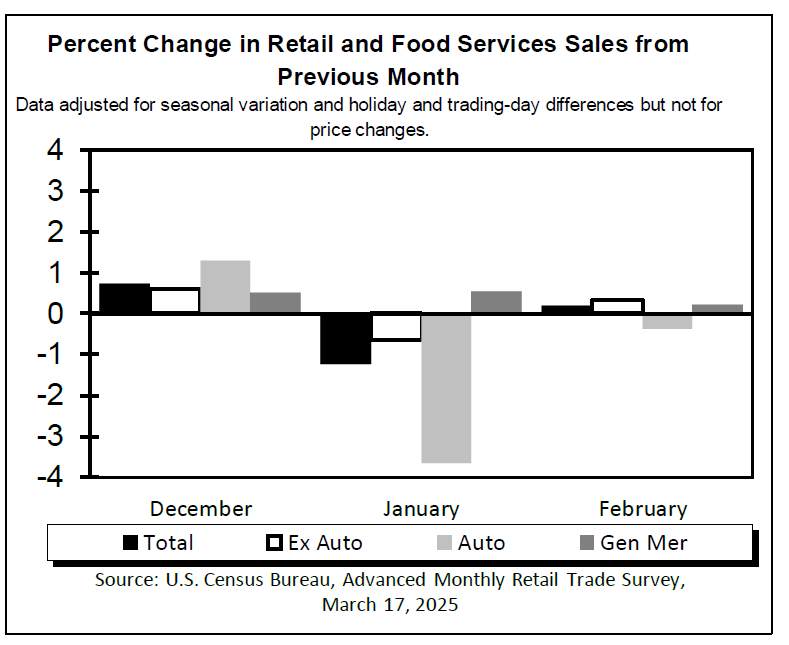
Retail and food services sales rose just 0.2% month-on-month (m/m), disappointing expectations for a stronger rebound following January's contraction. Data revisions also expanded January's contraction to -1.2% m/m from the initially reported 0.9% decline.
Vehicle and parts sales fell for the second consecutive month, weighing on the headline (-0.4% m/m). Sales at gasoline stations also posted a sizeable decline, falling by 1% from the prior month. Building materials and equipment stores' sales edged slightly higher (+0.2% m/m), posting the first gain since September 2024.
Sales in the "control group", which the excludes volatile components above (i.e., gasoline, autos and building supplies) fared much better than the headline, increasing by 1% on the month, fully reversing January's drop.
Online sales rebounded 2.4% on the month, but sales were mixed across brick-and-mortar retailers. The largest gains were in health & personal care stores (+1.7% m/m). Sales also increased at food and beverage stores (+0.4% m/m) and general merchandise stores (+0.2%). On the other hand, February marked the second consecutive month that sales declined at the clothing and accessories stores (-0.6%) and sporting goods & hobby stores (-0.4% m/m).
Sales at bars and restaurants posted a large decline, falling by 1.5%, extending the disappointing performance in this category to three consecutive months.
Key Implications
The rebound in the total retail sales was soft, but the gain in core sales was more robust, entirely reversing the January's pullback which was likely influenced by inclement weather across much of the U.S. Still, the yo-yo like movements in the last couple of months leave core retail sales with little progress, stuck at the same level they were back in December of 2024. As a result, we expect real consumer spending to lose momentum in Q1, expanding by just 1.5% (annualized), less than half its pace in the fourth quarter of 2024.
For the year as whole, consumer spending is expected to be much softer. U.S. consumers are getting nervous about the intensifying trade fight which is fanning flames consumer anxiety about inflation. As a result, households' confidence rapidly deteriorated in recent months. The University of Michigan's index of consumer confidence showed year-ahead inflation expectations jumping to 4.9% in March, up from 4.3% in February and 2.8% in December 2024. This is the highest level since November 2022, when core PCE inflation was running north of 5%. Even as the labour market continues to hold up reasonably well and household wealth is still significant, the drop in sentiment will likely manifest in weaker spending over the coming quarters.
GBP/USD Mid-Day Outlook
Daily Pivots: (S1) 1.2910; (P) 1.2934; (R1) 1.2958; More...
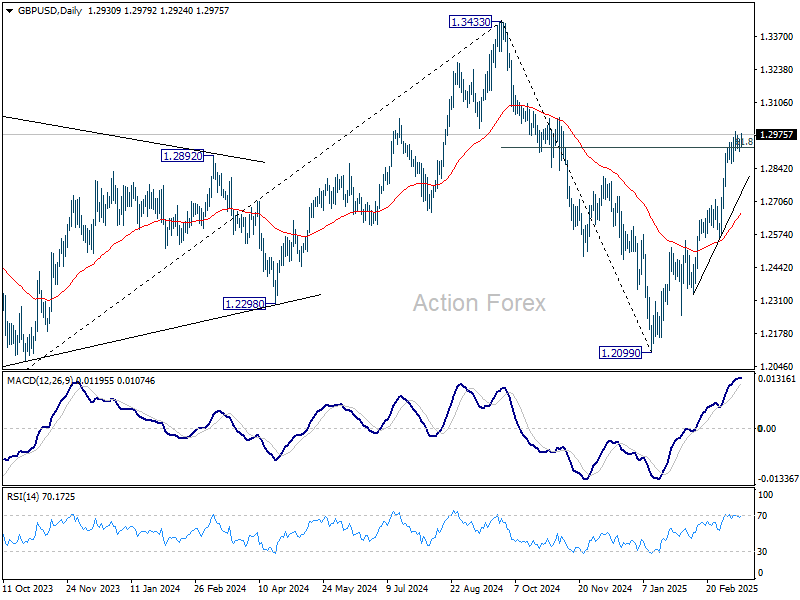
GBP/USD bounces slightly today and outlook is unchanged. Further rally is in favor with 1.2860 support intact. On the upside, sustained trading above 61.8% retracement of 1.3433 to 1.2099 at 1.2923 will pave the way back to 1.3433 high. However, break of 1.2860 will indicate short term topping, and turn bias back to the downside for deeper pullback.
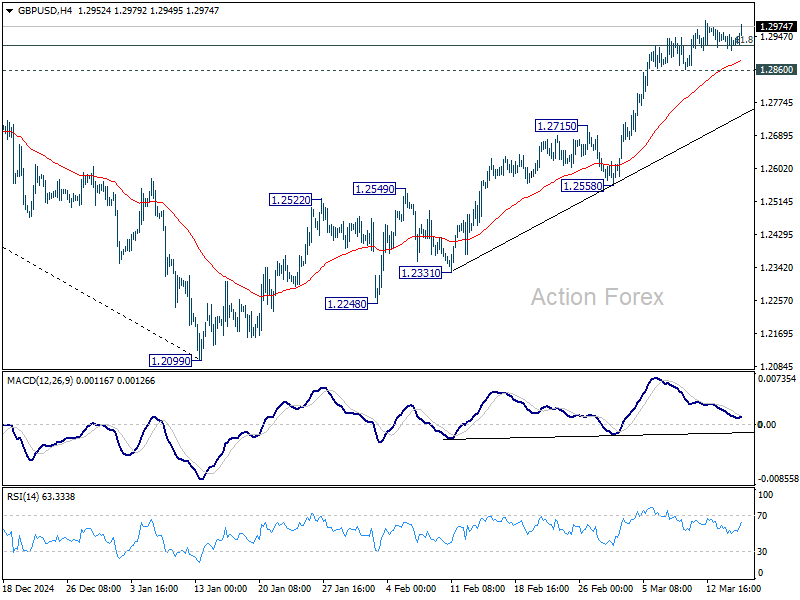
In the bigger picture, up trend from 1.3051 (2022 low) is not completed. Resumption is expected after corrective pattern from 1.3433 completes. Next target will be 1.4248 key resistance. This will now remain the favored case as long as 1.2099 support holds.
Dollar Edges Lower Post-Retail Sales, But Cautious Traders Keep Selling Momentum Limited
Dollar edged lower in early U.S. trading following weaker-than-expected retail sales data. However, the downside pressure remained limited, as investors took comfort in the fact that February’s sales growth marked a return to expansion after contraction in January. The data helped ease fears of an extended downturn in consumer spending, with markets breathing a sigh of relief that demand has not fallen into a prolonged slump. Still, with Fed's policy decision and updated economic projections looming midweek, traders remain cautious and hesitant to take aggressive positions.
Beyond Fed, geopolitical developments are also on investors’ minds. U.S. President Donald Trump indicated he would speak with Russian President Vladimir Putin on Tuesday to discuss potential steps toward ending the war in Ukraine. This follows positive talks between US and Russian officials in Moscow, raising hopes that diplomatic efforts could progress. However, it remains uncertain whether concrete agreements will emerge, and markets will be closely monitoring any developments that could impact global risk sentiment.
Meanwhile, Euro traders are also in wait-and-see mode, with focus squarely on Germany’s parliamentary vote on Chancellor-in-waiting Friedrich Merz’s proposed state borrowing program tomorrow. The budget committee approved the plans on Sunday, but the vote faces last-minute legal challenges from the far-right Alternative for Germany party, which has petitioned the constitutional court, arguing that there was insufficient time for expert scrutiny. If the challenge gains traction, it could delay or complicate the EUR500B infrastructure and defense spending program.
Adding to concerns for Germany, the Munich-based Ifo Institute released a bleak economic forecast, predicting that the country's economy will grow by just 0.2% this year, following two consecutive years of contraction. The report cited weak demand for industrial goods and increasing competitive pressures from global markets as key drags on growth.
In the currency markets, New Zealand Dollar is currently the strongest performer, followed by Australian Dollar, both of which are benefiting from renewed optimism surrounding China’s "special action plan" to boost consumption. On the other end, Japanese Yen is the weakest, followed by Dollar and Euro. The British pound and Swiss Franc are currently in the middle of the pack.
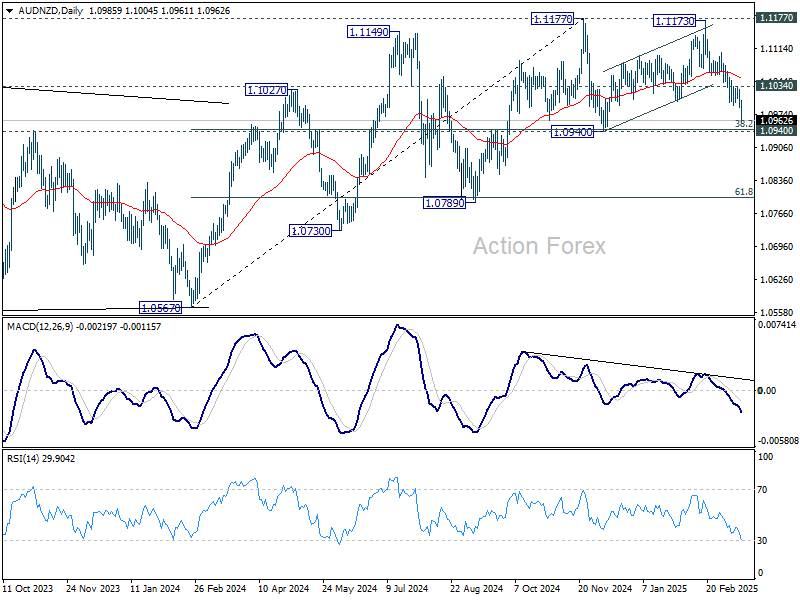
Technically, AUD/NZD's decline from 1.1173 accelerates lower today. Immediate focus is now on 1.0940 cluster support (38.2% retracement of 1.0567 to 1.1177 at 1.0944). Strong rebound from there will keep the up trend from 1.0567 intact for another rally through 1.1177 at a later stage. However, sustained break of 1.0940/4 will complete a double top pattern (1.1177, 1.1173), and indicates bearish trend reversal. Deeper decline should then be seen to 61.8% retracement at 1.0800 next.
In Europe, at the time of writing, FTSE is up 0.26%. DAX is up 0.26%. CAC is up 0.40%. UK 10-year yield is down -0.023 at 4.651. Germany 10-year yield is down -0.060 at 2.819. Earlier in Asia,Nikkei rose 0.93%. Hong Kong HSI rose 0.77%. China Shanghai SSE rose 0.19%. Singapore Strait Times rose 0.61%. Japan 10-year JGB yield fell -0.025 to 1.503.
OECD trims global growth outlook amid trade tensions and policy uncertainty
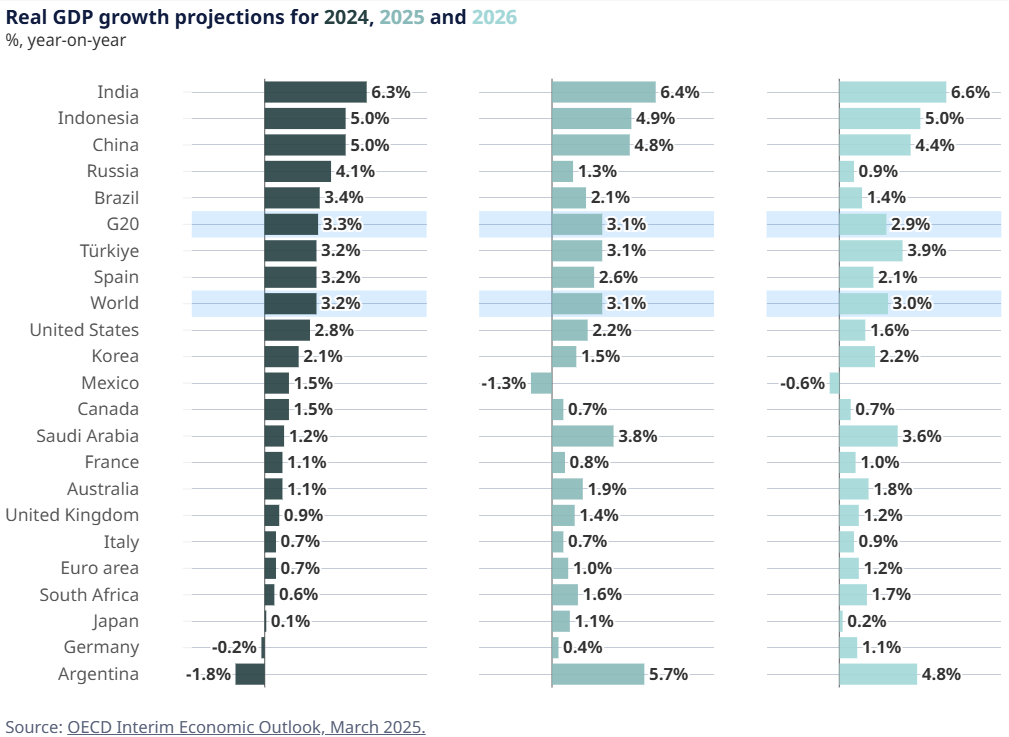
OECD forecasts a slight slowdown in global economic growth over the next two years, reflecting the effects of escalating trade tensions and heightened policy uncertainty. In its Interim Economic Outlook, OECD projects global growth will ease from 3.2% in 2024 to 3.1% in 2025, and further to 3.0% in 2026. These numbers represent a downgrade from its previous forecasts, which projected 3.3% growth for both this year and next.
Among advanced economies, the US is expected to lose momentum, with growth forecast at 2.2% in 2025 before cooling to 1.6% in 2026—down from earlier estimates of 2.4% and 2.1%.
Meanwhile, Eurozone is projected to increase from 1.0% growth this year to 1.2% in 2026. Although this marks an improvement relative to 2024’s mild performance, it still lags the OECD’s previous forecasts of 1.3% and 1.5%.
The imposition of higher tariffs is expected to weigh particularly heavily on North American economies beyond the US. Canada’s growth rate is set to slow to 0.7% this year and next, well below the 2% previously estimated.
Mexico would be hit hardest, with its economy forecast to contract by -1.3% in 2025 and a further -0.6% the following year—reversing prior expectations for moderate growth.
By contrast, China appears relatively well-positioned to manage the fallout from higher tariffs. OECD anticipates that targeted government stimulus will support growth to 4.8% in 2025—slightly above the previous forecast of 4.7%—before moderating to 4.4% in 2026.
OECD Secretary-General Mathias Cormann warned that signs of weakness are emerging in the global economy, primarily due to "heightened policy uncertainty." He added that "increasing trade restrictions" will raise costs for both production and consumption.
US retail sales rises 0.2% mom in Feb, ex-auto sales up 0.3% mom
US retail sales grew 0.2% mom to USD 722.7B in February, well below expectation of 0.7% mom. Ex-auto sales rose 0.3% mom to USD 584.7B , below expectation of 0.5% mom.
Ex-gasoline sales rose 0.3% mom. to USD 669.9B. Ex-auto& gasoline sales rose 0.5% mom to USD 627.2B.
Total sales for December through February period was up 3.8% from the same period a year ago.
ECB’s de Guindos: Trump’s tariffs complicate ECB's monetary policy decisions
ECB Vice President Luis de Guindos acknowledged that US President Donald Trump’s tariff policies have made the central bank’s monetary policy decisions more challenging, creating an environment of increased uncertainty.
Speaking to Spanish radio Onda Cero, de Guindos noted that the "clarity regarding future decisions" has diminished in a situation "much more opaque than just six months ago."
He also pushed back ECB’s inflation target timeline, stating that inflation is now expected to reach the 2% goal in Q1 2026, later than the previous mid-2025 projection, due to the impact of higher energy prices.
Despite these concerns, de Guindos remained cautiously optimistic that "everything is moving in the right direction." While tariffs could lead to some short-term inflationary effects, he suggested that slower economic activity resulting from trade disruptions could ultimately offset these pressures over time.
NZ BNZ services falls to 49.1, slips back into contraction
New Zealand’s BusinessNZ Performance of Services Index fell back into contraction territory in February, dropping from 50.4 to 49.1. The index remains well below its long-term average of 53.0.
Key components of the survey also showed deterioration, with Activity/Sales slipping from 53.8 to 49.2, New Orders/Business falling from 50.0 to 49.4, and Stocks/Inventories declining from 50.0 to 48.0. While Employment showed a slight improvement, rising from 47.4 to 48.9, it remains in contraction.
Despite the sector’s renewed contraction, negative sentiment among businesses showed a modest improvement, with 57.8% of comments in February expressing pessimism, down from 61.9% in January. Most firms cited the challenging economic climate as their primary concern.
BNZ’s Senior Economist Doug Steel said that “while one might have hoped that the PSI would move higher again, we know that economic turning points can be messy. The brief foray above 50 in January remains the only month in the last year the PSI hasn’t been in contraction”.
China’s data shows resilient start in 2025, government unveils plan to boost consumption
China’s economy got off to a stronger-than-expected start in the first two months of the year. Industrial production grew 5.9% yoy, beating market expectations of 5.3% yoy. Retail sales also exceeded forecasts, rising 4.0% yoy compared to an expected 3.8% yoy, reflecting improving consumer demand.
Meanwhile, fixed asset investment increased by 4.1% yoy, surpassing projections of 3.2% yoy, but ongoing weaknesses in the real estate sector persisted, with property investment falling -9.8% yoy. Additionally, private investment remained flat, signaling that confidence among smaller businesses and private enterprises was subdued.
China’s National Bureau of Statistics noted that existing and new policies aimed at stimulating growth have begun to take effect, leading to steady expansion in the industrial and services sectors, improved investment, and stable employment conditions. Officials highlighted “new quality productive forces” as key drivers of momentum.
To further bolster domestic demand, China’s State Council unveiled a “special action plan” over the weekend, aiming to increase household incomes, introduce childcare subsidies, and reduce financial burdens to encourage consumption.
While the plan was widely circulated across local governments, it lacked concrete details on financial support for implementation, leaving uncertainties about its immediate impact.
GBP/USD Mid-Day Outlook
Daily Pivots: (S1) 1.2910; (P) 1.2934; (R1) 1.2958; More...
GBP/USD bounces slightly today and outlook is unchanged. Further rally is in favor with 1.2860 support intact. On the upside, sustained trading above 61.8% retracement of 1.3433 to 1.2099 at 1.2923 will pave the way back to 1.3433 high. However, break of 1.2860 will indicate short term topping, and turn bias back to the downside for deeper pullback.
In the bigger picture, up trend from 1.3051 (2022 low) is not completed. Resumption is expected after corrective pattern from 1.3433 completes. Next target will be 1.4248 key resistance. This will now remain the favored case as long as 1.2099 support holds.
US retail sales rises 0.2% mom in Feb, ex-auto sales up 0.3% mom
US retail sales grew 0.2% mom to USD 722.7B in February, well below expectation of 0.7% mom. Ex-auto sales rose 0.3% mom to USD 584.7B , below expectation of 0.5% mom.
Ex-gasoline sales rose 0.3% mom. to USD 669.9B. Ex-auto& gasoline sales rose 0.5% mom to USD 627.2B.
Total sales for December through February period was up 3.8% from the same period a year ago.
WTI Oil Technical Outlook: Potential Corrective Rebound Looms
- The three-month downtrend phase of WTI crude oil from January 2025 has stalled at a major range support of US$65.40/barrel.
- China’s impending expansionary policies to boost domestic consumption have negated the recent weakness in oil prices ignited by geopolitical factors, and US President Trump’s erratic trade tariffs policy.
- Technical analysis suggests WTI crude oil may shape a potential medium-term multi-week corrective rebound to retest the key 200-day moving average at around US$73.50/barrel.
After a failed bullish breakout at the start of 2025, the price actions of West Texas Oil CFD (a proxy of the WTI crude oil futures) have evolved into a medium-term downtrend phase from an intraday high of US$80.76 per barrel to its recent 5 March low of US$65.40, an accumulated loss of 19% in the past three months.
The recent sluggishness in oil prices has been primarily driven by geopolitical factors such as a looming potential peace deal between Ukraine and Russia brokered by the US that may boost Russian oil flows after the removal of sanctions imposed by the previous US White House administration.
Also, OPEC+ members have signaled a willingness to proceed with an earlier planned output hike to increase oil supply by 138,00o barrels per day in April triggering another layer of negative feedback loop into oil prices; despite the growing risk of a slower global economic growth prospects due to US President Trump’s erratic global trade tariffs policy.
Interestingly, the multi-month downtrend of the West Texas Oil CFD has managed to stall again at its major range support zone of US$67.55/65.40 per barrel where it has staged several multi-week rebounds in past occasions since March 2023.
West Texas Oil CFD has staged a multi-day rally of 4.7% from last Tuesday,11 March intraday low to today, 17 March current intraday high of US$68.45 per barrel.
China’s expansionary policies may slow down the speed of decline in oil prices
The current upbeat tone in oil prices managed to negate the recent softness as highlighted earlier has been the willingness of China’s top policymakers to implement more expansionary fiscal policies to boost domestic consumption to reverse the ongoing deflationary spiral in the Chinese economy.
On Sunday, China’s State Council unveiled a “special action” plan to jumpstart consumer spending that consisted of measures to increase residents’ income and the establishment of a childcare subsidy scheme. This plan comes a week after Chinese Premier Li Qiang’s work report during the National People’s Congress which he mentioned the word “consumption” 27 times, the most in a decade, which was a switch from the previous year’s strongly emphasized word of “high-quality development”.
MACD trend indicator of WTI crude oil has turned bullish
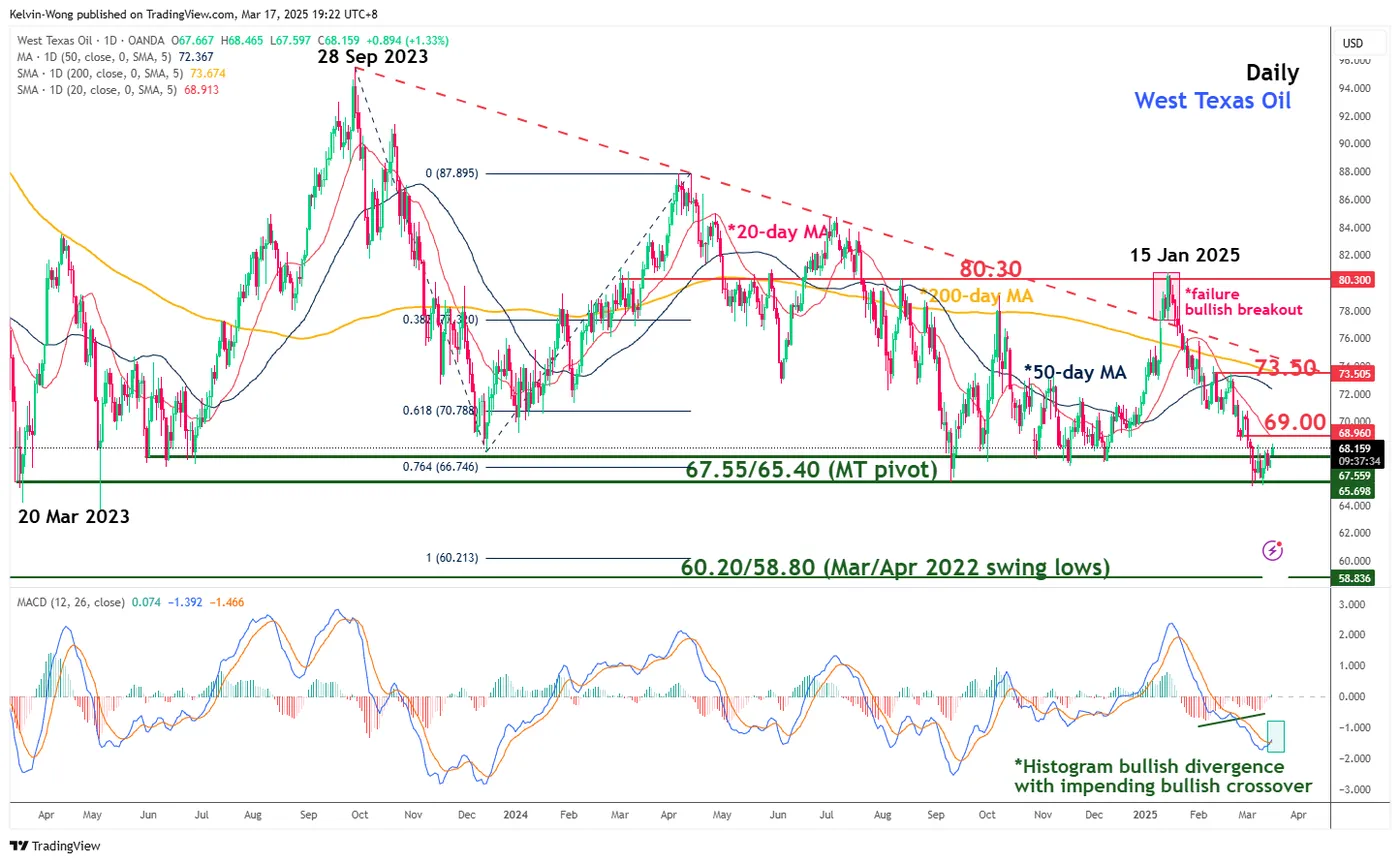
Fig 1: West Texas Oil CFD medium-term trend as of 17 Mar 2025 (Source: TradingView, click to enlarge chart)
The daily MACD trend indicator of West Texas Oil CFD (a proxy of the WTI crude oil futures) has flashed out two bullish conditions. Firstly,
A bullish divergence on the MACD Histogram was triggered earlier on 10 March 2025 followed by today’s impending MACD bullish crossover of its signal line.
These observations suggest that there may be a change of trend condition for its current three-month downtrend phase from 15 January 2025 swing high to kickstart a potential minor corrective rebound sequence to retrace some of its earlier losses (see Fig 1).
Watch the US$65.40 key medium-term pivotal support and a clearance above the intermediate resistance of US$69.00 (also the 20-day moving average) may see the medium-term resistance coming in at US$73.50 (also the 200-day moving average).
However, a breakdown with a daily close below US$65.40 may trigger an impulsive down move sequence to expose the next medium-term support zone of US$60.20/58.80 in the first step.
EURJPY Outlook after ECB Update (17th March)
Fundamental Factors Affecting EURJPY
- ECB Rate Cuts Expected: Analysts forecast two more rate cuts in April and June, bringing the deposit rate to 2.0% but not lower.
- Government Spending Impact: Increased defense and infrastructure spending, particularly in Germany, could boost growth but fuel inflation, limiting further easing.
- Diverging ECB Views: Policymakers remain split—some warn of potential future hikes, while others see room for continued easing.
- Market Uncertainty: Rate cut expectations have softened, with some traders now pricing in a possible pause in April.
- Economic Growth Projections: According to ECB estimates, the eurozone is expected to grow 0.9% in 2025, 1.2% in 2026, and 1.5% in 2027.
Key Takeaway for Traders
While the ECB is still on track for two rate cuts, fiscal stimulus, and inflation concerns may limit further easing beyond 2025. Traders should watch for ECB statements and economic data, as shifting rate expectations could drive EURJPY fluctuations.
EURJPY – D1 Timeframe
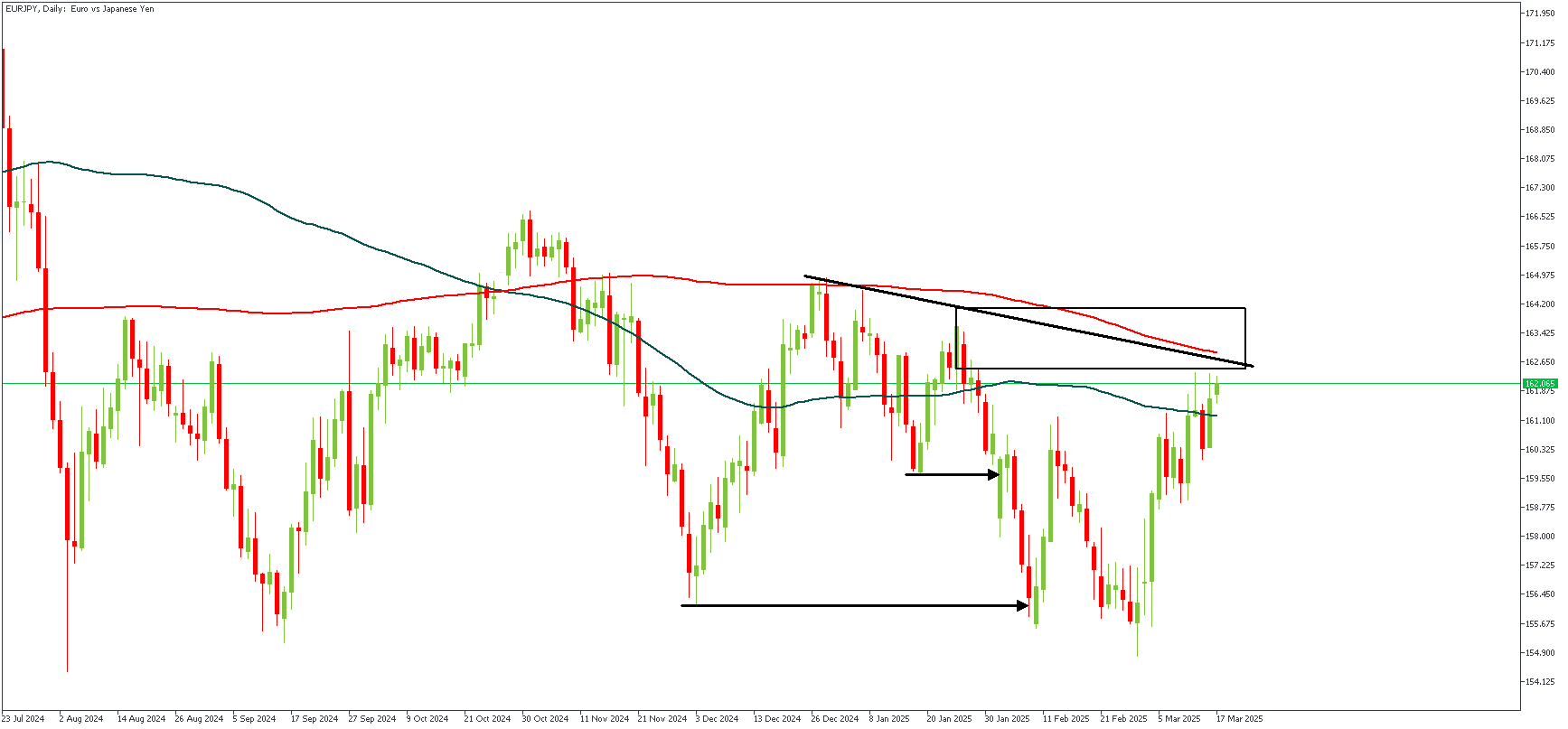
The EURJPY rate on the daily timeframe chart is currently leaning on the rally-base-drop supply zone after an impulsive bearish move. The bearish array of the moving averages, coupled with the trendline resistance and the 76% Fibonacci retracement level, signals the likelihood of renewed bearish momentum.
EURJPY – H4 Timeframe
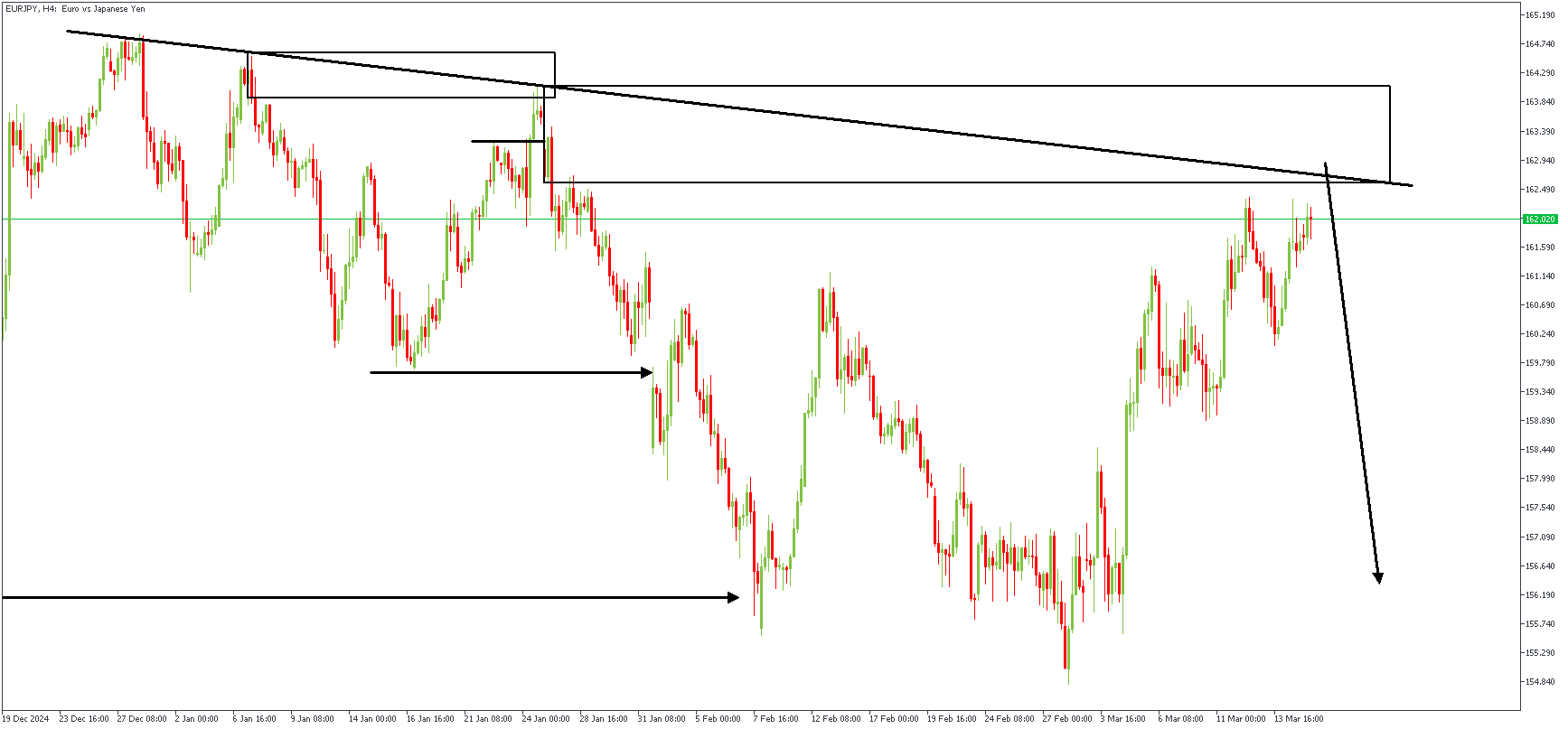
On the EURJPY 4-hour timeframe chart, we discover the elusive SBR (Sweep Break Retest) price action pattern. The supply zone is our major focus for the bearish continuation entry based on all the previously mentioned confluences.
Analyst’s Expectations:
- Direction: Bearish
- Target- 156.859
- Invalidation- 164.632
S&P 500 Analysis: How Long Could the Stock Market Correction Last?
Six days ago, we noted that the Nasdaq 100 had entered a correction phase. Now, the S&P 500 (US SPX 500 mini on FXOpen) has followed suit, closing more than 10% below its 19 February peak on Thursday, officially confirming a correction.
Statistically, according to research by Yardeni Research:
→ Market corrections occur quite frequently—since 1929, the S&P 500 has experienced 56 corrections.
→ Only 22 of those corrections turned into bear markets, defined as a drop of 20% or more from recent record highs.
S&P 500 Analysis: How Long Could This Correction Last?
On one hand, Friday’s market rebound suggests that buyers are stepping in.
On the other hand:
→ US Treasury Secretary Scott Bessent stated on Sunday that there are "no guarantees" the world's largest economy will avoid a recession. This came just a week after US President Donald Trump refused to rule out such a scenario.
→ The current correction has lasted 22 days so far, whereas historically, the average correction lasts 115 days and results in a 13.8% decline from the peak.
Technical Analysis of the S&P 500 (US SPX 500 mini on FXOpen)
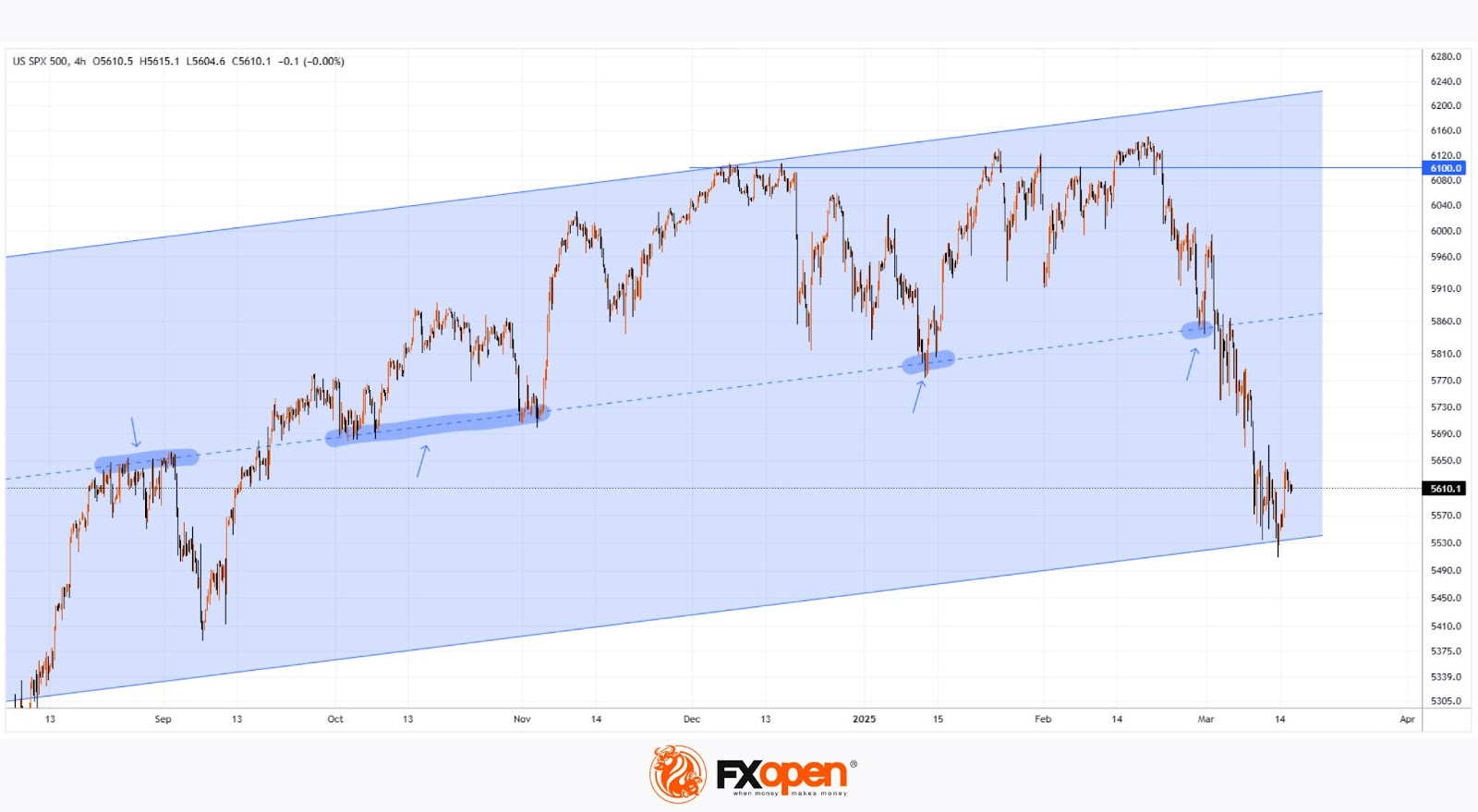
The price is forming an upward channel around the median line, which alternates between acting as support and resistance (marked in blue).
→ Price action suggests that bulls are struggling to hold above the 6,100 level. In February, they failed to push towards the upper boundary of the channel.
→ Since the price has reached the lower boundary of the channel, there is a possibility that bearish momentum may start to weaken.
However, if the price loses support at the lower boundary of the channel, this would be a bearish signal from a technical perspective, indicating the potential for a deeper correction in the S&P 500 (US SPX 500 mini on FXOpen).
Trade global index CFDs with zero commission and tight spreads. Open your FXOpen account now or learn more about trading index CFDs with FXOpen.
This article represents the opinion of the Companies operating under the FXOpen brand only. It is not to be construed as an offer, solicitation, or recommendation with respect to products and services provided by the Companies operating under the FXOpen brand, nor is it to be considered financial advice.
OECD trims global growth outlook amid trade tensions and policy uncertainty
OECD forecasts a slight slowdown in global economic growth over the next two years, reflecting the effects of escalating trade tensions and heightened policy uncertainty. In its Interim Economic Outlook, OECD projects global growth will ease from 3.2% in 2024 to 3.1% in 2025, and further to 3.0% in 2026. These numbers represent a downgrade from its previous forecasts, which projected 3.3% growth for both this year and next.
Among advanced economies, the US is expected to lose momentum, with growth forecast at 2.2% in 2025 before cooling to 1.6% in 2026—down from earlier estimates of 2.4% and 2.1%.
Meanwhile, Eurozone is projected to increase from 1.0% growth this year to 1.2% in 2026. Although this marks an improvement relative to 2024’s mild performance, it still lags the OECD’s previous forecasts of 1.3% and 1.5%.
The imposition of higher tariffs is expected to weigh particularly heavily on North American economies beyond the US. Canada’s growth rate is set to slow to 0.7% this year and next, well below the 2% previously estimated.
Mexico would be hit hardest, with its economy forecast to contract by -1.3% in 2025 and a further -0.6% the following year—reversing prior expectations for moderate growth.
By contrast, China appears relatively well-positioned to manage the fallout from higher tariffs. OECD anticipates that targeted government stimulus will support growth to 4.8% in 2025—slightly above the previous forecast of 4.7%—before moderating to 4.4% in 2026.
OECD Secretary-General Mathias Cormann warned that signs of weakness are emerging in the global economy, primarily due to "heightened policy uncertainty." He added that "increasing trade restrictions" will raise costs for both production and consumption.
ECB’s de Guindos: Trump’s tariffs complicate ECB’s monetary policy decisions
ECB Vice President Luis de Guindos acknowledged that US President Donald Trump’s tariff policies have made the central bank’s monetary policy decisions more challenging, creating an environment of increased uncertainty.
Speaking to Spanish radio Onda Cero, de Guindos noted that the "clarity regarding future decisions" has diminished in a situation "much more opaque than just six months ago."
He also pushed back ECB’s inflation target timeline, stating that inflation is now expected to reach the 2% goal in Q1 2026, later than the previous mid-2025 projection, due to the impact of higher energy prices.
Despite these concerns, de Guindos remained cautiously optimistic that "everything is moving in the right direction." While tariffs could lead to some short-term inflationary effects, he suggested that slower economic activity resulting from trade disruptions could ultimately offset these pressures over time.
Crypto Market Fails to Confirm Reversal
Market Picture
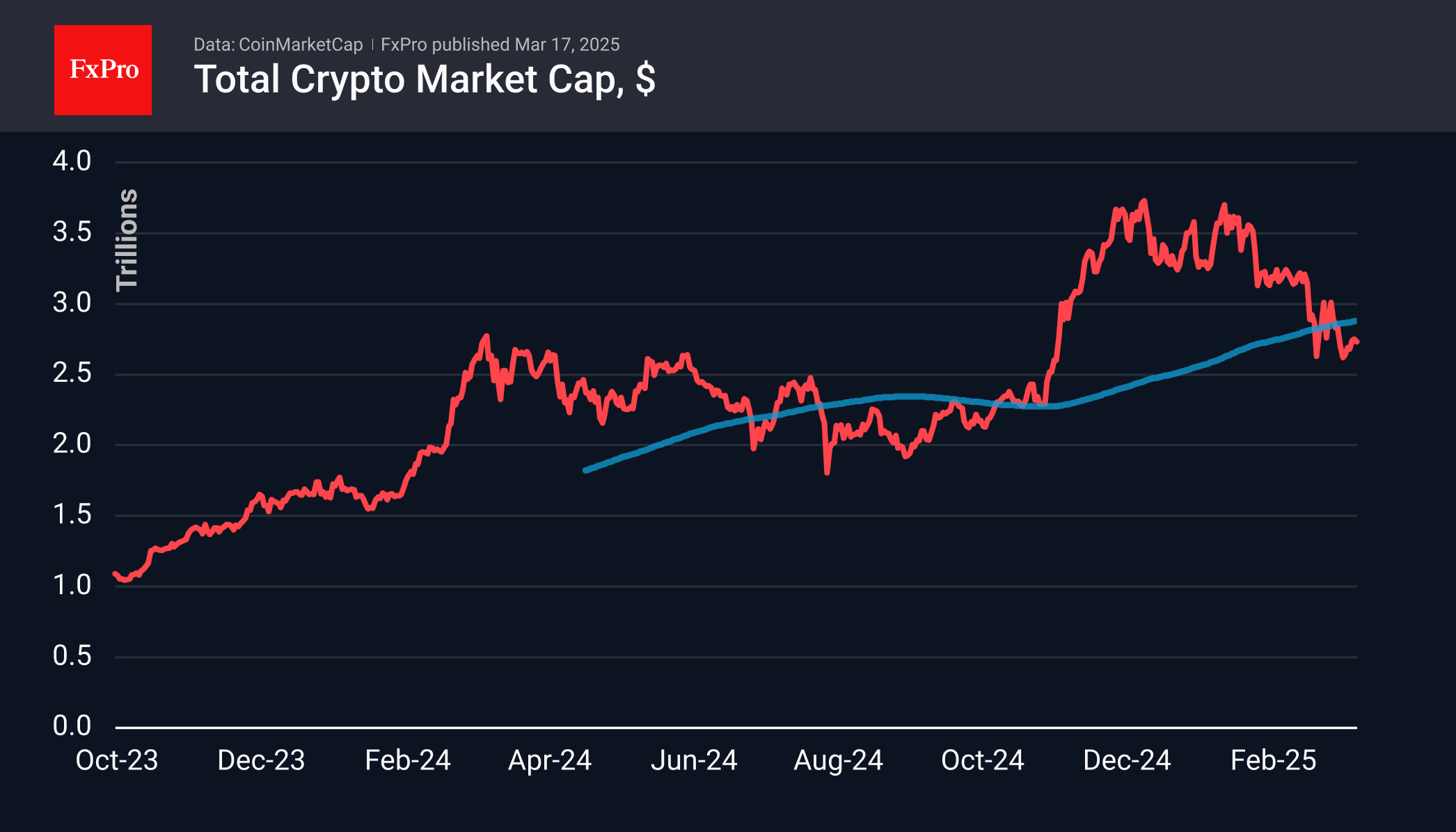
The crypto market is consolidating in the $2.70 trillion area, near the bottom of the trading range of the last several days. This makes one wary of the near future. Technically, the market is consolidating under its 200-day moving average, signalling a change from long-term sentiment to bearish.
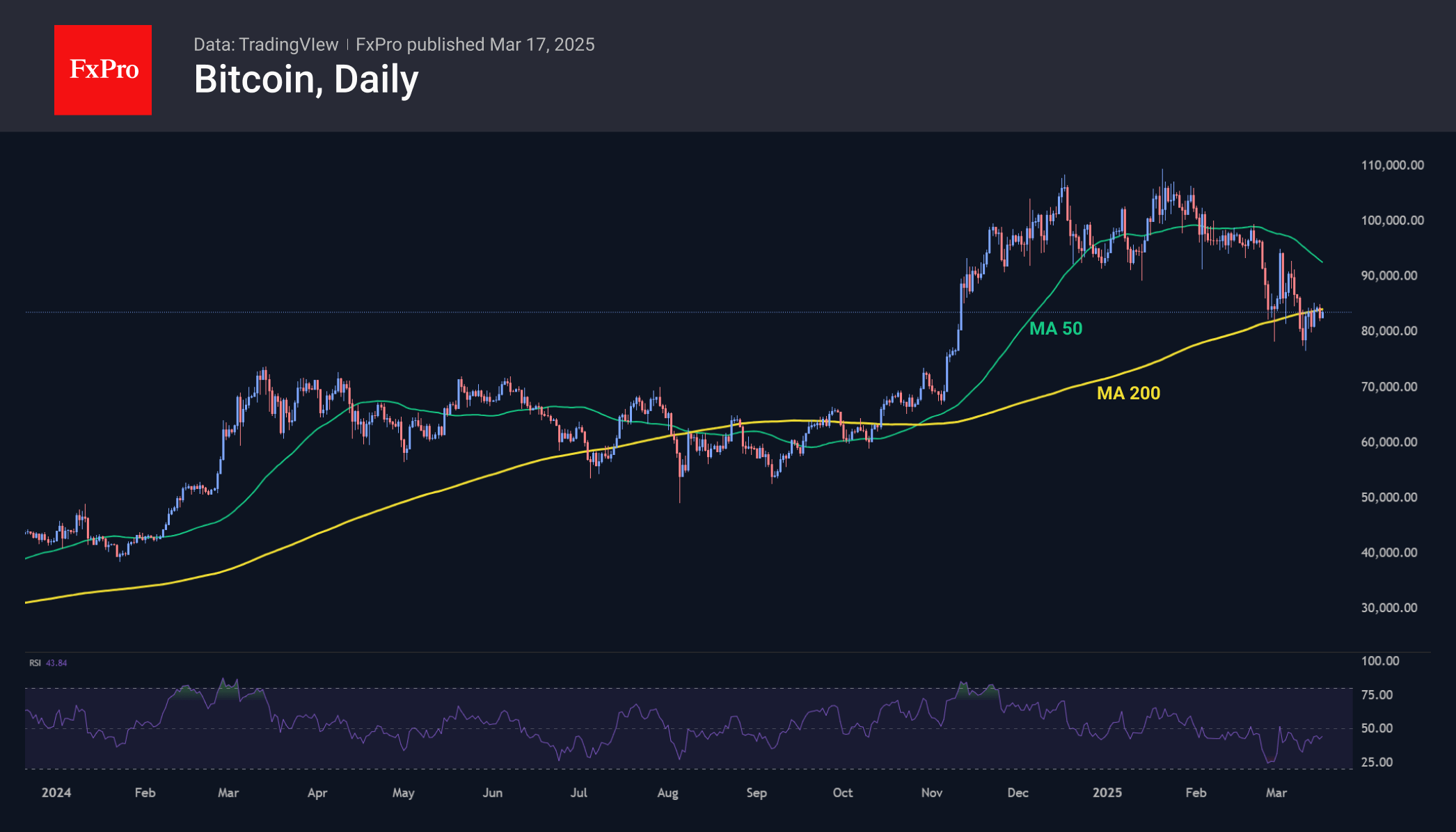
Bitcoin is cruising under its 200-day MA, bumping into selling intensification at the first attempts to get above that line. It is pointing upwards, which has shifted the resistance area to $84,000. This is a dangerous consolidation, removing the first cryptocurrency’s local oversold condition and going into neutral. During periods like this, bears could reacquire liquidity to dump the price again, and the current recovery could prove to be a trap for the bulls.
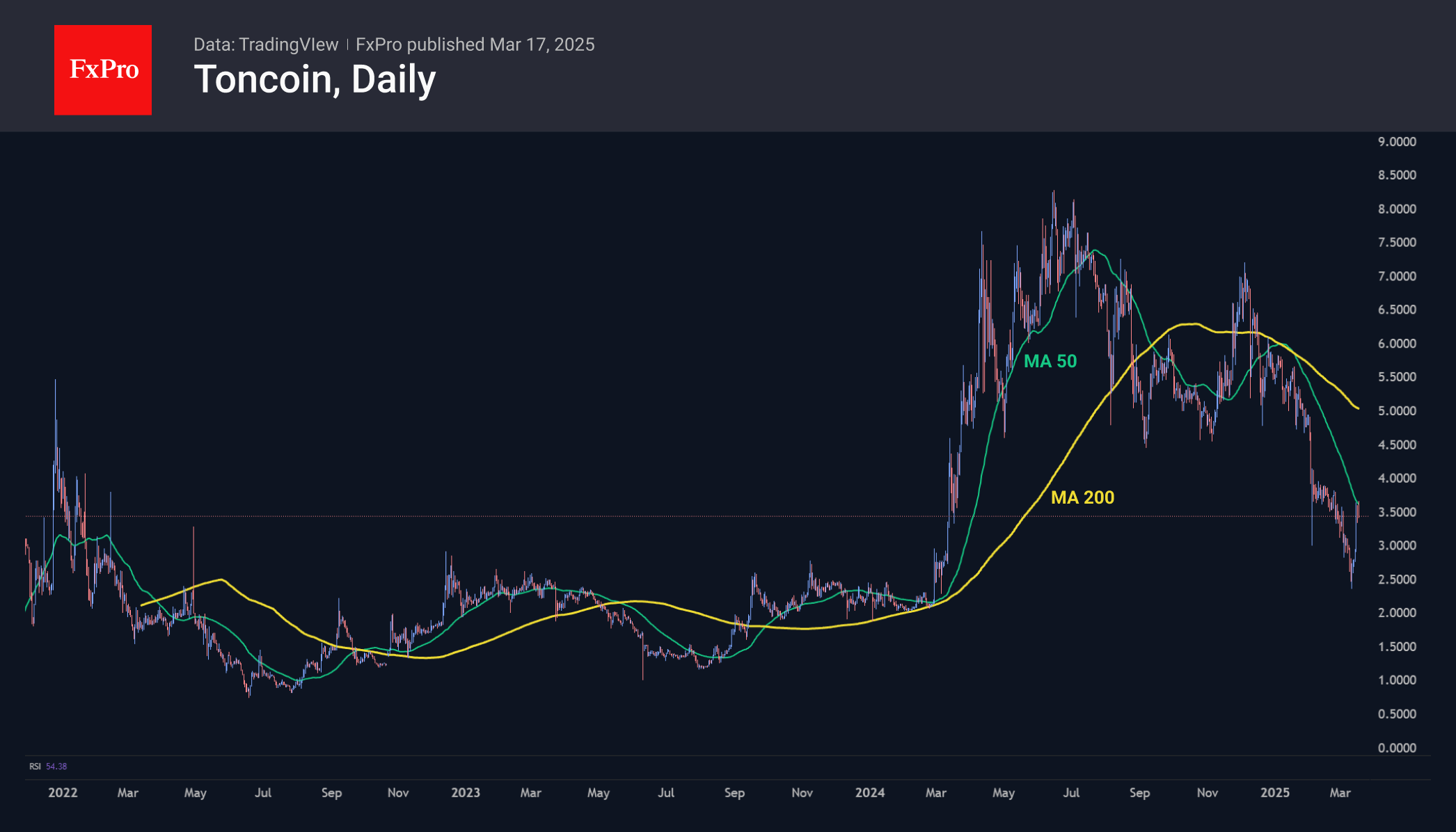
Telegram founder Pavel Durov was temporarily allowed to leave France for Dubai. Against this backdrop, the cryptocurrency TON jumped more than 20%. However, the bulls exhausted their strength near $3.6, which coincided with the 50-day moving average. On the other hand, TON erased its gains from last year’s rally early last week. This return to the former resistance level of the past two years has a high chance of being a solid foundation for further gains.
News Background
According to SoSoValue, net outflows from spot bitcoin-ETFs rose to $870.4 million last week. Cumulative inflows since the bitcoin-ETF was approved in January 2024 fell to $35.20 billion. Net outflows from ETH-ETFs rose to $143.1 million last week. Cumulative net inflows since the ETF’s launch in July fell to $2.52 billion.
Crypto traders expect Bitcoin to decline further in March, having accumulated positions worth $550 million in put options with a $70,000 strike, according to Amberdata. However, according to Deribit, a derivatives exchange, traders are showing an active build-up of positions in call options with strike prices of $100,000-120,000.
According to the ‘Data For Progress’ survey, 51% of respondents oppose a crypto reserve that would be filled by government spending and do not consider the development of the industry and blockchain technology a priority.
Brazilian authorities intend to propose the use of blockchain technology in international trade between BRICS countries. The initiative will be one of the priorities of the country’s presidency in the bloc, which began in January and will last a year.