Sample Category Title
GBP/USD Mid-Day Outlook
Daily Pivots: (S1) 1.2569; (P) 1.2630; (R1) 1.2663; More...
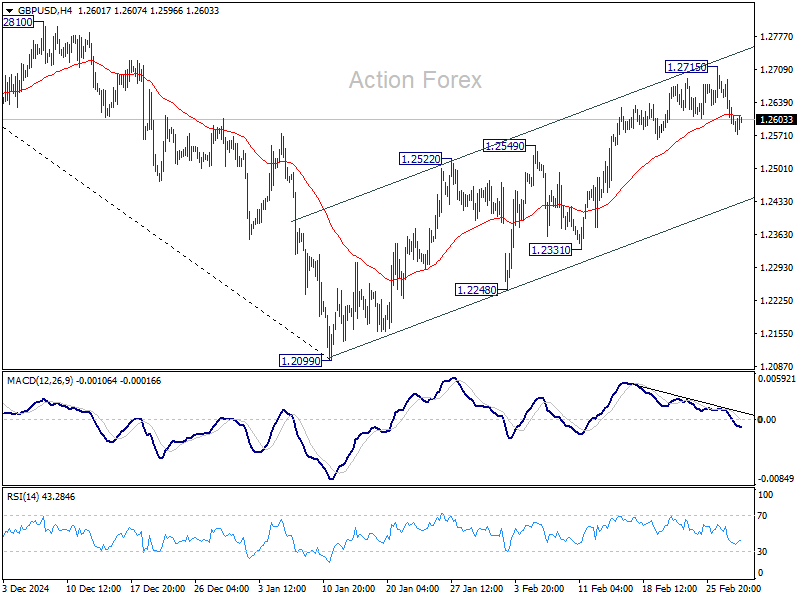
Intraday bias in GBP/USD stays mildly on the downside for the moment. Fall from 1.2715 short term top would target near term channel support (now at 1.2438). Firm break there will argue that whole rebound from 1.2099 has completed as a correction. On the upside, though, break of 1.2715 will resume the rebound to 1.2810 resistance next.
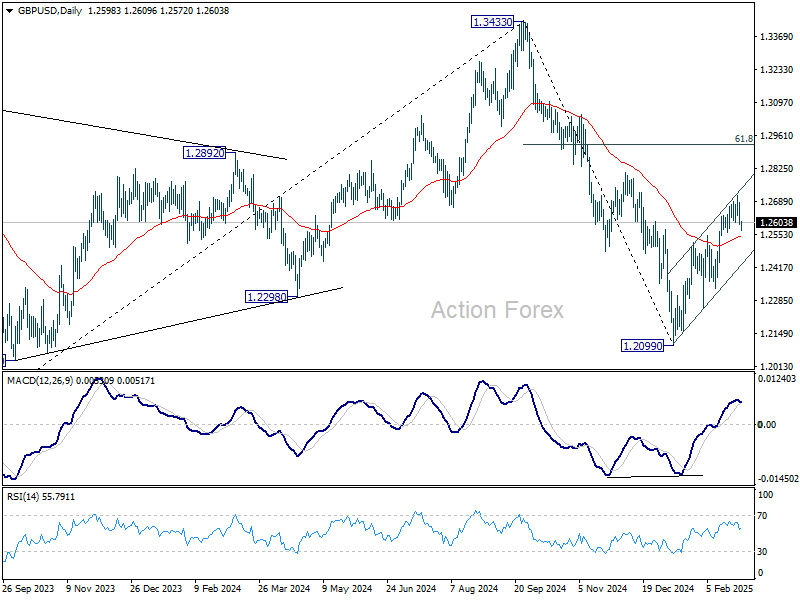
In the bigger picture, rise from 1.0351 (2022 low) should have already completed at 1.3433 (2024 high), and the trend has reversed. Further fall is now expected as long as 1.2810 resistance holds. Deeper decline should be seen to 61.8% retracement of 1.0351 to 1.3433 at 1.1528, even as a corrective move. However, firm break of 1.2810 will dampen this bearish view and bring retest of 1.3433 high instead.
Canada’s GDP Surged to End 2024
The Canadian economy topped expectations in the fourth quarter of last year, advancing 2.6% quarter/quarter annualized (q/q, AR). The third quarter was also revised higher (+2.2% q/q from +1.0 q/q). Stripping out external factors, final domestic demand came in at a very strong 2.4% q/q. The flash estimate for January showed a very strong 0.3% monthly increase.
Consumer spending was a major contributor in the quarter (+5.6% q/q from 4.2% q/q in Q3). Spending was concentrated on durable items (+14.2% q/q) like trucks, vans, and SUVs, as well as telecommunication and financial services (+5.8% q/q).
Residential investment shot higher (+16.7% q/q), with greater resale activity and increases in new construction/renovations all driving the gain. Non-residential investment was also strong (+8.1% q/q), as aircraft shipments in the quarter provided a one-time boost.
Exports gained 7.4% q/q, while imports were up by 5.4% q/q. The difference added 0.6 percentage points to overall GDP. High demand for precious metals, energy, and cars led the export gain, with most of this coming in December, when tariffs started flooding news headlines.
Key Implications
The Canadian economy flexed its muscles in the back half of 2024. Consumers were once again the driving force, as lower interest rates and the GST/HST tax break spurred spending on luxuries like autos and dining out. There was also evidence of businesses front-running tariffs, with exports to the U.S. surging in December. Elsewhere, non-residential business investment may have been strong in Q4, but we don't expect that to persist given the souring of business sentiment in Canada. All told, it was a strong quarter for Canadian growth. And while some of this momentum appears to have carried forward into 2025, with tariffs potentially on deck next week, today's report seems to be telling a story of what could have been for the Canadian economy.
Today's GDP release isn't going to sway the BoC. Yes, the report was strong. But Governor Macklem is more concerned about the risks on the horizon rather than what happened last year. The bank's own research shows huge downside risks to the economy should tariffs come to pass. Market pricing is still effectively a coin flip for the BoC's meeting on March 12th. This feels right, as the BoC could go either way. No one would complain if the BoC took out more insurance against the downside risks with another 25 bp cut, while a hold could also be justified should the bank prefer to take a wait-and-see approach.
EUR/USD Mid-Day Outlook
Daily Pivots: (S1) 1.0365; (P) 1.0430; (R1) 1.0462; More...
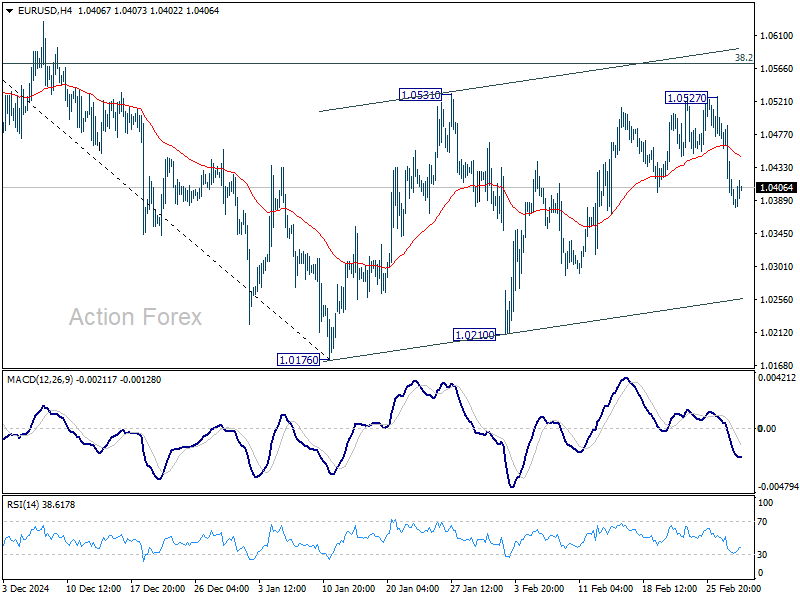
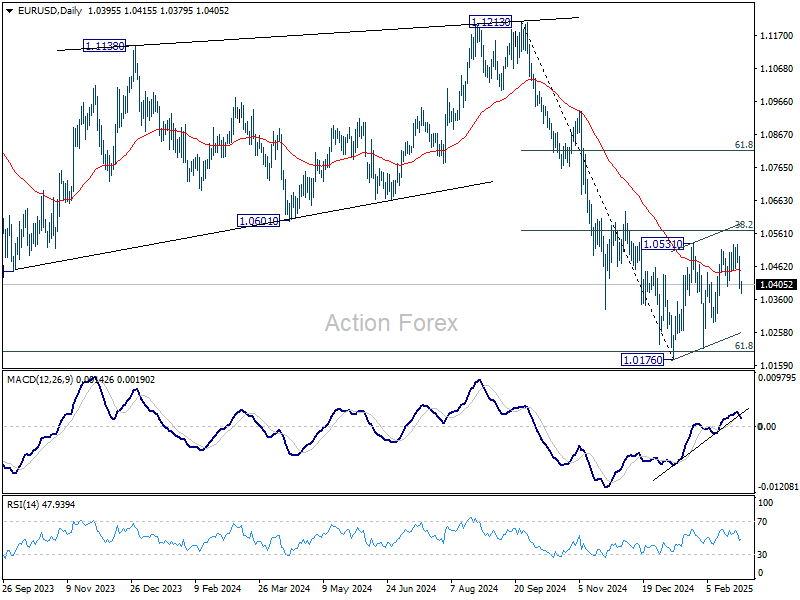
Intraday bias in EUR/USD stays on the downside at this point. Consolidations from 1.0176 should have completed with three waves up to 1.0527. Deeper fall should be seen to retest 1.0176/0210 support zone. Firm break there will resume whole decline from 1.1213. For now, risk will stay on the downside as long as 1.0527 holds, in case of recovery.
In the bigger picture, immediate focus is on 61.8 retracement of 0.9534 (2022 low) to 1.1274 (2024 high) at 1.0199. Sustained break there will solidify the case of medium term bearish trend reversal, and pave the way back to 0.9534. However, reversal from 1.0199 will argue that price actions from 1.1274 are merely a corrective pattern, and has already completed.
Sentiment Lifted by In-Line PCE Data, But Tariffs Could Limit Optimism
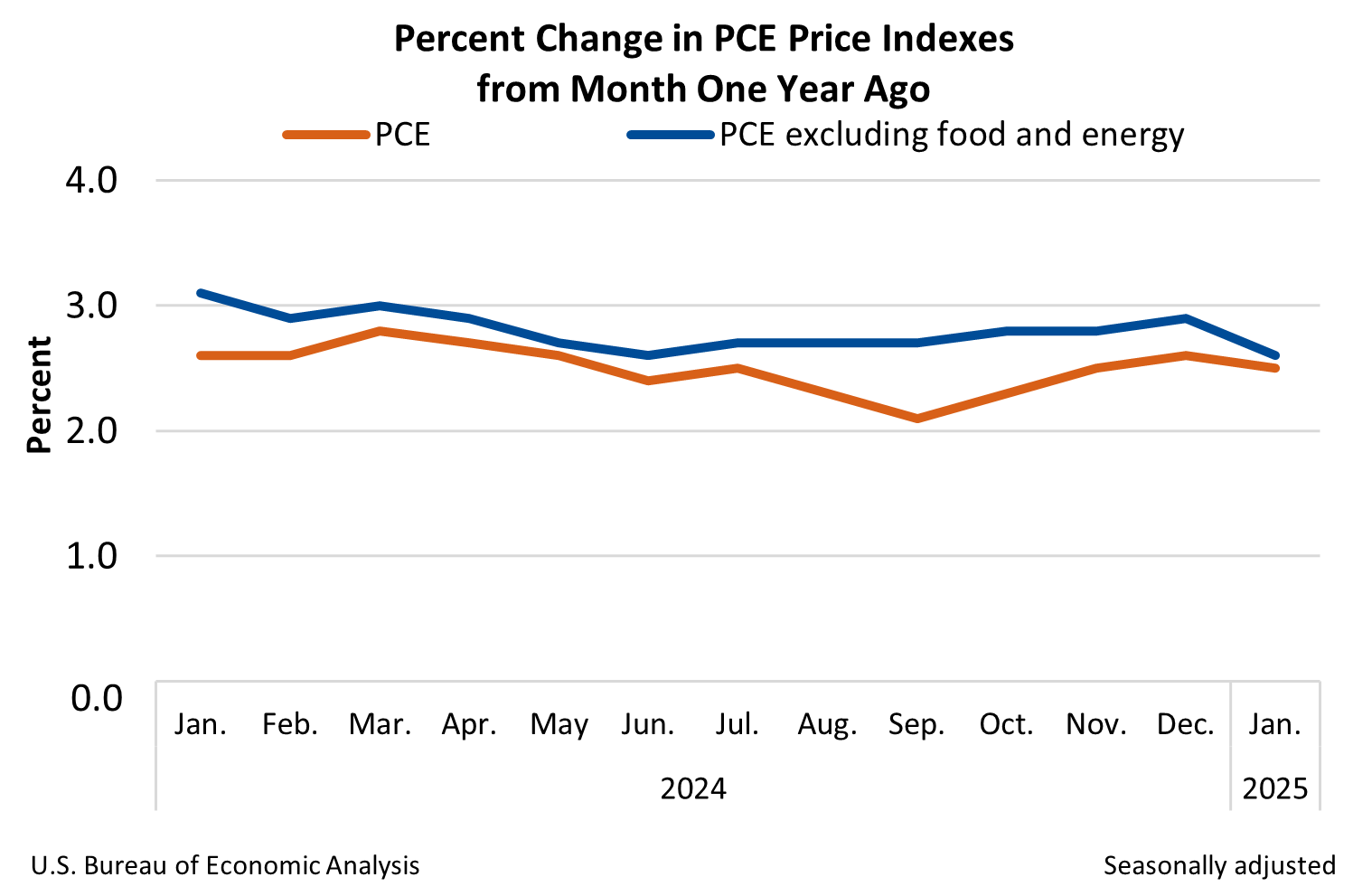
Risk sentiment received a boost in early US trading as January’s PCE inflation data came in line with expectations, lifting hopes that Fed may have room to cut rates in the first half of the year. Both headline and core PCE inflation slowed, adding to expectations that disinflation remains on track. Fed fund futures now indicate a roughly 70% chance of a 25bps rate cut in June, up from around 63% just a week ago.
However, it remains to be seen whether the bounce in equities, as suggested by higher futures, can hold. Market sentiment remains fragile, particularly with ongoing uncertainty surrounding US tariff policies. Investors are cautious about the economic fallout from trade measures, which could overshadow any optimism from cooling inflation data.
In the currency markets, Dollar is on track to close the week as the best performer, followed by Sterling and Swiss Franc. Meanwhile, Kiwi remains the weakest, followed by Aussie and Loonie, with little sign of a reversal. Euro and Yen are positioning in the middle.
In Europe, at the time of writing, FTSE is up 0.36%. DAX is down -0.57%. CAC is down -0.55%. UK 10-year yield is down -0.024 at 4.490. Germany 10-year yield is down -0.026 at 2.394. Earlier in Asia, Nikkei fell -2.88% Hong Kong HSI fell -3.28%. China Shanghai SSE fell -1.98%. Singapore Strait Times fell -0.65%. Japan 10-year JGB yield fell -0.02 to 1.376.
US PCE inflation slows as expected, personal income surges but spending contracts
The latest US PCE inflation data showed price pressures moderating slightly in January. Both headline and core PCE (excluding food and energy) price indices rose 0.3% month-over-month, aligning with market expectations.
On an annual basis, headline PCE inflation slowed to 2.5% yoy from 2.6% yoy, while core PCE eased to 2.6% yoy from 2.9% yoy, reinforcing the view that disinflation remains on track despite persistent price pressures in some sectors.
However, the consumer sector showed signs of strain. Personal income surged 0.9% mom, far exceeding expectations of 0.3%, but personal spending unexpectedly declined by -0.2%, missing the anticipated 0.2% gain.
Canada's GDP grows 0.2% mom in Dec, misses expectations
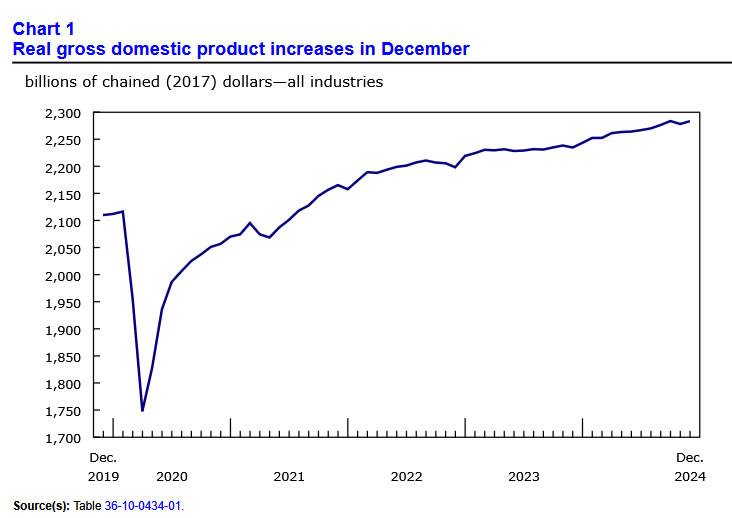
Canada's GDP expanded by 0.2% mom in December, falling short of the expected 0.3% growth. Both services-producing (+0.2%) and goods-producing industries (+0.3%) contributed to the increase, marking the fifth gain in the past six months. A total of 11 out of 20 industrial sectors posted growth.
Looking ahead, preliminary data suggests GDP grew by 0.3% mom in January, with gains led by mining, quarrying, oil and gas extraction, wholesale trade, and transportation. However, retail trade remained a weak spot, partially offsetting the overall growth.
BoE’s Ramsden sees inflation risks two-sided
BoE Deputy Governor Dave Ramsden indicated a shift in his inflation outlook, stating that he no longer views risks to achieving the 2% target as skewed to the downside. Instead, he now sees inflation risks as "two-sided," acknowledging the potential for "more inflationary as well as disinflationary scenarios".
Ramsden also raised concerns about the UK's sluggish economic growth, highlighting the possibility that the economy's supply capacity might be "even weaker" than previously assessed by BoE.
If this proves true, the UK’s "speed limit" for growth would be lower, leading to prolonged tightness in the labor market and sustained wage pressures. That would result in "greater persistence in domestic inflationary pressures."
Swiss KOF falls to 101.7, manufacturing and services under pressure
Switzerland's KOF Economic Barometer declined from 103.0 to 101.7 in February, missing expectations of 102.1.
The data suggests weakening momentum in the economy, with most production-side sectors facing increasing pressure. According to KOF, manufacturing and services sectors saw the most notable deterioration.
However, the report also pointed to some stabilizing factors, as foreign demand and private consumption showed resilience, helping to offset some of the negative trends.
BoJ’s Uchida: Yield rise reflects market’s views on economic and global developments
Speaking in parliament today, BoJ Deputy Governor Shinichi Uchida said recent rise in JGB yields "reflects the market's view on the economic and price outlook, as well as overseas developments."
"There's no change to our stance on short-term policy rates and government bond operations," he emphasized, adding that the bond holdings "continue to exert a strong monetary easing effect" on the economy.
When asked whether the prospect of further rate hikes and tapering would continue to drive yields higher, Uchida responded that it is ultimately “up to markets to decide.”
Japan's Tokyo CPI slows to 2.2% yoy in Feb, industrial production down -1.1% mom in Jan
Tokyo’s core CPI (ex-food) slowed to 2.2% yoy in February, down from 2.5% yoy and below market expectations of 2.3% yoy. This marks the first decline in four months, largely due to the reintroduction of energy subsidies. Meanwhile, core-core CPI (ex-food and energy) held steady at 1.9% yoy. Headline CPI slowed from 3.4% yoy to 2.9% yoy.
In the industrial sector, production contracted by -1.1% mom in January, a sharper decline than the expected -0.9%. Manufacturers surveyed by Japan’s Ministry of Economy, Trade, and Industry anticipate a strong 5.0% mom rebound in February, followed by a -2.0% mom drop in March.
On the consumer front, retail sales grew 3.9% yoy in January, slightly missing the 4.0% yoy forecast, but still pointing to resilient domestic demand.
EUR/USD Mid-Day Outlook
Daily Pivots: (S1) 1.0365; (P) 1.0430; (R1) 1.0462; More...
Intraday bias in EUR/USD stays on the downside at this point. Consolidations from 1.0176 should have completed with three waves up to 1.0527. Deeper fall should be seen to retest 1.0176/0210 support zone. Firm break there will resume whole decline from 1.1213. For now, risk will stay on the downside as long as 1.0527 holds, in case of recovery.
In the bigger picture, immediate focus is on 61.8 retracement of 0.9534 (2022 low) to 1.1274 (2024 high) at 1.0199. Sustained break there will solidify the case of medium term bearish trend reversal, and pave the way back to 0.9534. However, reversal from 1.0199 will argue that price actions from 1.1274 are merely a corrective pattern, and has already completed.
US PCE inflation slows as expected, personal income surges but spending contracts
The latest US PCE inflation data showed price pressures moderating slightly in January. Both headline and core PCE (excluding food and energy) price indices rose 0.3% month-over-month, aligning with market expectations.
On an annual basis, headline PCE inflation slowed to 2.5% yoy from 2.6% yoy, while core PCE eased to 2.6% yoy from 2.9% yoy, reinforcing the view that disinflation remains on track despite persistent price pressures in some sectors.
However, the consumer sector showed signs of strain. Personal income surged 0.9% mom, far exceeding expectations of 0.3%, but personal spending unexpectedly declined by -0.2%, missing the anticipated 0.2% gain.
Canada’s GDP grows 0.2% mom in Dec, misses expectations
Canada's GDP expanded by 0.2% mom in December, falling short of the expected 0.3% growth. Both services-producing (+0.2%) and goods-producing industries (+0.3%) contributed to the increase, marking the fifth gain in the past six months. A total of 11 out of 20 industrial sectors posted growth.
Looking ahead, preliminary data suggests GDP grew by 0.3% mom in January, with gains led by mining, quarrying, oil and gas extraction, wholesale trade, and transportation. However, retail trade remained a weak spot, partially offsetting the overall growth.
Canadian Dollar Eyes Canada’s GDP
The Canadian dollar is calm in the European session, trading at 1.4438, up 0.02% on the day. Later today, Canada releases GDP and the US publishes the Core PCE Price Index. USD/CAD has rallied for five straight trading days, gaining 1.8% during that time and hitting a three-week high.
Canada’s GDP expected to rebound in January
Canada’s economy is projected to have gained 0.3% m/m in December, following a 0.2% decline in November. Canada will also release GDP for fourth-quarter 2024, which is expected at 1.8% y/y, up from 1% in the third quarter. The forecast for an improvement in GDP is based on a busy December shopping season, as consumers took advantage of a sales tax holiday which started on December 15.
The Bank of Canada has also projected at 1.8% gain in GDP for Q4 2024 but remains concerned about the damage from potential US tariffs on Canadian products. The Trump administration has sent mixed messages as to whether the tariffs will take effect on March 4, leaving Canadian officials in the dark. The US imposed and then revoked 25% tariffs on Canada on Feb. 4 and suspended the tariffs for 30 days.
The BoC has said that a trade war with the US would inflict “permanent” damage on Canada’s GDP and raise inflation. Canada sends about 75% of its exports to the US and is extremely vulnerable to US tariffs. The BoC lowered rates by a quarter-point at the January 29 meeting but if the US reinstates tariffs against Canada next week, it would complicate any plans to continue lowering rates. The BoC meets next on March 12.
The US delivers core PCE inflation, the Fed’s preferred inflation gauge, later today. The market estimates for January stand at 2.6% y/y (vs. 2.8% in December) and 0.2% m/m (vs. 0.3% in December). This would indicate that inflation remains sticky and is above the Federal Reserve’s target of 2%. The Fed is in no rush to cut rates, unless inflation drops more than expected or the labor market, which has been cooling slowly, suddenly deteriorates.
USD/CAD Bounces Up, But Can It Keep the Momentum?
- USD/CAD recoups drop below EMAs as March tariffs become reality.
- Technical indicators suggest quick rebound is fragile; focus on 1.4470.
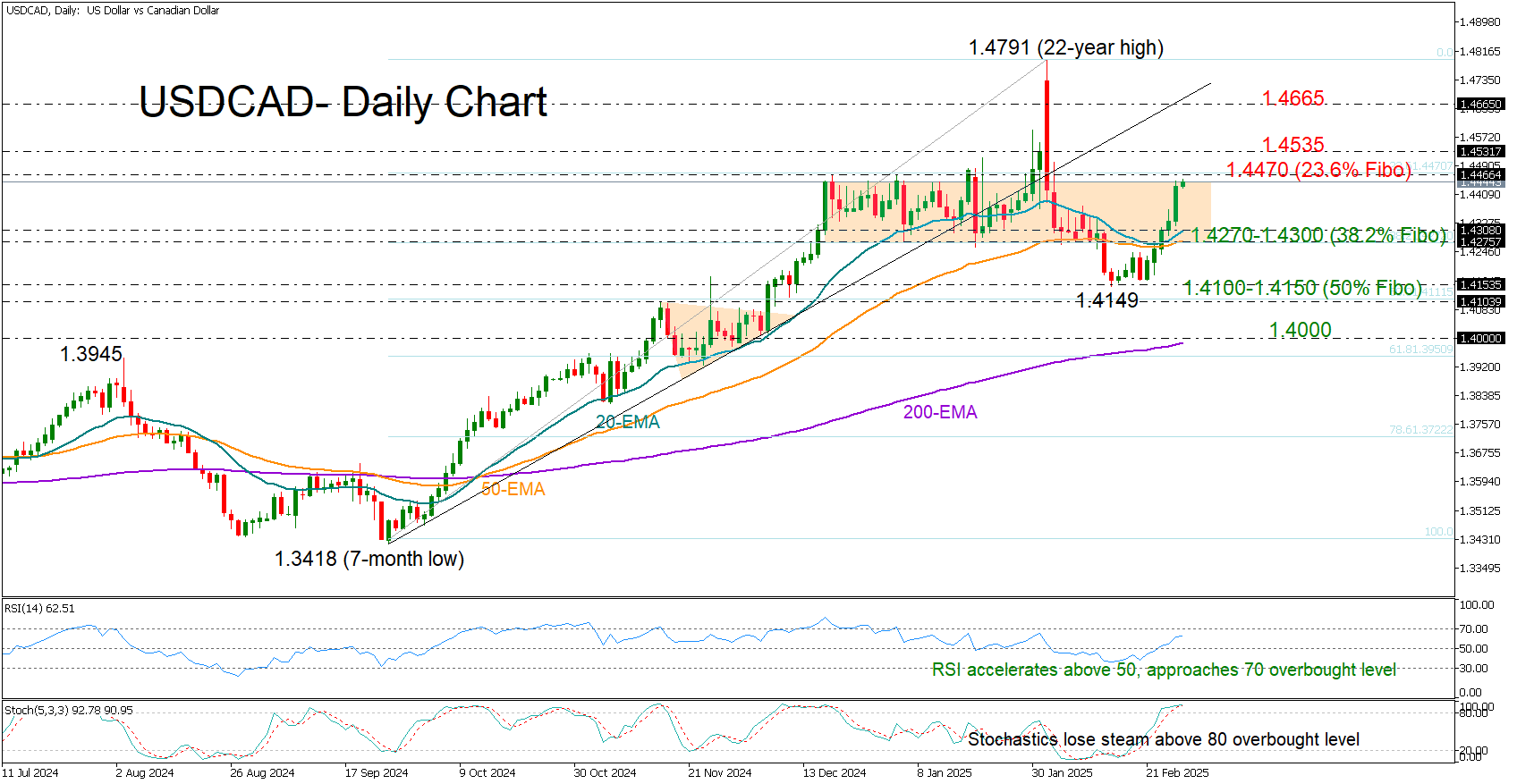
USD/CAD made a strong comeback just when traders were getting nervous about the bearish correction below the 20- and 50-day exponential moving averages (EMAs). Surprising news that the US president will not extend the monthly pause, and tariffs on Canadian, Mexican and Chinese imports could happen next week after the March 4 deadline fueled fresh demand for the greenback. Having set a solid footing near the 1.4150 support area, the pair accelerated straight towards the key resistance of 1.4470.
While the rebound is encouraging, technical indicators suggest that this could be a fragile recovery. The RSI and the stochastic oscillator are already knocking on overbought territory, meaning the rally could run out of steam unless there is a solid push past 1.4470. If that level breaks, the price may initially test the 1.4530 level before surging towards the 2020 peak of 1.4667. And if the bulls stay in control, the elusive 1.4800 round level could be back on the radar.
On the downside, the 20- and 50-day EMAs coupled with the 38.2% Fibonacci mark of 1.4270 could limit selling pressures. A clear close below this floor could send the pair sliding back to 1.4100-1.4150. Failure to hold there may confirm an extension towards the 1.4000 psychological level and the 200-day SMA.
In brief, USD/CAD’s latest bounce is promising but don’t pop the champagne just yet. If the pair can’t decisively clear 1.4470, this could turn into a classic bull trap.
Trump’s Tariff Threat: USD/CAD Hits Three-Week High
As we reported on 3 February, Trump’s tariffs pushed USD/CAD to a 22-year high.
However, a one-month tariff delay led to a sharp drop, sending USD/CAD to its 2025 low near 1.41550. As the end of the delay approaches, the pair has been climbing again since mid-February (as shown by the arrow).
Yesterday, President Trump confirmed that his proposed 25% tariffs on Mexican and Canadian goods will take effect on 4 March. This dashed hopes for another delay and triggered a breakout above the 1.43600 resistance level.
Technical Analysis of USD/CAD

Above current levels, key resistance lies at 1.44600, which has held firm since mid-December. However, drastic measures from Trump’s administration could drive further price movement within the blue-marked channel.
Expect volatility spikes ahead of Canada’s GDP release, scheduled for today at 16:30 GMT+3.
Trade over 50 forex markets 24 hours a day with FXOpen. Take advantage of low commissions, deep liquidity, and spreads from 0.0 pips. Open your FXOpen account now or learn more about trading forex with FXOpen.
This article represents the opinion of the Companies operating under the FXOpen brand only. It is not to be construed as an offer, solicitation, or recommendation with respect to products and services provided by the Companies operating under the FXOpen brand, nor is it to be considered financial advice.
Japanese Yen Declines as Tokyo Core CPI Eases
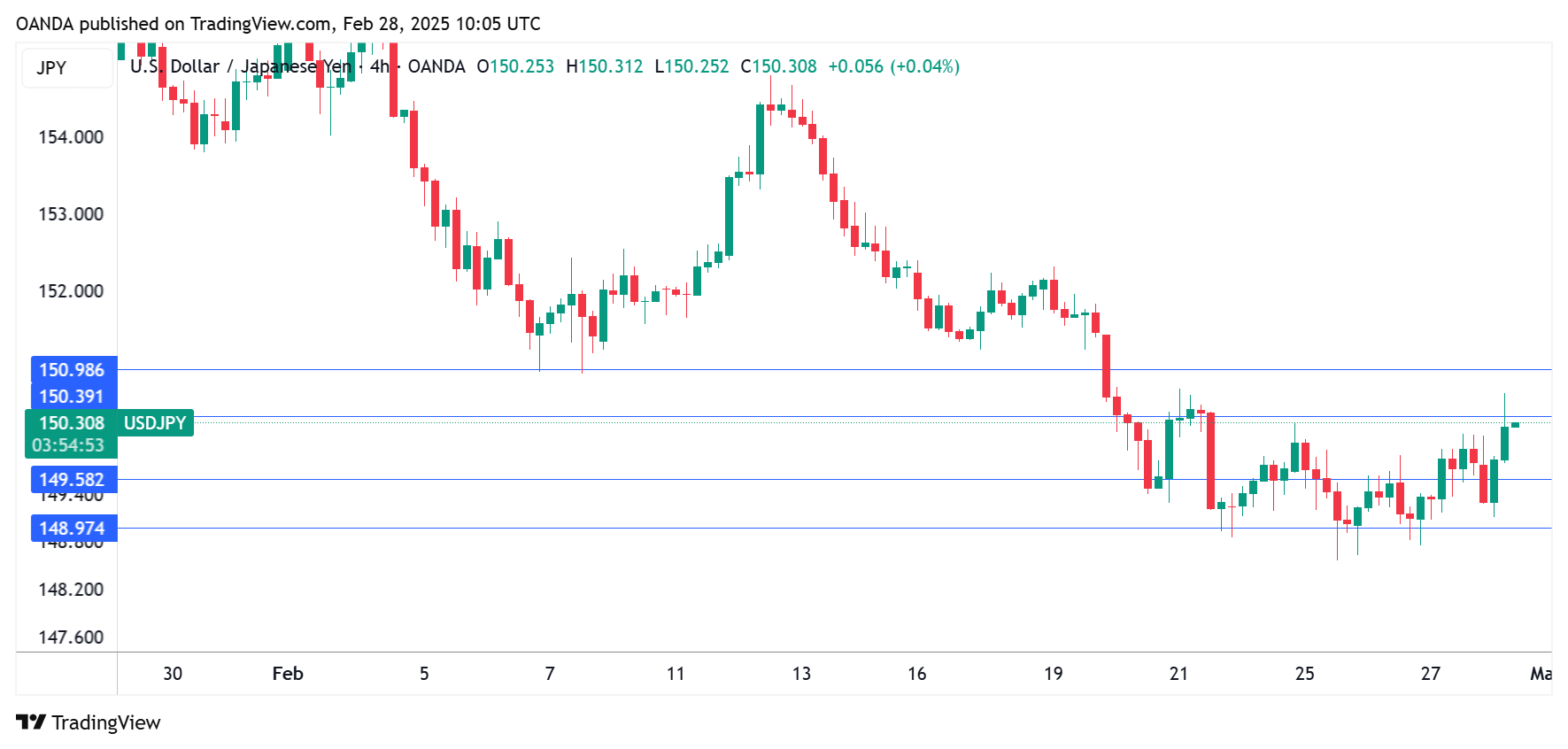
The Japanese yen has extended its losses on Friday. In the European session, USD/JPY is trading at 150.39, up 0.40% on the day.
Tokyo core CPI edges lower to 2.2%
After a string of releases that pointed to an upswing in inflation, Tokyo core CPI for February reversed the trend on Friday. Japan’s CPI, PPI and the Bank of Japan Core CPI all accelerated in the most recent releases but Tokyo Core CPI surprised to the downside, with a gain of 2.2% y/y. This was down from 2.5% in January and below the market estimate of 2.3%.
The soft Tokyo Core CPI reading is unlikely to raise many eyebrows at the Bank of Japan. The index remained above the BoJ’s 2% target for a fourth consecutive month and Bank policymakers are expected to remain hawkish about monetary policy. The BoJ raised rates in January and also revised its inflation forecasts upwards, a signal that further rate hikes are on the table.
The markets are expecting the BoJ to continue tightening and this has been resulted in higher yields for Japanese government bonds, which hit a 15-year high earlier this month. Governor Kazuo Ueda responded to the sharp rise in bond yields with a warning that the central bank stood ready to intervene in the bond markets. Ueda’s threat appears to have worked as bond yields have retreated slightly.
US Core PCE expected to tick lower
The US wraps up the week with core PCE inflation, the Fed’s peferred inflation gauge. The market estimates for January stand at 2.6% y/y (vs. 2.8% in December) and 0.2% m/m (vs. 0.3% in December). This would still be above the Federal Reserve’s target of 2%. The Fed is not expected to lower rates before May, barring an unexpected surprise from inflation or employment data.
USD/JPY Technical
- USD/JPY tested resistance at 150.39 earlier. Above, there is resistance at 150.98
- There is support at 149.57 and 148.98