

Sample Category Title
Canadian Dollar Unchanged, US GDP Next
The Canadian dollar is unchanged in the Wednesday session. Currently, USD/CAD is trading at 1.2775, down 0.02% on the day. On the release front, Canada releases an important inflation indicator, the Raw Materials Price Index. This indicator is expected to post a strong gain of 1.8%. In the US, Preliminary GDP is expected to rise 2.5%, and Pending Home Sales is forecast to climb 2.4%. On Thursday, the US will publish unemployment claims, personal spending and manufacturing PMI. As well, Fed chair Jerome Powell testifies before the Senate Banking Committee. Canada will publish Current Account.
The US dollar showed broad gains after Federal Reserve Chair Jerome Powell's testimony before a congressional committee on Tuesday. Powell was cautious, saying that the Fed planned to continue its current policy of gradual rate increases, despite the stimulus of government spending and recent tax reform. Powell sounded optimistic about economic conditions, noting that the US economy was benefiting from the global recovery as well as changes in fiscal policy. Importantly, Powell did not address the question of an acceleration of rate hikes. Currently, the Fed has projected three rate hikes in 2018, with increases widely expected at the March and May meetings. However, with inflation moving higher and the economy continuing to perform well, many analysts expect the Fed to raise rates four or more times this year. Any hints at an increased pace of rate hikes could send the US dollar broadly higher.
Pound Slips on Cautious Barnier; European Stocks Drag Lower
Here are the latest developments in global markets:
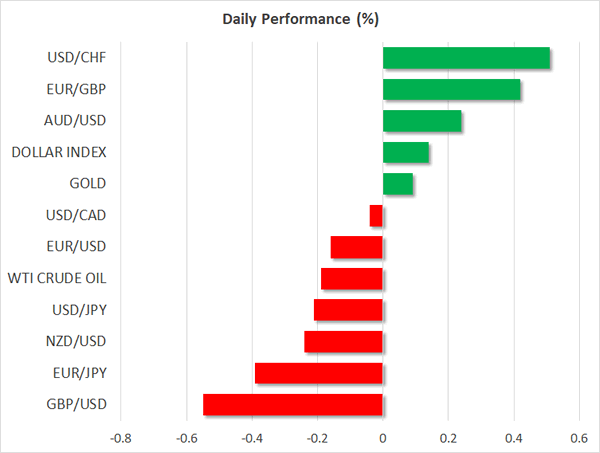
FOREX: The dollar index held onto gains during early European afternoon as investors' optimism that the Fed would raise rates more than three times this year heightened further after the Fed's new chair testimony in front of the House Financial Committee. Jerome Powell, the new Fed boss, reiterated that the US economy is on a healthy track and a normalization of the monetary policy is needed to avoid an overheating economy – acknowledging the growth effects of Trump's tax cuts – given that inflation will move towards the Fed's 2% target. The dollar index touched a fresh two-week high at 90.55 (+0.12%), whereas dollar/yen was on the backfoot, trading at 107.11 (-0.18%) on the face of a strengthening yen, which gained momentum after the Bank of Japan offered to buy a smaller amount of super-long government bonds on Wednesday in its regular buying operations. Inflation preliminary figures came in as expected in Eurozone (Italy's CPI numbers disappointed). Euro/dollar moved down to 1.2218 (-0.10%), while pound/dollar was the worst performer, diving to a two-week trough of 1.3845 (-0.48%) after the EU's Brexit negotiator Michel Barnier said that the Brexit legal draft treaty did not provide any surprises – the draft was expected to express political positions and terms of the exit as were discussed in the Brussel's meeting with the UK Prime Minister Theresa May in December – but he argued that there are still "significant divergences" on transition issues. Aussie/dollar managed to climb to 0.7807 (+0.23%) despite worse than expected Australian and Chinese data, while kiwi/dollar tumbled to 0.7215 (-0.26%) near three-week lows. Dollar/loonie was steady at 1.2768 (-0.05%).
STOCKS: European stocks headed lower on Wednesday following their US counterparts in Wall Street as Powell's speech on Tuesday raised flags that the Fed could increase interest rates faster than expected. Meanwhile, earnings releases from European corporates came in disappointing, adding further pressure to the market. The pan-European STOXX 600 and the blue-chip Euro STOXX 50 were down by 0.21% and 0.23% respectively at 1030 GMT with all sectors except financials and techs being in the red. . The German DAX 30 and the British FTSE 100 dropped by 0.26%, while the Spanish IBEX 35 was among the worst performers, losing 0.56% on the back of underperforming healthcare sectors. US stock futures were a sea of red, pointing to a negative open.
COMMODITIES: Oil prices were weaker. WTI crude was trading at $62.88/barrel (-0.21%) and Brent stood at 66.44 (-0.29%) ahead of the EIA weekly oil report. Earlier today, industrial data out of China, Japan and India – the world's major crude-consumers – indicated a slowdown in their monthly factory activities, signaling a potential ease in global demand. In other news, Reuters sources reported that OPEC will meet US shale firms on Monday for a dinner, where analysts expect both sides to discuss on how to mitigate the supply oil glut. In precious metals, gold managed to pare a small part of earlier losses, touching a session high of $1321.22/ounce.
Day Ahead: US updates Q4 GDP growth estimates; EIA oil report eyed
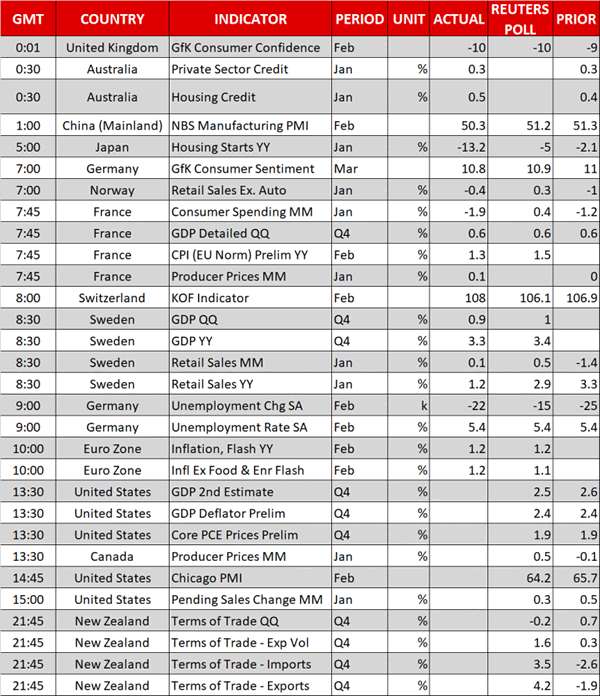
Looking forward to the day, economic releases will continue to attract attention with the US, Canada, and New Zealand being among the countries to publish figures.
Following the upbeat speech of the new Fed chair, Jerome Powell, yesterday before the House Financial Committee, who expressed his hawkish views on the US economy and sent the dollar index higher, US agencies are next in the line to potentially shake the dollar.
At 1330 GMT, the Bureau of Economic Analysis will release second estimates on the US GDP growth for the final quarter of 2017. Analysts believe that the economy has expanded by 2.5% quarter-on-quarter, slightly below the 2.6% growth estimated initially. Revised figures on inflation gauges involving the GDP growth deflator (this tracks the level of prices of all new, domestically produced, final goods and services) and the core Personal Consumption Expenditures index (PCE) will be also delivered along with the abovementioned data.
Then later in the day, the Kingsbury International and the National Association of Realtors will report on Chicago' manufacturing conditions at 1415 GMT (Chicago PMI) and pending home sales at 1500 GMT respectively, with both measures expected to slow down.
Elsewhere, Canada will see the release of producer prices for the month of January at 1330 GMT, while terms of trade will be out of New Zealand at 2145 GMT.
In energy markets, the focus will be on the EIA oil report due at 1530 GMT. .In contrast to the previous week when the numbers showed a decline of 1.616 million barrels in the US crude oil inventories, forecasts are now for a rise of 2.400 million barrels in the week ending February 23, the biggest increase recorded since the end of January. Gasoline and distillate stocks are also anticipated to fall.
In other areas of interest, political developments in Italy will gather attention as well as the country heads to the polls to elect a new government on March 4, at the same day when Germany will announce the results of a ballot by the SPD members who recently voted on whether they should re-establish a coalition agreement with Merkel's Conservatives, giving an end to a five-month political impasse. .NAFTA talks which entered the seventh-round of negotiations this week will be also in focus.
In equities, companies continue to report earnings as some investors are repositioning in response to rising expectations for a higher interest rate environment.
As Interest Rate Expectations Rise, Markets Take Another Tumble
- US Futures Pare Gains as Powell Speech Triggers Another Dip in Stocks;
- Sterling Dips After Release of Draft EU Brexit Treaty;
- US GDP Eyed But Attention on Tomorrow's Testimony.
US Futures Pare Gains as Powell Speech Triggers Another Dip in Stocks
US futures are trading slightly in the green on Wednesday, paring losses incurred on Tuesday following the hawkish testimony of new Federal Reserve Chairman Jerome Powell.
Powell's testimony on Tuesday in front of the House Financial Services Committee was the first of two this week, with the second being in front of the Senate Banking Committee on Thursday. The new Fed Chair was very optimistic on the economy and even opened the door to upgrades to economic forecasts next month and more rate hikes which lifted the dollar and US yields, particularly on the short end of the curve.
The markets are already relatively well positioned for rate hikes, if the Fed raises as planned, but there's still some catching up that will need to happen if four increases do materialise. The prospect of faster rate hikes in the near-term has been damaging for stock markets recently and explains why once again US indices shed more than 1% on Tuesday. This negative view of higher rates fed through to Asian and European stock markets also, both of which are comfortably in negative territory.
Sterling Dips After Release of Draft EU Brexit Treaty
The EU released its draft Brexit treaty this morning and despite containing no language that hadn't already been anticipated, it did weigh on the pound in the immediate aftermath, with it dropping around 40 pips against the euro and the dollar. While this isn't too significant a move, it does highlight the ongoing sensitivity of the pound to the Brexit talks and the transition period, even when what we're seeing and hearing isn't new news.
The pound has performed well since late last year when both sides agreed to progress to phase two of negotiations but as recent commentary - including Michel Barnier's warnings today - indicates, some significant differences still exist and tough negotiations lie ahead. This could leave the pound vulnerable as the deadlines approach, the first of which will be that to agree on transitional arrangements.
US GDP Eyed But Attention on Tomorrow's Testimony
Once again today there's plenty of economic data being released that will be of interest to traders. The disappointing PMIs from China overnight didn't help lift the sombre mood in Asian trade, with the manufacturing survey being particularly weak and falling at its sharpest rate since 2011, although this was likely driven largely by the timing of the lunar new year. Eurozone inflation eased a little in February, although this was in line with expectations and had little impact on the euro or expectations.
Still to come today we have GDP data from the US - which is likely to be revised down slightly from the flash reading - as well as pending home sales, the Chicago PMI and crude inventory numbers. While all of this will be of interest, tomorrow's appearance by Powell in front of the Senate Banking Committee will probably be more on traders' minds today.
GBPUSD Under Bearish Selling Pressure
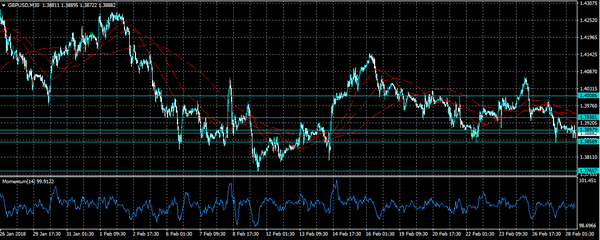
The British pound has remained under selling pressure against the U.S dollar during the European trading session, as intraday buyers failed to make headway above the key 1.3897 technical level. The GBPUSD pair currently trades around the 1.3880 level, with price-action likely to encounter further heavy selling below the current weekly price low, found at the 1.3857 level. Moving into Wednesday’s U.S trading session, the release of the U.S CORE PCE Index for February takes center stage, as it remains the Federal Reserve preferred measure of inflation.
The GBPUSD pair remains intraday bearish whilst trading below the key 1.3897 level, further losses towards the 1.3858 and 1.3765 levels seem possible.
A sustained move above the 1.3897 level, may lead to further GBPUSD upside towards the 1.3921 and 1.3938 resistance levels.
USDJPY Pair Back Testing Back Testing The 107.00 Level
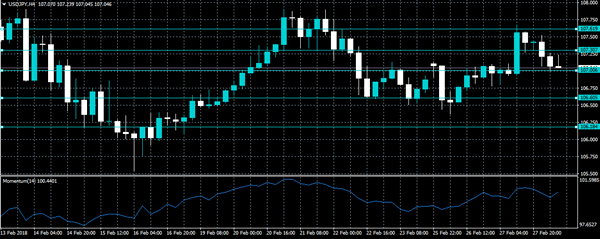
The U.S dollar has reversed Tuesday's strong trading gains against the Japanese yen currency, following weaker than expected Chinese and Japanese Manufacturing data. The USDJPY pair initially spiked towards the 107.60 level, following dovish comments from the new Fed Chair Jerome Powell. However, price-action has recently fallen back to test towards the 107.00 support level, with traders now focused on key U.S GDP, Inflation and Housing data.
The USDJPY pair is likely to turn bearish below the 107.00 level, with key technical support located at the 106.60 and 106.18 levels.
If price-action on the USDJPY pair manages to hold the 107.00 level, technical traders may look to test the 107.30 and 107.60 resistance levels.
.
Technical Outlook: EURUSD Cracks 1.2205 Support On Weak EU Inflation Data
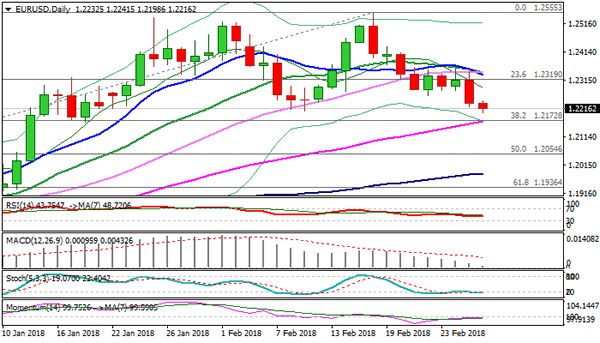
The Euro dented the upper boundary of key support zone between 1.2205 and 1.2173, increasing risk of further easing and eventual break lower.
Loss of these supports would have significant impact on larger longs which are still in play, as a number of stops lays just below.
Negative signal for the single currency today was release of EU inflation data which showed that the bloc’s inflation slowed in February and hit over one year low.
Eurozone inflation slowed to 1.2% (as forecasted) from 1.3% in January, moving further away from ECB’s target near 2%.
Weaker inflation supports ECB’s stance for increased caution in winding down the stimulus, despite strong growth in the EU economy, which exceeded expectations.
The Euro is also focusing on key political events in the zone, German coalition negotiations and Italian election, which could further depress the single currency on unexpected outcome.
Bearishly aligned techs are working in favor of further easing, with firm break through 1.2250/1.2173 pivots, needed to confirm double-top at 1.2237/55 and spark fresh bearish acceleration towards psychological 1.20 support.
To neutralize bearish threats, lift above former range top at 1.2360 zone, is required.
Res: 1.2241, 1.2260, 1.2285, 1.2340
Sup: 1.2198, 1.2173, 1.2148, 1.2088
US PCE Inflation To Hold Steady In January But Personal Income And Spending Expected To Moderate
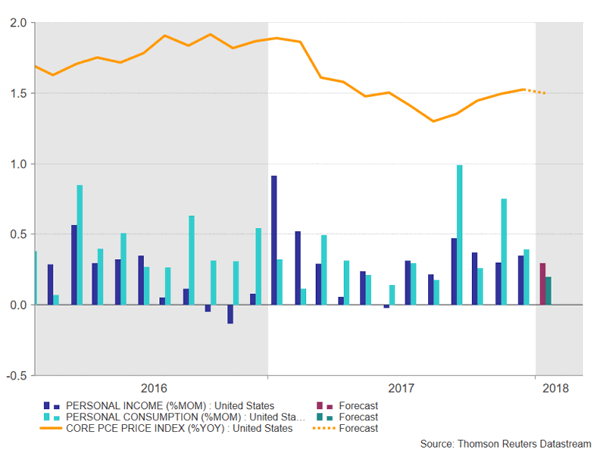
Consumer spending in the United States likely slowed at the start of 2018, data on Thursday is forecast to show, while the Federal Reserve’s preferred gauge of inflation is not expected to reveal an immediate risk of an uptick. The data on personal income and spending will be the first since the better-than-expected wage growth and CPI numbers for January, and the first after Jerome Powell took the help at the Fed.
Personal income is expected to rise by 0.3% month-on-month in January, a slight moderation from December’s 0.4% rate. Personal consumption is also forecast to ease, growing by just 0.2% m/m – half the rate of the prior month. If confirmed, the data would point to a softer start to the near year for US households and consumers. However, this is unlikely to develop into a trend as the Republican tax package and the tightening labour market should lift both household incomes and consumption over the coming year.
The more closely watched item of Thursday’s release will be the Personal Consumption Expenditures (PCE) measure of inflation. The core PCE price index, which the Fed targets for its 2% inflation objective, is expected to remain unchanged at 1.5% year-on-year for the third straight month in January. This compares with the headline rate of 2.1% of the consumer price index for the same period.
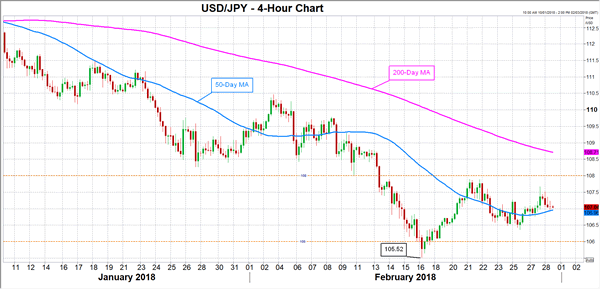
Should the core PCE price index unexpectedly pick up in January, it could give the dollar an additional lift, which was already boosted this week from Fed Chair Jerome Powell’s hawkish remarks at his semi-annual monetary policy testimony before Congress on Tuesday. The dollar could set its eyed on the 108-yen level.
An overall reading that is more-or-less in line with expectations and confirms the view that 2018 got off to a slow start would likely confine dollar/yen to the 106-108 range for a while longer. On the other hand, an unexpected weak report could push the pair back below the key 106 level and towards February’s 15-month low of 105.52.
It’s possible though that even in the event of a disappointing set of figures, markets may choose to overlook one-month’s data as the odds of a fourth rate hike were given a major boost after Powell’s testimony. Whether or not this feeds into a sustained rally for the US currency, however, is another question, as rising treasury yields have so far failed to shift the greenback out of its bearish phase.
US 30 Index Turns More Neutral In Medium-Term As It Enters Ichimoku Cloud
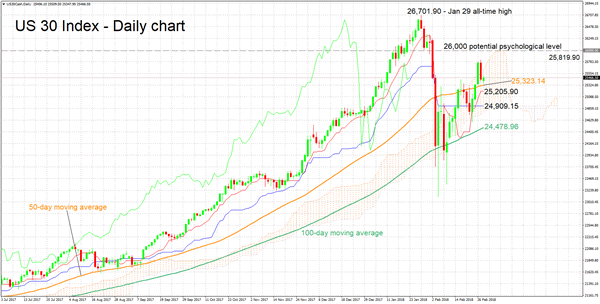
The US 30 index finished Tuesday's trading 1.3% lower after previously reaching a near four-week high of 25,819,90.
Despite yesterday's notable decline, the Tenkan- and Kijun-sen lines remain positively aligned, continuing to project a bullish picture in the short-term. However, both have flatlined, this being a sign that positive momentum could be losing steam.
Should the index advance, the area around yesterday's high of 25,819.90 could act as a barrier to the upside, while the range around the Ichimoku cloud not far below at 25,626.58 might also provide resistance. Stronger bullish movement would shift the focus to the 26,000 handle, this being a level that may hold psychological significance.
On the downside, immediate support could come around the current level of the 50-day moving average at 25,323.14. Further below, the area around the Tenkan-sen at 25,205.90 might offer support as well.
The medium-term picture is looking bullish to neutral at the moment. The index has fallen inside the Ichimoku cloud, tilting the outlook towards neutrality, though it continues to trade above both the 50- and 100-day MAs, with both MA lines maintaining a positive slope. A fall below the 50-day MA – price action is currently taking place not far above this level – would turn the outlook more neutral.
Overall, the short-term bias is bullish though the positive tone seems to be easing, and the medium-term outlook is looking bullish to neutral.
DAX Edges Lower After Powell Says Rate Hikes To Continue
The DAX index has posted slight losses in the Wednesday session. Currently, the index is trading at 12,455.59, down 0.28% since the Monday close. On the release front, Germany Gfk Consumer Climate edged down to 10.8, matching the estimate. Unemployment claims dropped by 22 thousand, beating the forecast of a decline of 17 thousand. In the Eurozone, CPI Flash Estimate and Core CPI Flash Estimate posted gains of 1.2% and 1.0%, respectively. Both indicators matched their estimates. Over in the US, Preliminary GDP is expected to rise 2.5%. On Thursday, Germany and the eurozone release manufacturing PMIs. In the US, Fed chair Jerome Powell testifies before the Senate Banking Committee.
US stock markets posted sharp losses on Tuesday, after Federal Reserve Chair Jerome Powell stated that the Fed would continue to raise rates gradually. Will European markets follow suit on Wednesday? Powell sounded optimistic about economic conditions, noting that the US economy was benefiting from the global recovery as well as changes in fiscal policy. Importantly, Powell did not address the question of an acceleration of rate hikes. Currently, the Fed has projected three rate hikes in 2018, with increases widely expected at the March and May meetings. However, with inflation moving higher and the economy continuing to perform well, many analysts expect the Fed to raise rates four or more times this year. Any hints at an increased pace of rate hikes could send the US dollar higher and send European stock markets downwards.
The markets did a good job estimating inflation data for February, as German and Eurozone CPI readings matched the estimates. The numbers show that inflation remains well below the ECB target of 2 percent, so policymakers needn’t worry about raising rates for some time. The ECB recently lowered its monthly bond purchases, with the program expected to wind up in September. If the economy remains strong, the ECB could opt to raise rates in the fourth quarter or in early 2019.
EUR/USD – Euro Inches Lower As Eurozone CPI Matches Forecast
The euro has ticked lower in the Wednesday session, after considerable losses on Tuesday. Currently, EUR/USD is trading at 1.2330, down 0.10% on the day. It’s a busy day on both sides of the pond for fundamental releases. In Germany, Gfk Consumer Climate edged down to 10.8, matching the estimate. Unemployment claims dropped by 22 thousand, beating the forecast of a decline of 17 thousand. In the Eurozone, CPI Flash Estimate and Core CPI Flash Estimate posted gains of 1.2% and 1.0%, respectively. Both indicators matched their estimates. Over in the US, Preliminary GDP is expected to rise 2.5%, and Pending Home Sales is forecast to climb 2.4%. On Thursday, Germany and the eurozone release manufacturing PMIs. The US will publish unemployment claims, personal spending and manufacturing PMI. As well, Fed chair Jerome Powell testifies before the Senate Banking Committee.
The US dollar showed broad gains after Federal Reserve Chair Jerome Powell’s testimony before a congressional committee on Tuesday. Powell was cautious, saying that the Fed planned to continue its current policy of gradual rate increases, despite the stimulus of government spending and recent tax reform. Powell sounded optimistic about economic conditions, noting that the US economy was benefiting from the global recovery as well as changes in fiscal policy. Importantly, Powell did not address the question of an acceleration of rate hikes. Currently, the Fed has projected three rate hikes in 2018, with increases widely expected at the March and May meetings. However, with inflation moving higher and the economy continuing to perform well, many analysts expect the Fed to raise rates four or more times this year. Any hints at an increased pace of rate hikes could send the US dollar broadly higher.
The markets did a good job estimating inflation data for February, as German and Eurozone CPI readings matched the estimates. The numbers show that inflation remains well below the ECB target of 2 percent, so policymakers needn’t worry about raising rates for some time. The ECB recently lowered its monthly bond purchases, with the program expected to wind up in September. If the economy remains strong, the ECB could opt to raise rates in the fourth quarter or in early 2019.
The week has started well for German president Angela Merkel, who received an overwhelming vote of confidence from her conservative CDU party on Monday. Delegates voted to in favor of the coalition with the socialist SPD party. Merkel’s party did poorly in the September election, and has paid the price as the SPD will receive the financial and foreign affairs portfolios in the new government. This will allow the SPD to set a more liberal policy regarding Germany’s role in the eurozone, and that could mean a shift away from its conservative and rigorous stance towards budgetary issues, such as support for weaker members of the eurozone. The coalition agreement must still be approved by SPD members, who will vote on the measure on March 4.