

Sample Category Title
Sunset Market Commentary
Markets
Core bonds mostly traded marginally stronger after yesterday's post Powell sell-off. EMU February inflation printed soft as expected (1.2% Y/Y and 1.0% Y/Y core), but the reaction on European bond markets was close to non-existent. The Bund future contract trended higher in the lower half of the 159 big figure. However the key 159.75 resistance (which corresponds with the 0.62% 10-y yield level) stays intact for now. The US 10-y Note future is holding within reach of recent correction low. Markets probably want further confirmation on yesterday's positive message on the US economy from Fed chairman Powell. The US yield curve shows a corrective bull flattening with the 30-y outperforming (-1.9 bp). Two year US bonds underperform (+0.6bp) as markets ponder the chances of four Fed rate hikes later this year. The German yield curves also flattens slightly with the 30-year yield declining 1.2bp.
The (trade-weighed) dollar held near the post-Powell correction top, but there were no sustained follow-through gains. EUR/USD continues testing the 1.22 support area. The pair touched a minor correction low this morning but no break occurred. EMU inflation (1.2% headline and 1.0% core) was soft as expected but had no impact on markets. The second revision of the US Q4 GDP brought little news. US yields/interest rate differentials also provided no trigger for further sustained USD gains, not against the euro nor against other majors. Markets want confirmation on Powell's optimistic assessment from hard US data. This cross-check might be provided by the early month key US economic data that will published starting tomorrow. EUR/USD hovers close to, mostly slightly north of 1.22. USD/JPY struggles not to fall below the 107 barrier.
Today, the focus for sterling trading was on the Legal Brexit draft text of the EU. In the comments after the release of the draft , EU negotiator Barnier said that there is no guarantee on a transition period with full access for Britain the to the signal market. The EU also proposed Northern Ireland to follow EU rules to avoid a hard border, a solution that is inacceptable for the UK. Sterling was sold after the comments of EU's Barnier. EUR/GBP jumped to the 0.8840 area. However, the established ranges remain perfectly intact. The combination of sterling weakness and dollar strength pushed cable to the 1.3825 area. Markets are now looking forward to the official response of UK PM May in her Brexit speech expected on Friday.
European equity markets mostly show limited losses after yesterday's setback on US equity markets and this morning's sell-off in Asia. Major US indices opened with gains of about 0.25%.
News Headlines
Euro zone inflation slowed to 1.2% Y/Y in February from 1.3% in January, the lowest level since December 2016. Core inflation was unchanged at 1.0%, as expected. The data question whether the ECB should start preparing markets for further policy normalization in the near future.
Sweden's GDP grew 0.9% in Q4 from Q3 and 3.3% Y/Y. The report was close to consensus (1.0% Q/Q and 3.4% Y/Y). However, January retail sales disappointed at 0.1% M/M and 1.2% Y/Y vs 0.4% M/M and 2.9% Y/Y expected. The retail data raised concerns on the Riksbank's intention to start policy normalization in the second half of this year. The krona weakens further with EUR/SEK testing a multi-year top near 10.10.
The EU proposed Northern Ireland to maintain most EU rules after Brexit under a draft treaty published on today. The draft contains the EU proposal to avoid a hard border between Northern Ireland in the Irish Republic. However it caused anger in London and Belfast. EU's Barrier also repeated that a transition period is not guaranteed and said that time was running out for a deal.
CAC Shrugs off Soft French Consumer Data
The CAC index has ticked lower in the Wednesday session. Currently, the index is at 5,338.50, down 0.08% on the day. On the release front, French Consumer Spending dropped 1.9%, well off the forecast of a 0.5% gain. This marked the third decline in four months. On the inflation front, CPI declined 0.1% for a second straight month, missing the estimate of 0.3%. In the Eurozone, CPI Flash Estimate and Core CPI Flash Estimate posted gains of 1.2% and 1.0%, respectively. Both indicators matched their estimates. On Thursday, Fed chair Jerome Powell testifies before the Senate Banking Committee.
Testifying for the first time before Congress, Federal Reserve Chair Jerome Powell stated that the Fed would continue to raise rates gradually. Powell sounded optimistic about economic conditions, noting that the US economy was benefiting from the global recovery as well as changes in fiscal policy. Importantly, Powell did not address the question of an acceleration of rate hikes. Currently, the Fed has projected three rate hikes in 2018, with increases widely expected at the March and May meetings. However, with inflation moving higher and the economy continuing to perform well, many analysts expect the Fed to raise rates four or more times this year. Any hints at an increased pace of rate hikes could send the US dollar higher and send European stock markets downwards.
Eurozone CPI indicators for February indicated that inflation remains well below the ECB target of 2 percent, so policymakers needn't worry about raising rates for some time. The ECB recently lowered its monthly bond purchases, with the program expected to wind up in September. If the economy remains strong, the ECB could opt to raise rates in the fourth quarter or in early 2019.
EUR/USD Mid-Day Outlook
Daily Pivots: (S1) 1.2187; (P) 1.2266 (R1) 1.2312; More....
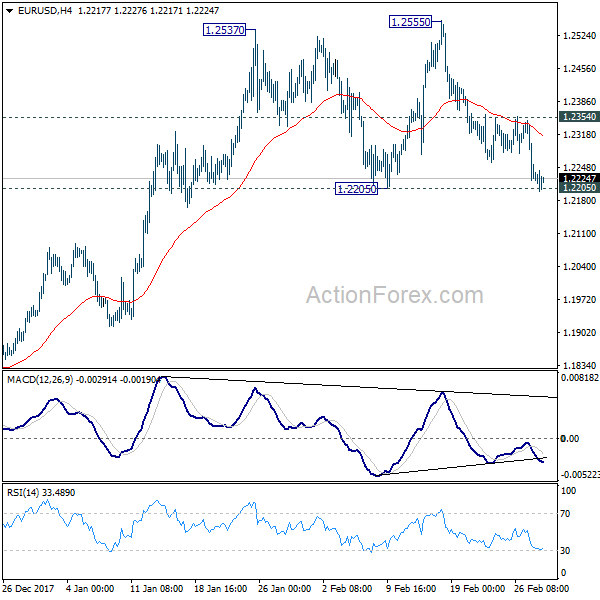
EUR/USD drops to as low as 1.2198 and is pressing 1.2205 key support. As noted before, decisive break of this important 1.2205 support will confirm rejection by 1.2516 key fibonacci level and trend reversal. In that case, further decline should be seen back to 1.1553 support next. On the upside, above 1.2354 minor resistance will bring retest of 1.2555 high. Break of 1.2555 will revive the bullish case of up trend resumption and target 100% projection of 1.0569 to 1.2091 from 1.1553 at 1.3075.
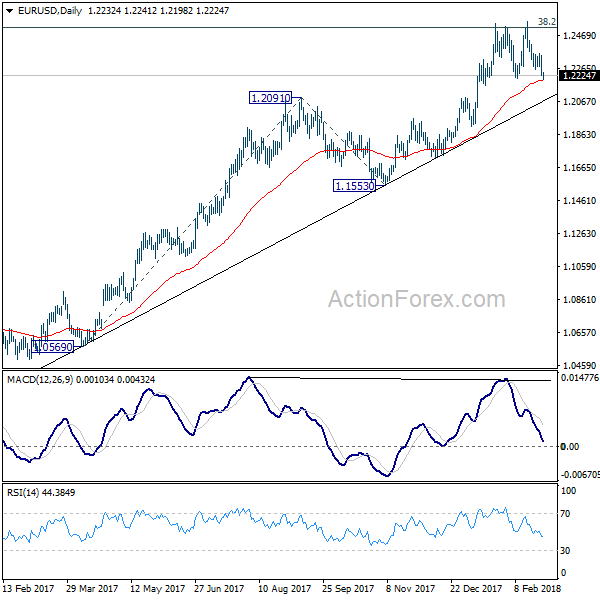
In the bigger picture, key fibonacci level at 38.2% retracement of 1.6039 (2008 high) to 1.0339 (2017 low) at 1.2516 remains intact despite attempts to break. Hence, rise from 1.0339 medium term bottom is still seen as a corrective move for the moment. Rejection from 1.2516 will maintain long term bearish outlook and keep the case for retesting 1.0039 alive. However, sustained break of 1.2516 will carry larger bullish implication and target 61.8% retracement of 1.6039 to 1.0339 at 1.3862.
GBP/USD Mid-Day Outlook
Daily Pivots: (S1) 1.3845; (P) 1.3921; (R1) 1.3984; More....
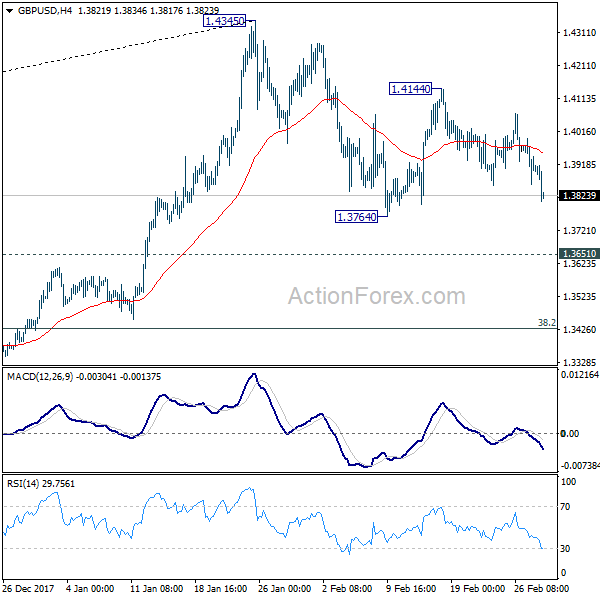
GBP/USD drops sharply today but it's still bounded in range of 1.3764/4144. Intraday bias remains neutral first. On the downside, break of 1.3764 will extend the correction from 1.4345 to 1.3651 resistance turned support. On the upside, break of 1.4144 will extend the rise from 1.3764 and target a test on 1.4345 resistance. Break there will resume larger up trend.
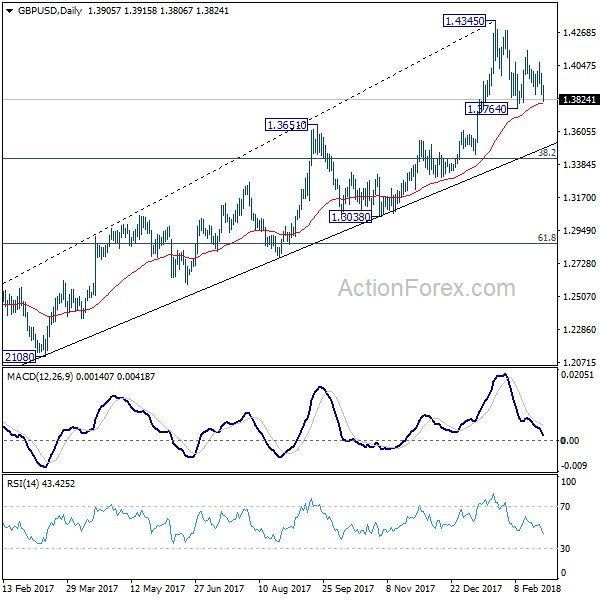
In the bigger picture, as long as 1.3038 support holds, medium term outlook in GBP/USD will remains bullish. Rise from 1.1946 is at least correcting the long term down from 2007 high at 2.1161. Further rally would be seen back to 38.2% retracement of 2.1161 (2007 high) to 1.1946 (2016 low) at 1.5466. However, GBP/USD fails to sustain above 55 month EMA (now at 1.4279) so far. Break of 1.3038 support, will suggests that rise from 1.1946 has completed and will turn outlook bearish for retesting this low.
USD/CHF Mid-Day Outlook
Daily Pivots: (S1) 0.9359; (P) 0.9388; (R1) 0.9417; More...
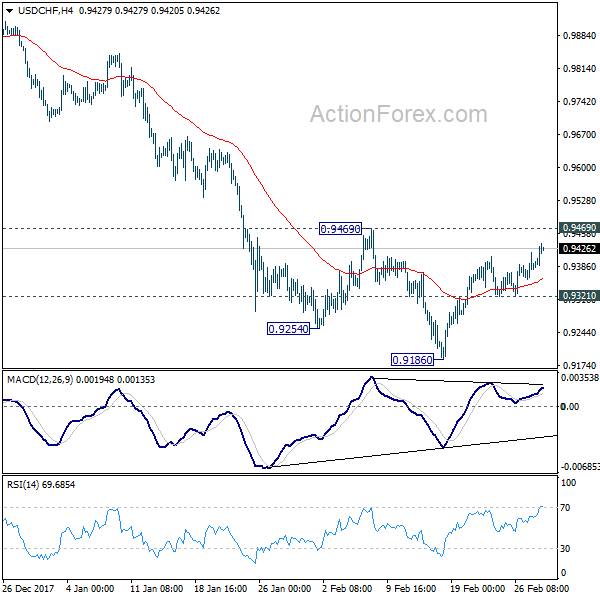
USD/CHF's rebound from 0.9186 extends higher today. But still, it's limited below 0.9469 key near term resistance. Intraday bias remains neutral for the moment. On the upside, considering bullish convergence condition in 4 hour MACD, break of 0.9469 will indicate near term reversal and turn outlook bullish for 55 day EMA (now at 0.9513) and above. On the downside, below 0.9321 minor support will bring retest of 0.9186. Break there will extend the larger down trend to 0.9115 medium term projection level next.
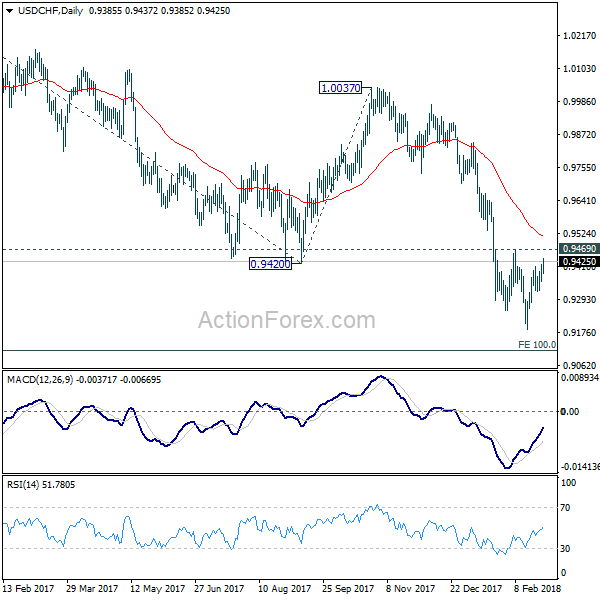
In the bigger picture, fall from 1.0342 is seen as a medium term down trend. Deeper decline should be seen to 100% projection of 1.0342 to 0.9420 from 1.0037 at 0.9115. Break will target 161.8% projection at 0.8545. In any case, sustained trading above 55 day EMA is needed to be the first sign of medium term reversal. Otherwise, outlook will stay bearish even in case of strong rebound.
USD/JPY Mid-Day Outlook
Daily Pivots: (S1) 106.84; (P) 107.25; (R1) 107.74; More...
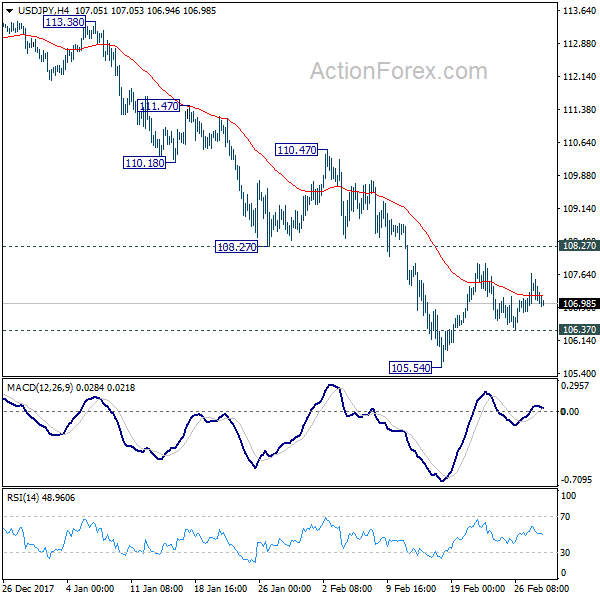
At this point, USD/JPY is still staying in tight range as consolidation continues. Intraday bias remains neutral. On the upside, break of 108.27 will be the first sign of near term reversal and will target 110.47 resistance for confirmation. On the downside, below 106.37 minor support will bring retest of 105.54 low. Break of 105.54 will extend the larger decline from 118.65 and target 100% projection of 118.65 to 108.12 from 114.73 at 104.20 next.
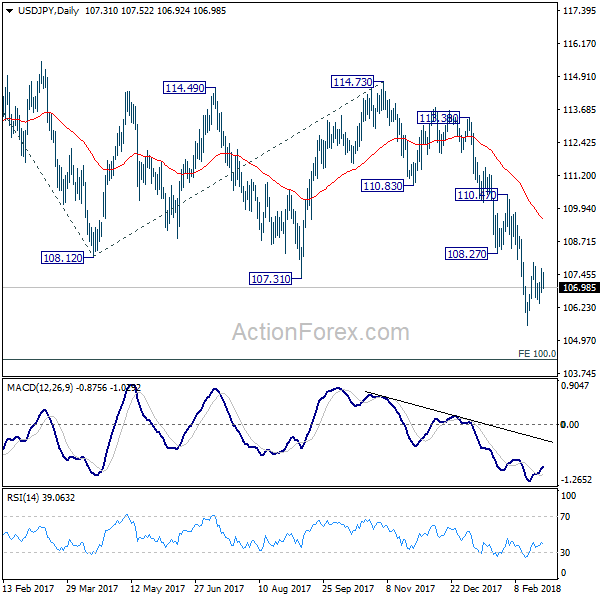
In the bigger picture, current development argues that the corrective pattern from 118.65 is extending. The solid break of 61.8% retracement of 98.97 to 118.65 at 106.48 now suggests that the pattern from 125.85 high is possibly extending. Deeper fall could be seen through 98.97 key support (2016 low). This bearish case will now be favored as long as 110.47 resistance holds.
US: Second Estimate of Q4 Real GDP Growth Confirms Solid End to 2017
The American economy grew by 2.5% (annualized) in the fourth quarter according to the BEA's second estimate. That was a tick lower than the first estimate, but right in line with expectations.
Headline consumer spending growth was unchanged at 3.8%, although services spending was slightly stronger (+2.1% versus 1.8%) at the expense of a downward revision to goods spending.
Business investment was revised down by a hair to 6.6% from 6.8%, owing to lower intellectual property investment (+2.4% versus 4.5%). Investment in structures (+2.5%) and equipment (+11.8%) were both revised up modestly.
Residential investment grew even faster than originally reported, rising 13% annualized (up from 11.6%). Residential structures were impacted by disruptions related to Hurricanes Harvey and Irma in the third quarter, with activity clearly rebounding in the fourth quarter.
The drag from inventories was revised up slightly, subtracting 0.7 percentage points from the headline figure.
Exports and imports were little changed, subtracting 1.1 percentage points from growth in Q4.
Key Implications
Well that was rather uneventful. Changes to GDP growth from the first to second estimate were quite minimal. A slight downward revision to growth in the fourth quarter does not change the story for the economy. Real GDP growth still ran at a healthy pace in Q4, and for the most part, momentum has carried through into 2018. Growth has been well-above the economy's potential growth rate (around 2.0%) and is consistent with ongoing declines in the unemployment rate, which at 4.1% is already below its estimated long-run level.
The Fed already knew that the economy had healthy momentum to end 2017, so this does little to change its thinking on the outlook. We will hear from Powell again on Thursday, when he testifies before the Senate Banking Committee, but his remarks will likely mirror those from yesterday.
Sterling Tumbles as EU’s Brexit Treaty Draft Shows Significant Divergences, Dollar Firm on Fed Expectations
Sterling is trading as the weakest major currency today. Fresh selling is seen on strong comments from EU Brexit negotiator Michel Barnier. That came as European commission published its own draft Brexit withdrawal treaty. The document highlighted, in Barnier's words "significant divergences" between UK and EU. Yen is trading as the strongest for the day, thanks to risk aversion. But Dollar is still the strongest for the week. The greenback was boosted by upbeat comments from Fed Chair Jerome Powell. Technically, EUR/USD is now finally pressing trend defining 1.2205 key support. This level will be the major focus in US session.
EC's version of Brexit treaty shows significant divergences still exist.
European Commission published a 119-page documents as the draft withdrawal agreement on Brexit today. (The document is available here if you're interested). EU chief negotiator Michel Barnier said that "if we want to succeed in these negotiations, and I want to succeed, we must accelerate." And he gave some strong words regarding the transition period and warned that it's not a given. Barnier also insisted that the ECJ may "play a role in the interpretation and implementation of the withdrawal agreement whenever it refers to European law." Regarding the issue of Ireland, he said that a fallback option is for Northern Ireland to remain in the customs union and pay a consistent tax regime with the Republic of Ireland. But in that case, the UK will have no regulatory authority over the goods produced in Northern Ireland. Regarding the Brexit bill, the draft treaty requests the UK to make two payments per year to EU after 2020 to settle its financial obligations.
Ahead of her high profile speech regarding UK-EU relationship, UK Prime Minister Theresa May emphasized that the British people will "bring back control of our laws, our borders and our money." And she warned that the Labour's push for customs union would be "be a betrayal of the British people.'' She further added that while the UK wants to keep trade with EU "as easy as possible" a customs union would mean "we couldn't do out own trade deals. So far, the differences between UK and EU are very clear. We'll look forward to May's speech to see whether she's doing anything to close the gaps.
Dollar strong on hope for four hikes this year
While mainly maintaining the FOMC's stance, the new Fed Chair Jerome Powell's Congressional testimony before the House Finance Services Committee was interpreted as a hawkish one. Heightened speculations for three, or more, rate hikes this year were reflected in higher yields, the rise of the US dollar to highest in 3 weeks and pullback in risk assets, including equities.
In short, Powell's assessment on US growth outlook was upbeat, describing growth and the employment market as strong. He also emphasized that fiscal policy, foreign growth, and financial conditions have turned from headwinds into tailwinds. Powell admitted that inflation remained low but affirmed that 'some of the shortfall in inflation last year', which were driven by 'transitory influences', should not repeat.
On the monetary policy outlook, the new Chair reiterated the gradual path to normalization. Yet, he added the Fed would 'continue to strike a balance between avoiding an overheated economy and bringing PCE price inflation to 2% on a sustained basis". This appears to have signaled that the future rate hike path might steepen. More in Hawkish Powell Raises Hopes For Four Rate Hikes This Year.
Released from US, Q4 GDP growth was revised lower by 0.1 to 2.5% annualized. GDP price index was revised low re to 2.3%. From Canada, IPPI rose 0.3% mom in January, RMPI rose 3.3% mom.
Swiss KOF signals above average growth, Eurozone CPI slowed
Swiss KOF economic barometer rose to 108.0 in February, up from 107.6 and beat expectation of 106.0. KOF noted that "from a longer-term perspective, the early 2017 improved sentiment appears to continue. And, "in the near future the Swiss economy should continue to grow at rates above average."
Also from Europe, Eurozone CPI slowed to 1.2% yoy in February, down from 1.3% yoy, in line with expectation. Eurozone CPI core was unchanged at 1.0% yoy. German unemployment dropped -22k in February, unemployment rate was unchanged at 5.4%, Gfk consumer sentiment dropped 0.2 to 10.8 in March. French Q4 GDP grew 0.6% qoq. UK Gfk consumer confidence dropped to -10 in February, down from -9.
BoJ Kuroda to have confirmation hearing on March 2
BoJ Governor Haruhiko Kuroda said today that monetary policy normalization would be "very gradual" one it's started. Kuroda will have his confirmation hearing at the parliament on March 2, for renewing his five year term. Separate hearing is scheduled for the two BoJ deputy governor nominees, on March 5. The two nominees include Masazumi Wakatabe, a Waseda University academic and an advocate of aggressive easing, and BOJ Executive Director Masayoshi Amamiya, a veteran central banker known for shaping monetary policy.
Japan retail sales rose 1.6% yoy in January versus expectation of 2.5% yoy. Japan industrial production dropped -6.6% mom in January versus expectation of -4.2% mom. Housing starts dropped -13.2% yoy in January.
NAB forecasts one RBA hike in 2018, instead of two
In Australia, the National Australia Bank lowered its RBA interest rate forecast for the year. NAB now expects only one RBA hike this year, instead of two. The bank said in its report that "weak wages growth and slow progress reducing unemployment means it is now less likely that the RBA will raise rates twice in 2018." It explained that "while total wages did increase a touch 0.55%, there was no acceleration in private wages growth." Nonetheless, "wage increases are overdue" and " tightness in employers' ability to find suitable labour, may finally see private sector wages start to moderately edge up." And, "we now see the RBA raising rates only once in late 2018 with November 2018 as the most likely start date for a gradual RBA rate hiking cycle." However, there is still a change for RBA to stand pat depending on data flow.
New Zealand business confidence stayed pessimistic
New Zealand ANZ business confidence improved to -19.0 in February, up from -37.8. That is, a net 19% of business were pessimistic about the year ahead. ANZ noted in the release that "a slower housing market, a small dip in net migration, difficulty finding credit and already-stretched construction and tourism sectors are making acceleration hard work from here." Meanwhile, "strong terms of trade and a positive outlook for wage growth are providing a push." And, "the rebound in business confidence is consistent with our belief that while no longer at top speed, this business cycle has legs yet. In particular, incomes are set to be supported by the strong terms of trade and higher wage growth."
GBP/JPY Mid-Day Outlook
Daily Pivots: (S1) 148.80; (P) 149.30; (R1) 149.78; More...
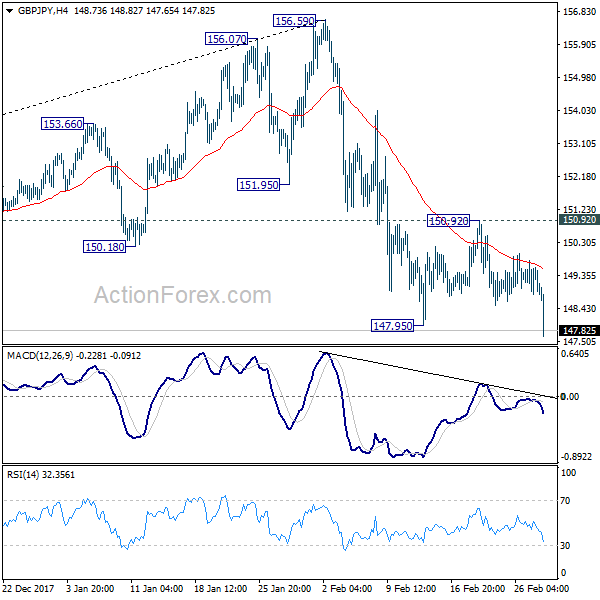
GBP/JPY's fall resumed from 156.59 by breaking 147.95 support. Intraday bias is turned back to the downside. Current fall should target 146.96 support next. Considering bearish divergence condition in daily MACD, firm break of 146.96 will be another sign of medium term trend reversal. On the upside, break of 150.92 resistance is needed to indicate short term bottoming. Otherwise, outlook will stay bearish in case of recovery.
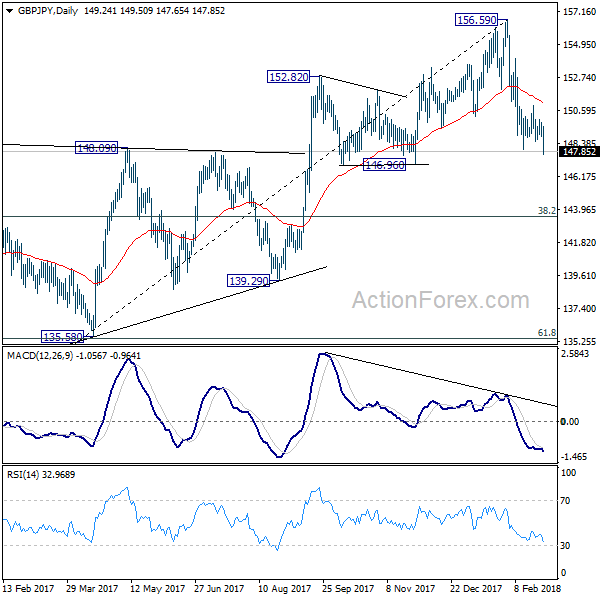
In the bigger picture, the case for medium term reversal continues to build up on loss of medium term momentum as seen in weekly MACD. Also, firm break of 146.96 will indicate rejection by 55 month EMA (now at 154.60) and add to that case of reversal. In that case, deeper fall would be seen to 38.2% retracement of 122.36 to 156.59 at 143.51 and then 61.8% retracement at 135.43. Meanwhile, break of 156.59 will extend the rise from 122.36 to 61.8% retracement of 195.86 to 122.36 at 167.78.
Economic Indicators Update
| GMT | Ccy | Events | Actual | Forecast | Previous | Revised |
|---|---|---|---|---|---|---|
| 23:50 | JPY | Retail Trade Y/Y Jan | 1.60% | 2.50% | 3.60% | |
| 23:50 | JPY | Industrial Production M/M Jan P | -6.60% | -4.20% | 2.90% | |
| 00:00 | NZD | ANZ Business Confidence Feb | -19 | -37.8 | ||
| 00:01 | GBP | GfK Consumer Confidence Feb | -10 | -10 | -9 | |
| 00:01 | GBP | BRC Shop Price Index Y/Y Feb | -0.80% | -0.60% | -0.50% | |
| 01:00 | CNY | Manufacturing PMI Feb | 50.3 | 51.2 | 51.3 | |
| 01:00 | CNY | Non-manufacturing PMI Feb | 54.4 | 55 | 55.3 | |
| 05:00 | JPY | Housing Starts Y/Y Jan | -13.20% | -4.70% | -2.10% | |
| 07:00 | EUR | German GfK Consumer Confidence Mar | 10.8 | 10.9 | 11 | |
| 07:45 | EUR | French GDP Q/Q Q4 P | 0.60% | 0.60% | 0.60% | |
| 07:45 | EUR | French GDP Y/Y Q4 P | 2.50% | 2.40% | 2.40% | |
| 08:00 | CHF | KOF Leading Indicator Feb | 108 | 106 | 106.9 | 107.6 |
| 08:55 | EUR | German Unemployment Change Feb | -22K | -17K | -25K | |
| 08:55 | EUR | German Unemployment Rate Feb | 5.40% | 5.40% | 5.40% | |
| 10:00 | EUR | Eurozone CPI Estimate Y/Y Feb | 1.20% | 1.20% | 1.30% | |
| 10:00 | EUR | Eurozone CPI Core Y/Y Feb A | 1.00% | 1.00% | 1.00% | |
| 13:30 | CAD | Industrial Product Price M/M Jan | 0.30% | 0.50% | -0.10% | |
| 13:30 | CAD | Raw Materials Price Index M/M Jan | 3.30% | 1.80% | -0.90% | |
| 13:30 | USD | GDP Annualized Q/Q Q4 S | 2.50% | 2.50% | 2.60% | |
| 13:30 | USD | GDP Price Index Q4 S | 2.30% | 2.40% | 2.40% | |
| 14:45 | USD | Chicago PMI Feb | 64.6 | 65.7 | ||
| 15:00 | USD | Pending Home Sales M/M Jan | 0.50% | 0.50% | ||
| 15:30 | USD | Crude Oil Inventories | -1.6M |
EUR/JPY Mid-Day Outlook
Daily Pivots: (S1) 131.29; (P) 131.52; (R1) 131.96; More....
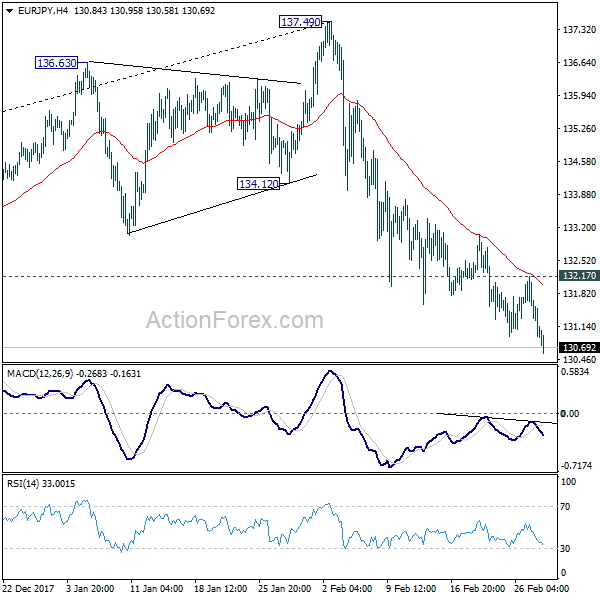
EUR/JPY's fall extends to as low as 130.58 so far and intraday bias remains on the downside. A medium term top is likely in place at 137.49 on bearish divergence condition in daily MACD. Deeper fall should be seen to 126.61 medium term fibonacci level next. On the upside, break of 132.17 resistance is needed to indicate short term bottoming. Otherwise, outlook will remain bearish in case of recovery.
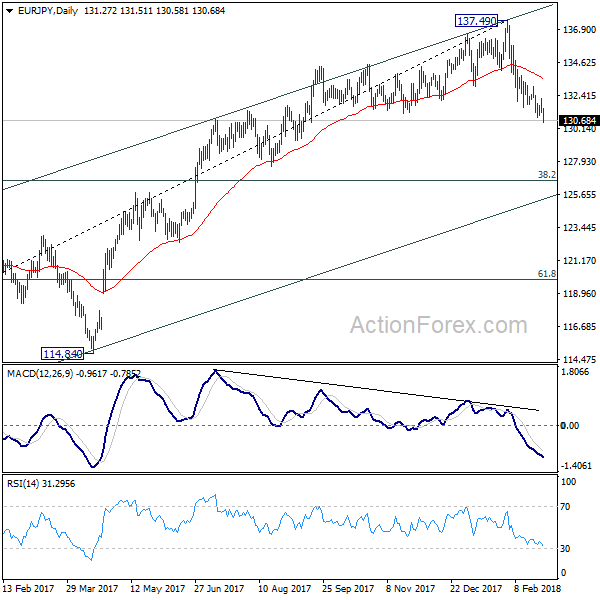
In the bigger picture, current development argues that rise from 109.03 has completed at 137.49, on bearish divergence condition in weekly MACD. Deeper fall should be seen to 38.2% retracement of 109.03 to 137.49 at 126.61 first. On the upside, break of 137.49 is needed to confirm medium term rise resumption. Otherwise, risk will now stay on the downside even in case of strong rebound.
GBP/JPY Mid-Day Outlook
Daily Pivots: (S1) 148.80; (P) 149.30; (R1) 149.78; More...
GBP/JPY's fall resumed from 156.59 by breaking 147.95 support. Intraday bias is turned back to the downside. Current fall should target 146.96 support next. Considering bearish divergence condition in daily MACD, firm break of 146.96 will be another sign of medium term trend reversal. On the upside, break of 150.92 resistance is needed to indicate short term bottoming. Otherwise, outlook will stay bearish in case of recovery.
In the bigger picture, the case for medium term reversal continues to build up on loss of medium term momentum as seen in weekly MACD. Also, firm break of 146.96 will indicate rejection by 55 month EMA (now at 154.60) and add to that case of reversal. In that case, deeper fall would be seen to 38.2% retracement of 122.36 to 156.59 at 143.51 and then 61.8% retracement at 135.43. Meanwhile, break of 156.59 will extend the rise from 122.36 to 61.8% retracement of 195.86 to 122.36 at 167.78.