Sample Category Title
Gold In Holding Pattern Ahead Of Federal Reserve Minutes
Gold is steady in the Wednesday session, following sharp losses on Tuesday. In North American trade, the spot price for an ounce of gold is $1329.08, down 0.05% on the day. On the release front, all eyes are on the Federal Reserve, which will release the January minutes later in the day. Earlier, Existing Home Sales disappointed, dropping to 5.38 million. This was well short of the estimate of 5.61 million. On Thursday, the US will release unemployment claims.
Gold prices remain under pressure, as the metal has lost 1.5% this week, erasing much of last week’s gains. Concerns that strong US numbers could stoke inflation and more rate hikes sparked the recent turbulence in global stock markets. This has triggered volatility in gold, as gold prices are sensitive to moves (or expected moves) in interest rates. The Fed is currently projecting three rate hikes this year, but if inflation continues to move upwards, many analysts are expecting that the Fed could press the rate trigger four, or even five times in 2018. Traders should be prepared for some movement from gold later in the North American session, as the minutes could provide some clues regarding future rate policy.
It’s been a busy start for Jerome Powell, who has just commenced his stint as chair of the Federal Reserve. Strong US data in recent weeks has raised speculation that the Fed may need to accelerate the pace of interest rate hikes in 2018. Meanwhile, concern over higher inflation and more rate hikes sent the stock markets into a frenzy earlier in February. Powell sought to reassure the markets that the Fed was monitoring the situation, but it’s doubtful that the Fed can do much to prevent volatility in the markets.
GBP/USD – Strong UK Employment Numbers Fail To Rally Pound, Fed Minutes Loom
The British pound has posted losses in the Wednesday session. In North American trade, GBP/USD is trading at 1.3946, down 0.37% on the day. On the release front, British employment numbers were solid. Wage growth remained at 2.5%, matching the forecast. Unemployment rolls declined 7.2 thousand, crushing the estimate of a 2.3 thousand gain. However, the unemployment rate ticked up to 4.4%, above the estimate of 4.4%. In the US, the key event is the Federal Reserve minutes from the January meeting. Earlier, Existing Home Sales disappointed, dropping to 5.38 million. This was well short of the estimate of 5.61 million. On Thursday, the UK releases revised GDP for the fourth quarter as well as Preliminary Business Investment. The US will publish unemployment claims.
The Bank of England has been hinting that it could speed up the pace of rate hikes, and this was further reinforced on Wednesday, as BoE Chief Economist Andy Haldane said that interest rates might need to climb faster than previously expected, in order to bring down inflation to the BoE’s target of 2 percent. The Bank has been reluctant to raise rates in order to lower inflation, but may be running out of options, as inflation hovers at 3 percent and continues to erode the purchasing power of consumers. The Bank has taken pains to be transparent with the markets, stating recently that the pace of rate hikes could be accelerated and larger hikes than previously forecast could be on the way.
It’s been a busy start for Jerome Powell, who has just commenced his stint as chair of the Federal Reserve. Strong US data in recent weeks has raised speculation that the Fed may need to accelerate the pace of interest rate hikes in 2018. The Fed is currently projecting three rate hikes this year, but if inflation continues to move upwards, many analysts are expecting that the Fed could press the rate trigger four, or even five times in 2018. Meanwhile, concern over higher inflation and more rate hikes sent the stock markets into a frenzy earlier in February. Powell sought to reassure the markets that the Fed was monitoring the situation, but it’s doubtful that the Fed can do much to prevent volatility in the markets.
USD/JPY – Japanese Yen Edges Lower As Japanese Manufacturing PMI Dips
The Japanese yen has ticked lower in the Wednesday session. In North American trade, USD/JPY is trading at 107.58, up 0.23% on the day. In Japan, Flash Manufacturing PMI dipped to 54.2, missing the estimate of 55.2 points. All Industries Activity slowed to 0.5%, matching the forecast. In the US, the key event is the Federal Reserve minutes from the January meeting. Earlier, Existing Home Sales disappointed, dropping to 5.38 million. This was well short of the estimate of 5.61 million. On Thursday, the US releases unemployment claims and Japan will release two inflation reports.
The yen posted sharp gains last week, as the currency gained 2.5% against the retreating dollar. However, the US dollar has rebounded this week and climbed to 107.90 earlier on Wednesday, marking a 1-week high. Have investors regained their appetite for risk? US markets have gained ground this week, pushing the US dollar higher. The stock markets could continue to set the direction for the safe-haven yen – if the markets remain in green territory, the yen could continue to lose ground.
The Bank of Japan is holding a steady course when it comes to top management. Governor Harohiko Kuroda has been reappointed to another 5-year term, the first time that a BoJ governor has been re-elected to a second term in 60 years. The move is a clear message from the Bank that it is no rush to make any change to the massive stimulus program, a key component of Abenomics. Kuroda has made it a priority to raise inflation, but this has proven a daunting task, as inflation is still below of the BoJ’s inflation target of 2%. In this period of strong volatility in the currency markets, Kuroda’s re-election may have a calming effect on the markets. What’s next for the BoJ? The yen has jumped 4.9% in 2018, and if the rise continues, policymakers could consider further easing in order to curb the yen’s value and protect the export sector, which has improved due to stronger global demand.
The Federal Reserve will be in the spotlight on Wednesday, with the release of the minutes from the January meeting, the last to have been chaired by Janet Yellen. The markets will be looking for hints regarding future rate policy, and any inkling of plans to raise interest rates more than three times in 2018 could trigger volatility in the currency markets as well as stock markets. Recent US numbers have been strong, and inflation indicators have been pointing upwards. This has raised concerns that the Fed may accelerate its pace of hikes, which triggered a sharp correction in global stock markets. The new chair of the Fed, Jerome Powell has tried to reassure the markets that the Fed is monitoring the situation, but it’s doubtful that the Fed can do much to prevent volatility in the markets.
The 3% Quandary
The FOMC Minutes led to a whipsaw in US dollar trading Wednesday and exposed a dilemma. The US dollar was the top performer once again while the Australian dollar lagged. China returns from holiday in the day ahead.
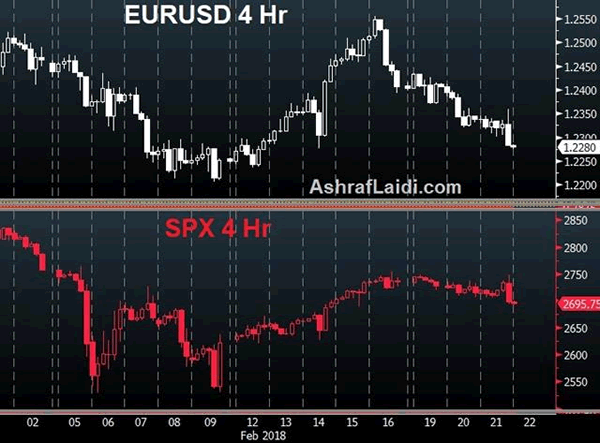
The FOMC Minutes didn't offer much in the way of surprises but offered plenty in the way of market moves. The US dollar fell 30-40 pips across the board on the headlines only to make a complete recovery 30 minutes later and finish at the highs.
In the lead-up to the release, there was fear about an especially hawkish set of minutes but that didn't materialize. Instead, there was the predictable optimism about growth along with hints at upside risks to inflation.
At first, it seemed fears in the market were soothed. The US dollar dropped and stock markets rallied. But bond traders pushed yields further in a sign of jitters about four rate hikes this year.
A short time late, stocks joined bonds lower and USD rallied. The looming level is 3% in the 10-year note. It rose 6 bps to 2.95% Wednesday – the highest since 2014. Along with the big figure, the 2014 high of 3.06% is a major level of resistance.
At this point, other markets are beginning to get worried about the reaction to higher borrowing costs. We get the sense that many are heading to the sidelines to see how it will shake out. Ultimately, 3% is just a number and it's not a magical line in the sand that's going to torpedo borrowers' finances so there might be a sigh of relief once it's breached. But until then, expect further jitters to continue.
If you're in London this week, you can attend Ashraf's full assessment for FX, yields and indices on Thursday evening at GKFX London HQs and on Friday at the London Forex Show.
Looking ahead, the Asia-Pacific economic calendar is light but it includes the return of China after a week of holidays. That's likely to add a bit of volatility and certainly some flows. Further down the agenda, the Fed's Quarles speaks at 0515 GMT along with French CPI, German IFO sentiment data, UK GDP and Canadian retail sales. All that should make for plenty of action.
ECB Meeting Minutes Due: More Hawkish Talk to be Expected?
The European Central Bank will release its account of the monetary policy meeting that took place in January on Thursday at 1230 GMT. The minutes from the December meeting took markets by surprise by being more on the hawkish side of the spectrum than markets expected, leading to a rally in the euro. Should Thursday's release build on the "hawkish momentum", then the single currency is again expected to post gains.
December's minutes indicated that the ECB may revisit its communication stance in early 2018 and led market participants to push their expectations for tighter monetary policy sooner than previously thought. Tomorrow's record of January's meeting will reveal whether this potential shift in policy has started becoming more concrete as early as in the first meeting of the year.
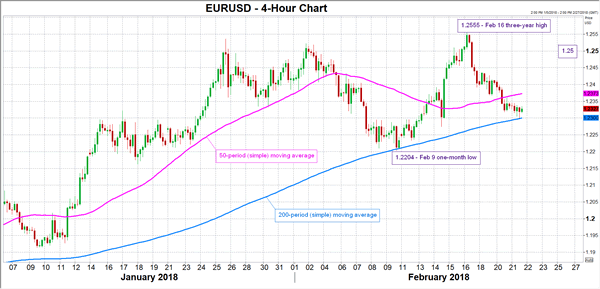
A hawkish tilt in ECB talk is anticipated to lead to a strengthening euro/dollar pair, with the area around the current level of the 50-period moving average at 1.2373 potentially acting as resistance. The range around this point also encapsulates the 1.24 handle that may be of psychological significance. Further above, the focus would shift to the range around 1.25 which was congested earlier in the year.
On the downside, support for the pair might be currently emerging around the 200-period MA at 1.23. If ECB policymakers' views do not appear as hawkish as forex market participants expect, then a downside violation of this area might take place. In this case, the attention would turn to the one-month low of 1.2204 – including the 1.22 handle – that was recorded on February 9.
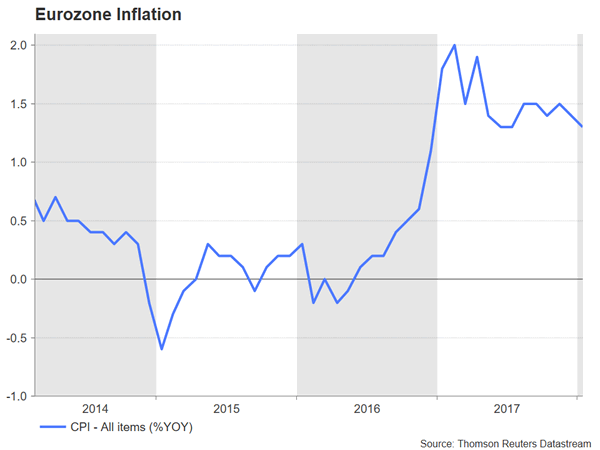
Overall, there is optimism in the markets about the eurozone remaining on a path of recovery in 2018, something which makes a tightening decision easier for the ECB. However, it should also be mentioned that not everything is conducive to a path of policy normalization. Inflation is well under the central bank's target of below but close to 2% on an annual basis, with the account of January's meeting possibly showing policymakers stressing this and thus advising for patience regarding the timing of further stimulus reduction.
It should also be kept in mind that another driver that could push down the euro is any policymaker concerns on an appreciating currency, something which weighs on inflationary pressures.
Returning to inflation, the euro area's final CPI figures for January are scheduled for release on Friday at 1000 GMT. Headline CPI is expected to be confirmed at 1.3% y/y, this reflecting a slowdown relative to December. Month-on-month, headline inflation is forecast to have contracted by 0.9%. Core CPI that excludes volatile food and energy items is projected to come in at 1.0% y/y, again reflecting a slowdown relative to December's respective figure. Given that prices in the eurozone often decline in January, one might be justified not to read much into Friday's numbers.
Other euro risk events moving forward are eurozone flash inflation figures for February due on the last day of the month – these would constitute the last inflation input ahead of the ECB meeting on March 8 – the Italian elections on March 4, as well as the result of the German Social Democratic Party's (SPD) ballot as regards whether the party should reenter a coalition with Chancellor Merkel's conservative bloc. The outcome of the SPD vote could be known on the Italian election day.
Lastly, it should be stated that the Federal Reserve will later on Wednesday (at 1900 GMT) release its own record relating to its late January meeting, the last presided by Janet Yellen. This also has the capacity to spur positioning in euro/dollar.
FOMC Minutes May Extend the Dollar’s Rebound, But Can it Last?
The Fed will release the minutes from the January FOMC meeting on Wednesday at 1900 GMT, and investors will be watching closely as they try to gauge whether the central bank will chart a more hawkish course moving forward. While an optimistic tone in the minutes may help the dollar to extend its latest recovery, it is critical to keep in mind that the broader market narrative remains one of USD weakness, for now at least.
While the Fed kept borrowing costs unchanged back in January, the accompanying statement was interpreted as having a hawkish tilt. Policymakers upgraded their language around inflation, and appeared more upbeat on the broader economy. Perhaps more importantly, they altered slightly their assessment over the future course of interest rates. The word "further" was added to the sentence "The Committee expects that economic conditions will evolve in a manner that will warrant further gradual increases in the federal funds rate". This subtle change was widely seen as a preliminary sign that the FOMC is contemplating the prospect of more rate hikes in the future, something that investors will be looking to confirm through these minutes.
At the time of writing, markets have fully priced in two quarter-point Fed rate hikes this year, and also see a 70% probability for a third one, according to the Fed funds futures. In case the minutes echo an equally optimistic tone as the statement, the probability for a third hike could move closer to 100%, and investors may even price in some expectations for a fourth one. Such an outcome would likely help the dollar to extend its latest rebound. Dollar/yen is likely to move higher in this scenario and break above its latest highs at 108.00. Such a break could open the way for a test of the 109.30 resistance territory, marked by the peaks of February 9.
On the contrary, if the minutes fail to live up to the hawkish expectations and instead appear to be relatively neutral or cautious, then the dollar could resume its broader downtrend. Dollar/yen may inch lower and test the 106.80 support zone, identified by the lows of February 14. If sellers prove strong enough to overcome that barrier, then the pair could gradually aim for a test of 105.50, the low it posted on February 16.
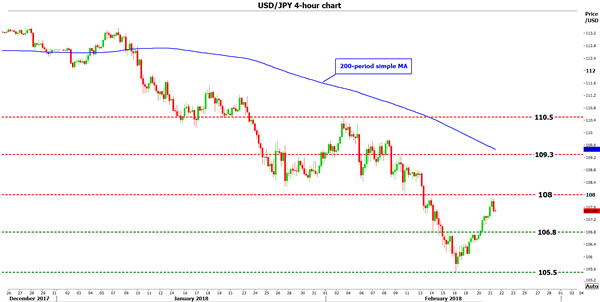
All the above said, it is critical to remember that the bigger story remains one of USD weakness, amid elevated concerns regarding widening US deficits and longer-term debt sustainability. Thus, even in case the dollar spikes higher on the minutes, it remains to be seen whether it can maintain the positive momentum. It may take something more than just a slightly hawkish tone in these minutes for this narrative to change, and for the dollar's downtrend to reverse.
In this respect, markets will pay very close attention to Jerome Powell's testimony before Congress next week. The testimony of the new Fed Chair will not only shed some light on his own views, but may also provide markets with some commentary on the encouraging developments that happened after the January meeting and hence will not be discussed in these minutes. For instance, how the Committee views the acceleration in wages and the stronger-than-anticipated CPI numbers for January. Powell's comments could be the biggest determinant of expectations over what the Fed is likely to deliver this year and thus, the dollar's overall direction.
US 500 Index Loses Some Ground; Bearish Crossover of 20 and 40 SMAs
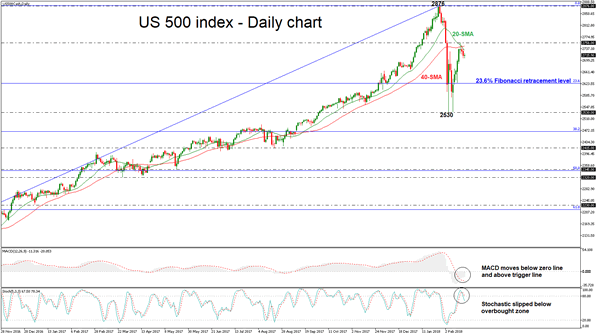
The US 500 index is moving slightly lower after the sharp buying interest in the previous week pared some of the steep losses from earlier in the month. The price is developing below the bearish crossover within the 20 and 40 simple moving averages in the daily timeframe, suggesting downward pressure.
From the technical point of view, the MACD oscillator is holding below the zero line but jumped above the trigger line in the previous sessions. The stochastic oscillator is moving lower and posted a bearish crossover in the overbought zone.
Should the index record losses, support could come at the 23.6% Fibonacci retracement level at 2,625 of the up-leg with the low of 1,807.30 and the high of 2,876. Falling below this level could help shift the focus to the downside towards the 2,530 support barrier.
Conversely, further advancing could see the index meeting the immediate resistance around the 2,756 barrier. A stronger bullish movement would turn the attention towards the 2,876 mark, this being the peak from January 29.
WTI Crude Oil Futures see Bullish Bias with Scope to Extend Higher
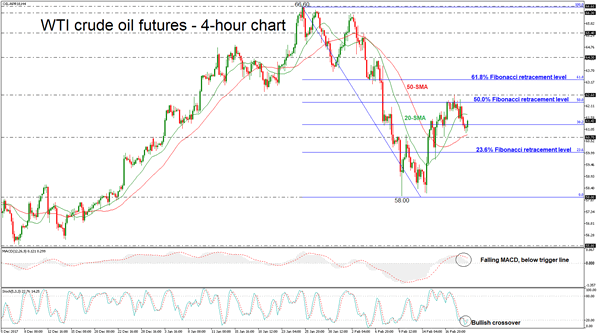
WTI crude oil futures have been underperforming since yesterday's trading period, however over the last few hours they are trying to gain some ground. In the short-term timeframe, the technical indicators seem to be in confusion as they are giving signals for opposite tendency.
In the 4-hour chart, the MACD oscillator is falling in the positive zone below its trigger line, approaching the zero line. However, the stochastic oscillator recorded a bullish crossover in the oversold territory, suggesting a retracement of the bearish bias.
If price action climbs above the 20-day simple moving average near 61.72 at the time of writing, immediate resistance could come at 62.60, slightly above the 50.0% Fibonacci retracement level at 62.27 of the down-leg from 66.60 to 58.00. The price tested several times the latter obstacle as it is acting as significant resistance barrier. Clearing this level could see additional gains towards the 64.30 resistance barrier but first prices need to successfully surpass the 61.8% Fibonacci level at 63.30
On the flip side, should price extend their losses, the next support level to have in mind is the 60.70. In case of a fall below that barrier, oil could hit the 23.6% Fibonacci mark around 60.00.
Sunset Market Commentary
Markets
Global core bonds gained some ground today with German Bunds outperforming US Treasuries. A bigger-than-forecast setback from (record) EMU PMI's initiated Bund gains. US Treasury investors weren't inclined to blindly follow the Bund's move higher with tonight's supply operation and FOMC Minutes in mind. Both have the potential to weigh on US Treasuries: supply via lower demand against the background of rising yields and the projected surge in the US's twin deficit and FOMC Minutes via a hawkish tone suggesting a continuation of monetary policy normalization. Philly Fed Harker, who doesn't vote on policy this year, confirmed his more dovish views of only two additional hikes this year. German yields decline by 1 bp (5-yr) to 2.8 bps (30-yr). Changes on the US yield curve are limited to -1 bp. Spreads vs Germany are unchanged apart from Greece (+10 bps) and Portugal (-4 bps)
The dollar gained gradually further ground today, but the pace of the rise remained very modest. Flash EMU February PMI's slowed more than expected. The report caused an outperformance of Bunds over Treasuries, further widening the interest rate differential. However, the direct impact on the euro was very modest. EUR/USD drifted further south in the lower half of the 1.23 big figure. However, looking at other USD cross rates, we assume that the price action was still mainly a continuation of the USD uptrend rather than anything else. EUR/USD trades currently in the 1.2320 area. The first important support area (1.2206/1.2165) is still quite far away. USD/JPY underperforms the overall USD performance. The pair hovers in the 107.40/50 area. USD traders are now looking forward to the auction of 5-yr Treasuries and the Minutes of the January Fed meeting scheduled this evening after the close of the European markets. We expect to Fed maintain a hawkish tone.
Sterling reversed part of yesterday's rebound. Part of the move occurred after softer than expected UK labour market data. The UK economy added less jobs than expected in the three months to December and the unemployment rate unexpectedly rose to 4.4%. Wage growth (2.5% Y/Y) was in line with consensus. The data played a role, but Brexit also remained at work. The letter of 62 Brexit-hardliners of the Conservative Party to UK PM May urging the government to go for clean break from the EU indicates the difficult position of the UK PM and prevents a further GBP-rebound. EUR/GBP trades in the 0.8840 area. Cable hovers in the mid 1.39 area.
News Headlines
The IHS Markit EMU composite PMI declined from 59.6 in January to 57.5 this month. The market consensus expected a more modest decline to 57.5. Both the measure for the manufacturing sector (57.5 from 58.8) and for the services sector (56.7 from 58.0) declined more than expected. The indicator suggests that the EMU growth momentum eased at the start of 2018, but it remains at a healthy level.
Britain's unemployment rate rose to 4.4% from 4.3% in the three months to December. It was the first rise in almost two years. Employment growth also printed at a softer than expected 88 000 in the three months to December (165 000 was expected). Average hourly earnings were close to expectations at 2.5% Y/Y.
ECB member Vitas Vasiliauskas in a Reuters interview said that he has not seen "any unwarranted tightening" of financial conditions. He added that an appreciating currency is a normal reaction to an improving economic outlook.
The Swedish government expects this year's budget surplus at 1.1 % of GDP, compared with a 0.9 % surplus in December. The upward revision was primarily due to reduced government expenditure, but also because tax revenues are seen growing faster, the government said.
Elliott Wave Analysis: USDCHF In A Bigger Flat
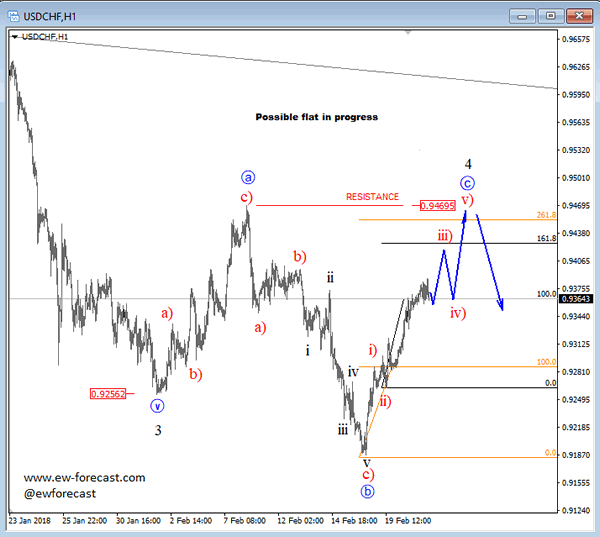
USDCHF can be making a bigger flat correction on the hourly chart, where we see a completed three-wave rally within first leg a, followed by a three-wave decline within wave b and now sharp bounce from recent lows near 0.9200 can suggest final blue leg c to be in progress. We know that in a flat pattern we have a structure of a 3-3-5, meaning final wave c always needs to unfolds five waves. Here we can see this nicely developing, but now we only see three waves to the upside with red minor wave iii) leading the way. That said price can rally up towards the 0.9467/0.947 region, where an ideal resistance region can be seen, and a new turn lower can show up.
USDCHF, 1H