Sample Category Title
GBP/USD Analysis: Slightly Weakens On Tuesday Morning
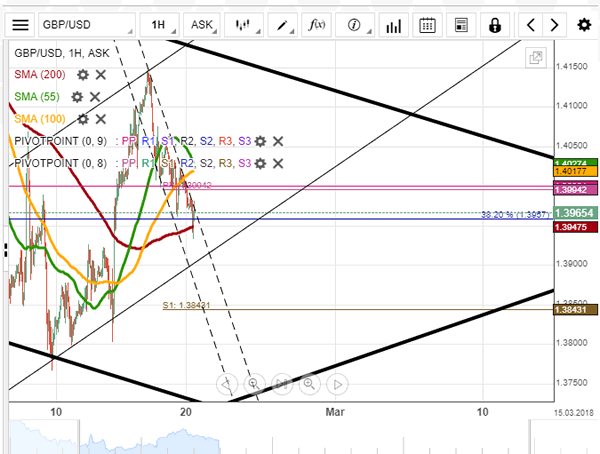
The British Sterling was confined by the 55– and 200-hour SMAs on Monday. It did, however, breach a notable support cluster set by the 100-hour SMA and the weekly and monthly PPs circa 1.40 along the way.
As apparent on the chart, the pair is bounded by two significant barriers on each side; thus, a breakout is likely to determine its subsequent direction during the day. In terms of technicals, the rate is flashing strong oversold signals that could be an early indication of a soon period of appreciation. This scenario is supported by the fact that the lower boundary of a two-week ascending channel that could put upward pressure on the pair is likewise located nearby.
In case no events shake the market, the pair could maintain its trading range between the 55– and 200-hour SMAs in this session.
USD/JPY Analysis: Continues Pushing Higher
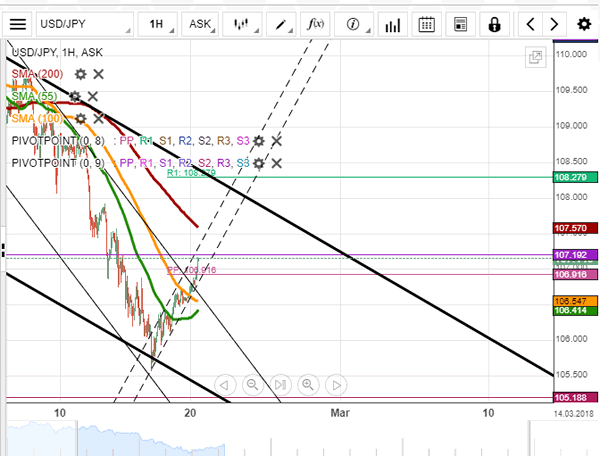
The US Dollar continues to gain value against its Japanese counterpart for the third consecutive session. The pair breached the 55– and 100-hour moving averages and the upper boundary of a two-week descending channel during the previous 24 hours, thus adding to the overall bullish sentiment.
Given that the pair is moving neatly towards the senior channel, the 108.00 area could be reached later in the week. However, the current steepness is unlikely to hold, as technical indicators point to a possible bearish correction. This fall is expected to be brief, as the southern side is supported by the 100– and 55-hour SMAs circa 106.40.
Meanwhile, bullish gains should be capped near the 107.50 mark where the long-term moving average is located.
Gold Analysis: Likely To Reverse From 1,335.00
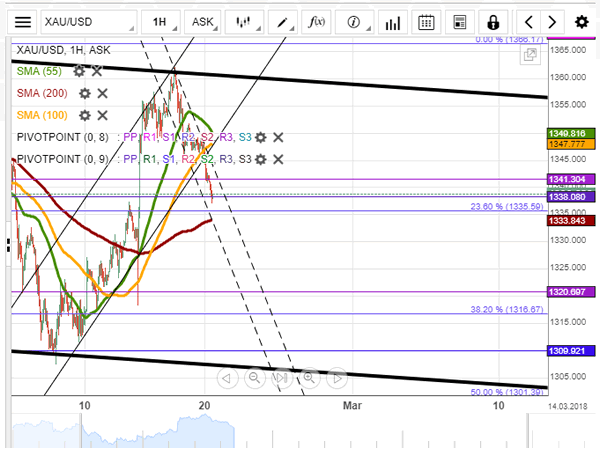
The first part of Monday's session was spent with no changes to the overall market price, as Gold was fluctuating in a narrow range between the 55– and 100-hour SMAs. The latter, reinforced by the bottom boundary of a two-week channel up, was breached late in the evening, thus pushing the rate closer to the 200-hour SMA, the 23.60% Fibo retracement and the monthly PP circa 1,335.00.
Technical oscillators have been pushed in the strongly oversold region, thus pointing to a possible recovery during this session. Thus, the base scenario favours a test of the aforementioned 1,335.00 level and a subsequent surge towards the 55– and 100-hour SMAs.
By and large, moving averages are expected to be strong barriers that should not surrender today
Dollar Bounces From 3-Year Lows, Business Surveys And Dairy Auction Due
Here are the latest developments in global markets:
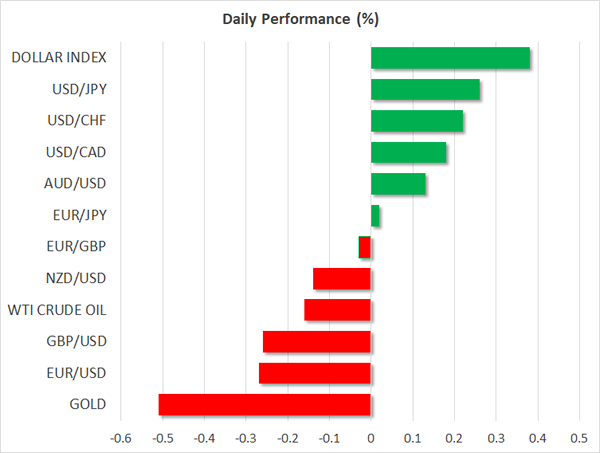
FOREX: The dollar index traded 0.4% higher on Tuesday, drawing some support from an uptick in the yields of longer-dated US Treasuries. The index rebounded on Friday after touching a fresh 3-year low, and has continued recovering since.
STOCKS: US markets remained closed yesterday in celebration of the President’s Day holiday. Earlier on Friday, the S&P 500 and the Dow Jones closed marginally higher, though the Nasdaq Composite fell 0.2%. Moreover, futures tracking the S&P, Dow, and Nasdaq 100 are currently in negative territory, suggesting that the turbulence in equity markets may still have some room to run. In Asia, most major indices were flashing red today. Japan’s Nikkei 225 and Topix closed 1.0% and 0.7% lower respectively, while in Hong Kong, the Hang Seng fell by 0.8% on its first day back from holidays. Chinese markets remain closed for the Lunar New Year festivities. In Europe, futures tracking the Euro STOXX 50 were little changed.
COMMODITIES: Oil prices were mixed today, as the two major benchmarks moved in different directions. While WTI gained almost 0.2%, Brent crude declined by roughly 0.4%. Although oil prices have recouped some of their losses in recent days, the outlook surrounding the oil market continues to be clouded by the continued surge in US production. On Friday, the US Baker Hughes oil rig count showed a further increase in the number of active oil rigs, providing a fresh signal that US output likely increased further from its record-high 10.27 million bpd. In precious metals, gold was 0.5% lower on Tuesday, as the recovery in the greenback made the dollar-denominated metal appear less attractive.
Major movers: De Guindos nominated for ECB Vice President; SPD votes on coalition government
Monday was relatively quiet in terms of price action, with most FX pairs seeing range-bound trading as US and Canadian traders were away on holiday. There were a few interesting news developments though, most notably the nomination of Spanish Economy Minister Luis de Guindos to succeed Vitor Constancio as the ECB’s Vice President.
While De Guindos is not anticipated to rock the boat in terms of policy, the nomination of a Southern European as ECB vice-chief has stoked speculation that the next ECB President after Draghi may be from central Europe, perhaps German or French. This is significant, since nations like Germany and France have traditionally favored a tighter policy stance. Thus, if somebody like Bundesbank chief Jens Weidmann is nominated to replace Draghi, then the ECB could well sail in a more hawkish direction over time.
Staying in Europe, today in Germany, the members of the SPD will begin voting in a postal ballot on whether their party should proceed with forming a coalition government with Merkel’s CDU. The results are not expected until March 4, the day that Italy will also head to the polls to elect its next government.
Sterling/dollar is nearly 0.3% lower today, extending the hefty losses it posted on Monday and Friday. A cocktail of soft UK retail sales, a recovering dollar, and some comments from the EU’s top Brexit negotiator are the culprits behind the pair’s recent underperformance. On Friday, EU chief negotiator Michel Barnier said the UK’s red lines close the door to a Swiss or Norwegian model for Brexit, enhancing the narrative that these talks are still far from bearing fruit.
Elsewhere, the minutes from the Reserve Bank of Australia’s (RBA) latest policy gathering released overnight packed few surprises. Policymakers reiterated the key risks they see as clouding the economy’s outlook, such as the high levels of household debt and the subdued growth in wages. Aussie/dollar stumbled after the release, but recouped its losses to trade even higher in the following hours.
In trade news, the US Commerce Department recommended on Friday that the US imposes heavy tariffs on steel and aluminum imports. If enacted, such measures would probably escalate further the trade tensions between the US and China, not least because China has already warned it may retaliate to such an action.
Day ahead: Business & consumer confidence surveys and bi-weekly milk auction on the horizon
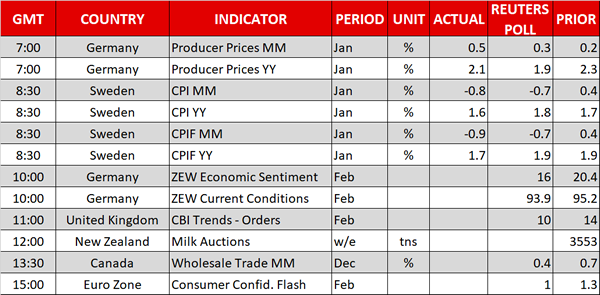
The ZEW institute’s surveys gauging economic sentiment and current conditions in Germany, eurozone’s largest economy, will be made public at 1000 GMT. Both releases are expected to reflect a decline in February after January’s surge. A related survey from the European Commission’s Directorate General for Economic and Financial Affairs covering the whole of the euro area – February’s flash consumer confidence – is scheduled for release at 1500 GMT. It also projects a dip in consumer confidence after rising to its highest since 2000 in January.
Out of the UK, the Confederation of British Industry’s monthly order book balance, gauging factory activity, will be released at 1100 GMT. The measure is anticipated to further ease in February; in December it touched a near 30-year high as British manufacturers were supported by strong export demand.
The bi-weekly milk auction is due around 1400 GMT; the release is tentative, lacking a specific time of release. Dairy products are New Zealand’s largest goods export earner, thus kiwi pairs will be eyed as the reading goes public.
Canadian wholesale trade data for the month of December are scheduled for release at 1330 GMT.
Swedish central bank Governor Stefan Ingves will be talking about the economy and monetary policy at 1730 GMT.
As the earnings season continues, Walmart and Home Depot will be among companies releasing results in the US.
Technical Analysis: NZDUSD hits 6-day low; looks bearish to neutral in short-term
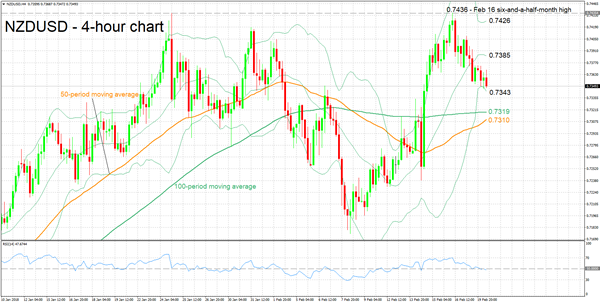
NZDUSD recorded a six-day low of 0.7347 earlier on Tuesday. This compares to last week’s (February 16) six-and-a-half-month high of 0.7436.
The RSI has been declining following last week’s high, though it seems to be consolidating around the 50-neutral perceived level at the moment, painting a bearish to neutral picture in the short-term.
Stronger-than-expected dairy prices out of today’s auction could lend some support to the pair, with price advancing potentially meeting resistance around 0.7385, this being the middle Bollinger line, a 20-period moving average line.
A weaker than anticipated release on the other hand, could see the pair extending its declines. The lower Bollinger band at 0.7343 could be providing support at the moment, with a downside violation shifting the focus to the area around the 100-period MA at 0.7319.
Technical Outlook: GBPUSD Maintains Bearish N/T Bias, Cracks 10SMA Pivot
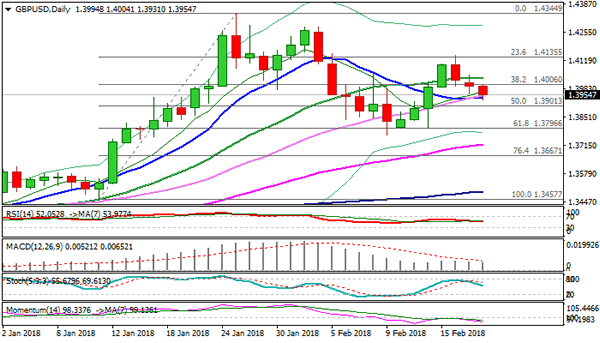
Cable remains in red for the third straight day and extends pullback from 1.4144 (16 Feb high), probing through converged 10/30SMA's at 1.3951. Repeated close below 20SMA (1.4030) on Monday and loss of psychological 1.40 support were negative signals, which could be boosted by close below 10SMA today. This could further weaken daily techs (daily MA's are turning to bearish setup and fresh bearish momentum is building) for test of pivotal 1.39 zone (base of thick 4-hr cloud/Fibo 61.8% of 1.3764/1.4144 upleg) and risk extension towards key supports at 1.3796 (Fibo 61.8% of 1.3457/1.4344/12/14 Feb higher base) and 1.3764 (9 Feb low), loss of which would generate strong bearish signal. To sideline immediate downside risk, lift and close above 1.4030 (20SMA) is needed.
Res: 1.4000, 1.4030, 1.4054, 1.4104
Sup: 1.3900, 1.3854, 1.3796, 1.3764
NZDUSD Intraday Analysis
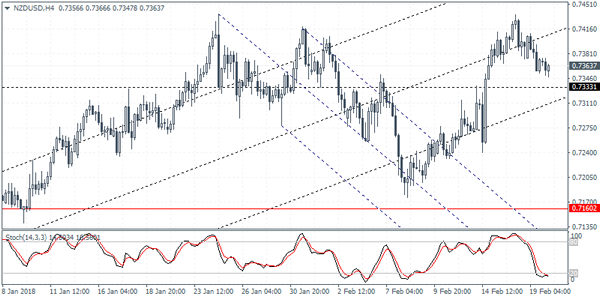
NZDUSD (0.7363): The New Zealand dollar remains firmly supported above the 0.7333 level with the declines off the recent highs being only gradual. However, we expect that in the near term, NZDUSD could be seen pushing lower to test the support level at 0.7333 region. A rebound off this level could keep the bias positioned to the upside with further gains likely on a close above the previously established highs of 0.7430. To the downside, in the event that the support at 0.7333 fails, we can expect further declines to push the currency pair lower to the support level at 0.7160.
GBPUSD Intraday Analysis
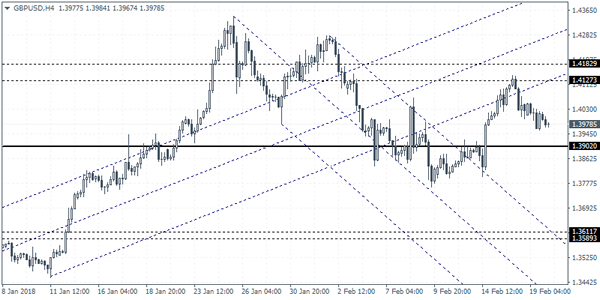
GBPUSD (1.3978): The British pound was seen posting declines after last Friday's retest to 1.4121. The declines could be seen extending towards 1.3902 level in the near term. On the 4-hour chart, the lower high being formed near the resistance suggests that the downside momentum could push GBPUSD towards the mentioned lower support. Any short-term bounce to the upside could be limited to the previous minor resistance level of 1.4035. A close above this level could suggest price moving back to retest the major resistance area of 1.4182 - 1.4127.
EURUSD Intraday Analysis
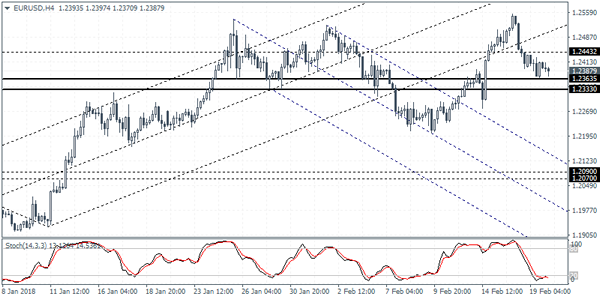
EURUSD (1.2387): The EURUSD was seen trading within a small range yesterday but price action managed to close on a bearish note. With price now trading close to the support level established around 1.2363 - 1.2330, we expect to see a modest rebound in the near term. The minor breached support level at 1.2443 could now turn to resistance on a rebound. A break down below 1.2330 is required in order for EURUSD to post further declines in the medium term. In the event that the currency pair closes above 1.2443 on a daily basis, we could expect to see price continuing to consolidate above the mentioned support level.
USD Maintains Gains Amid Thin Trading
The U.S. dollar managed to hold on to the gains made from Friday as the U.S. markets were closed on Monday. Trading was broadly limited ahead of Wednesday's FOMC meeting. With the USD posting some gains, most other major currencies were seen easing back, albeit only slightly.
The Bank of England Governor, Mark Carney was speaking at an event yesterday, but he did not touch upon the monetary policy of the central bank.
Looking ahead, the economic calendar today will see the release of the German producer price index. Economists forecast that producer prices might have increased 0.3% on the month. The ZEW economic sentiment for Germany and the Eurozone will be coming out later. Both measures are expected to show moderation following the previous month's increase. Data from the U.S. is scarce with the NY trading session limited to the Eurozone consumer confidence data.
Technical Outlook: EURUSD – N/T Bears Resume After Monday’s Doji, Risk Further Easing
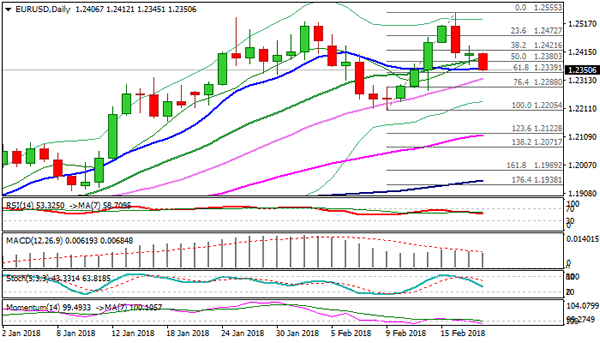
The Euro stands at the back foot on Tuesday and accelerated through support at 1.2380 (20SMA), triggering fresh extension of bear-leg from 1.2555 (16 Feb high) after Monday's action ended in Doji, signaling indecision. Studies on lower timeframes turned in bearish mode and warn of further easing after strong bearish signal was generated on Friday's bearish outside day. Fresh bearish extension below on Tuesday so far cracked 10SMA (1.2353), eyeing next pivot at 1.2339 (Fibo 61.8% of 1.2205/1.2555 upleg) close below which will be bearish signal and would unmask key support at 1.2205 (09 Feb low). Overall structure is bullish and sees current easing as consolidation before fresh push higher, with dips to be contained by rising 30SMA (1.2318). However, risk of deeper dips on break below 1.2205 pivot exists and is signaled by daily RSI/MACD bearish divergence. Bearish scenario needs close below 1.2205 to signal double-top (1.2237/55) on daily chart and spark stronger correction of 1.553/1.2555 rally, towards 1.2172 (Fibo 38.2%) and 1.2116 (rising 55SMA). German ZEW economic sentiment report is key event from the EU today and could further pressure the single currency on weaker than expected release (Feb f/c 28.4 vs Jan 31.8).
Res: 1.2380, 1.2421, 1.2445, 1.2471
Sup: 1.2339, 1.2318, 1.2275, 1.2205