

Sample Category Title
Elliott Wave Analysis: 10 Year US Notes Can Face A Bullish Reversal
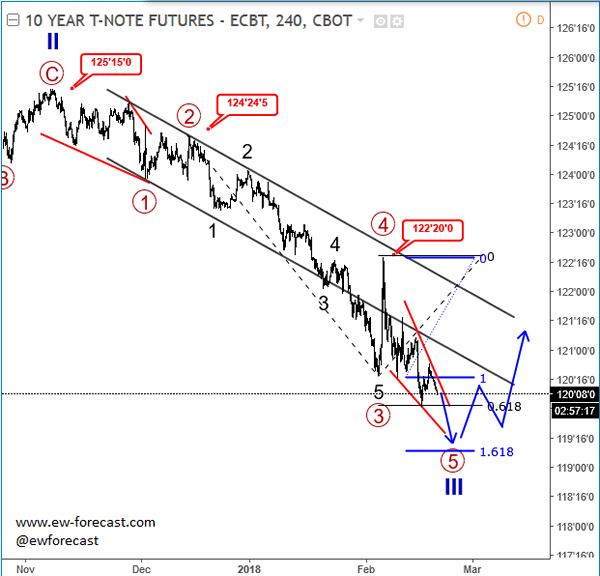
10 year US notes can be trading at the end of a higher degree wave III. Specifically we see final sub-wave 5 in action, that resembles an Elliott wave ending diagonal. An ending diagonal is a special type of pattern that usually indicates a strong movement into the opposite direction, once completed. In our case, we think price can post a low near the 120'0/119'0 region, and later make a minimum three-wave recovery.
10 Year US Notes, 4H
U.S. Treasury Sale In Focus As Dollar Recovers
The recovery of Asian equities paused on Tuesday, following a pullback in Europe yesterday and the likelihood of U.S. stocks opening in the red when traders return to their desks after a long weekend. The Japanese Nikkei 225 led the losses, falling more than 1% with declines hitting all sectors but utilities. Meanwhile, the Hong Kong's Hang Seng Index recovered early losses to edge up slightly higher on the first trading day of the Year of the Dog. China remained closed for the Lunar New Year and will return on Thursday.
The greenback, which was hit aggressively last week, rebounded against its major peers, with the Dollar Index up 1.2% from the three-year low recorded on 16th of February. Given that U.S. markets were closed for Presidents' Day and no data was released, there wasn't any specific trigger for the dollar's rally. Traders have been struggling recently to find a reasonable correlation between fixed income markets and currency markets, as the dollar was not responding to the differentials in bond yields. However, it's becoming evident that a pullback in equities is becoming a positive indicator for the U.S. currency and vice-versa. This relation is likely to hold for the short-run, as risk appetite continues to support outflows from the USD to other major currencies.
Investors have been dumping the dollar despite the increase in bond yields, as many focused on the rising twin deficits instead. This week will certainly be interesting for bond investors, as the U.S. government plans to sell $258 billion worth of debt. The combination of rising inflation and mounting budget deficit comes at a cost and investors will decide how much extra premium they require on holding U.S. debt. I think the short end of the yield curve looks relatively attractive with the 2-year bond yields currently at a 9-year high. However, it's the long end which matters the most in the current environment, as a break of 3% on the U.S. 10 year-yields is likely to test investors' confidence in equities.
The Euro is also in focus with the German ZEW to be released later today. The sharp selloff in European equities two weeks ago should have dented investors' confidence, and this will reflect in today's figures. Euro traders should also watch politics in Germany, as the Social Democratic Party will hold a ballot today to ask their members if the SPD should enter into a coalition with Angela Merkel. Although the results won't be announced until 3rd of March, an early indication of how the voting goes is likely to impact the Euro.
EURUSD Intraday Bearish Below 1.2390 Level
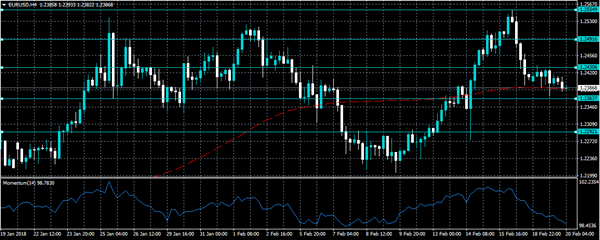
The euro has moved below the 1.2390 level against the greenback, after the U.S dollar index rebounded higher on bullish comments from U.S President Donald Trump. The EURUSD pair now trades just below the pivotal 1.2390 level, after finding interim weekly support around the 1.2365 level on Monday. Euro traders remain cautious ahead of a key vote in German politics today, where the Social Democrat Party will hold a ballot vote, centering around the decision on whether to form a new coalition government.
The EURUSD pair is intraday bearish whilst trading below the 1.2390 level, further downside towards 1.2360 and 1.2290 remains possible.
A sustained move back above the 1.2390 level should lead the EURUSD pair to strengthen back towards the 1.2430 level. Extended intraday resistance is found at the 1.2491 and 1.2554 levels.
USDJPY Now Intraday Bullish Above 106.60 Level
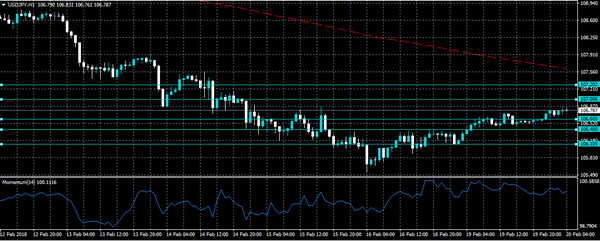
The U.S dollar has moved higher against the Japanese yen overnight, with price-action now trading well away the fourteen-month trading low set last week. The USDJPY pair currently trades around the 106.75 region, with bullish momentum in the U.S dollar index supported by positive comments on the U.S economy from U.S President Donald Trump. Going forward, the 106.60 level remains the key pivot point traders are watching today, with the next major upside technical hurdle located at the 107.30 level.
The USDJPY pair remains intraday bullish while trading above the 106.60 level, continued buying towards the 107.00 and 107.30 resistance level seems possible.
Should the USDJPY pair move below the 106.60 level, sellers may test towards the 106.40 and 106.10 support regions.
Daily Wave Analysis: EUR/USD Challenges Support Zone Within Bearish Wave C
Currency pair EUR/USD
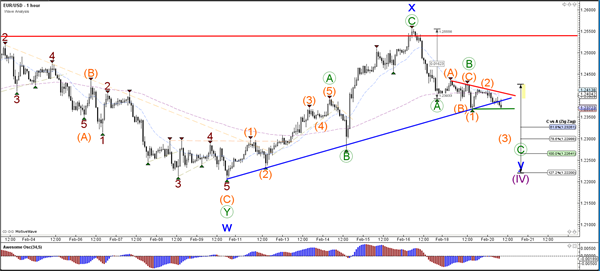
The EUR/USD has either completed the 5th wave (purple) at the most recent high or price is expanding via a WXY corrective pattern within wave 4 (purple).
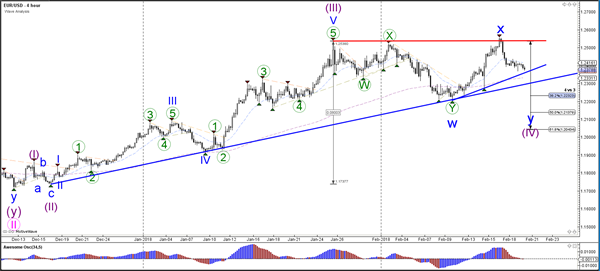
The EUR/USD is probably building a bearish ABC (green) zigzag when considering the strong bearish price action in wave A (green). A break below the support trend line (green) could see price fall lower towards 1.2250-1.23.
Currency pair GBP/USD
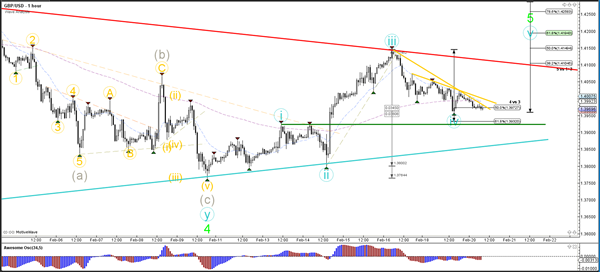
The GBP/USD is in between support (green/blue) and resistance trend line (red). A bullish breakout could indicate a continuation within wave 5 (green) whereas a bearish break could indicate a new downtrend.
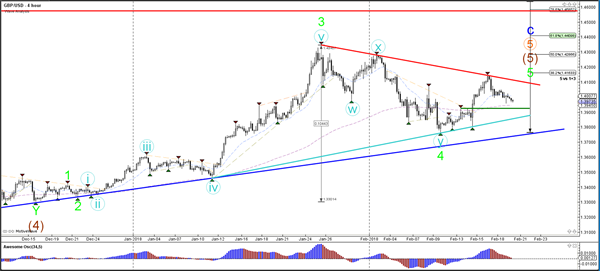
The GBP/USD is challenging the Fibonacci levels of wave 4 (blue).
Currency pair USD/JPY
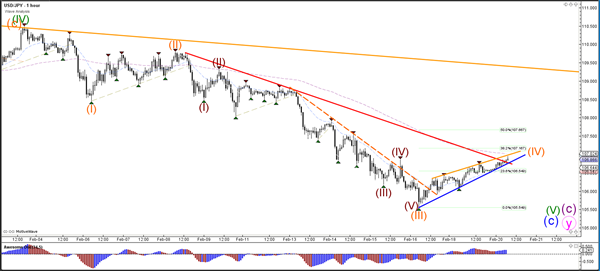
The USD/JPY is retesting the resistance levels of the downtrend.
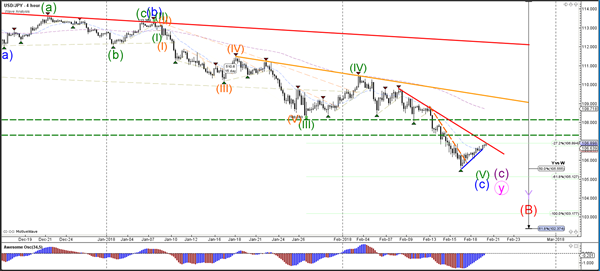
The USD/JPY is building a correction within potential wave 4 (orange).
EURUSD Posts A Pullback After Challenging A Fresh 3-Year High Of 1.2554
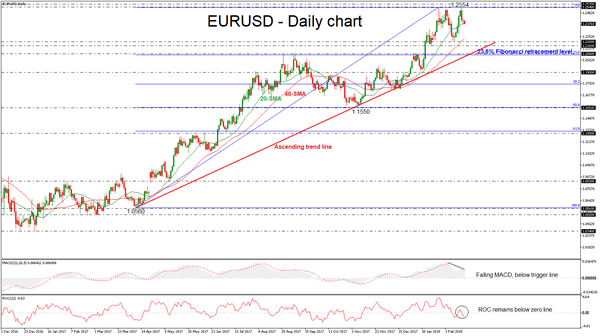
EURUSD has been underperforming in the past three days after it reached a new more than three-year high of 1.2554 during the prior week. The price created a pullback and is now trading slightly lower near the 20-simple moving average in the daily timeframe. The short-term technical indicators are bearish and point to more weakness in the market.
From the technical point of view, the MACD oscillator is moving lower in the positive territory below its trigger line, signaling further downside potential move. Also, the ROC indicator is sloping slightly to the upside in the negative zone, however, an indication for an upside movement could be identified if the indicator crosses above the zero line.
Should prices reverse lower, immediate support could come at 1.2200 strong psychological level, which holds near the 40-day SMA. Below that, the 1.2160 barrier is another major support. A drop below the aforementioned area could take the world’s most traded currency pair towards its ascending trend line, which overlaps with the 1.2080 level and the 23.6% Fibonacci retracement level of the up-leg from 1.0560 to 1.2540.
To the upside, there is a significant resistance area within 1.2540 and 1.2570 obstacles, taken from the high in December 2014. A rally above those levels could drive the price further up, challenging the 1.2880 resistance level in the medium-term.
GOLD Lower As Dollar Strengthens
The Australian dollar fell by 0.20% after the Reserve Bank of Australia (RBA) released its minutes for their January meeting. In the minutes, the bank mapped carefully a steady rise in the base interest rates while being wary of high mortgage rates. The bank commissioners were happy that the economy was doing well, thanks to higher commodity prices and synchronized global growth. Still, the bank did not outline when they will start raising rates since wage growth and inflation have remained low.
The euro is lower against the dollar, but slightly higher against the yen and the pound. Today, the EUR/USD is likely to see some significant movements as traders digest the news of the new ECB vice president and as they look forward to Germany's economic data. They will also focus on a meeting of EU finance ministers. Yesterday, Spain's Finance Minister, De Guindos was appointed by consensus as a new ECB VP leaving way for Germany's Finance Minister as a likely successor to Draghi.
Gold is down by almost a percentage point, partly because of a strong dollar. The dollar index is up by 0.22%. It is higher by 0.15%, 0.17%, 0.14%, and 0.18% against the euro, pound, Canadian dollar, and Japanese yen. Gold tends to go down when the dollar moves up because of its characteristics as a safe haven. The strength in the dollar is attributed to a higher inflation rate coupled with higher treasury yields and the rise in the VIX.
EUR/USD
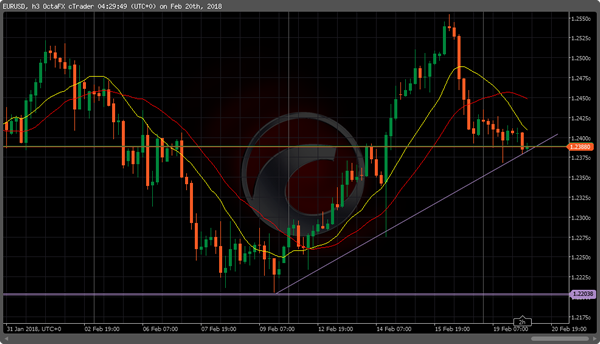
The pair crossed the 1.2400 level for the first time since Wednesday as traders waited for key data from the EU area. At the same time, the longer-term moving average crossed the shorter-term moving average. The pair is currently trading at an important support level of 1.2370. The pair could continue the downward pressure as it seeks to recover some of the losses it had last week.
AUD/USD
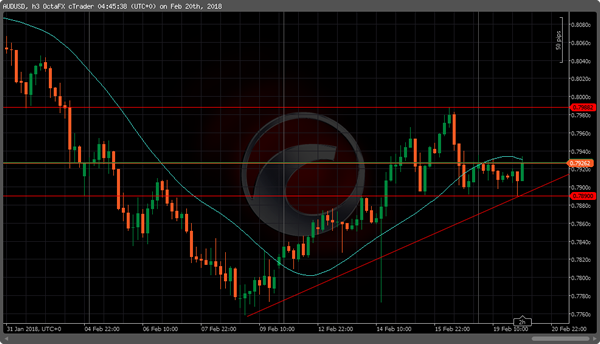
Following the release of the RBA minutes, there are no major economic data expected from Australia this week. This means that the action from the US dollar will weigh on the performance of the Aussie. After the minutes were released, the pair fell to an important support level of 0.7890. There is a likelihood that the pair could continue moving lower as indicated by the triangular moving average below, with the next price target being 0.7960.
XAUUSD
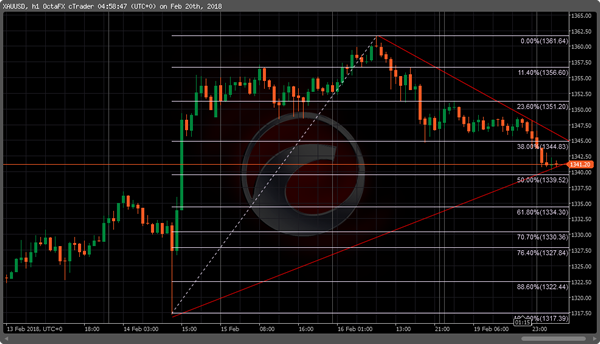
The stronger dollar has weighed down the price of gold. The XAUUSD pair has made an almost 50% Fibonacci Retracement from the highest point last week. It is now trading at $1341.20 which is also an important support level. Sustained dollar strength could get the pair down to $1334, which provides strong support.
Forex Analysis: RBA Bullock Says Mortgage Stress Is Still Relatively Low In Australia
BOE Governor Mark Carney delivered a speech about leadership and values at Regent’s University, in London, followed by audience questions. Some of his comments were: something will go wrong again even if we don’t know what it is or when. He said the best defence against a future crisis is an anti-fragile system. He cites the success of BOE liquidity provisions for banks ahead of the Brexit vote. He said that bitcoin has pretty much failed as a store of value or as a medium of exchange.
RBA Assistant Governor Bullock spoke at the Responsible Lending and Borrowing Summit in Sydney, with audience questions following. Some of the comments made were: mortgage stress is still relatively low in Australia. 'The historically high levels of mortgage debt in Australia raise questions about the resilience of household balance sheets to a change in circumstances and the ability of the financial system to absorb a widespread increase in household financial stress. The information we have suggests that, while there are some pockets of financial stress, the overall level of stress among mortgaged households remains relatively low'. She also notes a large proportion of interest-only loans are due to expire between 2018 and 2022. Among such borrowers, she said, there may be some who 'do not meet current lending standards for extending their interest-only repayments but would find the step-up to principal and interest repayments difficult to manage'.
RBA Meeting Minutes were published with the following headlines: Rising AUD would impede pickup in growth and inflation. Low rates helping to reduce unemployment and lift inflation. Further progress on inflation likely to be only gradual. The underlying inflation is seen rising gradually to 2.25 pct by mid-2020 and the strong price competition in the retail sector is expected to last for a few years yet. Wage growth will remain subdued, despite strong employment; recent deals will weigh on growth. A pick-up in household incomes is needed to support consumption but there are risks to the downside. The tighter mortgage lending rules had helped contain housing risks and high household debt levels still warrant careful attention. The housing market conditions had generally eased, especially in Sydney. Global growth could continue to surprise on the upside, given the synchronised upturn and accommodative global financial conditions, despite recent volatility in equity markets.
EURUSD is down -0.24% overnight, trading around 1.23778.
USDJPY is up 0.32% in early session trading at around 106.921.
GBPUSD is down -0.19% to trade around 1.39678.
AUDUSD is up 0.14% overnight, trading around 0.79227.
Gold is down -0.52% in early morning trading at around $1,339.29.
WTI is down -0.08% this morning, trading around $62.18.
Major data releases for today:
Eurogroup meetings will take place today and this may impact on moves in EUR crosses.
At 07:00 GMT, German Producer Prices Index (MoM) (Jan) is expected to be 0.3% from 0.2% previously. Producer Prices Index (YoY) (Jan) is expected to be 1.9% from 2.3% previously. EUR pairs could see price movement based on the outcome of this data.
At 08:15 GMT, Swiss Industrial Production (YoY) (Q4) will be released with a prior value of 5.5%. Industrial Production (QoQ) (Q4) will also be released, with a previous value of 8.6%. CHF crosses may increase in volatility after this release.
At 10:00 GMT, German ZEW Survey – Current Situation (Feb) is expected at 93.9 from a prior 95.2. ZEW Survey – Economic Sentiment (Feb) is expected to be 16.0 from 20.4 previously.
At 10:00 GMT, Eurozone ZEW Survey – Economic Sentiment (Feb) is expected to be 28.4 from 31.8 previously.
At 15:00 GMT, Eurozone Consumer Confidence (Feb) is expected to be 1.0 against a previous reading of 1.3. This data could move EUR pairs.
Currencies: Will Fed Help To Put A Floor Under The Dollar?
Sunrise Market Commentary
- Rates: Flattening US yield curve on Fed verdict?
We expect the FOMC to announce the start of its BS run-off, hang on the 2017/2018 rate projections (1-3) and potentially lower its neutral rate forecast. That would cause a flattening of the US yield curve. The front end of the US yield curve will in this scenario rise further as the market implied probability of a 2017 rate hike currently stands at 53%. - Currencies: Will Fed help to put a floor under the dollar?
Today's Fed policy assessment might be key for the dollar. The start of reducing the BS will probably give the dollar only limited additional interest rate support short-term. The new Fed dots will signal substantial additional rate rises to come. In theory this should be USD positive, but will the FX market believe the Fed more than it did until now?
The Sunrise Headlines
- US stock markets eked out small gains yesterday (+0.1%) in an uneventful session. Overnight, Asian risk sentiment is mixed but changes remain small.
- Trump warned that America would “totally destroy” North Korea if forced to defend itself or its allies, as the US president used his debut address to the UN general assembly to issue stark threats to a “wicked few” oppressive regimes.
- Theresa May will offer a €20B Brexit payment to the EU when she lays out her divorce strategy Friday, according to the FT. She hopes it will break a threemonth deadlock over negotiations and allow talks to include a future trade deal.
- Shipments of cars and electronics in August drove up Japan's exports at the fastest pace in nearly 4 years (18.1% Y/Y), evidence that overseas demand is strong enough to support healthy economic growth. Imports rose 15.2% Y/Y.
- Iraq's oil minister said OPEC and other crude producers were considering extending or even deepening a supply cut to curb a global glut, while a report showed a smaller-than-expected increase in U.S. inventories.
- Two key US senators said they had reached a pact on the parameters of a critical budget resolution, removing an obstacle on the complex path towards Republican-led tax cuts.
- Today's calendar contains UK retail sales, US existing home sales and a German 30-yr Bund auction. However, these will all be overshadowed by tonight's FOMC meeting and press conference by chair Yellen
Currencies: Will Fed Help To Put A Floor Under The Dollar?
Will Fed put a floor under the dollar?
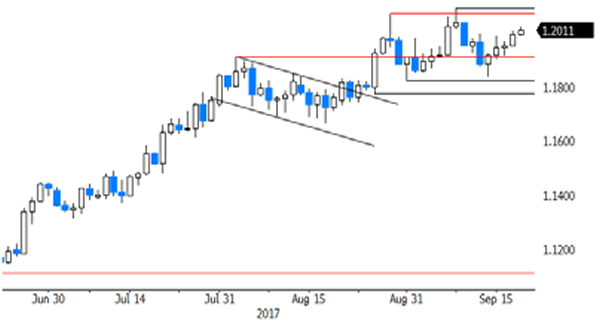
USD trading remained technical in nature yesterday as investors counted down to tomorrow's FOMC decision. Data were second tier and had little impact on trading. USD/JPY set a new ST top, but reversed gains later. EUR/USD traded close to mostly slightly below 1.20.
Overnight, Asian equities are narrowly mixed after WS closing at again new record levels. Japan August trade data were stronger-than-expected, but doesn't change to broader picture going into tomorrow's BOJ policy announcement. The BOJ is largely expected to keep course, lagging the normalisation process in other major economies. This prospect weighs on the yen, especially if rates in the US or Europe would rise further. The overall picture for the dollar stays unchanged. USD/JPY holds in the mid 111 area, within reach of the ST correction top. The dollar continues to trade weak against the euro. EUR/USD tries to regain the 1.20 barrier. EUR/JPY trades near the highest levels since December 2015.
Today, the eco data (German PPI, US existing home sales) will be largely ignored as investors will forward to the Fed policy decision. For an in depth preview of the Fed decision, see the fixed income part of this report. The start of the reduction of the balance sheet is a symbolic step in the normalisation process. The move was extensively pre-announced and the initial impact on market liquidity is limited. In this context, the new Fed rate dots might be more important for the dollar. We don't see changes in the median dot for 2017 (one additional hike) and for 2018 (3 extra hikes), but chances of a downward revision of the 2019 median dot (2.5 extra rate hikes) and the long run (3%) are high. The Fed's ongoing intention to normalize policy should be USD supportive given that hardly any further tightening is discounted. However, are there reasons for the market to believe the Fed more after today's meeting than it did till now? For that to happen, the Fed dots probably need ‘confirmation' from good eco data and higher inflation. We won't get that today. In this context, the defuse/fragile picture for the dollar might persist for some time. We assume more USD consolidation near the recent lows, maybe with room for some modest USD gains, but we dare not anticipate on it.
From a technical point of view EUR/USD hovers in a ST consolidation pattern between 1.1823 and 1.2070. It was disappointing for EUR/USD bears that last week's correction didn't reach the range bottom. More confirmation is needed that the recent bottoming out process in US yields and in the dollar might be the start of more sustained USD gains (against the euro).
The day-to-day momentum in USD/JPY is more constructive. The yen trades weak across the board. USD/JPY regained the 110.67/95 previous resistance. This a short-term positive. EUR/JPY shows a similar positive picture. So, the yen might stay under pressure at least until the next event risk pops up.
EUR/USD: nearing correction top ahead of the FOMC decision
UK retail sales in focus
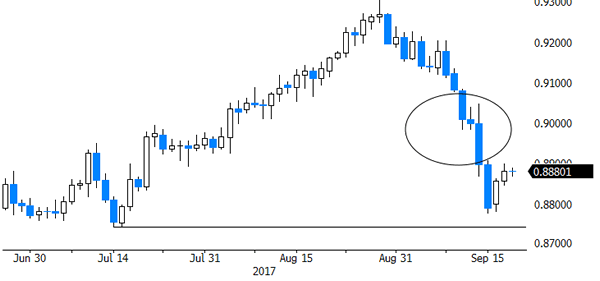
Sterling traded with a slightly negative intraday yesterday following a sharp rally last week, when the BoE warned that it was likely to raise its policy rate in the coming months. BoE governor Carney confirmed that view on Monday, but sterling started to lose ground. The political bickering between UK PM May and UK Foreign Secretary Johnson was also a slight sterling negative. EUR/GBP closed the session at 0.8881 (from 0.885). Cable hovered around the 1.35 pivot.
Today, the UK August retail sales take centre stage. A very modest rise of 0.2% M/M and 1.2% is expected A soft figure questions the viability of the recent hawkish BoE speak. However, the BoE is temporary giving more weight on prices than on activity data. Even so, the sterling rally might lose further momentum in case of a poor report. Markets will also look forward to PM's Brexit speech. A more conciliatory PM May would be a ST sterling positive. The recent GBP rebound is losing momentum. Even so, we look out whether sterling can return to the recent correction top (EUR/GBP low). If that move fails, the easiest part of the sterling rebound might be behind us.
EUR/GBP made an impressive uptrend since April and set a new MT top at 0.9307 late August on the back of euro strength. Simultaneously, UK price data were soft enough to keep the BoE side-lined. Recent price data amended this story and the ST-trend reversal of sterling was reinforced by recent BoE hawkish comments. Medium term, we maintain a EUR/GBP buy-on-dips approach as we expect the mix of relative euro strength and sterling softness to persist. However, the prospect of (limited) withdrawal of BOE stimulus put a solid floor for sterling ST term. We look out how far the current correction has to go. EUR/GBP is nearing support at 0.8743 and 0.8652, which we consider difficult to break. We start looking to buy EUR/GBP on dips
EUR/GBP: GBP-rebound rebound slows
Market Update – Asian Session: USD Slightly Stronger Around The Globe
Headlines/Economic Data
General Trend: Nikkei and Australian equities decline following gains on Monday's session
HSBC FY17 Adj Revenues rise 5% y/y primarily driven by higher revenue in 3 main global businesses; To issue up to $7.0B in Tier 1 capital
Indian banks continue to detail exposures related to billionaire jeweler Nirav Modi amid fraudulent transactions at Punjab National Bank
India Bank index declines by over 1%, Rupee drops
Japan
Nikkei 225 opened -0.4%; closed -1.0%
Topix Electric Appliances Index -1.5%, Real Estate -1.4%, Securities -1.1%
Large banks decline
Automakers trade generally lower and reverse gains from Monday’s session
(JP) Japan Econ Min Motegi: Japan will soon be out of deflationary situation
(JP) Japan FSA has urged local banks to review foreign bond management – Asahi
(JP) Japan Fin Min Aso: Expect BOJ to keep working with govt to beat deflation;reaching 2% inflation is a way to prove Japan has beat deflation
(JP) Japan corporate poll shows that a little over 50% of Japanese companies do not plan to raise base pay this year
7211.JP Mitsubishi confirms considering raising stake in Mitsubishi Motors, no decision has been made yet
Looking Ahead: Japan prelim Feb Manufacturing PMI due for release on Wed
Korea
Kospi opened -0.4%
Samsung, [-1.7%],005930.KR To cut OLED panel productionby 60% amid slow iPhone X sales – Nikkei
(KR) South Korea PM Lee Nak-yon: GM Korea decided to shut down its Gunsan plantand the US Trump administration is putting together measures restricting steelimports; pushing us into a difficult situation - Korean press
(KR) Economists note a failure to properly respond to currency fluctuationscould lead to sparking foreign capital flight or dampening exports from SouthKorea - Korean press
GM Korea union demanding debt for equity swap and a new production model; said to have offered ~$2.2B debt for equity swap for Korean operations
(KR) South Korea to allow non-financial firms to currency trade, starting in March - Korean press
(KR) South Korea Fin Min Kim reiterates market decides FX rate and to take steps on Won (KRW) if needed - South Korean Press
China/Hong Kong
Hang Seng opened %, Shanghai Composite closed for holiday
Hang Seng Financials Index -1.4% (HSBC declines after earnings report)
Alibaba Pictures [+7%], 1060.HK, strength attributed to strong Lunar New year box office
Rusal [486.HK]: Declines over 3% as the company denied any plan to change CEO
(CN)China Housing Ministry: Will interfere if local property curbs go against China's policy direction – press
HSBC, HSBA.UK Reports FY17 Adj pretax $20.99B v $19.3B y/y, Adj Rev $51.5B v $50.2B y/y; To issue $5.0-7.0B in tier 1 capital in H1
Australia/New Zealand
ASX 200 opened -0.2%; closed flat
ASX 200 Resources Index -0.8%, Telecom -0.6%, Financials -0.4%
Telecom Vocus Communications [VOC.AU] declines over 10% after cutting dividend and outlook
BHP [BHP.AU] declines ahead of earnings report
(NZ) New Zealand Q4 PPI Input Q/Q: 0.9% v 1.1% prior; PPI Output Q/Q: 1.0% v 1.0%prior
(AU) RBA Assistant Gov Bullock: Mortgage stress in Australia is stillrelatively low; Banking system is strong and well capitalized, supportedby prudent lending standards
(AU) RESERVE BANK OF AUSTRALIA (RBA) FEB MINUTES:Low rates helping to reduce unemployment and lift inflation
NAB.AU Said to be getting ready to layoff the first 1.0K roles under the A$1.0B cost cutting initiative last year
Looking Ahead: Australia Q4 wage price index due for release on Wednesday
Other Asia
(SG) Singapore Fin Min:Planning 2ppt raise to GST from 2021-20215 taking the rate to 9% in order tosupport aging society
(SG) Singapore Minister: Property tax isnt about cooling the market, we are competitive despite higher tax
North America
Mosaic [MOS] Reports Q4 $0.34* v $0.27e,Rev $2.1B v $1.89Be
NXP Semiconductors [NXPI]: Qualcomm said to be working on deal price for NXP, said to be in low $120/shr – CNBC
Johnson & Johnson [JNJ]: Said to be exploring the sale of $2B product sterilization unit - press
Looking Ahead: Wal-Mart due to report earnings during NY morning
Europe
(UK) PM May said to have a contingency plan to withhold payments of the £40B Brexit bill if EU leaders backtrack on their post-Brexit free trade deal commitments - financial press
(UK) According to letter seen last week, Netherlands government to ‘activate hard Brexit’ plan amid lack of clarity from the UK –Sky News
(UK) BOE Gov Carney: Brexit is what moves the GBP, not speculation about any future trade deal with the US; Bitcoin has pretty much failed as a store of value or medium of exchange
Looking Ahead: Germany Feb ZEW data due for release
Levels as of 01:00ET
Nikkei225 -1.0%, Hang Seng -0.4%; Shanghai Composite closed for holiday; ASX200 -0.0%, Kospi -1.2%
Equity Futures: S&P500 -0.3%; Nasdaq100 -0.1%, Dax -0.1%; FTSE100 +0.0%
EUR 1.2412-1.2379; JPY106.86-106.56; AUD 0.7933-0.7889;NZD 0.7374-0.7348
Apr Gold -0.9% at $1,343/oz; Apr Crude Oil +1.1% at $62.20/brl; Mar Copper -0.5% at $3.19/lb