Sample Category Title
Pound Dips At Start Of Week
The British pound is trading quietly in the Monday session. In North American trade, GBP/USD is trading at 1.4002, down 0.21% on the day. On the release front, there are no US events, with US markets closed for Presidents’ Day. In the UK, Rightmove HPI gained 0.8%, its strongest gain in four months. On Tuesday, the UK releases CBI Industrial Order Expectations.
GBP/USD gained 1.3% last week, as the dollar continued to lose ground to its major rivals. However, the dollar rebounded with gains on Friday, following strong US housing and consumer confidence reports on Friday. Building Permits jumped to 1.40 million in January, up from 1.30 million in December. This easily beat the estimate of 1.29 million. Housing Starts followed suit and improved to 1.33 million in January, up from 1.19 million a month earlier. This was well above the forecast of 1.28 million. There was more positive news from consumer confidence, as UoM Consumer Confidence climbed to 99.9, well above the estimate of 95.4 points. Despite stock market volatility, consumer confidence was boosted by the recent tax reform package and a red-hot labor market.
Should cryptocurrencies be regulated? Bitcoin has seen wild fluctuations in recent months, ranging from under $1000 to just under $20,000. There are growing calls for these currencies to be regulated, and central banks could play a key role in such a move. However, last week, ECB President Mario Draghi poured cold water on any ECB involvement, saying that it was not the ECB’s responsibility to ban or regulate Bitcoin. Draghi added that the ECB was exploring the use of blockchain, a digital technology to monitor bitcoin transactions. Still, with Bitcoin gaining more and more popularity, the Bank of England and other central banks will have to pay greater to attention to the impact of Bitcoin on the currency markets.
Yen Edges Lower In Thin Holiday Trade
The Japanese yen has posted slight losses in the Monday session. In North American trade, USD/JPY is trading at 106.54, up 0.23% on the day. On the release front, there are no US events, with US markets closed for Presidents’ Day. In Japan, the current account surplus jumped to JPY 0.37 trillion in January, up from JPY 0.09 trillion a month earlier. This easily beat the estimate of JPY 0.14 trillion. On Tuesday, Japan releases Manufacturing PMI and All Industries Activity.
The US posted sharp housing and consumer confidence reports on Friday, but the dollar failed to make headway against the surging Japanese yen. Building Permits jumped to 1.40 million in January, up from 1.30 million in December. This easily beat the estimate of 1.29 million. Housing Starts followed suit and improved to 1.33 million in January, up from 1.19 million a month earlier. This was well above the forecast of 1.28 million. There was more positive news from consumer confidence, as UoM Consumer Confidence climbed to 99.9, well above the estimate of 95.4 points.
The yen enjoyed a banner week, as the currency climbed 2.5% this week. This marked the strongest weekly gain since July. Nervous investors continued to snap up the safe-haven yen, as stock markets across the globe continued to show volatility, draining risk appetite. On Friday, the dollar dropped below 106 yen for the first time since November. If the markets continue to fluctuate during the week, the yen rally could continue.
Bank of Japan Governor Harohiko Kuroda has been reappointed to another 5-year term, the first time a BoJ governor has received a second term in 60 years. The move is a clear message from the Bank that it is no rush to make any change to the massive stimulus program, a key component of Abenomics. Kuroda has made it a priority to raise inflation, but this has proven a daunting task, as inflation is still below of the BoJ’s inflation target of 2%. In this period of strong volatility in the currency markets, Kuroda’s re-election may have a calming effect on the markets. What’s next for the BoJ? With the yen continuing to rise, policymakers may contemplate further easing in order to curb the yen’s value and protect the export sector, which has improved due to stronger global demand.
Elliott Wave Analysis: NZDJPY Update
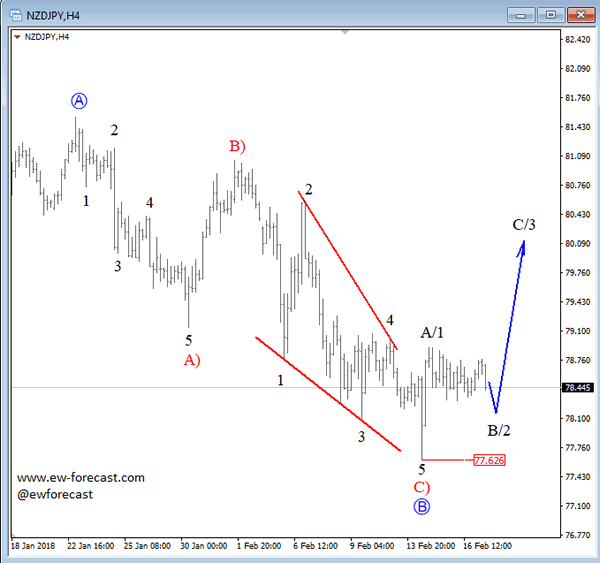
NZDJPY may have recently completed a three-wave decline labeled as A)-B)-C) at the 77.63 level, from where a new intra-day bounce followed. This bounce can be start of minimum three-wave reversal with wave A/1 leading the way. That said, we can see that an ending diagonal unfolded within final leg C) of a decline, which means that current recovery can go as high as to the starting point of this pattern, meaning price can reach 81.10 level in upcoming sessions.
NZDJPY, 4H
Sunset Market Commentary
Markets
US markets are closed for President's Day, resulting in a very low volume trading session. The EMU eco calendar only contained second tier eco data, resulting in sentiment-driven trading. Negative underlying core bond sentiment caused a small sell-off in Bunds with the curve bear steepening. German yields increase by 0.3 bps (2-yr) to 4.3 bps (30-yr). On intra EMU-bond markets, 10-yr yield spread changes versus Germany increase by 3 bps for Spain and Italy. Spain announced the launch of a new 30-yr benchmark, likely tomorrow. Italian BTP's lose some ground as media report about cracks in the centre-right coalition. Greece outperforms (-6 bps) after Fitch upgraded the country's rating from B- to B (positive outlook).
The dollar entered calmer waters today. Traded volumes were subdued with US markets closed. Even so, USD selling already eased at the end of last week and the US currency stayed off the recent lows today. There were only second tier eco data in Europe. European risk sentiment turned less positive than last week. In line with the recent market dynamics, this was slightly supportive for the dollar, even for USD/JPY. EUR/USD trades in the 1.2380 area. USD/JPY is changing hands around 106.75. There is no sign of a sustained USD rebound yet. That said, there was also no additional damage for the dollar. Looking at where we were on Friday morning, this might be a minor relief for USD bulls.
Sterling traded with a slightly negative bias today, both against the dollar and the euro. Trading was mostly technically in nature. There were no important UK eco data except for the Rightmove house prices published overnight. EUR/GBP trades in the 0.8860 area. Cable dropped back below the 1.40 handle. Markets are looking forward to the CBI order data tomorrow and, even more, UK wage data scheduled for release on Wednesday.
News Headlines
"Signs are mounting that the German economy is increasingly confronted with bottlenecks with regard to highly skilled staff, which could become an obstacle for an even stronger expansion," the Bundesbank says in its monthly report.
IHS Markit said its UK Household Finance Index, a monthly gauge of financial well-being, fell to a seven-month low of 42.2 from 42.9 in January. British households became more pessimistic about their finances this month. Most now expect borrowing costs to rise again within six months after the Bank of England raised interest rates in November, a survey showed on Monday.
The European Monetary Fund being planned to replace the euro zone bailout fund should be an intergovernmental body controlled by EMU member states and independent of the EC, the Fund's head Klaus Regling said. The Commission wants the ESM to become an EU institution governed by a separate treaty signed by EMU countries.
German Chancellor Merkel put forward her close ally Annegret Kramp-Karrenbauer, premier of the state of Saarland, to take over as secretary general of her Christian Democratic Union (CDU), party sources said.
Irish Finance Minister Donohoe said Irish central bank governor Philip Lane's name will be withdrawn for the vice presidency of the ECB. Donohoe said he'll support Spanish Economy Minister Luis de Guindos
Canadian Dollar Unchanged, No Fundamentals to Start Off Week
The Canadian dollar is almost unchanged in the Monday session, after posting losses on Friday. Currently, USD/CAD is trading at 1.2493, up 0.07% on the day. On the release front, there are no Canadian or US events on the schedule, so traders can expect the pair to have a quiet day. In the US, banks and stock markets are closed for Presidents' Day.
The Canadian dollar posted losses on Friday, but managed to post slight gains last week. The currency weakened on Friday, after the US posted sharp housing and consumer confidence reports. Building Permits jumped to 1.40 million in January, up from 1.30 million in December. This easily beat the estimate of 1.29 million. Housing Starts followed suit and improved to 1.33 million in January, up from 1.19 million a month earlier. This was well above the forecast of 1.28 million. There was more positive news from consumer confidence, as UoM Consumer Confidence climbed to 99.9, well above the estimate of 95.4 points. This marked a 4-month high. On Wednesday, the Canadian dollar recorded its best one-day performance in 2018, gaining close to 1 percent against the greenback. The US dollar sagged as investors focused on poor retail sales reports in January. Retail Sales was flat at 0.0%, short of the estimate of 0.5%. Core Retail Sales declined 0.3%, well off the forecast of +0.2%.
Should cryptocurrencies be regulated? Bitcoin has seen wild fluctuations in recent months, ranging from under $1000 to just under $20,000. There are growing calls for these currencies to be regulated, and central banks could play a key role in such a move. However, last week, ECB President Mario Draghi poured cold water on any ECB involvement, saying that it was not the ECB's responsibility to ban or regulate Bitcoin. Draghi added that the ECB was exploring the use of blockchain, a digital technology to monitor bitcoin transactions. Still, with Bitcoin gaining more and more popularity, the Bank of Canada and other central banks will have to pay greater to attention to the impact of Bitcoin on the currency markets.
GBPUSD: Vulnerable, Looks To Follow Through Lower
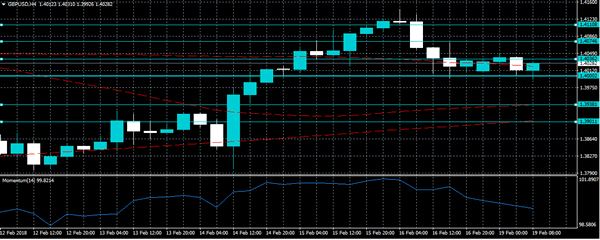
GBPUSD: The pair saw price weakness on Friday and now looks to follow through lower in the days ahead. Support lies at the 1.4050 level where a break will turn attention to the 1.4000 level. Further down, support lies at the 1.3950 level. Below here will set the stage for more weakness towards the 1.3900 level. Conversely, resistance stands at the 1.4150 levels with a turn above here allowing more strength to build up towards the 1.4200 level. Further out, resistance resides at the 1.4250 level followed by the 1.4300 level. On the whole, GBPUSD looks to correct lower.

GBPUSD Intraday Bullish above 1.4000 Level
The British pound is trying to build upside momentum against the greenback, after earlier finding technical support just below the key 1.4000 level. The GBPUSD pair currently trades around the 1.4020 level, with the U.S dollar index starting to give back intraday gains amidst depressed market volumes. Sterling traders are awaiting a key note speech from Bank of England Governor Mark Carney later this evening, ahead of the BOE's Inflation Report on Tuesday.
The GBPUSD pair is likely to see continued upside whilst trading above the 1.4000 level, key intraday resistance is now found at the 1.4036 and 1.4074 region.
Should the GBPUSD start to move below the 1.4000 support level, we may see a deeper correction back towards the 1.3938 and 1.43901 support levels.
EURUSD Back Testing Key 1.2430 Resistance Level
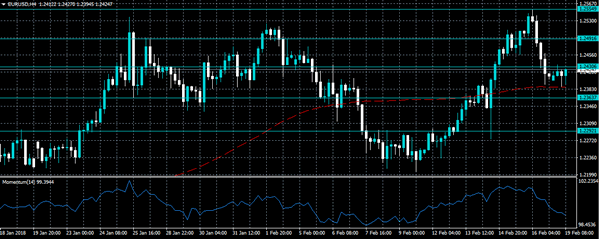
The euro has moved back towards the key 1.2430 level against the U.S dollar, after earlier finding strong intraday technical support from its 100-day moving average on the four-hour time frame. The EURUSD pair continues to trade in a contained price-range between the 1.2390 to 1.2430 levels, with no clear intraday directional bias in early week trading. Moving into the U.S session, trading volumes remain light with the Eurogroup meeting underway in Brussels and U.S markets away for President's Day.
The EURUSD price-action will likely extend higher once the 1.2430 level is clearly breached, key intraday resistance is found at the 1.2490 and 1.2554 levels.
A sustained move below the 1.2390 level should lead the EURUSD pair to decline towards the 1.2367 and 1.2292 support regions.
DAX Starts Week Quietly, US Markets Closed for Holiday
The DAX index has started the week in subdued form. In the Monday session, the index is trading at 12,464.00 up 0.10% since the Friday close. On the release front, the eurozone current account surplus narrowed to EUR 29.9 billion, short of the estimate of EUR 30.5 billion. US markets are closed for Presidents' Day. On Tuesday, Germany releases ZEW Economic Sentiment and the eurozone will publish releases Consumer Confidence.
The recent correction in global stock markets has sent the DAX lower, with the index losing 5.9% in February. However, the index rebounded last week, posting a winning week for the first time since mid-January. Strong corporate earnings in Europe last week boosted European stock markets. The US recently passed massive corporate and individual tax reform, worth $1.5 trillion. This could significantly boost earnings in the first quarter of 2018 for European companies which have major operations in the US, such as banking giant Deutsche Bank.
The recent turbulence in the global stock markets has triggered strong volatility in the currency markets, and ECB President Mario Draghi recently stated that the ECB was concerned about the euro's sharp fluctuations. Last week, Draghi weighed in on Bitcoin, a cryptocurrency which has seen wild fluctuations in recent months. There are growing calls for regulation of these currencies, and central banks could play a key role in such regulation. However, Draghi poured cold water on any ECB involvement, saying that it was not the ECB's responsibility to ban or regulate Bitcoin. Draghi added that the ECB was exploring the use of blockchain, a digital technology to monitor bitcoin transactions.
Forex Technical Analysis: EUR/USD, USD/JPY, GBP/USD
EUR/USD
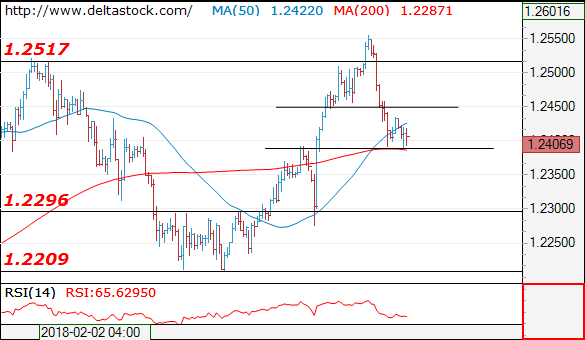
Current level - 1.2406
The sharp reversal at 1.2555 signals a completion of the whole rise from 1.2210 and the bias is bearish, as a break through 1.2390 support will challenge 1.2290 area. Initial resistance lies at 1.2450.
| Resistance | Support | ||
| intraday | intraweek | intraday | intraweek |
|
1.2450 |
1.2650 |
1.2390 |
1.2290 |
|
1.2560 |
1.2870 |
1.2290 |
1.2210 |
USD/JPY
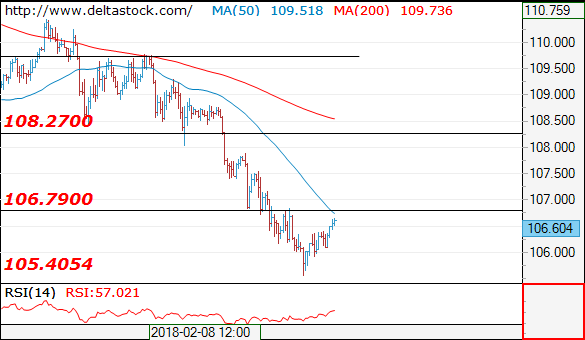
Current level - 106.60
The reversal at 105.50 signals a completion of the slide since 109.70, but the pair is still struggling below 106.80 interim resistance. My outlook here is neutral.
| Resistance | Support | ||
| intraday | intraweek | intraday | intraweek |
|
106.80 |
108.30 |
105.40 |
105.40 |
|
108.30 |
110.40 |
103.50 |
102.40 |
GBP/USD
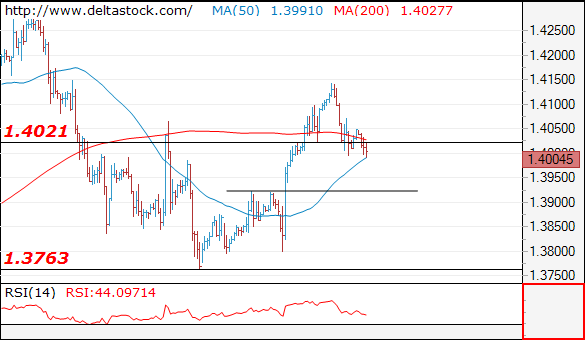
Current level - 1.4004
The recent reversal at 1.4150 signals a negative intraday bias, for a slide towards 1.3920 area. Initial minor resistance lies at 1.4080.
| Resistance | Support | ||
| intraday | intraweek | intraday | intraweek |
|
1.4080 |
1.4280 |
1.3990 |
1.3760 |
|
1.4185 |
1.4340 |
1.3920 |
1.3620 |