Sample Category Title
Pound Higher As British CPI Surprises Markets
The British pound has posted gains in the Tuesday session. In North American trade, GBP/USD is trading at 1.3892, up 0.39% on the day. On the release front, British CPI was unchanged at 3.0%, edging above the forecast of 2.9%. There are no major events out of the US. On Wednesday, the US releases inflation and retail sales data. Traders should be prepared for some movement from the pair during the North American session.
There were no surprises from British inflation numbers on Tuesday. CPI, the primary gauge of consumer spending, was unchanged at 3.0% in January. CPI has hovered around the 3% level since August, well above the BoE target of 2.0%. Wage growth has not kept up with the brisk clip of inflation, putting a further squeeze on the British consumer. This could dampen consumer spending, a key driver of the economy. High inflation is putting pressure on the Bank of England to raise interest rates, and last week the Bank said that it was considering faster and larger rate increases than it had projected back in November. Many analysts have circled May as the date of the next rate increase.
A key factor in last week’s market turbulence was investor concern over more rate hikes due to inflation. Given this concern, it’s likely that the US CPI and Core CPI releases on Wednesday will be a market-mover. The markets will be glued to the inflation indicators, and if inflation numbers are higher than expected, we could see some volatility from the US dollar as well as the stock markets.
Calm Returns, Where To Watch
Just as bloogers and analysts began writing about Monday's sharp market rebound, indices around the world are back in the red, yet off their lows. One relationship that's increasingly taking hold is the inverse relation between indices and the US dollar. Interestingly, USD remained weak despite the overnight sell-off in Tokyo and early Europe. JPY, EUR and CHF are the strongest, while GBP backs off its highs following stronger than expected inflation data. 120 pip gain was locked in the EURUSD trade.
One clue on whether Monday's bounce will last was in the announcement of a White House infrastructure plan. It surely faces a tough test in Congress but it highlights the administrations priorities; or more aptly, the lack of an emphasis on deficit reduction.
It came along with fresh White House projections which are undoubtedly optimistic and still foresee a nearly $1 trillion deficit next year. With the potential for more stimulus in the pipeline and continued high military spending, the bond market is beginning to worry about debt issuance.
US 10-year yields ticked another basis point higher Monday to 2.86% and as high as 2.89%. There is a sudden focus on borrowing levels and it seems almost inevitably that some type of shudder – small or large – will hit stocks once 3% is breached.
A pair of big drivers towards or away from that level is likely on Wednesday with US CPI and retail sales data.
USD/JPY Daily Outlook
Daily Pivots: (S1) 107.22; (P) 107.99; (R1) 108.59; More...
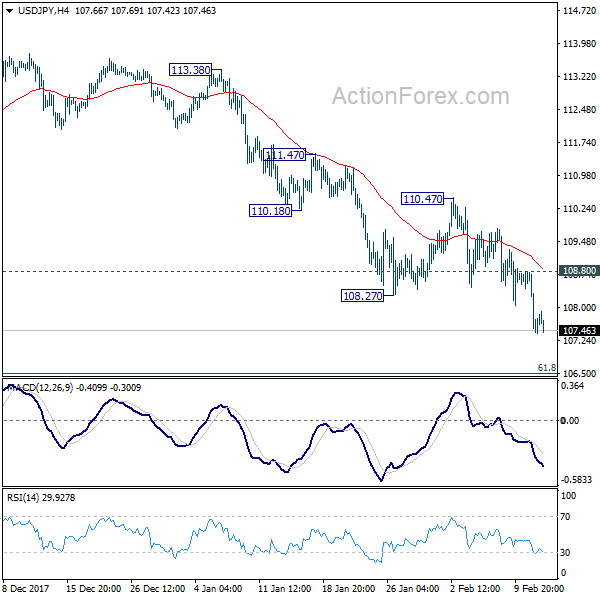
Intraday bias in USD/JPY remains on the downside for the moment. Current fall should extend to 106.48 fibonacci level. We'd look for strong support around there to bring rebound. However, on the upside, break of 108.80 minor resistance is needed to be the first sign of short term bottoming. Otherwise, outlook will remain bearish in case of recovery.
In the bigger picture, current development argues that the corrective pattern from 118.65 is extending. There is risk of dropping further to 61.8% retracement of 98.97 to 118.65 at 106.48. But this level should provide strong support to contain downside and bring resumption of rise from 98.97. However, sustained break of 106.48 will now likely send USD/JPY through 98.97 to resume the corrective fall from 125.85 (2015 high).
USD/JPY Stays Weak as Traders Eye US CPI and Retail Sales
Yen continues to trade higher in calm markets. DOW closed up 0.16% at 24640.45 overnight as consolidation continued. Nikkei also opened higher initial trading but turns flat since then. Hong Kong HSI is up 0.75% in thin trading ahead of lunar new year holidays. While USD/JPY dip extended recent decline, EUR/JPY and GBP/JPY are held by the temporary lows established earlier. The greenback remains one of the weakest and will look into CPI and retail sales from US today for inspirations.
Fed Powell: Global economy recovering strongly
New Fed Chair Jerome Powell said in his swearing-in ceremony yesterday that the global economy is "recovering strongly for the first time in a decade." Fed is in the progress of "gradually normalizing both interest rate policy and our balance sheet with a view to extending the recovery and sustaining the pursuit of our objectives." And, he would purse monetary policy "without concern for short-term political pressures." Additionally, Powell pledged to "preserve the essential gains in financial regulation while seeking to ensure that our policies are as efficient as possible."
Separately, the Wall Street Journal reported that the White House is considering to nominate Cleveland Fed President Loretta Mester for Vice Fed Chair. On the other hand, CNBC reported that San Francisco Fed President John Williams was also being considered for the post.
ECB Draghi: Not his job to regulate Bitcoin
ECB President Mario Draghi said it's "not the ECB's responsibility" to regulate Bitcoins. He acknowledge the blockchain technology as "quite promising" that could bring "many benefits". But he warned that "it's still not secure for central banking and therefore we need to look through it and investigate it more." And when asked by the public on whether he should buy Bitcoin, Draghi said "frankly i would think it carefully".
NAB predicts two RBA hikes this year
NAB chief economist said in a note that he forecasts RBA to hike twice this year, in August and November. He noted that "lower unemployment, and evidence of wages growth moving upwards - even gradually - should be enough to give the RBA confidence that inflation will eventually lift above the bottom of the band." However, higher AUD exchange rate could threaten this outlook.
On the data front
Japan GDP rose 0.1% qoq in Q4, below expectation of 0.2% qoq. GDP deflator rose 0.01% yoy. Australia Westpac consumer confidence dropped -2.3% in February. Eurozone and Germany GDP will be the main focus in European session where Eurozone industrial production will also be featured Later in the day, US CPI and retail sales will be the main focus.
USD/JPY Daily Outlook
Daily Pivots: (S1) 107.22; (P) 107.99; (R1) 108.59; More...
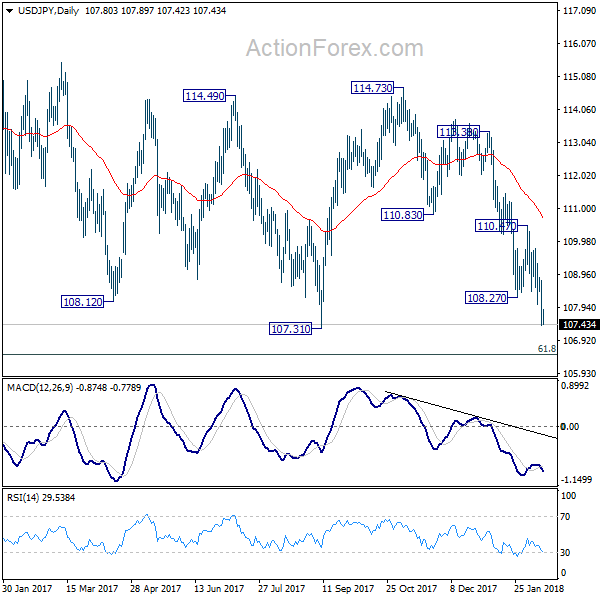
Intraday bias in USD/JPY remains on the downside for the moment. Current fall should extend to 106.48 fibonacci level. We'd look for strong support around there to bring rebound. However, on the upside, break of 108.80 minor resistance is needed to be the first sign of short term bottoming. Otherwise, outlook will remain bearish in case of recovery.
In the bigger picture, current development argues that the corrective pattern from 118.65 is extending. There is risk of dropping further to 61.8% retracement of 98.97 to 118.65 at 106.48. But this level should provide strong support to contain downside and bring resumption of rise from 98.97. However, sustained break of 106.48 will now likely send USD/JPY through 98.97 to resume the corrective fall from 125.85 (2015 high).
Economic Indicators Update
| GMT | Ccy | Events | Actual | Forecast | Previous | Revised |
|---|---|---|---|---|---|---|
| 23:30 | AUD | Westpac Consumer Confidence Feb | -2.30% | 1.80% | ||
| 23:50 | JPY | GDP Q/Q Q4 P | 0.10% | 0.20% | 0.60% | |
| 23:50 | JPY | GDP Deflator Y/Y Q4 P | 0.00% | 0.00% | 0.10% | 0.20% |
| 02:00 | NZD | RBNZ 2-Year Inflation Expectation Q1 | 2.10% | 2.00% | ||
| 07:00 | EUR | German GDP Q/Q Q4 P | 0.60% | 0.80% | ||
| 07:00 | EUR | German CPI M/M Jan F | -0.70% | -0.70% | ||
| 07:00 | EUR | German CPI Y/Y Jan F | 1.60% | 1.60% | ||
| 10:00 | EUR | Eurozone Industrial Production M/M Dec | 0.10% | 1.00% | ||
| 10:00 | EUR | Eurozone GDP Q/Q Q4 P | 0.60% | 0.60% | ||
| 13:30 | USD | CPI M/M Jan | 0.30% | 0.10% | ||
| 13:30 | USD | CPI Y/Y Jan | 1.90% | 2.10% | ||
| 13:30 | USD | CPI Core M/M Jan | 0.20% | 0.30% | ||
| 13:30 | USD | CPI Core Y/Y Jan | 1.70% | 1.80% | ||
| 13:30 | USD | Retail Sales Advance M/M Jan | 0.20% | 0.40% | ||
| 13:30 | USD | Retail Sales Ex Auto M/M Jan | 0.50% | 0.40% | ||
| 15:00 | USD | Business Inventories Dec | 0.30% | 0.40% | ||
| 15:30 | USD | Crude Oil Inventories | 1.9M |
CADJPY Plummets to New Almost 8-Month Low
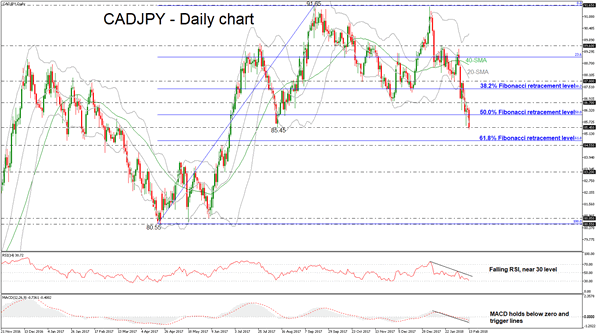
CADJPY has plummeted aggressively today as it posted a fresh an almost 8-month low of 85.37. The pair has been underperforming breaking below the 50.0% Fibonacci retracement level near 86.00 of the up-leg with the low of 80.55 and the high of 91.65. The short-term technical indicators are bearish and point to more weakness in the market.
Having a look at the daily timeframe, the momentum indicators are holding in the negative territory. The MACD oscillator slipped below its trigger line in the bearish area, while the RSI indicator is pointing to the downside in the negative territory. Moreover, the price has fallen below the Bollinger Band, signaling bearish tendency.
If price action drops below the 85.45 barrier, it could open the way for the next immediate support of 61.8% Fibonacci mark of 84.78. Clearing this key level would see additional losses towards the 84.55 support obstacle.
Upsides moves are likely to find resistance at the 86.70 barrier. Rising above this area would help to endorse the focus to the upside towards the 38.2% Fibonacci level of 87.40 and 87.80.
Sunset Market Commentary
Markets
Trading on US and European bond markets was again confined to tight ranges. Investor sentiment in Europe turned more cautious despite yesterday's rally on WS. A sharp decline of USD/JPY and a mediocre performance of European equities provided a cautious bid for core bonds, but the intraday gains remained modest. At the start of the US trading, the US NFIB small business confidence printed stronger than expected. Fed's Mester said that recent market turmoil doesn't change her assessment on the economy. At the time of writing, US/core yields are mostly slightly lower. The picture on the equity markets remains indecisive. US yields decline up to 1.5 bp with the 2-year underperforming (+2 bp, Mester comments?). German yields decline up to 1.5 bp, with the 10-year outperforming. 10-y yield spreads versus Germany widened across the board. Italy and Spain added 4bp. Portugal widened 6bp. Greece again underperformed (+11bp).
Dollar weakness prevailed today. We didn't see any specific economic news to explain the move. The sharp decline of USD/JPY in Asia this morning and early in Europe also weighed on other USD cross rates. USD/JPY dropped from the 108.75 area to fill bids below 107.50 just before noon in Europe. The move created uncertainty on European equity markets. The risk-off this time didn't help the dollar against the likes of the euro. The USD/JPY decline also propelled EUR/USD back to the 1.2350 area. The EUR/USD rally slowed temporary early in US dealings after a strong NFIB confidence and 'hawkish' comments from Fed's Mester (no impact yet from recent market turmoil). Still, the dollar is holding within reach of the intraday lows. EUR/USD trades at 1.2350. USD/JPY trades near 107.70.
The UK January price data were slightly stronger than expected. Headline CPI stabilized at 3.0% (a decline to 2.9% was expected). Core CPI unexpectedly rose to 2.7% Y/Y from 2.5%. PPI prices were mixed, but especially input PPI was also higher than expected. The report was in line with the assessment from last week's BoE inflation report. The BoE indicated that the balance of policy risks tilted to more vigilance on inflation rather than on stimulating growth. The BoE also said that at least three rate hikes might be needed to bring inflation to target. Sterling gained a few ticks (against the euro) after the inflation data, but the gain was limited an short-lived. Investors apparently want clarity on Brexit first before engaging in sterling long positions. Euro strength also blocked the downside in EUR/GBP. EUR.USD trades again just below 0.89.
European equities failed to extended yesterday's rebound. Most indices are losing between 0.25% and 0.5%, with Spain and Italy underperforming (-1.0%). Major US indices started the session with losses of about 0.5%.
News Headlines
British inflation unexpectedly stabilized at 3.0%, close to its highest level in nearly six years. The market consensus expected a modest decline to 2.9%. Core inflation even rose to 2.7% from 2.5%. PPI data series were mixed, mostly also slightly higher than expected. The data confirm the assessment of the BoE at last week's inflation rapport that the policy rate might need to be raise at a slightly faster pace than anticipated until recently in order to bring inflation back to the 2% target.
Optimism among US small companies rose more than expected in January as a record number of owners said now was a good time to expand their activity, according to a National Federation of Independent Business survey. The NFIB headline small business optimism index rose from 104.9 to 106.9. Only a rise to 105.3 was expected.
Federal Reserve Member Loretta Mester said that recent stock market turmoil hasn't changed her view on the economic outlook. "While a deeper and more persistent drop in equity markets could dash confidence and lead to a pullback in risk-taking and spending, the movements we have seen are far away from this scenario," Mester said
CAC Steady After US Markets Recover
The CAC index is showing limited movement in the Tuesday session, after posting small gains on Monday. Currently, the index is at 5,135.50, down 0.09% on the day. On the release front, French French Preliminary Payrolls edged up to 0.3%, beating the forecast of 0.2%. Wednesday should be busier, with key events in Germany and the eurozone. Germany and the eurozone will release GDP reports, and Germany will also publish Final CPI.
After last week's massive losses, global stock markets have steadied this week. The CAC lost 3.6% last week, and has endured an awful February, shedding 6.9%. Much of the sell-off can be attributed to investor concern over higher inflation in the US, which could lead to raise hikes from the Federal Reserve and other central banks. Inflation has also moved higher in the eurozone, although with plenty of slack in the economy, the ECB is not contemplating any rate hikes.
ECB President Mario Draghi said last week that he is more confident that eurozone inflation is moving closer to the ECB target of just below 2 percent, due to improving economic growth. However, Draghi listed currency market volatility as an obstacle to the inflation target, and added that the ECB would carefully monitor the euro's exchange rates. Draghi's concerns about the exchange rate have been underscored by last week's stock market turbulence, which boosted the dollar and sent the euro lower by 1.6 percent. The ECB tapered its massive stimulus program from EUR 60 billion to 30 billion/mth in January, and the markets are looking for hints as to whether the ECB will normalize policy and wind up stimulus in September.
US Inflation and Retail Sales Set to Guide the Dollar and Equities
The US will see the release of CPI and retail sales data for January on Wednesday, at 1330 GMT. Forecasts suggest that inflation is set to slow somewhat, while retail sales excluding automobiles are anticipated to rise at the same pace as previously. These data - and particularly the inflation prints - could play a large role in determining how many times the Fed will raise interest rates this year, and thus may dictate not only the dollar's short-term bias, but also whether the recent volatility in stocks will heighten or subside.
Both the headline and the core CPI rates are anticipated to have declined to 1.9% and 1.7% respectively in yearly terms, from 2.1% and 1.8% previously. As for retail sales, the headline print is expected to have slowed to 0.2% month-on-month from 0.4% previously, while the core figure that excludes automobile sales is projected to have risen at 0.4%, the same pace as the previous month.
It's not an exaggeration to say that this set of inflation data may hold special importance for both investors and policymakers. Let's not forget that the recent stock market turmoil started after the US surprisingly reported an acceleration in wage growth, which generated speculation that inflation may be set to pick up soon and consequently sent US bond yields sharply higher. Higher bond yields, in turn, weigh on demand for equities, as bonds now begin to produce adequate returns to keep investors interested. Thus, bond and equity investors are likely to look at the CPI prints to either confirm or disprove the narrative that a surge in inflation is just around the corner.
Of course, the CPI figures are likely to hold large implications for the dollar as well, which has managed to stabilize and even claw back some of its losses over the past days. At the time of writing, markets have fully priced in two Fed rate hikes by year end, and also see a 40% probability for a third one according to the Fed funds futures.
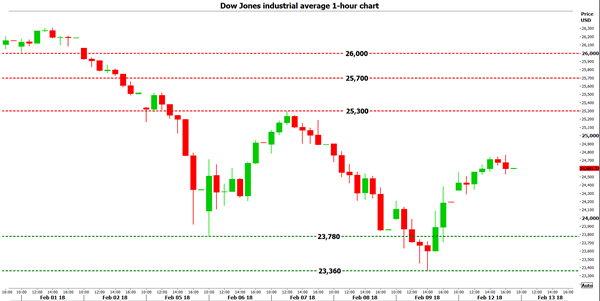
A potential upside surprise in the CPIs - and especially in the core rate - is likely to reinforce the narrative that inflationary pressures have started to intensify. Something like that would probably send higher both the probability for a third Fed hike this year and US Treasury yields. The dollar would probably benefit from such an outcome, as higher yields are generally positive for the currency (though this relationship has become dubious lately). Dollar/yen is likely to surge and break back above the key hurdle of 108.00, potentially aiming for the 108.50 zone. Should the bulls manage to overcome that barrier, then the 109.30 area could come into play. Higher yields, though, would also exert greater downward pressure on equity indices. The Dow Jones may head lower in this scenario and test the 23780 support territory, marked by the lows of February 8. A potential downside break of that level could pave the way for extensions towards the index's recent lows, near 23360.
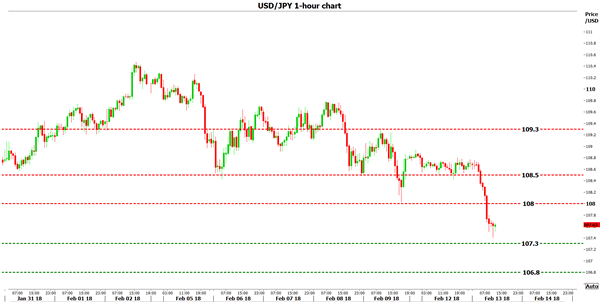
Conversely, softer-than-expected inflation prints could weigh on the dollar, but provide some much-needed relief to stock indices. Dollar/yen could edge lower and possibly break below the September low of 107.30, potentially aiming for a test of the 106.80 level, identified by the high of 24 June 2016. If sellers are strong enough to overcome that hurdle as well, then support may be found near 105.60, marked by the high of October 2016. As for the Dow, it is likely to rebound in such a case and aim for the 25300 resistance, marked by the peaks of February 7. An upside break of that area is possible to set the stage for extensions towards the January 16 low, at 25700, with even further advances likely to test the psychological 26000 territory.
Canadian Dollar Trading Sideways
The Canadian dollar continues to have an uneventful week. In the Tuesday's session, the pair is trading at 1.2587, up 0.07% on the day. On the release front, there are no Canadian indicators on the schedule. In the US, the sole indicator is the NFIB Small Business Index, which improved to 106.9, above the estimate of 106.2 points. On Wednesday the US releases CPI and retail sales indicators. Traders should be prepared for movement from USD/CAD during the North American session.
Last week's market selloff boosted the US dollar, at the expense of the Canadian dollar and most other major currencies. The Canadian dollar dropped 1.2% last week, and is down 2.2% in February, erasing the gains we saw in January. Interestingly, the catalyst for the current turbulence has been solid economic data in the US, namely, improved payrolls and wage growth reports. Is the correction over? It's too early too tell, since much of the sell-off is related to investor concerns over possible interest rate hikes by major central banks. The Bank of England has said it could accelerate its pace of hikes, and the Federal Reserve could follow suit if inflation moves higher.
It's been a rough February for the Canadian dollar, which has declined 2.4%. The loonie was hurt by last week's massive sell-off in the stock markets, as nervous investors lost their risk appetite and scurried away from minor currencies such as the Canadian dollar. However, the country's economic fundamentals remain solid, and the Bank of Canada is expected to raise rates twice more this year, after hiking rates in January. If oil prices remain high and the economy remains strong, there is room for the Canadian dollar to gain ground.
Canadian employment growth has impressed in recent months, but the trend reversed sharply in January. Employment Change plunged by 88.0 thousand, well off the estimate of +10.3 thousand. The unemployment rate climbed from 5.7% to 5.9%, missing the estimate of 5.8%. The Canadian dollar reacted on Friday with losses, but managed to recover and ended the Friday session almost unchanged.
USDJPY Targeting 107.29 Key Support Level
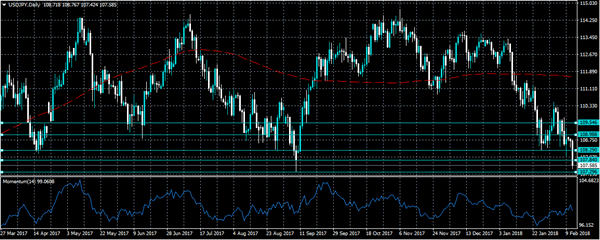
The U.S dollar has moved sharply lower against the Japanese yen currency during the European trading session, with the pair falling to its lowest trading level since September 2017. The USDJPY is currently trading around the 107.55 region, after finding interim technical support around the 107.40 level. Broad-based U.S dollar weakness is the major theme spreading through the foreign exchange markets on Tuesday, with sellers now looking towards the pairs five-month low located at the 107.29 level.
The USDJPY pair is strongly bearish while price-action trades below the 108.29 level, further selling towards 107.00 and 106.60 remains possible.
Should the USDJPY pair start to trade above the 108.29 level, key technical resistance is found at the 108.45 and 108.98 levels.