

Sample Category Title
EU Gives Upbeat Forecasts, RBNZ Keeps Rates Unchanged
The European Commission released its quarterly forecasts yesterday and gave an upbeat assessment to the growth in the Eurozone. Inflation and unemployment were however more subdued in comparison. The forecasts show that inflation in the Eurozone will stay below the ECB's 2% target rate in 2019 at only 1.6%.
In the overnight trading session, the RBNZ voted to keep the overnight cash rate unchanged at 1.75%. The decision comes after a weak fourth quarter inflation data and a somewhat mixed unemployment numbers for the quarter.
Looking ahead, focus shifts to Threadneedle Street as the Bank of England will conclude its monetary policy with the statement and press conference. The BoE is expected to keep rates unchanged at today's event. Economists are divided on whether the BoE will leave forward guidance unchanged or whether it will bring forward the rate hike expectations. The BoE is currently expected to leave rates unchanged at least until August this year.
Elsewhere, the weekly unemployment claims from the U.S. will be coming out later in the evening.
Currencies: Dollar Gains Traction On Higher Yields And Expansive Fiscal Policy
Sunrise Market Commentary
- Rates: Core bond sell-off resumes
The short squeeze in core bonds earlier this week seems to have done its job. Underlying negative core bond sentiment takes the upper hand again. The US Congress' 2-yr spending deal will significantly raise US deficits and is structurally negative for Treasuries. Speeches by Fed/ECB governors and the US 30-yr Bond auction could also impact trading. - Currencies: Dollar gains traction on higher yields and expansive fiscal policy
The dollar rebound accelerated as a poor US bond action and prospects for a big US budget deficit propelled US yields. The downside of the dollar looks better protected. EUR/USD dropped below intermediate support. The BoE's policy decision and inflation report might keep the door open for a next rate hike later this year. This might be slightly supportive for sterling.
The Sunrise Headlines
- The comeback of US stock markets stalled with indices ending mixed between flat (Dow) and -0.9% (Nasdaq) lower. Most Asian indices are in positive territory this morning with China underperforming.
- Congressional leaders said they had reached an agreement on a 2-yr budget deal, charting a path out of the turmoil over spending and immigration that had shuttered the government last month and left its long-term funding in jeopardy.
- China's export growth (11.1% Y/Y) bested expectations in January as the value of imports (36.9% Y/Y) vastly exceeded forecasts thanks in part to the timing of the Lunar New Year and a recovery in oil prices from a year earlier.
- The Reserve Bank of New Zealand kept its official cash rate at 1.75%, and also said it expects inflation to reach the mid-point of its target two years later than forecast. Governor McDermott said the kiwi will weaken as the Fed hikes.
- Oil prices dropped to their lowest point in 2018 after US government data showed US crude stockpiles rose faster than expected last week and monthly data for domestic production surpassed all-time highs.
- Sources said that China has resumed an outbound investment scheme after a 2y hiatus, granting licenses to about a dozen global money managers, signalling that Beijing is less worried about capital outflows amid a surge in the renminbi.
- Today's eco calendar contains the BoE's policy meeting and US weekly jobless claims. The ECB publishes its economic bulleting and several ECB & Fed governors speak. Ireland and the US tap the bond market
Currencies: Dollar Gains Traction On Higher Yields And Expansive Fiscal Policy
EUR/USD drops below intermediate support
EUR/USD finally broke 1.2323/35 support yesterday. Later in US dealings, different factors supported the US dollar. The US 10-yr yield ticked higher after a poor 10-yr action. US Senate leaders announced a 2-yr budget deal (still to be approved) that would raise government spending by $300 bn, raising the budget deficit. The prospect of an expansionary fiscal policy and higher rates inspired further USD gains and hurt equities. EUR/USD finished the day at 1.2264. USD/JPY held north of 109 despite renewed nervousness on equity markets.
Asian equities are trading mixed with Korea and Japan outperforming, supported by the stronger dollar. China is mixed as trade data show a very sharp rise of imports. The Yuan eases after touching the highest level in more than two year yesterday. Higher US yields are keeping USD/JPY well supported (109.60 area). EUR/USD hovers near yesterday's closing levels. The kiwi dollar (NZD/USD 0.72) weakened as the RBNZ indicated that inflation will only reach the 2.0% target in 2020.
There are few important data today. Many ECB members attend a conference in Frankfurt. We keep a close eye at the US 30-yr Bond auction. The prospect of a rising deficit supports the rise in US yields. The dollar could regain traction on higher US yields and on the prospect of an expansive US fiscal policy. Risk sentiment remains a wildcard. Yesterday's price action suggests that the downside of the dollar is becoming better protected. ECB speakers will probably reiterate that ECB normalization will develop in a very gradual way and that FX volatility is a risk. Technical picture: the dollar decline slowed of late and EUR/USD finally dropped below 1.2323/35 support. A break below 1.2165 would call off the ST downside alert (for USD). A correction of EUR/JPY reinforced the EUR/USD decline yesterday, but this factor might ease if risk aversion cools.
The BoE decides on policy and publishes its inflation report today. The BoE might be slightly more positive on growth and keep its assessment on inflation (rise in sterling to counterbalance higher oil price?). The BoE assessment might keep the door open for a next rate hike later this year (August?). Today's BoE communication might be slightly supportive for sterling. Of late, a break of the EUR/GBP 0.8928 resistance failed. A neutral (not too soft) BoE assessment might push EUR/GBP back lower in the established range. EUR/GBP 0.8690 remains solid support. A break probably won't be easy as long Brexit uncertainty persists.
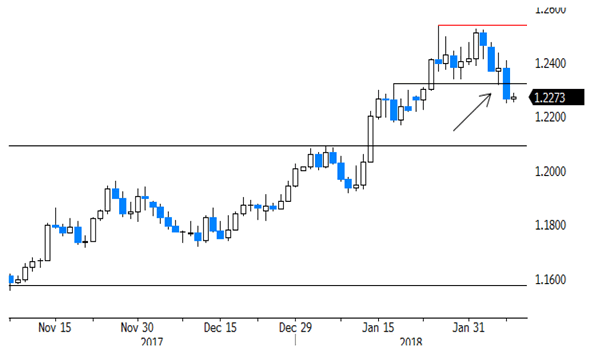
EUR/USD: finally drops below1.2323/35 support as dollar rebounds
Market’s Wild Ride Not Over Yet
Investors across the globe are finding it difficult time currently to decide on whether to buy the recent dips, or to remain on the sidelines until the dust settles. After gaining 1.2% on Wednesday, the S&P 500 closed 0.5% lower in the biggest reversal since 25 August 2015. It seems volatility instruments continued to dominate investors' behavior. After falling by 7 points on the opening of the U.S. trading session, the VIX made its way again to 28 towards the close, suggesting that volatility may stay for longer. Speculators may be having some fun trading such a volatile market, but this isn't true for longer-term investors.
Many contrarians would like to follow Baron Rothschild's advice: “Buy when there's blood in the streets”. As of now, I do not see any blood, but a healthy correction which has been overdue for a long time. From a valuation perspective, the forward price to earnings ratio on the S&P 500 has dropped from 20 at the beginning of the year to below 18, suggesting that prices are still expensive when compared to historic averages. Deciding to buy, sell, or hold is a tough one in such circumstances, but if investors believe the global economy and corporates will continue firing on all cylinders, the downside risk is likely to be limited from current levels. However, another 5-10% correction should not be ruled out.
Fixed income markets have started looking attractive and if the surge in bold yields resumes, there will be more incentives to pull out from stocks to bonds. That's why bond markets, particularly in the U.S. will play a major role in how much further the correction may continue.
The Bank of England is expected to keep monetary policy unchanged when it meets later today, but pound traders will take the hints from Mark Carney, and the Quarterly Inflation Report. Sterling has appreciated more than 6.9% since the central bank last met on December 14, but gave up 3% after peaking at 1.4344 on January 25 and is currently up 2.9% for the year. After raising interest rates by 25 basis points in November, there are little reasons for the BoE to tighten again soon. Most recent data showed signs of economic slowdown, including in the service and manufacturing sectors. Meanwhile, wages grew only by 2.4% in the three months to November, and CPI ticked lower from 3.1% to 3%. Sterling's reaction will depend on Mark Carney's tone and any potential changes in the Quarterly Inflation report.
Super Thursday For The Bank Of England
The Bank of England is expected to largely proceed as normal today on ‘Super Thursday’ when the central bank releases its policy decision and statement plus the Inflation Report.
US Fed’s Dudley spoke at an event jointly hosted by Thomson Reuters and the European American Chamber of Commerce in New York about Banking Culture. Dudley made comments that there has been progress in bank culture but more can be done. They are not expecting a huge bank deregulatory swing. The Fed is focussed on feedback loops in the markets. The stock market bump has no effect on economic outlook but a sustained drop would impact outlook. The market is generally functioning ok and general liquidity is pretty good. The Fed will continue to study the effects of regulations on liquidity.
US Consumer Credit Change (Dec) was $18.45B v an expected $20.00B, from a previous $27.95B.
The Reserve Bank of New Zealand Interest Rate Decision was left on hold, as expected, at 1.75%. The Rate statement and the Monetary Policy Statement were released at the same time. Some of the comments from the RBNZ were that policy will remain accommodative for a considerable period. The forecast is for rates to rise in the second quarter of 2019. Numerous uncertainties remain and policy may need to adjust. The RBNZ sees inflation reaching 2% in Q3 of 2020 versus Q2 of 2018. It cut the Q1 2018 growth forecast to 0.8% from 1.2% previously. The move in NZD is largely due to the move in USD. The CPI is forecasted to trend upwards towards the midpoint of the target and domestic economic growth is projected to strengthen. House price inflation has increased somewhat but housing credit growth continues to moderate. Labour market conditions continue to improve. The RBNZ has revised down the impact of new government policies in the near term. The NZDUSD fell to session lows of 0.72088 when this data was released.
Comments from the RBNZ Press Conference discussing the rate decision and monetary policy statement were: that the next rate move could be up, or it could be down. Market volatility is seen as a “bit of a warning sign” and shows nervousness towards interest rate normalisation but there was no reason to change forecasts after equity market volatility. The RBNZ remains confident about heading towards the inflation target and that its policy stance is sensible. If volatility translates into interest rate markets it would be an upside risk on the bank’s interest rate track. RBNZ Governor Spencer said that ‘’we are reasonably close to a neutral level of unemployment’’. About the NZD, he stated he is not concerned about it, is comfortable where it is, and expects it to drift lower but stay in this vicinity and normalisation of rates will happen, the risk is if it happens quickly. The NZDUSD has continued its decline to 0.71804.
US FOMC Member Williams spoke at a community leader’s luncheon in Honolulu, Hawaii. He does not see the economy as a bubble or headed into overdrive and he sees inflation picking up this year. He said that he can see productivity continuing to moderate. The Federal Government has an unsustainable fiscal path and the Fed is focusing on inflation, as the job market has tightened. He said that he is not worried about the debt crisis right now and if the economy continues to add 2M jobs this year he expects to see inflation pressures. The recent market turmoil has not changed policy or economic outlook. The US economy can clearly handle gradually rising interest rates. He also made the comment that the goal of Wells Fargo penalties was to send a message: banks in the US must follow laws and regulations.
Japanese Foreign Bond Investment (Feb 2) was ¥-886.6B from ¥41.1B previously, which was revised down to ¥16.4B. Foreign Investment in Japanese Stocks (Feb 2) came in at ¥-126.7B from ¥-300.5B previously, which was revised up to ¥-171.8B. USDJPY hit a low of 109.114 after the release before retracing higher.
Chinese Exports (YoY) (Jan) were 11.1% v an expected 9.6%, from 10.9% previously. Imports (YoY) (Jan) were 36.9% v an expected 9.8%, from 4.5% previously. Trade Balance USD (Jan) was $20.34B v an expected $54.10B, from a prior $54.69B. Exports CNY (YoY) (Jan) were 6.0% from 10.8% previously, which was revised down to 7.4%. Imports CNY (YoY) (Jan) was 30.2% from 18.7% previously. Trade Balance CNY (Jan) was 135.80B v an expected 325.00B, from a prior of 361.98B. The miss in the trade balance has caused USDCNH to move up 0.50% to 6.35201.
Japanese Economy Watchers Survey: Current (Jan) was 49.9 v an expected 53.7, from 53.9 prior. Economy Watchers Survey: Outlook (Jan) was 52.4 v an expected 53.5, from 52.7 prior. USDJPY continued its move higher to reach 109.766, from 109.557, when the data was released.
EURUSD is unchanged overnight, trading around 1.22636.
USDJPY is up 0.42% in early session trading at around 109.765.
GBPUSD is up 0.08% to trade around 1.38890.
USDCNH is up 0.62% overnight, trading around 6.35860.
NZDUSD is down -0.75% overnight at around 0.71828.
Gold is down -0.55% in early morning trading at around $1,310.70.
WTI is down -0.15% this morning, trading around $61.51.
Major data releases for today:
At 07:00 GMT, German Current Account n.s.a. (Dec) is expected to be €25.0B from a previous €25.4B. Exports (MoM) (Dec) are expected to be -1.0% from 4.1% previously. Imports (MoM) (Dec) are expected to be -0.5% from 2.3% previously. Trade Balance s.a. (Dec) is expected to be €21.7B from a prior €22.3B. EUR pairs could move because of this data release.
At 08:45 GMT, German Buba President Weidmann will speak on Monetary Policy in the European Context at the Monetary and Economic Policies on both sides of the Atlantic conference in Frankfurt.
At 09:00 GMT, RBA Governor Lowe will be speaking at the A50 Australian Economic Forum in Sydney. His comments have the potential to influence trades on AUD.
At 13:30 GMT, the Bank of England Interest Rate Decision is expected to be left unchanged at 0.5%. The BOE Minutes, BOE Quarterly Inflation Report and the Monetary Policy Statement will be released at the same time. The BOE Asset Purchase Facility is expected to come in unchanged at £435B. GBP crosses could see a spike in volatility after this data is released.
At 13:15 GMT, Canadian Housing Starts s.a. (YoY) (Jan) are expected to be 210K from a previous 217K.
At 13:30 GMT, US Initial Jobless Claims (Feb 2) are expected to be 232K from a previous 230K. Continuing Jobless Claims (Jan 26) are expected to be 1.945M from 1.953M previously.
At 14:00 GMT, US FOMC Member Kaskari will be speaking. USD crosses and US assets may experience volatility around this time in reaction to his comments and audience questions.
At 14:00 GMT, Canadian BOC Governing Council Member Wilkins will be speaking on innovation and inclusive growth at the G7 Symposium in Quebec. CAD crosses could be volatile around this time in reaction to comments made.
Aussie Trading Marginally Higher In The Morning Session
For the 24 hours to 23:00 GMT, the AUD declined 0.94% against the USD and closed at 0.7815.
LME Copper prices declined 0.8% or $54.0/MT to $7006.0/MT. Aluminium prices declined 0.7% or $14.5/MT to $2181.5/MT.
In the Asian session, at GMT0400, the pair is trading at 0.7817, with the AUD trading slightly higher against the USD from yesterday’s close.
Overnight data showed that Australia’s NAB business confidence index dropped to a level of 6.0 in the three months to December 2017. The index had recorded a revised reading of 8.0 in the previous quarter.
Elsewhere in China, Australia’s largest trading partner, trade surplus narrowed more-than-estimated to CNY135.8 billion in January, compared to a surplus of CNY362.0 billion in the prior month. Markets were expecting the nation to register a trade surplus of CNY330.0 billion.
Moreover, the nation’s exports rose 6.0% on an annual basis in January, exceeding market expectations for a gain of 2.6% and after recording an increase of 7.4% in the previous month. Further, the nation’s imports jumped 30.2% YoY in January, beating market expectations for a rise of 5.3%. Imports had climbed 0.9% in the previous month.
The pair is expected to find support at 0.7787, and a fall through could take it to the next support level of 0.7758. The pair is expected to find its first resistance at 0.787, and a rise through could take it to the next resistance level of 0.7924.
Going ahead, traders would eye the Reserve Bank of Australia’s (RBA) quarterly statement on monetary policy, due to release overnight.
The currency pair is trading below its 20 Hr and 50 Hr moving averages.

Euro-Zone Economy To Show Robust Growth This Year And Next: European Commission
For the 24 hours to 23:00 GMT, the EUR declined 1.03% against the USD and closed at 1.2259, following downbeat industrial output data from Germany and reports that leader of Social Democrats (SPD), Martin Schulz, would not be taking over as Germany's Finance Minister.
On the economic front, Germany's seasonally adjusted industrial production retreated 0.6% on a monthly basis in December, less than market expectations for a fall of 0.7%. In the prior month, industrial production had recorded a revised rise of 3.1%.
Separately, the European Commission, in its winter economic forecast report, stated that the Euro-zone's economy is expected to continue its robust growth this year and next, on the back of strong economic fundamentals and better-than-expected pick-up in global economic activity and trade. The commission projected that the common currency region would expand by 2.3% in 2018, revised up from 2.1% estimated earlier in November. Growth in 2019 is expected to be 2.0%, up from 1.9%. However, the Commission warned that uncertainties linked to Brexit and geopolitical tensions continue to pose threats to the region's economic performance in the medium term.
The greenback gained ground against its major peers, after the US lawmakers clinched a two-year budget deal, thus pushing back concerns over a government shutdown.
On the data front, MBA mortgage applications in the US rebounded 0.7% in the week ended 02 February 2018, after recording a drop of 2.6% in the prior week. Moreover, the nation's consumer credit climbed less-than-anticipated by $18.45 billion in December, compared to market expectations for an advance of $20.00 billion. Consumer credit had risen by a revised $31.02 billion in the previous month.
In the Asian session, at GMT0400, the pair is trading at 1.2276, with the EUR trading 0.14% higher against the USD from yesterday's close.
The pair is expected to find support at 1.2213, and a fall through could take it to the next support level of 1.2149. The pair is expected to find its first resistance at 1.2373, and a rise through could take it to the next resistance level of 1.2469.
Going ahead, traders would keep a close watch the Euro-zone's economic bulletin report and Germany's trade balance figures for December, both due to release in a few hours. Moreover, the US initial jobless claims data, due to release later today, will be on investors' radar.
The currency pair is trading below its 20 Hr and 50 Hr moving averages.

Pound Trading On A Positive Footing, Ahead Of BoE’s Interest Rate Decision
For the 24 hours to 23:00 GMT, the GBP declined 0.62% against the USD and closed at 1.3875, after data showed that UK's Halifax house price index registered an unexpected drop of 0.6% on a monthly basis in January, defying market expectations for a gain of 0.2%. The index had registered a revised fall of 0.8% in the prior month.
Yesterday, the European Commission forecasted that Britain's economic growth would slow to slow to 1.4% this year, before slipping to 1.1% next year.
In the Asian session, at GMT0400, the pair is trading at 1.3889, with the GBP trading 0.1% higher against the USD from yesterday's close.
Overnight data indicated that Britain's RICS house price balance remained unchanged at a level of 8.0 in January, compared to market expectations of a drop to a level of 5.0.
The pair is expected to find support at 1.3827, and a fall through could take it to the next support level of 1.3766. The pair is expected to find its first resistance at 1.3972, and a rise through could take it to the next resistance level of 1.4056.
Trading trend in the Pound today is expected to be determined by the Bank of England's (BoE) interest rate decision, scheduled to be announced later in the day. The central bank is widely anticipated to keep monetary policy steady.
The currency pair is showing convergence with its 20 Hr moving average and trading below its 50 Hr moving average.

Japan’s Trade Surplus Widened Above Expectations In December
For the 24 hours to 23:00 GMT, the USD slightly rose against the JPY and closed at 109.37.
In the Asian session, at GMT0400, the pair is trading at 109.37, with the USD trading flat against the JPY from yesterday's close.
Overnight data revealed that Japan's trade surplus (BOP basis) widened more-than-expected to ¥538.9 billion in December, compared to a surplus of ¥181.0 billion in the prior month. Investors had envisaged the nation's trade surplus to widen to ¥520.4 billion.
Early morning data showed that the nation's Eco-Watchers Survey for the current situation eased to a level of 49.9 in January, more than market expectations for a fall to a level of 53.7. The index had registered a level of 53.9 in the prior month. Moreover, the nation's Eco-Watchers Survey for the future outlook recorded an unexpected drop to a level of 52.4 in January, confounding market anticipations for a rise to a level of 53.6 and compared to a level of 52.7 recorded in the previous month.
The pair is expected to find support at 108.96, and a fall through could take it to the next support level of 108.55. The pair is expected to find its first resistance at 109.74, and a rise through could take it to the next resistance level of 110.11.
Looking forward, Japan's tertiary industry index for December, set to release in the early hours of tomorrow, will be on investors' radar.
The currency pair is showing convergence with its 20 Hr moving average and trading above its 50 Hr moving average.

Swiss Franc Trading A Tad Higher This Morning
For the 24 hours to 23:00 GMT, the USD rose 0.86% against the CHF and closed at 0.9435.
In the Asian session, at GMT0400, the pair is trading at 0.9440, with the USD trading marginally higher against the CHF from yesterday’s close.
The pair is expected to find support at 0.9368, and a fall through could take it to the next support level of 0.9297. The pair is expected to find its first resistance at 0.9483, and a rise through could take it to the next resistance level of 0.9527.
The currency pair is trading above its 20 Hr and 50 Hr moving averages.

Canada Building Permits Advanced In December
For the 24 hours to 23:00 GMT, the USD rose 0.5% against the CAD and closed at 1.2569.
Macroeconomic data revealed that Canada's building permits rebounded 4.8% MoM in December, higher than market expectations for a rise of 2.0%. Building permits had fallen by a revised 7.3% in the prior month.
In the Asian session, at GMT0400, the pair is trading at 1.2559, with the USD trading 0.08% lower against the CAD from yesterday's close.
The pair is expected to find support at 1.2511, and a fall through could take it to the next support level of 1.2464. The pair is expected to find its first resistance at 1.2592, and a rise through could take it to the next resistance level of 1.2626.
Ahead in the day, market participants will keep a close watch on Canada's housing starts data for January.
The currency pair is showing convergence with its 20 Hr moving average and trading above its 50 Hr moving average.
