Sample Category Title
EUR/USD Downward Trend
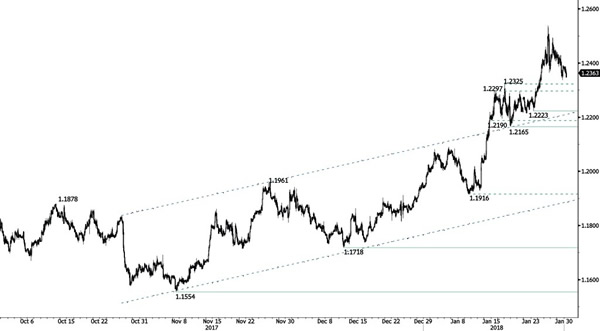
EUR/USD is trading lower. The pair lies in a bearish short-term momentum. Hourly support is given at 1.2223 (23/01/2018 low). The technical structure suggests further short-term upside moves.
In the longer term, the momentum is turning largely positive. We favor a continued bullish bias. Key resistance is holding at 1.2856 (15/10/2014 high) while strong support lies at 1.1554 (08/11/2017 low).
GBPUSD Further Bearish Below 1.4000 Level
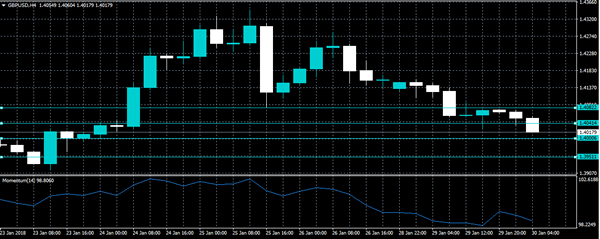
The British pound has extended losses against the greenback in early Tuesday trading, with price-action dropping back towards the key 1.4000 level. Overnight strength in the U.S dollar index, and an undercurrent of political uncertainty in the United Kingdom has hit the GBPUSD pair hard. Further losses below the 1.4000 level may accelerate downside pressures, as selling momentum appears to be gathering with a series of key support levels already breached.
The GBPUSD pair is likely to come under further selling pressure below the 1.4000 level. Strong intraday support is found at 1.3950 and 1.3867.
Should price-action on the GBPUSD pair move above the 1.4041 level, buyers may test toward the key 1.4082 resistance area.
EURO Losses Likely To Extend Below 1.2385
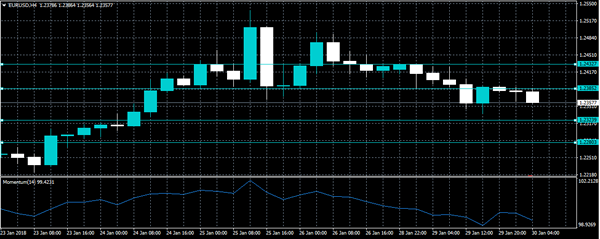
The euro currency has weakened further against the U.S dollar in early Tuesday trading, falling back towards the 1.2350 level, as U.S 10-year Treasury-yields rally towards multi-year highs. Rising long-term bond yields in the United States has encouraged buying in the U.S dollar index, putting selling pressure back on the EURUSD pair. During the upcoming European session, traders will look to the release of fourth quarter GDP figures from the eurozone trading block, and headline January CPI inflation from the German economy.
EURUSD losses are likely to extend while price-action trades below the 1.2385 level. Downside targets for intraday sellers remain 1.2323 and 1.2280.
Should the EURUSD start to trade above the 1.2385 level, buyers may test towards the pairs 100-month moving average, at 1.2432.
European Data, Central Bankers On Deck For Tuesday
The data deluge continues on Tuesday, with European releases dominating the headlines amid a quiet session for North America. On the monetary policy front, a pair of central bankers will capture the market’s attention ahead of the US Federal Reserve interest rate announcement later in the week.
The economic calendar heats up at 08:00 GMT with a report on Spanish Q4 GDP. The Spanish economy is forecast to grow 0.7% quarter-on-quarter, which translates into an annualized gain of 3.1%.
Two hours later, the European Commission will release preliminary Eurozone GDP data. The 19-member euro area is forecast to grow 0.6% in the fourth quarter and 2.6% annually. Both readings match the previous quarter’s gain.
The European Commission will also release several sentiment indicators, including services sentiment, consumer confidence, industrial confidence, business climate and economic sentiment.
Meanwhile, Germany is schedule to report on inflation at 13:00 GMT. The consumer price index (CPI) for Europe’s largest economy is projected to rise 1.7% annually in January. The harmonised index of consumer prices (HICP), which calculates inflation using a method consistent with the European Union, is forecast to rise 1.6% year-over-year.
On the monetary policy front, Bank of England (BOE) Governor Mark Carney is scheduled to deliver a speech at 15:30 GMT. Just one hour later, European Central Bank (ECB) official Yves Mersch will deliver public commentary.
The Federal Reserve will kick off its two-day policy meeting on Tuesday, with the Federal Open Market Committee (FOMC) scheduled to deliver its rate statement the following afternoon. The US central bank is widely expected to stand pat at the forthcoming meeting.
In commodity news, the American Petroleum Institute (API) will release its weekly crude oil stock report at 21:30 GMT. The official inventory report courtesy of the US Energy Information Administration (EIA) is due the following morning.
EUR/USD
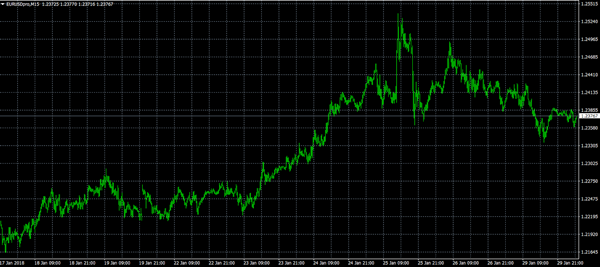
Europe’s common currency moderated on Monday following another week of huge gains. The EUR/USD was last seen trading at 1.2371, where it was down 0.1% from the previous close. The pair faces immediate support near the 10-day SMA around 1.2300. On the upside, resistance is likely found around 1.2430.
GBP/USD
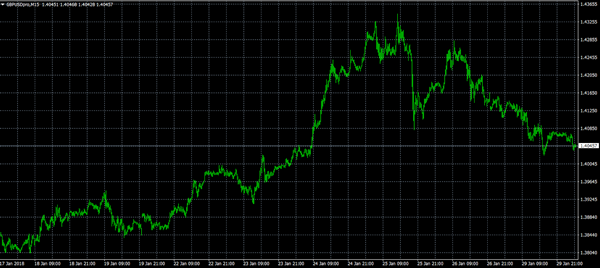
Like the euro, cable backtracked on Monday, but remained in a firm uptrend. The GBP/USD continued lower at the start of European trade, falling 0.2% to 1.4045. The pound’s near-term outlook will be dominated by ongoing developments concerning Brexit, which the market appears to have shrugged off recently.
USD/CAD
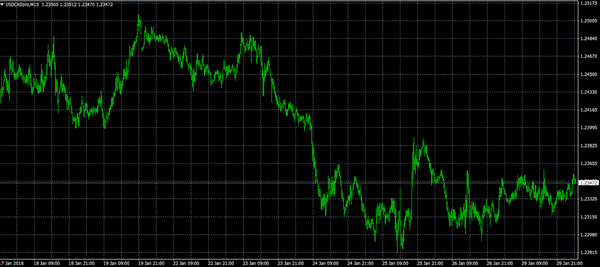
The US dollar bounced back against its northern counterpart on Monday, with the USD/CAD climbing toward the 1.2350 handle. The latest uptick suggests that the Bank of Canada’s latest rate hike may have already been priced into the market. That being said, investors can expect further vulnerability for the greenback in the short term.
Elliott Wave Analysis: EURUSD And GBPUSD Look For A Bullish Reversal
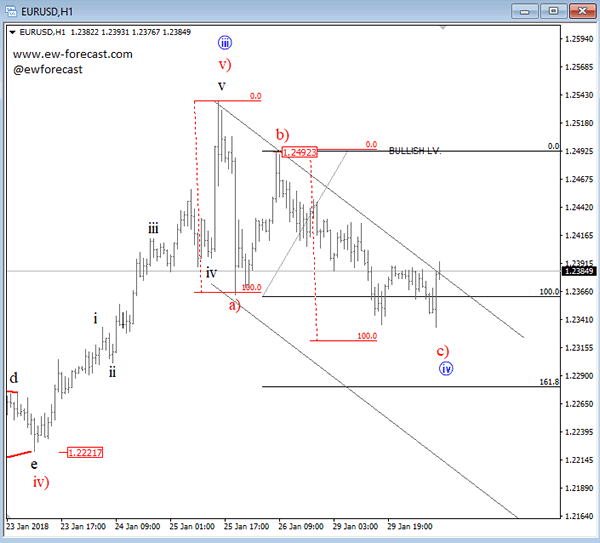
We have seen some nice USD recovery recently, but so far only in corrective structure on several FX pairs. EURUSD has three waves down; ideally a-b-c move is coming to an end and will complete wave four this week, maybe already after the US close when Trump will have a speech. Technically speaking we will be looking up to 1.26 if pair closes on a daily basis above trend line resistance and rallies above 1.2492.
EURUSD, 1h
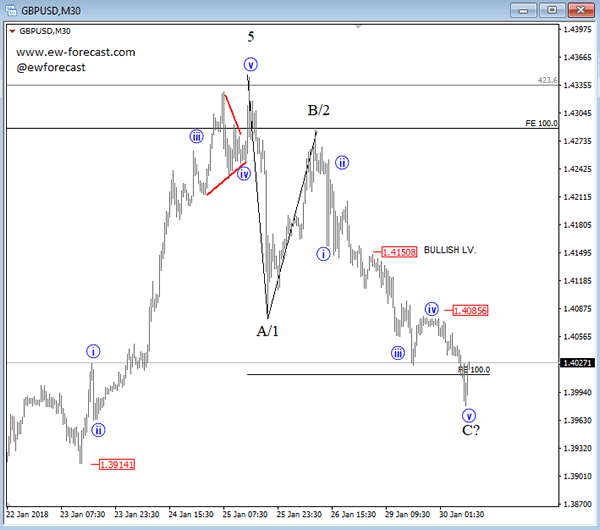
Cable can be in a similar situation; now at the end of wave C if we consider that pair has five subwaves down into wave C=A level. Rise above 1.4150 would be bullish for the pair.
GBPUSD, 30Min
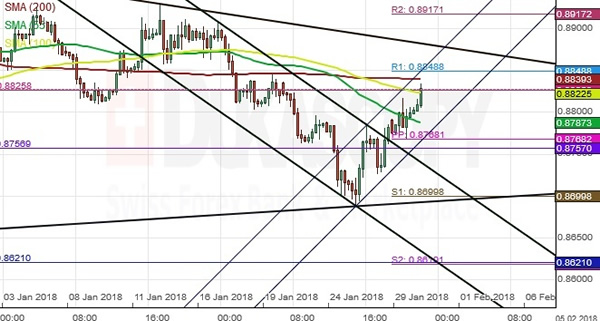
EUR/GBP 4H Chart: Short Period Of Consolidation
The common European currency has been trading in a downtrend channel against the British pound since the middle of January. Although the decline has been stopped by the weekly PP at 0.86 for a temporary retracement to the upside.
After testing the downtrend's boundary on 25th January, the pair started to consolidate to the north. A junior pattern has been drawn to trail the movement of the market.
The bull is likely to continue dominating the pair for a short period of consolidation until it is stopped by the weekly PP at 0.88 or the daily dominant channel upper trend line.
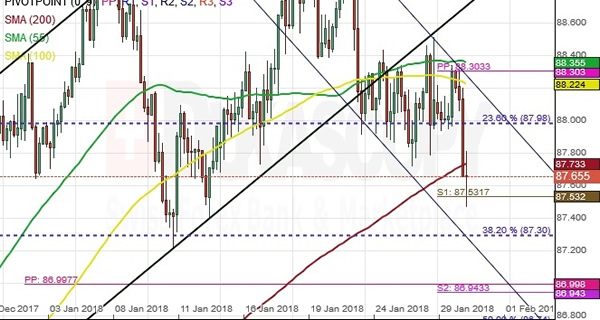
AUD/JPY 4H Chart: Bear Rallying South
The Aussie has been gaining strength against the Japanese Yen since late November. Although the bullish movement was stopped by the weekly pivot point at 88.89 level.
The pair already breached past the 23.60% Fibonacci retracement level and was slowly heading south. This movement is likely to be stopped by the combined support of the weekly and monthly PP levels near the 86.94 mark. The retracement can be measured by connecting the November low at 84.37 and the January high at 89.10.
Regarding the short-term, the bear is likely to continue growing stronger until it breaks the junior pattern's upper trend line.
EURUSD Analysis: Breaches Trend-Line
As previously expected, the notable resistance of the 55-hour SMA and the monthly R3 circa 1.2436 stopped any attempts for the common European currency to strengthen against the Greenback within the last session. Thus, the rate pushed lower and breached the three-week upward-sloping trend-line. It did return near the given line late on Monday, but failed to gain enough bullish momentum to return above the 1.24 mark. It is likely that the pressure of the 55– and 100-hour SMAs and the weekly PP in this area results in a slight movement south towards the 200-hour SMA. The pair should remain between these moving averages until some fundamental events cause a breakout. The general tendency, however, should nevertheless be southwards.

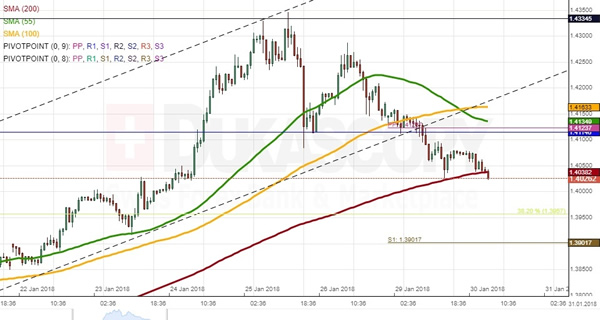
GBPUSD Analysis: Tests 200-Hour SMA
The British Pound continues to depreciate against the US Dollar for the second consecutive session. This bearish momentum has resulted in a breakout of a four-week ascending channel. At the time of this analysis, the pair was testing the 200-hour SMA located near the 1.4050 mark. Technical indicators demonstrate that there is still some donwside potential, especially if this long-term moving average is breached. A possible downside target in this case could be the 38.20% Fibo near 1.3950. On the other hand, fundamentals might still push the rate higher within this session, thus pushing the Pound towards the 55– and 100-hour SMAs at 1.4150. By and large, longer-term perspective demonstrates that bears should prevail during the following trading sessions.
USDJPY Analysis: Near Strong Resistance
Following a strong period of decline during the previous sessions, the US Dollar managed to regain some of its lost positions on Monday. Gains, however, were largely limited due to the notable resistance of the 55– and 100-hour SMAs and the monthly S3 located nearby.
Technical indicators favour another fall towards the distant weekly S1 at 107.53 during this session. In case fundamentals fail provide strong upside momentum, this is the most probable scenario. By and large, the US Dollar should soon accelerate against the Yen and return near the 109.50 mark where the upper boundary of a six-week descending channel is located.