Sample Category Title
GBP/USD Mid-Day Outlook
Daily Pivots: (S1) 1.3502; (P) 1.3541; (R1) 1.3579; More.....
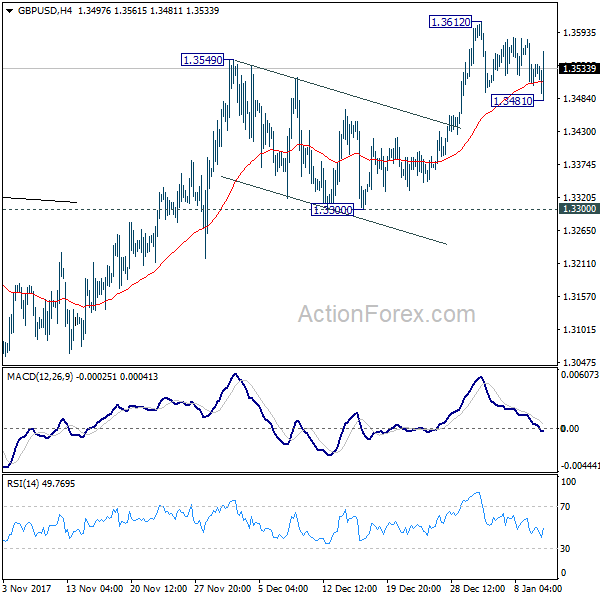
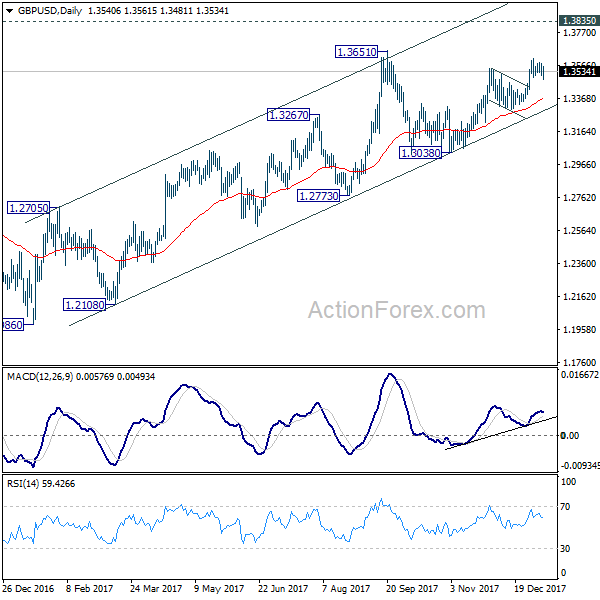
Despite dipping to 1.3481, GBP/USD quickly recovered and is back above 4 hour 55 EMA. Intraday bias remains neutral first. At this point, another rise is still in favor. Above 1.3612 will target 1.3651 key resistance first. Break will resume medium term rise from 1.1946 and target key resistance level at 1.3835. However, another decline and break of 1.3481 will raise the chance of near term reversal and turn focus back to 1.3300 support.
In the bigger picture, the break of long term trend line resistance from 1.7190 (2014 high) is seen as a sign of long term reversal. However, rise from 1.1946 (2016 low) is not impulsive looking. And the pair is limited below 1.3835 key resistance. Hence, we won't turn bullish yet and would continue to monitor the development. On the downside, break of 1.3038 support will now indicate that rebound from 1.1946 has completed and turn outlook bearish. Meanwhile, sustained break of 1.3835 should at least send GBP/USD to 38.2% retracement of 2.1161 (2007 high) to 1.1946 (2016 low) at 1.5466.
EUR/USD Mid-Day Outlook
Daily Pivots: (S1) 1.1908; (P) 1.1942 (R1) 1.1968; More....
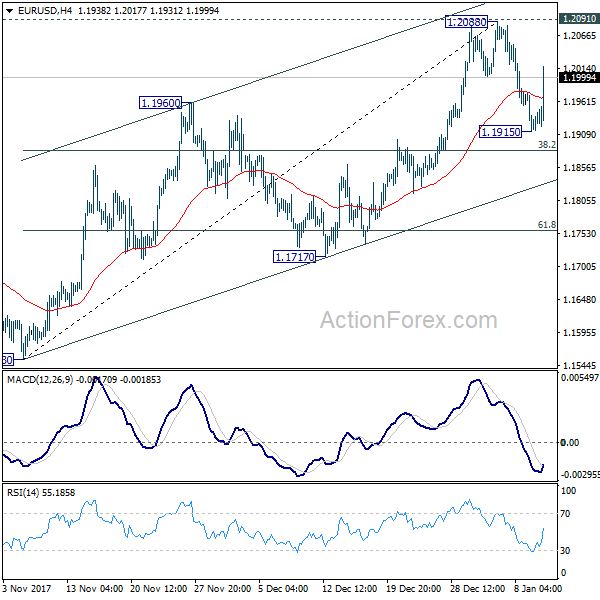
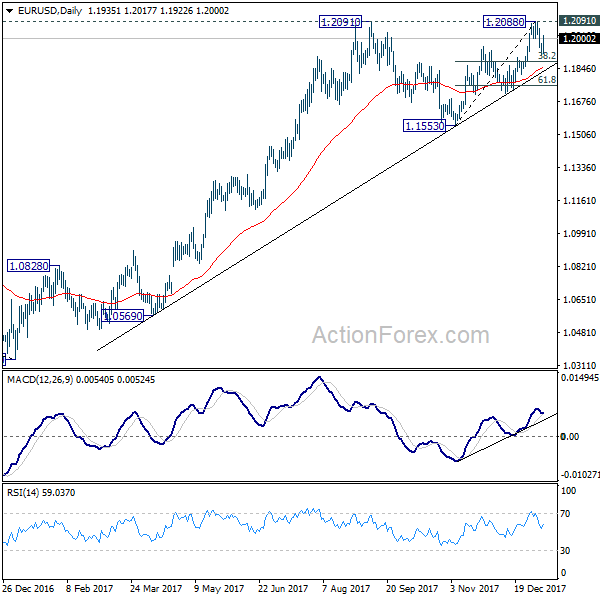
EUR/USD rebounds strongly after hitting 1.1915. Intraday bias is turned neutral and near term outlook is turned mixed. But after all, decisive break of 1.2091 key resistance is needed to confirm up trend resumption. Otherwise, more corrective trading should be seen with risk of another fall. Below 1.1915 will turn bias to the downside for 38.2% retracement of 1.1553 to 1.2088 at 1.1884. Break will target 61.8% retracement at 1.1757 and below.
In the bigger picture, rise from 1.0339 medium term bottom is still seen as a corrective move for the moment. Therefore, in case of another rally, we'd be expect 38.2% retracement of 1.6039 (2008 high) to 1.0339 (2017 low) at 1.2516 to limit upside and bring reversal. That is also close to 61.8% projection of 1.0569 to 1.2091 from 1.1553 at 1.2494.
Dollar Broadly Pressured as China Reported to Halt US Treasury Purchases
Dollar dives broadly today on news that China is considering to diversify its foreign exchange reserves away from Dollar. It's reported by Bloomberg, without unnamed source, that Chinese officials are recommending the government to slow or even halt purchase of US treasuries. The China's State Administration of Foreign Exchange has yet provide a response to press query yet. But it's believed that the lowered attractiveness of US assets, as well as trade tensions between the two countries could be the reasons for the change in strategies.
The report triggered broad based selloff in the greenback, in particular against Yen. USD/JPY's strong break of 112.02 near term support how suggests that recent fall fro m114.73 is resuming and would target 110 handle and below. The development also mixed up the outlook in EUR/USD and USD/CHF. Both pairs appeared to be reversing recent trends but could now be heading back to 1.2088 and 0.9698 respectively. USD/CAD and AUD/USD are relatively steady in range.
Yen remains the strongest major currency for the week. BoJ's cut in JGB purchases has heightened speculations that the central bank is preparing to trim its stimulus measures. However, we do not view this as an abrupt shift from BOJ's monetary stance. Instead, we believe the aim of BOJ is on a steepening of the back end of its yield curve so as to provide support for banks and real money investors. A steeper yield curve would help raise profitability of financial institutions, allowing them to ease lending standards and take risks on their balance sheets. More in BOJ Trimmed JGBs Purchase, Aiming At Yield Curve Steepening Instead Of Policy Normalization
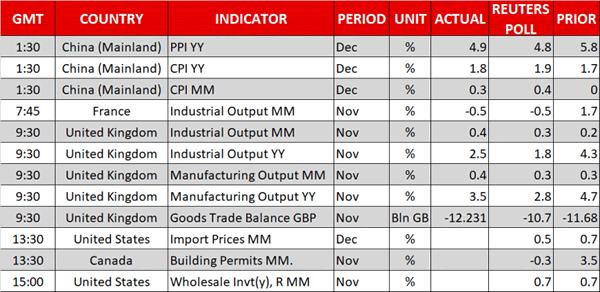
On the data front, US import price rose 0.1% mom in December. Canada building permits dropped -7.7% mom in November. UK industrial production rose 0.4% mom, 2.5% yoy in November. Manufacturing production rose 0.4% mom, 3.5% yoy. Construction output rose 0.4% mom. Visible trade deficit widened to GBP -12.2b. China CPI quickened to 1.8% yoy in December but missed expectation of 1.9% yoy. PPI slowed to 4.9% yoy, above expectation of 4.8% yoy.
EUR/USD Mid-Day Outlook
Daily Pivots: (S1) 1.1908; (P) 1.1942 (R1) 1.1968; More....
EUR/USD rebounds strongly after hitting 1.1915. Intraday bias is turned neutral and near term outlook is turned mixed. But after all, decisive break of 1.2091 key resistance is needed to confirm up trend resumption. Otherwise, more corrective trading should be seen with risk of another fall. Below 1.1915 will turn bias to the downside for 38.2% retracement of 1.1553 to 1.2088 at 1.1884. Break will target 61.8% retracement at 1.1757 and below.
In the bigger picture, rise from 1.0339 medium term bottom is still seen as a corrective move for the moment. Therefore, in case of another rally, we'd be expect 38.2% retracement of 1.6039 (2008 high) to 1.0339 (2017 low) at 1.2516 to limit upside and bring reversal. That is also close to 61.8% projection of 1.0569 to 1.2091 from 1.1553 at 1.2494.
Economic Indicators Update
| GMT | Ccy | Events | Actual | Forecast | Previous | Revised |
|---|---|---|---|---|---|---|
| 01:30 | CNY | PPI Y/Y Dec | 4.90% | 4.80% | 5.80% | |
| 01:30 | CNY | CPI Y/Y Dec | 1.80% | 1.90% | 1.70% | |
| 09:30 | GBP | Industrial Production M/M Nov | 0.40% | 0.40% | 0.00% | 0.20% |
| 09:30 | GBP | Industrial Production Y/Y Nov | 2.50% | 1.80% | 3.60% | 4.30% |
| 09:30 | GBP | Manufacturing Production M/M Nov | 0.40% | 0.30% | 0.10% | 0.30% |
| 09:30 | GBP | Manufacturing Production Y/Y Nov | 3.50% | 2.80% | 3.90% | 4.70% |
| 09:30 | GBP | Construction Output M/M Nov | 0.40% | 0.70% | -1.70% | -1.10% |
| 09:30 | GBP | Visible Trade Balance (GBP) Nov | -12.2B | -11.0B | -10.8B | |
| 13:00 | GBP | NIESR GDP Estimate Dec | 0.60% | 0.50% | 0.50% | 0.60% |
| 13:30 | CAD | Building Permits M/M Nov | -7.70% | -0.70% | 3.50% | 4.40% |
| 13:30 | USD | Import Price Index M/M Dec | 0.10% | 0.40% | 0.70% | 0.80% |
| 15:00 | USD | Wholesale Inventories M/M Nov F | 0.70% | 0.70% | ||
| 15:30 | USD | Crude Oil Inventories | -7.4M |
Dollar Dives after China Said to Hold Back on US Treasuries; Oil Waits for EIA Report
Here are the latest developments in global markets:
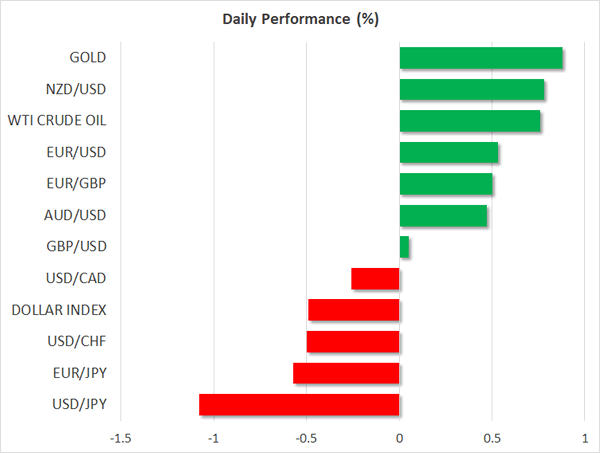
FOREX: The dollar took a knock after Chinese officials recommended to slow down or cut purchases of US Treasuries according to Bloomberg. The dollar stretched its losses toward a two-week low of 111.29 (-1.08%) versus the yen and sank marginally below the 92-key level regarding its index against six major currencies (-0.46%). The euro advanced on the news, flying from $1.1930 to $1.2000 (+0.60%), while the pound erased earlier losses, rebounding to an intra-day high of $1.3558. The antipodean currencies also bounced higher, with the kiwi winning the most among its peers. Kiwi/dollar touched a three-month high at $0.7228 (+0.78%). The Swedish krona rose by 0.70% to 8.07 per dollar supported by Riksbank's meeting minutes which confirmed that a monetary tightening was on the way. Note that in December the Swedish central bank signaled the end of negative interest rates. However, the minutes showed that policymakers were cautious about the timing and the speed of the policy adjustment.
STOCKS: A rise in 10-year US Treasury yields as well as in Germany's 10-year bond yields stressed stocks trading in Europe on Wednesday. The pan-European STOXX 600 was down by 0.44% at 1130 GMT, with all sectors being in the red except financial and energy sectors, while the blue-chip Euro STOXX 50 slipped by 0.32%. The German DAX 30 declined by 0.74%, while the British FTSE 100 and the Spanish IBEX 35 were moving sideways. US stock futures were pointing to a positive opening.
COMMODITIES: After yesterday's strong rally underpinned by declining US oil inventories and ongoing OPEC-led supply cuts, oil prices paused their uptrend near three-year highs during Wednesday's early European trading hours. WTI crude was 0.67% higher at $63.38 per barrel and Brent increased by 0.38% to $69.08. Gold surged to a five-day high of $1,320.76 per ounce on the back of a weaker dollar.
Day ahead: Fed policymakers to deliver further speeches; EIA report pending
Public speeches by a handful of central bankers will dominate economic events later on Wednesday, while data releases will be limited.
At 1330 GMT the US will report on the import price index for the month of December, with analysts seeing the gauge rising by 0.4% m/m below the previous mark of 0.7%. Export prices are also said to come in softer in the aforementioned period, expanding by 0.3% m/m compared to 0.5% seen in the prior month. However, the former will attract a greater attention as higher import costs are likely to have a stronger effect on inflation and therefore have the potential to influence rate hike probabilities.
At the same time, Canada will be publishing readings on building permits. In October, the number of new building permits jumped by 3.5% m/m but for November, forecasts are for the measure to decline by 0.3%.
Next on the calendar, US wholesale inventories due at 1300 GMT are expected to continue rising at October's pace of 0.7% m/m in November.
Regarding public appearances, Chicago Fed President Charles Evans and Dallas Fed President Robert Kaplan will hold discussions at 1400 GMT and 1410 GMT respectively. Kaplan will also give a speech at 1315 GMT.
James Bullard, St. Louis Fed President will give a presentation on the US economy and monetary policy at 1830 GMT.
In the UK, the BOE Deputy Governor Ben Broadbent will answer questions on central bank policy on BBC radio at 1300 GMT.
In energy markets, investors will wait for the EIA report which tracks the weekly change in the US oil inventories to come into view at 1530 GMT.
CAC Edges Lower as French Industrial Production Contracts
The CAC index has rolled off five straight winning sessions, but is in red territory in the Wednesday session. Currently, the index is at 5506.50, down 0.34%. It's a light day on the release front, with no eurozone indicators. French Industrial Production disappointed, posting a decline of 0.5%, edging below the estimate of -0.4%. On Thursday, the eurozone releases Industrial Production and the ECB will publish the minutes of the December policy meeting.
Global stock markets have jumped out of the gates in 2018, and the CAC has also pushed higher, posting strong gains of 3.8% in January. Investors are giving the eurozone economy a thumbs-up, as the bloc is on track for a solid fourth quarter, as growth continues and unemployment falls. Inflation has also moved higher, although the ECB is unlikely to reconsider its current stimulus program, which ends in September.
The year 2017 was a good one for the eurozone, marked by strong growth. The labor market has also rebounded, as unemployment steadily declined over the course of 2017. In December, the reading dropped to 8.7%. This marked its lowest level since March 2009, when the rate stood at 8.5%. This is yet another indication of the impressive rebound in the eurozone economy, as growth has been steady and the employment picture has improved. Retail Sales, the primary gauge of consumer spending, posted a strong gain of 1.5% in December, after a decline of 1.1% in November. European stock markets have responded with strong gains, and the CAC has gained ground since the New Year. If the eurozone economy continues to impress early in 2018, the CAC should continue to move higher.
The political deadlock in Germany has been a setback for French President Emmanuel Macron, a staunch proponent of European unity. Macron has grandiose plans for the further integration of the eurozone, such as harmonizing corporate tax regimes and establishing a eurozone budget. Merkel would make an ideal partner to reform the bloc, but she has her hands full trying to set up a new government in Germany. The election in Germany was inconclusive, and talks between Merkel's conservative bloc and two smaller parties floundered. Merkel has started talks with the Social Democrats, but German coalition talks tend to move slowly, and could last for several more months. Macron's grand plans for Europe will have to remain on the shelf until Merkel has a government in place.
Canadian Dollar Inches Upwards
USD/CAD continues to move sideways this week. In the Wednesday session, the pair is trading at 1.2447, down 0.14% on the day. On the release front, Canada releases Building Permits, a major construction indicator. The markets are braced for a decline of 0.7%. In the US, today's key event is Import Prices, with an estimate of 0.4%.
The Canadian dollar made up some ground against the greenback in December, and the currency hasn't missed a beat in January, with gains of 1.2% percent. Recent economic indicators have pointed upwards, led by excellent employment numbers. In December, the economy added 78.6 thousand jobs, defying experts who predicted a minuscule gain of 1.8 thousand. This release comes on the heels of a superb November release, when the economy added 79.5 thousand news jobs. The unemployment rate dropped to 5.7% in December, down from 5.9% a month earlier. Last week marked a third winning week for the rejuvenated Canadian dollar, and on Friday the currency hits its highest level against the US dollar since late September.
Another factor which has boosted the Canadian dollar has been the recent rise in oil, which has jumped 6.8% since mid-December. Geopolitical tensions have boosted oil prices, in particular tensions with North Korea and the recent civil unrest in Iran. Still, there is pressure on the Bank of Canada to raise its benchmark rate of 1.0%, which is lagging behind the Federal Reserve rate of between 1.25%-1.50%. With the Fed widely expected raise rates in January, the recent gains by the Canadian dollar could evaporate if the BoC doesn't raise rates at its policy meeting on January 17. However, the BoC has voiced concerns about the Canadian economy, and as things stand, the BoC is not planning to raise rates. This could mean a rough ride for the Canadian currency next week.
Interest rates may be in the headlines, but another important parameter is the Federal Reserve's balance sheet. As of this month, the Fed has started to shrink its massive balance sheet of $4.4 trillion. The balance sheet ballooned during the financial crisis of 2008-2009, and good times have allowed the Fed to begin trimming its portfolio. Incoming Fed Chair Jerome Powell, who takes over in February, has estimated that the balance sheet could drop to anywhere between $2.4 trillion to $2.9 trillion after several years of cuts. Fed policymakers have not indicated a magic number for the balance sheet, but the cuts indicate a vote of confidence in the US economy.
US Futures Tumble on China Treasuries Reports
Equities, Bonds and USD Slide as China Questions Attractiveness of Treasuries
US futures are coming under pressure ahead of the open on Wednesday, following reports from a Chinese official that the country is considering cutting or halting its purchases of US Treasuries.
If the reports turn out to be true and China no longer sees Treasuries as an attractive option, the repercussions could be significant as the country is one of the biggest holders of US debt. A significant change in policy could put considerable upside pressure on US yields, the result of which would be an effective tightening for the US. US 10-year yields spiked on the reports but have since settled and are up around three basis points on the day, having already risen in line with other countries yields on Tuesday.
The tightening effect of such measures would likely have an impact on how many times the Federal Reserve raises interest rates this year, which is why we've seen a corresponding drop in the dollar. The euro has spiked back above 1.20 against the dollar on the back of the reports before settling just below, while cable has moved back into the green on the day having been down around half a percent earlier in the session.
Yields Rise For Second Day as BoJ Move Provides Additional Upward Pressure
The move in Treasuries comes a day after yields generally rose on Tuesday in response to the Bank of Japan buying slightly fewer long-term JGBs, which traders took as a sign that the central bank is preparing to take its foot off the easing gas. While the BoJ has repeatedly rejected speculation that its preparing to reduce its accommodation, there was a lot of talk towards the back end of last year that it was being considered and that's why traders have been so quick to jump on it.
Oil Spikes on API Report as Traders Eye EIA Release
Oil is trading higher for a second day after surging to fresh 3-year highs on Tuesday, as API reported a huge decline in inventories last week, the biggest drop since September 2016. EIA will release its inventory data on Wednesday and its release typically carries more weight than the API number. Should EIA report a similar figure to API, it could trigger another push higher in oil - with markets previously anticipating only a 3.89 million barrel drawdown - while a smaller number may see it pare its gains.
API Weekly Crude Oil Stocks
Oil has already made substantial gains over the course of the last six months - with both Brent and WTI crude up just shy of 50% from their June lows - driven primarily by the agreement to cut production between OPEC and some non-OPEC countries, including Saudi Arabia and Russia. While some doubted whether the countries would follow through on the deal and how effective it would be, the results are clear for all to see with oil now trading back at more sustainable levels, despite US output continuing to rise. I do wonder how much more upside we'll see though before countries involved in the deal either reduce the size of the cuts or end them altogether.
Follow the Yield, and Then Follow the Currency
Wednesday January 10: Five things the markets are talking about
Global equities have taken a well-deserved pause overnight as investors access the recent surge in sovereign bond yields.
Higher global yields was always going to be one of the major trading themes for 2018, and in week-two of the new trading year, investors are having to adapt probably a tad more quicker to rates backing up. Some U.S analysts are already calling U.S yield curve moves a 'bear' market.
This morning's Swedish Riksbank December minutes are being viewed as more 'hawkish' with Governor Ingves hoping to hike rates before the ECB. Even Norway's CPI data is validating Norges view of bringing its first potential hike forward.
Last Friday's 'out of the ball park' Canadian employment numbers have bond dealers repricing the possibility that Governor Poloz can afford to be more proactive on tightening. Current odds are at +83% for a +25bps hike on Jan.17.
Elsewhere, 10-year sovereign yields from the U.S, Germany, China, Japan and Korea are trading at multi-month and -year highs.
What to watch: U.S inflation data this Thursday and Friday – will price pressures remain mute for now?
1. Equities take a breather
One day after posting more record gains stateside, global equities seem to be taking a much-needed time out.
In Japan, the Nikkei share average took a breather overnight after sharp gains; with some index-heavy stocks losing ground after the index hit a 26-year high in the previous session. The Nikkei ended -0.3% lower, while the broader Topix was up +0.2%.
Down-under, the main benchmarks in New Zealand and Australia fell -0.6%, while in S. Korea the Kospi fell -0.4% on a -3.1% drop for index heavyweight Samsung Electronics.
In Hong Kong, Hong Kong stocks extended their winning streak to a 12th day, again aided by strong inflows from mainland China. At the close of trade, the Hang Seng index was up +0.2%, while the Hang Seng China Enterprises index rose +0.27%.
In China, stocks gain for the ninth day as banks and consumer firms rally. At the close, the Shanghai Composite index was up +0.24%, while the blue-chip CSI300 index was up +0.45%.
Note: China's producer prices rose at their slowest pace in a year in December, while the country's consumer inflation accelerated less than expected to +1.8%last month from +1.7% in November.
In Europe, regional markets opened slightly lower, but have bounced from their lows with some mixed results. Oil prices continue to support energy stocks. Elsewhere, market attention is turning to upcoming inflation data from the U.S and corporate earnings stateside.
Futures on the S&P 500 Index have decreased -0.2%, the first retreat in more than a week.
Indices: Stoxx600 -0.1% at 399.6, FTSE +0.3% at 7752, DAX -0.5% at 13320, CAC-40 -0.1% at 5520, IBEX-35 +0.4% at 10468, FTSE MIB +0.4% at 23095, SMI -0.3% at 9587, S&P 500 Futures -0.2%
2. U.S oil hits highest in three years, gold prices mixed
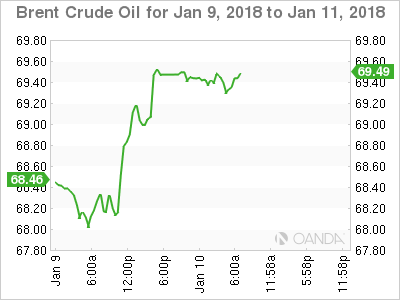
Ahead of the U.S open oil prices have hit their highest since 2014 as OPEC-led production cuts and healthy demand helped to balance the market. But, there continues to be fears that the market is overheating.
Brent crude futures are at +$69.10 a barrel, +28c above Tuesday's close. Brent touched +$69.29 in late Tuesday trading, the highest since May 2015. U.S West Texas Intermediate (WTI) crude futures are at +$63.42 a barrel, up +46c. Earlier prices rose to +$63.57, the highest since Dec., 2014.
Note: OPEC together with Russia and a group of other producers, last November extended an output-cutting deal to cover all of 2018. The cuts were aimed at reducing a global supply overhang.
Data yesterday from API further supported prices – it showed that U.S crude inventories fell by -11.2m barrels in the week to Jan. 5, to +416.6m barrels. This came as the U.S EIA raised its 2018 world oil demand growth forecast by +100k bpd from its previous estimate.
Note: Traders are expected to take direction from this morning's official EIA weekly stocks data, which is due at 10:30 EDT.
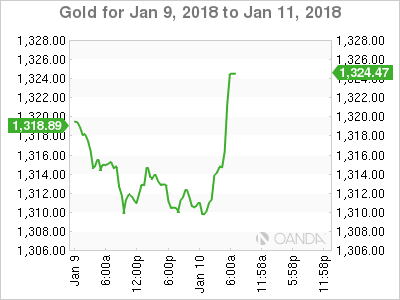
Gold prices have done a u-turn on the news that China officials suggesting that U.S treasuries are less attractive and are recommending halting buying. Spot prices have rallied hard in the last hour to +$1,324.26 an ounce.
Note: Prices fell -0.6% on Tuesday, its biggest one-day loss in a month.
3. Fixed income to watch this week's U.S price data
U.S government bonds have edged higher as the market prepares to see how an important theme for 2018 may start to play out – inflation.
Tuesday, U.S 10-year yields backed up +7 bps to +2.55%, a level last 10-months ago, and the Treasury curve steepened the most in three-weeks, as a plethora of sovereign bond supply from the U.S, the U.K, Japan and Germany come to the market this week coincided with a surprise cut in purchases of long-dated Japanese government bonds by the BoJ.
Fixed income dealers are looking ahead to tomorrow's U.S PPI report and CPI Friday.
Note: With the U.S unemployment rate holding at +4.1% for the last three months of 2017 and Treasury Inflation-Protected Securities (TIPS) signaling faster inflation coming, the Fed has yet to find a way to bring inflation to the +2% level. With U.S policy makers having penciled-in three-rate increases for 2018, this week's data could confirm that the Fed can stay on track.
4. Dollar hurt by China official's view that treasuries are less attractive
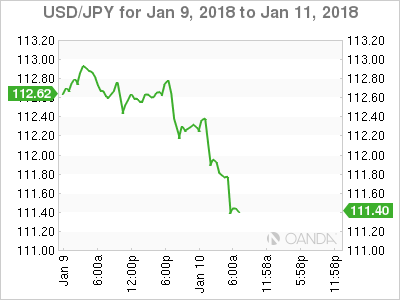
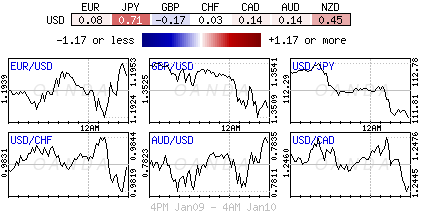
Ahead of the U.S open, some Chinese officials recommended slowing or halting U.S Treasury buying. This has had an immediate negative impact on the U.S dollar across the board (+0.52% €1.2000, +0.11 £1.3547, -0.75% ¥111.44)
In Asia, the yen climbed for a second day as traders unwound short positions in the wake of the BoJ's paring back purchases of ultra-long dated bonds.
Mixed UK data forced the sterling initially lower in the Euro session. GBP/USD tested below £1.35 as wider trade deficit in Nov offset better Industrial Production data (see below).
With Scandinavian central banks becoming a tad more 'hawkish' the Scandi currency pairs have gotten more attention this morning. EUR/NOK fell to 2-month lows after higher-than-expected Norwegian CPI data for Dec. Pair tested €9.60 before stabilizing, while the EUR/SEK cross was lower by -0.3% as the Dec. Riksbank minutes were deemed a bit more 'hawkish' than expected.
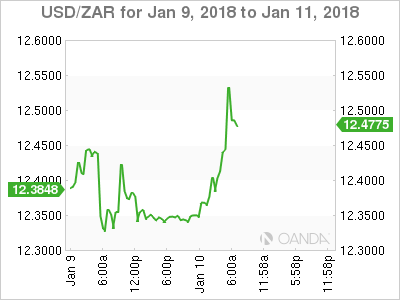
Elsewhere, USD/ZAR ($12.4805) was higher by over +1% on reports that South Africa President Zuma relents on inquiry into South African state capture.
5. U.K manufacturing rose in November
Data this morning showed that U.K manufacturing grew again in November, posting its seventh monthly expansion in a row for the first time on record. This would suggest that U.K producers are continuing to benefit from the pound's (£1.3494) weakness and strong global demand.
Note: U.K Manufacturing accounts for about a fifth of the country's largely services-driven economy.
Factory output grew by +0.4% compared with October, slightly above market expectations of +0.3% expansion. The monthly figure for October was revised up to +0.3% from +0.1%.
Separately, the ONS said the U.K. goods trade deficit with the rest of the world widened slightly in November to -£12.2B from the revised October figure of -£11.7B.
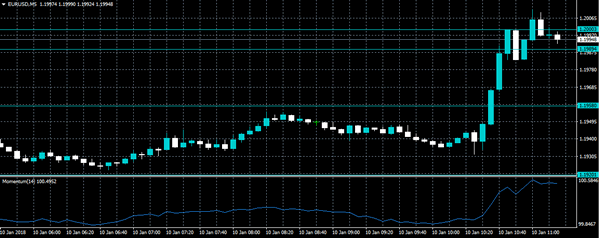
EURUSD Turning Bullish Above 1.1989 Level
The EURUSD pair has made a strong move to the upside during the European trading session, reaching 1.2010, following a quick reversal in the U.S dollar index towards the 92.00 support level. Weakness the U.S dollar index was caused by sharp upside moves in the U.S bond market, as speculation mounts that the Bank of Japan may soon normalize Japanese fiscal policy. Moving into the U.S trading session, EURUSD buyers may try to keep price-action above the 1.1989 level, to maintain bullish trading momentum.
The EURUSD pair is likely to remain bullish while trading above the 1.1989 level, buyers will look to the 1.2030 and 1.2050 resistance levels while price-action holds above the 1.1989 zone.
Should price-action move below the 1.1989 level, downside support for EURUSD is currently found at 1.1958 and 1.1920 levels.
GBPUSD Now Bullish Above 1.3550 Level
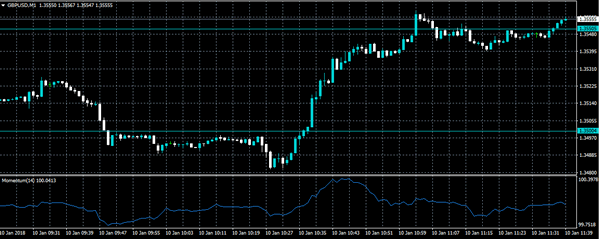
The British pound has quickly reversed fortunes against the U.S dollar, rising back above the 1.3550 level, following a sharp move lower in the value of the U.S dollar index. The GBPUSD pair had slipped to a weekly-low of 1.3482 during the European trading session, despite better than expected Manufacturing and Industrial production figures from the United Kingdom. U.S dollar weakness is now the main theme for financial markets moving into the U.S session, with sterling likely to press higher while the greenback remains pressured.
The GBPUSD pair has now turned intraday bullish, and will likely continue to gain towards the 1.3567 and 1.3612 levels while price trades above the pivotal 1.3550 zone.
Should price-action on the GBPUSD pair slip back below the 1.3550 level, intraday support is now found at 1.3537 and 1.3500.