Sample Category Title
There Is Still Some Work To Be Done
There is still some work to be done
The primary focus overnight was the US yield curve which continues to steepen as US 10 year yields are trading at a nine-month high in the wake of the tax reform bill.
A combination of anticipated economic positivity and robust US data suggests the bond markets are banking on some level of financial boost which could flow through and accelerate doggedly low inflation. But the pace of the move over the past 24 hours also suggests a rapid unwinding of the last month's fashionable yield curve flatteners as growth optimism appears to be finally kicking in and focus returns to all things inflationary. Is it a trend or merely a year-end position related distortion as it's difficult to price this move in as the tax bill passage has come with no unforeseen developments. Interesting observation from CITI NY G-10 desk ' Over the past three years, the average yield gain in US 10y from mid-December to year-end has been ~20bps.'
Friday's PCE release will warrant attention and could very well be the primary dollar event of the week after the Tax reform bounce failed to ignite a stronger dollar response. Profiled from last weeks CPI, PCE is expected to be another weaker print. However, given the surging US bond yields, a miss may not weigh that dollar negative as the market has soundly positioned the USD negativity following the dovish Fed hike, Doug Jones victory and tepid CPI. But given that subdued inflation readings have been capping interest rate expectation, an unlikely positive interpretation could elicit a significant response as dollar short bets head for the exits . Keeping in mind that any minor shift in sentiment could trigger outsized moves in thin, year-end markets
Equity Markets
For the most part, US equity markets brushed aside higher ten-year Treasury yields as the energy sector was boosted by a lift in crude following the latest US inventory data but the spillover into Forex markets has been non-existent.
Energy Markets
The DoE US inventory drawdown was more significant than expected.And sentiment remains upbeat while WTI prices continue to benefit from the Forties pipeline shutdown as pipeline repairs could drag on for a month or possibly longer.
G-10
The New Zealand Dollar
The Kiwi bounced aggressively higher on a solid last quarter GDP revision. The gradual unwind of political risk hs the Kiwi is better placed to benefit from stronger economic data
The Euro
The market is ignoring any potential fall out from Catalonia elections and focusing on ECB the yield curve and ECB chatter.
The Euro surged higher at yesterday London open, driven by a Bund sell-off. But the focus was really on EURJPY which broke through multi-month highs before profit-taking
Not a great deal to add to yesterday's note as Eurozone money markets are steepening and given the outstanding economic prints coming out of the EU; it's easy to rationalise that the EU economy is leaps and bounds ahead of where the US economy was sitting when the Fed began to normalise. The Euro should move constructively higher on this storyline
The Japanese Yen
The USDJPY was boosted by US yields and traded tick for tick vs the UST 10 year yields. Focus shift to today BoJ meeting, but frankly not much is expected although all ears and eyes will be on Kuroda's presser.The markets expect Kuroda to reaffirm the current BoJ policy which should be slightly positive for USDJPY.
Higher US yields are keeping the dollar bears at bay who have been much less aggressive in fading the Tax Reform dollar bump than expected but with no significant dollar bounce either, Fx traders continue to doubt any significant economic impact of the bill
Asia FX
Asian currencies staged an impressive year-end display yesterday in the face of a resilient USD likely taking cues from reports from China Economic work conference has raised expectations that regulators will ease deleveraging efforts in 2018 delivering an unexpected holiday season gift for EM Asia investors. Also, the Yuan traded at 15-week Highs as traders unwound long dollar bets heading into year compounded by seasonal factors.
The Malaysian Ringgit
The Malaysian Ringgit closed stronger but fell against regional peers. Unlike other ASEAN currencies, the KRW for example, the MYR does not see the same level of equity inflow to offset the negative from higher global yields. One of the significant headwinds for Ringgit appreciation is higher US interest rates, and while the MYR is better positioned than regional peers to withstand a steeper US yield curve, holiday thinned-trading conditions have long-term investors taking to the sidelines until early 2018 which is likely tempering optimism. But the Ringgit remains constructive, and one can only suspect year-end market conditions are holding the local note back from testing this year's USDMYR lows
The Korean Won
Local currencies were pushed higher by proprietary participants liquidating their dollar long positions after US tax reform failed to send the USD higher According to Q4 IMM NDF rollover data, the markets were still holding long USDKRW.But with USDCNH toppling through 6.60 yesterday we could see the Won drift lower given the BOK sensitivity to the RMB complex
US Dollar Mixed In Anticipation Of Tax Reform Legislation
BOJ to stand pat on QE but could signal lower stimulus
The US dollar is mixed against major pairs on Wednesday after the tax reform bill had to go through another round of voting due to last minute changes on the Senate approved bill. The news did little for the greenback as the market is already pricing in the tax overhaul becoming legislation with the timing not that crucial. The USD is higher against the JPY and the CHF, but depreciated against the CAD and the EUR.
- Bank of Japan (BOJ) expected to keep monetary policy unchanged
- Canadian inflation and retail sales forecasted to have slight gains
- US Final Q3 GDP to remain at 3.3 percent
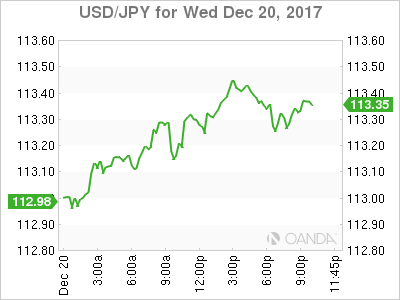
The USD/JPY gained 0.50 percent on Wednesday. The currency pair is trading at 113.45 awaiting of The Bank of Japan (BOJ) realeasing its monetary policy statement on Thursday, December 20 around midnight EST. The central bank is expected to maintain its stimulus program despite signs of improvement in the economy with the goal that inflation accelerates. BOJ Governor Haruhiko Kuroda will offer a press conference at 1:30 am EST. The market will be following his words for any hint of reducing the quantitative easing program going forward, but likely it will be tied to improving inflation.
Next year poses more questions for the BOJ as the term of Mr Kuroda expires in April, but given the electoral win of Shinzo Abe Kuroda could become the first Japanese central bank governor to serve two consecutive terms. The BOJ has been slow to follow other central banks in abandoning or signalling their end of QE programs as inflation has remained well below their 2 percent target.
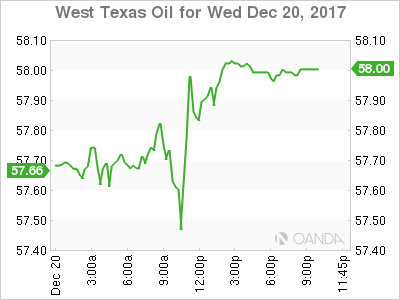
Oil prices rose in the last 24 hours after the Energy Information Administration (EIA) published the weekly US crude inventories. Oil stocks fell by 6.5 million barrels more than the expected 3.6 million drawdown. Gasoline stocks had another buildup but unlike last week this time it was smaller than the forecasted figure at 1.2 million barrels.
The lower supply numbers validate the efforts of the Organization of the Petroleum Exporting Countries (OPEC) and 10 other major producers who agreed to limit output until the end of 2018. Weather and geopolitical disruptions in crude supply have kept the price rising despite the threat of increased output from producers who are not part of the agreement like Brazil, Canada and the United States.
The issues at the Forties pipeline in the North Sea forced the operator to shut it down to perform repairs with no a two to four week window. The Forties carries 450,000 daily barrels of oil to the UK and a third of the UK natural gas output. Oil prices could fall when the maintenance is finished ending the disruption and with the expectation that the battle between the OPEC initiate to limit output will face off against rising producing from the US.
Market events to watch this week:
Monday, December 18
7:30 pm AUD Monetary Policy Meeting Minutes
Tuesday, December 19
8:30 am USD Building Permits
Wednesday, December 20
10:30 am USD Crude Oil Inventories
4:45 pm NZD GDP q/q
Midnight JPY Monetary Policy Statement
Thursday, December 21
1:30 am JPY BOJ Press Conference
8:30 am CAD CPI m/m
8:30 am CAD Core Retail Sales m/m
8:30 am USD Final GDP q/q
8:30 am USD Unemployment Claims
Friday, December 22
4:30 am GBP Current Account
8:30 am CAD GDP m/m
8:30 am USD Core Durable Goods Orders m/m
Gold Gains Ground, Investors Eye Final GDP
Gold has posted gains in the Wednesday session. In North American trade, the spot price for an ounce of gold is $1265.24, up 0.30% on the day. On the release front, Existing Home Sales improved to 5.81 million in November, its strongest pace since December 2006. Thursday is a busy day in the US, with the release of third quarter Final GDP. We'll also get a look at the Philly Fed Manufacturing Index and unemployment claims.
It's been a tough battle for Republicans, but President Trump's election pledge to implement major tax reform is on the verge of becoming law. The tax bill was passed in the House of Representatives and the Senate on Tuesday, but the bill is being sent back to the House for another vote on Wednesday due to a procedural requirement. The legislation is expected to be ratified by the House and will then be sent to Trump to be signed into law. As expected, the congressional votes went along party lines, with the Senate narrowly approving the bill by a count of 51-48. This marks the first major overhaul of the US tax code in 30 years, and reduces corporate taxes from 35% to 21%. After failing to overturn Obamacare, the Republicans can finally chalk up their first legislative victory in the Trump administration, ahead of Congressional elections in 2018.
The US economy has been firing on all cylinders, marked by strong growth and low unemployment. The fly in the ointment has been inflation, which remains well below the Federal Reserve target of 2.0%. The economy gets a report card for its third quarter performance, with the release of Final GDP on Thursday. Investors expect another banner quarter, as the estimate stands at 3.3%, which would be unchanged from the Preliminary GDP release. We could see some movement in gold prices following the GDP release
Trade Idea Wrap-up: USD/CHF – Exit long entered at 0.9850
USD/CHF - 0.9850
Most recent candlesticks pattern : N/A
Trend : Near term down
Tenkan-Sen level : 0.9857
Kijun-Sen level : 0.9857
Ichimoku cloud top : 0.9885
Ichimoku cloud bottom : 0.9854
Original strategy :
Bought at 0.9850, Target: 0.9950, Stop: 0.9820
Position : - Long at 0.9850
Target : - 0.9950
Stop : - 0.9820
New strategy :
Exit long entered at 0.9850,
Position : - Long at 0.9850
Target : -
Stop : -
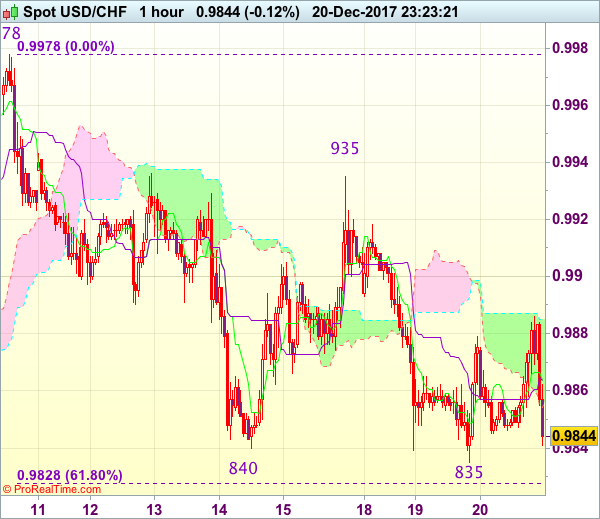
Despite intra-day brief bounce to 0.9886, the subsequent selloff on dollar’s broad-based weakness dampened our near term bullishness and downside risk remains for the decline from 0.9978 to extend weakness to 0.9795-00, however, reckon downside would be limited to 0.9750 and risk from there has increased for a rebound later due to anticipated oversold condition.
In view of this, would be prudent to exit long entered at 0.9850 and stand aside for now. Only above said resistance at 0.9886 would revive bullishness and signal an intra-day low is formed, bring rebound to 0.9905-10 and later towards resistance at 0.9935-36 which is likely to hold from here.
Trade Idea Wrap-up: GBP/USD – Stand aside
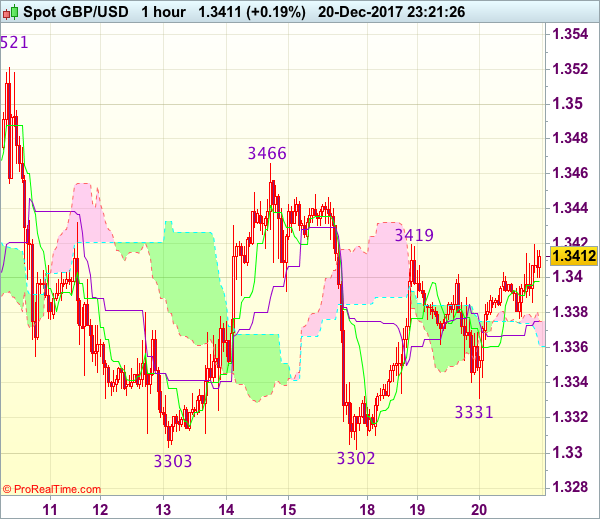
GBP/USD - 1.3411
Most recent candlesticks pattern : N/A
Trend : Sideways
Tenkan-Sen level : 1.3398
Kijun-Sen level : 1.3375
Ichimoku cloud top : 1.3375
Ichimoku cloud bottom : 1.3361
Original strategy :
Sold at 1.3390, stopped at 1.3405
Position : - Short at 1.3390
Target : -
Stop : - 1.3405
New strategy :
Stand aside
Position : -
Target : -
Stop : -
As the British pound has edged higher on back of the rally in euro, dampening our bearishness and near term upside risk remains for test of 1.3419 resistance, break there would extend the rebound from 1.3302 to 1.3445-50, however, reckon indicated resistance at 1.3466 would hold from here, bring retreat later.
In view of this, would not chase this rise here and would be prudent to stand aside for now. Below 1.3360 would suggest an intra-day top is possibly formed, bring test of 1.3331 support but only break there would revive bearishness and signal the rebound from 1.3302 has ended, bring retest of this level first.
Trade Idea Wrap-up: EUR/USD – Buy at 1.1820
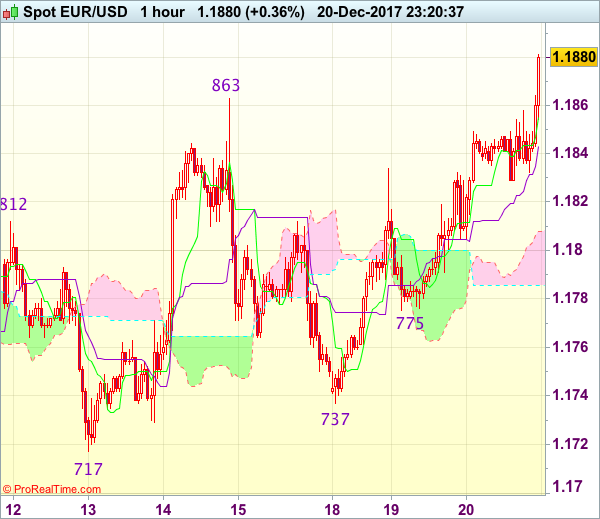
EUR/USD - 1.1877
Most recent candlesticks pattern : N/A
Trend : Near term up
Tenkan-Sen level : 1.1864
Kijun-Sen level : 1.1852
Ichimoku cloud top : 1.1808
Ichimoku cloud bottom : 1.1786
New strategy :
Buy at 1.1820, Target: 1.1920, Stop: 1.1785
Position : -
Target : -
Stop : -
As the single currency has surged again in NY morning and broke above indicated previous resistance at 1.1864, adding credence to our view that another leg of the rise from 1.1717 is underway and bullishness remains for this move to extend further subsequent gain to 1.1900 but price should falter below resistance at 1.1940 today, risk from there is seen for a retreat later due to near term overbought condition.
In view of this, would not chase this rise here and would be prudent to buy euro on pullback as 1.1820 should limit downside. Below 1.1800 would bring test of 1.1775 support but only break there would suggest top is formed instead, then subsequent retreat to 1.1750 would follow but support at 1.1737 should remain intact.
Dollar Pushes Yen Lower, US Home Sales Sparkle
USD/JPY has recorded slight gains in the Wednesday session, continuing the upward movement seen on Tuesday. In North American trade, USD/JPY is trading at 113.19, up 0.25% on the day. On the release front, Japanese All Industries Activity rebounded with a gain of 0.3%, its best gain since August. In the US, Existing Home Sales surged 5.81 million in November, its strongest pace since December 2006. Later in the day, the Bank of Japan releases its monetary policy statement. Thursday is a busy day in the US, with the release of third quarter Final GDP. We'll also get a look at the Philly Fed Manufacturing Index and unemployment claims.
Investors shouldn't expect any dramatic announcements from the Bank of Japan, which is holding a policy meeting and will make a rate announcement. The BoJ is expected to hold the course and maintain interest rate levels and its stimulus package. Japan's economy has rebounded in 2017, as a stronger global economy has boosted the country's export and manufacturing sectors. Still, ultra-low interest rates have resulted in a weak yen, much to the angst of Japan's trading partners, which has accused Tokyo of manipulating the exchange rate in order to boost exports. Although BoJ Governor Haruhiko Kuroda has dropped some hints about reducing stimulus, absent a surge in inflation, such a move is unlikely in the near future.
The White House is all decked out for Christmas, and President Trump's gift-wrapped present from Republican lawmakers should be ready later on Wednesday. Trump's election pledge to implement major tax reform is on the verge of becoming law. The tax bill was passed in the House of Representatives and the Senate on Tuesday, but the bill is being sent back to the House for another vote on Wednesday due to a procedural requirement. The legislation is expected to be ratified by the House and will then be sent to Trump to be signed into law. As expected, the congressional votes went along party lines, with the Senate narrowly approving the bill by a count of 51-48. This marks the first major overhaul of the US tax code in 30 years, and reduces corporate taxes from 35% to 21%. After failing to overturn Obamacare, the Republicans can finally chalk up their first legislative victory in the Trump administration, ahead of Congressional elections in 2018.
Trade Idea Wrap-up: USD/JPY – Buy at 112.80
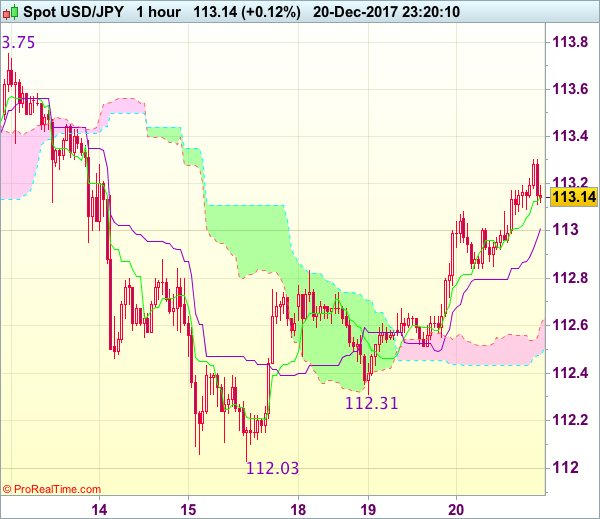
USD/JPY - 113.17
Most recent candlesticks pattern : N/A
Trend : Near term up
Tenkan-Sen level : 113.15
Kijun-Sen level : 113.01
Ichimoku cloud top : 112.61
Ichimoku cloud bottom : 112.48
Original strategy :
Buy at 112.80, Target: 113.70, Stop: 112.45
Position : -
Target : -
Stop : -
New strategy :
Buy at 112.80, Target: 113.70, Stop: 112.45
Position : -
Target : -
Stop : -
As the greenback has continued trading with a firm undertone, adding credence to our bullish view that the rise from 112.03 low is still in progress and may extend further gain to 113.40, then towards resistance at 113.75, however, break there is needed to retain bullishness and signal the rise from 110.84 low has resumed for headway towards 113.95-00 first.
In view of this, we are looking to buy dollar on pullback as 112.75-80 should limit downside and bring another rise later. Below 112.50-55 would suggest top is formed, bring test of 112.31 support but only break of latter level would signal the rebound from 112.03 has ended instead, bring retest of this level later.
The Tax Cuts & Jobs Act: Short-term Gain = Long-term Pain
Highlights
- Republicans have delivered on a key election promise – lower taxes. Congress is on the verge of passing the Tax Cuts and Jobs Act (TCJA), at a cost of $1.5 trillion over the next ten years.
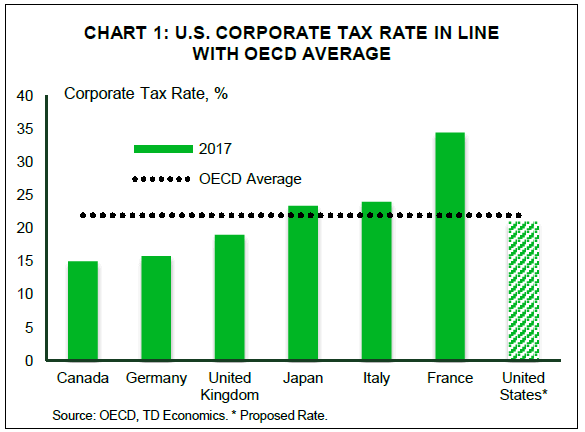
- The biggest permanent change that will reinforce U.S. international competitiveness is the drop in the corporate income tax rate to 21% from 35%.
- In order to pass the bill with a very narrow majority in the Senate, cuts to personal taxes will expire in 2025. This sets up a fiscal cliff battleground for a future administration.
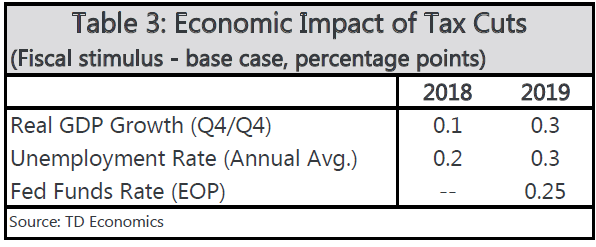
- The tax cuts will provide a modest economic boost over the near term. In the forecast we published on December 14th, prior to the final conference agreement for the TCJA, we had incorporated a 0.1 and 0.3 percentage point lift to GDP growth in 2018-19, respectively.
- Subsequently, the agreed-plan has front-loaded more of the tax cut into 2018. This suggests the 2018 fiscal boost could be nudged up to 0.2 percentage points.
- With an economy very close to full employment, a fiscal boost is likely to lead to higher inflation, and a slightly faster pace of rate hikes.
- It will also add to a national debt level already set to rise. Over the medium term, this poses several risks to government finances and the economy. The TCJA ultimately reflects an inter-generational shift of the tax burden to future taxpayers.
Republicans in the Senate and the House have passed a compromise tax reform bill that will soon be passed into law. At a total cost of $1.5 trillion over ten years, it will provide a modest short-term boost to the U.S. economy, but not enough to offset the full cost of the plan. As many provisions of the tax cuts expire and higher interest rates weigh on growth, the plan will switch from stimulus to economic drag over the medium term. Barring severe spending cuts to pay for the tax cuts, the U.S. debt-to-GDP ratio is expected to rise above its already worsening outlook.
Our recent Quarterly Economic Forecast incorporated a boost from tax cuts for the first time. We estimated that real GDP growth would be lifted of 0.1 percentage points in 2018 and 0.3 percentage points in 2019 on a Q4/Q4 basis as a result of the tax cuts. Now that the final details of the plan are known, the size of the tax cut is somewhat larger in 2018 than we had assumed, putting some upside risk to our December forecast. However, tax cuts remain skewed to higher income taxpayers, who have a much lower propensity to consumer out of savings. In addition, it takes time for firms to adjust their business and investment objectives to a new corporate tax regime. Therefore we continue to expect the immediate economic lift from tax cuts to be modest. Moreover, the U.S. is essentially operating at full employment and the Federal Reserve is well underway in removing monetary stimulus. We expect that faster growth could result in higher inflation and be met with at least one additional rate hike by the Federal Reserve over the next two years relative to our prior baseline forecast in September.
Nuts & Bolts of the package
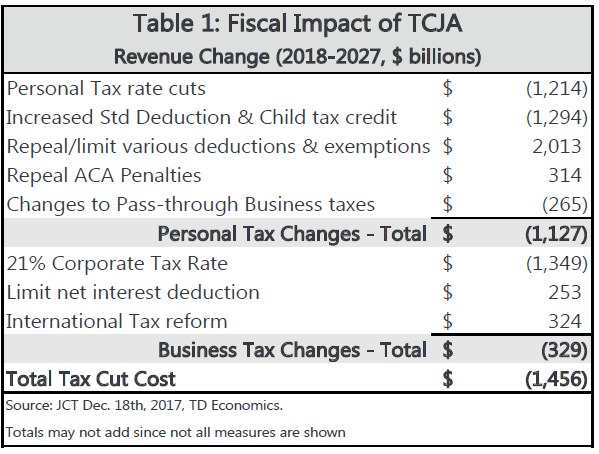
The price tags of key elements of the plan are shown in Table 1 and a summary of key changes relative to the current system are shown in Table 2 (for more details please see the Appendix). The biggest change is arguably the permanent drop in the corporate tax rate from 35% to 21%. That puts America's CIT rate below the OECD average and enhances its competitiveness versus its trading partners (see Chart 1).
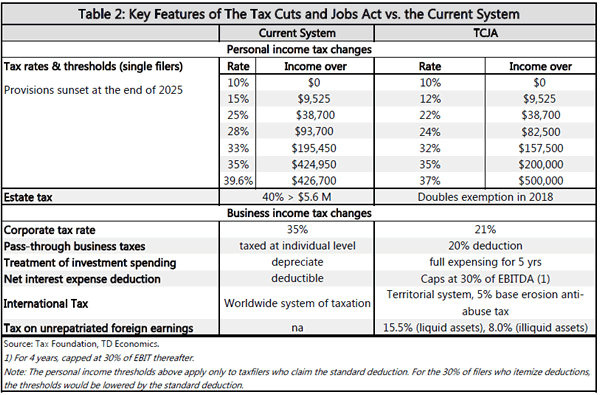
There are tax cuts on the personal side too. However, to make the package fit in Senate budget rules, most elements on this front are set to expire in 2025. This includes the tax cuts for pass-through businesses, which are on the personal side of the income tax system. The sunset clause sets up a future administration for another fiscal cliff, faced with the tough decision to either let taxes reset back to higher ranges, or extend the cuts. The latter would further worsen an already bleak U.S. budget situation.
Another change that hasn't received a lot of attention is a move to change the inflation measure for items of the tax cut that are indexed to inflation. The system will move to the Chained CPI measure, from a traditional CPI measure. On average, the chained measure is lower than the traditional one, meaning the benefits of various deductions and credits that are indexed to inflation will grow more slowly, as will the level of tax brackets. This saves the government money versus the previous system.
Modest fiscal bump….
While the TCJA makes major changes to the tax system, we do not expect it to be a game changer for the U.S. economy. The tax cuts are expected to provide a modest lift to consumer spending and business investment over the first few years of the plan. On the personal side, estimates from the Tax Policy Center of the conference plan as of December 15th note that overall average after-tax income would rise 2.2% or about $1,600 in 2018. However, those benefits are greatly skewed to higher-income individuals. Taxpayers in the middle-income quintile (those with income between $49,000 and $86,000) would receive an average tax cut of about 1.6% or $900. In contrast, taxpayers in the 95th-99th percentile of the income distribution will see the largest boost to income in percentage terms, 4.1% or $13,000.
The scale of fiscal stimulus is larger this time around than that of mid-2008, which was about $500 per household and during a deep economic recession. The TCJA is occurring at a time when consumer spending was already on track to grow by 2.7% in real terms in 2017. We incorporated a boost to consumer spending in our recent forecast of approximately 0.2 percentage points in 2018 and 0.4 percentage points in 2019 (on a Q4/Q4 basis). With the final details of the tax plan in hand, there is a slight upside risk to this view. However, given the distribution of the tax cuts to upper incomes, and the likely lift to inflation, we continue to expect the lift to spending in real terms to be modest. In a previous report, we outlined a table that demonstrated that multiplier estimates are lower for tax cuts to upper income households, due to a lower marginal propensity to consume out of an additional dollar of income.
A permanently lower corporate tax rate and the ability to fully expense spending on equipment are forecast to boost business investment over the next few years. That boost is mitigated somewhat by the cap on the interest deduction, which raises the cost of debt-financed investments. Growth in business investment already had considerable momentum at the end of 2017 and was set to be upgraded for 2018 even before the tax cut. Our outlook has been lifted slightly, and to a greater extent in 2019-20 as companies adjust capital spending budgets.
As part of the transition from a worldwide to a territorial tax system, businesses will be required to repatriate profits from overseas operations at a reduced tax rate (15.5% on liquid and 8% on illiquid assets). Right now, many corporations have deferred profits held overseas as they only pay taxes once the profits are repatriated. Republicans hope this will cause U.S. businesses to invest domestically and/or raise wages. The move is estimated to raise roughly $340 billion in revenues for the Federal government over the next ten years.
However, the U.S. did a similar tax holiday in 2004, and subsequent analysis showed that companies spent 79 cents of every dollar on share repurchases and 15 cents on dividends. There was no evidence of an increase in domestic investment. This is good news for equity markets and shareholders, but may not lead to as much capital spending as hoped. The administration believes that a more competitive international tax rate should result in more investment domestically relative to other jurisdictions. This is difficult to model, and if it is indeed the case, there is upside risk to our business investment outlook over the medium term.
The lower tax rate does reduce the user cost of capital, and will likely lead to higher levels of investment relative to our previous base case view. Over the medium term, capital deepening would lead to a slightly faster pace of potential growth through a better productivity performance. But, it takes time to shift the supply side of the economy, and we expect the effect will be modest, on the order of a tenth of a percentage point on potential growth.
… But could make the porridge too hot
The biggest uncertainty in the outlook is how the Federal Reserve will respond to a fiscal boost at a time when the economy doesn't need one. Stronger economic growth is expected to drive a low unemployment rate even lower (Table 3). Given the further drop in the unemployment rate assumed in our December forecast, we now expect the Fed to raise rates one more time by the end of 2019. However, there is greater than usual uncertainty about how the Fed will respond. There will be a higher level of turnover on the Federal Reserve Board's Open Market Committee over the next year. If new board members are more hawkish, you could see a quicker trigger on future rate hikes. At the same time, new members could also be more cautious about leaning against Washington's tax cuts.
The unemployment rate is already below the Federal Reserve's estimation of the natural rate, and most measures of labor underutilization are back to their pre-recession lows. Our forecast for a slightly lower unemployment rate requires continued improvement in the labor force participation rate, as strength in job demand and wages draws more people into the labor market. However, we could be wrong on this assumption and it may prove difficult to raise participation rates higher. If so, the unemployment rate would drop even faster than anticipated, intensify wage pressures and paint the Federal Reserve into a corner to respond with more offsetting rate hikes.
Beyond the first four years of the plan, the fiscal stimulus shifts to fiscal drag, making growth slightly lower than it otherwise would have been. This is due to several factors, including the expiration of some provisions, while other measures become less generous, including the lower inflation measure. According to the non-partisan Joint Committee on Taxation's analysis, average tax rates fall initially but then start to rise, shifting the plan from a fiscal stimulus to a fiscal drag. Moreover, since the Fed would lean against faster inflation, the economy would be expected to grow more slowly in the out years than previously expected. That is one of the ways in which the tax cut is really short-term gain for longer-term pain.
Tax cuts make a bad fiscal situation worse
Third party estimates suggest that even after accounting for additional economic growth, the tax plan could add over $1 trillion to the debt level by 2027. This is concerning given the federal government was already facing a deteriorating fiscal situation. Expenditures related to an aging population (Social Security and Medicare) and a rising share of interest payments were already conspiring to expand the deficit after 2019 (Chart 2).
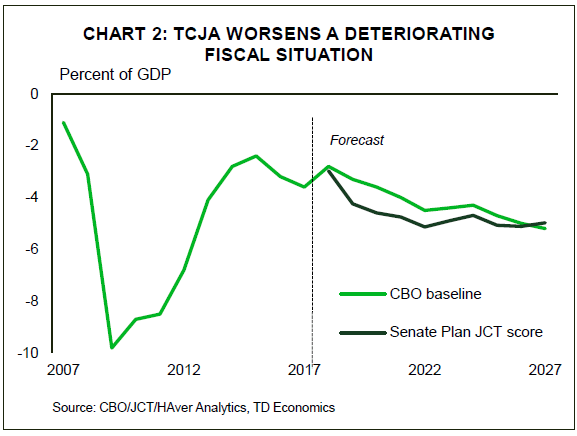
Even though much of the tax cuts must sunset in 2025, deficits are still larger in the intervening years. That adds to the debt burden and arguably gives the government less flexibility to respond to an economic downturn. Republicans also speculate that the tax cuts would eventually be made permanent by a future government. But, the Committee for a Responsible Federal Budget estimates that the cost of extending various aspects of the plan could be between $500 and $750 billion. This would need to be paid for with reduced spending elsewhere or risk even larger deficits and related debt-service costs. This represents an inter-generational shift of risks to the younger generation of taxpayers. The required policy response could boomerang back in creating a less competitive economic climate for Americans.
Although the budget resolution passed by Congress earlier this fall contained massive spending cuts to get the budget back to balance on paper, it remains to be seen whether this will actually occur. The present magnitude of cuts suggests it's unlikely. The U.S.'s debt to GDP is already projected to rise from 106% to 110% by 2027. Without significantly offsetting spending cuts, the ratio would rise to 114% under the Senate's earlier version of the tax cut plan.
A higher debt burden will cause interest costs to eat up more taxpayer dollars, leaving less room for other priorities. A higher government debt burden crowds out investment in the private sector, dampening productivity growth over the longer term. The likelihood of a fiscal crisis also increases, should investors become unwilling to finance the government's borrowing without greater compensation via higher interest rates.
Great haste makes great waste
Facing mid-term elections in 2018, Republicans were under a great deal of pressure to get some part of their agenda passed. Adding to the pressure, the narrow GOP majority in the Senate is set to get narrower with the newly elected Democratic Senator from Alabama to take office in January. The final conference tax plan was assembled quickly, and key Republicans are already admitting that Congress would need to draft another bill to make "technical corrections" as problems arise. This could prove troublesome in a divided Senate.
Moreover, despite a stated desire for simplicity in the tax system, the tax changes for pass-through businesses arguably make the tax system more complicated. It also provides an incentive for high earners to find ways to reclassify their personal income as business profit. There are limits to the type of business that can claim the deduction, but sorting out who qualifies will take time and will prove a challenge for the IRS.
The Bottom Line
Republicans have delivered one of their key election promises, lower taxes. But, with the U.S. economy in the mature stages of an economic expansion, there is little economic rationale for trading off more economic stimulus for more government debt. The exception is the situation of boosting productivity via capital deepening within corporations or within America's infrastructure. The latter is nowhere to be seen in this bill. In the past, both parties have agreed that the corporate tax rate should be lowered, and this plan successfully brings it down to a competitive level. It levels the playing field for the U.S. to attract more investment, which could provide a much-needed productivity boost.
In the meantime, the economy is operating at essentially full capacity, fiscal stimulus is likely to boost wages and inflation and lead to a faster pace of tightening by the Federal Reserve, which dampens the boost from the tax cut. It also raises the risk of a policy error, where the Fed might overreact to the amount of stimulus in the economy and tighten rates too much. Moreover, the U.S. already faces a worsening fiscal situation and a tax cut digs the government deeper into a hole. Larger deficits at a time when borrowing costs are rising presents a key downside risk for the U.S. economy over the medium term.
Appendix
Personal Income tax
- Lowers tax rates, but retains seven brackets in contrast to earlier versions of the plan which had a flatter structure.
- The standard deduction was roughly doubled to $12,000 for single filers, while the personal exemption was eliminated and the Child tax Credit was increased to $2000.
- The State and Local tax (SALT) deduction is capped at $10,000.
- The mortgage interest deduction (MID) is capped at $750,000 for new loans, while eliminating the deduction for equity debt.
- Repeals penalty payments for not having insurance as was the case under the Affordable Care Act. This saves the government money by not having to pay insurance premium subsidies.
- Businesses gain a 20% deduction for pass-through income, which sunsets after 2025. This is limited to the greater of 50% of wage income or 25% of wage income plus 2.5% of the cost of tangible depreciable property for qualifying businesses. This benefit will not be available to many businesses in the services sector. Limitations do not apply for those with incomes below
- $315,000 (joint filers) and phase out over a $100,000 range.
- The estate tax is retained, but the exemption level is doubled, and will rise with inflation going forward.
Corporate income tax
- Corporate tax rate falls to 21%, effective January 1st, 2018, and the Corporate Alternative Minimum Tax is repealed.
- Businesses will be able to fully expense short-loved capital investment, such as machinery and equipment for five years. And raises the small business expensing cap to $1 million.
- The interest deduction is capped at 30% of EBITDA for four years, and 30% of EBIT thereafter (making it less generous). This will raise the cost of debt-financed investment, and therefore offsets somewhat, the boost from full expensing and a lower CIT rate.
- Eliminates net operating loss carrybacks while providing indefinite net operating loss carryforwards, limited to 80% of taxable income.
- Increases small business eligibility for cash accounting from $5 million to $25 million in income.
- Moves to a territorial system with anti-abuse rules and a base erosion anti-abuse tax (BEAT) at a standard rate of 5% of modified taxable income over an amount equal to regular tax liability for
- the first year, then 10% through 2025 and 12.5 percent thereafter, with higher rates for banks.
- Enacts a deemed repatriation of currently deferred corporate profits at a rate of 15.5% for liquid assets and 8.0% of illiquid assets.
BOJ Expected to Stand Pat But Eyes on Kuroda
Under an ultra-easy monetary policy which aims to hold the 10-year bond yields around zero percent, the Japanese economy has indeed shown signs of recovery in several sectors this year. However, with inflation sharply undershooting the BOJ's target, policymakers are less likely to change their monetary policy stance at the end of their two-day meeting on Thursday. Still, the latest speech by the BOJ governor signalled that a stimulus reduction is not ruled out in the coming years given that persisting negative rates could have adverse effects on the economy. Therefore, the policy statement and the press conference following the rate decision would be of much interest to investors for clues on future policy adjustments.
Japanese GDP growth has been less volatile in the year-to-date period, with the economy expanding positively the last seven quarters on a yearly basis. Throughout the year, exports were the main contributors to growth as a depreciating currency boosted overseas sales after a year of negative demand, while retail sales supported by low-inflationary pressures rose to two-year high levels. But an aging population held wage growth subdued despite the unemployment rate falling to record low levels and therefore restricted inflation from gaining momentum. Note that in December, the core CPI which is closely watched by the BOJ stood at 0.8% y/y, well off the central bank's 2% goal. Moreover, it is worthy to note that the government plans to motivate companies to raise wages by offering tax benefits for those who comply and cut benefits for those who abstain from raising wages. The relevant proposal is expected to be sent for an approval to the Parliament by April 1.
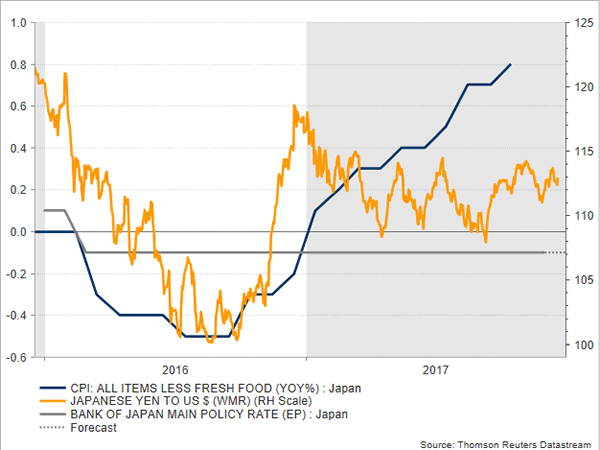
Although the BOJ is expected to keep interest rates unchanged at -0.1% on Thursday, a recent speech by the BOJ governor, Haruhiko Kuroda, gave rise to speculation that the central bank might cut stimulus sooner than projected. Kuroda, who previously argued that the bank will do "whatever it takes" to achieve its inflation target, adopted a different approach in Zurich, mentioning the concept of "reversal rates", a situation where low rates harm the banking industry by pressuring banking profits and hence weaken the effects of a loose monetary policy. Therefore, Kuroda is anticipated to support that, besides inflation, financial stability is also a key factor to determine monetary direction. However, he is also expected to suggest that any policy adjustments will not take place until late 2018 or 2019 as his term expires in April and his reappointment has not been confirmed yet. But even if Kuroda decides to step down, Etsuro Honda, a potential dove successor is not anticipated to proceed with stimulus withdrawal.
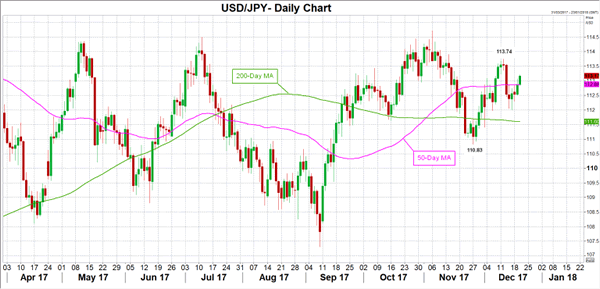
Looking at forex markets, dollar/yen has been consolidating gains around one-month high levels the past two-weeks, maintaining a bullish picture in the short-term.
Dovish remarks by the BOJ on Thursday could push the pair up to break December's top at 113.74. Steeper increases though could also target the area around the 114 key level, which has acted as strong resistance in the past.
Alternatively, a hawkish BOJ message could drive the market down to the 112 area where the 50-day moving average also lies. The 200-day moving average at 111.60 could also act as support, while a close below the previous low at 110.83 would shift the bias to bearish.