Sample Category Title
Dollar Unmoved after ADP Grew 190k, Sterling and Aussie Staying Weak
Mid-Day Report: Dollar Unmoved after ADP Grew 190k, Sterling and Aussie Staying Weak
Quick update: CAD is sold off after BoC said in the statement that Governing "Council will continue to be cautious, guided by incoming data in assessing the economy's sensitivity to interest rates, the evolution of economic capacity, and the dynamics of both wage growth and inflation." The language suggests BoC will stay in wait-and-see mode in near term, practically rule out a hike in January.
Dollar continues to trade with a mixed today as economic data released from US provide little inspiration. Sterling weakness remains the main theme in rather directionless markets. Misalignment within UK politicians remain the key issue in Brexit negotiation and Prime Minister Theresa is still struggling to put things back under control. Meanwhile, Australian Dollar stays as the second weakest one after today's GDP mixed. On other hand, Yen is extending its rebound, in particular against Europeans. Canada Dollar follow closely as markets await BoC rate decision. The Loonie would be given a boost if BoC signals that it's back in tightening path again.
Release from US, ADP report showed 190k growth in private sector jobs in November, just 1k below expectation of 191k. Non-farm productivity was finalized at 3.0% in Q3, unit labor costs at -0.2%. From Canada, labor productivity dropped -0.6^ qoq in Q3. Release earlier today, Eurozone retail PMI rose to 52.4 in November. German factory orders rose 0.5% mom in October. Swiss CPI was rose to 0.8% yoy in November.
UK PM May insist on making very good progress after talking to DUP leader
In UK, Prime Minister Theresa May finally had a phone call with North Ireland DUP leader Arlene Foster today. Foster, who interrupted May's talk with European Commission President Jean Claude Juncker, initially refused to answer the call. May said afterwards that "very good progress" was made in Brexit negotiation, but a DUP spokesman sounded indifferent and said that there was "more work to be done". May is expected to go back to Brussels to resume the negotiation with EU and targets to complete "sufficient" progress by Sunday at most. But so far, the issue of Irish border remain a key showstopper and there isn't any positive development seen yet.
ECB Mersch urged to plan for QE exit
ECB Executive Board member Yves Mersch urged the central bank to start planning for ending the asset purchase program. He said that "while a too quick end to the buying program could lead to excessive market reactions, we should not forget that the longer the programme lasts, ... the greater the risks will become." And, "a credible perspective for an exit from QE is therefore key in curbing risks."
Greek 10 year yield dropped to 8 year low
Greece 10 year government bond year drops to as low as 4.802% today, hitting the lowest level in eight years since November 2009. This is partly a reflection on the preliminary agreement with Eurozone regarding the reforms of the bailout program. That kept Greece on course for ending financial aids next year in August. Also, it reflects general optimism within Eurozone as investors are back taking more risks and yields. It's also seen as a factor keeping the Swiss Franc soft.
Australia GDP showed weak spending growth
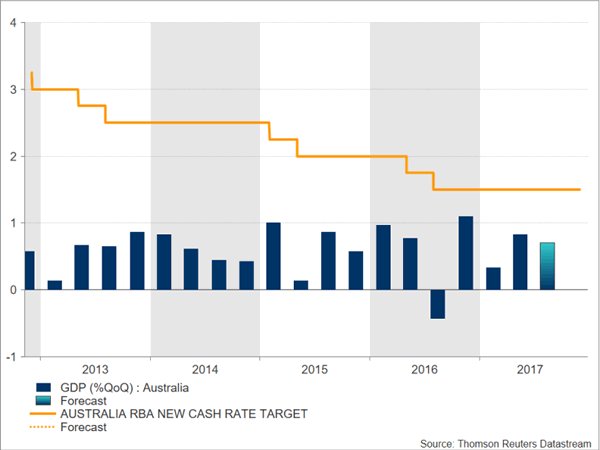
Australian Dollar tumbles broadly today as weighed down by disappointing GDP data. Q3 GDP rose 0.6% qoq 2.8%, below expectation of 0.7% qoq, 3.0% yoy. Despite the miss, the headline numbers are not bad at all. Treasurer Scott Morrison described the figures as indicating "solid" economic growth. And he said that "this is above the OECD average and puts Australia back up towards the top of the pack for major advanced economies around the world." However, weak household consumption is seen as the most worrying part of the details. Consumer spending grew just 0.1% qoq and was at the lowest rate in more than a decade since 2005. Sluggish wage growth, as pointed out by RBA rate statement released yesterday, was a key factor and would likely continue to be.
GBP/USD Mid-Day Outlook
Daily Pivots: (S1) 1.3381; (P) 1.3429; (R1) 1.3489; More....
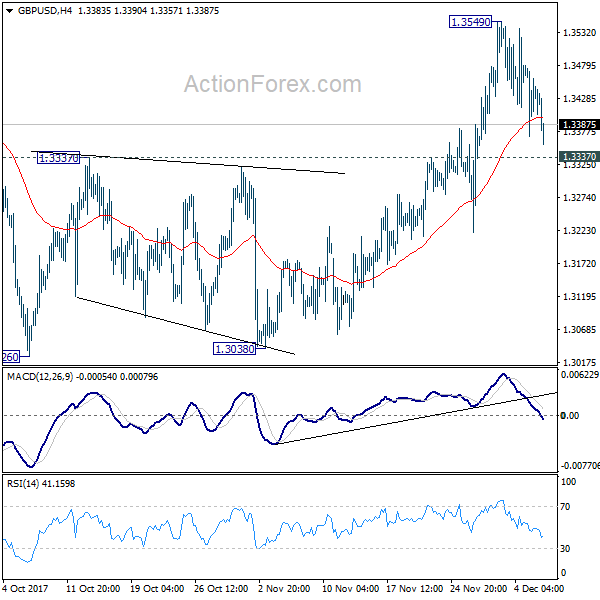
GBP/USD's pull back from 1.3549 extends to as low as 1.3357 so far today. But the pair is still staging above 1.3337 resistance turned support. Intraday bias remains neutral and another rise is still expected. Break of 1.3549 will target 1.3651 high and above. However, decisive break of 1.3337 will argue that rise from 1.3038 has completed and turn bias back to the downside for this support.
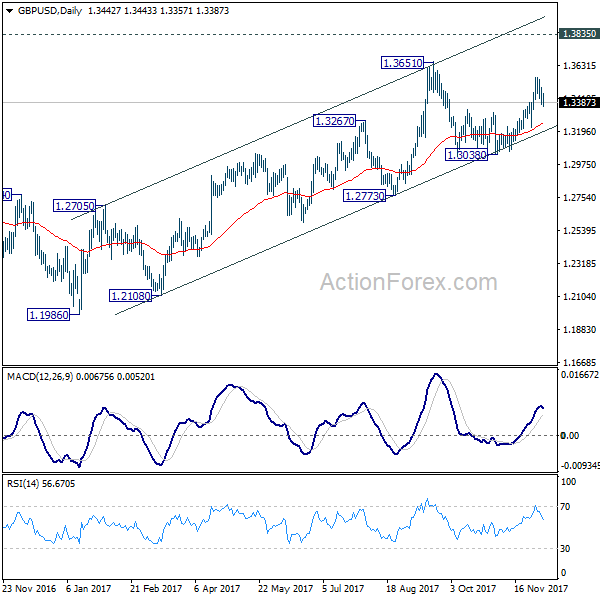
In the bigger picture, while the medium term rebound from 1.1946 low is strong, it's still limited below 1.3835 key support turned resistance. As long as 1.3835 holds, we'd view such rebound as a correction. That is, we'd expect another leg in the long term down trend through 1.1946 low. However, sustained break of 1.3835 should at least send GBP/USD to 38.2% retracement of 2.1161 (2007 high) to 1.1946 (2016 low) at 1.5466.
Economic Indicators Update
| GMT | Ccy | Events | Actual | Forecast | Previous | Revised |
|---|---|---|---|---|---|---|
| 00:30 | AUD | GDP Q/Q Q3 | 0.60% | 0.70% | 0.80% | 0.90% |
| 07:00 | EUR | German Factory Orders M/M Oct | 0.50% | -0.20% | 1.00% | 1.20% |
| 08:15 | CHF | CPI M/M Nov | -0.10% | 0.00% | 0.10% | |
| 08:15 | CHF | CPI Y/Y Nov | 0.80% | 0.80% | 0.70% | |
| 09:10 | EUR | Eurozone Retail PMI Nov | 52.4 | 51.1 | ||
| 13:15 | USD | ADP Employment Change Nov | 190K | 191K | 235K | |
| 13:30 | CAD | Labor Productivity Q/Q Q3 | -0.60% | -0.40% | -0.10% | -0.20% |
| 13:30 | USD | Nonfarm Productivity Q3 F | 3.00% | 3.30% | 3.00% | |
| 13:30 | USD | Unit Labor Costs Q3 F | -0.20% | 0.30% | 0.50% | |
| 15:00 | CAD | BoC Rate Decision | 1.00% | 1.00% | 1.00% | |
| 15:30 | USD | Crude Oil Inventories | -5.6M | -3.2M | -3.4M |
Are US Equity Markets Losing Their Sparkle?
- No Tax Reform May Mean No Santa Rally This Year;
- GBP Stutters as Irish Border Issue Goes Unresolved;
- Bitcoin Surges Again as CBOE and CME Prepare to Offer Futures.
No Tax Reform May Mean No Santa Rally This Year
It's been a rocky few days for US equities and that may be starting to take its toll, with US futures pointing to a weaker open on Wednesday, as Europe and Asia post similar losses.
It would appear some of the sparkle has disappeared from the markets at the start of December after what has been another impressive performance since the middle of November. The prospect of tax reform in the US, which has made progress, has aided the rally in recent weeks but clearly a number of significant hurdles remain and this is likely to continue to impact investor sentiment this month. A failure to deliver tax reform may well ensure the santa rally eludes us this year.
The pound is trading around half a percentage point lower against the dollar and the euro this morning as optimism around Brexit negotiations fades. The DUP's decision to scupper a deal on phase one of the talks late in the day has raised serious questions regarding whether one can now be achieved by the EU summit next week when progress is expected to be discussed. If the Irish border issue remains unresolved, it's unlikely that the EU will sign off on negotiations progressing to future trade and transition deal.
GBP Stutters as Irish Border Issue Goes Unresolved
Sterling had previously rallied to two month highs against the greenback on the prospect of a deal being achieved, as both parties appeared to have closed in on a financial settlement being agreed, at least in theory. As it turns out, what had been touted as being the largest stumbling block has turned out to be nothing in comparison to finding a solution to the border problem that satisfies all involved. The next week could get very tense for Theresa May and questions over her leadership are already once again being asked, providing more downside pressure on the currency.
Bitcoin Surges Again as CBOE and CME Prepare to Offer Futures
Bitcoin is surging once again on Wednesday in a fashion that has become all too familiar this year. The cryptocurrency was up almost 10% on the day at one stage, reaching a new high above $12,800 in the process, and continues to trade close to these highs at the time of asking. The moves we've seen over the last week or so have been quite remarkable even for Bitcoin and while there has been fundamental factors supporting the rise this year, the speculative contribution to the rise can't be overlooked.
CBOE and CME Group are preparing to offer Bitcoin futures over the next couple of weeks and perhaps this has played a major role in the surge. That said, the increased media coverage we've seen around Bitcoin recently may have actually fed the frenzy, with fomo traders piling in to avoid missing out on a rare opportunity to make these kinds of gains. The danger here of course is that this kind of action leaves traders very vulnerable to bubbles bursting and significant losses due to a lack of understanding of what is being traded.
While political stories are currently dictating market sentiment at the moment, there are a number of key data points still to come this week that will have an influence. Today we'll get ADP employment numbers for November, ahead of Friday's official jobs report, as well as unit labour costs and productivity numbers. The Bank of Canada will also make its latest interest rate decision, although no change is expected with the central bank having already raised interest rates twice in recent meetings.
Brexit Bears Lead Pound; Stocks Continue Declining; BOC Rate Decision Pending
Here are the latest developments in global markets:
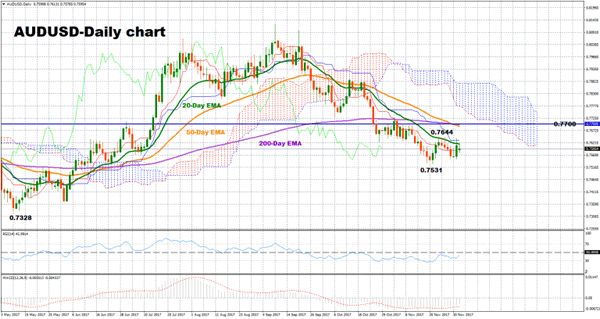
Forex: Sterling stretched toward a fresh one-week low of 1.3360 (-0.61%) as fears over a potential impasse in Brexit talks, which could postpone negotiations until February and therefore scale back business investments, lingered in the background. The dollar steadied versus the yen near one-week lows as concerns over a government shutdown offset positive sentiment related to the delivery of tax reforms. The euro was trading flat against the greenback at 1.1824, while versus sterling it managed to reverse earlier losses, picking up to a session high of 0.8852 (+0.47%). The aussie was moving sideways around one-week lows of 0.7580 after a miss in GDP growth readings (-0.21%). Dollar/loonie inched down to 1.2667 (-0.17%).
Stocks: A strong selloff in tech shares and basic metals continued to lead the drag in European stocks on Wednesday. The benchmark STOXX 600 was down by 0.56% at 1130GMT with all sectors trading down. The Spanish IBEX 35 declined by 0.93%, the German DAX 30 lost 0.92% and the French CAC 40 fell by 0.40%. The British FTSE 100 rebounded on the back of a weaker pound.
Commodities: Oil prices continued to fall as markets perceived the rise in US refinery inventories in the API weekly report as a weakness in demand. WTI crude tumbled by 1.27% to $56.90 per barrel and Brent slipped by 1.0% to $62.18. Gold was steady at $1,267.50 per ounce, trading near four-month low levels.
Day ahead: ADP employment might slow; BOC rates expected steady
The release of the ADP nonfarm employment report out of the US and a final settling of interest rates for this year by the Bank of Canada are expected to be the main highlights on Wednesday.
At 1315GMT, the US-based ADP Research Institute will publish readings on nonfarm employment, indicating the number of jobs added to the private sector in November. The report, which provides a snapshot of US nonfarm payrolls due on Friday, is expected to show a smaller increase of 185,000 positions compared to a six-month high of 235,000 seen in October.
Next in focus would be the Bank of Canada's rate announcement at 1500GMT. Despite November's impressive employment readings, the central bank will likely keep rates on hold as the annualized GDP growth seems to be slowing down, while consumers are struggling to meet their debt obligations as wage growth remains subdued. However, the monetary policy statement following the decision could bring some volatility to the loonie if policymakers use a different language to express their views on the economic outlook.
In energy markets, investors will look through the EIA report on US crude oil inventories. According to forecasts, crude inventories will drop by 3.40 million barrels in the week ending December 1 compared to a fall of 3.42 million in the preceding week. On the other hand, gasoline inventories and distillate stocks are anticipated to increase though not by much.
CAC Dips as Financial Stocks Falter
The CAC is in red territory on Wednesday. Currently, the index is at 5352.00, down 0.45% on the day. On the release front, the sole eurozone release is Retail PMI, which improved to 52.4. This marked a seven-month high. On Thursday, France will release Trade Balance, with the trade deficit expected to remain unchanged at EUR 4.7 billion.
On Tuesday, French Final Services PMI looked sharp, punching above the symbolic 60-point level. This marked the indicator's highest level since May 2011. The strong reading is indicative of strong expansion, as the service sector has been buoyed by strong customer demand and strong economic conditions. French service providers remain optimistic that activity in the sector will increase in the upcoming 12-month period. The French economy has rebounded in impressive fashion in 2017, and looks to wrap up the year on firm footing, as a strong manufacturing sector has triggered improved job growth.
The eurozone economy has enjoyed a strong rebound in 2017, marked by steady growth and lower unemployment. The ECB has projected GDP of 2.2% and inflation of 1.2% for 2017. The economic recovery pushed the ECB into action, which tapered its asset purchase program, although it did extend the program until September 2018. Still, the cautious ECB said on Wednesday that it was concerned about "increased risk-taking behavior in global financial markets" as this could lead to sharp asset price corrections. The ECB is also keeping its eye on political uncertainty in Europe, notably the deadlocked Brexit negotiations and the political vacuum in Germany. In the meantime, European stock markets remain at high levels and the euro is enjoying the view from the 1.18 level.
GBPUSD: Weakens On More Bear Threats
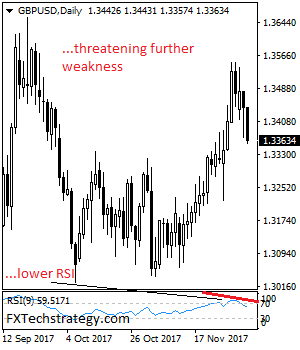
GBPUSD: The pair failed to follow through lower on Wednesday causing to decline further. This leaves GBPUSD weak and vulnerable to the downside with eyes on the 1.3300 zone. Support lies at the 1.3350 level where a break will turn attention to the 1.3200 level. Further down, support lies at the 1.3150 level. Below here will set the stage for more weakness towards the 1.3100 level. Conversely, resistance stands at the 1.3400 levels with a turn above here allowing more strength to build up towards the 1.3450 level. Further out, resistance resides at the 1.3500 level followed by the 1.3550 level. On the whole, GBPUSD looks to decline further.
GOLD Retest of Cont. SHS Bearish Pattern is Possible
Gold might be going through a revaluation phase, where Cryptocurrencies like Bitcoin are now rivaling it as the preferred risk-off asset or when such inflation risks persist. This crypto hype has potentially weakened some demand for Gold. Furthermore, there is the possibility that the US Fed may hike rates three times over the next 12 months, and this shifts further investments from Gold into Bonds.
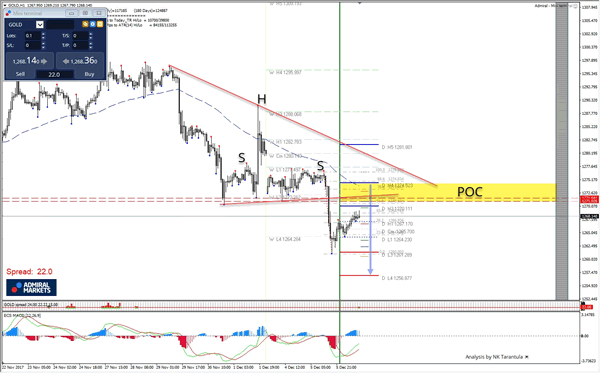
Technically Gold is showing Bearish SHS continuation pattern (Head and Shoulders at support) and the price might retest a neckline that is a part of POC zone. The POC 1271-1274.50 (Bearish SHS neckline, order block, EMA89, D H4, 78.6) could potentially reject the price towards 1264.23 , 1261.28 and 1256.87. Break of 1281.80 and 4h close above it, might possibly negate bearish scenario.
- H3 - Weekly Camarilla Pivot (Weekly Interim Resistance)
- W H4 - Weekly Camarilla Pivot (Strong Weekly Resistance)
- D H4 - Daily Camarilla Pivot (Very Strong Daily Resistance)
- D L3 - Daily Camarilla Pivot (Daily Support)
- D L4 - Daily H4 Camarilla (Very Strong Daily Support)
- PPR - Progressive Polynomial Channel
- POC - Point Of Confluence (The zone where we expect price to react aka entry zone)
DAX Slides As Banking, Tech Stocks See Red
The DAX index has posted sharp losses in the Wednesday session. Currently, the DAX is at 12,939.50, down 0.84% on the day. On the release front, German and European indicators were positive, but this was not enough to keep the DAX from moving into red territory. German Factory Orders gained 0.5%, above the estimate of -0.2%. There was more positive news, as Eurozone Retail PMI improved to 52.4 points in November, its highest level since June. On Thursday, German releases Industrial Production and ECB President Mario Draghi holds a press conference hosted by the ECB.
There is little to cheer about on the Frankfurt exchange on Wednesday, as almost all of the DAX listings are in red territory. Financial stocks are down sharply, with Commerzbank and Deutsche Bank posting losses of 1.82% and 1.60% respectively. Technology stocks are also down, led by Infineon Technologies, which has declined 1.28% on the day.
The eurozone has enjoyed a strong 2017, marked by steady growth and lower unemployment. The ECB has projected GDP of 2.2% in 2017 and inflation of 1.2%. Things are so good that the ECB finally acted and tapered its asset purchase program, although it did extend the program until September 2018. Still, the cautious ECB said on Wednesday that it was concerned about increased risk-taking behavior in global financial markets” as this could lead to sharp asset price corrections. The ECB is also keeping its eye on political uncertainty in Europe, notably the deadlocked Brexit negotiations and the political vacuum in Germany. In the meantime, European stock markets remain at high levels and the euro is enjoying the view from the 1.18 level.
Euro Shrugs Off Sharp German Industrial Report
The euro has inched lower in the Wednesday session. Currently, EUR/USD is trading at 1.1814, down 0.10% on the day. On the release front, German Factory Orders gained 0.5%, above the estimate of -0.2%. There was more positive news, as Eurozone Retail PMI improved to 52.4 points in November, its highest level since June. In the US, today's highlight is ADP Nonfarm Employment Change, which is expected to slow to 189 thousand. On Thursday, German releases Industrial Production and ECB President Mario Draghi holds a press conference hosted by the ECB. The US will release unemployment claims.
The eurozone has enjoyed a strong 2017, marked by steady growth and lower unemployment. The ECB has projected GDP of 2.2% in 2017 and inflation of 1.2%. Things are so good that the ECB finally acted and tapered its asset purchase program, although it did extend the program until September 2018. Still, the cautious ECB said on Wednesday that it was concerned about increased risk-taking behavior in global financial markets” as this could lead to sharp asset price corrections. The ECB is also keeping its eye on political uncertainty in Europe, notably the deadlocked Brexit negotiations and the political vacuum in Germany. In the meantime, European stock markets remain at high levels and the euro is enjoying the view from the 1.18 level.
Will we see a slowdown in the US labor market? The markets are predicting that ADP Nonfarm Employment Change will slow to 189 thousand, compared to 235 thousand in the previous release. Investors are, of course, much more interested in the official nonfarm employment change release on Friday. The key release is expected to slow to 200 thousand, down from 261 thousand in the previous release. If nonfarm payrolls is weaker than expected, the dollar could lose ground against the euro and other rivals.
Loonie Strengthens Ahead Of January Rate Hike
Loonie strengthens ahead of January rate hike
Later today the Bank of Canada (BoC) will announce its December interest-rate decision: we think it will remain unchanged, but a climb is likely in January. USD/CAD has tracked front-end yield spreads tightening in the last six months. With a US Federal Reserve December rate hike priced-in and a hawkish BoC, a USD/CAD reversal from 1.29 resistance presages a deeper correction towards 1.2566 (100-day moving average).
Q3 economic data surprised to the upside. Labour markets exceeded expectations, demand was strong, and the prospect of US tax reform could accelerate Canadian growth and reduce risk of the North American Free Trade Agreement falling apart. The BoC is likely to hike rates steadily, in a gradual process.
Brazilian real to weaken
As Brazil’s central bank is expected to drop its prime lending rate to an all-time low of 7%, and demand for the USD rises with the US Federal Reserve’s impending rate hike, the real should continue to weaken against the greenback. Since the start of the year, the USD/BRL has been trading between 3.1 and 3.4. Brazilian rates have fallen by half in the past year, and 2018 might see further cuts. Capital outflows are likely to accelerate, as the interest-differential to the USA narrows.
The interest rate cut is driven by inflation, which surprisingly stands way below the official target. Banco Central do Brasil is targeting inflation at 3-6%, yet consumer prices have dived from double digit to less than 2% growth. Inflation for November is expected to print at 2.88% annually.
CRUDE OIL Losing Steam
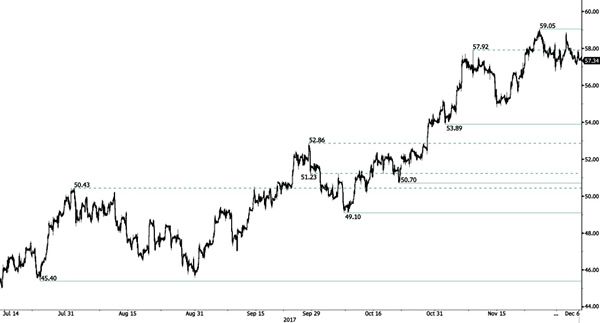
Crude oil continues its consolidation phase and should not challenge the 60-dollar level. Expected to show continued sideways move. Support is given at a distance at 54.81 (14/11/2017 low)
In the long-term, crude oil has recovered after its sharp decline last year. However, we consider that further weakness are very likely. For the time being the pair lies in an upside momentum. Strong support lies at 35.24 (05/04/2016) while resistance can now be found at 55.24 (03/01/2017 high).