Sample Category Title
Trade Idea Wrap-up: USD/CHF – Sell at 0.9920
USD/CHF - 0.9877
Most recent candlesticks pattern : N/A
Trend : Near term down
Tenkan-Sen level : 0.9867
Kijun-Sen level : 0.9886
Ichimoku cloud top : 0.9947
Ichimoku cloud bottom : 0.9941
Original strategy :
Sell at 0.9920, Target: 0.9820, Stop: 0.9955
Position : -
Target : -
Stop : -
New strategy :
Sell at 0.9920, Target: 0.9820, Stop: 0.9955
Position : -
Target : -
Stop : -
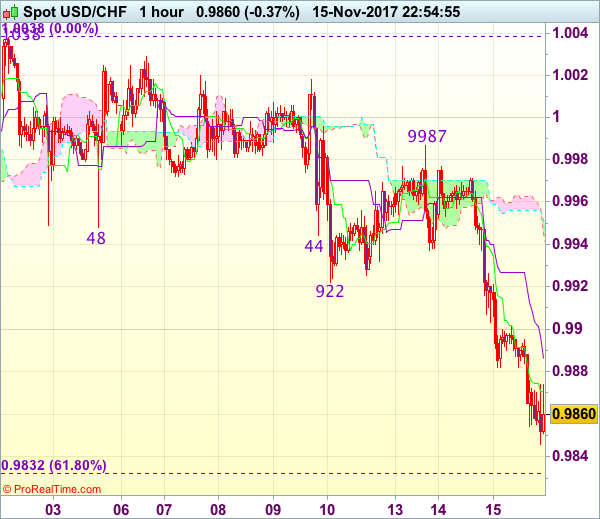
As the greenback has fallen again after brief recovery, suggesting the erratic decline from 1.0038 top is still in progress for at least a retracement of early upmove, hence bearishness remains for this fall to extend further weakness to previous resistance at 0.9837, break below there would encourage for subsequent decline towards 0.9795-00 which is likely to hold on first testing due to near term oversold condition.
In view of this, we are looking to sell dollar on subsequent recovery as 0.9922 (previous support) should limit upside. Above 0.9940-45 would defer and risk test of 0.9970-75 but price should alter below resistance at 0.9987, bring another decline later.
US: Retail Sales Show Solid Demand in October
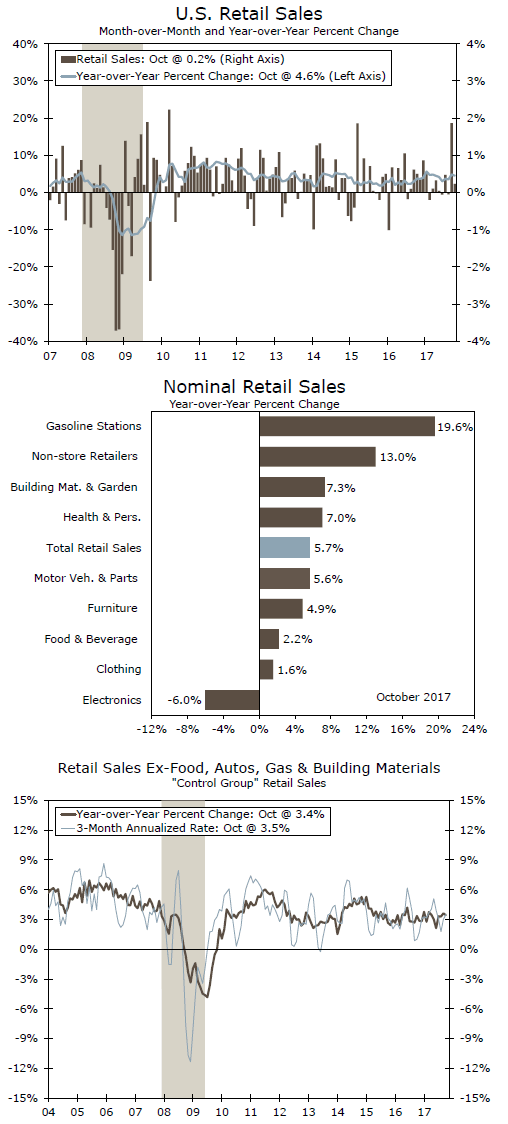
Retail sales rose 0.2 percent in October after rising 1.9 percent in September. Excluding categories impacted by weather events, retail sales remained quite strong which bodes well for Q4 personal consumption.
Retail Sales Ease in October as Hurricane Swell Recedes
Retail and food services sales rose 0.2 percent in October and September's surge was revised higher to 1.9 percent. This was stronger than expected, as consensus had penciled in a flat month of sales as the boost from gas prices, building supplies and auto sales associated with the hurricanes eased from September. Control group sales - which exclude autos, food, gasoline and building materials were less impacted by the hurricanes in September, and were up a stronger 0.3 percent in October. Control group sales are up a solid 3.5 percent average annualized rate over the past three months, which suggests spending has solid momentum going into the last quarter of 2017.
The higher gasoline prices caused by Hurricane Harvey's aim at the Gulf Coast faded in October, and gasoline station sales declined 1.2 percent on the month after surging 6.4 percent in September. Building materials sales also declined in October as payback for the outsized 3 percent rise the previous month, when immediate repairs and storm-proofing pushed up sales at home improvement stores. Notably, those were the only significant declines in October. The volatile nonstore retailer category fell 0.3 percent on the month but remains one of the strongest categories over the year.
Auto dealers' sales continued to increase in October, rising 0.8 percent after September's 4.6 percent surge. Vehicle replacement following the hurricanes have certainly provided a boost to the category, which saw sales rise 4.5 percent over the year on a three month average basis. Furniture stores may have also seen a boost from replacing storm damages, as sales rose 0.7 percent in October and are up 4.2 percent during the past three months relative to the same period last year. Continued inroads made in the housing market likely also helped with that year-over-year gain.
Sales at eating and drinking places ramped up 0.8 percent in October which was its largest monthly gain since January. Electronics and appliance stores also saw sales rise 0.7 percent in October but remain down over the year. Sales jumped 1.5 percent in the sporting goods and hobby store category in October - its first meaningful monthly increase this year, sales are down 2.4 percent over the year, however.
Control Group Sales Show Demand Strong for Q4
Retail sales were up for most categories in October, which is reassuring as a gauge of consumer spending momentum in the start of Q4. Control group sales, which go into the calculation of personal consumption expenditures in GDP, were up more than the headline in October because they were not adversely impacted by the comedown in gasoline prices. They also strip out volatile spending on food, auto and home improvement stores, and are thus a good gauge of underlying consumption demand. Control group sales saw momentum increase in October, which is good news for retailers going into the holiday season and for Q4 GDP calculations if this strength holds up.
Trade Idea Wrap-up: GBP/USD – Buy at 1.3100
GBP/USD - 1.3163
Most recent candlesticks pattern : N/A
Trend : Near term down
Tenkan-Sen level : 1.3174
Kijun-Sen level : 1.3155
Ichimoku cloud top : 1.3146
Ichimoku cloud bottom : 1.3102
Original strategy :
Buy at 1.3130, Target: 1.3230, Stop: 1.3095
Position : -
Target : -
Stop : -
New strategy :
Buy at 1.3100, Target: 1.3210, Stop: 1.3065
Position : -
Target : -
Stop : -
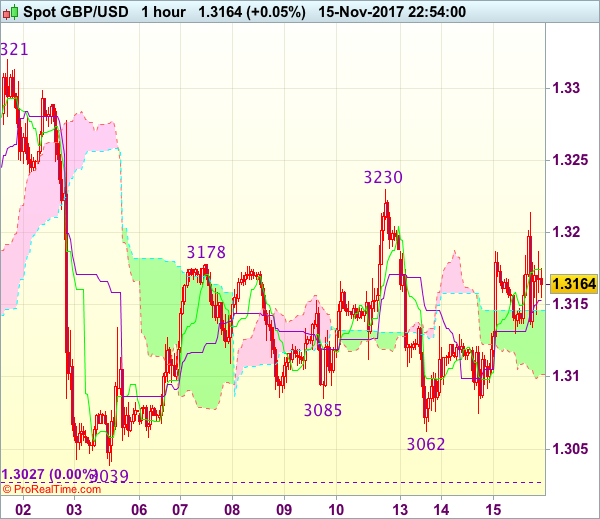
As the British pound rebounded again after holding above support at 1.3062 (this week’s low), retaining our view that further consolidation would take place and another bounce to 1.3210-15, then towards resistance at 1.3230 would be seen, however, as broad outlook remains consolidative, reckon upside would be limited to 1.3250 and price should falter below 1.3275-80.
In view of this, we are looking to buy cable on dips as 1.3100-05 should limit downside. Below 1.3075 would risk test of said support at 1.3062 but break there is needed to suggest a downside break of recent broad range has taken place, bring retest of strong support area at 1.3027-39, only break there would confirm and extend recent decline to psychological support at 1.3000 first.
Trade Idea Wrap-up: EUR/USD – Buy at 1.1745
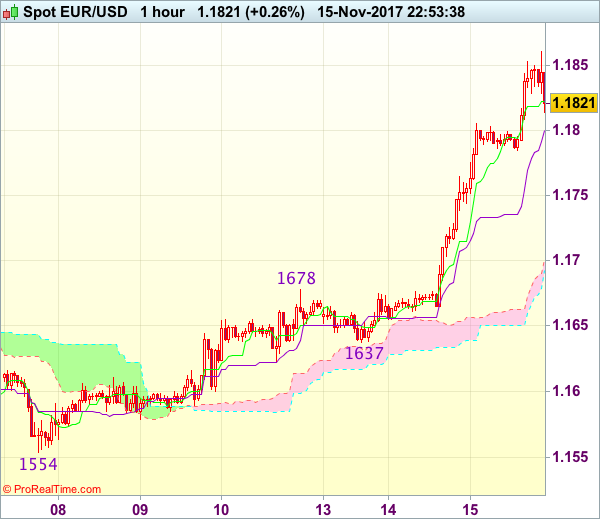
EUR/USD - 1.1810
Most recent candlesticks pattern : N/A
Trend : Near term up
Tenkan-Sen level : 1.1827
Kijun-Sen level : 1.1803
Ichimoku cloud top : 1.1711
Ichimoku cloud bottom : 1.1701
Original strategy :
Buy at 1.1745, Target: 1.1845, Stop: 1.1710
Position : -
Target : -
Stop : -
New strategy :
Buy at 1.1745, Target: 1.1845, Stop: 1.1710
Position : -
Target : -
Stop : -
As the single currency has retreated after rising to 1.1861, suggesting consolidation below this level would be seen and below the Kijun-Sen (now at 1.1803) would bring pullback to 1.1770, however, reckon 1.1745-50 (50% Fibonacci retracement of 1.1637-1.1861) would limit downside and bring another rise later, above said resistance at 1.1861 would extend recent see from 1.1554 low to previous resistance at 1.1880, then 1.1900-10.
In view of this, would not chase this rise here and we are looking to buy euro on pullback as 1.1745-50 should limit downside. Below the upper Kumo (now at 1.1711) would defer and signal a temporary top is formed instead, bring weakness to previous resistance at 1.1678 (now support) but only break there would provide confirmation.
CPI: Core Inflation Is Back on Track
Consumer price inflation rose more slowly in October due to a pullback in energy prices, but core inflation picked up. Reflation increasingly looks to be back on track which will support further Fed tightening.
Soft Headline, but Core Inflation Is Strengthening
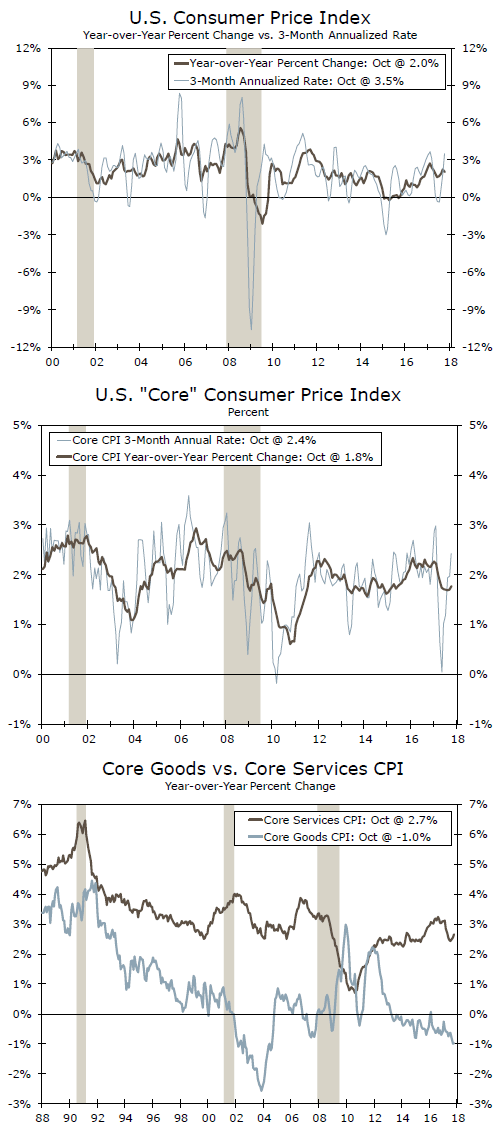
Inflation was toned down in October with the Consumer Price Index increasing 0.1 percent after two months of 0.4 percent-plus gains. The yearover- year rate subsequently edged back down to 2.0 percent. The slowdown reflected a decline in energy prices as the supply disruptions surrounding Hurricanes Harvey and Irma abated. Gasoline prices fell 2.4 percent over the month, more than offsetting increases for electricity and gas services. Food prices were flat in October and have continued to increase more slowly than other items over the past year, up 1.3 percent.
Excluding food and energy, inflation was noticeably stronger. The core index rose a "high" 0.2 percent (0.225 percent before rounding). That pushed the year-over-year change up to 1.8 percent. The performance over the past three months is even more impressive; core prices have advanced at a 2.4 percent annualized rate, making the slowdown in inflation earlier this year look increasingly temporary.
Core services have been the primary source of inflation weakness this year, but services prices rose 0.3 percent in October. Gains were broadly based, including shelter, medical care, transportation and even wireless phone services, which were up for a second straight month.
Core goods prices also posted a rare increase. Replacement demand following the recent hurricanes generated some support to used car prices which were up 0.7 percent. However, other categories were also more supportive of inflation - or at least less deflation - including medical goods (non-prescription drugs) and tobacco products.
Reflation Supportive of Fed Tightening Plans, But Will Be Slow
The Fed has struggled this year in determining if the slowdown in core inflation has been due to a confluence of one-offs or more persistent disinflationary forces. We have been of the mindset that the pullback has been due primarily to a few unique factors that look unsustainable. The primary categories holding down core inflation earlier this year - cell phone plans, housing costs and physician services - have all gathered steam in recent months. The pickup clears the way for a December rate hike and supports the case for continued tightening in the year ahead.
The FOMC, however, will be watching the PCE deflator more closely. While much of the early estimates for the PCE deflator are derived from the CPI report, healthcare, which is about twice as important in the PCE deflator, is derived from Producer Price Index (PPI) estimates. Yesterday's PPI showed healthcare services inflation slipping to 1.2 percent, the smallest 12-month change since the spring of 2016. That should keep the core PCE deflator from swiftly rebounding to the FOMC's target in the coming months and keep the FOMC on the path of only gradual rate increases.
More Signs of Stabilization in U.S. CPI in October
Highlights:
- Year-over-year headline CPI growth edged down from 2.0% from 2.2% in September as part of a surge in September gasoline prices was reversed.
- Food prices were unchanged on a month-over-month basis, but the year-over-year rate ticked up to 1.3% - its highest reading since November 2015.
- Excluding food & energy prices, 'core' CPI inched up 0.2% on a month-over-month basis and the year -over-year ticked up to 1.8% after 5 straight 1.7% readings.
The headline year-over-year rate dipped lower to 2.0% but only because gasoline prices partially retraced a hurricane-related 13% surge in September. Energy prices were still up 6.4% from a year ago.
Year-over-year food price growth ticked up to 1.3% - still modest but nonetheless the fastest annual gain for the component since November 2015.
Core CPI increased 0.2% on a month-over-month basis. That was enough to push the year-over-year rate of growth in October up to 1.8% after five straight 1.7% readings. A sharp drop in telecommunication prices earlier this year is still biasing the measure lower. Excluding that drop, core price growth would be right at the Fed's 2% inflation objective. There is still little evidence that inflation is getting out of hand but the stabilization in core measures in recent months and indications that demand growth remains solid - including somewhat stronger-than-expected October retail sales separately reported this morning - should reassure the Fed that price growth will tick higher rather than lower going forward. A 25 basis point hike in the fed funds target range is widely expected in December. We continue expect further demand growth and further tightening in labour markets will ultimately prompt a gradual hiking cycle to continue next year.
US Data Not Strong Enough to Reverse USD Sell-off
- European equities suffer more losses as the stock market correction continues. Main indices lose up to 1%. US stock markets open on a weak footing as well, dropping around 0.75%.
- US consumer prices barely rose in October (0.1% M/M) as the boost to gasoline prices from hurricane-related disruptions to Gulf Coast oil refineries was unwound, but rising rents and healthcare costs pointed to a gradual buildup of underlying inflation (0.2% M/M).
- US retail sales rose more than expected in October (0.2% M/M). The market had expected no change after retail sales clocked a blistering 1.9% M/M rise in September when people replaced vehicles and items destroyed by hurricane Harvey and Irma. Control retail sales, which exclude volatile items, rose 0.3% from September.
- The UK labor market showed signs of slowing in the third quarter as the number of people in work fell for the first time in almost a year even as unemployment held at a 42-yr low. There was no sign of respite for UK wage earners though who face a squeeze on incomes from high inflation, after pay growth held steady in the latest three months
- BoE governor Broadbent said markets have placed too much emphasis on the idea that interest rates need to be kept low in the face of Brexit uncertainty. "Even as inflation rose, and the rate of unemployment fell further, interest-rate markets continued to under-weight the possibility that bank rate might actually go up this year," he said.
- Waiting too long to halt monetary policy stimulus could be disruptive, ECB Hansson said, adding that a more supportive euro zone economy justified a shift in the central bank's policies.
- Greece invited holders of about €30 bn euros in its debt to swap 20 small outstanding bonds for 5 new benchmark ones. The plan is to boost market liquidity before Greece emerges from bailouts in August 2018. The eligible papers are 20 bonds that were issued in 2012 in a voluntary scheme where private bondholders took a 53.5% haircut.
- Signs that Sweden's red-hot housing market is cooling off are unlikely to impact monetary policy now, but may make the central bank's path toward normalizing rates trickier, Swedish Riksbank Governor Ingves said.
Rates
Bull flattening yield curves
Global core bonds gained ground today, bull flattening the yield curves. The move occurred mainly in Asian and European dealings on the back of deteriorating risk sentiment on stock markets, re-establishing last week's lost correlations. A disappointing Bund auction couldn't change the tide. Brent crude stabilized after yesterday's sell-off, but the picture remains fragile. The upleg in core bonds petered out ahead of key US eco data. Both CPI inflation and retail sales moderated from last month's levels, but printed near consensus. Their impact on core bond markets was negligible.
At the time of writing, US yield changes range between flat and -3.7 bps (30-yr). The German yield curve drops up to 4 bps (30-yr). On intra-EMU bond markets, 10-yr yield spread changes versus Germany are broadly unchanged with Portugal (+5 bps), Greece (+4 bps) and Spain (+3 bps) underperforming. Portuguese bonds fell prey to some profit taking following the impressive rally of late. Investors anticipate a second rating upgrade into investment grade by Fitch in December (current rating BB+ with positive outlook).
The German Finanzagentur held a 10-yr Bund auction (€3 bn 0.5% Aug2027). Demand was weak with total bids amounting only to €2.97 bn, below the amount on offer and below the €3.68 bn average at the previous 4 Bund auctions. The Bundesbank retained €0.52bn for secondary market operations, resulting in an official bid cover of 1.2 (real bid cover 0.99). The auction had no tail.
Currencies
US data not strong enough to reverse USD sell-off
The euro rally/USD sell-off continued today. There was again no high profile story to explain the move. Overall risk sentiment again weighed more on the dollar than on the euro. EUR/USD (temporary) cleared the 1.1837 post-ECB top. US retail sales and CPI were marginally better than expected, but didn't help the dollar much. EUR/USD trades in the 1.1820 area. USD/JPY is changing hands around 112.75.
Profit taking on risky assets continued overnight. Japan Q3 growth was marginally below consensus at 1.4% Q/Qa, with especially private consumption being a drag on growth. USD/JPY drifted further south in the 113 big figure (yen strengthened). The decline in core yields and risk-off sentiment outweighed Japanese domestic data, as usual. EUR/USD (1.1790 area) maintained yesterday's gains.
There were no data with market moving potential in EMU. The euro short squeeze simply resumed at the start of the European trading session, almost exactly the same way as was the case yesterday morning. EUR/USD set a new post-ECB top north of 1.1837. Again, we didn't see a specific trigger. The move was partially euro strength, but growing risk off sentiment also kept the dollar in the defensive. In the afternoon, the focus turned to the 'key' US CPI and retail sales data. Except for the early month data (ISM, payrolls) those data are the last important input for the December 13 Fed decision. Unfortunately (from a market point of view), the retail sales and the CPI were very close to expectations. If anything, they were marginally stronger than expected. Still, the dollar lost a few more ticks immediately after the publication of the data, but the USD decline finally petered out. The USD currency is looking for an intraday bottom. USD/JPY trades in the 112.75 area (from an intraday low near 112.50 and despite ongoing risk-off). EUR/USD jumped to the 1.1860 area, but a test of the next key resistance (1.1880) didn't occur. EUR/USD trades currently again in the 1.1820 area. We still consider the USD sell-off overdone (especially against the euro), but for now there is no trigger to turn the established trend. So, no good reasons to try to catch the falling (USD-)knife yet.
EUR/GBP tests 0.90
UK labour market data showed a mixed picture today. Wage growth (2.2% Y/Y) was marginally higher than expected, but remains low. The unemployment rate was stable as expected at 4.3%. Employment growth in the three months to September unexpectedly declined by 14k. A 52K rise was expected. The unexpected decline in employment confirms the recent slowdown in the UK economy. Sterling lost some further ground after the publication of the data. EUR/GBP jumped temporary north of 0.90, but the gain could not be sustained. The pair trades currently in the 0.8985 area. Cable spiked to the 1.3135/40 area, but trades currently again around 1.3165. The price moves in the sterling cross rates were also perturbed by the intraday price swings in the dollar and the euro.
Trade Idea Wrap-up: USD/JPY – Hold long entered at 112.60
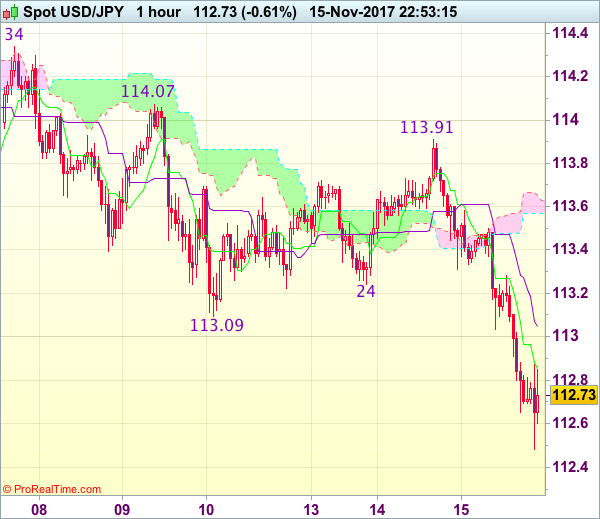
USD/JPY - 112.72
Most recent candlesticks pattern : N/A
Trend : Near term down
Tenkan-Sen level : 112.86
Kijun-Sen level : 113.05
Ichimoku cloud top : 113.65
Ichimoku cloud bottom : 113.57
Original strategy :
Bought at 112.60, Target: 113.60, Stop: 112.25
Position : - Long at 112.60
Target : - 113.60
Stop : - 112.25
New strategy :
Hold long entered at 112.60, Target: 113.60, Stop: 112.25
Position : - Long at 112.60
Target : - 113.60
Stop : - 112.25
As the greenback has remained under pressure after recent selloff on dollar’s broad-based weakness, oversold condition should prevent further sharp fall below 112.40-45 and bring rebound later today or tomorrow, above 113.05-09 (current level of the Kijun-Sen and previous support) would suggest low is possibly formed, bring test of 113.25-30 but break of latter level is needed to add credence to this view, bring further gain to 113.60-65, having said that,. price should falter well below resistance at 113.91.
In view of this, we are holding on to our long position entered at 112.60. Below support at 112.30 would signal the fall from 114.74 top is still in progress for weakness towards 112.00-05 before prospect of another rebound.
Commentary on US CPI / Retail Sales
Sellers immediately attacked the Dollar on Wednesday after U.S. consumer prices marginally increased by 0.1% in October – the smallest gain witnessed in three months.
Although the 0.1% increase in consumer prices was in line with market expectations, it continues to highlight how stubbornly low inflation in the United States remains a recurrent theme. While it is widely expected that the Federal Reserve will raise interest rates in December, the future path of rate hikes beyond 2017, is open to discussion amid low inflation concerns. On a positive note, U.S. retail sales unexpectedly rose 0.2% in October which is likely to boost sentiment towards the U.S. economy and offer some support to the tired Dollar.
Taking a look at the technical picture, the Dollar Index dipped towards 93.40 following the release. The 94.00 level has the ability to transform into a dynamic resistance that could encourage a further decline towards 93.50 and 93.00, respectively. A solid breakout back above 94.50 threatens the current bearish setup.
Trade Idea: USD/CAD – Exit short entered at 1.2770
USD/CAD - 1.2785
Trend: Near term up
Original strategy :
Sold at 1.2770, Target: 1.2570, Stop: 1.2830
Position: - Short at 1.2770
Target: - 1.2570
Stop: - 1.2830
New strategy :
Exit short entered at 1.2770
Position: - Short at 1.2770
Target: -
Stop:-
Although the greenback did retreat after meeting resistance at 1.2773 yesterday, the pair found renewed buying interest at 1.2700 and has staged another rebound today, dampening our bearishness and suggesting near term upside risk remains for the rebound from 1.2665 (last week’s low) to extend gain to 1.2800, then test of resistance at 1.2820 but a firm break above this level is needed to signal the correction from 1.2917 has ended, bring further gain to 1.2880, then towards this level which is likely to hold from here.
In view of this, would be prudent to exit short entered at 1.2770 and stand aside for now. Only below said support at 1.2700 would revive bearishness and signal the rebound from 1.2665 has ended, bring another test o this level, break there would extend the fall from 1.2917 top for retracement of recent rise to support at 1.2636 but a drop below this level is needed to signal recent rise has ended at 1.2917, bring further fall to 1.2600 and later towards 1.2550-60.
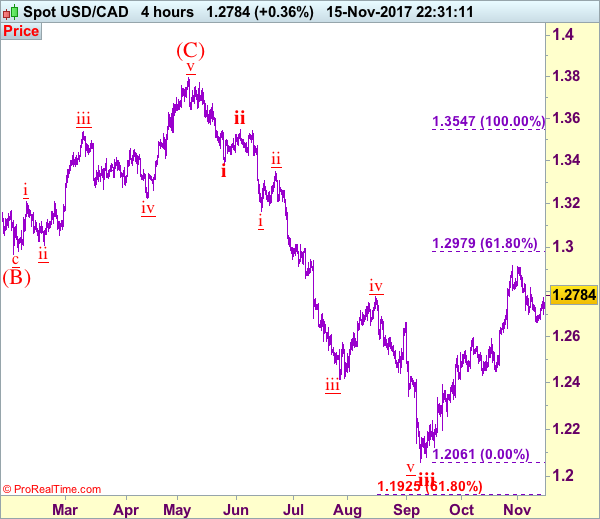
To recap, wave B from 1.3066 is unfolding as an a-b-c and is sub-divided as a: 1.2192, b: 1.2716 and wave c is a 5-waver with i: 1.1983, ii: 1.2506, extended wave iii with minor iii at 1.0206, wave iv ended at 1.0781 and wave v as well as wave iii has ended at 0.9931, hence the subsequent choppy trading is the wave iv which is unfolding as (a)-(b)-(c) with (a) leg of iv ended at 1.0854, followed by (b) leg at 1.0108 and (c) leg as well as the wave iv ended at 1.0674. The wave v is sub-divided by minor wave (i): 0.9980, (ii): 1.0374, (iii): 0.9446, (iv): 0.9913 and (v) as well as v has possibly ended at 0.9407, therefore, consolidation with upside bias is seen for major correction, indicated target at 1.3700 and 1.4000 had been met and further gain to 1.4700 would be seen later.