Sample Category Title
EURO Sellers Still Retain Control Below 1.1640
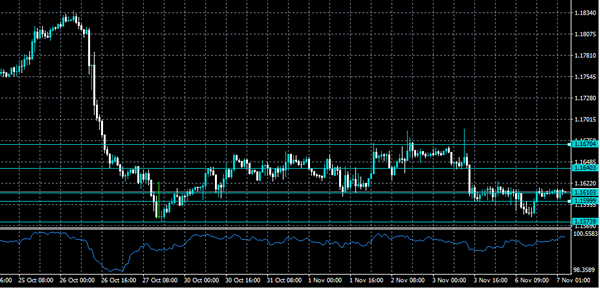
The euro has staged a minor recovery above the 1.1600 level against the U.S dollar, after the U.S dollar index started to decline during late Monday trade. A bullish double-bottom pattern on the EURUSD pair encouraged technical buying interest, as euro sellers failed to break the former monthly price-low at 1.1573. Traders now await European Central Bank President Mario Draghi’s opening remarks, as he delivers a scheduled speech at the ECB Forum on Banking Supervision, in Frankfurt, Germany.
The EURUSD still remains bearish while trading below the 1.1640 technical level, with sellers still retaining control of the pair. Further declines towards the 1.1599 and 1.1573 levels still seem most likely.
Should price-action break above the 1.1640 level for a sustained period, the bearish dynamic surrounding the pair will change, with buyers then likely to target the 1.1670 again.
Sterling Intraday Bullish ABove 1.3160
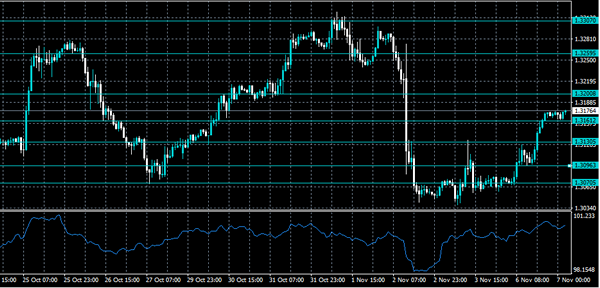
The British pound has started to recover against the U.S dollar, hitting 1.3177, amidst a broad-based sell-off in the U.S dollar index that began on Monday. Technical buying interest has accelerated in the GBPUSD pair, after intraday buyers pushed price-action clearly back above the 1.3130 resistance level. The pair currently trades towards the highs of the week, with financial markets attention now firmly focused on the upcoming speech by FED Chair Janet Yellen during today's U.S trading session.
The GBPUSD pair has turned intraday bullish while trading above the 1.3160 level. Further upside towards the 1.3200 and 1.3259 levels remains most likely while price-action holds above the 1.3160 region.
Should price action fall below the 1.3160 level, a decline towards the 1.3130 seems possible. Further extended GBPUSD intraday support is found at 1.3096 and 1.3070.
Central Bank Speeches Headline Tuesday
Central bank developments will take centre stage on Tuesday, as commentary from the ECB and Fed will move the financial markets.
European Central Bank President Mario Draghi will deliver a speech at 09:00 GMT. The ECB announced recently that it will begin to unwind its stimulus program, but that the duration of the bond-buying will likely continue beyond September 2018. The central bank is responding to a much-improved regional economy.
In North America, Federal Reserve Chairwoman Janet Yellen will deliver a speech at 19:30 GMT. Yellen is wrapping up her final months as Fed boss after President Donald Trump announced Jerome Powell as her replacement.
North of the boarder, Bank of Canada (BOC) Governor Stephen Poloz will also deliver a speech on Tuesday. The BOC has been actively raising interest rates this year in response to a booming Canadian economy.
Earlier in the day, the Reserve Bank of Australia (RBA) held its main interest rate at 1.5%, as expected by the great majority of economists.
'Conditions in the global economy are continuing to improve. Labour markets have tightened and further above-trend growth is expected in a number of advanced economies, although uncertainties remain,' the RBA said in its official rate statement. 'Growth in the Chinese economy is being supported by increased spending on infrastructure and property construction, with the high level of debt continuing to present a medium-term risk. Australia's terms of trade are expected to decline in the period ahead but remain at relatively high levels.'
In terms of economic data, the European Commission's statistical agency will report on retail sales at 10:00 GMT. Receipts at retail stores are forecast to rise 0.6% in September after falling 0.5% the previous month. This translates into an annualized gain of 2.7%.
In US data, the government will report on consumer credit change for the month of September. Meanwhile, the American Petroleum Institute (API) will report on weekly crude inventories ahead of the official tally on Wednesday.
EUR/USD
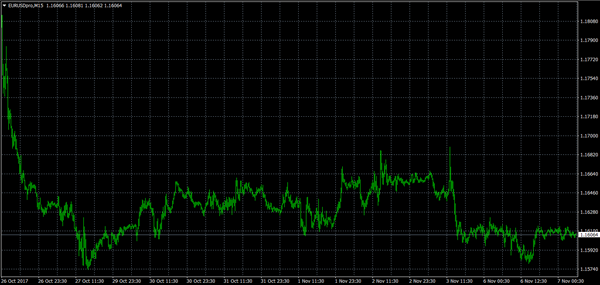
The euro was little changed on Tuesday, hovering just north of 1.1600. The pair remains in a tight range, with markets still speculating on the outlook of ECB policy. Investors can, therefore, expect little market movement for the euro without a major fundamental catalyst.
GBP/USD
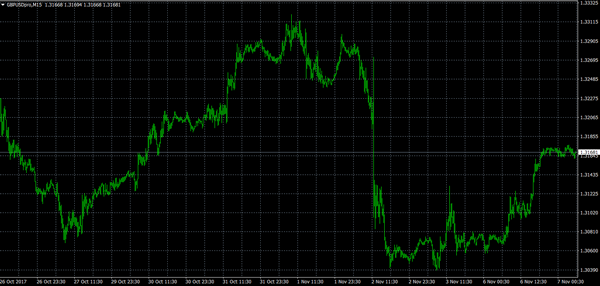
Cable rose sharply at the start of the week, climbing back above 1.3100 US. The GBP/USD exchange rate was last seen trading at 1.3169. It faces a strong support zone near 1.3030. On the opposite side of the ledger, resistance is likely found just ahead near 1.3200.
USD/CAD
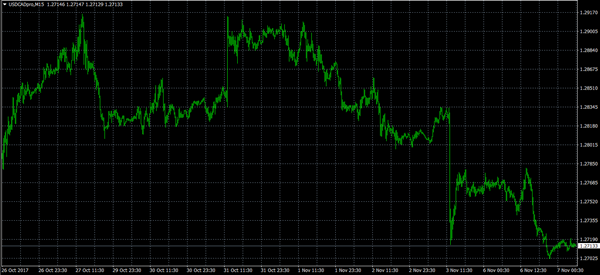
The Canadian dollar has strengthened in recent sessions, with the USD/CAD falling back toward the 1.2700 handle. The pair is down from more than three-month highs as the greenback backtracks against a basket of world peers.
Currencies: Dollar Fails To Overcome Technical Resistance, For Now
Sunrise Market Commentary
- Rates: Test of contract high (Bund) likely; sell-the-uptick?!
The German Bund is near the 163.43 contract high. Failure to sustainably move above this level could be an opportunity to sell-the-uptick. The rally of oil prices didn't impact bonds until now and we look out whether that remains the case. The start of the US' quarterly refinancing operation is negative for US Treasuries. - Currencies: Dollar fails to overcome technical resistance, for now
The dollar came close to/tested important technical levels yesterday and against the euro and the yen, but no real break occurred. Today, the calendar is again thin. Still we look out whether a next attempt might succeed. Sterling regains most of the post-BoE decline. For now, we don't seen any fundamental news to explain the move.
The Sunrise Headlines
- US equities ended with small gains, led by the energy sector after crude price soared more than 3%. Brent crude rose above $64/barrel for the first time since June 2015. Asian indices gain up to 1% this morning.
- Australia's central bank showed increasing confidence in the investment picture outside mining while retaining concerns about the prospects for household spending as it kept interest rates at a record-low 1.5%
- New Zealand's government confirmed it's considering a dual mandate for the central bank targeting full employment alongside price stability. WSJ reported that Fed Williams advocates the adoption of a price level targeting strategy in the face of the ongoing low inflation.
- The ECB will reinvest €130bn of bonds that are set to mature in the coming year, according to data released yesterday – but the early months of 2018 are likely to see a low amount of re-investments.
- The ECB's plan to force banks to set aside more money against future bad loans got tacit support from euro zone finance ministers despite concerns in Italy the move might weaken some of its banks.
- Italy's centre-right led by former prime minister Berlusconi has fended off a strong challenge from the populist Five Star Movement to win the presidency of Sicily, ringing alarm bells for Matteo Renzi and his centre-left Democratic party (PD) in a poll seen as the final test ahead of Italy's next general election.
- Today's eco calendar contains German industrial production, EMU retail sales and US JOLTS job openings. ECB Draghi, Lautenschlaeger and Nouy speak at an ECB conference. Austria, Germany and the US tap the market
Currencies: Dollar Fails To Overcome Technical Resistance, For Now
Dollar holding near recent highs
Yesterday, FX trading showed two faces. Initially, the euro was in the defensive even as EMU eco data were strong. USD/JPY, EUR/JPY and EUR/USD all lost ground in lockstep. EUR/USD dropped temporary below 1.16, but the correction stalled ahead of the 1.1575 post-ECB low Late in Europe, the dollar came under pressure. The USD decline coincided with a new up-leg of the oil price. EUR/USD closed the session at 1.1610, little changed from Friday. USD/JPY finished the session at 113.71 (from 114.07).
Overnight, Asian equities are in very good shape. Several indices including the Nikkei are trading at multi-year highs. Higher oil and commodity prices are supporting energy and materials companies. USD/JPY trades again in the 114 area. The USD/JPY performance remains mediocre given the stock market rally. EUR/USD is little changed in the 1.1605/10 area. The Reserve Bank of Australia as expected left its policy rate unchanged at 1.5%. The RBA remains positive on growth and employment, but low inflation/wages and a high consumer debt make the RBA cautious to raise rates in the foreseeable future. The AUD trades little changed below 0.77.
The eco calendar remains thin today, with the September US JOLTS job openings and the EMU retail sales. None is a market mover. The speeches of Draghi, Lautenschlager and Nouy at an ECB forum on supervision on “Europe's changing banking landscape” might be important for banks shares, but not for FX or bond markets. The start of the US quarterly refunding and some political events may be the focus today.
Last week, EUR/USD held close to the post-ECB low, but there were no followthrough losses for the euro. The nomination of Powell as next Fed-Chairman, new proposals to change the US tax code and Friday's payrolls were not able to break this stalemate. Until now, the dollar failed to really profit from high interest rate differentials (especially at the short end of the curve). This is slightly disappointing for USD bulls. That said, EUR/USD currently trades more than 400 ticks below the cycle top. The wide positive interest rate differential should give the dollar downside protection unless there is high profile US negative news. For now, the rise in oil prices had hardly any impact on interest rates or on FX. We look out whether this remains the case. Yesterday's USD price action was mixed. EUR/USD failed to go for a test of the 1.1575 area. USD/JPY was again not able to break the 114.50 range top. We maintain a sell-on-upticks bias, but the dollar clearly needs good news to realise any sustained gains. It is not sure this news will come in very soon.
From a technical point of view, EUR/USD dropped below 1.1670/62 support, but no convincing follow-through dollar gains occurred. A break below the 1.1575 post-ECB low would confirm that the recent EUR/USD uptrend is broken. EUR/USD 1.1423 (38% retracement of 2017 rise) is the next downside target on the charts. USD/JPY's momentum was positive in past months. The pair regained 110.67/95 resistance. The pair tested the 114.49 MT range top, but the attempt failed. A sustained break would improve the technicals. We remain cautious to preposition for further USD/JPY gains.
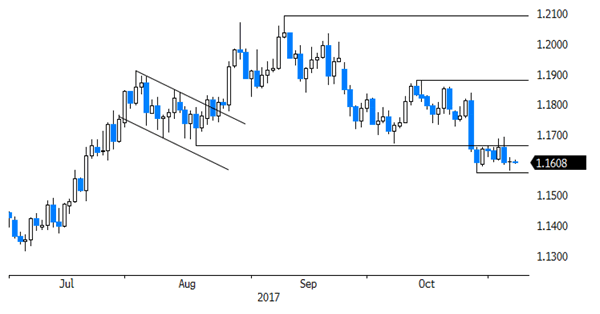
EUR/USD nearing the 1.1575 post-ECB low, but no real test yet
EUR/GBP
Sterling extends rebound
On Friday, sterling regained modest ground after Thursday's post-BoE sell-off. This rebound continued yesterday. We didn't see any eco or political news to explain the follow through sterling buying. Maybe some investors hope on progress in the next round of Brexit-negotiations which starts later this week. For now, the political scandals (inside and outside the Conservative party) don't affect sterling trading. EUR/GBP closed the session at 0.8815. The decline was at least partially due to euro softness. Cable also rebounded and finished the session at 1.3171.
Overnight, the Like for like BRC retail sales unexpectedly declined 1.0 Y/Y (a more modest slowdown from +1.9% Y/Y to +0.8% was expected). Later today, the Halifax house prices will be published. They probably won't be important for sterling trading. So, domestic politics and Brexit will probably set the tone for trading. We look out how far the repositioning of sterling goes.
MT technical. In September, sterling rebounded as the BoE prepared markets for a rate hike. This rebound ran into resistance as markets anticipated that any rate hikes would be very gradual and limited. This view was confirmed at last week's BoE policy meeting. EUR/GBP currently trades in a 0.8733/0.9033 consolidation range. A downside test of this range was rejected last week. We maintain the view that the 0.8733 -0.8652 support area will be though to break in a sustainable way. A EUR/GBP buy-on-dips approach is favoured. 0.9023/33 is the first important resistance for the EUR/GBP cross rate
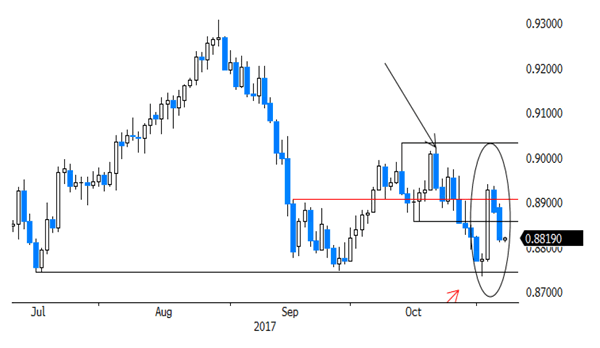
EUR/GBP: reverses most of post-BoE sterling decline, but no important technical levels are hit.
USD/JPY Elliott Wave Analysis
USD/JPY - 114.16
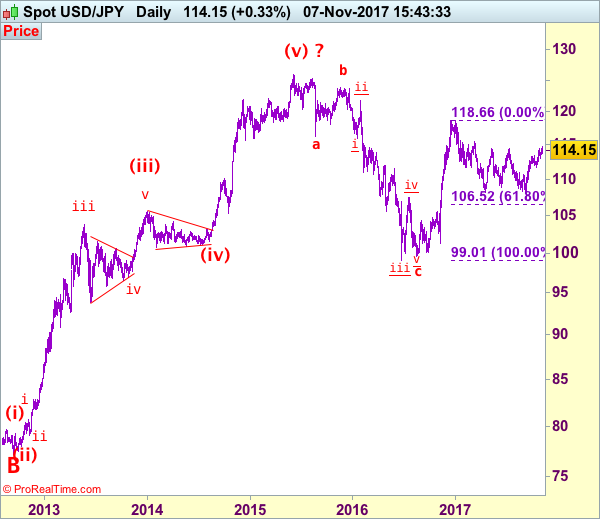
USD/JPY – Wave V of larger degree circle V has possibly ended at 75.31 and major correction has commenced and already met indicated target at 125.00.
As the greenback has maintained a firm undertone after recent break of indicated previous resistance at 114.45-50, adding credence to our bullish view that the rise from 107.32 low is still in progress and bullishness remains for this move to extend gain to 115.00, above there would signal the correction from 118.66 top has ended earlier at 107.32 and the rise from there may extend further gain to previous resistance at 115.51. Looking ahead, a sustained breach above this level at 115.51 would retain bullishness, then subsequent gain to 116.00-10 and possibly 116.50-60 would follow.
Our preferred count is that, triangle wave IV (with circle) ended at 101.45 and the circle wave V brought dollar down to the record low of 75.31 in 2011 and the subsequent rebound signal major correction has commenced with A leg ended at 84.19, followed by wave B at 77.14 and impulsive wave C is now unfolding (indicated upside target at 125.00 had been met) for gain towards 127.00 level. In the event dollar drops below support at 99.01, this would confirm medium term decline from 125.86 top (2015 high) has resumed for subsequent weakness to 98.00 and possibly 97.00.
Under this count, this wave C is unfolding as impulsive waves with (1) (2), 1 2 ended at 80.67, 79.07, 82.84 and 81.69 respectively, hence the extended wave 3 has ended at 103.74 and wave 4 correction of recent upmove should bring weakness to 92.57, then towards 90.88 but psychological support at 90.00 should limit downside and bring another rally later in wave 5, indicated target at 125.00 had been met and gain to 127.00 cannot be ruled out but reckon price would falter below 130.00.
On the downside, whilst initial pullback to 113.00-10 cannot be ruled out, reckon downside would be limited to 112.50-60 and 112.00 would contain downside, renewed buying interest should emerge above support at 111.65 and bring another rise later. Only a drop below said support at 111.65 would suggest a temporary top is formed instead, bring weakness to 111.00 but downside should be limited to 110.40-50 and support at 109.55 should remain intact. A breach of strong support at 109.55 would abort and suggest the rebound from 107.32 has ended instead, risk weakness to 109.00 and possibly 108.50-60 but price should stay well above said support at 107.32 and bring another rebound later.
Recommendation: Buy at 112.95 for 114.95 with stop below 111.95.
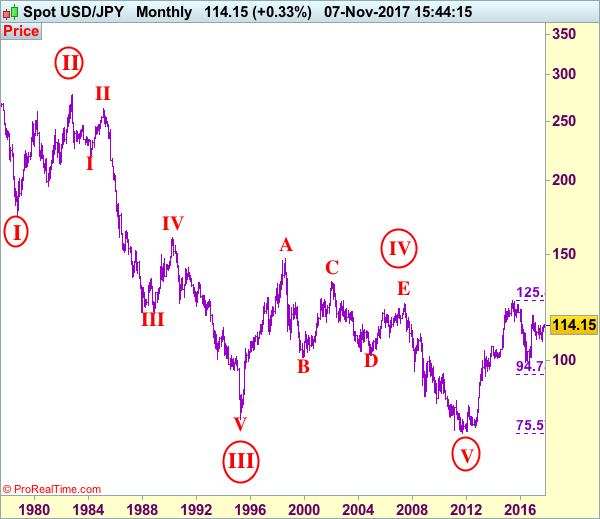
On the monthly chart, we have changed our preferred count that an impulsive wave is unfolding with major wave III with circle ended at 79.75, then followed by wave IV with circle and is labeled as a triangle with A: 147.64 (11 August, 1998), B: 101.25, C: 135.20, D: 101.67 and E leg ended at 124.14 to end the wave IV with circle. Hence, wave V with circle commenced from there and hit a record low of 75.31, however, the subsequent strong rebound signals this circle wave V has possibly ended there, hence gain to (indicated upside target at 122.00 and 125.00 had been met), the retreat from 125.86 suggests wave A of major correction has ended there and wave B correction back to 99.00, then 95.00 would be seen, however, reckon downside would be limited to 90.00, bring another rebound in wave C next year.
Oil Hits A New Two-Year High, No Immediate Resistance
Oil prices continue to be front and center for traders in a relatively quiet market. Brent crude surged 3.5% to trade above $64 on Monday, after the arrests in Saudi Arabia raised investors’ concerns over the stability of the Middle East region. Comments from Saudi Gulf Affairs Minister, Thamer Al-Sabhan, stating that the government of Lebanon has declared war on Saudi Arabia, added more tooil’s political risk premium. Fundamentals remain very positive, with OPEC’s willingness to resume the 1.8 million production cuts, and booming demand from developed and emerging markets. However, conflicts within the Middle East are becoming a majorinfluencer on energy markets, and a further surge in prices will likely be due to political risk premium rather than fundamental support. If tensions escalatefurther, traders will be targeting $70 for Brent, although such levels may not be sustainedin the long run.
In currency markets, the dollar changed little against its major peers, after falling slightly on Monday. There weren’t any significant economic releases to justify the dollar’s weakness, but U.S. TreasuryBonds seem to have a story to tell. Unlike U.S. stocks, which are showing a very bright economic outlook, yields on U.S. 10-year Treasury Bonds fell for six out of the seven past trading sessions, to trade at 2.31%. The yield curve flattened further, with the 2-year–30-year spread touching 117 basis points, a level last seen in 2007. The flattening yield curve suggests that economic growth and inflation willremain weak in the mid-to-long term which is just the opposite of what stock markets are suggesting. Who's right and who's wrong, only time will tell.
The decision by Reserve Bank of Australia to keep interest rates unchanged had little impact on the Australian dollar. AUDUSD jumped 0.2% after the announcement, but erased gains shortly thereafter and fell slightly into negative territory. The central bank’s language hasn’t changed, and continues to expect GDP growth to pick up and to average around 3% over the next few years, despite signs of weak inflation and consumer spending. Given the balanced approach by RBA, expect the Aussie to remain in narrow trading range.
The economic calendar is also light today, with only a few tier-2 economic data reports due for release. European Central Bank President, Mario Draghi, is due to speak later today at the ECB forum on banking supervision. But given that ECB has just revealed its plan of a gentle taper two weeks ago, I don’t expect his comments to move the markets.
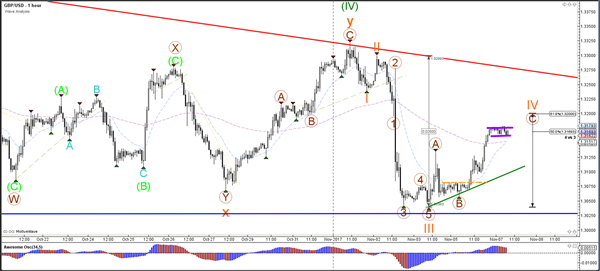
The GBP/USD Is Building A Small Flag. A Break Below Or Above It Could Indicate A Small Breakout
Data released on Monday indicates that the Eurozone economy is on target to close out 2017 strongly. The latest Markit composite PMI fell to 56.0 in October, slightly lower than the previous months reading of 56.7, but well above the key 50 zone indicating positive sentiment for growth. PMI data showed the 2 largest economies, Germany and France, have remained strong. Not all PMI data was positive, as Italian growth slowed and Spain saw its mainstay services sector falling to its lowest level in 9 months. The decline in sentiment in Spain is not surprising given the political crisis that has developed following the Catalonian referendum, with many businesses concerned for their future. An investor sentiment index, released by Sentix, indicated that sentiment has grown to a level not seen in over 10 years – all attributed to a growing economy. With robust economic growth, which is likely to create upward inflationary pressure, the ECB’s recent decision to finally scale back Quantitative Easing can only help in accelerating Eurozone growth.
Earlier this morning, the Reserve Bank of Australia left interest rates unchanged (as expected) at 1.5%, for the 15th month in a row. RBA Governor Philip Lowe said the board expects the current low inflation rate to gradually lift as economic growth improves, stating; “Inflation remains low, with both CPI and underlying inflation running a little below 2%”. The markets are now looking ahead to the RBA’s latest quarterly outlook report (the November Statement on Monetary Policy), due on Friday, which might prove to be more insightful about future policy than today’s interest rate decision. The report is not expected to have changes for growth and inflation forecasts. However, AUD could see volatility if there are any significant changes to the inflation picture, specifically if the report indicates any possible delays to the timing of a rate hike.
EURUSD is unchanged in early Tuesday trading at around 1.1608.
USDJPY is 0.25% higher to currently trade around 114.00.
GBPUSD is little changed overnight, currently trading around 1.3170.
Gold is 0.2% lower in early session trading at around $1,279.50.
WTI is 0.16% higher, trading at around $57.50.
Major data releases for today:
At 15:00 GMT, the UK National Institute of Economic and Social Research will release a 3-month estimate for UK GDP (August to October). The report is released 1 month ahead of the official GDP report and has been known to be highly accurate.
At 19:00 GMT, Bank of Canada Governor Stephen Poloz will be speaking before the CFA Montreal and the Montreal Council on Foreign Relations on the topic of Central banks’ ability to understand inflation. Any hints to future Canadian Monetary Policy will see volatility in CAD.
Trade Idea: EUR/JPY – Hold short entered at 132.70
EUR/JPY - 132.33
Original strategy:
Sold at 132.70, Target: 130.70, Stop: 133.30
Position: - Short at 132.70
Target: - 130.70
Stop: - 133.30
New strategy :
Hold short entered at 132.70, Target: 130.70, Stop: 132.70
Position: - Short at 132.70
Target: - 130.70
Stop:- 132.70
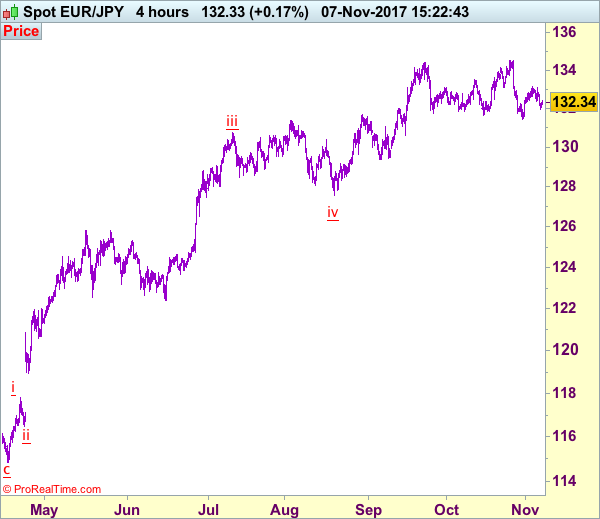
Although the single currency rose briefly to 133.12 yesterday, as renewed selling interest emerged there and euro has retreated again, retaining our bearishness and consolidation with downside bias remains, below support at 131.98 would suggest the rebound from 131.45 has ended at 133.12, bring retest of this level later, below there would extend the fall from 134.50 for a correction of early upmove to 131.00, then towards 130.50-60.
In view of this, we are holding on to our short position entered at 132.70. Above 133.12 would defer and suggest first leg of corrective decline from 134.50 top has ended, risk a stronger rebound to 133.50-60 but still reckon upside would be limited to 133.95-00, price should falter well below said last week’s high at 134.50, bring another selloff later.
Our latest preferred count is that wave (ii) is ABC-X-ABC which ended at 123.33 and wave (iii) is unfolding with wave iii ended at 100.77, followed by wave iv at 111.57 and wave v as well as the wave (iii) has ended at 97.04, followed by wave (iv) at 111.43 and wave (v) has ended at 94.12 which is also the end of the larger degree v, this also implied the major wave (C) has also ended there, hence major correction has commenced from there with (A) leg unfolding in its lower degree wave c which has possibly ended at 145.69. Under this count, A-B-C wave (B) has commenced with A leg ended at 136.23, wave B at 143.79 and wave C has possibly ended at 149.79.
Our larger degree count is that the decline from 139.26 is wave (C) and is sub-divided into a diagonal triangle i-ii-iii-iv-v with wave i - 105.44, wave ii- 123.33, wave iii - 97.03, wave iv - 111.43, followed by the final wave v as well as the end of wave (C) at 94.12, this also mark the bottom of larger degree wave B. Under this count, major rise in wave C has commenced as an impulsive wave with minor wave III ended at 145.69, wave V is still in progress for further gain to 150.00. Having said that, this so-called wave V could well be the first leg of larger degree 5-waver wave C and this wave C should bring at least a retest of wave A top at 169.97 (July 2008).
Trade Idea: AUD/USD – Hold short entered at 0.7720
AUD/USD – 0.7672
Original strategy:
Sold at 0.7720, Target: 0.7550, Stop: 0.7780
Position: - Short at 0.7720
Target: - 0.7550
Stop:- 0.7780
New strategy :
Hold short entered at 0.7720, Target: 0.7550, Stop: 0.7720
Position: - Short at 0.7720
Target: - 0.7550
Stop:- 0.7720
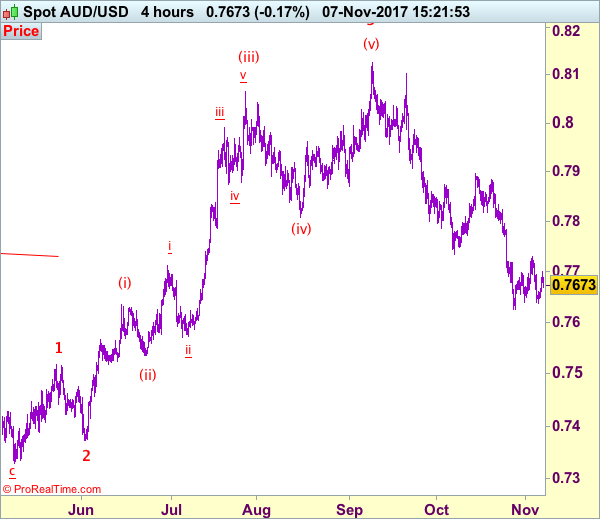
Although aussie rebounded after finding support at 0.7638, as 0.7701 has capped upside and price has retreated, retaining our bearishness for another test of said support, break there would add credence to our view that the rebound from 0.7625 has ended at 0.7730, bring retest of this level, below there would extend recent decline from 0.8125 top to 0.7600, having said that, loss of downward momentum should prevent sharp fall below 0.7550 and reckon 0.7500 would hold from here, bring rebound later.
In view of this, we are holding on to our short position entered at 0.7720. Above said resistance at 0.7730 would defer and risk a stronger rebound but only break of previous support at 0.7770 would abort and suggest a temporary low has possibly been formed, bring rebound to 0.7800 and then towards 0.7825-35 later.
On the 4-hour chart, recent upmove from 0.7329 is unfolding as an impulsive rise with wave 3 as well as smaller degree wave (iii) extending, only minor wave v of (iii) has ended at 0.8125, hence bullishness remains for this move to extend headway to 0.8200, then towards 0.8300, however, reckon upside would be limited to 0.8400 and the final wave 5 should falter below 0.8500, bring correction later.
Daily Wave Analysis: USD/JPY Bearish Daily Candle And Rising Wedge At 115 Resistance
Currency pair USD/JPY
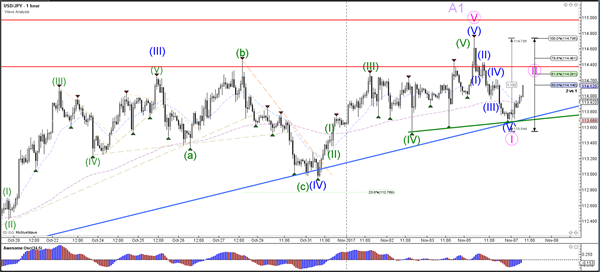
The USD/JPY is challenging the 114.50-115 resistance zone, which is a major break or bounce spot. Yesterday's daily candle ended up bearish with a major wick on the top of the candle. A rising wedge reversal chart pattern could also be taking place but the confirmation of the pattern occurs when price breaks below the support.
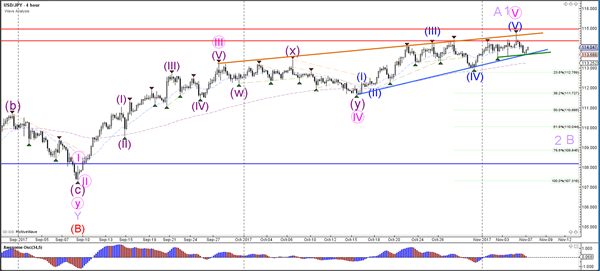
The trend is up at the moment but price seems to be losing steam and speed as it approaches resistance (red). The USD/JPY will need to break above resistance (red) or below support (blue) before the direction could be clear.
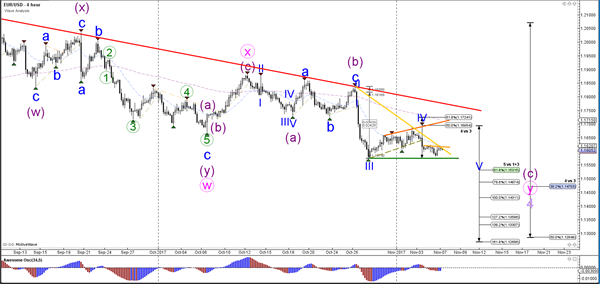
Currency pair EUR/USD
EUR/USD is still struggling to move lower as it failed yesterday to break below the low and bottom (green). The pattern however remains bearish but a new break below the bottom is needed before the wave 5 (blue) is able to continue.
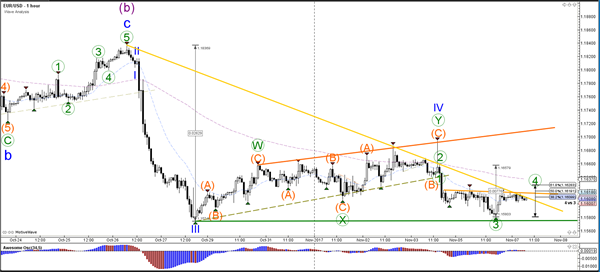
The EUR/USD seems to be building a wave 4 (green) correction and the Fibonacci levels could act as resistance. A break above the 61.8% Fibonacci level makes a wave 4 (green) less likely.
Currency pair GBP/USD
The GBP/USD is testing the Fibonacci levels of wave 4 (orange), which could act as resistance. A break above the 61.8% Fib makes a wave 4 (orange) less likely.
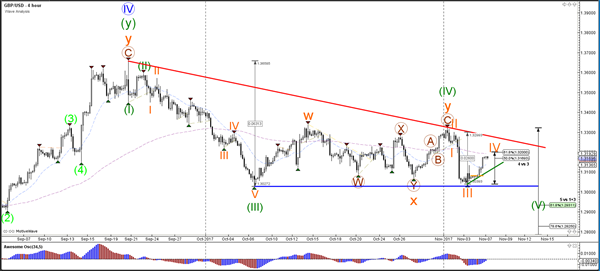
The GBP/USD is building a small flag. A break below or above it could indicate a small breakout.