Sun, Apr 19, 2026 05:26 GMT
More

    Sample Category Title

    AUD/USD Daily Report

    ActionForex

    Daily Pivots: (S1) 0.6437; (P) 0.6472; (R1) 0.6511; More...

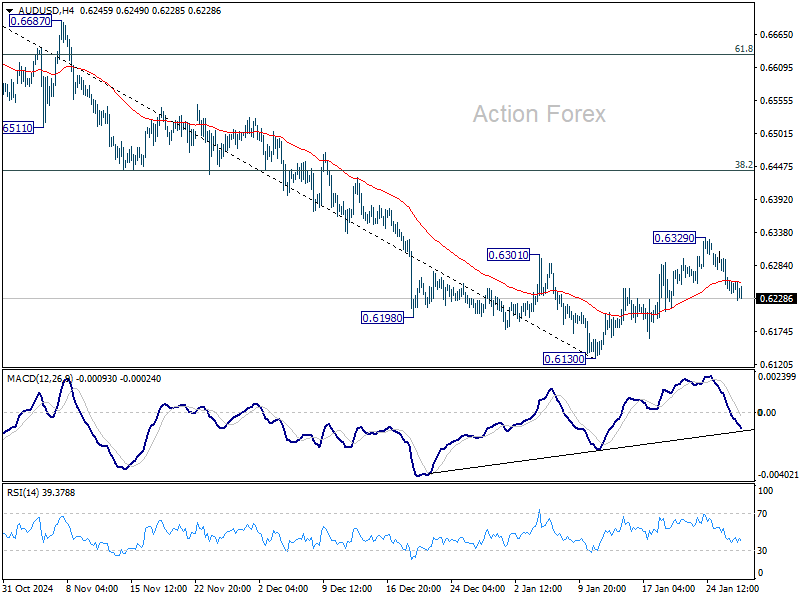
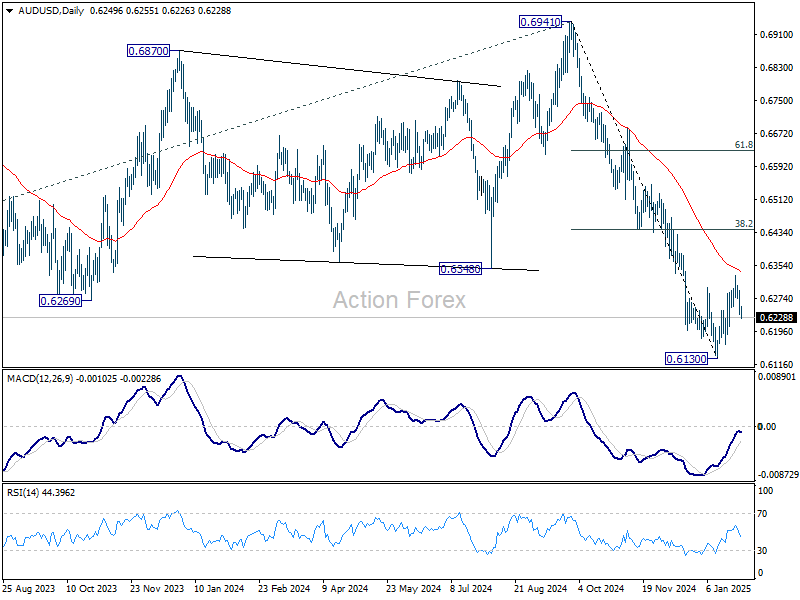
    Intraday bias in AUD/USD remains neutral and more sideway consolidations could be seen. Further decline is expected as long as 0.6687 resistance holds. On the downside, decisive break of 61.8% projection of 0.6941 to 0.6511 from 0.6687 at 0.6421 will resume the fall from 0.6941 to 100% projection at 0.6257 next.

    In the bigger picture, rise from 0.6269 (2023 low) should have completed with three waves up to 0.6941. Corrective pattern from 0.6169 (2022 low) is now extending with another falling leg. Deeper decline would be seen back to 0.6269 as sideway trading extends.

    USD/CAD Daily Outlook

    Daily Pivots: (S1) 1.3958; (P) 1.4068; (R1) 1.4165; More...

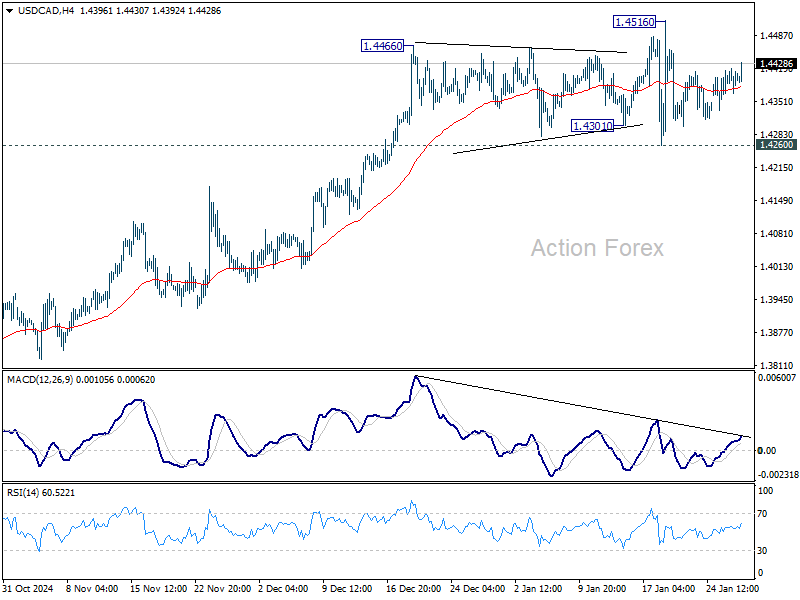
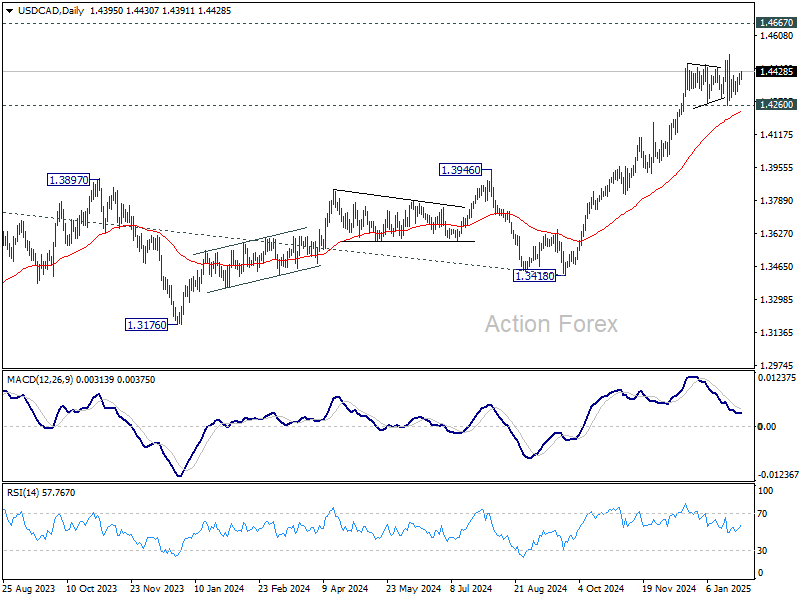
    Intraday bias in USD/CAD is turned neutral first with current retreat. Further rally is expected as long as 1.3930 support holds. On the upside, break of 1.4177 temporary top will resume larger up trend to 61.8% projection of 1.3418 to 1.4104 from 1.3930 at 1.4354 next.

    In the bigger picture, up trend from 1.2005 (2021) is resuming with break of 1.3976 key resistance (2022 high). Next target is 61.8% projection of 1.2401 to 1.3976 from 1.3418 at 1.4391. Now, medium term outlook will remain bullish as long as 1.3418 support holds, even in case of deep pullback.

    EUR/CHF Daily Outlook

    Daily Pivots: (S1) 0.9281; (P) 0.9313; (R1) 0.9334; More....

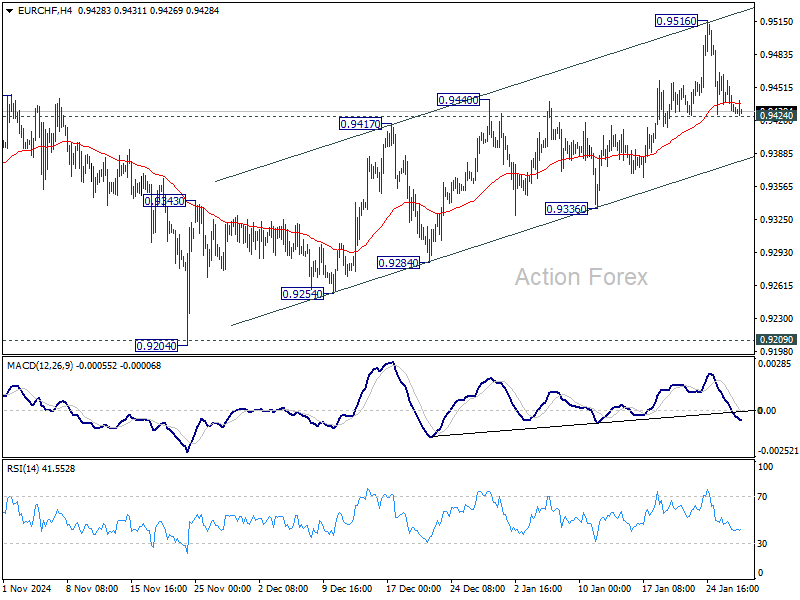
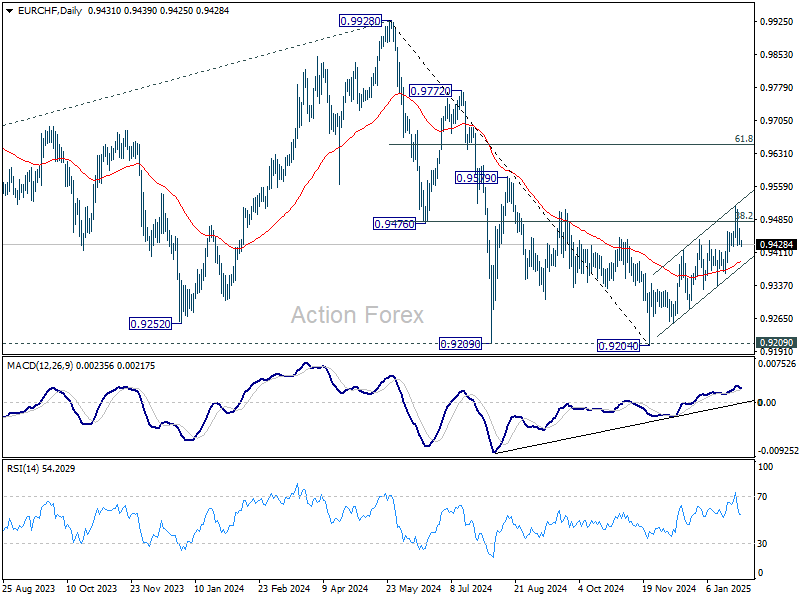
    Intraday bias in EUR/CHF stays mildly on the downside for the moment. Deeper fall would be seen to retest 0.9204/9 support zone. Decisive break there will indicate larger down trend resumption. For now, outlook will stay bearish as long as 0.9364 resistance holds.

    In the bigger picture, outlook will now stay bearish as long as 0.9444 resistance holds. Decisive break of 0.9209 low will resumed long term down trend to 61.8% projection of 0.9772 to 0.9209 from 0.9444 at 0.9096 next.

    EUR/GBP Daily Outlook

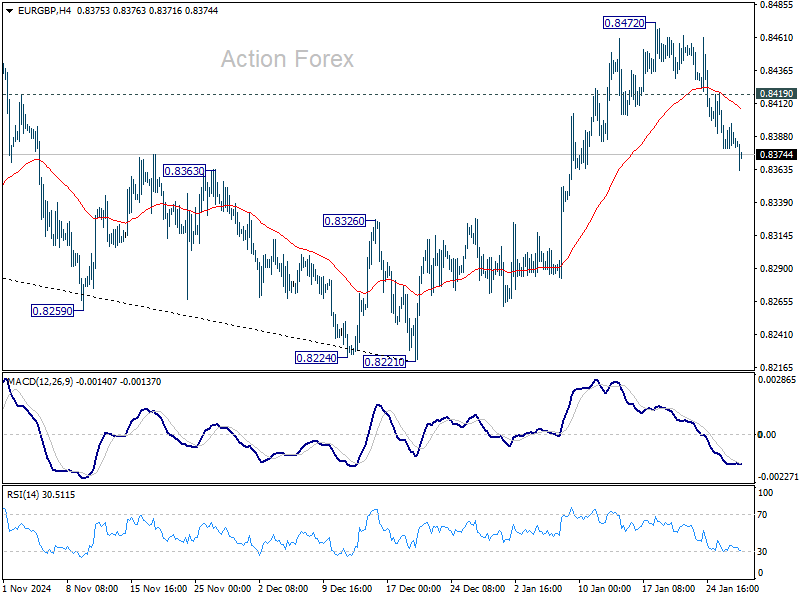
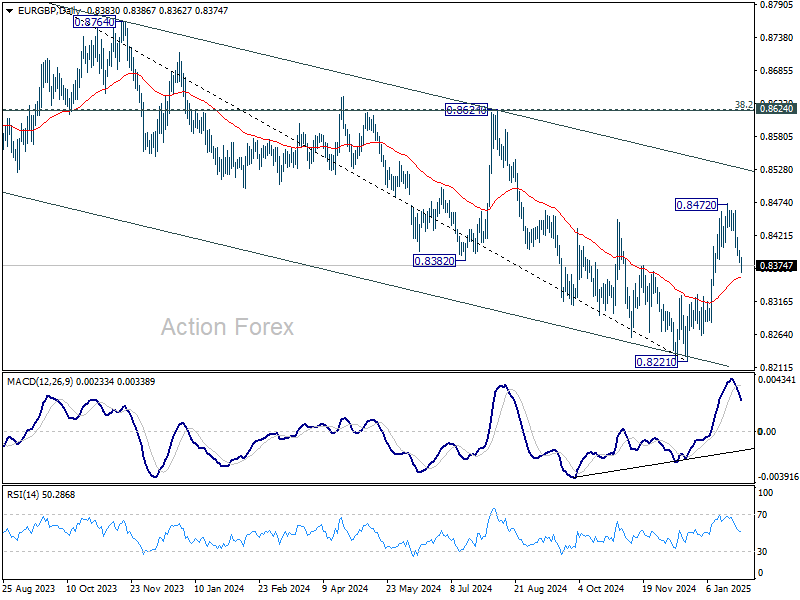
    Daily Pivots: (S1) 0.8330; (P) 0.8347; (R1) 0.8364; More...

    Range trading continues in EUR/GBP and intraday bias remains neutral at this point. Outlook stays bearish with 0.8446 resistance intact. On the downside, decisive break of 0.8259 will resume larger down trend to 0.8201 key support.

    In the bigger picture, down trend from 0.9267 (2022 high) is in progress. Next target is 0.8201 (2022 low), but strong support should be seen there to bring rebound. However, outlook will remain bearish as long as 0.8624 resistance holds even in case of strong rebound. Decisive break of 0.8201 will indicate long term bearish reversal.

    EUR/AUD Daily Outlook

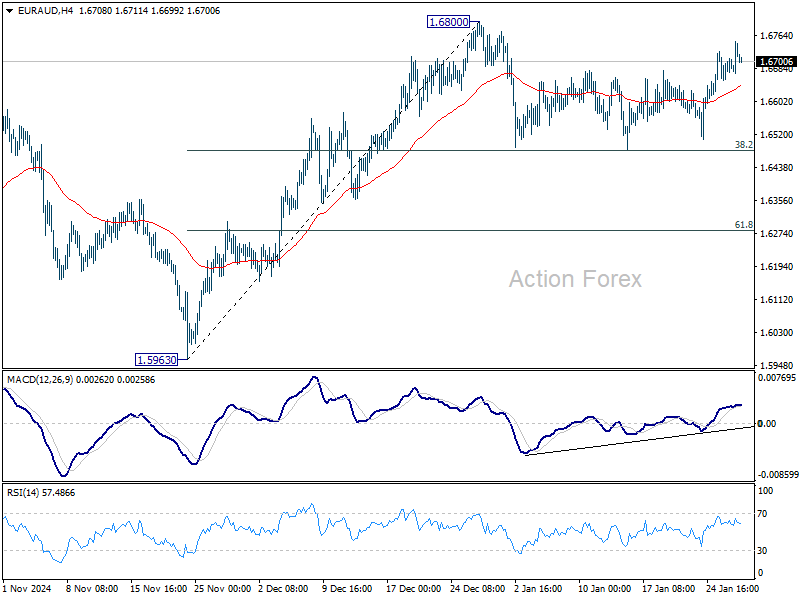
    Daily Pivots: (S1) 1.6137; (P) 1.6191; (R1) 1.6256; More...

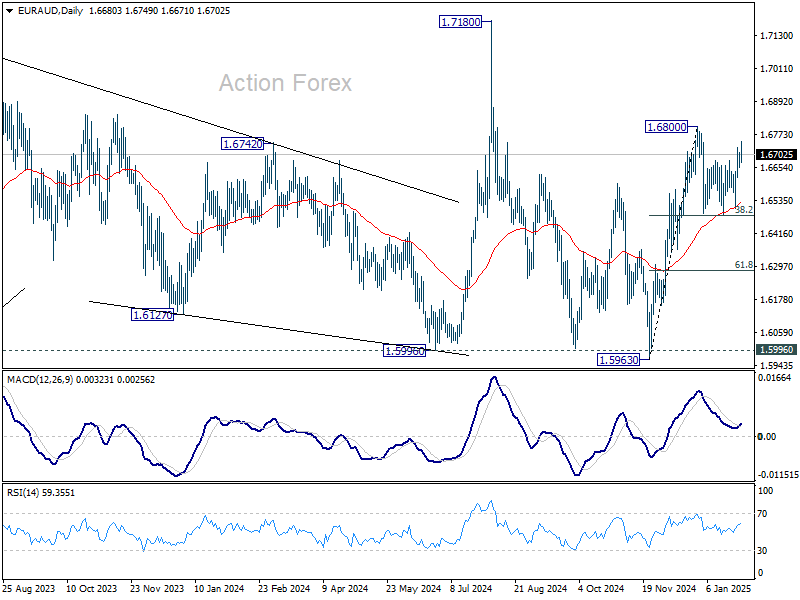
    Intraday bias in EUR/AUD remains neutral for the moment. Another decline is in favor as long as 1.6359 resistance holds. Sustained break of 1.5996 key support will carry larger bearish implications. However, break of 1.6359 will be the first sign of bullish reversal and target 1.6598 resistance for confirmation.

    In the bigger picture, immediate focus is now on 1.5996 key support level. Sustained break there will argue that whole up trend from 1.4281 (2022 low) is already reversing. Deeper decline would be seen to 61.8% retracement of 1.4281 to 1.7180 at 1.5388, even as a correction. Nevertheless, strong rebound from current level, followed by break of 1.6359 resistance, will keep medium term outlook neutral at worst.

    GBP/JPY Daily Outlook

    Daily Pivots: (S1) 191.63; (P) 192.85; (R1) 193.67; More...

    GBP/JPY's fall from 199.79 continues today and intraday bias stays on the downside. As noted before, corrective rise from 180.00 could have completed with three waves up to 199.79. Deeper decline would be seen to 183.70 support next. On the upside, above 194.60 minor resistance will turn intraday bias neutral again first.

    In the bigger picture, price actions from 208.09 are seen as a correction to whole rally from 123.94 (2020 low). The range of consolidation should be set between 38.2% retracement of 123.94 to 208.09 at 175.94 and 208.09. However, decisive break of 175.94 will argue that deeper correction is underway.

    EUR/JPY Daily Outlook

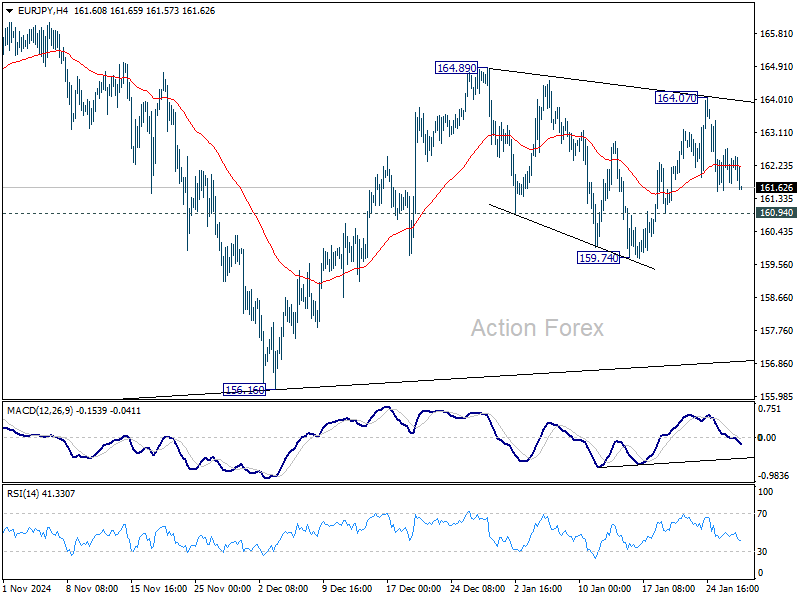
    Daily Pivots: (S1) 161.17; (P) 161.64; (R1) 162.30; More....

    EUR/JPY's fall from 166.67 continues today and intraday bias stays on the downside. As noted before, corrective rebound from 154.40 could have completed with three waves up to 166.67. Deeper decline would be seen to 155.14 support next. On the upside, above 162.10 resistance will turn intraday bias neutral again first.

    In the bigger picture, price actions from 175.41 are seen as correction to rally from 114.42 (2020 low). The range of consolidation should have been set between 38.2% retracement of 114.42 to 175.41 at 152.11 and 175.41 high. However, decisive break of 152.11 would argue that deeper correction is underway.
    Yen Rebound Gains Momentum, NZD Gains on RBNZ’s Moderated Easing Outlook

    Kiwi rebounded broadly during Asian session, supported by a less dovish-than-expected rate cut from RBNZ. While the 50bps reduction to 4.25% had been widely anticipated, RBNZ’s updated forecasts, which suggest a slower pace of easing in 2025, surprised markets. The central bank projects the OCR to reach 3.50% by the end of next year, a level slightly higher than many had anticipated. This has divided analysts over the February rate decision, with ANZ expecting a 25bps cut while Westpac holds firm on a 50bps reduction. Regardless of the outcome, the moderated easing trajectory has bolstered Kiwi against its peers.

    Yen also extended its rally, gaining strength across the board as its rebound against Dollar and European currencies gained momentum. While US Treasury yields showed some overnight recovery, they have struggled to generate sustained upward movement. 10-year yield is just testing critical technical support, reflecting hesitation among bond buyers. Hopes remain that Treasury Secretary nominee Scott Bessent might instill fiscal discipline in the Trump administration, at least for now.

    For the week so far, Yen is currently the strongest performer, followed by Swiss Franc, both benefiting from falling US and European yields. Euro has clawed back some ground after earlier losses, placing third. On the weaker side, Loonie continues to lag, weighed down by uncertainty surrounding Trump’s tariff threats. Aussie and Dollar round out the bottom three, with Kiwi and Sterling holding middle positions.

    Following up on yesterday's comment on AUD/JPY, fall from 102.39 extends lower today, on both Aussie's weakness and Yen's strength. Further decline is now in favor as long as 55 D EMA (now at 100.08) holds. Decisive break of 38.2% retracement of 90.10 to 102.39 at 97.69 should indicate that corrective rebound from 90.10 has completed with three waves up to 102.39. In this bearish case, deeper fall should be seen to 61.8% retracement at 94.79 and below.

    In Asia, at the time of writing, Nikkei is down -1.04%. Hong Kong HSI is up 0.44%. China Shanghai SSE is up 0.37%. Singapore Strait Times is down -0.23%. Japan 10-year JGB yield is up 0.0024 at 1.073. Overnight, DOW rose 0.28%. S&P 500 rose 0.57%. NASDAQ rose 0.63%. 10-year yield rose 0.037 to 4.302.

    FOMC minutes highlight gradual approach to policy easing amid uncertainty

    The minutes from the FOMC November meeting revealed that if economic data aligns with expectations, it would likely be appropriate to "move gradually" toward a neutral policy stance over time. However, they stressed that decisions were "not on a preset course" and would depend on the state of the economy and risks to the outlook.

    The committee acknowledged the volatility of recent economic data, highlighting the importance of focusing on "underlying economic trends" rather than reacting to short-term fluctuations. Most participants assessed risks to employment and inflation goals as "roughly in balance."

    Participants discussed the delicate balance required in easing policy, weighing the risks of moving "too quickly," which could hinder inflation progress, against those of moving "too slowly," which could weaken economic activity and employment.

    Some members suggested that a "pause" in policy easing might be warranted if inflation remained "elevated", while others argued for "accelerating" easing if labor market or economic conditions deteriorate.

    Uncertainty over the "neutral" interest rate also played a significant role in shaping the committee's deliberations. Many participants believed this uncertainty made it prudent to reduce policy restraint "gradually," ensuring flexibility in responding to future developments.

    RBNZ cuts rates by 50bps; projections indicate slower easing ahead

    RBNZ delivered a widely expected 50bps cut to its Official Cash Rate, bringing it down to 4.25%. The central bank maintained easing bias, stating that if economic conditions align with projections, “the Committee expects to be able to lower the OCR further early next year.”

    Governor Adrian Orr did not rule out another large cut in February during the post-meeting press conference. But RBNZ now forecasts the cash rate will drop to around 3.5% by the end of 2024, signaling smaller moves or pauses to assess the impact of prior easing.

    On the economic front, RBNZ expects -0.2% contraction in Q3 2024, followed by recovery to 0.3% growth in Q4. Growth is anticipated to strengthen to a steady 0.6% quarterly rate through 2025 and 2026. “Economic growth is expected to recover during 2025, as lower interest rates encourage investment and other spending,” the central bank noted. .

    Inflation is projected to slow from 2.2% currently to 2% by early 2025, but RBNZ forecasts show it picking up again and remaining between 2.0% and 2.5% through early 2027.

    Australian CPI steady at 2.1% in Oct, underlying inflation shows mixed trends

    Australia’s monthly CPI was unchanged at 2.1% yoy in October, below expectations of a rise to 2.5% yoy. This marks the lowest annual inflation rate since July 2021.

    Core inflation metrics presented mixed signals, with CPI excluding volatile items and holiday travel slowing from 2.7% yoy to 2.4% yoy. However, trimmed mean CPI, a preferred gauge of underlying inflation, rose from 3.2% yoy to 3.5% yoy, signaling persistent inflationary pressures in certain sectors.

    At the group level, notable price increases were observed in Food and non-alcoholic beverages (+3.3%), Recreation and culture (+4.3%), and Alcohol and tobacco (+6.0%). These were partly offset by a sharp decline in Transport prices, which fell -2.8%, driven by lower fuel costs.

    Michelle Marquardt, head of prices statistics at the Australian Bureau of Statistics, noted that "the falls in electricity and fuel had a significant impact on the annual CPI measure this month." She highlighted the value of core inflation measures, such as the trimmed mean, in offering deeper insights into inflation trends amid significant price fluctuations.

    AUD/NZD dives but no bearish reversal yet

    AUD/NZD plunged in the Asian session, driven by contrasting developments in Australia and New Zealand. However, it is too early to declare a bearish trend reversal for the cross, with near-term sideways consolidation likely.

    In Australia, RBA received some relief as headline inflation in October did not reaccelerate as feared. While the trimmed mean CPI showed underlying inflation pressures remain strong, declines in CPI excluding volatile items and holiday travel offered some hope. The data keeps the possibility of a February rate cut alive, albeit with low odds.

    Meanwhile, in New Zealand, RBNZ's 50bps rate cut aligned with expectations, but its projected easing path disappointed dovish expectations. RBNZ now forecasts the OCR to drop to 3.50% by the end of 2025, implying only 75bps of further cuts from the current 4.25%. This signals that RBNZ could slow its pace of rate cuts to 25bps steps as early as February, provided the economy stabilizes.

    Technically, a short term top should be in place at 1.1177 in AUD/NZD with today's steep fall. However, outlook will remain mildly bullish as long as 1.0962 support holds. Some consolidations is now expected between 1.0962/1.1177 before resuming the choppy rally from 1.0567.

    Looking ahead

    Germany Gfk consumer confidence and Swiss UBS economic expectations will be released in European session. Later in the day, US will release GDP revision, durable goods orders, goods trade balance, personal income and spending, Chicago PMI, and jobless claims.

    EUR/JPY Daily Outlook

    Daily Pivots: (S1) 161.17; (P) 161.64; (R1) 162.30; More....

    EUR/JPY's fall from 166.67 continues today and intraday bias stays on the downside. As noted before, corrective rebound from 154.40 could have completed with three waves up to 166.67. Deeper decline would be seen to 155.14 support next. On the upside, above 162.10 resistance will turn intraday bias neutral again first.

    In the bigger picture, price actions from 175.41 are seen as correction to rally from 114.42 (2020 low). The range of consolidation should have been set between 38.2% retracement of 114.42 to 175.41 at 152.11 and 175.41 high. However, decisive break of 152.11 would argue that deeper correction is underway.

    Economic Indicators Update

    GMT CCY EVENTS ACT F/C PP REV
    00:30 AUD Monthly CPI Y/Y Oct 2.10% 2.50% 2.10%
    01:00 NZD RBNZ Rate Decision 4.25% 4.25% 4.75%
    02:00 NZD RBNZ Press Conference
    07:00 EUR Germany GfK Consumer Confidence Dec -18.8 -18.3
    09:00 CHF UBS Economic Expectations Nov -7.7
    13:30 USD GDP Annualized Q3 P 2.80% 2.80%
    13:30 USD GDP Price Index Q3 P 1.80% 1.80%
    13:30 USD Initial Jobless Claims (Nov 22) 220K 213K
    13:30 USD Goods Trade Balance (USD) Oct P -101.6B -108.2B
    13:30 USD Wholesale Inventories Oct P -0.10% -0.20%
    13:30 USD Durable Goods Orders Oct 0.40% -0.70%
    13:30 USD Durable Goods Orders ex Transport Oct 0.20% 0.50%
    13:30 USD Personal Income M/M Oct 0.30% 0.30%
    13:30 USD Personal Spending Oct 0.40% 0.50%
    13:30 USD PCE Price Index M/M Oct 0.20% 0.20%
    13:30 USD PCE Price Index Y/Y Oct 2.30% 2.10%
    13:30 USD Core PCE Price Index M/M Oct 0.30% 0.30%
    13:30 USD Core PCE Price Index Y/Y Oct 2.80% 2.70%
    14:45 USD Chicago PMI Nov 44.9 41.6
    15:00 USD Pending Home Sales M/M Oct -1.70% 7.40%
    15:30 USD Crude Oil Inventories -1.3M 0.5M
    17:00 USD Natural Gas Storage -4B -3B


    Review of RBNZ: Another 50bp in February More Likely Than Not

    • The RBNZ cut the OCR by 50bps to 4.25% at its final policy meeting for this year.
    • The RBNZ’s OCR forecast profile was revised down as expected and now shows the OCR at 3.55% at the end of 2025. The Governor indicated the forward track was consistent with a 50bp cut at the February MPS but then a slower pace later in 2025.
    • The Governor indicated the neutral OCR likely lies in the 2.5% - 3.5% range.
    • Beyond this year, the RBNZ’s forecasts for economic growth have been revised down somewhat, reflecting a downward revision to assumed potential output (in particular, slower population growth due to smaller migrant inflows).
    • Revisions to the RBNZ’s historical estimates of the output gap imply that there is less spare capacity than estimated previously, and thereafter a less negative gap over the forecast horizon than projected previously.
    • The peak unemployment rate has been revised down to 5.2%, consistent with the starting point surprise seen in the Q3 data.
    • Inflation is forecast to remain at or above 2% - non-tradables inflation has been revised up in the near term and is in line with Westpac’s forecasts.
    • The RBNZ sees balanced risks for inflation. There remains some uncertainty on how quickly domestic inflation pressures will normalise, balanced by uncertainty on how quickly the economy will respond to interest rate cuts.
    • We now think that it’s more likely than not that the RBNZ will cut the OCR by 50bp in February 2025, contingent on the economy and financial conditions evolving in line with our expectations.
    • After that, uncertainty around the OCR outlook is higher, but we think the easing cycle will be over by mid-year, with the OCR still troughing at 3.5%.

    Key take out: OCR cut 50bps, RBNZ signals a high chance of a 50bp cut in February.

    As widely expected, the RBNZ cut the OCR by 50bps to 4.25%. The decision was reached by consensus and so no vote was taken.

    The RBNZ’s projected track for the OCR was revised lower over 2025 but higher in 2026 from that seen in the August MPS.

    • The projected average OCR in Q4 2025 was revised down 30bps to 3.55%. This is consistent with around 75bps of cuts in 2025 that the Governor noted would likely be largely frontloaded into the February 2025 meeting.
    • The projected OCR for Q4 2026 was revised up 4bps to 3.17%, implying perhaps 1-2 25bps rate cuts in 2026.
    • The RBNZ assumes the OCR reaches around 3.06% in Q4 2027 (the final quarter of the forecast).

    According to the RBNZ, the most important driver of today’s decision was that inflation remains well-contained and the economy has significant excess capacity. Hence there remains scope to continue cutting the OCR towards the neutral zone.

    The RBNZ seems interested in continuing to frontload cuts to get to the neutral zone. That looks like a decent chance of a 50bps cut in February and then just one more 25bp cut in 2025 – all going according to forecast. From then, the OCR profile flattens out noticeably and seems consistent with the idea that the easing cycle will be to all intents and purposes complete by mid-2025. We don’t see much here that is consistent with the more dovish views of global investors we noted in our recent Client Pulse survey.

    The RBNZ continues to emphasize the data dependence of future OCR moves. Either a 25bps or 50bps easing could occur in February depending on the performance of the economy.

    Risks to the RBNZ’s central projections.

    The RBNZ singled out two key uncertainties regarding the near-term outlook – one concerning the persistence of some components of inflation where pricing behaviour is yet to normalise, and the other concerning the speed and timing of the recovery of growth in response to lower interest rates. The RBNZ also notes the possibility of greater inflation volatility over the medium term, reflecting geopolitical risks and climate-related energy and food risks. Other specific economic assumptions that are subject to uncertainty include the outlook for migrant inflows (and their impact) and the extent to which government spending evolves in a way that is consistent with the forecasts in Budget 2024 – the latter perhaps a warning shot to the Government as it begins to consider the fiscal strategy that will underpin Budget 2025.

    Westpac’s OCR call.

    Given the Governor indicated that he saw a high chance the OCR would be cut by another 50bp at the February MPS we would concur this is more likely than not. Our forecasts of the key data between now and the February MPS are not very different to the RBNZ’s – hence it’s hard to hang our hats on any specific piece of data that might move the RBNZ back to a 25bp move.

    After that the outlook is murkier. We didn’t see anything today that suggests our view of the economy is different. Hence a 3.5% trough in the OCR mid-year still looks appropriate. We think that last 25bp cut will come at the May MPS. A skip in the April review seems consistent with the neutral zone getting very close and we do expect some very tangible signs of strength in the housing market by then. It should also be evident that the peak in the Unemployment rate will be near by April based on business surveys and strengthening consumer confidence.

    RBNZ forecast detail: Domestic inflation pressures persist, but import prices pose downside risk to overall inflation.

    The RBNZ’s updated forecasts show inflation sitting just above 2% for most of the projection period. Their longer-term inflation forecast is just slightly higher than they previously assumed, with domestic (non-tradables) inflation now expected to ease more gradually than the RBNZ assumed in August.

    The upwards revision to the RBNZ’s forecasts for domestic inflation is consistent with their updated thinking on the economy’s productive capacity. As discussed below, the RBNZ now estimates that the economy’s rate of potential growth is lower than previously assumed, so there will be less spare capacity in the coming years than they had thought.

    We agree with the RBNZ’s updated thinking on domestic inflation. Domestic inflation has consistently surprised to the upside of the RBNZ’s forecasts over the past two years. While inflation in interest rate-sensitive areas of the economy is cooling (like in the hospitality sector), we’re still seeing strong price increases in less interest rate-sensitive areas, like council rates and insurance premiums. That means total non-tradables inflation is only returning to average rates gradually. The RBNZ’s forecast for non-tradables inflation are now close to our own.

    Despite the lingering firmness in domestic inflation, we still see downside risk to the RBNZ’s overall inflation forecasts as a result of weak imported prices (aka tradables inflation). Imported prices have been much weaker than the RBNZ assumed over the past year and have more than offset the persistence in domestic inflation. While the RBNZ expects inflation in these areas will lift relatively quickly over the year ahead, we think import prices will remain soggy for a while yet.

    As a result, we think it’s likely that overall inflation will dip briefly below 2% in 2025. However, the undershoot of the target midpoint is likely to be temporary and modest and won’t alarm the RBNZ too much. Importantly, this is an area where the uncertain global backdrop will be crucial. Concerns about trade restrictions in the US have already pushed the NZD down in recent weeks, and that could limit or offset the falls in imported inflation that we’ve seen over the past year.

    GDP growth forecasts revised lower.

    Compared to August, the RBNZ is actually slightly more confident about a pickup in economic activity in the near term, lifting its forecast for December quarter GDP growth from +0.1% to +0.3%. Beyond that, though, the RBNZ has substantially revised down its estimates of both actual and potential output over the coming years. It now expects GDP growth of 2.3%y/y for December 2025, compared to 3.3%y/y in the August statement.

    The RBNZ’s growth forecasts are very similar to our own for 2025 (we are slightly more optimistic about 2026).

    This downgrade of the economy’s growth potential was driven by a few factors. First, the RBNZ has assumed that New Zealand’s poor productivity growth performance in recent years will continue. Second, the RBNZ now sees a stronger link between population growth and potential GDP growth – which amplifies the effects of a downward revision to its net migration forecasts for the next few years.

    Notably, Stats NZ today foreshadowed that there will be an upward revision to GDP growth over the year to March 2023 and the year to March 2024 when the September quarter GDP figures are released next month. The updated projections presented in today’s MPS do not incorporate these revisions, and so are based on the data as last published with the release of the June 2024 quarter GDP figures back in September. These revisions are sufficiently historic that they don’t tell us much about the current degree of spare capacity in the economy, but they do show that New Zealand’s labour productivity in recent years hasn’t been quite as poor as was previously reported.

    The net effect of the RBNZ’s revised GDP assumptions is that it now expects a substantially less negative output gap in the years ahead – i.e. less spare capacity in the economy, with the gap being closed sooner. This change is in turn reflected in the upward revision to the RBNZ’s forecasts of non-tradables inflation in the years ahead.

    In a similar vein, the RBNZ has revised down its forecast of the peak unemployment rate for this cycle, from 5.4% to 5.2%. That partly reflects a lower-than-expected starting point, with the unemployment rate rising only to 4.8% in the September quarter, compared to the RBNZ’s forecast of 5.0%. The RBNZ is assuming that this shortfall will persist, with more people dropping out of the labour force altogether as hiring remains soft. We made a similar adjustment to our forecasts after the September quarter labour market surveys, though we still expect a higher peak next year of 5.4%.

    Key domestic data to watch ahead of the RBNZ’s February 2025 Review.

    The next RBNZ policy review will take place on 19 February 2025. Given the unusually long break until the next meeting, there will be a significant number of key domestic economic data releases ahead of that meeting. Indeed, the RBNZ will receive a new round of all of the top-tier quarterly indicators, and so there is plenty of scope for outcomes different to the 50bp rate cut signalled by the RBNZ. The most important releases are:

    • The Q3 GDP report (19 December): The outcome of this report will be compared to the RBNZ’s estimate, with any deviation having implications for the RBNZ’s estimate of the output gap and perhaps also its view on near-term growth momentum. As noted earlier, revisions to historical GDP data will also have a bearing on the RBNZ’s assessment.
    • The Q4 QSBO survey (14 January, TBC): The focus will be on indicators of spare capacity and cost/inflation pressures. It will also be interesting to see to what extent confidence, hiring and investment indicators are lifting from low levels as monetary conditions ease.
    • The Q4 CPI (22 January) and January Selected Price Indexes (14 February): With headline inflation now close to the RBNZ’s 2% target midpoint, the focus will be on whether the composition of the CPI – including key non-tradables prices – is evolving in a manner consistent with it staying there over the coming year.
    • Q4 labour market survey (5 February): Developments in both the unemployment rate and labour costs will be compared against the RBNZ’s updated estimates, while measures of labour input will provide some insight into how GDP might have fared during the quarter.

    In addition to the above, key monthly activity indicators such as the BusinessNZ manufacturing and services indexes and the ANZ Business Outlook survey will also be of interest, as will developments in retail spending and housing indicators (albeit the latter tend to be difficult to read given that the housing market typically goes somewhat quiet over the holiday period). The Government’s Half-Year Economic and Fiscal Update and Budget Policy Statement (17 December) might also contain information bearing on expectations regarding the future stance of fiscal policy.

    Aside from domestic indicators, the focus will be on any clarity that emerges regarding the implications of the Trump presidency for New Zealand’s export outlook and financial conditions (longer term interest rates and the exchange rate). The sustainability of this year’s rebound in dairy commodity prices will also move into focus as attention begins to turn to prospects for the 2025/26 season.

    AUD/NZD dives but no bearish reversal yet

    AUD/NZD plunged in the Asian session, driven by contrasting developments in Australia and New Zealand. However, it is too early to declare a bearish trend reversal for the cross, with near-term sideways consolidation likely.

    In Australia, RBA received some relief as headline inflation in October did not reaccelerate as feared. While the trimmed mean CPI showed underlying inflation pressures remain strong, declines in CPI excluding volatile items and holiday travel offered some hope. The data keeps the possibility of a February rate cut alive, albeit with low odds.

    Meanwhile, in New Zealand, RBNZ's 50bps rate cut aligned with expectations, but its projected easing path disappointed dovish expectations. RBNZ now forecasts the OCR to drop to 3.50% by the end of 2025, implying only 75bps of further cuts from the current 4.25%. This signals that RBNZ could slow its pace of rate cuts to 25bps steps as early as February, provided the economy stabilizes.

    Technically, a short term top should be in place at 1.1177 in AUD/NZD with today's steep fall. However, outlook will remain mildly bullish as long as 1.0962 support holds. Some consolidations is now expected between 1.0962/1.1177 before resuming the choppy rally from 1.0567.