Sun, Apr 19, 2026 19:17 GMT
More

    Sample Category Title

    Canadian Inflation Jumps Higher in October

    TD Bank Financial Group

    Headline CPI inflation increased in October to 2.0% year-on-year (y/y), above expectations for a 1.9% y/y print and up from the 1.6% y/y reading from September.

    The acceleration was due to base-year effects on gasoline prices (the impact of price changes from a year ago falling out of the data), which were down 4.0% y/y, compared to down 10.7% y/y in September. Also pushing prices higher were food costs (2.7% y/y), which have been rising faster than overall inflation for three straight months.

    Encouragingly, inflation in services has continued to ease (3.6% y/y from 4.0% y/y in September). Shelter costs have been a big driver of services inflation, but with lower interest rates, mortgage interest cost inflation has decelerated (14.7% y/y from 16.7% y/y in September), while rent inflation is also easing (7.3% y/y from 8.2% y/y in September).

    The Bank of Canada's preferred "core" inflation measures increased to 2.6% y/y on average, from 2.4% y/y in September.

    Key Implications

    Today's data reinforced the message that the Bank of Canda's (BoC) goal of stabilizing inflation won't be a smooth path. While the increase in headline inflation was expected, the move higher in core inflation was discouraging. Even worse, on a three-month basis, core inflation moved from just above the BoC's target, at 2.1%, to 2.8%. That was a big move and points to core inflation remaining above the BoC's target in the coming months. High inflation for shelter, food, and health care were behind this, and aren't looking likely to go away any time soon.

    The BoC is likely to view today's data release as a minor setback. Inflation had become a background worry, and while it isn't raising any red flags yet, today's data is a reminder that getting price growth to settle at 2% will take time. The BoC will also be getting a reading on Q3 GDP growth next week. That release will do a lot to help guide the central bank in deciding whether it will cut by 25 or 50 bps in December. We think that a 25 bp cut remains the most likely outcome, especially given the resilience that the economy has demonstrated over the last few months.

    USD/JPY Mid-Day Outlook

    Daily Pivots: (S1) 153.89; (P) 154.63; (R1) 155.41; More...

    USD/JPY's break of 153.87 resistance turned support and rising channel suggest short term topping at 156.74. Intraday is back on the downside for pull back to 151.27, and possibly below. But strong support should emerge at 38.2% retracement of 139.57 to 156.74 at 150.18 to contain downside. On the upside, above 155.35 minor resistance will bring retest of 156.74 high instead.

    In the bigger picture, price actions from 161.94 are seen as a corrective pattern to rise from 102.58 (2021 low). The range of medium term consolidation should be set between 38.2% retracement of 102.58 to 161.94 at 139.26 and 161.94. Nevertheless, sustained break of 139.26 would open up deeper medium term decline to 61.8% retracement at 125.25.

    Yen and Swiss Franc Climb as Ukraine War Intensifies on 1000th Day

    The European session saw a significant shift toward risk aversion as geopolitical tensions escalated on the 1,000th day of Russia's war in Ukraine. Investors sought refuge in major US and European treasuries, leading to a notable decline in yields. Safe-haven assets such as Gold, Swiss Franc, and Japanese Yen jumped. But the overall market response has remained relatively contained so far.

    In a marked escalation of the conflict, Ukraine deployed US-supplied ATACMS missiles to strike Russian territory for the first time today. This action followed approval from US President Joe Biden, granted just this week, allowing Ukraine to utilize these medium-range missiles for such attacks. Ukrainian President Volodymyr Zelenskiy addressed parliament, stating that the war's "decisive moments" are expected in the coming year. On the other hand, Russian President Vladimir Putin issued a warning by signing a revised doctrine that lowers the threshold for a nuclear strike. These developments have intensified geopolitical risks, prompting investors to adopt a cautious stance.

    Meanwhile, Canadian Dollar rebounded during early US session, supported by inflation data that slightly exceeded expectations. While this upside surprise is unlikely to derail the BoC from another aggressive 50bps rate cut from the current 3.75% at its December meeting, it may prompt policymakers to consider a more measured pace as interest rates approach neutral levels.

    Overall in currency markets, Japanese Yen is currently as the best performer of the day, followed by Swiss Franc and Canadian Dollar. British Pound lagged, making it the worst performer, with Euro and US Dollar also showing weakness. Australian and New Zealand Dollars positioned themselves in the middle of the performance spectrum.

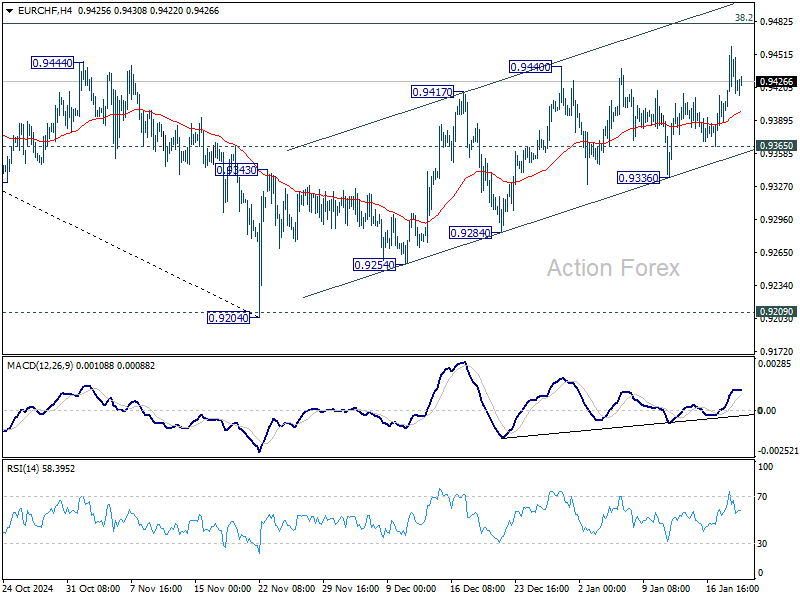
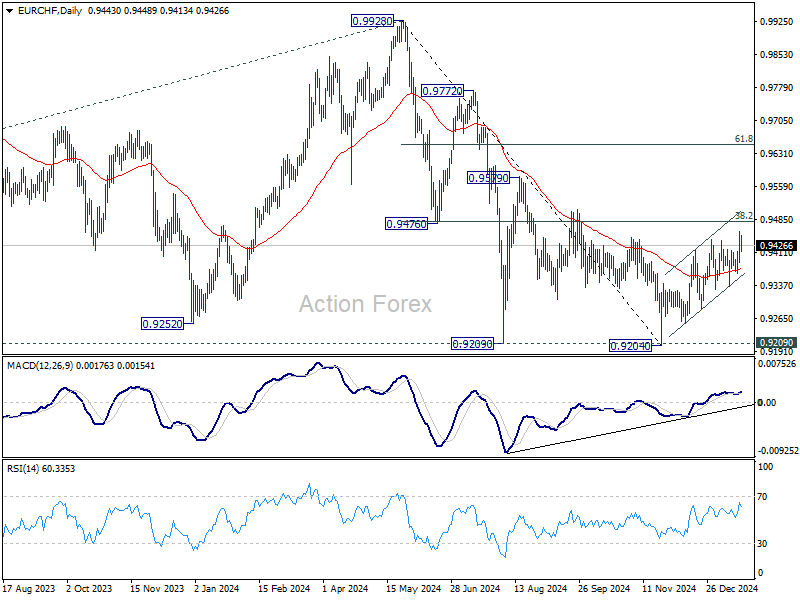
    Technically, EUR/CHF is finally breaking out of the five-wave converging triangle pattern. The repeated rejection by 55 D EMA keeps outlook bearish. Break of 0.9305 low will probably bring resumption of larger down trend through 0.9209 low.

    In Europe, at the time of writing, FTSE is down -0.41%. DAX is down -1.27%. CAC is down -1.36%. UK 10-year yield is down -0.052 to 4.418. Germany 10-year yield is down -0.059 at 2.316. Earlier in Asia, Nikkei rose 0.51%. Hong Kong HSI rose 0.44%. China Shanghai SSE rose 0.67%. Singapore Strait times rose 0.68%. Japan 10-year JGB yield fell -0.0113 to 1.065.

    Canada’s CPI rebounds to 2% in Oct, services inflation slows to lowest since Jan 2022

    Canada's inflation accelerated in October, with the annual headline CPI rising to 2.0% yoy, slightly above expectations of 1.9% yoy and up from September’s 1.6% yoy. Slower decline in gasoline prices was a key driver, with prices falling -4.0% yoy compared to a sharper -10.7% yoy drop in September. Excluding gasoline, the all-items CPI maintained a steady rate of 2.2% yoy, consistent with August and September.

    Goods prices saw a modest rebound, rising 0.1% yoy following -1.0% yoy decline in September. Services inflation moderated to 3.6% yoy, the smallest increase since January 2022. On a monthly basis, CPI rose by 0.4% mom, reversing a similar decline from the previous month.

    Core inflation measures also exceeded expectations. CPI median increased from 2.3% yoy to 2.5% yoy, CPI trimmed rose from 2.4% yoy to 2.6% yoy, and CPI common ticked up from 2.1% yoy to 2.2% yoy. All three exceeded consensus forecasts.

    BoE’s Bailey links tax rises to need for measured policy easing

    BoE Governor Andrew Bailey highlighted in a parliamentary committee hearing today that the Labour government’s tax increases, outlined in the Autumn Budget, support the central bank’s gradual approach to easing monetary policy.

    He explained, “There are different ways in which the increase in employer National Insurance Contributions announced in the Autumn Budget could play out in the economy.” This cautious approach, he said, will allow the Bank to observe how these fiscal changes interact with other inflation risks.

    Bailey also cautioned about persistent wage pressures, with firms surveyed by the BoE expecting wage growth of 4% over the next year, even as the labor market shows early signs of loosening. He emphasized the importance of carefully monitoring these developments.

    ECB's Panetta calls for shift to neutral amid stagnant demand

    Italian ECB Governing Council member Fabio Panetta emphasized today that restrictive monetary policies are "no longer necessary", given inflation’s proximity to the target and sluggish domestic demand.

    Panetta noted, “In the current phase, we should focus more on the sluggishness of the real economy,” highlighting the risk that a lack of recovery could drive inflation well below target, creating challenges for monetary policy to counteract.

    He advocated for normalizing the ECB’s stance and moving toward a neutral or even “expansionary territory” if necessary, stressing, “We are probably a long way from the neutral rate.” Panetta also reminded that lowering rates below neutral at the bottom of a cycle aligns with standard policy frameworks historically followed by both ECB and Fed.

    Separately, Estonian ECB Governing Council member Madis Muller shared that, “I wouldn’t ever want to say anything is a done deal,” but he expressed confidence that “we can again reduce interest rates in December.”

    Eurozone CPI finalized at 2% in Oct, core CPI at 2.7%

    Eurozone inflation was finalized at 2.0% yoy in October, a rise from September's 1.7% yoy. Core CPI, excluding volatile components such as energy, food, alcohol, and tobacco, held steady at 2.7% yoy. Among contributors, services had the largest impact, adding +1.77 percentage points to the overall rate, followed by food, alcohol, and tobacco (+0.56 pp) and non-energy industrial goods (+0.13 pp). Energy, on the other hand, exerted downward pressure, subtracting -0.45 pp from the headline figure.

    Inflation across the broader EU came in at 2.3% yoy, up slightly from September's 2.1%. Member states showed a wide divergence in inflation rates. Slovenia recorded no inflation at 0.0%, while Lithuania and Ireland posted modest increases of 0.1%. At the other end of the spectrum, Romania led with the highest annual rate of 5.0%, followed by Belgium and Estonia at 4.5% each. Compared to September, inflation rose in 19 member states, remained stable in six, and declined in two.

    RBA minutes highlight need for multiple good quarterly inflation reports before easing

    In the minutes from the November meeting, RBA emphasized “minimal tolerance” for a prolonged period of high inflation, acknowledging the already “lengthy period” of elevated prices. They underscored the need to observe "more than one good quarterly inflation outcome" before concluding that a sustainable disinflation trend was underway.

    Members discussed various scenarios that could challenge the forecasts, necessitating adjustments in policy.

    One critical scenario revolved around weaker consumption. If consumption proved “persistently and materially weaker” than anticipated and threatened to significantly lower inflation, RBA suggested that a rate cut might be warranted. Conversely, stronger recovery in consumption could mean the current monetary stance would need to "remain in place for longer".

    The labor market also featured prominently in deliberations. Should employment conditions ease more sharply than expected, resulting in rapid disinflation, the Board acknowledged that looser monetary policy might become appropriate. On the other hand, if the economy’s supply capacity turned out to be “materially more limited” than assumed, a tighter stance could be required.

    External risks were also assessed, including potential major shifts in US economic policy following the presidential election, uncertainty around the scope of China’s anticipated stimulus measures, and the broader implications of rising global government debt levels.

    USD/JPY Mid-Day Outlook

    Daily Pivots: (S1) 153.89; (P) 154.63; (R1) 155.41; More...

    USD/JPY's break of 153.87 resistance turned support and rising channel suggest short term topping at 156.74. Intraday is back on the downside for pull back to 151.27, and possibly below. But strong support should emerge at 38.2% retracement of 139.57 to 156.74 at 150.18 to contain downside. On the upside, above 155.35 minor resistance will bring retest of 156.74 high instead.

    In the bigger picture, price actions from 161.94 are seen as a corrective pattern to rise from 102.58 (2021 low). The range of medium term consolidation should be set between 38.2% retracement of 102.58 to 161.94 at 139.26 and 161.94. Nevertheless, sustained break of 139.26 would open up deeper medium term decline to 61.8% retracement at 125.25.

    Economic Indicators Update

    GMT CCY EVENTS ACT F/C PP REV
    00:30 AUD RBA Meeting Minutes
    07:00 CHF Trade Balance (CHF) Oct 8.06B 4.25B 4.95B 4.94B
    09:00 EUR Eurozone Current Account (EUR) Sep 37.0B 27.0B 31.5B 35.4B
    10:00 EUR Eurozone CPI Y/Y Oct F 2.00% 2.00% 2.00%
    10:00 EUR Eurozone CPI Core Y/Y Oct F 2.70% 2.70% 2.70%
    13:30 USD Building Permits Oct 1.42M 1.44M 1.43M
    13:30 USD Housing Starts Oct 1.311M 1.34M 1.35M
    13:30 CAD CPI M/M Oct 0.40% 0.30% -0.40%
    13:30 CAD CPI Y/Y Oct 2.00% 1.90% 1.60%
    13:30 CAD CPI Median Y/Y Oct 2.50% 2.40% 2.30%
    13:30 CAD CPI Trimmed Y/Y Oct 2.60% 2.40% 2.40%
    13:30 CAD CPI Common Y/Y Oct 2.20% 2.10% 2.10%


    Canada’s CPI rebounds to 2% in Oct, services inflation slows to lowest since Jan 2022

    Canada's inflation accelerated in October, with the annual headline CPI rising to 2.0% yoy, slightly above expectations of 1.9% yoy and up from September’s 1.6% yoy. Slower decline in gasoline prices was a key driver, with prices falling -4.0% yoy compared to a sharper -10.7% yoy drop in September. Excluding gasoline, the all-items CPI maintained a steady rate of 2.2% yoy, consistent with August and September.

    Goods prices saw a modest rebound, rising 0.1% yoy following -1.0% yoy decline in September. Services inflation moderated to 3.6% yoy, the smallest increase since January 2022. On a monthly basis, CPI rose by 0.4% mom, reversing a similar decline from the previous month.

    Core inflation measures also exceeded expectations. CPI median increased from 2.3% yoy to 2.5% yoy, CPI trimmed rose from 2.4% yoy to 2.6% yoy, and CPI common ticked up from 2.1% yoy to 2.2% yoy. All three exceeded consensus forecasts.

    Full Canada CPI release here.

    Aussie Shrugs After RBA Says No Rush to Ease

    The Australian dollar is showing limited movement on Tuesday. In the European session, AUD/USD is trading at 0.6501, down 0.14% on the day. The Aussie flew out of the gates on Monday, climbing 0.75%.

    RBA minutes: No rush to cut rates

    The Reserve Bank of Australia has maintained its cash rate at 4.35% over the past year, making it an outlier among other major central banks that are in the midst of a rate-cutting cycle. The RBA released the minutes of the meeting earlier this month, which indicated that policymakers are not in any rush to lower rates.

    The minutes stated that the Board considered underlying inflation to be “too high” and it did not expect inflation to return sustainably to the 2%-3% target range until 2026. The Board remained “viligant to the upside risks of inflation” and that “it was not possible to rule anything in or out in relation to future changes in the cash rate target”. That is a long way of saying that the Bank has not ruled out rate cuts or hikes.

    The minutes reiterated that the Board’s highest priority is returning inflation to target. Given that the Board stated that inflation remains too high and goods inflation is expected to rise, the message from the minutes is that a rate cut is not imminent. The minutes served as a message to the markets that the RBA is willing to maintain rates unless inflation falls unexpectedly. The RBA meets next on Dec. 10 and is expected to hold rates.

    AUD/USD Technical

    • AUD/USD tested support at 0.6489 earlier. Below, there is support at 0.6467
    • 0.6530 and 0.6552 are the next resistance lines

    BoE’s Bailey links tax rises to need for measured policy easing

    BoE Governor Andrew Bailey highlighted in a parliamentary committee hearing today that the Labour government’s tax increases, outlined in the Autumn Budget, support the central bank’s gradual approach to easing monetary policy.

    He explained, “There are different ways in which the increase in employer National Insurance Contributions announced in the Autumn Budget could play out in the economy.” This cautious approach, he said, will allow the Bank to observe how these fiscal changes interact with other inflation risks.

    Bailey also cautioned about persistent wage pressures, with firms surveyed by the BoE expecting wage growth of 4% over the next year, even as the labor market shows early signs of loosening. He emphasized the importance of carefully monitoring these developments.


    ECB’s Panetta calls for shift to neutral amid stagnant demand

    Italian ECB Governing Council member Fabio Panetta emphasized today that restrictive monetary policies are "no longer necessary", given inflation’s proximity to the target and sluggish domestic demand.

    Panetta noted, “In the current phase, we should focus more on the sluggishness of the real economy,” highlighting the risk that a lack of recovery could drive inflation well below target, creating challenges for monetary policy to counteract.

    He advocated for normalizing the ECB’s stance and moving toward a neutral or even “expansionary territory” if necessary, stressing, “We are probably a long way from the neutral rate.” Panetta also reminded that lowering rates below neutral at the bottom of a cycle aligns with standard policy frameworks historically followed by both ECB and Fed.

    Separately, Estonian ECB Governing Council member Madis Muller shared that, “I wouldn’t ever want to say anything is a done deal,” but he expressed confidence that “we can again reduce interest rates in December.”

    US 100 Index Awaits Fresh Direction

    • US 100 index slides below 20-day EMA, but remains supported
    • Technical indicators reflect uncertainty among traders

    The US 100 stock index has recently pulled from a record high of 21,230 to set a footing near the 23.6% Fibonacci retracement of its August-November uptrend at 20,288. Despite its retreat, the index seems well-supported and market sentiment is currently in a holding pattern.

    The 20-day exponential moving average (EMA) has again resumed its resistance role, capping the index within a tight range, as seen earlier this month. With technical indicators offering unclear signals, traders are stuck in wait-and-see mode. The Relative Strength Index (RSI) sits around its 50 neutral level, signaling indecision, while the stochastic oscillator seems to be printing a potential bullish cross just around its 20 oversold level.

    Given the current setup, the index is poised for a potential breakout in either direction. A rally above the 20-day EMA at 20,550 could pave the way toward the 20,880 barrier. Even higher, the bulls could attempt to chart a new record high near the resistance line at 21,345, while a step above 21,500, could challenge the 161.8% Fibonacci extension of the latest pullback at 21,800 or even touch the psychological bar of 22,000.

    On the other hand, if the index falls below the support trendline from August at 20,335 and beneath its 50-day EMA, bearish momentum could pick up steam toward 19,880 and the 38.2% Fibonacci of 19,700. A deeper pullback could eventually bring the 50% Fibonacci level at 19,230 into play.

    In short, the US 100 index is holding a neutral bias, waiting for a clear move above 20,550 or below 20,200 to gain fresh direction. 

    Gold Price Analysis: Is $2,600 Breakout a Bullish Signal or a Temporary Retracement?

    • The bullish rally in gold is fueled by concerns over the Russia-Ukraine conflict stirring safe haven demand.
    • Market sentiment is torn between the prospect of fewer Fed rate cuts in 2025 and rising geopolitical risks
    • Goldman Sachs analysts predict gold will set new records by the end of 2025, further bolstering bullish sentiment.

    Gold bulls came out of the blocks with speed this week as heightened geopolitical tensions in Europe dominated the weekend. News that the US has authorized Ukraine to use ATACMS missiles to strike in Russian Territory saw the precious metals safe have appeal return.

    There is no doubt that Gold has also benefited from a weaker US Dollar to start the week.

    Currency Strength Chart (Strongest to Weakest): JPY, AUD, NZD, USD, CAD, GBP, CHF, EUR

    Source: FinancialJuice

    At the moment though, the precious metal is caught between a rock and a hard place. Markets continue to bet on less rate cuts in 2025 from the Federal Reserve which is keeping the USD supported. At the same time, the heightened geopolitical risk around Russia-Ukraine and the ongoing situation in the Middle East are keeping Gold buyers interested. The question is, which of the two opposing forces will win?

    The longer term picture for Gold does appear to favor the bulls. Looking back at President Trump’s first term in office, Gold prices rose as much as 55% on account of the trade war with China and tensions with Iran and North Korea. Looking at the picks by President Trump for some of the key positions in his administration and a lot of them are what you would call ‘China hawks’.This has only ramped up expectations of a potential US-China trade war, one of the driving forces behind the Gold rally in Trump’s previous term. Will history repeat itself?

    Adding to the idea that Gold might be beginning the next leg to the upside, Goldman Sachs analysts predict the precious metal will set a new record by the end of 2025.

    Economic Data Ahead

    US data is sparse this week with Geopolitics and more names for Trump’s cabinet likely to drive market sentiment. This morning, news that Russian President Vladimir Putin may use nuclear weapons to any strikes on Russian territory have added a new safe haven narrative.

    On Friday, the only high impact data release from the US is due. The S&P global PMI report will be watched closely as markets are still weighing up the actual health of the US jobs market. This is a direct result from two broad-based downgrades to the numbers since June.

    Following the US PPI data release last week, markets will also focus on the pricing of manufacturing and labor costs. Any uptick here usually trickles downstream to consumers and could suggest an uptick in inflation is indeed on its way, even before President Trump officially takes office.

    Technical Analysis Gold (XAU/USD)

    From a technical analysis standpoint, Gold has failed to maintain its bearish momentum despite a daily candle close below the outer trendline. Earmarks of a false breakout as the precious metal found support at the 100-day before rallying over the last two days to rise around 2.7% thus far.

    The previous breakout of the inner trendline was followed by a retest before a continuation to the downside. This time however, the geopolitical landscape has helped the precious metal push toward a key resistance area around the 2650 handle.

    The move higher this week mirrors the selloff over the past week or two, the question is will it be able to match the selloff in terms of the size of the move. If Goldman Sachs are right, this could potentially be the beginning of the next upside leg leading to new ATHs.

    Immediate resistance rests at 2639 and 2650 before the longer term zone around 2673 comes into focus.

    On the support side, we have potential support resting at 2624 and 2600 before last week’s lows come into focus.

    GOLD (XAU/USD) Daily Chart, November 19, 2024

    Source: TradingView (click to enlarge)

    Support

    • 2624
    • 2600
    • 2574.5

    Resistance

    • 2639
    • 2650
    • 2673

    Bitcoin Aiming for $110K

    Market Picture

    The cryptocurrency market is down 0.5% in 24 hours to $3.08 trillion. The market has paused after rallying since the end of last week. Ethereum and Litecoin have pulled back from recent highs, while XRP is stabilising. Bitcoin and Solana are hovering near recent highs and are getting ready to update them.

    As a result, the sentiment index reached 90 for only the third time this year—it was only higher at the end of 2020. This sentiment confirms that traders are sticking to the four-year halving cycles. In 2020, price records attracted companies to buy the first currency in reserve to support market interest in equities. By 2024, even politicians seem to be scoring PR points by showing their commitment to Bitcoin.

    Bitcoin is trading at nearly $92K. A break above the 13th’s highs of $93.3K would signal an entry into a growth extension with a target of $110K after a corrective pullback to 76.4% of the initial momentum. Such shallow corrections are typical of strong bull markets when buyers quickly return.

    News Background

    According to CoinShares, global crypto fund investments rose by $2.193 billion last week, following inflows of $1.978 billion the week before. Investments in Bitcoin rose by $1.481 billion, Ethereum by a significant $646 million, and Solana by $24 million. Investments in funds that allow bitcoin shorts rose sharply by $49 million. Investments in funds with multiple crypto assets fell by $19 million.

    BCA Research noted that the value of one of the fractal analysis metrics signals a possible rise in Bitcoin above $200K in the current cycle.

    Bernstein expects key catalysts in 2025 to push Bitcoin towards the $200K target level. These include the appointment of a new SEC chairman and treasury secretary, regulatory easing, progress on creating a US strategic bitcoin reserve, creating a powerhouse for BTC mining in the US, and creating a regulatory framework for stablecoins. Another driver will be coin purchases in ETFs, as well as by miners and companies such as MicroStrategy.

    From the 11th to the 17th of November, MicroStrategy purchased an additional 51,780 BTC (~$4.6 billion) using proceeds from the issuance and sale of shares. The average purchase price was approximately $88,627. MicroStrategy now reserves 331,200 BTC at an average price of $49,874 per coin.

    Record daily fees pushed Solana to a peak of over $245 in December 2021. The return of meme coin hype fuelled high network activity.