

Sample Category Title
Euro Holding Crucial Trend Support Vs US Dollar
Key Highlights
- The Euro corrected from 1.2070 to 1.1850 against the US Dollar this past week.
- The EUR/USD is currently holding a major bullish trend line support near 1.1850-70 on the 4-hours chart.
- The US Non-farm Payrolls in August 2017 were 156K, down from the last 189K (revised).
- The US Unemployment Rate was up in August 2017 from 4.3% to 4.4%.
EUR/USD Technical Analysis
The Euro was under pressure above 1.2050 against the US Dollar. As a result, there was a decline in EUR/USD recently, but the pair is holding a major support area near 1.1850.
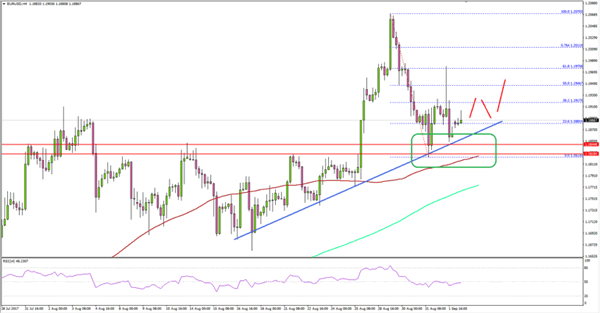
Looking at the 4-hours chart, there is a major bullish trend line support near 1.1850-70. The mentioned 1.1850 level is also a key horizontal support. Furthermore, the 100 simple moving average (H4) is also positioned near 1.1825.
Therefore, the 1.1850 support is very important for the current uptrend in EUR/USD. On the upside, the pair face challenges near 38.2% and 50% Fib retracement level of the last decline from the 1.2070 high to 1.1823 low at 1.1917 and 1.1946 respectively.
US NFP, Unemployment Rate and ISM Manufacturing Index
This past Friday, there were a few important releases in the US such as the non-farm payrolls of August 2017, the unemployment rate and the ISM Manufacturing Index.
The nonfarm payrolls figure published by the US Department of Labor for August 2017 was forecasted to increase by 180K. However, the actual result was disappointing, as the nonfarm payroll employment increased by 156K in August 2017.
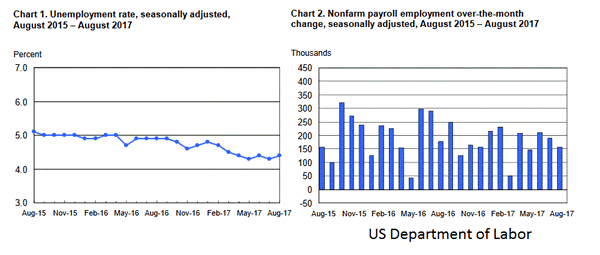
Furthermore, the last NFP reading was revised down to 189K. Looking at the US Unemployment Rate, there was an increase in August 2017 from 4.3% to 4.4%.
The report added that:
The labor force participation rate, at 62.9 percent, was unchanged in August and has shown little movement on net over the past year. The employment-population ratio, at 60.1 percent, was little changed over the month and thus far this year.
Later, the Institute for Supply Management (ISM) Manufacturing Index for August 2017 was released. The forecast was slated for a rise from 56.3 to 56.5. However, the result was positive, as there was an increase to 56.8.
Overall, the EUR/USD is holding a monster support at 1.1850. As long as the pair is above 1.1850, it might recover and trade back towards 1.1950-1.2000 in the near term.
Trade Idea : USD/CHF – Stand aside
USD/CHF - 0.9598
Most recent candlesticks pattern : N/A
Trend : Down
Tenkan-Sen level : 0.9599
Kijun-Sen level : 0.9600
Ichimoku cloud top : 0.9613
Ichimoku cloud bottom : 0.9610
New strategy :
Buy at 0.9540, Target: 0.9640, Stop: 0.9505
Position : -
Target : -
Stop : -
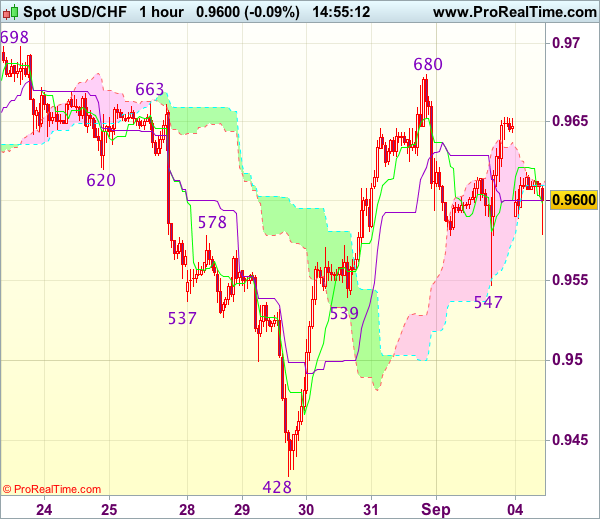
The greenback opened lower today and further consolidation below last week’s high of 0.9680 would be seen, hence downside risk is for another fall towards 0.9539-47 support area, however, if our view that low has been formed at 0.9428 last week is correct, downside would be limited and bring another rebound later. Above 0.9653-55 resistance would bring another test of 0.9680 but break there is needed to add credence to this view and extend gain to resistance at 0.9698-99 which needs to be penetrated to retain bullishness for headway to 0.9730-40.
In view of this, would not chase this rise here and would be prudent to buy dollar on subsequent retreat. Below 0.9515-20 would risk weakness to 0.9490-00 but still reckon downside would be limited to 0.9450-60 and said support at 0.9428 should remain intact, bring another rebound later.
North Korean Hydrogen Bomb Test Rattles Markets
On Sunday, North Korea claimed that it had conducted a test of a hydrogen bomb meant to be carried by a long-range missile. The test of a 100-kiloton bomb was 10 times larger than anything previously tested and is 7 times more powerful than the bomb that destroyed Hiroshima to end the second world war.
Chinese President Jinping warned 'a dark shadow is looming over the world' and, in a joint statement with Russia said its ally North Korea would be 'appropriately dealt with'. With this latest test, geopolitical tensions have risen and the markets have reacted with a risk off sentiment turning to Yen and Gold to hold.
In economic news, the NFP release on Friday was a big surprise to the markets coming in at 156K against the consensus of 180K. The markets were hoping the recent strong ADP release (237K against the forecast 185K), whilst there is not a direct correlation between the two, would result in a strong NFP. With Average Hourly Earnings also decreasing (to 0.1% from the previous 0.3%), it is evident that the lack of upward inflationary pressure will likely delay the Fed in hiking rates this year. As a result, USD was sold against its peers, as the market has determined there is little value in holding the greenback.
ECB President Draghi is expected to express concern over EUR strength when the ECB meets on Thursday. A number of Federal Reserve officials are scheduled to speak this week, including member of the Board of Governors Lael Brainard, Minneapolis Fed President Neel Kashkari, Dallas Fed President Robert Kaplan and New York Fed President Bill Dudley, all of who have expressed doubt about the need for another rate hike this year. US markets are closed on Monday for the Labour Day Bank Holiday.
EURUSD is trading near early highs set on Monday, currently trading around 1.1899.
USDJPY was sold following the North Korea bomb test and is currently trading around 109.55.
GBPUSD is little changed from Friday, currently trading around 1.2955.
Gold is living up to its safe-haven status, climbing up to $1,337.98 in early Tuesday trading. Currently, Gold is trading around $1,337.
WTI is down 0.25% in early trading to currently trade around $47.60pb.
At 09:30 BST, the UK Chartered Institute of Purchasing & Supply and Markit Economics will release PMI Construction for August. Markets are expecting a slightly better release of 52, from the previous release of 51.9. Unless the release is significantly different from the consensus the markets do not expect to see any impact on GBP.
At 10:00 BST, Eurostat will release Eurozone Producer Price Index (YoY) for July. The consensus is calling for a lower number of 2.2% compared to the previous release of 2.5%. Whilst a lower number is traditionally seen as bearish for EUR, the markets do not expect any major impact to the value of EUR as they await further clarity of monetary policy from the ECB at their meeting on September 7th.
USDJPY Intraday Analysis
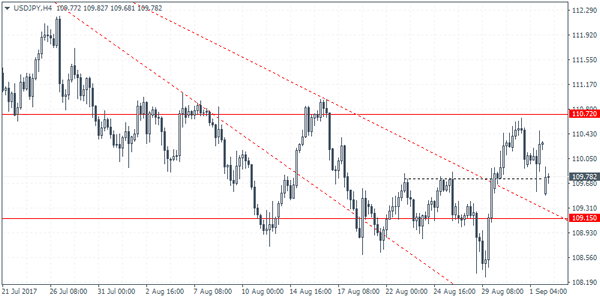
USDJPY (109.78): USDJPY is likely to resume its bullish trend following Friday's retest to the support level at 109.65. This was the level from which USDJPY broke out from the falling trend line. With price not quite testing the resistance level at 110.72, we could expect a breakout from this level. A convincing close above 110.72 will keep the bullish bias intact as USDJPY will now be targeting 113.00. To the downside, failure to hold above 109.65 will keep USDJPY consolidating with the potential to retest the 109.15 support.
Trade Idea : GBP/USD – Stand aside
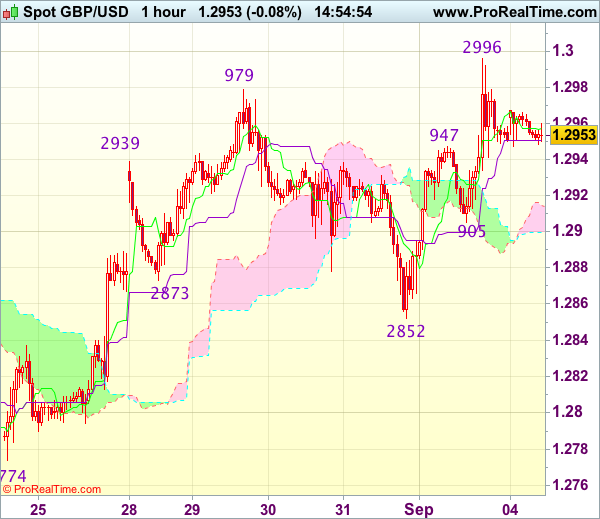
GBP/USD - 1.2952
Most recent candlesticks pattern : N/A
Trend : Near term up
Tenkan-Sen level : 1.2957
Kijun-Sen level : 1.2951
Ichimoku cloud top : 1.2914
Ichimoku cloud bottom : 1.2900
New strategy :
Stand aside
Position : -
Target : -
Stop : -
Although Friday’s anticipated rally has justified our bullishness, lack of follow through buying on break of previous resistance at 1.2979 suggests upside would be limited to 1.3000 and price should falter below another previous resistance at 1.3032, risk from there is seen for a retreat to take place due to loss of near term upward momentum.
In view of this, would not chase this rise here and would be prudent to stand aside for now. Below 1.2930 would risk test of support at 1.2905 but only break there would signal top has been formed at 1.2996 instead, bring subsequent fall to 1.2875-80 and later towards said support at 1.2852.
GBPUSD Intraday Analysis
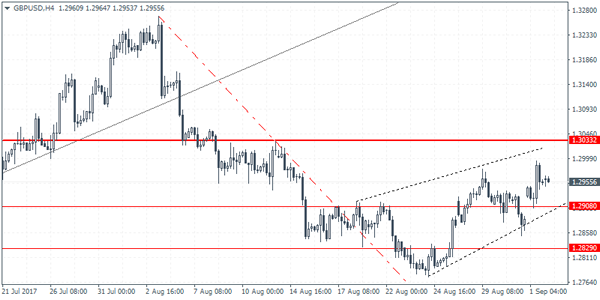
GBPUSD (1.2955): The British pound managed to push higher, but the currency pair eased back after briefly rising to a 14-day high. Further upside gains can be expected as GBPUSD approaches the previously broken support level at 1.3033. A retest of this level as resistance will confirm the downside bias. This will also potentially mark the right shoulder formation in the chart pattern, setting the stage for a decline back to the neckline support at 1.2847. A breakdown below this neckline support will signal a move towards 1.2628.
EURUSD Intraday Analysis
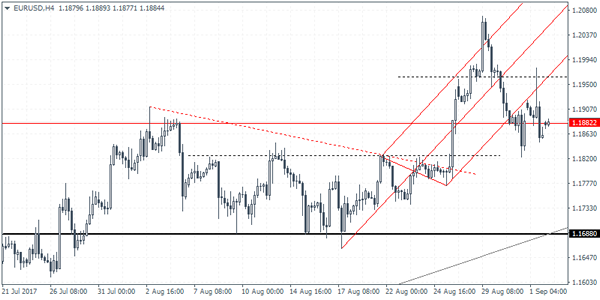
EURUSD (1.1884): The EURUSD closed last week below 1.2000 handle. Friday's payrolls data briefly pushed the common currency to test the minor intraday resistance at 1.1963 following which the common currency reversed to close lower on the day. We now expect the EURUSD remain trading below 1.1882 into this Thursday's ECB meeting. The next main support is seen at the 1.1688 level which could be tested. However, for this to occur, EURUSD will need to break past the minor intraday support at 1.1825. A decline to 1.1688 could potentially mark a decent correction in EURUSD's rally to 1.2000.
US Dollar Closes With Modest Gains
The US dollar closed out on Friday with some modest gains. The nonfarm payrolls data was broadly mixed. According to the data from the Bureau of Labor Statistics, the US economy added 156k jobs in August. This was below consensus estimates of 180k. July's numbers were also revised down to 189k from 209k previously.
Average hourly earnings were also weak, rising just 0.1% on the month after rising 0.3% in July. The unemployment rate inched higher to 4.4%.
The rather weak payrolls report was offset by the ISM manufacturing PMI data. For August, manufacturing PMI rose to 58.8, beating estimates by a strong margin and accelerating from 56.3 in July.
Looking ahead, the economic calendar today will include the Eurozone Sentix investor confidence. Median estimates point to a reading of 27.4, slightly below 27.7 that was registered previously. The UK's construction PMI numbers will also be coming out later in the day with forecasts showing a modest increase from 51.9 in July to 52.1 in August.
Trade Idea : EUR/USD – Sell at 1.1955
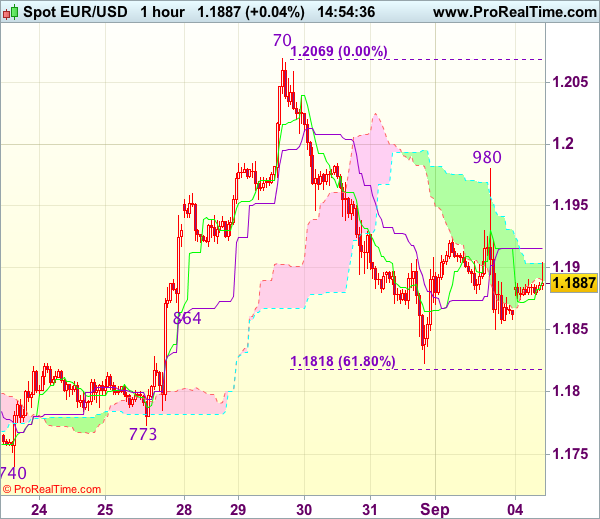
EUR/USD - 1.1891
Most recent candlesticks pattern : N/A
Trend : Up
Tenkan-Sen level : 1.1891
Kijun-Sen level : 1.1915
Ichimoku cloud top : 1.1904
Ichimoku cloud bottom : 1.1888
New strategy :
Sell at 1.1955, Target: 1.1855, Stop: 1.1990
Position : -
Target : -
Stop : -
Although the single currency staged a brief bounce to 1.1980 on Friday, the subsequent anticipated retreat suggests the rebound from 1.1823 has ended there and consolidation with downside bias is seen for another fall to this level, break there would add credence to our view that top has been formed at 1.2070 earlier and extend the fall from there to 1.1815-18 (61.8% Fibonacci retracement of 1.1662-1.2070), then 1.1790-00 but downside should be limited and previous support at 1.1773 should remain intact.
In view of this, we are looking to sell euro again on recovery as 1.1950-55 should limit upside. Only break of said resistance at 1.1980 would abort and signal the fall from 1.2070 has ended at 1.1823 yesterday, bring further gain to 1.2000 and possibly towards 1.2025-30.
Currencies: Risk-Off Sentiment To Block USD Rebound
Sunrise Market Commentary
- Rates: Risk aversion after North Korean nuclear test
Risk aversion dominates Asian trading this morning (positive for core bonds) after Pyongyang's latest nuclear test which triggered an aggressive verbal response by the US. Such geopolitical events had a rather short timestamp on markets of late, but the absence of US traders (Labour Day Holiday) and eco data suggests that it will be today's only trading theme. - Currencies: Risk-off sentiment to block USD rebound.
On Friday, the dollar easily dismissed a mediocre US payrolls report, suggesting that the recent USD decline was exhausted. During the weekend, geopolitical tensions returned to the forefront. Of late, a global safe haven bid didn't help the dollar much. So, a further USD comeback might not be that easy.
The Sunrise Headlines
- US equities closed modestly higher as weak payrolls were fast digested. Asian equities started the week on a weak footing after North Korea tested a powerful nuclear bomb. The yen strengthened, but already lost part of the gains. Gold is moderately higher, but off the lows.
- North Korea said it successfully tested a hydrogen bomb with “unprecedentedly big power” that can be loaded onto an intercontinental missile, in its first nuclear test under US Trump's presidency.
- US defence secretary Mattis, who was a rather dovish voice inside the administration recently, said the US will answer any threat from the North with a “massive military response”.
- US Congressmen return from summer recess Tuesday with the eyes of bond traders squarely upon them. Among their pressing tasks: increase America's borrowing authority and prevent an unprecedented default before Sep 29.
- Moody's raised the outlook on Portugal's Ba1 bond rating to positive from stable as growth continues to show resilience and the debt structure improves. S&P confirmed Sweden's AAA rating stable outlook and Fitch Germany's AAA.
- Russia is likely to back a further extension of the OPEC agreement cutting oil output, the country's deputy prime minister said. Crude traded volatile, but sideways on Friday and is slightly lower overnight.
- The eco calendar is uneventful and US markets are closed for Labour Day today. Later this week focus is on ECB meeting (Thursday), US Congress (debt ceiling, government shutdown) and US Non-manufacturing ISM (Wednesday)
Currencies: Risk-Off Sentiment To Block USD Rebound
Dollar cautiously softer as sentiment turns risk-off
On Friday, the US payrolls disappointed. The dollar instantaneously lost ground, but losses were rapidly erased. EUR/USD spiked from about 1.1920 to 1.1980, but soon turned back south. The dollar received additional support for a strong US manufacturing ISM. Similarly, USD/JPY dropped temporary to the mid 109 area, only to return north of 110. Investor doubts on the statistical accuracy of the August Payrolls might have played a role in the modest USD reaction to the report. The USD price action suggest that the recent setback of the USD is exhausted. EUR/USD finished the session at 1.1860 (from 1.1910). USD/JPY ended at 110.25 (from 109.989).
During the weekend, geopolitical risk returned to the forefront as North Korea tested a new nuclear bomb on Sunday. Major regional equity indices are losing about 1%. China outperforms. USD/JPY opened sharply lower in the 109.25 area, but the yen already returned an important part of the earlier gains (currently 109.80 area). The North Korea tensions have little impact on EUR/USD. It holds very tight range near the 1.1880 level.
Today, US markets are closed today and the EMU calendar is uneventful with only the Sentix investor confidence for September and the PPI for July. Later this week, most attention goes to Thursday's ECB meeting, the return of US Congress (Tuesday) and many Fed speeches ahead of the black period. The rumour mill about the ECB meeting is running hot. ECB Nowotny downplayed euro strength, but unnamed ECB sources suggested that euro strength is making the ECB Council nervous. Other sources said that a decision on the APP programme might be delayed to October or even to December. The stronger euro isn't going to help inflation higher, but growth is above trend, which implies that underlying inflation will at some point start rising. This puts the ECB in a difficult position. The US House will have to hurry up with the vote on a continuing spending bill to avert a government shutdown early October and on the debt ceiling. Regarding US data, we expect the Non-manufacturing ISM to be strong as was the manufacturing one.
Sentiment on the dollar improved slightly after the post Jackson-Hole sell-off. However, for now, the US currency didn't regain any technically relevant level against the euro or the yen. So, the jury is still out whether a sustained USD rebound is on the cards. The data might be slightly USD supportive A (moderate) risk-off sentiment didn't help the dollar much of late . Therefore, we start the week with a neutral bias.
If EUR/USD would fall below the 1.18/1.1775 area, it would suggest that more downside short-term. For such a move, the USD needs good data and higher US yields. On the euro side of the story, Draghi has to convince markets that low inflation is enough a reason for the ECB to maintain a loose monetary policy. On the topside, the 1.2070 correction top remains the first reference.
A downward correction in core (US and European) yields supported the yen in August. USD/JPY declined from mid-114 mid-July and came within reach of the key 108.13 range bottom, but the support did its job. We maintain the working hypothesis that this level won't be broken as a lot USD bad news is discounted. A cautious buy-on-dips (with stop-loss protection below 108) may be considered. USD/JPY needs to regain the 110.95 level to suggest an improved upside momentum. Such a break might be difficult if sentiment would turn risk-off.
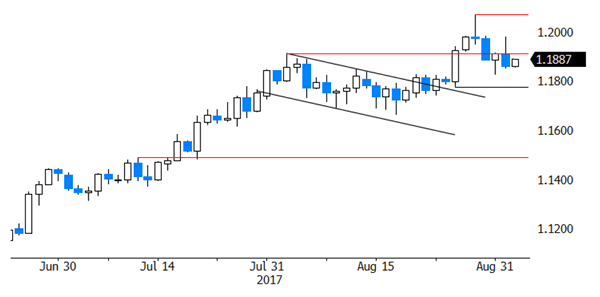
EUR/USD: dollar 'resists' disappointing payrolls report, but no technical signal of a sustained rebound of the US currency yet
EUR/GBP
EUR/GBP drops below 0.92
Sterling traded sideways in the Friday's morning session, ignoring an unexpectedly strong Manufacturing PMI. The improvement was broad-based suggesting that the weak pound is starting to help the economy. EUR/GBP kept close to the 0.9210 going towards the US payrolls release. Strange enough, cable didn't return gains against the dollar after the weaker payrolls unlike EUR, JPY, …. This resulted in a significant decline of EUR/GBP. The pair closed the session at 0.9159 (from 0.9211). Cable closed the session at 1.2951 (from 1.2930).
Today, only the UK construction PMI will be published. A big deviation from consensus is needed to inspire any GBP reaction. During the weekend, there were diverging comments on the poor progress in the Brexit negotiations. UK Davis dismissed rumours that the UK would consider to pay an exit bill of about £ 50 bln. The lack of process in the Brexit talks is a negative for sterling. However, as is the case for the dollar, the recent sterling decline (especially against the euro) looks exhausted. So, some consolidation ahead of the ECB meeting might be on the cards.
From a technical point of view, EUR/GBP cleared the 0.8854/80 resistance (top end June), opening the way for further gains. The move was the result of euro strength. Simultaneously, UK price data were soft enough to keep the BoE sidelined. MT, we maintain a buy EUR/GBP on dips approach as we expect the combination of relative euro strength and sterling softness to persist. The 0.9415 'flash-crash spike' is the next target on the charts. However, wait for a correction, e.g. to the technical support in the 0.88/89 area, to sell sterling again versus the euro.
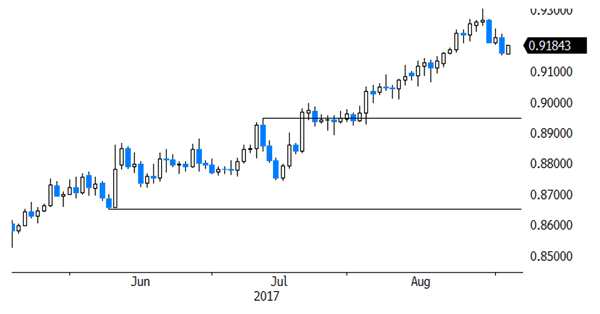
EUR/GBP: sterling extends gradual rebound, despite BRexit stalemate