Sample Category Title
USD/CHF Daily Outlook
Daily Pivots: (S1) 0.9552; (P) 0.9616; (R1) 0.9649; More....
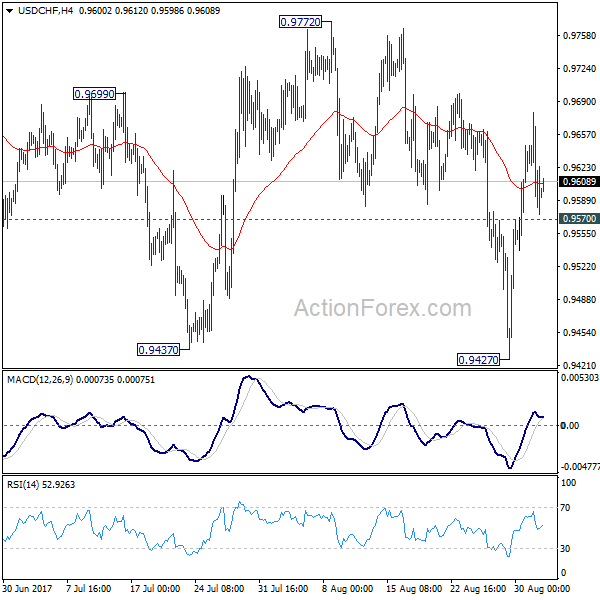
No change in USD/CHF's outlook. considering it's close to to 0.9443 key support, consolidation from 0.9427 might extend further. But still, break of 0.9772 resistance is needed to confirm near term reversal. Otherwise, outlook stays bearish for another decline. Below 0.9537 minor support will turn bias back to the downside for retesting 0.9427 first. Break of 0.9427 will resume whole decline from 1.3042.
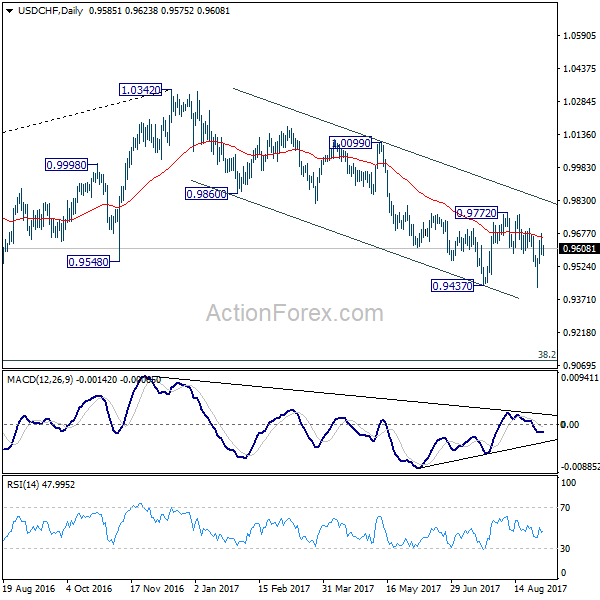
In the bigger picture, current development suggests that 0.9443 key support (2016 low) could be taken out firmly as down trend form 1.0342 extends. There are various interpretation of the price actions. But in any case, medium term outlook will stay bearish as long as 0.9772 resistance holds. Current down trend could extend to 38.2% retracement of 0.7065 (2011 low) to 1.0342 (2016 high) at 0.9090.
Euro Recovers On Faster Flash Inflation Estimates
The common currency recovered after falling to a 4-day low yesterday as data showed that the Eurozone flash inflation estimates accelerated stronger than expected. Headline inflation was seen rising 1.5%, more than the median estimates and rising higher from 1.3% in July. Core inflation howeverrose 1.2% as expected.
In the US, the commerce department reported that personal spending accelerated in July with personal incomes rising as well. However, personal consumption expenditure continued to rise unchanged at 1.4% on an annual basis. On the political front, the US Treasury Secretary, Steven Mnuchin said that President Trump is on track to implement the tax reforms by the end of the year.
Looking ahead, the economic calendar today will see the US nonfarm payrolls. According to the median estimates, the US economy is expected to add 180k jobs for August. The unemployment rate is expected to remain steady at 4.3% while the wages are expected to rise 0.2%, slightly slower than 0.3% increase seen the month before. Later in the day, the ISM manufacturing PMI data will also be released.
USDJPY Rejected From 38.2 Fib Level
The USDJPY pair has fallen back towards the 110 level, after being strongly rejected from the 110.67 level, which represents the 38.2 percent Fibonacci retracement level, of this week's price low, to the July monthly price high.
During the Asian session, the USDJPY pair has found strong support, from the 109.89 level, and is currently holding above the 110 level, ahead of the United States August Nonfarm payrolls jobs report.
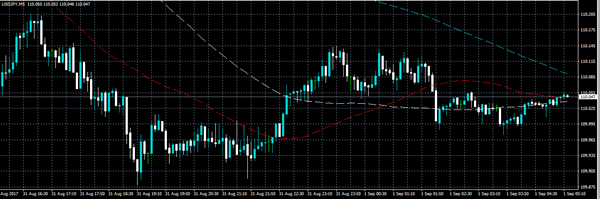
The USDJPY pair remains neutral ahead of the Nonfarm payrolls job report, although in the long-term the pair is still trading in a downtrend.
Key intraday technical resistance is located at 110.37, 110.69, 110.84 and the crucial 111.40-111.50 region.
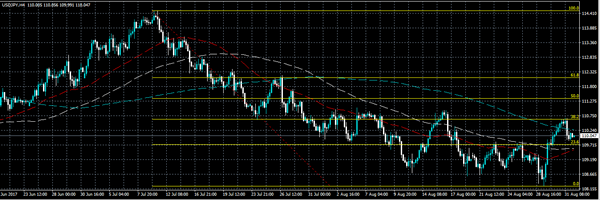
Key intraday technical support is located at the current daily price low, at 109.89, and the 23.6 Fibonacci level of the mentioned price retracement, at 109.75. The weekly pivot point offers further critical support, at 109.28.
Sterling Neutral Ahead Of PMI Data
The GBPUSD pair has moved back towards its 100-day moving average, currently located at the 1.2921 level, ahead of the release of the United Kingdom manufacturing PMI, for the month of August.
Sterling has risen sharply from yesterday's steep decline, which saw the GBPUSD pair hit a weekly price low, of 1.2852. During the Asian session, the pair has so far climbed to a two-day trading high, hitting 1.2947.
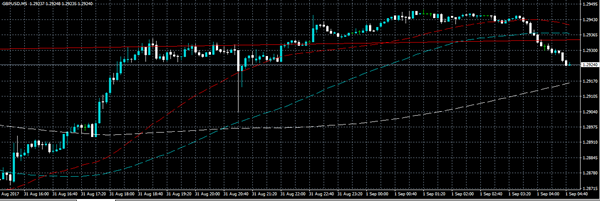
The GBPUSD pair remains neutral on a short and medium-term basis, with price-action again consolidating above and below the 100-day moving average and daily pivot point.
Key intraday technical resistance is located at the current daily high, at1.2947, the current weekly price high, at 1.2979, and the 1.3011 level.
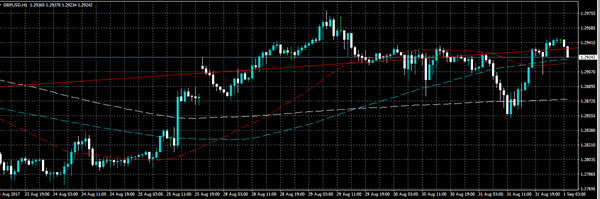
To the downside, the 50-hour moving average offers strong intraday support, at 1.2916, as does the 1.2890 level. The GBPUSD pairs 200-hour moving average, offers critical support, at 1.2872.
USD/JPY Daily Outlook
Daily Pivots: (S1) 109.67; (P) 110.16; (R1) 110.46; More...
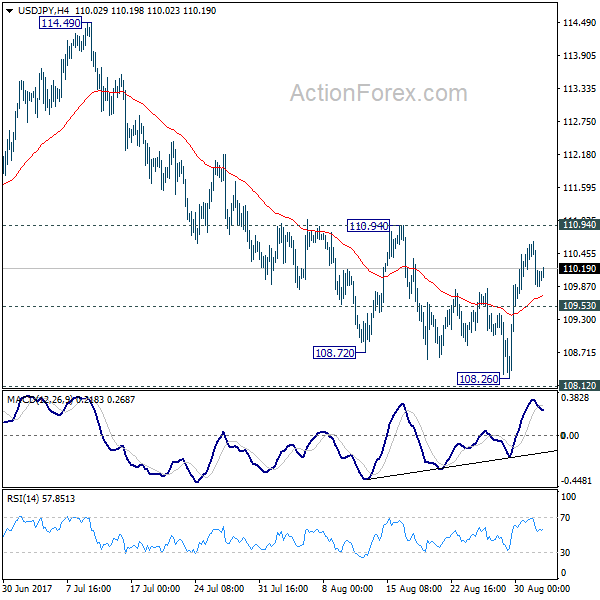
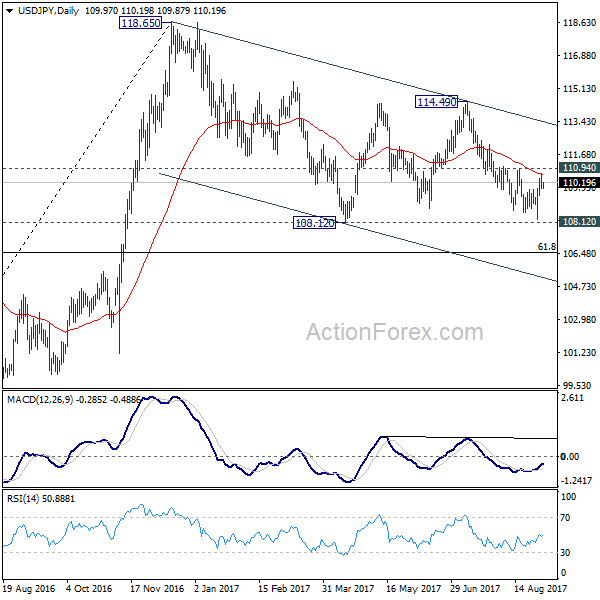
Intraday bias in USD/JPY remains neutral for the moment. With 110.94 resistance intact, outlook stays bearish and deeper decline is still expected. On the downside, below 109.53 minor support will turn bias to the downside for 108.12 support first. Firm break of 108.12 support will resume the whole corrective decline from 118.65. In that case, USD/JPY will target 61.8% retracement of 98.97 to 118.65 at 106.48. Nonetheless, considering bullish convergence condition in 4 hour MACD, break of 110.94 will indicate near term reversal and bring stronger rebound back towards 114.49 resistance.
In the bigger picture, the corrective structure of the fall from 118.65 suggests that rise from 98.97 is not completed yet. Break of 118.65 will target a test on 125.85 high. At this point, it's uncertain whether rise from 98.97 is resuming the long term up trend from 75.56, or it's a leg in the consolidation from 125.85. Hence, we'll be cautious on topping as it approaches 125.85. If fall from 118.65 extends lower, downside should be contained by 61.8% retracement of 98.97 to 118.65 at 106.48 and bring rebound.
The USD Keeps Strengthening Against The Common Currency
The euro continues to weaken thanks to comments from ECB officials regarding the negative impact of a strong currency on economic growth. At the same time, the EUR/USD is still under pressure from the stronger than expected 3% GDP growth in the US for the second quarter of this year. Investor appetite did not improve for the euro even after the release of the preliminary report on the consumer price index in the Eurozone, which saw an increase to 1.5% in August compared to 1.3% in the previous month. The unemployment rate in the euro area came in at 9.1%, its lowest level since 2009 and in line with the forecast.
US dollar bulls were cheered by data on personal spending and personal income that increased in July by 0.3% and 0.4% respectively against 0.2% and 0.0% growth in June. Investors are reluctant to build up positions ahead of the labor market report for August in America that will be published tomorrow. In case of stronger than expected data, we may see the fall accelerate for the pair that will also spike thanks to fixing of positions.
The British pound continues to lose ground on the background of Brexit negotiation concerns. Investors ignored speculations about possible monetary tightening by the Bank of England due to lower risks of turbulence. The lack of progress in negotiations on the terms of the UK leaving the European Union will restrain traders from buying the pound.
EUR/USD
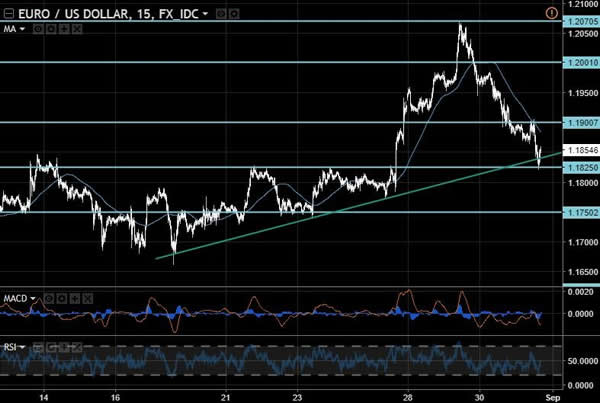
The EUR/USD price recently tested important support at 1.1825. In case of success, we may see a further price decline with potential targets at 1.1750 and 1.1620. In order to renew upward dynamics with the objectives at 1.2000 and 1.2070, the quotes need to break through the SMA100 on the 15-minute chart and the 1.1900 mark.
GBP/USD
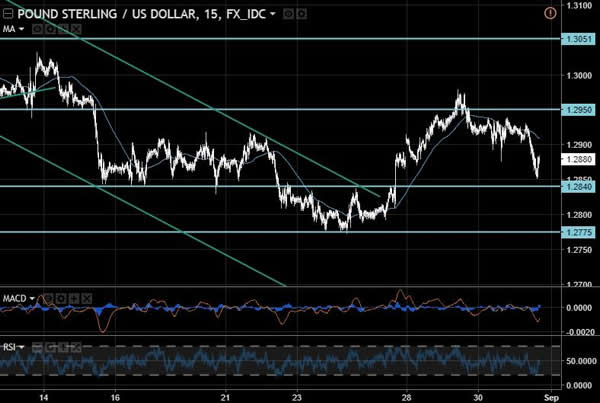
The GBP/USD has shown a sharp decline reaching the 1.2850 mark. If the decline continues, the immediate goal will be at 1.2775, but the quotes need to break through support at 1.2840. Currently, the price is rising after a rebound and we do not exclude that within this impulse quotes will be able to return to the 1.2900-1.2950 range.
USD/CAD
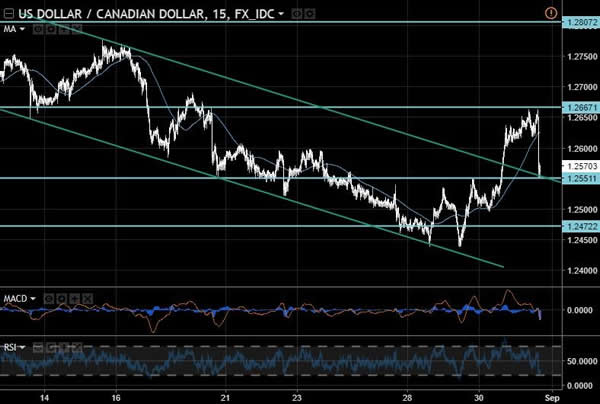
The USD/CAD is falling sharply after the release of strong GDP data in Canada, according to which the national economy grew by 0.3% in June against the predicted increase of only 0.1%. In case of breaking through the 1.2550 mark, the next targets will be at 1.2470 and 1.2400. However, if we see profit taking after a sharp decline, the pair may return to 1.2600.
AUD/USD Daily Outlook
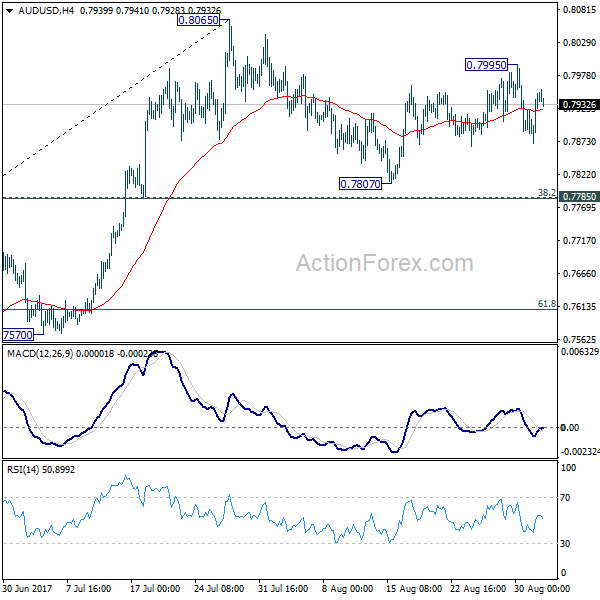
Daily Pivots: (S1) 0.7894; (P) 0.7922; (R1) 0.7973; More...
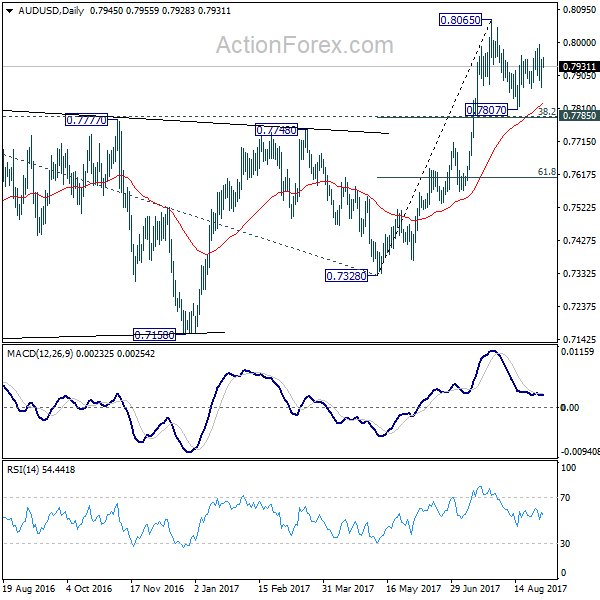
Intraday bias in AUD/USD remains neutral for the moment. Price actions from 0.8065 are developing into a consolidation pattern. In case of another fall, downside should be contained by 0.7785 cluster support (38.2% retracement of 0.7328 to 0.8065 at 0.7783) to bring rebound. On the upside, firm break of 0.8065 will confirm rally resumption for 100% projection of 0.6826 to 0.7833 from 0.7328 at 0.8335.
In the bigger picture, rise from 0.6826 medium term bottom is still in progress. At this point, there is no confirmation of trend reversal yet and we'll continue to treat such rebound as a corrective pattern. But in any case, break of 55 month EMA (now at 0.8097) will target 38.2% retracement of 1.1079 to 0.6826 at 0.8451. Break of 0.7328 support is needed to confirm completion of the rebound. Otherwise, further rise is now in favor.
US Dollar Awaits NFP, Faces Barrier Near 110.60 Vs Yen
.
Key Highlights
- The US Dollar has recovered sharply this week and traded above 110.00 against the Japanese Yen.
- There are two bearish trend lines positioned near 110.60 on the 4-hours chart of USD/JPY.
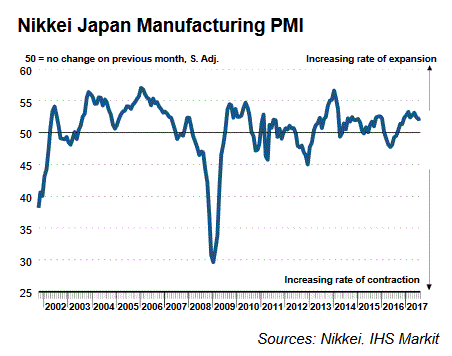
- Japan's Nikkei Manufacturing PMI for August 2017 posted a minor decline from 52.8 to 52.2.
- Today, the US nonfarm payrolls for August 2017 will be released, which is slated to post 180K, down from the last 209K.
USD/JPY Technical Analysis
The US Dollar after trading as low as 108.26 recovered sharply this week against the Japanese Yen. The USD/JPY pair traded towards 110.60 where it faced sellers and currently correcting lower.
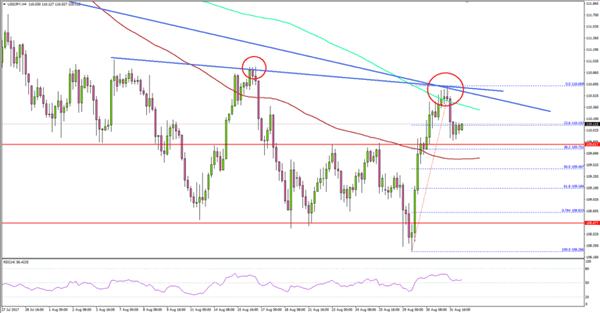
On the upside, there are two bearish trend lines positioned near 110.60 on the 4-hours chart. These trend lines stopped the recent upside move near 110.60 and pushed the pair back below the 200 simple moving average.
The pair corrected below the 23.6% Fib retracement level of the last wave from the 108.26 low to 110.66 high. On the downside, there is a major support near 109.80, which acted as a resistance earlier.
The 109.80 area is also the 38.2% Fib retracement level of the last wave from the 108.26 low to 110.66 high. Therefore, any major dips towards 109.80 can be considered as buying opportunity. The 200 SMA is positioned at 109.70, which is likely to act as a major hurdle for sellers.
Japan's Nikkei Manufacturing PMI
Today, the Japanese Nikkei Manufacturing PMI for August 2017 was released. The forecast was slated for no major change from the last reading of 52.8.
The actual result was on the lower side, as there was a decline in the PMI in August from 52.8 to 52.2. The output, new orders and employment expanded and posted a decent rise in August 2017.
Commenting on the report, the Director at IHS Markit, Paul Smith, stated:
August's survey showed growth moving broadly sideways, maintaining the recent positive trend of improvement in the health of the manufacturing sector.
Overall, the USD/JPY pair remains supported on the downside near 109.80-109.60. If the outcome of today's NFP is above 180K, the pair would accelerate the upside move.
Economic Releases to Watch Today
US nonfarm payrolls August 2017 – Forecast 180K, versus 209K previous.
US Unemployment Rate August 2017 – Forecast 4.3%, versus 4.3% previous.
US Average Hourly Earnings (MoM) August 2017 – Forecast 0.2%, versus 0.3% previous.
US ISM Manufacturing Index for August 2017 – Forecast 56.3, versus 56.5
Currencies: Dollar In Need Of Strong Payrolls
Sunrise Market Commentary
- Rates: Can US payrolls US 10-yr yield away from 2.1%?
We expect a strong payrolls report today even if statistical distortions aren't excluded. Such scenario should pull the US 10-yr yield away from key 2.1% after this week's earlier lackluster attempt. Oil prices are finally affected by the consequences of hurricane Harvey, which is an additional negative. The US long weekend could dampen the blow by the end of US dealings. - Currencies: Dollar in need of strong payrolls
The dollar's upward correction ran into resistance after comments of US Secretary Mnuchin who said the weaker dollar is positive for US trade. The US payrolls need to be strong to avoid renewed dollar weakness. Sterling trading will be guided by the EUR/USD reaction on the payrolls. The EUR/GBP downward correction also stalled, but triggered no key level
The Sunrise Headlines
- US equities extended their winning positive run, gaining around 0.5% with Dow Jones underperforming (+0.25%). Most Asian stock markets record similar gains overnight with Japan (flat) underperforming.
- The havoc wrought by tropical storm Harvey began to spread well beyond the Houston area as the damage to the US's energy infrastructure sent the gasoline price sharply higher and forced Washington to step in to prevent fuel shortages.
- China's manufacturing activity expanded at the fastest pace in six months in August, according to the Caixin PMI (51.6 from 51.1 vs 51.0 expected), buoyed by a surge in export orders and higher prices.
- The dollar extended losses after Treasury Secretary Mnuchin told CNBC that a weaker currency is "somewhat better" for US trade. He also said Congress may have to raise the federal debt limit sooner to account for funds to help Texas.
- President Emmanuel Macron unveiled the ambitious labour overhaul at the center of his drive to revive France's economy, drawing muted criticism from traditionally combative unions that have stymied such efforts in the past.
- China's President Xi Jinping will reveal the new leadership team for his second term in mid-October, official Xinhua news agency said. The ruling Chinese Communist party's 19th congress would convene in Beijing on October 18.
- Today's eco calendar contains US payrolls, unemployment rate, average hourly earnings and manufacturing PMI's in the EMU (final), UK and US (ISM).
Currencies: Dollar In Need Of Strong Payrolls
Dollar correction stalls and partially reverses
The dollar's upward correction initially continued yesterday after ECB rumours that the strong euro raised concerns inside the ECB general council. EUR/USD fell to an intraday low of 1.1823, off opening levels around 1.1885. Comments of US Treasury Secretary Mnuchin initiated a reversal. He said that a weaker dollar was 'somewhat better” for US trade. EUR/USD closed at 1.1910, slightly up from 1.1884 at Wednesday's close. USD/JPY showed a similar picture of initial additional dollar strength with an intraday high at 110.67, followed in the US session by a dollar re-weakening that pushed USD/JPY to a 109.98 close, slightly down from the 110.18 previous close.
Overnight, Asian equities trade flat (Japan) to modestly higher. FX moves are modest as investors await the US payrolls. EUR/USD is marginally lower at about 1.19 while USD/JPY is little changed at 110.04. The Canadian dollar, which performed strong yesterday on the back of strong GDP, higher oil prices and some overall USD weakness in the US session, strengthens still a bit further versus the USD overnight.
Today, the focus will be almost exclusively on the US payrolls, but we keep an eye on the debt ceiling debate as well. It looks, after the damages caused by storm Harvey, like the law raising the debt ceiling will meet less resistance in Congress, which is a MT dollar positive. Regarding the payrolls, we think the labour market is strong, but the August report typically has some statistical issues that urge for caution. These issues include the AHE (wages), a key component that is closely watched by the Fed. The early timing of the payrolls usually dampen the AHE increase. The dollar has been in the defensive for a long time with an exhaustion move (?) in the days following the JH conference. Tuesday afternoon, investors started to take profits on short dollar positions. Yesterday afternoon, the profit taking on dollar shorts was already abruptly aborted. The dollar correction didn't take out any key dollar positive technical level.
In case of a strong payrolls report (plus 200K new jobs, 0.3% M/M or higher AHE and/or a drop in the unemployment rate), we will see whether the dollar is able the resume the correction and take finally out technically relevant levels. In case of EUR/USD, a sustained drop below 1.18/1.1775 is needed to open the possibility for a further correction direction 115 area. If not, the current 1.2071 top would remain in danger. For USD/JPY, a break above 111 is needed to call off the downside alert and make the 108 support more robust.
Broader context and technical picture. Late June, EUR/USD started a new up-leg as investors anticipated a reduction of ECB bond buying. The Fed was expected to normalize policy only in a very gradual way as US inflation remains soft. Uncertainty on the policy of the Trump administration was a secondary negative for the dollar. EUR/USD set a correction top north of 1.19 before consolidating in a 1.1662/1.1910 range. EUR/USD jumped temporary above 1.20 after Jackson Hole. Sentiment on the dollar remains fragile, but there are signs of a EUR/USD topping out. Strong US data are needed for a sustained USD comeback. In MT perspective, the EUR/USD rally has gone far. A return of EUR/USD to the 1.15/16 area is possible. Pockets of US political risk are a (negative) wildcard for the dollar. We wait for a technical signal. A break below the 1.18/1.1775 area would be a sign of a loss off upside momentum.
A downward correction in core (US and European) yields supported the yen in August. USD/JPY declined from mid-114 mid-July and came within reach of the key 108.13 range bottom, but the support did its job. We maintain the working hypothesis that this level won't be broken as a lot USD bad news is discounted. A cautious buy-on-dips (with stop-loss protection below 108) may be considered.
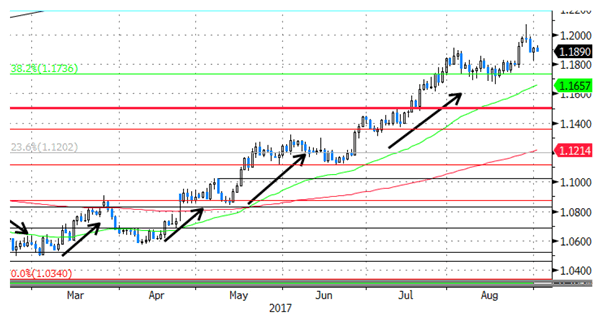
EUR/USD: downward correction still technical irrelevant. Will strong payrolls push the pair below first serious support?
EUR/GBP
Sterling rebound against the euro slows
Sterling's upward correction against the euro ran already into resistance. EUR/GBP closed at 0.9211, slightly up from 0.9195 Wednesday's close. The pair still trades around these levels. Hawkish comments of BoE Saunders had no impact either and neither had the stalemate in the third Brexit negotiation round. GBP/USD closed little changed at 1.2930. US payrolls and the impact on EUR/USD (see above) will give direction for EUR/GBP and cable today.
From a technical point of view, EUR/GBP cleared the 0.8854/80 resistance (top end June), opening the way for further gains. The move was the result of euro strength. Simultaneously, UK price data were soft enough to keep the BoE sidelined. MT, we maintain a buy EUR/GBP on dips approach as we expect the combination of relative euro strength and sterling softness to persist. The 0.9415 ‘flash-crash spike' is the next target on the charts. However, we don't jump on the up-trend anymore after the recent rally and wait for a correction, e.g. to the technical support in the 0.88/89 area.
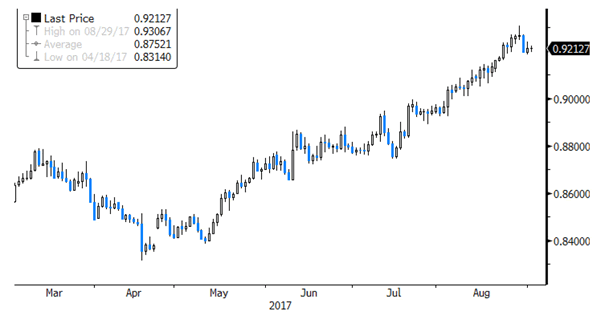
EUR/GBP: correction aborted?
USD/CAD Daily Outlook
Daily Pivots: (S1) 1.2418; (P) 1.2541; (R1) 1.2605; More....
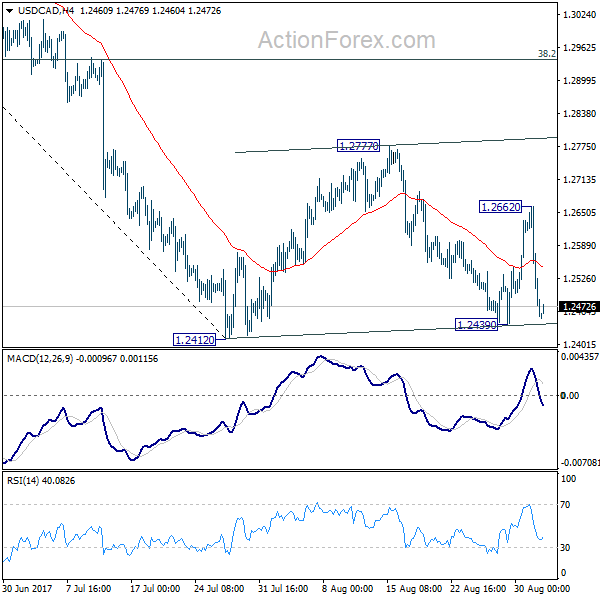
USD/CAD's reversed and dropped sharply after hitting 1.2662. But it's staying above 1.2412 low and intraday bias is turned neutral first. Consolidation from 1.2412 could still expect and above 1.2662 will bring another rise. But upside should be limited by 38.2% retracement of 1.3793 to 1.2412 at 1.2940 to bring fall resumption eventually. On the downside, break of 1.2412 will extend larger fall from 1.3793 and target next long term fibonacci level at 1.2048.
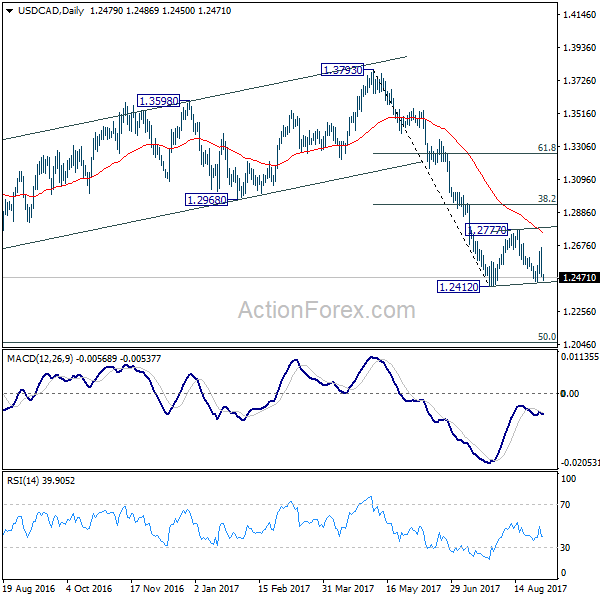
In the bigger picture, price actions from 1.4689 medium term top are seen as a correction pattern. Such corrective fall is still expected to extend to 50% retracement of 0.9406 to 1.4869 at 1.2048. At this point, we'd look for strong support from there to contain downside and bring rebound. Nonetheless, on the upside, sustained break of 1.2968, 38.2% retracement of 1.3793 to 1.2412 at 1.2940 will be the first sign of completion of the correction and will turn focus back to 1.3793 key resistance.