

Sample Category Title
Market Update – Asian Session: PBOC Returns To Open Market Operations, Kiwi Falls 0.5% To A 2-Week Low
Asia Summary
Hong Kong banks led the market higher with the PBoC resuming open market operations after 12 consecutive skips, this was speculated in the press ahead of the announcement given that the government and policy banks needed to sell at least CNY483B in bonds this week and a high chance companies would start to hoard cash ahead of tax payments later this month. According to Chinese press going forward OMO's are expected to remain more modest than prior to this latest hiatus.
NZD/USD fell to a two-week low of 0.7237, attributed to a technical move that then triggered stop losses. The A$ gained slightly on stronger business confidence and conditions for the month of June. However, Australian miners remained under pressure and next week will kick off with results from Rio Tinto, July 11th and then BHP on July 19th.
Key economic data
(AU) AUSTRALIA MAY HOME LOANS M/M: 1.0% V 1.5%E
(NZ) NEW ZEALAND JUN CARD SPENDING RETAIL M/M: 0.0% V 0.8%E; TOTAL M/M: 0.1% V -0.2% PRIOR
(UK) JUN BRC LFL SALES Y/Y: 1.2% V 0.8%E
(UK) UK June Barclays Card Consumer Spending Y/Y: 2.5% v 2.8% prior (15-month low)
(AU) AUSTRALIA JUN NAB BUSINESS CONFIDENCE: 9 V 8 PRIOR; CONDITIONS: 15 V 11 PRIOR
(CN) China Passenger Car Association (PCA): Jun vehicle sales +4.6% y/y; YTD sales -0.2% y/y
Speakers and Press
China
(CN) China may start to inject cash again through OMO due to Govt and policy banks need to sell at least CNY483B in bonds this week and companies may keep cash through July for tax payments - financial press
(CN) China Investment Corporation (CIC) reports 2016 net return on overseas investment 6.22% v -2.96% y/y
Japan
(JP) According to SMBC Nikko Securities analyst: BoJ is unlikely to be prompted into action by the rise in five-year yield unless it causes a spike in volatility or pushes 10-year yields higher
(JP) According to latest Asahi poll 61% feel that Japan PM Abe cannot be trusted
Australia/New Zealand
(NZ) New Zealand PM English: Government allocates NZ$1.0B to a housing infrastructure fund that will focus on 9 projects
US
(US) US President Trump may name Randal Quarles as the Fed's supervision vice chair later today - US press
(US) Fed's Williams (moderate, non-voter): US fiscal policy is on an unsustainable path; reasonable view to expect one more rate hike this year
Asian Equity Indices/Futures (00:30ET)
Nikkei +0.5%, Hang Seng 1.1%, Shanghai Composite -0.2%, ASX200 -0.1%, Kospi +0.3%
Equity Futures: S&P500 +0.1%; Nasdaq flat, Dax +0.2%, FTSE100 +0.1%
FX ranges/Commodities/Fixed Income (00:30ET)
EUR 1.1398-1.1391; JPY 114.26-114.03; AUD 0.7620-0.7603; NZD 0.7272-0.7230
Aug Gold -0.2% at 1,211/oz; Aug Crude Oil +0.4% at $44.58/brl; Sept Copper -0.2% at $2.65/lb
GLD SPDR Gold Trust ETF daily holdings fall 2.96 tonnes to 832.4 tonnes
(CN) PBOC SETS YUAN REFERENCE RATE AT 6.7983 V 6.7964 PRIOR
(CN) PBoC injects combined CNY40B in 7-day and 14-day reverse repos (1st injection in 12 sessions)
(TH) Thailand sells combined THB105B in 3-month, 6-month and 329-day bonds
(JP) Japan MoF sells ¥21.80T v ¥2.2T indicated in 0.10% 5-year JGB bonds; avg yield -0.0350% v -0.065% prior; bid-to-cover: 4.85x v 4.71x prior
Asia equities notable movers
Australia
Slater &Gordon, SGH.AU Reaches in-principle conditional agreement to settle Hall Proceeding; +12.2%
Japan
Suzuki Motor , 7269.JP Netherlands Vehicle Authority said to investigate possible misuse of vehicle emissions software – press; -3%
Hong Kong/China
Geely Automobile, 175.HK Positive profit alert: Guides H1 Net +100% v CNY1.91B y/y; Rev to substantially increase; +3.8%
Korea
005380.KR Hyundai and Kia said to discuss cutting China sales target - South Korean Press
US Session Highlights
(UK) PM May met with Australian PM Turnbull, as she vows to create closer ties, especially on trade. Over the weekend, May had met with Pres Trump, who promised a fast track to a free trade agreement. PM May, weakened after the unneeded early election, has been active in garnering support from third parties in terms of trade to strengthen her position with the EU. But after last week's reports that the EU and Japan were to agree to free trade terms, Japan has said that may not be the case, and in fact the UK may take their front seat on trade talks.
(US) US regulatory agency CFPB announced completion of a rule that would allow class action suits against banks. The rule would prevent banks and credit card companies from including class action bans in customer contracts. The new rules become effective in ~240 days, but under the Congressional Review Act, the GOP has 60 legislative days to block it.
US Treasuries managed to hold some ground today, as investors continued to sell fixed income but at a slower pace. 10-year yield dropped 1.3bps to 2.37%, and the 10s/30s yield curve widen, rising to 55.5bps, with 30-year bond yield only slightly lower at 2.93%.
US markets on close: Dow flat, S&P500 +0.1%, Nasdaq +0.4%
Best Sector in S&P500: IT
Worst Sector in S&P500: Real Estate
Biggest gainers: CF +6.6%; MOS +5.3%; FCX +5.2%
Biggest losers: M -7.1%; GPS -6.3%; BBY -6.3%
At the close: VIX 11.1 (-0.08pts); Treasuries: 2-yr 1.39% (-1.4%), 10-yr 2.37% (-0.8%), 30-yr 2.93% (-0.3%)
Cable Remains Flat Ahead Of Employment Data
Key Points:
- Strong support at 1.2849 likely to cap a further slide lower.
- Pair remains technically neutral.
- Keep a close watch on the U.S. CPI figures, due out during Friday's session.
The Cable experienced a relatively torrid week as the pair was initially beset by a negative UK Manufacturing PMI result of 54.3. In addition, the Construction PMI also proved disappointing, coming in fractionally lower at 54.8. Subsequently, the pair declined through most of the week to close around the 1.2885 mark. However, it's uncertain if the pair will retain its sideways direction in the week ahead. Subsequently, let's review the salient events from last week with a view to forming a directional bias for the coming days.
Last week proved highly negative for the Cable as the pair dealt with the release of some negative UK economic data points. In particular, the UK Manufacturing PMI result quickly turned negative, coming in well below estimates at 54.3, and commencing a slide in the GBPUSD. Additionally, the Construction PMI was also disappointing, slipping to 54.8, and adding to the selling pressure. Late in the week also saw a range of U.S. economic data released with the Non-Farm Payroll figures rising sharply to 222k. Subsequently, the pair saw some strong selling and closed the week out over 140 pips lower and around the 1.2885 mark.
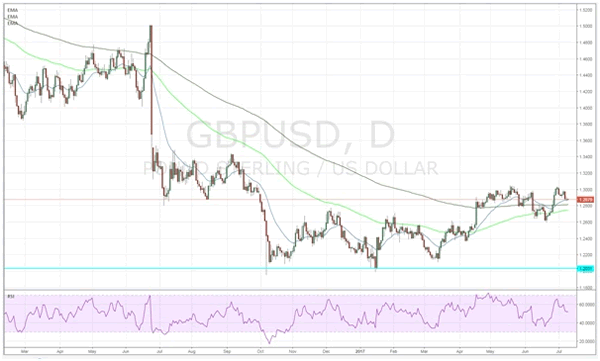
Looking ahead, it could potentially be a relatively busy week for the Cable with the UK BRC Retail Sales and U.S. Core CPI figures due for release. The BRC Retail Sales figures are due for release early in the week and are forecast at 0.5% which represents a significant gain from the prior result of -0.4%. Subsequently, if the estimates are correct, expect the Cable to find some support from the positive result. In addition, the U.S. Core CPI figures are set for release and the forecast has them returning a 0.2% m/m result. However, there is mounting speculation that the U.S. economy could be suffering some headwinds presently. Subsequently, the inflation figures will be closely monitored by the market for signs of slowing. Finally, the Bank of England has a range of members, and their chief economist, due to speak in the coming week and may provide some illumination on when the central bank will choose to tighten.
From the technical perspective, the pair largely remained within a consolidation phase through most of last week. In addition, the RSI Oscillator remains within neutral territory and is presently trending sideways. Subsequently, our initial bias is neutral for the week ahead with the caveat to expect a gentle slide with strong support at 1.2849 capping any further downside moves. Support is currently in place for the pair at 1.2849, 1.2767, and 1.2706. Resistance exists on the upside at 1.3045, 1.3272, and 1.3441.
Ultimately, the coming few sessions are likely to focus heavily upon the U.S. Core CPI and UK employment change figures. However, given the recent lack of volatility, it might just take a significant event to alter the pair's present sideways direction. Subsequently, it is likely to be Friday's session, with the release of the US CPI data that sets the tone of the short term fundamental trend. So monitor the outcome closely because a miss of the estimate (0.2% m/m) could cause some significant upside moves for the pair.
Is Oil Ready To Rebound?
Key Points:
- A corrective ABC wave could carry oil higher moving forward.
- Despite any near-term bullishness, the long-term bias remains bearish.
- 48.55 level likely to be the next peak for oil prices.
Oil prices had a rather abrupt reversal last week, raising concerns that the declining channel was beginning to break down to some extent. However, this seems to be at odds with the broader technical bias which suggests that a rally back up to the 48.55 mark is still plausible. Indeed, oil is already showing early signs of a recovery – potentially a rather sizable one.
Nevertheless, on the face of things, oil's bias does look rather bearish and fears of continued losses may not be altogether unwarranted. What's more, in the long run, further losses are almost certain aswe aren't expecting the commodity to overcome the fundamental forces causing its long-term decline any time soon. However, the most recent push lower could very well be fleeting and a propertesting of the upside constraint of the channel is still a real possibility.
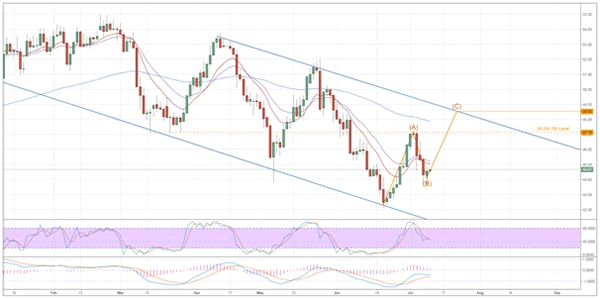
One of the key technical readings suggesting that recent losses are about to reverse is the MACD oscillator which, despite a nearly 6% fall in oil prices, continues to signal that bullish momentum is intact. When combined with the presence of some long shadows on the two prior candles, a reversal around the 44.30 handle is looking rather likely. Moreover, a reversal here would confirm the presence of a corrective ABC wave – a sign that the uptrend could resume very shortly.
If buying pressure does return, it should see oil back up to the top of the channel but no higher than the 48.55 handle. Indeed, any price action above the $47 mark is going to be up against some strong headwinds given the presence of the 100 day moving average and the prevailing pessimism over the future of oil prices. As a result of this, we should see yet another extended downtrend take hold eventually and this may reach as low as the $40 handle.
Ultimately, we may have to wait for the US Crude Oil Inventories data to be posted before oil prices really get moving again. Currently, a draw is expected which could be the spark needed to put the bulls back in the driving seat. Nevertheless, keep an eye on the release as an unexpected build could dash any hopes of a near-term rally and see oil plunge back to form a double bottom structure.
Elliott Wave View: USDJPY Bullish Against 112.86
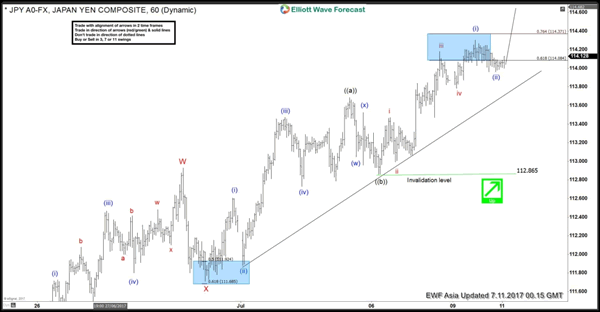
Short term USDJPY Elliott Wave view suggests the pullback to 111.7 low on 6/29 ended Minor wave X. Up from there, wave Y is unfolding as an Elliott wave zigzag structure where Minute wave ((a)) ended at 113.68 and Minute wave ((b)) ended at 112.86. Up from there, Minutte wave (i) of ((c)) ended at 114.3. Minutte wave (ii) of ((c)) ended at 113.96, but a break above 114.3 will add validity to the view that the next leg higher has started. Until then, a double correction in Minutte wave (ii) still can’t be ruled out before pair resumes the rally higher. Near term, while dips stay above 112.86, and more importantly as far as pivot at 111.7 low stays intact, expect pair to extend higher. We don’t like selling the pair.
USDJPY 1 Hour Elliott Wave Chart
Market Morning Briefing: See Good Chances Of Fresh And Further Strength In The Euro
STOCKS
Dow (21408.52, -0.03%) is range-bound in the 21550-21250 region and could possibly continue to remain so for another couple of sessions. A corrective fall towards 21000 is on the cards for the medium term. For now, sideways consolidation may continue.
Dax (12445.92, +0.46%) opened with a gap up but could not move above 12500. Only on a sustained break above 12500 can we negate a possibility of a further fall towards 12300 or lower just now, else the index could start moving towards 12600 again in the near term. 12500 is a crucial level to watch.
Shanghai (3203.93, -0.27%) continues to remain in the near term up channel. A slight dip towards 3200-3190 is possible before resuming the uptrend. Medium term looks bullish.
Nikkei (20135.63, +0.27%) is rising as expected and could move up towards 20200-20300 in the near term.
Nifty (9771.05, +1.09%) shot up sharply yesterday, rising from levels near 9650, surprising the market. Yesterday’s move indicates sharp bullish momentum in force and while that holds, we could see a rise towards 9850-9900 in a few sessions. Near term looks bullish.
COMMODITIES
Gold (1211) and Silver (15.55) are trading within the range of 1188-1231 and 15.20-16.10 respectively. We will remain bearish on Bullion while they are trading below 1250 and 16.50 levels. We think the sideways modes within these ranges are expected to remain unchanged, and a bounce towards there resistances can be seen in the latter part of the week due to near term oversold condition.
No directional movement had been seen in Copper (2.66) as it is trading within the range of 2.66-2.78. We will remain bullish on copper while it is trading above 2.55 levels.
Brent (47.06) and WTI (44.58) are trading marginally higher to keep the upside possibilities open. The recent trading range could be 44.60-48 for Brent and 42-46 for WTI . Both of them are in a neutral trading zone and could move either side.We will be assured of strength of Brent and WTI only when a firm and sustainable closing above 48 and 46 are made by both of them. Otherwise a failure to close above those levels may push them towards 44 and 42 levels respectively.
Gold/WTI ratio (27.31)found support at 26 levels and could move towards 28.5-29 by the end of this week.
FOREX
See good chances of fresh and further strength in the Euro (1.1393) towards 1.1460, possibly higher, with good Support at 1.1360 and 1.1300. The Dollar Index (96.10) remains weak overall with decent chances of decline to 95.50-40.
The Euro holds onto strength against the Yen as well with Euro-Yen (130.10) likely to climb higher towards 131 over the course of the week. The Yen is possibly the weakest currency just now with Dollar-Yen (114.18) also looking like it can rise further towards 115, with intra-day Support at 113.75. The continued rise in the US-Japan yield spread provides Support to Dollar-Yen.
Although the Pound (1.2875) remains weak while below 1.2935, it may also have intra-day Support at 1.2850-40 now. Only if that breaks can we see further decline towards 1.2800-2750. So, the fall from the high of 1.3030 a couple of weeks ago could start slowing down. Careful about getting trapped in a Short there.
We called for a fall in the Aussie (0.7615) to 0.7530 yesterday, but the market appears a little uncertain as some Intra-day Support is also seen at 0.7600-7575. So, there could be spiky movement in the Aussie, a little like in Pound. The cleanest currencies to trade just now might be the Euro and the Yen.
The Chinese Yuan (USDCNY 6.8040) is weakening slowly, with emerging chances of further weakness towards 6.82. This one needs to the watched.
Dollar-Rupee came down to 64.53 yesterday and trades near 64.50 on the NDF just now. Range Support may be expected in the 64.45-40 region today.
INTEREST RATES
The US yields have come off as mentioned yesterday. The 5YR (1.93%), 10Yr (2.37%) and the 30YR (2.93%) are trading slightly lower from previous levels of 1.40%, 1.96% and 2.39% respectively.
The US 10-5Yr differential (0.44%) has reached the resistance and could come off towards 0.4250% by tomorrow.
The US-Japan 10YR (2.27%) has also started come off exactly as expected and could move down towards 2.2% in the near term. This could possibly pull down Dollar-Yen also towards levels near 112.
The German-Us 10Yr (-1.83%) and the German-US 2Yr (-1.99%) both have some scope to move on the upside and could rise in the near term, indicating a stronger Euro.
Inside the Forex Market: Fake News, Currency Wars & Corruption
Fake News, Read All About It!
Fake news has become one of the buzzwords of 2017, with almost weekly reports regarding politicians or political events, causing outrage due to their spurious nature. The growing importance of social media has exacerbated the problem with fake news reports spreading like wildfire and quickly garnering vast amounts of attention before they can be disputed and or corrected.
The term was widely used during President Trump's election campaign due to both Trump's own incorrect reporting of various facts and figures and also because of CNN's constant fictitious reporting of his campaign. The most famous of these episodes was CNN's incorrect reporting of the number of attendees at Trump's inauguration where they portrayed the event as being virtually empty. CNN have recently come under attack again for allegedly "staging" a protest in the aftermath of the recent London terror attacks.
The purpose of fake-news is typically to gain either financially or politically from the reaction achieved through the spreading of often sensationalist or controversial information.
Information Leaks & Anonymous Comments
Currency traders will be familiar with this concept as the Forex market has long been plagued by false reports, unchecked source comments, and anonymous leaks. These episodes are particularly common during periods of crisis. The European banking crisis, which was at its peak between 2010 and 2014, often saw currency markets whipsawed on the release of ECB leaks, which would later be denied, or source comments which would later be retracted.
During this time, it was not uncommon to see vicious volatility in EUR currency pairs traders reacted to the breaking news flooding their newswires. The common occurrence of these events made it a difficult period for intra-day traders who were often shaken out of positions because of this dynamic.
Verbal Intervention
There are, however, some instances when central banks will purposely use commentary to affect the markets. This is known as a verbal intervention. For example, the SNB's Jordan commonly takes to the wires to announce that the SNB are monitoring the Swiss Franc exchange rate and will act if it continues to strengthen. These comments are designed to deter traders from continuing to buy the Swiss Franc. The ECB are another central bank well known for using verbal intervention to drive the currency rate.
Following the announcement of a huge 1 trillion EUR stimulus program in February 2015, ECB members consistently took to the wires to drive the exchange rate down as it appeared that, despite the stimulus program, EUR was rapidly recovering against the US Dollar.
As you can see in the chart above, each time EURUSD approached the 1.14 mark, various ECB members would hit the wires, weighing on the currency rate.
Currency Wars
The matter of central banks and/or governments, purposely manipulating currency markets has been a hot topic over the last year. Over the course of Trump's election campaign, he frequently declared his intention to label China a currency manipulator. Trump has since dialled back on his claims though many economists that although they no longer fit the bill, at one point (specifically 2000-2014) China was manipulating currency markets to halt the rise of the Renminbi and maintain the country's competitive advantage.
The practice of suppressing currency rates to maintain a competitive advantage has commonly been referred to as a "race to the bottom", where global economies have been engaged in huge monetary easing since the GFC, to maintain their competitiveness and attempt to boost growth. Another phrase often used to describe this practice is "currency wars". In February, the issue of currency wars once again took the limelight as Trump's top trade adviser Peter Navarro accused Germany of profiting from a "grossly undervalued" Euro which he labelled an "implicit Deutsche mark."
Clearly, there is a huge financial gain to be made by anyone who is in a position to profit from leaked reports, false comments and anonymous reporting in the currency markets and indeed, one major issue over the years has been the early acquisition of economic data releases or central bank policy announcements.
Insider Trading
In 2012, Philipp Hilderbrand resigned his position as Chairman of the SNB after it was revealed that his wife, a former hedge fund trader, bought 400,000 Swiss Francs' worth of US Dollars just three weeks before the SNB declared their strategy cap the rise of the Swiss Franc. While Hilderbrand denied claims, many accused the SNB Chairman of giving his wife the information ahead of time to allow her to profit from the announcement.
In April of this year, a recording emerged of two Barclay's bankers in 2008 claiming that the Bank of England was putting significant pressure on commercial banks to keep LIBOR rates suppressed. The LIBOR rigging scandal has been a huge focal point of those seeking to illuminate corrupt banking practices, and this latest revelation once again throws into question the matter of central banks manipulating markets. With so many instances of subversive tactics being used by banks and governments to affect currency markets, the only real question is, who will be next?
Inside The Forex Market: Famous Fat Finger Trades & Flash Crashes
Efficient Markets?
Fat finger trades & flash crashes; these are terms that many of you might have heard on financial news channels or even seen plastered across headlines in newspapers, but do you really know what they mean?
Despite the fact that the global foreign exchange market is the most liquid market in the world and involves some of the brightest people and most sophisticated technology, errors still occur, and accidents still happen all the time. Like freak waves rising from an otherwise calm sea, these episodes might be fairly infrequent, but when they occur they can cause serious damage!
What Are Fat Finger Trades?
"Fat-finger trades" are the term given to a trade that is placed in error and the term alludes to the instance of someone accidentally hitting an extra digit on their keyboard when placing a trade. These type of errors have occurred since the beginning of electronic trading and have accounted for dramatic market shocks.
What Are Flash-Crashes?
A similar problem is that of "flash crashes" which are typically triggered by algorithmic trading programs which flood the market with orders and exacerbate sell-off. These programs, which are typically momentum based, chase the market and during times of thin liquidity can push markets to extreme lows in a matter of minutes. Below, we take a look at some famous episodes of these problems.
Famous Fat-Finger Trades & Flash Crashes
Drunk Trader Sends Oil to Eight Month Highs
In 2010 Steve Perkins, a futures trader at PVM Oil Futures, mistakenly bought 7 million barrels of crude during a late-night drinking session. The error saw Oil spike to an eight-month high, leaving markets dumbfounded. The next morning an admin clerk contact Perkins over the abnormally large trade but was unable to recall the incident. After attempting to cover his tracks with a story about trading alongside a client, Perkins was eventually forced to admit that he was unable to remember what happened after refusing to put his desk in touch with the client.
The drunken error pushed Oil up by more than $1.50 a barrel in less than 30 minutes. To put this in context, this type of acute price shift would only usually be seen in response to a significant geopolitical event and was 10 times the size of the typical quantity of oil futures traded in that timeframe. PVM eventually reversed the entire trade for a total loss of $9,763,252 which is roughly equal to the firm's annual revenue.
So, the next time you feel like placing a trade after a few evening drinks, think again!
Gold Goes Bust
Just this week we saw Gold cratering 1% due to an alleged "fat finger trade". On Monday, Gold plummeted from $1,254 to $1,236.46 due to a huge 18,500 lot order which equates to 1.85 million ounces of gold. This is way above the typical average dealing size for Gold and markets were once again rocked as they scrambled to figure out what was behind the crash. The person behind the error is not yet known, and some traders suspect that the error wasn't, in fact, a "fat finger" trade but an algo error which triggered a flash crash
You might be wondering what a flash crash is; a flash crash is essentially where a market crashes due to the rapid execution of algo orders which all trigger one after another. Typically these crashes occur during hours of thin liquidity such as overnight trading where there are gaps in the order book, and the price jumps lower, chased by algo orders which push the market deeper and deeper.
Sterling Flash Crash
In October 2016 GBP suddenly collapsed 6% lower during overnight trading due to heavy algo selling during thin liquidity. Flash crashes have become an increasingly common occurrence as algorithmic trading continues to gain market share and the risks of automatic execution programmes are a strongly debated area. Algorithmic programmes have the ability to act and react far quicker than human traders and periods of sharp price movement are accelerated due to this.
Summer Wipeout
The Sterling flash-crash echoed the events of August 24th, 2015 when the Dow Jones Index dropped a massive 1,100 points during just five minutes of trading, sending heavy ripples across global markets. Indeed, high beta currency pairs saw significant declines in response as automatic sell programs triggered massive collapses across risk-correlated pairs. However, automatic programs are not solely to blame, and one of the elements that has been named as exacerbating these episodes is that of dealers selling to hedge their options exposure.
How Options Hedging Affects Markets
During times of market panic, many traders buy put options which means that they make money if the market goes down. Consequently, the dealer loses money as the market sell off and so to try and mitigate their losses, they sell the underlying market. During period of mass panic where large amounts of put options are purchased, dealers need to sell equally large quantities of the underlying market to mitigate their losses
So there you go; the next time you see the market crash seemingly out of nowhere you can assume that either someone has accidentally added a few extra zeros to their order or the algos have gone wild!
Inside the Forex Market: Searching for Black Swans?
What is a "Black Swan"?
The term was made popular by Finance professor Nassim Nicholas Taleb, who also writes for the Wall Street Journal and spent 21 years working on Wall Street as a quant trade developing computer models for investment banks. Taleb brought the term to popular attention in the aftermath of the financial crisis in his book "The Black Swan: The Impact of the Highly Improbable".
The term itself refers to an event which occurs well beyond the boundaries of what is typically expected and, therefore, represents a catastrophic surprise. The unexpected and random nature of black swan events makes them extremely difficult to predict. Given the difficult nature of anticipating these events, Taleb suggests it is important for people to always be aware that such dramatic events can happen and to focus on their risk management, protecting themselves.
(As an extra bit of info, the phrase comes from the belief in the Western world that all swans are white. This belief was based on the fact that these were the only ones accounted for until Willem de Vlamingh discovered black swans in Australia).
So, now you know what a Black Swan event is you're probably wondering what some of the most famous Black Swan events are; some of these you might have heard of and maybe some you haven't.
The Collapse of Long-Term Capital Management (LTCM)
In the late 90s, a 100 billion Dollar bond trading fund went pop and nearly took the entire financial system with it through their strategy of highly leveraged arbitrage trading. As the fund grew in size so too did the number of traders trying to piggy-back their strategy, and so the fund moved out of bond arbitrage and into equity arbitrage, swaps, volatility and global markets. Following severe losses during the Asian Financial Crisis, LTCM suffered a 14% loss - its biggest loss ever up till then.
Shortly after the Asian Financial Crisis, Russia defaulted on its sovereign debt which saw global markets plunging and triggered a $53 million one-day loss for LTCM. A few weeks later the fund was facing over $1 trillion in default risks. A default by the fund would have seen around 50 other counterparties (including investment bank UBS) defaulting also, and so the Fed and a conglomerate of Wall Street banks were forced to step in and bail them out.
The Global Financial Crisis
Ten years on from the collapse of LTCM the global financial system was once again rocked by the collapse of a major financial institution. In 2008, Wall Street giant Lehman Brothers filed for bankruptcy with a debt of $619 billion making it the largest bankruptcy filing in history. The bank was heavily involved in the sub-prime mortgage market and highly leveraged so as the credit crunch of 2007 took its toll the bank suffered enormous losses as mortgage delinquencies and foreclosures ripped through the mortgage market.
The US government worked to offer a $700 billion bailout package which failed to pass Congress and subsequently the bank officially went bankrupt. The market reaction was extreme with the FTSE 100 dropping 5% in a day and the Dow Jones shedding 2.5% while HBOS, which owns the UK's largest mortgage lender, suffered a 17.5% one-day loss. These declines came as central banks across the globe offered huge waves of funding to stabilise the market.
The Oil Crisis
In just a few months over 2014, the price of Oil plummeted from over $100 per barrel to just $50. US Crude Oil production has been surging for years jumping over 50% between 2011 and 2013, annually, from 2 billion barrels to 3 billion barrels. In 2014, Libya's oil production which had dropped to 250k barrels per day from around 1.8million barrels over April-June sharply rebounded to 900k barrels a day. The sharp increase in supply following the reopening of Libya's oil fields which had been closed for months during the civil war caused an acute shift in the supply-demand scale sending Oil cratering.
These are just a few of the many Black Swan events which have rocked markets. So, as these events are so unpredictable, what is the importance for you? The main takeaway here comes down to risk management. When trading, your capital is always at risk, and it is important to always be aware of the unmeasurable risk of such an event taking place. So, always make sure that you trade with a stop loss, this means that should such an event occur your account will be protected against any sudden moves.
What is Forex Trading?
There are some things that knock you for six when you hear them, and this is generally the case when one first encounters the foreign exchange markets, or 'forex' for short. Followed by the credit (debt) market (think US government bonds, notes and bills here), forex is the largest, most liquid market on the planet - an immense auction house which has a daily turnover of $5.1 trillion (according to the 2016 Triennial Central Bank Survey of FX and over-the-counter (OTC) derivatives markets). Forex is a globally decentralized marketplace, which simply means that there's no central exchange or physical location. It Operates around the clock five days a week, with the action beginning in Wellington, New Zealand and closing on Friday evening in New York, essentially allowing one to pick and choose when to trade.
Within this mammoth auction house, the forex market caters to investment managers, hedge funds, corporations, individual speculators/investors and international trade. For example, in order for a UK company to import baseball caps from the US, the Brits would have to exchange GBP for US dollars in order for the organisation to be able to complete the transaction.
The main participants, other than government central banks who probably have the most influence, are the large international banks, such as: Citi Bank and JP Morgan. These two organisations recorded the largest overall volume in the forex markets as of May 2016. Now that we have a brief understanding of what the forex market is, how much is traded/exchanged on a daily basis and who the main 'players' are, let's look at what forex trading is from an individual trader's perspective. If you've ever been on holiday to a foreign country, there's a good chance that you've already participated in the forex market, exchanging one's home currency for that of another.
The forex market is traded in pairs. The EUR/USD, the GBP/USD and the AUD/USD are all considered currency pairs. The 'base currency' is the first currency that appears in a currency pair quotation, the EUR, GBP and AUD (highlighted in bold) are all base currencies. The 'quote currency', or 'counter currency', is the second currency - the US dollar (underscored). So, when we look at the currency quotations provided by IC Market's market watch platform, one can see that in order to buy 1 unit of GBP, it will cost buyers $1.25181 at current market prices. The 'ask' tab represents the current price for buyers, and the 'bid' tab denotes the current price offered to sell.
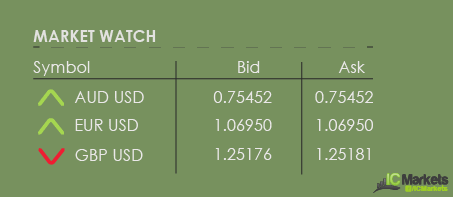
In your forex trading career, you'll be dealing with a plethora of new terminology. A 'pip' is one of the more common terms you'll hear in the trading industry, which essentially means 'point in percentage' or 'price interest point'. IC Markets uses 4 decimal places to denote a one-pip movement. Using the market watch platform above, we can see that in order to buy 1 Euro, it'll cost $1.06950. Now, assuming that the market skips to $1.06960, price has just moved one pip higher. Conversely, should the unit decline in value to $1.06900, one is now able to purchase the 1 unit of Euro for 5 pips less than originally quoted ($1.06950-$1.06900). What is the very last number on the currency quotation then? This is called a 'pipette', which equals 1/10 of a pip. Therefore, if the EUR/USD quotation above moves to $1.06952 from the current price of $1.06950, we effectively have a 2-pipette advance.
The value of a pip, of course, depends on how a trader sizes his/her positions. This is where the use of leverage and risk management comes into play.
Leverage basically means having the ability to control a large sum of capital using very little of your own funds and borrowing the rest. By way of example, say one looks to trade a $100k position at leverage of 100:1, the broker will set aside $1k from your funds, thus allowing you to take on the larger position. IC Markets offer flexible leverage options ranging from 1:1 to 1:500, which is good news for conservative traders out there. As you can imagine, leverage is a double-edged sword. While high leverage could net one incredibly high gains, it can just as easily wipe you out, highlighting the need to correctly manage risk!
The difference between the bid/ask prices is called the 'spread'. This is another common term, which basically represents brokerage service costs. Looking at the GBP/USD quotation above, one can see that the spread or 'cost' to purchase 1 unit of GBP using IC Markets is around half a pip. The EUR/USD effectively has no spread at the time of writing - very tight indeed! The broader the spread the more expensive it is for one to trade, whereas the thinner the spread the cheaper it is. Liquid and frequently traded currency pairs usually offer a small bid/ask spread, while the more erratic, less traded pairs typically boast a larger bid/ask spread. In addition to this, spreads typically widen during high-impacting news events, such as the mighty US non-farm payrolls report generally released on the first Friday of each month. Technically speaking, spreads widen here due to lack of liquidity. Let's not forget that a spread is simply the difference between willing buyers and sellers. At times of high volatility, the difference becomes larger and thus the spread is equally increased.
How To Bounce Back From Trading Losses: 5 Lessons Learned
Trading is an interesting profession and has no peak as in other occupations. It is in fact an endless journey of discovery of oneself and trading itself. Trading for me at beginning was very tough not that I was not successful in other endeavours but i took it like every beginner thinking that it was easy. With this perception, i approached trading without a plan or proper trading education on how the market works. What do you expect? Your guess is as good as mind. It was a total disaster after taking many losses; i was almost psychologically blown a way. At this stage, two important things happened to me, my P&L was in the red and i was down emotionally.
My worst loss that stands out in all my losses was a trade i took (short EURUSD) in anticipation of French Referendum thinking that it would be in favour of the European Union but alas I got a margin call after the result was negative. Please do not ask me about a stop loss i did put a stop loss but i later removed it because i was so confident it was going to be a winning trade.Hey, can't you understand. I have been declaring losses so i thought this time around i would take a large position and cover all my losses. I was subsequently charged to court (trading), tried and found guilty (for losses).Punishment, six months without trading. While serving my term i embraced trading education especially technical analysis and trading psychology. So when I got a handle of certain strategies applying technical analysis and trading psychology i started trading again but not without losses but i followed my trading plan anyway and things improved especially when i became comfortable with losses as expenses in the business of trading.
Valuable Lessons/Tips
Never Trade Without A Trading Education-acquire proper trading education because the knowledge through trial and error in the market can be more expensive and time consuming than the normal trading education
Never Trade Without A Plan
Having a trading plan is a most in this business if you want to succeed. This plan most specify and predetermine your entries,exits,stop loss, position size and your psychology(your emotion at the time you click enter).There could be more you could have on your plan but the most important thing is that you must follow it, because when you follow your plan you have a chance of succeeding in trading. You may be tempted to say do I have to follow this damn plan everyday, just go to a near by Airport and observe what pilots do everyday; they follow their flight plan and check each one before taking off. He can as well say, i feel better flying without my plan today because I do it everytime.That you know my friend will be disastrous.
Do Not Be Smarter Than Your Emotion
What do traders do when they are tired? They wait for an opportunity instead of turning off their computers and call it a day they stay on waiting to initiate a position and when the trade turns out to be a loser they become angry adding to the tiredness.Hey,you know what, you can not win at trading if you are not in your right frame of mind. If you have problems with your spouse please do not trade, if you have a string of losses do not trade, take some time off and go over your losses until you know what went wrong before you can put on another trade. If any thing occupies your mind apart from the market and following your trading plan when you are ready to trade, do all you can to resolve it before you start trading for the day. If you cannot, go golfing.
Cut Your Losses Shut And Let Your Winners Run
This one sounds familiar,right.The professionals do exactly as is stated here but what do novice traders do? They do the opposite by letting their losses run and cutting their winners shut. In other words, they are patient with their losses and impatient with their winners thinking that their positions would come back. The hard truth is the market does not know whether you are winning or losing. It will go wherever it wants to go and do what it has been doing, which is moving up, down and sideways. It is now left to you to find opportunities within these up moves and down moves.
Becoming A Professional Trader Takes Time
This might sound funny. Do not ask any trader to tell you how many years it will take you to become a professional/experience trader. The truth is that real professional traders know that the education of a trader never ends. It is ongoing because market is not static, it changes so if you think you have acquired enough trading knowledge and market conditions change and you cannot cope with the changes you automatically become a learner. The fastest way to become a good trader is to learn from the professional traders (their strategies and how they apply them) taking into consideration your own psychological make up.