Sample Category Title
Gold Wave Analysis
- Gold broke support area
- Likely to fall to support level 2600.00
Gold recently broke the support area located at the intersection of the support level 2680.00 (former monthly high from September), support trendline of the daily up channel from September and the 61.8% Fibonacci correction of the upward impulse 1 from the start of October.
The breakout of this support area accelerated the active minor ABC correction from the end of November.
Gold can be expected to fall further to the next support level 2600.00 (which stopped the previous intermediate correction (4) in October).
USDJPY Wave Analysis
- USDJPY broke resistance area
- Likely to rise to resistance level 156.00
USDJPY currency pair today broke the resistance area located between the resistance level 153.25 (which reversed the pair twice at the end of October) and the 61.8% Fibonacci correction of the sharp downward impulse from the start of July.
The breakout of this resistance area is likely to further increase the bullish pressure on this currency pair.
Given the strongly bullish US dollar sentiment that can be seen across the FX markets today, USDJPY currency pair can be expected to rise further to the next resistance level 156.00, former minor support from July.
CAD: Critical Zone Could Turn Bearish
The USDCAD currency pair experienced a sudden rise in buying strength as Donald Trump won the US presidential election. This win has given a significant boost to the US Dollar. In contrast, the Canadian Dollar looks weak ahead of crucial domestic employment data. Since Trump’s policies could lead to higher inflation through changes in tariffs and taxes, the US Federal Reserve may have to shift to a less easy-going (less dovish) stance. The dovish stance could increase Treasury yields and further strengthen the Dollar. However, higher tariffs on US imports would likely hurt the Canadian economy, which heavily relies on exporting goods to the US. Due on Friday, Canada’s job market data is another critical factor. If job growth is weaker than expected, the Canadian Dollar may drop, especially if the Bank of Canada considers more rate cuts. Traders also keenly anticipate the upcoming Federal Reserve meeting, where a rate cut is expected. Still, the main focus will be any hints about future rate decisions.
CADCHF – H3 Timeframe
Remember the SBR price action pattern? It’s shown by an initial sweep of a high or low, followed by a break of structure in the opposite direction to the sweep. The 3-hour timeframe of CADCHF shows such a pattern being formed as price swept above the high, followed by a bearish break of structure. The confluence here is the supply zone at the 88% Fibonacci retracement level, with the initial profit target at the 23% region.
Analyst’s Expectations:
- Direction: Bearish
- Target: 0.62236
- Invalidation: 0.63351
NZDCAD – D1 Timeframe
NZDCAD, on the daily timeframe, has initially reacted off of the 76% Fibonacci retracement level. With trendline support as a confluence with the drop-base-rally demand zone, I’d say it’s pretty much locked and loaded in favor of the Bulls.
Analyst’s Expectations:
- Direction: Bearish
- Target: 0.84920
- Invalidation: 0.81723
The 2024 U.S. Elections: Economic Implications
Summary
Election Day is in the rearview mirror. Although the outcome of every race has not yet been determined, the outlook for control of Congress and the White House has become considerably clearer. Donald Trump has been elected President of the United States. Republicans have picked up a majority of at least a few seats in the Senate. Control of the House of Representatives has not yet been officially called, but it appears more likely than not Republicans will hold onto their majority in the lower chamber of Congress.
We will publish an in-depth discussion of our post-election forecast in our 2025 Annual Economic on November 21. For now, as the dust continues to settle, we walk through our preliminary thoughts on the election results and their implications for the U.S. economy.
- Tax & Spend Policy: An extension of the expiring provisions of the 2017 Tax Cuts and Jobs Act (TCJA) is already baked into our existing economic forecast. As a result, a full extension enacted some time next year, should that occur, would not have an impact on our forecasts for economic growth, inflation, the federal budget deficit, etc.
- Some additional tax cuts seem probable in our view, although the timing, size and specifics are highly uncertain. New tax cuts of a similar size to the original TCJA probably would lead us to upwardly revise our forecasts for real GDP growth and inflation by a couple of tenths of a percentage point in 2026 and 2027, all else equal.
- Trade Policy: President-elect Trump has proposed a 10% across-the-board tariff on America's trading partners with a 60% tariff levied on China. If implemented shortly after Inauguration Day on January 20, these tariffs would impart a modest stagflationary shock to the U.S. economy in 2025. Our model simulations show that the core CPI inflation rate next year would shoot up from its baseline value of 2.7% to 4.0%. Under this scenario, U.S. real GDP would rise by a sluggish 0.6% in 2025.
- Of course, President-elect Trump may decide not to impose tariffs that are so high, and he may not do it so quickly upon taking office. Furthermore, we view these estimates as closer to an upper-bound than a midpoint of the range of possible outcomes. That said, we are inclined to push up our core CPI inflation forecast for 2025, currently 2.7%, given the balance of risks.
- Tariffs would directionally offset the boost to economic growth from tax cuts but would further add to the inflationary impulse from tax cuts. Thus, although we may reduce our economic growth forecasts for the next couple of years due to higher tariffs, tax cuts could serve as a mitigating factor. Finally, tariffs increase federal revenues, suggesting they might help limit deficit widening from extending and expanding the TCJA.
- Federal Reserve: Our current forecast looks for the FOMC to cut its target range for the federal funds rate, currently 4.75%-5.00%, to 3.00%-3.25% by the end of next year. However, the FOMC may not want to ease policy by that much if new tax cuts and tariffs cause inflation to shoot higher over the next couple of years. Thus, we think the risks to our fed funds rate forecast are skewed to the upside (i.e., less easing next year than we currently project).
- The FOMC's reaction function likely would be more hawkish in response to higher inflation from tax cuts than from tariffs. Tighter monetary policy is an effective method for slowing demand growth, but it cannot do much to combat inflationary pressure from a supply shock such as tariffs.
Tariffs & Taxes to Dominate the Post-Election Policy Outlook
Election Day 2024 finally has come and gone. Although the outcome of every race has not yet been determined, the outlook for control of Congress and the White House has become considerably clearer. Donald Trump has been elected President of the United States, becoming just the second person to serve two non-consecutive terms as president (Grover Cleveland was the first person to accomplish this feat. Cleveland was elected in 1884 and 1892). In the Senate, Democrats entered the election with a 51-49 seat majority when including the three independents who caucus with the Democrats. Republicans picked up Senate seats in West Virginia, Ohio and Montana, with several more contested seats still undecided. Republicans appear destined for a majority of at least a few seats in the upper chamber of Congress, although this is not yet finalized. In the House of Representatives, Republicans possessed a 220-212 majority going into election night (three seats are currently vacant). Although some races are still too close to call, it appears more likely than not Republicans will hold onto their majority in the lower chamber of Congress. If realized, this would result in Republican control of both chambers of Congress and the White House for the first time since 2017–2018.
Because the dust has not yet settled on the election, we will not rush into any major forecast changes today. We will publish our 2025 Annual Economic Outlook (AEO) in about two weeks (November 21), and the AEO will contain an in-depth discussion of our post-election forecast for the U.S. economy. We will also be hosting a webinar that same day to discuss our annual outlook. But for now, we will walk through our preliminary thoughts on the recent election results and their implications for the U.S. economy.
Tax & Spend Policy
As a candidate, Donald Trump expressed support for a variety of new tax & spend policies. Some of these proposals came with concrete details, while others were more high-level and vague in nature. The Committee for a Responsible Federal Budget (CRFB), a nonpartisan think tank in Washington, D.C. that covers fiscal policy issues, published an exhaustive analysis attempting to quantify the costs and savings of Donald Trump's campaign proposals. The table below summarizes this analysis, with the "high" and "low" estimates representing the range of potential outcomes depending on what exactly one assumes when nailing down the specifics of each proposal. In the CRFB's central estimate, the cumulative budget deficit would increase by $7.75 trillion over the 10-year period starting in FY 2026 if all of Donald Trump's proposals became law. If realized, this would amount to approximately 2.6% of U.S. GDP per year. Note that this estimate of $7.75 trillion would be in addition to the roughly $22.1 trillion cumulative budget deficit that the Congressional Budget Office (CBO) already projects the federal government will incur over the next decade under current law.
Figure 1
Of course, the table above shows a very broad range of estimates that contain a significant amount of uncertainty. Furthermore, just because a candidate proposes something does not mean it necessarily will become law. More often than not, most of a candidate's campaign proposals do not make it over the finish line. Determining exactly what will become law in the immediate aftermath of an election is probably a fool's errand, but what we can do is share the policy areas where we feel the most and least confident.
Republicans seem intent on extending the expiring parts of the 2017 Tax Cuts and Jobs Act (TCJA) that are scheduled to lapse at the end of 2025. We discussed the outlook for the TCJA and its potential economic implications in a recent report, and we would suggest our readers check out that report for a deeper dive into the outlook for U.S. tax policy. We feel reasonably confident Republicans will extend most or all of the TCJA, and an extension is already in our economic forecast. As a result, a full extension enacted some time next year, should that occur, would not have an impact on our forecasts for economic growth, inflation, the federal budget deficit, etc. Note also that a simple extension of the TCJA would not impart a fiscal impulse to the economy. Individual income tax rates would not be cut from their current levels. Rather, TCJA extension would prevent tax rates from rising back to their pre-2017 levels.
What about other, new tax cuts? We are more uncertain about the outlook for tax policy beyond TCJA extension. Some additional tax cuts seem probable in our view, although how large they are and what specific taxes are cut is difficult to say. As a starting point, the original TCJA cost $1.5 trillion on net over 10 years. New tax cuts of this size in addition to TCJA extension probably would lead us to upwardly revise our forecasts for real GDP growth and inflation by a couple of tenths of a percentage point in 2026 and 2027, all else equal.
Perhaps additional tax cuts could be even larger than this, but we note the fiscal realities at present are different from what they were in 2016 when Donald Trump last took office. Just extending the TCJA and leaving spending on its current trajectory would leave the gap between revenues and outlays historically wide in the years to come (Figure 2). Interest rates are elevated compared to the 2010s, and the United States is already running the largest structural budget deficit among its G7 peers (Figure 3). Furthermore, bear in mind that tax policy is an area where Congress will be involved heavily in the policymaking process. The president cannot unilaterally change federal income tax rates. This is in contrast to tariffs, the topic to which we turn next.
Figure 2
Figure 3
Trade Policy
During the campaign, President-elect Trump vowed to impose a 10% across-the-board tariff on America's trading partners with a 60% tariff levied on China. As we wrote in a report we published in July, these tariff increases, if implemented shortly after Inauguration Day on January 20, would impart a modest stagflationary shock to the U.S. economy. Our model simulations show that the core CPI inflation rate next year would shoot up from its baseline value of 2.7% to 4.0% (Figure 4).1 The unemployment rate would rise from a baseline of 4.3% to 4.6% (Figure 5). If trading partners retaliate with their own equivalent tariffs on American exports—60% in the case of China and 10% for everyone else—the jobless rate rises even further to 4.8%. Under this scenario, U.S. real GDP would grow by a sluggish 0.6% in 2025.
Of course, President-elect Trump may decide not to impose tariffs so quickly upon taking office. He may reconsider given the potential drawbacks of the levies, or the administration may use the threat of tariffs as a negotiating tactic with foreign governments. The president also may decide to exempt certain products and/or countries. However, given Trump's frequent mentioning of tariffs during the campaign and his previous use of levies in 2018–2019, which affected more than $400 billion of American imports, we advise readers to take the president-elect's threats of tariffs seriously if not literally. Moreover, over the past few decades Congress has delegated significant powers to the president to act unilaterally in regard to trade policy. Therefore, the president would not need congressional approval to impose significant tariffs on America's trading partners.
Figure 4
Figure 5
Given the uncertainty on the tariff outlook, our forecast will not fully adopt the results that are implied by the model simulations discussed above. These estimates are probably closer to an upper-bound than they are the midpoint of the range of possible outcomes. That said, we are inclined to push up our core CPI inflation forecasts for 2025, currently 2.7%, given the balance of risks. Note that the tariffs would directionally offset the boost to economic growth from tax cuts but would further add to the inflationary impulse from tax cuts for households. Thus, although we may reduce our economic growth forecasts for the next couple of years due to higher tariffs, tax cuts could serve as a mitigating factor. Finally, bear in mind that tariffs increase federal revenues, suggesting that they might help limit deficit widening that would result from extending and expanding the TCJA. Depending on the policies that are ultimately adopted, these changes could increase tariff revenue for the federal government by a few hundred billion dollars per year (Figure 6).
Figure 6
Federal Reserve & Monetary Policy
Our current forecast looks for the Federal Open Market Committee (FOMC) to cut its target range for the federal funds rate, currently 4.75%-5.00%, to 3.00%-3.25% by the end of next year. However, the FOMC may not want to ease policy by that amount if new tax cuts and tariffs cause inflation to shoot higher over the next couple of years. Thus, the risks to our fed funds rate forecast are skewed to the upside (i.e., less easing next year than we currently project).
In our view, it is important to remember that not all sources of inflation are created equal. The FOMC's reaction function likely would be more hawkish in response to higher inflation from tax cuts than from tariffs. Fiscal stimulus via tax cuts likely would lead to faster economic growth and lower unemployment in the near term, while tariffs would reduce economic growth and increase unemployment. Tighter monetary policy is an effective method for slowing demand growth, but it cannot do much to combat supply-side pressure on inflation from tariffs. Put another way, both tariffs and tax cuts would increase U.S. inflation, but tighter monetary policy is a much more effective remedy for the latter than the former.
During his upcoming four-year term, President-elect Trump will have the ability to reappoint or replace Jerome Powell in May 2026 as the Chair of the Federal Reserve System (Figure 7). Additionally, Trump could reappoint or replace Philip Jefferson as the Vice Chair of the Federal Reserve (September 2027) and Michael Barr as the Vice Chair of Supervision (July 2026). As a candidate, Trump has said that the president should have a say in the monetary policy decisions of the Federal Reserve. Giving the president a vote on the FOMC would require a change in the Federal Reserve Act. We are skeptical that Congress would change the Federal Reserve Act in such a momentous direction. More likely, Trump could nominate individuals to leadership positions on the Federal Reserve Board who are sympathetic to the president's monetary policy views. Those nominees would need to be confirmed by the Senate. Depending on the qualifications of those individuals, it is an open question at this point whether the Senate would confirm their nominations.
Figure 7
Immigration Policy
President-elect Trump has vowed to secure the nation's borders and to deport undocumented immigrants, which the Pew Research Center estimates totaled 11 million individuals in 2022.2 The American labor force grew at an annual average rate of 1.6% in 2022–2023, the strongest growth rate in more than 20 years. As we noted in a report we published earlier this year, more than half of this supercharged growth rate was due to "foreign born" workers, many of whom undoubtedly are undocumented. As we also noted in that report, labor force growth is one of the primary determinants of a country's long-term potential rate of economic growth. Therefore, policies restricting immigration and/or large-scale deportations would lead to slower labor force growth and, by extension, slower potential economic growth, everything else equal. There very well may be valid reasons to adopt such a policy. But, side effects of a policy that restricts immigration and deports undocumented people likely would be upward pressures on labor costs and a detrimental effect on the nation's potential economic growth rate.
Unauthorized immigration is difficult to measure, but recent data from the Department of Homeland Security show that encounters at the U.S. border, a proxy for undocumented immigration, increased significantly over the past few years (Figure 8). However, monthly data show that encounters at the border have fallen sharply in recent months (Figure 9). Our forecast assumes labor force growth of 0.5%-1.0% in 2025 and 2026, much slower than the 1.6% pace that prevailed in 2022 and 2023. This forecast assumes that immigration into the United States continues to normalize relative to its surge over the past few years.
Thus, even if President-elect Trump uses executive authority to further tighten immigration restrictions, it may have a marginal rather than major impact on our forecast for the U.S. labor force and economy. Much more sweeping policy changes could occur if Congress were to legislate changes to the U.S. immigration system, but it is much harder to make changes to immigration law using budget reconciliation, in contrast to other more directly budget-related policy areas, such as taxes.3 Without budget reconciliation, any such bill would be subject to the 60-vote filibuster threshold in the Senate.
Figure 8
Figure 9
Conclusion: Some Uncertainty Removed, but Plenty Remains
The return of Republican control of Congress and the White House for the first time since 2017–2018 opens the door to potential policy changes that will impact our economic outlook. It goes without saying that there is tremendous uncertainty about what will be enacted over the course of the next two years under President-elect Trump and this Congress. Extending the TCJA seems quite likely, and additional tax cuts seem possible, although the size, timing and specifics are yet to be determined. Directionally at least, policy change along these lines would be consistent with more fiscal stimulus and faster economic growth and inflation over the next few years. If higher tariffs are also enacted, this would further boost our inflation forecasts in the near term, but it would dampen our economic growth outlook. On balance, we think the risks are skewed to the upside for our federal funds target range forecast for year-end 2025, currently 3.00%-3.25%.
We will publish our 2025 Annual Economic Outlook (AEO) in about two weeks (November 21), and the AEO will contain an in-depth discussion of our post-election forecast for the U.S. economy. We will also be hosting a webinar that same day to discuss our annual outlook. We would encourage our readers to tune in after we have fine-tuned our forecasts in the days ahead.
It goes without saying that there is tremendous uncertainty about what will be enacted over the course of the next two years under President Trump and this Congress.
Endnotes
1 – We used the Global Economic Model of Oxford Economics to run the simulations. The baseline values noted herein are Oxford Economics', which in some cases differ from our own forecasts.
2 – Jeffrey Passel and Jens Manuel Krogstad. "What we know about unauthorized immigrants living in the U.S." Pew Research Center. July 22, 2024. (Return)
3 – For more information on how budget reconciliation works, see the Bipartisan Policy Center's "Budget Reconciliation, Simplified" from August 2024. (Return)
Bearish Scenario on AUD Pairs
The AUDUSD pair saw a sharp drop of over 130 pips today, mainly due to increased demand for the US Dollar (USD). The USD Index (DXY) surged to a four-month high after exit polls from the US presidential election indicated that Republican nominee Donald Trump was leading the race. Additionally, projections that Republicans could gain control of the House and Senate added to the Dollar's strength. A Trump presidency has raised concerns about renewed tariffs and trade tensions with China, negatively impacting the Australian Dollar (AUD) as Australia's economy is closely tied to China. Higher US Treasury yields, driven by worries over government spending and smaller rate cuts from the Federal Reserve, also boosted the USD, putting more pressure on the AUDUSD pair. However, a rally in US equity markets has led to some profit-taking on the safe-haven USD, and support for the AUD has come from the Reserve Bank of Australia's (RBA) hawkish stance and signs of improvement in China's economy. Despite this, it's uncertain whether the AUDUSD can sustain any recovery, and traders are waiting for more convincing buying interest to see if the pair can truly stabilize or if it remains vulnerable to further selling.
AUDCHF – H3 Timeframe
The price action on the 3-hour timeframe of AUDCHF recently broke below the previous low, setting a bearish sentiment. The bullish movement appears to be headed for the supply zone near 88% of the Fibonacci retracement. The supply zone provides an appropriate confluence in favor of the bearish sentiment, with the immediate target being the highlighted horizontal line.
- Analyst's Expectations:
Direction: Bearish
- Target:0.56968
- Invalidation:0.58231
EURAUD – H3 Timeframe
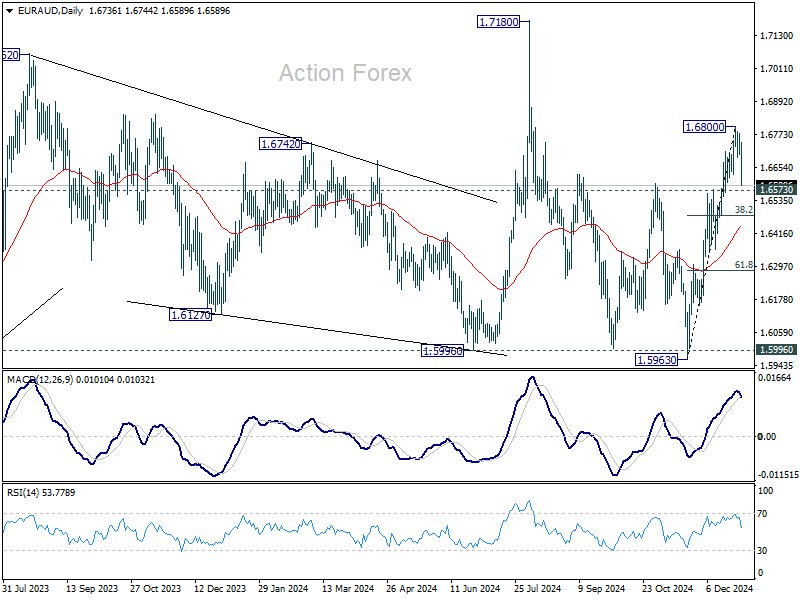
EURAUD on the 3-hour timeframe has recently broken above the previous high, followed by a retracement now inching towards the drop-base-rally demand zone at 76% of the Fibonacci retracement zone. The bullish array of the moving averages, trendline support, and the drop-base-rally demand zone provide a great confluence in favor of a bullish continuation.
Analyst's Expectations:
- Direction: Bullish
- Target:1.65990
- Invalidation: 1.61240
Gold Prices Plunge as Trump Triumphs: What’s Next for XAU/USD?
- Gold prices plummet as Trump’s election victory boosts the US dollar and Treasury yields.
- Market sentiment shifts towards higher interest rates, diminishing gold’s appeal.
- Technical analysis suggest bearish momentum is building, will safe haven demand return and underpin Gold prices?
Gold prices in freefall as the US Dollar Index and US Treasury Yields surged following a Donald Trump election victory. The US Dollar Index and US 10 Yield are both trading at levels last seen in July with the former up around 1.7% on the day. The Republicans have secured the Senate as well while there is growing optimism of a clean sweep which would see them claim the House as well which in theory should underpin the US Dollar moving forward.
US Election Results
Source: Edison Research, Reuters (click to enlarge)
Market participants appear convinced that a Trump victory will lead to higher rates for longer, thus diminishing the appeal of the non-yielding precious metal. This coupled with renewed optimism that President Trump will be able to reach a peace deal in the Middle East has also weighed on Gold prices.
Looking at the rate probabilities for December and we can already see significant repricing of expectations. Prior to the elections markets were pricing in a 77% probability of a 25 bps cut in December, this has been revised down to 66% post election and could decline further should the republicans secure the House as well.
Source: CME FedWatch Tool (click to enlarge)
The problem for Gold prices moving forward is that President Trump will only take office in January. This means that any of the optimism around a Middle East peace deal and the potential for higher rates may not change until then. This could leave Gold in a spot of bother with the recent selloff likely to continue.
The Federal Reserve meeting tomorrow is likely to have a limited impact on markets. The outlook moving forward by the Fed will be key for now, but markets may be hesitant to look too far ahead. The reason is simple, with Trump assuming office in January there is a chance that the Fed outlook may face significant changes in the new year if tariffs and inflation become topics of concern.
Technical Analysis Gold (XAU/USD)
From a technical analysis standpoint, Gold has been flirting with overbought territory since the Middle of October before the accelerated selloff today. Looking at the daily timeframe and Gold is now trading below the long-term ascending trendline (inner) for the first time since it started way back in August. A daily candle close below this level could open up the potential for a deeper pullback.
Gold (XAU/USD) Daily Chart, November 6, 2024
Source: TradingView (click to enlarge)
Looking at a four hour chart, Gold had been showing signs that bullish pressure had been starting to wane. This was most notable by the multiple rejections of the 2750/oz handle, which faced multiple tests this past week.
Having broken below the 2700 handle, Gold selloff gathered momentum rushing toward the 2750 psychological level. A break of this handle opens up a run toward the 2639 support area before the 2624 comes into focus.
Given the speed of the selloff, the possibility of a retracement before continuation is also a possibility. A retest of the trendline could be ideal for market participants looking for a potential bearish continuation.
This would require a pullback toward the 200-day MA which lines up with the trendline and key level at 2685.75. Should momentum build, a deeper pullback toward 2700 would not rule out a further leg to the downside and would provide a potentially better risk to reward for potential shorts.
Gold (XAU/USD) Four-Hour (H4) Chart, November 6, 2024
Source: TradingView (click to enlarge)
Support
- 2650
- 2639
- 2624
Resistance
- 2673
- 2685
- 2700
Sunset Market Commentary
Markets
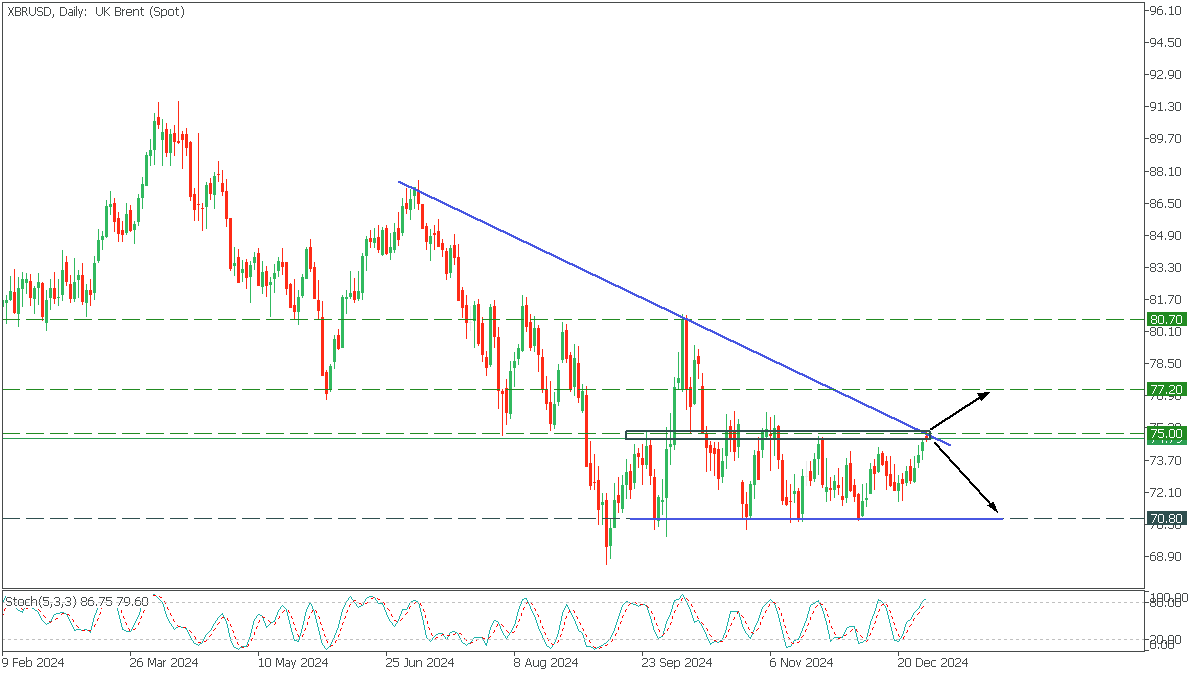
The shape of the post-US election phase of the Trump trade were already crystal clear before the open of European markets. Donald Trump secured his second term as US president with supplementary institutional comfort of a Senate majority. Even a House majority remains a possible additional pillar to facilitate the implementation of his political agenda. US yields jumped sharply this morning. For now, tentative further follow-through action is running into resistance as US markets reopened. US yields currently add between 11 bps (2-y) and 22 bps (30-y) in a distinct bear steeping move. A resilient US economy might be pushed further to the limits of capacity, creating upside inflation risk, by a growth supportive fiscal and (de)regulatory policy. In this context, the Fed might sit back when assessing the need to prevent an unwarranted slowdown and/or cooling of the labour market. Last month’s repositioning continues. End September money markets saw the September Fed dots (50 bps additional easing in 2024 and 100 bps in 2025) as (much too) conservative, discounting a combined additional 75 bps for the November and December meetings and 150 bps of further easing next year. Currently, a 25 bps cut tomorrow still look safe. A next step in December is discounted for about 65%. Only 50 bps cumulative easing is seen left for next year. The reassessment at the long end is even more impressive, with the 10-y yield (currently near 4.45%) about 85/90 bps higher compared to the September low. Aside from potentially reduced/delayed Fed support, investors are also asking a higher US inflation and credit premium. For now, higher expected (nominal) growth still outweighs these risk premia for US equity investors. Major US indices are jumping between 3.0% (Dow) and 2% (S&P 500). Interestingly, European (and to a lesser extent UK) yields are parting ways with the US. The German curve also steepened, but with the 2-y yield easing 9 bps; the 10-y little changed and the 30-y rising 5.0 bps. Markets apparently see a more domestic oriented/’isolationist’ US policy as a potential reason for the likes of the ECB to ease policy more aggressively. We doubt this to be the ECB reaction function in a context of rising risk premia and a vulnerable euro. To be continued. Contrary the US, a weaker euro and lower yields aren’t enough for European indices to hold opening gains (Eurostoxx 50 -0.7%). Also something to watch, after a tentative rebound of late, oil is running into resistance (Brent $74 p/b from S76+ yesterday).
On FX markets, the dollar jumps sharply. Higher interest rate support, a strong domestic growth outlook, potential fall-out from higher tariffs on the economies of US trading partners and higher risk premia (admittedly also on US bonds) for now are a good reason for the USD to play ‘primus inter pares’. DXY jumps from a close yesterday at 103.42 to 105.25. USD/JPY adds from an open of 151.6 to 154.3. EUR/USD tumbles from the 1.093 area to test the 1.07 area. At this pace of correction, 1.0601 YTD low and 1.0448 (2023 low) might come within reach soon. Cable is also hit hard, (1.286 from 1.304), but outperforms the euro (EUR/GBP 0.8325). UK short-term yields decline only modestly compared to the big losses in EMU. Tomorrow’s UK policy meeting might bring some more clarity on the BoE reaction function especially after a (growth -supportive) budget of the Labour government announced last week.
News & Views
The Czech government in its freshly printed forecasts expects growth to pick up from 1.1% this year to 2.5% in 2025. The latter is a slight downward revision from the 2.7%. Increased household spending and corporate investment would drive the acceleration. The government aims to reduce the budget gap from 2.8% in 2024 to 2.3% of GDP next year. Finance minister Stanjura noted growth and inflationary risks from potential new export barriers, global supply disruption, ongoing weakness in the country’s main trading partner Germany, and, most importantly, from a potential trade war between the US and China. Annual inflation forecasts were left unchanged at 2.4% and 2.3% respectively, within the 2% +/- 1 ppt target range of the central bank. The latter is meeting tomorrow. Vice governor Zamrazilova last week said she’ll choose between a rate cut and a pause, being the first to float the latter option. She thinks rates have room to go lower still but is evaluating how to spread them in time instead of moving back-to-back. Markets and analysts nevertheless stick to a 25 bps rate cut to 4%. The Czech koruna, along with most other CE FX, lose ground in the wake of Trump’s victory but do trade off the intraday lows. EUR/CZK currently changing hands around 25.34.
Crypto Euphoria
Market Picture
The cryptocurrency market surged with excitement as its capitalization jumped 7% in just 24 hours, reaching $2.45 trillion and briefly peaking at $2.48 trillion, matching the highs seen in July. Trading volumes since the start of the day were the highest since early August and have a chance of surpassing those levels.
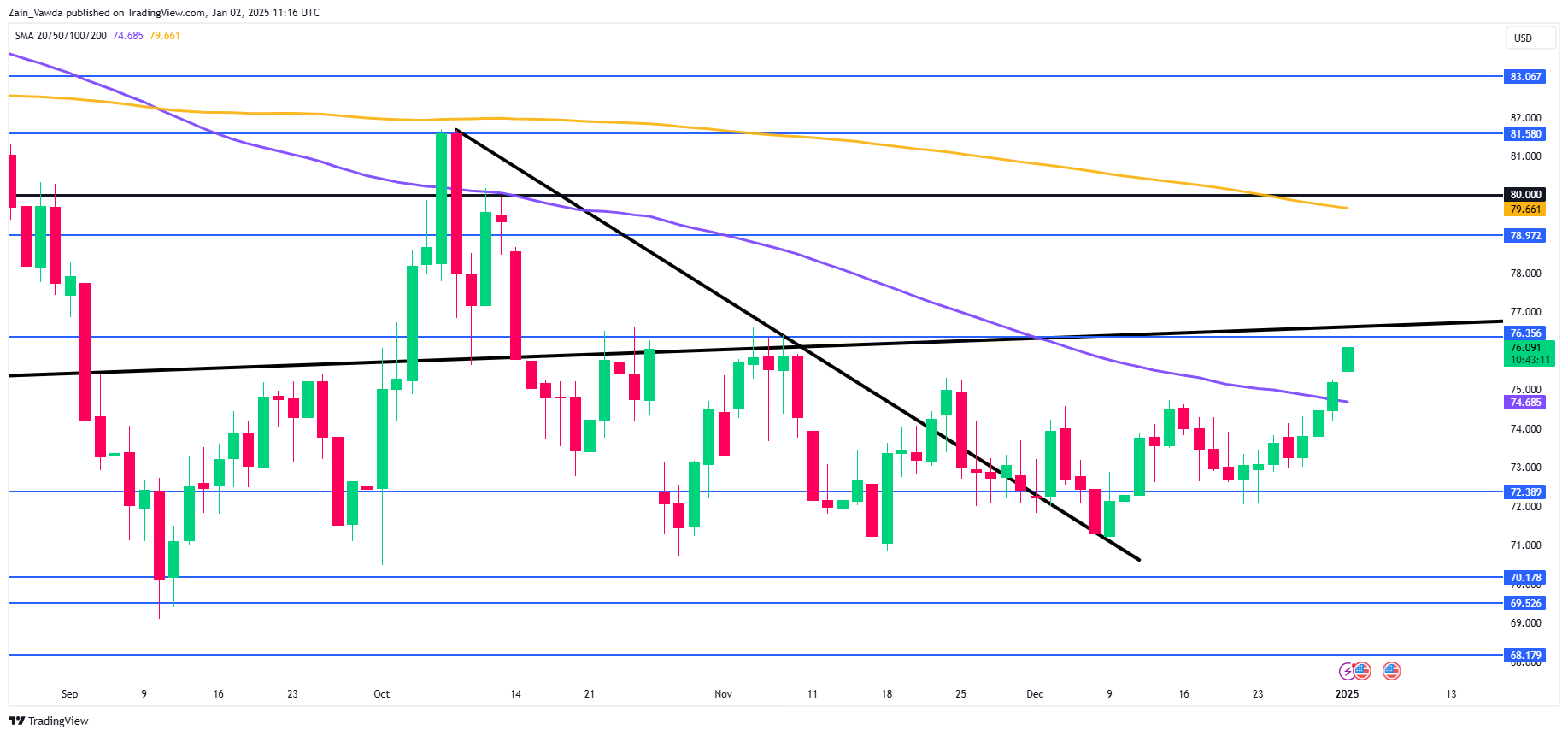
Bitcoin has been a key driver of the crypto market rally, rising 6.6% over the past 24 hours to an all-time high of $75.4K before retreating to $73.8K at the time of writing. The current move is within a rising channel that has been in place since September. Its upper border is now near $76.6K (above the recent highs), and the RSI is far from overbought, suggesting that there is still upside potential.
Dogecoin rallied nearly 55% from its November 3rd lows to Wednesday afternoon’s high, fuelled by Trump’s improved chances of victory and anticipation around the election results. In addition to the general positivity for cryptocurrencies, speculators are betting on Musk’s potential position in the new administration. The Tesla founder and head of X (formerly Twitter) has maintained the recognition of one of the first meme coins for many years.
News Background
Another recalculation saw the difficulty of mining the first cryptocurrency jump by 6.24%. The index reached a record high of 101.65 T. The average hash rate over the two-week calculation period dropped slightly (680 EH/s) but is currently back above 720 EH/s.
The Michigan State Pension Fund announced the purchase of shares in two Ethereum funds for approximately $11 million. The organisation was one of the top five holders of ETHE. This is the first pension fund initiative since the launch of spot ETH ETFs in July. Bloomberg called the Michigan authorities’ decision a ‘big win for Ethereum’.
According to Arkham, the largest transaction in recent months was sent by the bankrupt cryptocurrency exchange Mt. Gox to two unknown wallets: 34,371 BTC ($2.3 billion).
Dollar Stays Strong on Trump’s Win While Republicans Sweep Congress
Following Donald Trump's clear victory over Kamala Harris in the US presidential election, accompanied by a full Republican “Red Sweep” in Congress, US futures, Treasury yields, and the Dollar all surged sharply higher. Markets are responding favorably to expansionary fiscal policies, tax cuts, and a pro-growth agenda under the new administration. Major European indexes also rose, despite warnings from some analysts that Trump’s return may be an economic "nightmare" for Europe.
In currency markets, Dollar has jumped to a clear leadership position. Euro and Yen are currently the weakest performers, followed by Swiss Franc and Sterling. Loonie is holding second place, benefiting from its close economic ties with the US, while risk-on sentiment has kept both Kiwi and Aussie relatively resilient.
Attention now shifts to tomorrow's rate decisions by BoE and Fed. Both central banks are widely expected to implement a 25 bps rate cut in response to softer inflationary pressures. BoE’s new economic projections, which will be released with the rate decision, could offer more clarity on the pace of policy easing going forward. For Fed, probability of another rate cut in December has slipped below 70%, as indicated by fed funds futures, reflecting increased market uncertainty.
Technically, USD/CNH also surged sharply higher today following broad based Dollar strength. Current development affirms the case that whole corrective fall from 7.3679 has completed with three waves down to 6.9709. Near term outlook will stay bullish as long as 7.0860 support holds. Next target is 7.3111 resistance. Extended weakness in offshore Yuan could exert some pressure on Chinese and Hong Kong stocks, with risk of dragging down Aussie and Kiwi.
In Europe, at the time of writing, FTSE is up 0.88%. DAX is up 0.41%. CAC is up 0.88%. UK 10-year yield is up 0.027 at 4.557. Germany 10-year yield is down -0.019 at 2.410. Earlier in Asia, Nikkei rose 2.61%. Hong Kong HSI fell -2.23%. China Shanghai SSE fell -0.09%. Singapore Strait Times rose 0.60%. Japan 10-year JGB yield rose 0.0516.
Eurozone PPI down -0.6% mom in Step, led by energy prices
Eurozone's PPI decreased by -0.6% mom in September, slightly exceeding the expected decline of -0.5% mom. On an annual basis, PPI fell by -3.4% yoy, marginally less than the anticipated -3.5% yoy drop.
The monthly decline in Eurozone PPI was primarily driven by a significant -1.9% mom decrease in energy prices. Intermediate goods prices remained stable, while capital goods saw a slight decrease of -0.1% mom. In contrast, prices for both durable and non-durable consumer goods increased by 0.2% mom.
Across the broader EU, PPI also dropped by -0.6% mom and -3.3% yoy. Among member states, Estonia, Spain, and Romania led the monthly declines with falls of -3.6%, -2.4%, and -2.2%, respectively, while Ireland recorded a significant 4.8% increase, followed by Finland and Greece with more modest gains of 1.0% and 0.7%.
Eurozone PMI services finalized at 51.6, PMI composite at 50.0
Eurozone PMI Services for October was finalized at 51.6, up from September’s 51.4. PMI Composite also moved to 50.0 from 49.6, indicating stagnation rather than expansion across the region. The services sector continues to play a vital role in keeping Eurozone’s economy afloat, yet concerns of a Q4 contraction remain.
Spain topped the Eurozone with PMI Composite of 55.2, while Ireland followed at 52.. Italy’s index reached 51.0, a four-month high. Meanwhile, Germany's reading improved to 48.6, still in contraction but at a three-month high. France recorded an eight-month low of 48.1.
Cyrus de la Rubia, Chief Economist at Hamburg Commercial Bank, remarked, “The modest expansion of the services sector has been crucial in keeping the currency union out of recession.” He highlighted that declining inflation and higher wages are likely bolstering consumer spending, which sustains demand in services. However, de la Rubia pointed out that their GDP Nowcast for Q4 indicates a “slight contraction” in overall Eurozone output.
De la Rubia also noted that structural issues, such as labor shortages which exert upward wage pressures, continue to keep inflation elevated. "The ECB will find it "difficult, if not impossible", to achieve the 2% inflation target in a sustainable manner in this environment," he added.
BoJ minutes: Yen stabilization gives time to monitor global economic risks
Minutes from BoJ's September meeting reveal a careful stance on monetary policy amid global economic uncertainties. At the meeting, BoJ kept its interest rate steady at 0.25%.
Regarding future direction of monetary policy, members broadly agreed that if Japan's economic and inflation outlook aligns with their projections, the Bank would "continue to raise the policy interest rate" and gradually adjust its level of monetary accommodation.
The minutes also underscore the need for "high vigilance" given uncertainties in overseas economies, particularly in the US, and ongoing volatility in global financial markets.
Some members pointed out that recent retracements in Yen’s depreciation have moderated upside risk to inflation from import prices. Given this development, they noted that the Bank has "enough time" to evaluate the effects of global economic shifts and recent policy rate hikes before deciding on further moves.
Japan's PMI services finalized at 49.7, first contraction since Jun
Japan's services sector slipped into contraction in October, with PMI Services index finalized at 49.7, down from September’s 53.1 and marking its first contraction since June. PMI Composite also declined to 49.6 from 52.0, signaling a contraction in private sector activity for the first time in four months and the lowest reading since November 2023.
According to Usamah Bhatti, Economist at S&P Global Market Intelligence, the services sector’s performance “came to an abrupt halt” at the start of Q4. While the decline was modest, it was driven by a notable slowdown in new business inflows, particularly in export orders. Despite the dip, businesses maintained a positive outlook, though optimism weakened to its lowest in over two-and-a-half years, with companies citing concerns over labor shortages as a key factor.
The services sector slowdown, combined with a continuing contraction in manufacturing, contributed to the steepest private sector contraction in nearly a year. New order inflows stagnated, particularly impacted by weakened demand in manufacturing order books. Business sentiment, overall, has also softened, with optimism now at its lowest since January 2021.
NZ employment falls -0.5% in Q3, unemployment rate rises to 4.8%
New Zealand’s labor market showed signs of cooling in Q3, with employment falling by -0.5% qoq, in line with expectations. Unemployment rate rose from 4.6 to 4.8%, slightly better than the anticipated 5.0%, but still indicative of softening labor conditions.
Labor force participation rate also declined, dropping from 71.7% to 71.2%, while the employment rate slipped from 68.4% to 67.8%, reflecting fewer people actively engaged in the workforce.
On the wage front, growth showed deceleration. The labor cost index, which includes salary and wage rates with overtime, rose by 3.8% yoy, down from the previous quarter’s 4.3% yoy increase.
The slowdown in wage growth suggests some relief in wage-driven inflation pressures, which could factor into RBNZ's upcoming rate cut.
USD/JPY Mid-Day Outlook
Daily Pivots: (S1) 151.12; (P) 151.83; (R1) 152.32; More...
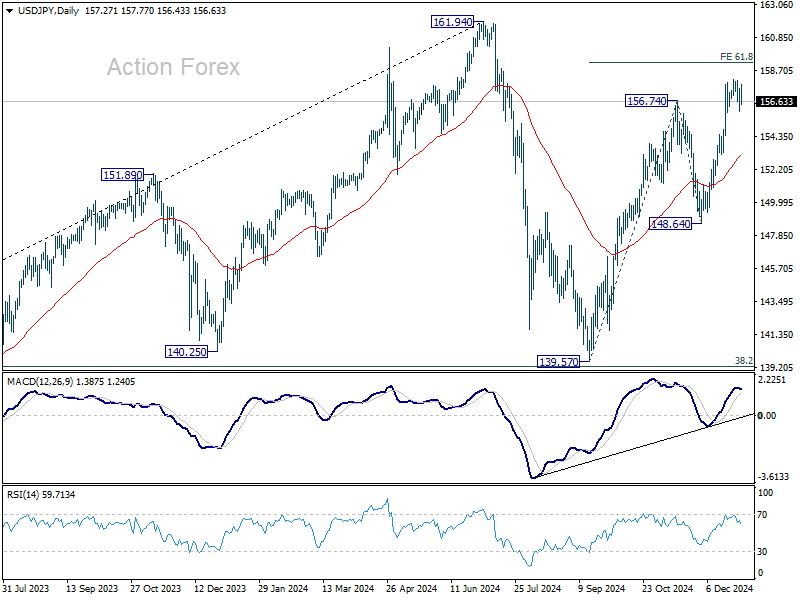
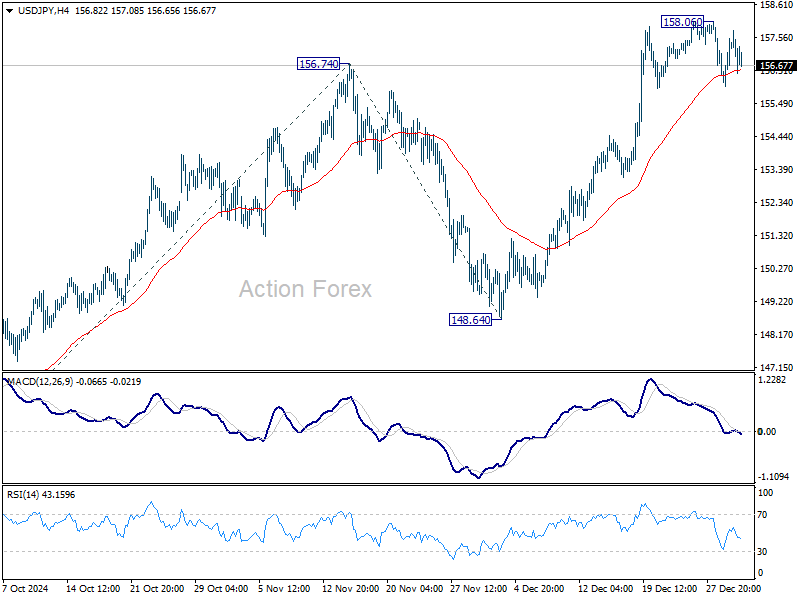
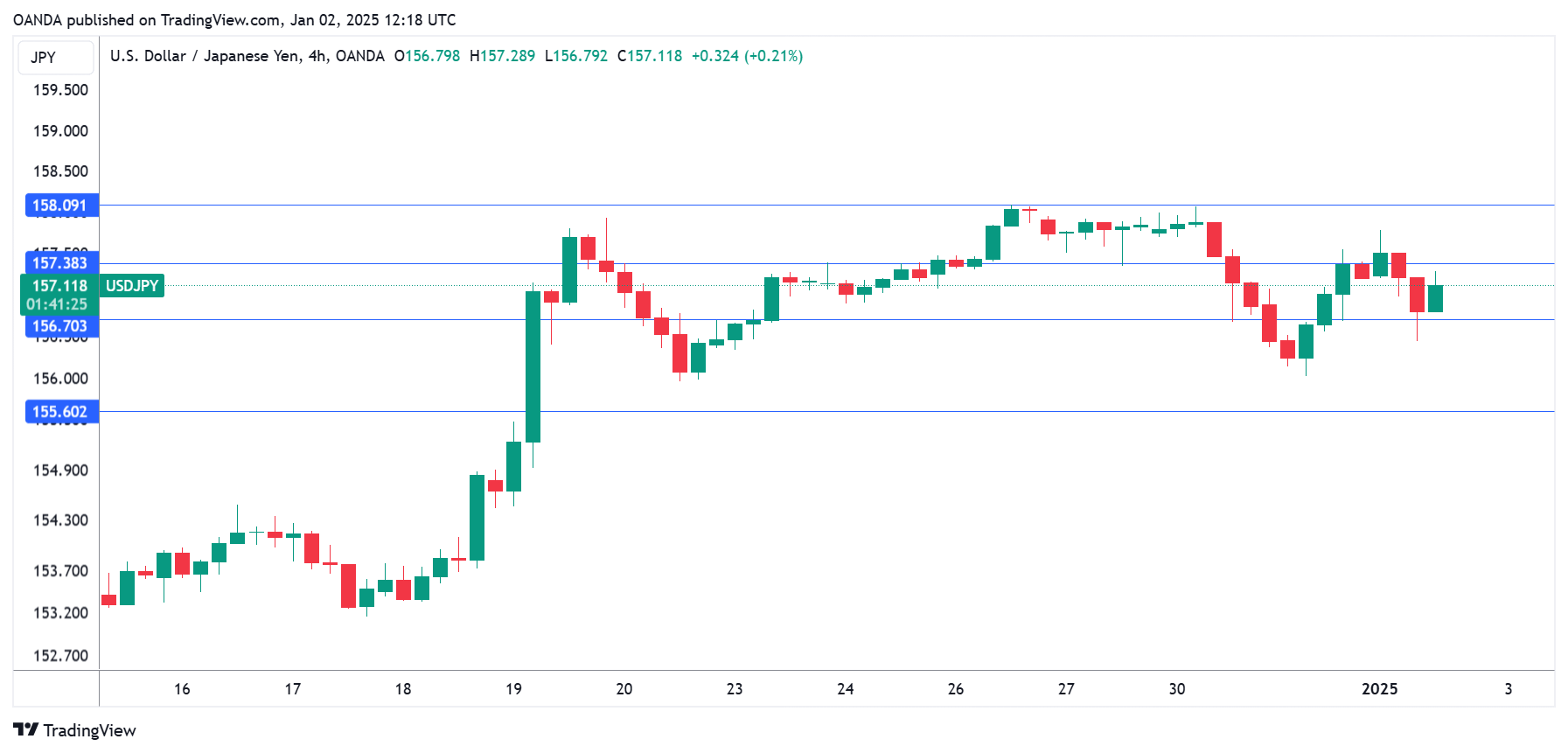
Intraday bias in USD/JPY remains on the upside for the moment. Current rally from 139.57 should target 61.8% projection of 141.63 to 153.87 from 151.27 at 158.83. For now, outlook will remain bullish as long as 151.27 support holds, in case of retreat.
In the bigger picture, price actions from 161.94 are seen as a corrective pattern to rise from 102.58 (2021 low). The range of medium term consolidation should be set between 38.2% retracement of 102.58 to 161.94 at 139.26 and 161.94. Nevertheless, sustained break of 139.26 would open up deeper medium term decline to 61.8% retracement at 125.25.