

Sample Category Title
EUR/USD Daily Outlook
Daily Pivots: (S1) 1.0365; (P) 1.0407; (R1) 1.0470; More....
Intraday bias in EUR/USD remains neutral first and more consolidations could be seen. While stronger recovery cannot be ruled out, outlook will remain bearish as long as 1.0629 resistance holds. Firm break of 1.0330 will confirm decline resumption and target 61.8% projection of 1.0936 to 10330 from 1.0629 at 1.0254, and then 100% projection at 1.0023.

In the bigger picture, focus stays on 50% retracement of 0.9534 (2022 low) to 1.1274 at 1.0404. Strong rebound from this level will keep price actions from 1.1273 (2023 high) as a medium term consolidation pattern only. However, sustained break of 1.0404 will raise the chance that whole up trend from 0.9534 has reversed. That would pave the way to 61.8% retracement at 1.0199 first. Firm break there will target 0.9534 low again.

USD/JPY Daily Outlook
Daily Pivots: (S1) 155.64; (P) 156.78; (R1) 157.61; More...
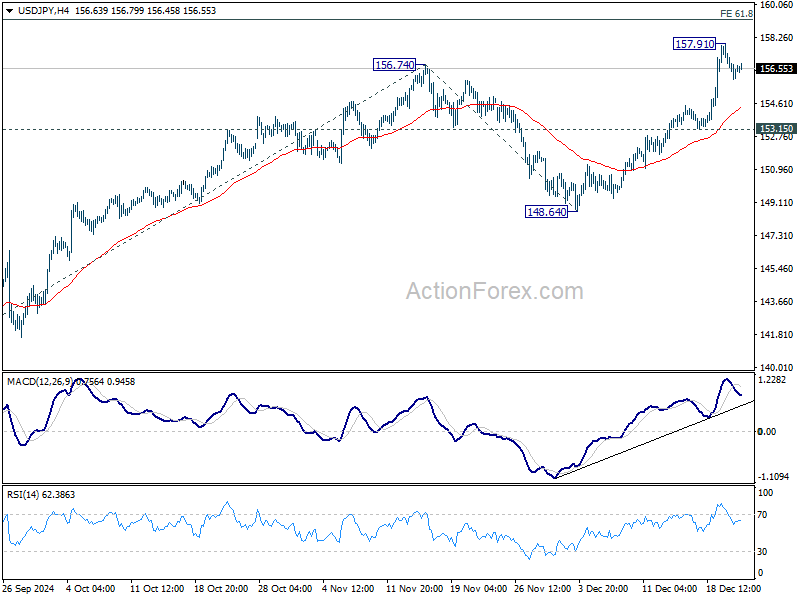
Intraday bias in USD/JPY remains neutral as consolidations continues below 157.91 temporary top. Deeper pull back cannot be ruled out, but outlook will stay bullish as long as 153.15 support holds. On the upside, break of 157.91 will resume the rally from 139.57 to 61.8% projection of 139.57 to 156.74 from 148.64 at 159.25 next.
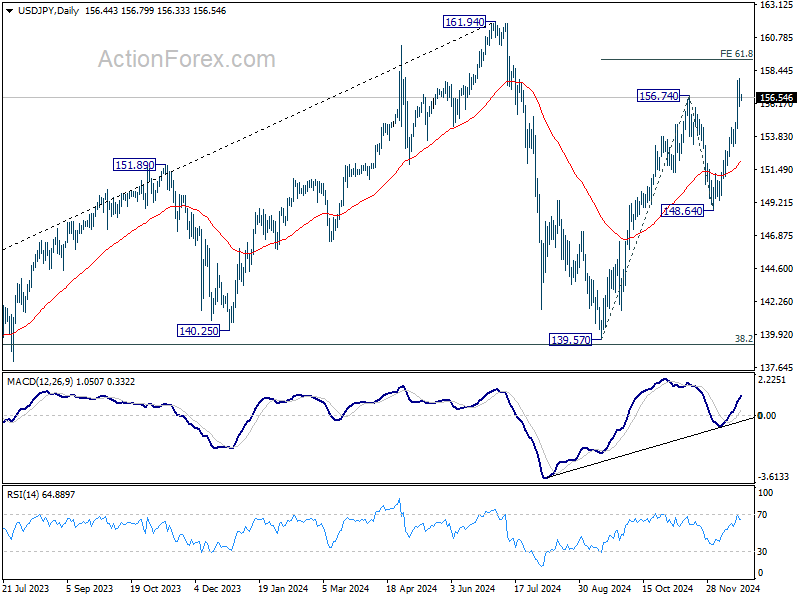
In the bigger picture, price actions from 161.94 are seen as a corrective pattern to rise from 102.58 (2021 low). The range of medium term consolidation should be set between 38.2% retracement of 102.58 to 161.94 at 139.26 and 161.94. Nevertheless, sustained break of 139.26 would open up deeper medium term decline to 61.8% retracement at 125.25.
GBP/USD Daily Outlook
Daily Pivots: (S1) 1.2491; (P) 1.2553; (R1) 1.2630; More...
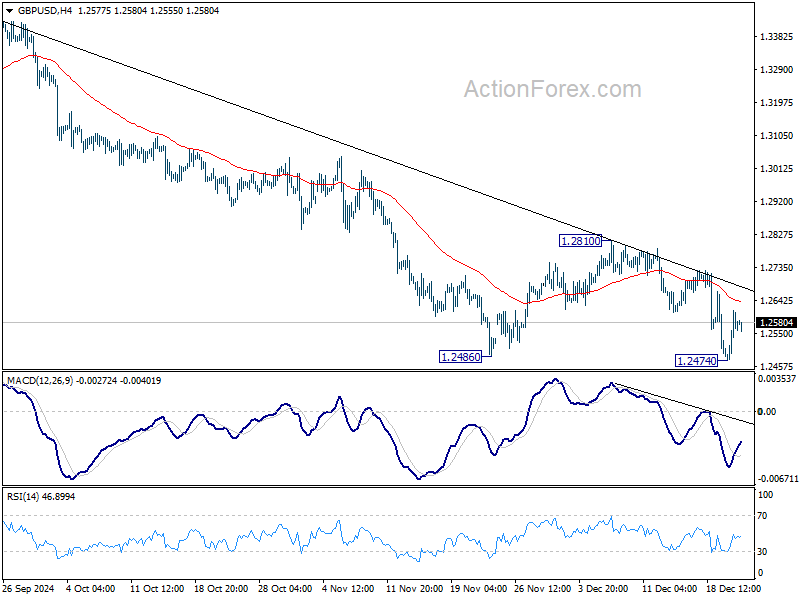
Intraday bias in GBP/USD remains neutral and more consolidations would be seen above 1.2474 temporary low. Outlook will stay bearish as long as 1.2810 resistance holds. On the downside, break of 1.2474 will resume the fall from 1.3433 to 1.2298 cluster support zone.
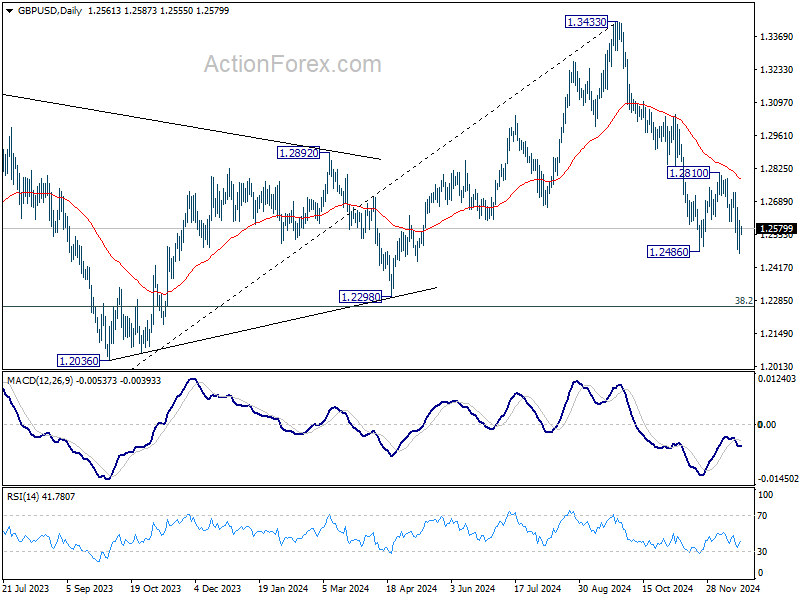
In the bigger picture, price actions from 1.3433 medium term are seen as correcting whole up trend from 1.0351 (2022 low). Deeper decline could be seen to 38.2% retracement of 1.0351 to 1.3433 at 1.2256, which is close to 1.2298 structural support. But strong support is expected there to bring rebound to extend the corrective pattern.
USD/CHF Daily Outlook
Daily Pivots: (S1) 0.8898; (P) 0.8946; (R1) 0.8979; More…
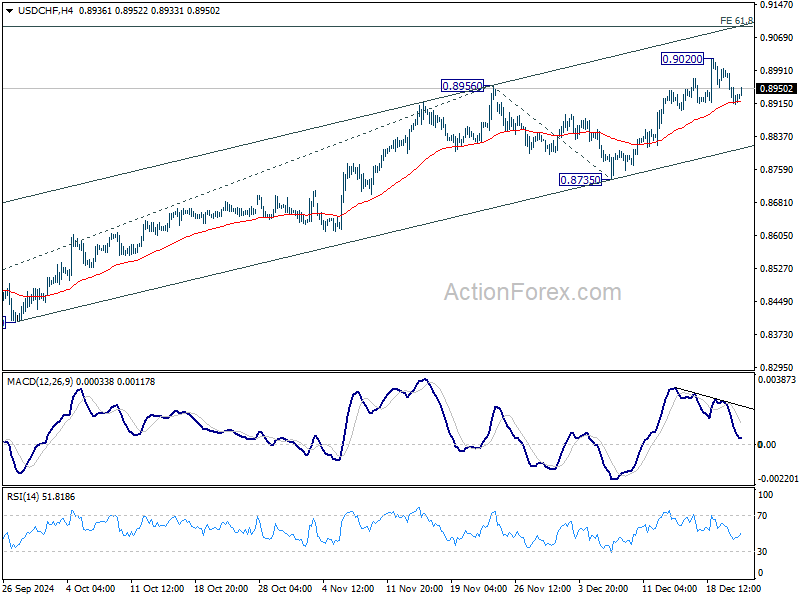
USD/CHF is staying in consolidation below 0.9020 temporary top and intraday bias stays neutral. While deeper pull back might be seen, downside should be contained above 0.8735 support to bring another rally. Above 0.9020 will resume the rise from 0.8374 and target 61.8% projection of 0.8374 to 0.8956 from 0.8735 at 0.9095.
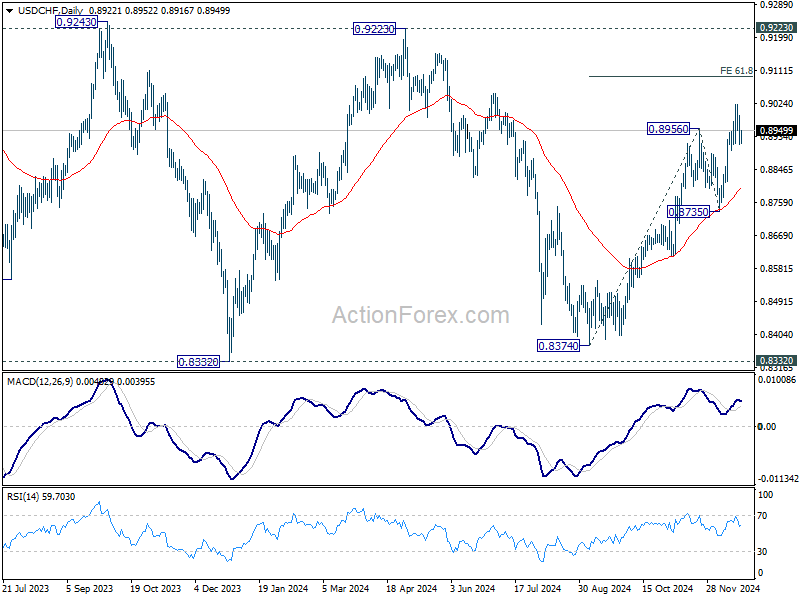
In the bigger picture, price actions from 0.8332 (2023 low) are currently seen as a medium term corrective pattern, with rise from 0.8374 as the third leg. Overall outlook will continue to stay bearish as long as 0.9223 resistance holds. Break of 0.8332 low is in favor at a later stage when the consolidation completes.
USD/CAD Daily Outlook
Daily Pivots: (S1) 1.4328; (P) 1.4382; (R1) 1.4428; More...
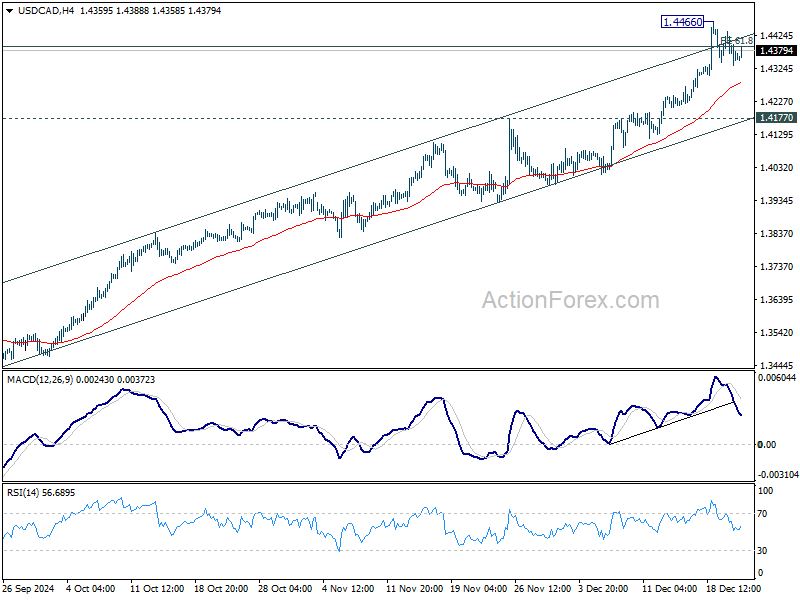
Intraday bias in USD/CAD stays neutral as consolidation continues below 1.4466 temporary top. While deeper pull back cannot be ruled out, outlook will stay bullish as long as 1.4177 resistance turned support holds. On the upside, break of 1.4466 and sustained trading above 1.4391 will pave the way to retest 1.4667/89 long term resistance zone.
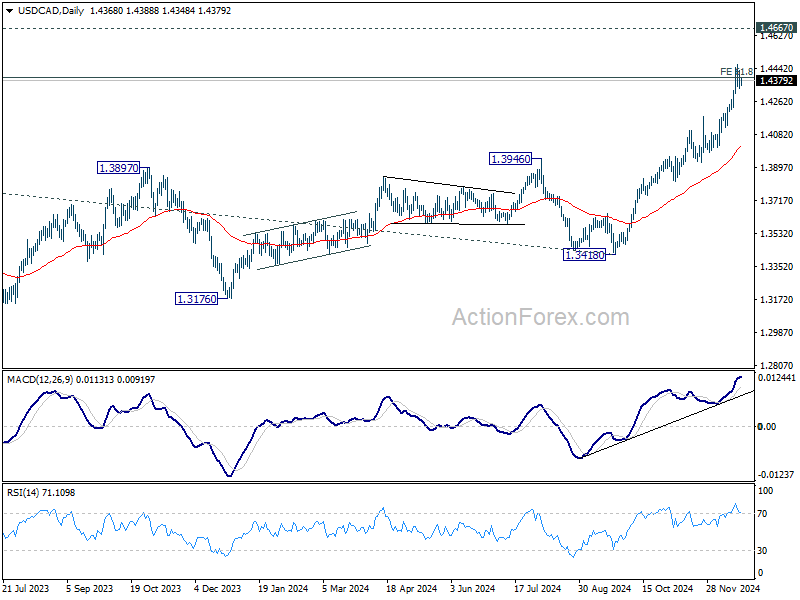
In the bigger picture, up trend from 1.2005 (2021) is in progress and met 61.8% projection of 1.2401 to 1.3976 from 1.3418 at 1.4391 already. Sustained trading above there will pave the way to 1.4667/89 key resistance zone (2020/2015 highs). Medium term outlook will remain bullish as long as 55 W EMA (now at 1.3729) holds, even in case of deep pullback.
XAU/USD Chart Analysis and Analytical Gold Price Forecast for 2025
With the holiday season underway, this week may be less volatile than the previous one, which was dominated by central bank decisions. This presents an opportunity to analyse the broader trends and outlook for gold prices in 2025.
The XAU/USD chart reveals that gold prices have been moving within an ascending channel, gaining approximately 27% since the start of 2024.
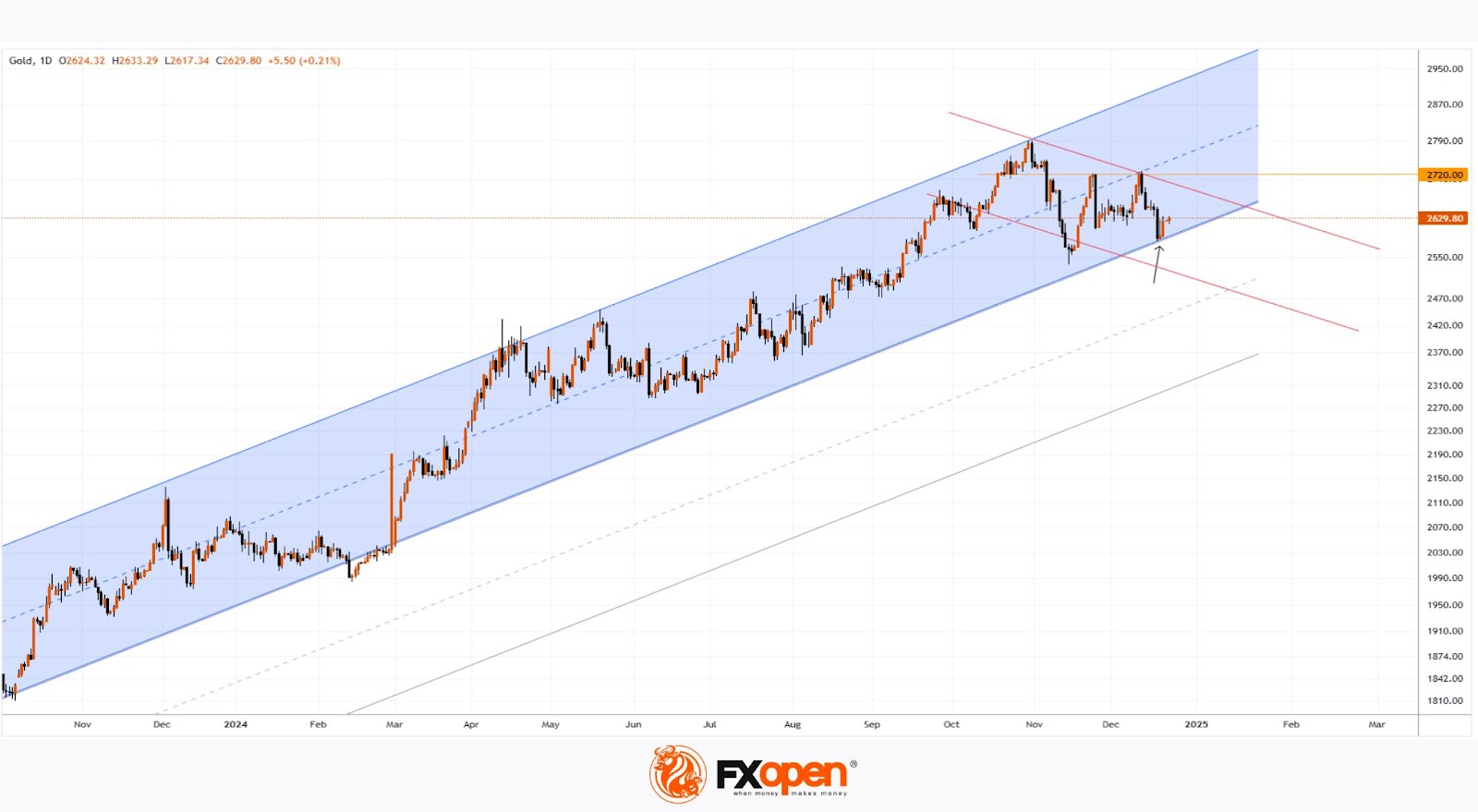
The short-term outlook appears bearish due to the following factors:
- Gold prices fell after last week’s Federal Reserve interest rate cut, signalling increased selling pressure.
- The $2,720 level remains a key resistance, having reversed the price downward in November and December.
- While a recent upward reversal (indicated by an arrow) shows renewed buying interest near the lower boundary of the ascending channel, persistent selling pressure could still lead to a bearish trend. This might result in a breakdown below the blue channel's lower boundary and the formation of a descending channel (outlined in red).
Despite short-term challenges, analysts remain optimistic about gold's prospects for 2025. Donald Trump's return to the White House may significantly change global trade, Western alliances, and geopolitical dynamics. These uncertainties may increase demand for gold as a so-called safe-haven asset.
A BullionVault survey of around 1,450 participants predicts that gold prices could reach $3,070 by the end of 2025, driven by concerns over geopolitics and mounting national debt.
In this context, even if the lower boundary of the blue channel is breached, bullish momentum could resume, possibly from one of the grey support levels.
Start trading commodity CFDs with tight spreads. Open your trading account now or learn more about trading commodity CFDs with FXOpen.
This article represents the opinion of the Companies operating under the FXOpen brand only. It is not to be construed as an offer, solicitation, or recommendation with respect to products and services provided by the Companies operating under the FXOpen brand, nor is it to be considered financial advice.
Gold Price and Crude Oil Price Face Hurdles
Gold price started a fresh decline below $2,665. Crude oil prices are now struggling to clear the $70.00 and $70.50 resistance levels.
Important Takeaways for Gold and Oil Prices Analysis Today
- Gold price climbed higher toward the $2,665 zone before there was a sharp decline against the US Dollar.
- A key bearish trend line is forming with resistance near $2,632 on the hourly chart of gold at FXOpen.
- Crude oil prices extended downsides below the $70.00 support zone.
- A major bearish trend line is forming with resistance near $70.00 on the hourly chart of XTI/USD at FXOpen.
Gold Price Technical Analysis
On the hourly chart of Gold at FXOpen, the price recovered above the $2,650 resistance. The price even spiked above $2,665 before the bears appeared.
A high was formed near $2,665 before there was a fresh decline. There was a move below the $2,650 support level. The bears even pushed the price below the $2,620 support and the 50-hour simple moving average.
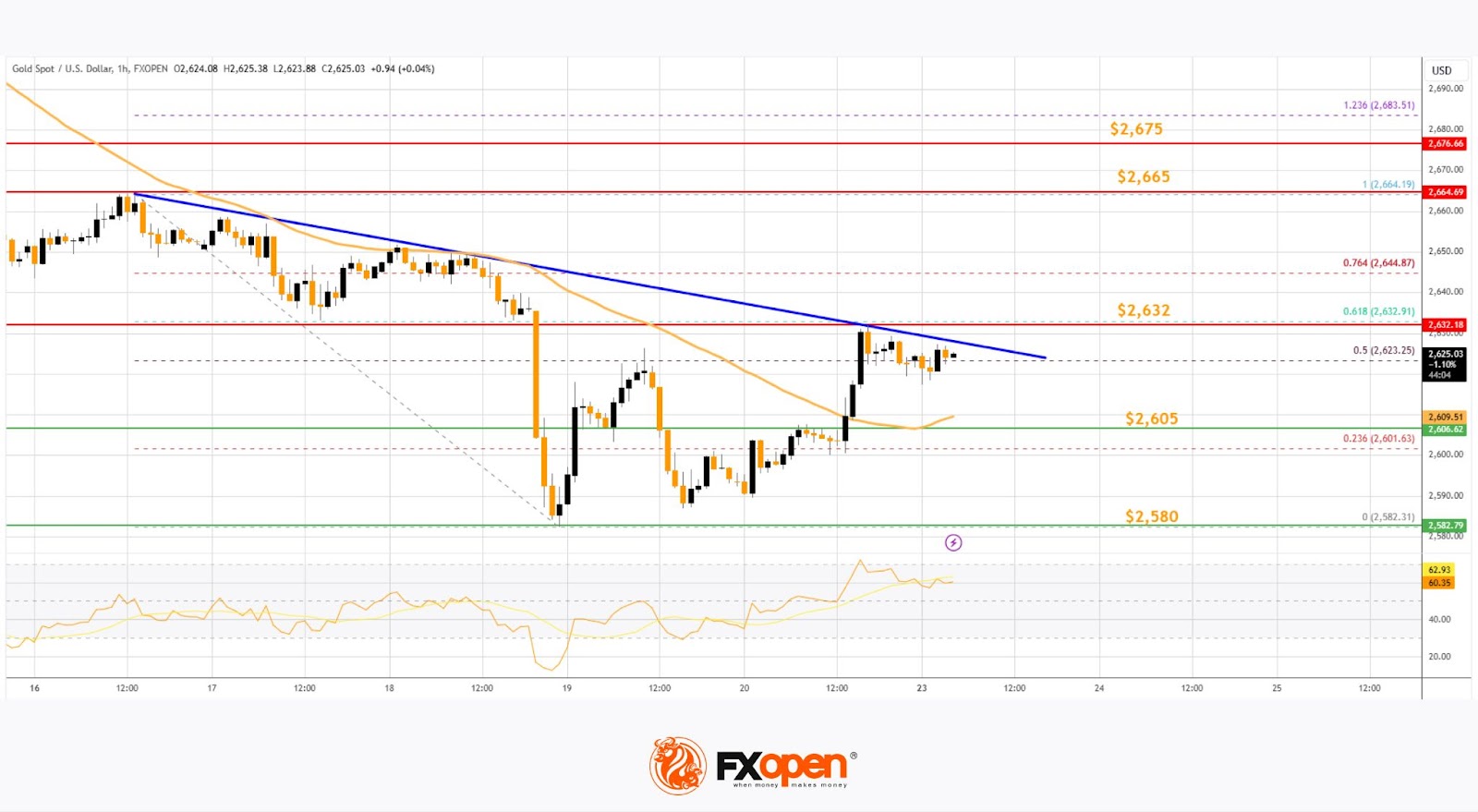
It tested the $2,580 zone. A low formed near $2,582 and the price is now showing bearish signs. There was a minor recovery wave above the 50% Fib retracement level of the downward move from the $2,664 swing high to the $2,582 low.
However, the bears are active below $2,650. Immediate resistance is near $2,630 and a key bearish trend line at $2,632. It is close to the 61.8% Fib retracement level of the downward move from the $2,664 swing high to the $2,582 low.
The next major resistance is near the $2,665 zone. The main resistance could be $2,675, above which the price could test the $2,700 resistance. The next major resistance is $2,720.
An upside break above the $2,720 resistance could send Gold price toward $2,750. Any more gains may perhaps set the pace for an increase toward the $2,770 level.
Initial support on the downside is near the $2,605 level. The first major support is near the $2,580 level. If there is a downside break below the $2,580 support, the price might decline further. In the stated case, the price might drop toward the $2,550 support.
Oil Price Technical Analysis
On the hourly chart of WTI Crude Oil at FXOpen, the price struggled to continue higher above $70.50 against the US Dollar. The price formed a short-term top and started a fresh decline below $70.00.
There was a steady decline below the $69.40 pivot level. The bears even pushed the price below $69.00 and the 50-hour simple moving average. Finally, the price tested the $68.35 zone. The recent swing low was formed near $68.36, and the price is now correcting losses.
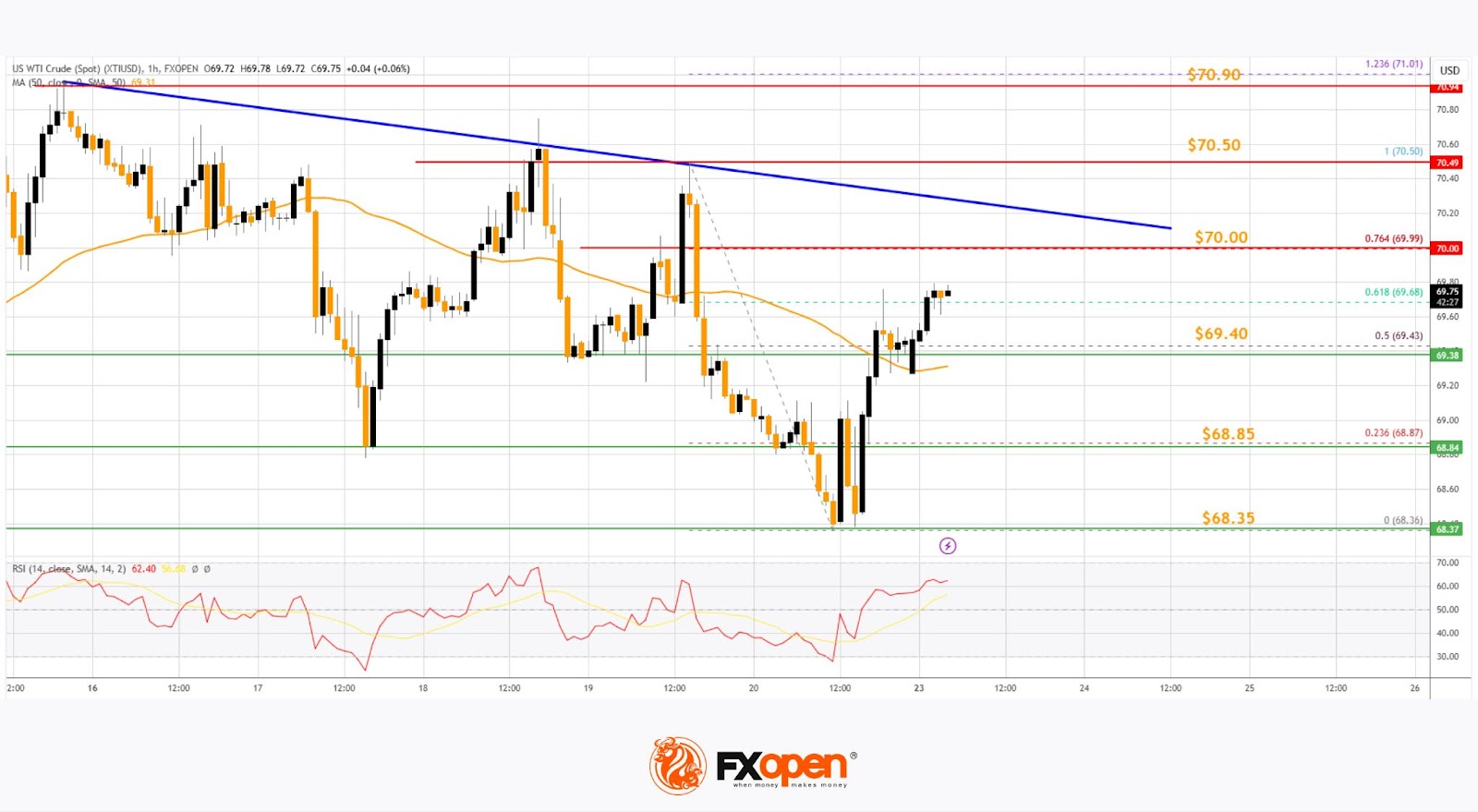
There was a minor move above the 50% Fib retracement level of the downward move from the $70.50 swing high to the $68.36 low. On the upside, immediate resistance is near the $70.00 level.
There is also a major bearish trend line forming with resistance near $70.00. The trend line is close to the 76.4% Fib retracement level of the downward move from the $70.50 swing high to the $68.36 low.
The next resistance is near the $70.50 level. The main resistance is near a trend line at $70.90. A clear move above the $70.90 zone could send the price toward $72.00. The next key resistance is near $72.50. If the price climbs further higher, it could face resistance near $74.20. Any more gains might send the price toward the $75.00 level.
Immediate support is near the $69.40 level. The next major support on the WTI crude oil chart is near $68.85. If there is a downside break, the price might decline toward $68.35. Any more losses may perhaps open the doors for a move toward the $66.00 support zone.
Start trading commodity CFDs with tight spreads. Open your trading account now or learn more about trading commodity CFDs with FXOpen.
This article represents the opinion of the Companies operating under the FXOpen brand only. It is not to be construed as an offer, solicitation, or recommendation with respect to products and services provided by the Companies operating under the FXOpen brand, nor is it to be considered financial advice.
AUD/USD Daily Report
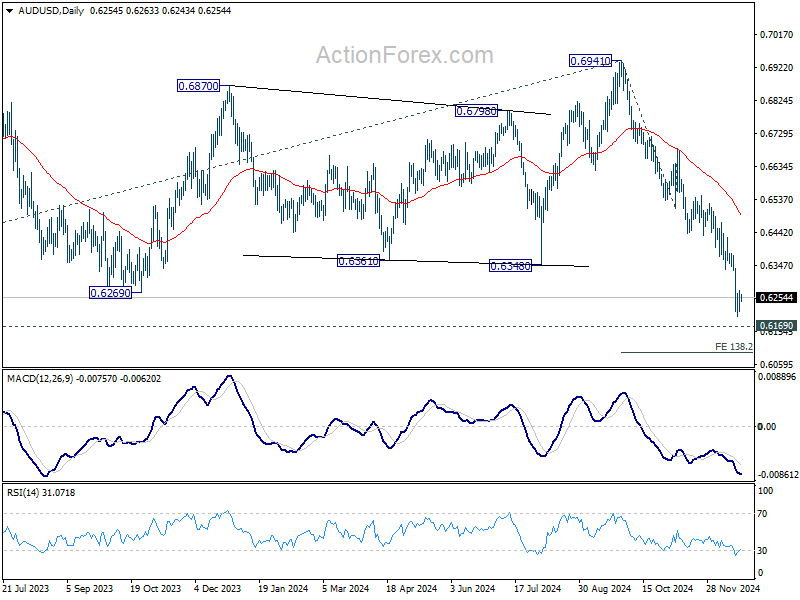
Daily Pivots: (S1) 0.6219; (P) 0.6247; (R1) 0.6278; More...
Intraday bias in AUD/USD remains neutral for sideway trading above 0.6198. Consolidations should be relatively brief as long as 0.6336 support turned resistance holds. Break of 0.6198 will resume the fall from 0.6941 to 0.6169 long term support, and then 138.2% projection of 0.6941 to 0.6511 from 0.6687 at 0.6074. Nevertheless, firm break of 0.6336 will bring stronger rebound lengthier correction before staging another decline.
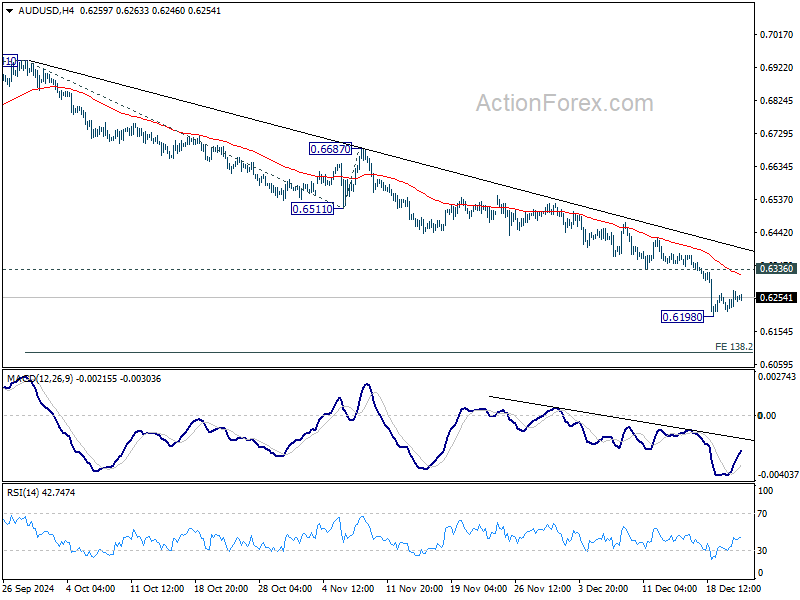
In the bigger picture, price actions from 0.6169 (2022 low) are seen as a medium term consolidation to the down trend from 0.8006. Firm break of 0.6169 support will confirm down trend resumption for 61.8% projection of 0.8006 to 0.6169 from 0.6941 at 0.5806 next. In any case, outlook will stay bearish as long as 55 W EMA (now at 0.6588) holds.
Dollar Holds Ground Amid Quiet Holiday Forex Markets
As markets wind down for the year-end holiday period, forex trading activity turns subdued, with limited momentum across major pairs. Dollar, while maintaining its position as the strongest currency of the month, is facing challenges in decisively breaking last month’s highs against European majors. However, the greenback still made some headway against Yen and commodity currencies
This week’s economic calendar is notably lighter, with the focus shifting to central bank minutes from BoJ, BoC, and RBA, alongside a handful of key data releases from the US, Canada, and Japan.
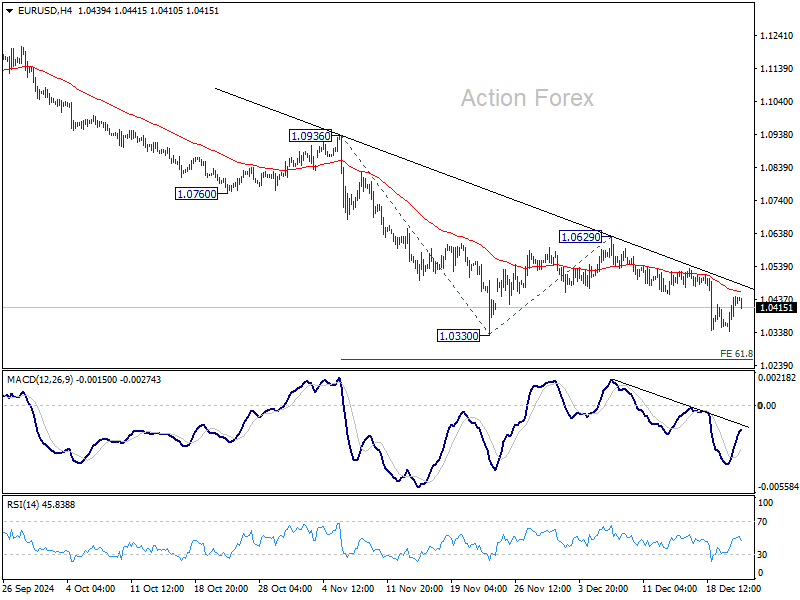
Technically, while EUR/USD failed to break through 1.0330 support on first attempt last week, it seems not giving up yet, with the recovery capped below falling 55 4H EMA. Another fall remains in favor through 1.0330 to 61.8% projection of 1.0936 to 10330 from 1.0629 at 1.0254. However, a significant breakout below this projection is likely to occur only after the New Year.
In Asia, Nikkei closed up 1.19%. Hong Kong HSI is up 0.70%. China Shanghai SSE is down -0.50%. Singapore Strait Times is up 0.88%. Japan 10-year JGB yield rose 0.011 to 1.067.
ECB’s Lagarde: Inflation target within reach, services inflation still stubborn
In an interview with the Financial Times, ECB President Christine Lagarde expressed optimism about nearing the inflation target.
She remarked that ECB is "very close" to declaring that inflation has been "sustainably" brought back to its 2% medium-term target.
The latest inflation reading of 2.2% reflects the success of ECB’s restrictive monetary policy. However, she highlighted persistent concerns in the services sector, where inflation remains high at 3.9%, describing it as "not budging much" despite showing slight signs of decline.
On the topic of US tariff threats, Lagarde emphasized the economic risks of retaliatory trade measures, stating, "Retaliation was a bad approach." She warned that tit-for-tat trade conflicts could harm the global economy.
Natural gas prices surge on winter demand and long-term power trends
Natural gas prices climbed to a nearly two-year high, driven by immediate weather-related demand and a bullish long-term outlook for global energy consumption.
In the short term, forecasts for below-average temperatures across the northern hemisphere—including North America, Europe, China, and Japan—are expected to significantly increase daily heating demand as these regions, which account for more than two-thirds of global gas consumption, enter their peak heating season. This has bolstered sentiment, with limited downside for prices likely until well into 2025.
Beyond the seasonal factors, the long-term outlook for natural gas remains robust. Rising electricity demand as the race for artificial intelligence accelerates, is projected to grow power consumption for such facilities by 10–15% annually through 2030, potentially accounting for up to 5% of global power demand by that time.
Natural gas is expected to play a pivotal role as a baseload energy source in this transition, given its current dominance in power generation. In the US, natural gas powers approximately 40–45% of electricity production, while globally, that share is closer to 25%. However, as more countries transition from coal to gas, the share of gas in electricity generation is anticipated to increase.
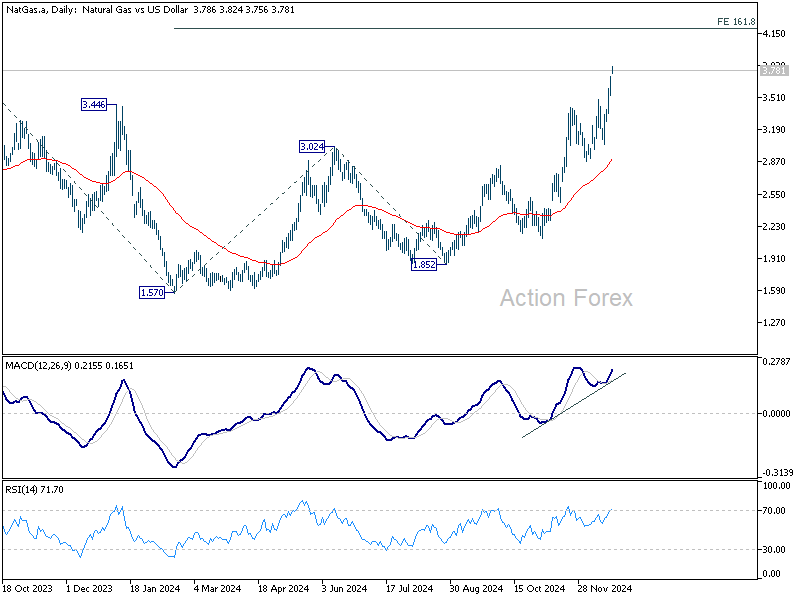
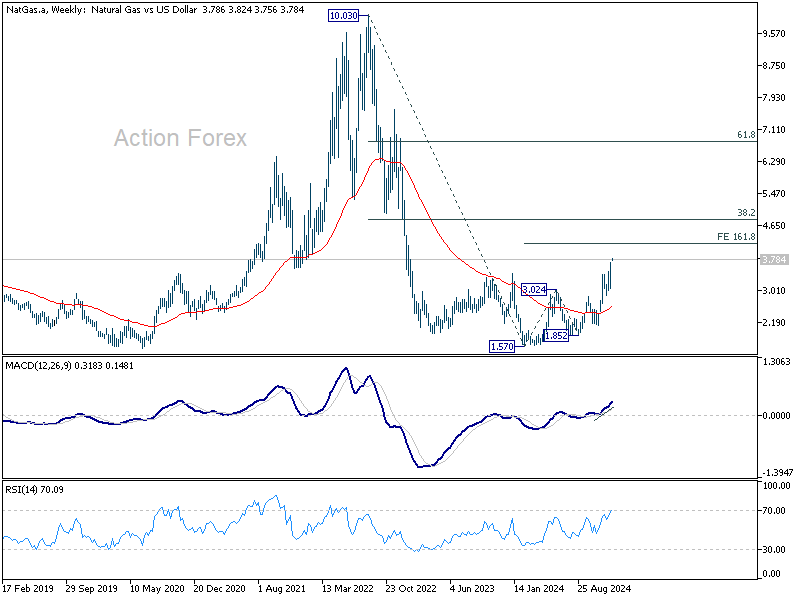
Technically, the break of 3.446 resistance last week was an important sign of underlying medium term momentum. Rise from 1.570 (Feb low) is now expected to continue to 161.8% projection of 1.570 to 3.024 from 1.852 at 4.204.
Nevertheless, momentum should target to wane above 4.204, and, in particular, as it approaches 38.2% retracement of 10.03 to 1.570 at 4.80.
Minutes and deliberations from BoC, BoJ and RBA highlight a holiday week
With the global markets winding down for the holiday season, the week ahead features a much lighter economic calendar. The spotlight will fall on central bank deliberations and meeting minutes from BoJ, BoC and RBA. A handful of key economic data releases from the US, Canada, and Japan will also attract attention as the year concludes.
For BoJ, Summary of Opinions for December, due on Friday, holds more weight than Tuesday’s October minutes, as markets seek clarity on the board’s discussions regarding a potential rate hike in January. The report will also provide insights into BoJ’s perspective on two critical issues: the uncertainty surrounding wage growth in 2025 and the risks posed by US trade policies. These considerations are likely to influence the pace and direction of Japan’s policy normalization, shaping expectations for the coming months.
BoC’s December meeting marked a turning point in its monetary policy stance, with a 50bps rate cut and a clear message that further easing would no longer be automatic. Policymakers indicated that decisions would now be taken on a meeting-by-meeting basis, reflecting a shift toward caution after substantial easing since June. The minutes will be analyzed for clues about how close the BoC is to a pause, the expected pace of additional cuts, and how deep further easing might go.
Meanwhile, RBA introduced a surprising dovish pivot at its December meeting. Growing confidence in the disinflationary trend led the board to omit language suggesting openness to further tightening. However, while this shift suggests the RBA is exploring a less restrictive path, it does not necessarily mean the first rate cut is imminent. Market participants will scrutinize the meeting minutes to understand the reasoning behind this "big pivot" and gauge what data RBA considers essential before moving toward easing.
On the data front, attention will turn to US consumer confidence and durable goods orders, Canada’s monthly GDP, and Tokyo CPI from Japan.
Here are some highlights for the week:
- Monday: Germany import prices; UK Q3 GDP Final; Swiss UBC economic expectations; Canada GDP, IPPI, RMPI; US consumer confidence; BoC summary of deliberations.
- Tuesday: BoJ minutes; RBA minutes; US durable goods orders, new home sales.
- Wednesday: Japan corporate services prices.
- Thursday: Japan housing starts, US jobless claims.
- Friday: Japan BoJ summary of opinions, Tokyo CPI, industrial production, retail sales, unemployment rate; US goods trade balance.
AUD/USD Daily Report
Daily Pivots: (S1) 0.6219; (P) 0.6247; (R1) 0.6278; More...
Intraday bias in AUD/USD remains neutral for sideway trading above 0.6198. Consolidations should be relatively brief as long as 0.6336 support turned resistance holds. Break of 0.6198 will resume the fall from 0.6941 to 0.6169 long term support, and then 138.2% projection of 0.6941 to 0.6511 from 0.6687 at 0.6074. Nevertheless, firm break of 0.6336 will bring stronger rebound lengthier correction before staging another decline.
In the bigger picture, price actions from 0.6169 (2022 low) are seen as a medium term consolidation to the down trend from 0.8006. Firm break of 0.6169 support will confirm down trend resumption for 61.8% projection of 0.8006 to 0.6169 from 0.6941 at 0.5806 next. In any case, outlook will stay bearish as long as 55 W EMA (now at 0.6588) holds.
Natural gas prices surge on winter demand and long-term power trends
Natural gas prices climbed to a nearly two-year high, driven by immediate weather-related demand and a bullish long-term outlook for global energy consumption.
In the short term, forecasts for below-average temperatures across the northern hemisphere—including North America, Europe, China, and Japan—are expected to significantly increase daily heating demand as these regions, which account for more than two-thirds of global gas consumption, enter their peak heating season. This has bolstered sentiment, with limited downside for prices likely until well into 2025.
Beyond the seasonal factors, the long-term outlook for natural gas remains robust. Rising electricity demand as the race for artificial intelligence accelerates, is projected to grow power consumption for such facilities by 10–15% annually through 2030, potentially accounting for up to 5% of global power demand by that time.
Natural gas is expected to play a pivotal role as a baseload energy source in this transition, given its current dominance in power generation. In the US, natural gas powers approximately 40–45% of electricity production, while globally, that share is closer to 25%. However, as more countries transition from coal to gas, the share of gas in electricity generation is anticipated to increase.
Technically, the break of 3.446 resistance last week was an important sign of underlying medium term momentum. Rise from 1.570 (Feb low) is now expected to continue to 161.8% projection of 1.570 to 3.024 from 1.852 at 4.204.
Nevertheless, momentum should target to wane above 4.204, and, in particular, as it approaches 38.2% retracement of 10.03 to 1.570 at 4.80.