Sun, Apr 26, 2026 05:39 GMT
More

    Sample Category Title

    Dollar Strengthens Mildly Amid Quiet Trading, ECB to Cut Again This Week

    ActionForex

    The Monday Asian session started quietly with Japan on holiday and the US and Canada on extended weekends. Market reactions to China’s Minister of Finance press briefing over the weekend have been subdued, as traders await further details regarding China’s anticipated fiscal stimulus. Without specifics, it's difficult to gauge the broader impact on the country’s economic outlook.

    In the currency markets, Dollar is currently leading gains, followed by British Pound and Canadian Dollar. On the downside, New Zealand Dollar is the weakest, followed by Australian Dollar and Swiss Franc. Euro and Japanese Yen are trading in the middle. But most major pairs are just confined within Friday’s narrow trading ranges. The key event of the week will be the anticipated ECB rate cut, while inflation data from the UK, Canada, and New Zealand will also be closely monitored for further policy signals.

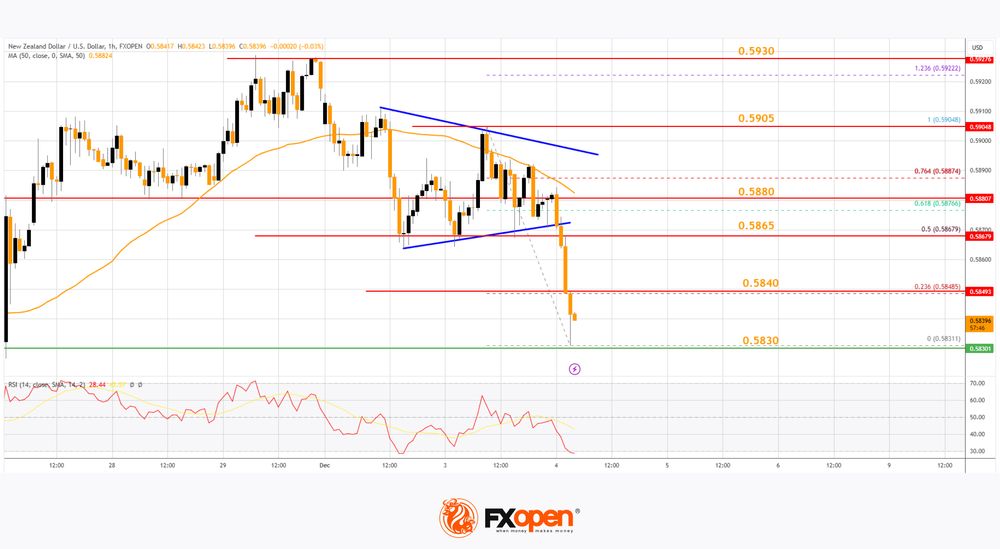
    Technically, NZD/USD recovered after touching 61.8% retracement of 0.5849 to 0.6378 at 0.6051. But outlook will stay bearish as long as 0.6153 resistance holds. Decisive break of 0.6051 will bring deeper fall back to 0.5849 support next. The upcoming Q3 CPI data from New Zealand could play a critical role in determining the pair’s next move.

    In Asia, at the time of writing, Hong Kong HSI is down -0.10%. China Shanghai SSE is up 1.87%. Singapore Strait Times is up 0.42%. Japan is on holiday.

    China’s CPI falls back to 0.4% yoy in Sep, PPI down -2.8% yoy

    China’s inflation data for September, released over the weekend, showed continuously weak price momentum.

    Headline CPI growth slowed to 0.4% yoy, down from 0.6% yoy in August and missing market expectations of 0.6%. Core CPI, which excludes volatile food and energy prices, rose by just 0.1% yoy, its lowest reading since February 2021. This marked the 20th consecutive month in which core inflation remained below 1.0%, underscoring persistent weak domestic demand and the need for stronger economic stimulus to encourage consumer spending.

    Food prices remained a key driver of inflation, with a 3.3% yoy increase. Vegetable prices surged by 22.9% yoy, and pork prices jumped by 16.2% yoy. These spikes in food costs contributed to the overall rise in consumer prices, but price weakness in other areas remains a concern. For instance, prices of new energy vehicles, which face international tariff pressures, fell by -6.9% yoy.

    On the industrial front, PPI fell by -2.8% yoy in September, deeper than the -1.8% yoy decline in August and missing expectations of a -2.5% yoy drop. This marked the 24th consecutive month of negative PPI readings

    New Zealand BNZ services unchanged at 457, stuck in contraction

    New Zealand's BusinessNZ Performance of Services Index was unchanged at 45.7 in September, marking the seventh consecutive month in contraction and remaining well below the long-term average of 53.1.

    Katherine Rich, CEO of BusinessNZ, noted that the services sector appears to be "stuck in a rut" and is struggling to get out of contraction.

    The detailed data reflects mixed performance across key components. While activity/sales edged slightly higher from 44.3 to 45.6, employment saw a sharp decline, dropping from 49.4 to 45.7—reflecting further weakness in job creation. New orders/business also ticked down marginally from 46.9 to 46.7, while supplier deliveries dipped further to 43.2 from 43.5.

    One small positive came from a reduction in the proportion of negative comments from respondents, which fell to 58.5% in September, compared to 60.8% in August and 67.0% in June and July. However, a significant number of businesses still cited the broader economic environment as a key negative factor impacting their performance.

    ECB to Cut Rates, CPI Reports from UK, Canada, and New Zealand Awaited

    ECB is at the forefront this week and is set to deliver a widely expected rate cut. Meanwhile, key inflation data from several major economies, including the UK, Canada, and New Zealand, will offer crucial insights into their central banks' next moves

    ECB is widely expected to lower the deposit rate by 25bps to 3.25% . This marks a significant shift from its previous stance, driven by increasing concerns about economic stagnation and faster-than-expected decline in inflation across the Eurozone. Supporting this expectation, a recent Reuters poll indicated that 70 out of 75 economists surveyed anticipate the 25bps rate cut, a dramatic change from the mere 12% who predicted such a move just a month ago. Looking ahead, 68 of these economists also foresee an additional 25bps reduction, bringing the deposit rate down to 3.00%.

    Inflation data will be in sharp focus this week too, with CPI releases from the United Kingdom, Canada, New Zealand, and Japan drawing significant attention.

    In the UK, headline inflation is projected to decline to 1.9% in September, below BoE's 2% target after two months of slight rebounds. However, core CPI is expected to remain relatively high at 3.4%, only a slight decrease from 3.6%. BoE's MPC is notably divided on the future path of monetary policy. Recently, Governor Andrew Bailey suggested that more aggressive easing could be an option, while Chief Economist Huw Pill urged caution. Consequently, every piece of incoming data will be critical ahead of the November meeting. Additionally, the UK is set to release employment figures and retail sales data.

    In Canada, CPI for September might show a slight increase but is expected to remain close to BoC's target, with core measures holding steady. This situation has led to growing calls for BoC to expedite its policy easing and return interest rates to a neutral setting more swiftly to prevent inflation from falling below target. Should CPI data reveal any downside surprises this week, it could prompt the BoC towards a more substantial 50bps rate cut at its meeting on October 23.

    Turning to New Zealand, Q3 CPI is anticipated to show a sharp slowdown from 3.3% to 2.3%, reinforcing RBNZ significant 50bps cut last week. There is speculation that RBNZ may follow up with another 50bps reduction on November 27 to conclude the year, especially since the next meeting isn't scheduled until mid-February next year. Should this week’s CPI data support the case for further easing, RBNZ may feel compelled to act preemptively once again.

    Other important economic indicators to monitor this week include Germany's ZEW Economic Sentiment Index, Australia's employment statistics, Japan's CPI figures, and China's GDP report.

    Here are some highlights for the week:

    • Monday: New Zealand BNZ services; China trade balance; Swiss PPI.
    • Tuesday: UK employment; Germany ZEW; Eurozone industrial production; Canada CPI, wholesale sales; US Empire State manufacturing.
    • Wednesday: New Zealand CPI; UK CPI; Canada housing starts, manufacturing sales; US import prices.
    • Thursday: Japan trade balance, tertiary industry index; Australia employment, NAB quarterly business confidence; Eurozone CPI final, trade balance, ECB rate decision; US retail sales, jobless claims, Philly Fed survey, industrial production, business inventories, NAHB housing index.
    • Friday: Japan CPI; China GDP, industrial production, retail sales, fixed asset investment; UK retail sales; Eurozone current account; US building permits and housing starts.

    USD/CHF Daily Outlook

    Daily Pivots: (S1) 0.8557; (P) 0.8573; (R1) 0.8590; More

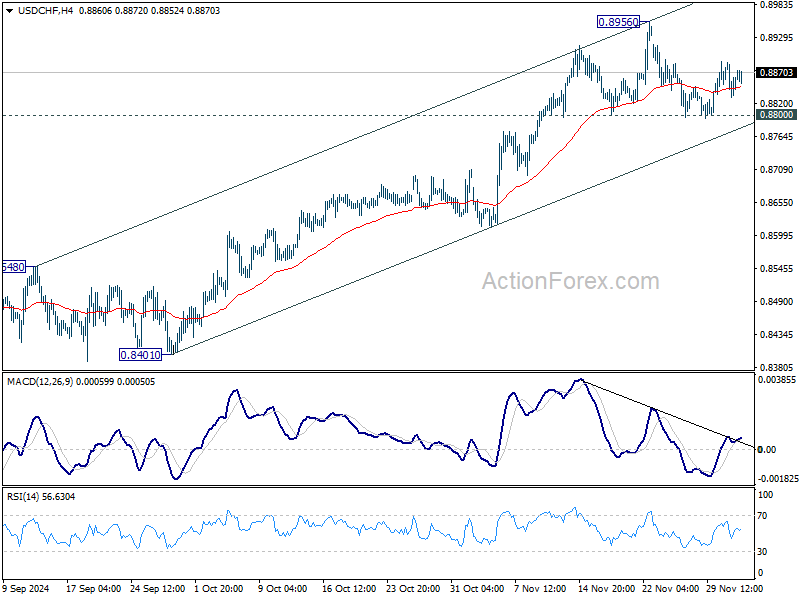
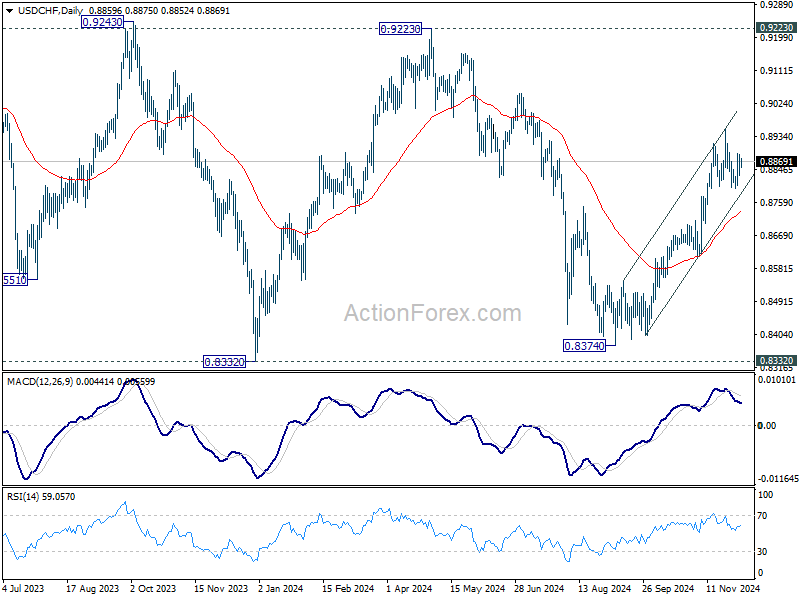
    USD/CHF trades mildly higher in Asian session but stays below 0.8611 temporary top. Intraday bias remains neutral First. further rally is expected as long as 0.8529 minor support holds. Above 0.8611 will resume the rebound from 0.8374 short term bottom to 38.2% retracement of 0.9223 to 0.8374 at 0.8698. However, firm break of 0.8529 will turn bias back to the downside for retesting 0.8374 low instead.

    In the bigger picture, price actions from 0.8332 (2023 low) are currently seen as a medium term corrective pattern, with fall from 0.9223 as the second leg. Strong support could be seen from 0.8332 to bring rebound. Yet, overall outlook will continue to stay bearish as long as 0.9243 resistance holds. Firm break of 0.8332, however, will resume larger down trend from 1.0146 (2022 high).

    Economic Indicators Update

    GMT CCY EVENTS ACT F/C PP REV
    21:30 NZD Business NZ PSI Sep 45.7 45.5 45.7
    06:30 CHF Producer and Import Prices Y/Y Sep -1.20%
    06:30 CHF Producer and Import Prices M/M Sep 0.10% 0.20%

    EUR/USD Dives To 1.0900: Can It Stage a Recovery?

    Key Highlights

    • EUR/USD started a fresh decline below the 1.1000 support zone.
    • A connecting bearish trend line is forming with resistance at 1.0945 on the 4-hour chart.
    • GBP/USD extended losses and traded below the 1.3080 support.
    • Gold started a consolidation phase near the $2,650 level.

    EUR/USD Technical Analysis

    The Euro started a fresh decline from the 1.1200 resistance against the US Dollar. EUR/USD traded below the 1.1120 and 1.1000 support levels to enter a bearish zone.

    Looking at the 4-hour chart, the pair settled below the 1.1000 level, the 100 simple moving average (red, 4-hour), and the 200 simple moving average (green, 4-hour). The pair even tested the 1.0900 zone. A low was formed at 1.0900 and the pair is now consolidating losses.

    On the downside, immediate support sits near the 1.0900 level. The next key support sits near the 1.0880 level. Any more losses could send the pair toward the 1.0850 level. Any more losses could send the pair toward the 1.0820 level.

    On the upside, the bears might be active near the 1.0945 level. The first major resistance might be near the 1.0975 level. It is close to the 23.6% Fib retracement level of the downward move from the 1.1208 swing high to the 1.0900 low.

    A close above the 1.0975 level could set the tone for another increase. The next major resistance could be 1.1020. A clear move above the 1.1020 level might send EUR/USD toward 1.1050. Any more gains might call for a test of the 1.1120 zone.

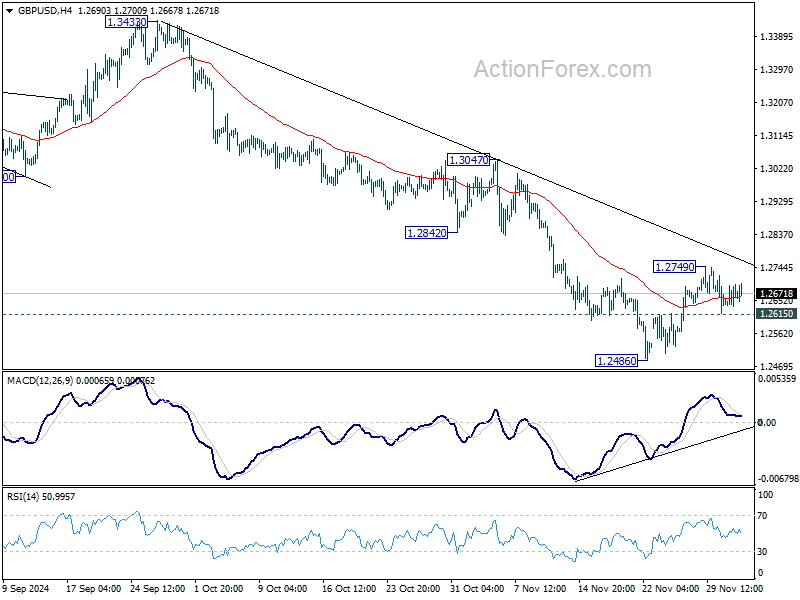
    Looking at GBP/USD, the bears remained active and were able to push the pair below the 1.3120 and 1.3080 support levels.

    Upcoming Economic Events:

    • Fed's Kashkari speech.

    New Zealand BNZ services unchanged at 457, stuck in contraction

    New Zealand's BusinessNZ Performance of Services Index was unchanged at 45.7 in September, marking the seventh consecutive month in contraction and remaining well below the long-term average of 53.1.

    Katherine Rich, CEO of BusinessNZ, noted that the services sector appears to be "stuck in a rut" and is struggling to get out of contraction.

    The detailed data reflects mixed performance across key components. While activity/sales edged slightly higher from 44.3 to 45.6, employment saw a sharp decline, dropping from 49.4 to 45.7—reflecting further weakness in job creation. New orders/business also ticked down marginally from 46.9 to 46.7, while supplier deliveries dipped further to 43.2 from 43.5.

    One small positive came from a reduction in the proportion of negative comments from respondents, which fell to 58.5% in September, compared to 60.8% in August and 67.0% in June and July. However, a significant number of businesses still cited the broader economic environment as a key negative factor impacting their performance.

    Full NZ BNZ PSI release here.

    China’s CPI falls back to 0.4% yoy in Sep, PPI down -2.8% yoy

    China’s inflation data for September, released over the weekend, showed continuously weak price momentum.

    Headline CPI growth slowed to 0.4% yoy, down from 0.6% yoy in August and missing market expectations of 0.6%. Core CPI, which excludes volatile food and energy prices, rose by just 0.1% yoy, its lowest reading since February 2021. This marked the 20th consecutive month in which core inflation remained below 1.0%, underscoring persistent weak domestic demand and the need for stronger economic stimulus to encourage consumer spending.

    Food prices remained a key driver of inflation, with a 3.3% yoy increase. Vegetable prices surged by 22.9% yoy, and pork prices jumped by 16.2% yoy. These spikes in food costs contributed to the overall rise in consumer prices, but price weakness in other areas remains a concern. For instance, prices of new energy vehicles, which face international tariff pressures, fell by -6.9% yoy.

    On the industrial front, PPI fell by -2.8% yoy in September, deeper than the -1.8% yoy decline in August and missing expectations of a -2.5% yoy drop. This marked the 24th consecutive month of negative PPI readings

    CHFJPY Wave Analysis

    • CHFJPY broke resistance zone
    • Likely to rise to resistance level 174.90

    CHFJPY currency pair under the bullish pressure after the earlier breakout of the resistance zone located between the key resistance level 172.00 (which stopped the previous waves A, C,E and (1)) and the 50% Fibonacci correction of the primary downward correction 4 from July.

    The breakout of this resistance zone accelerated the active intermediate impulse sequence (3) from the end of September.

    Given the rising bullish Swiss franc sentiment, CHFJPY currency pair be expected to rise further to the next resistance level 174.90.

    GBPUSD Wave Analysis

    •  GBPUSD reversed from support zone
    • Likely to rise to resistance level 1.3200

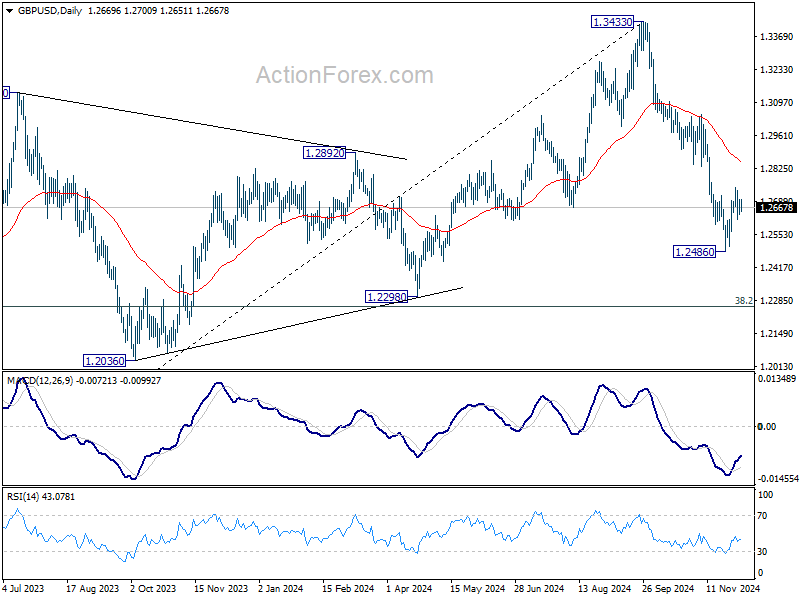
    GBPUSD currency pair recently reversed up from the support zone located between the pivotal support level 1.3030 (former monthly high from July), lower daily Bollinger Band and the 50% Fibonacci correction of the upward impulse from August.

    The upward reversal from this support zone stopped the previous minor correction ii from the end of September.

    Given the clear daily uptrend and the oversold daily Stochastic, GBPUSD currency pair be expected to rise further to the next resistance level 1.3200.

    Eco Data 10/14/24

    GMT Ccy Events Actual Consensus Previous Revised
    21:30 NZD Business NZ PSI Sep 45.7 45.5 45.7
    06:30 CHF Producer and Import Prices M/M Sep -0.10% 0.10% 0.20%
    06:30 CHF Producer and Import Prices Y/Y Sep -1.30% -1.20%
    08:12 CNY Trade Balance (USD) Sep 81.7B 91.5B 91.0B
    GMT Ccy Events
    21:30 NZD Business NZ PSI Sep
        Actual: 45.7 Forecast:
        Previous: 45.5 Revised: 45.7
    06:30 CHF Producer and Import Prices M/M Sep
        Actual: -0.10% Forecast: 0.10%
        Previous: 0.20% Revised:
    06:30 CHF Producer and Import Prices Y/Y Sep
        Actual: -1.30% Forecast:
        Previous: -1.20% Revised:
    08:12 CNY Trade Balance (USD) Sep
        Actual: 81.7B Forecast: 91.5B
        Previous: 91.0B Revised:

    Dollar Strengthens with Fed Clarity, China Ambiguity Drags Regional Sentiment

    Global financial markets last week were influenced by a combination of clarity and uncertainty. In the US, economic data reinforced expectations of a gradual and measured policy easing path by Fed. Investors embraced the prospect that Fed would not repeat the aggressive 50 bps rate cut implemented in September. This optimism regarding a soft landing for the US economy propelled stock markets to new record highs, with gains observed across a broad range of sectors.

    In contrast, ambiguity surrounding China's fiscal stimulus measures led to significant volatility in Asian markets. Traders offloaded stocks in Hong Kong and mainland China, reversing some of the recent strong rallies. The lack of a clearly defined fiscal policy roadmap from Chinese authorities has unsettled investors. This volatility is likely to persist until more concrete fiscal plans are unveiled, as uncertainty prompts many investors to reduce exposure rather than risk unforeseen downturns.

    In the currency markets, Swiss Franc emerged as the strongest performer, narrowly outperforming the Dollar, which was the second strongest. The greenback is approaching key technical levels alongside 10-year Treasury yield, which will be critical in determining whether Dollar is reversing its near-term downtrend. Japanese Yen was the third strongest currency, completing the trio of traditional safe-haven assets that benefited amid uncertainties.

    On the weaker side, Canadian Dollar ended the week as the worst performer, followed by New Zealand Dollar and Australian Dollar. Despite robust employment data from Canada, the Loonie struggled due to firm market expectations of swift policy easing by BoC. Kiwi remained under pressure following RBNZ's 50 bps rate cut. Both Kiwi and the Aussie were additionally weighed down by the uncertainty clouding China's economic policies.

    US Stocks Hit New Records, Dollar Index and 10-Year Yield Approach Resistance

    Stronger-than-expected inflation data has not deterred investor optimism regarding the US economic outlook. Markets are increasingly confident that Fed a gradual approach to policy normalization. Equities are responding positively, with major indices hitting new highs

    While Dollar was taken higher by rising Treasury yields, both Dollar Index and 10-year yield are now facing key resistance levels. The next move would decide whether current bounces in both are reversing the prior down trend, or just correcting it.

    The case for a 25bps rate cut by Fed in November solidified with the stronger-than-expected September CPI data. This expectation aligns with the insights from the latest FOMC minutes, which revealed a more intense debate over the September 50bps rate cut than the voting outcome suggested. Investors appear unfazed by the reduced probability of a larger 50bps cut at the upcoming meeting, instead expressing optimism about a soft landing—or even no landing—for the US economy.

    This bullish sentiment propelled both DOW and S&P 500 to new record highs, concluding a winning week. The major indices notched their fifth consecutive week of gains, with S&P 500 and NASDAQ Composite each climbing 1.1%, while DOW advanced 1.2%. The rally was broad-based, indicating confidence in the resilience of the economy despite lingering inflationary pressures.

    Simultaneously, funds flowed out of Treasuries, causing the 10-year yield to surge and close above the psychologically significant 4% mark. The rise in yields provided support to Dollar Index, which ended the week higher.

    Currently, fed fund futures are now pricing in a nearly 90% chance of a 25bps rate cut in November, dropping rates to 4.50%-4.75%, with around 10% chance of no change. For December, futures indicate an 85% likelihood of another 25bps cut.

    Technically, DOW finally broke through 61.8% projection of 32327.20 to 39889.05 from 38000.96 last week. Near term outlook will now stay bullish as long as 41831.74 support holds. Next target is 100% projection at 45562.81.

    Medium term momentum is also healthy as seen in W MACD. Outlook will stay bullish as long as 55 W EMA (now at 38757.11) holds. Current rise from 28660.94 (2022 low) is in progress for 100% projection of 18213.65 to 36952.65 from 28660.94 at 47399.94.

    While 10-year yield extended the rebound from 3.603, it's now in proximity to a key fibonacci resistance of 38.2% retracement of 4.997 to 3.603 at 4.135. This is also close to 55 W EMA (now at 4.074). Strong resistance could be seen there to limit upside, at least on first attempt. Break of 4.004 support will bring deeper pullback to 55 D EMA (now at 3.909).

    However, from a pure technical perspective, it's plausible that correction from 4.997 (2023 high) has completed with three waves down to 3.603. With 3.253 cluster support (38.2% retracement of 0.398 to 4.997 at 3.240) intact, the up trend from 0.398 (2020 low) remains in force. So, sustained trading above 4.135 will add to the medium term bullish case, and trigger stronger rise towards 4.737/997 resistance zone.

    Dollar Index's rebound from 100.15 extended higher last week. Rally from 100.15 is seen as an up- leg inside the sideway pattern from 99.57 (2023 low). Further rise is in favor as long as 55 D EMA (now at 102.13) holds. Sustained break of 55 W EMA (now at 103.47) would bring stronger rally towards 106.13/107.34 resistance zone.

    However, pullback in 10-year yield could cap Dollar Index at 55 W EMA. In this case, firm break of 55 D EMA in DXY would suggest a reversal back toward 100.15 low

    China’s Fiscal Ambiguity Sparks Volatility, HSI Defending Critical 20k Level

    Hong Kong and China markets saw extended huge volatility as investor reacted to the absence of detailed fiscal stimulus from China's National Development and Reform Commission. Following the substantial monetary package announced last month, expectations were high for concrete fiscal support to bolster the slowing economy. However, the NDRC's post-holiday press conference provided little in terms of specifics, leading to a deep sell-off in Hong Kong while China's also ended lower after initial spike. This disappointment extended its impact to the currency markets, where both Aussie and Kiwi weakened, despite strong risk-on sentiment in the US.

    Attention now shifts to the market's reaction on Monday following announcements from China's Finance Ministry on Saturday. Finance Minister Lan Foan pledged to "significantly increase" government debt to revive the faltering economy. Measures include assisting local governments with debt issues, providing subsidies to low-income households, supporting the property market, and replenishing capital for state-owned banks.

    However, the absence of specific figures regarding the size of the stimulus package has left investors uncertain about the effectiveness and scale of these initiatives. The lack of numerical details would prolong investors' wait for a clearer policy roadmap. This uncertainty is expected to continue until the next meeting of China's legislature, which is responsible for approving additional debt issuance. Although the date for this meeting has not been announced, it is anticipated in the coming weeks.

    Technically, despite the huge volatility, HSI's outlook will stay bullish as long as 38.2% retracement of 14794.16 to 23241.74 at 20014.76 holds, i.e. 20k psychological level. Firm break of 23241.74 and sustained trading above 55 M EMA (now at 21701.78) will suggest that HSI is already revering the long term down trend from 33484.08 (2018 high).

    However, decisive break of 20k will suggest that prior rebound, while impressively strong, was merely part of a corrective move. That would also indicate rejection by the 55 M EMA and set up further decline to resume the long term down trend.

    As for China's Shanghai SSE, key support lies in 3174.26 prior resistance, which is close to 50% retracement of 2635.09 to 3674.40 at 3154.74. Further rally would remain in favor as long as this level holds.

    However, firm break of 3174.26 should confirm rejection by key resistance at 3731.69 (2021 high). In this case, the strong rebound from 2635.09 is merely an up-leg an the long term range pattern, and should have completed.

    AUD/USD Weekly Report

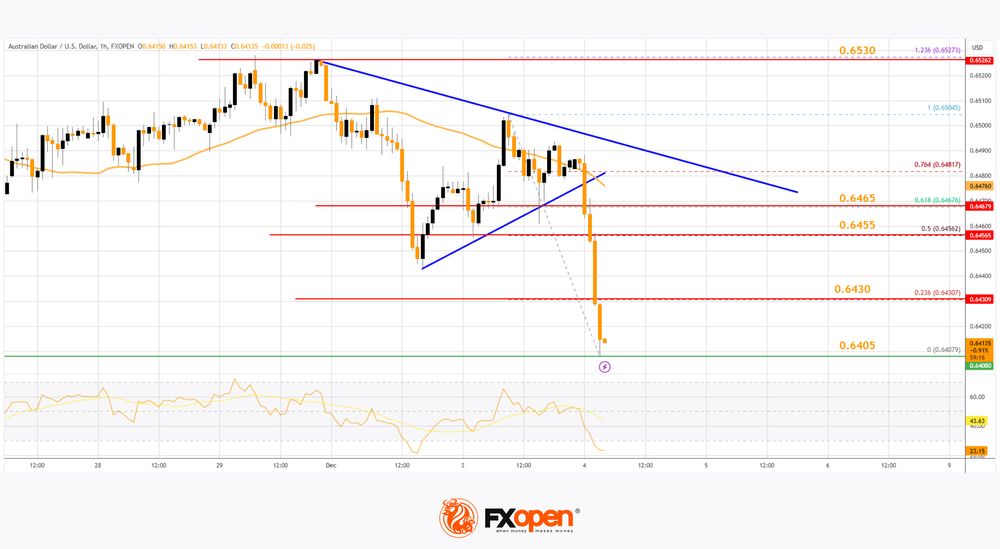
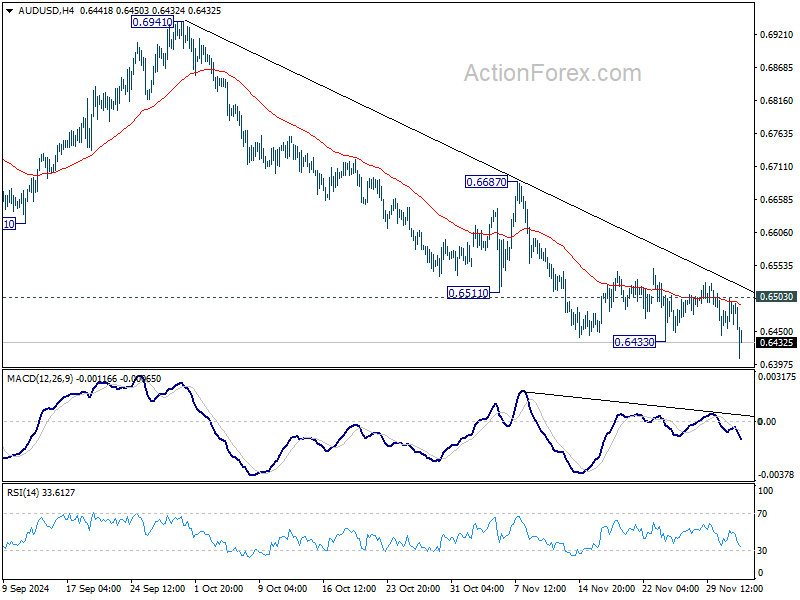
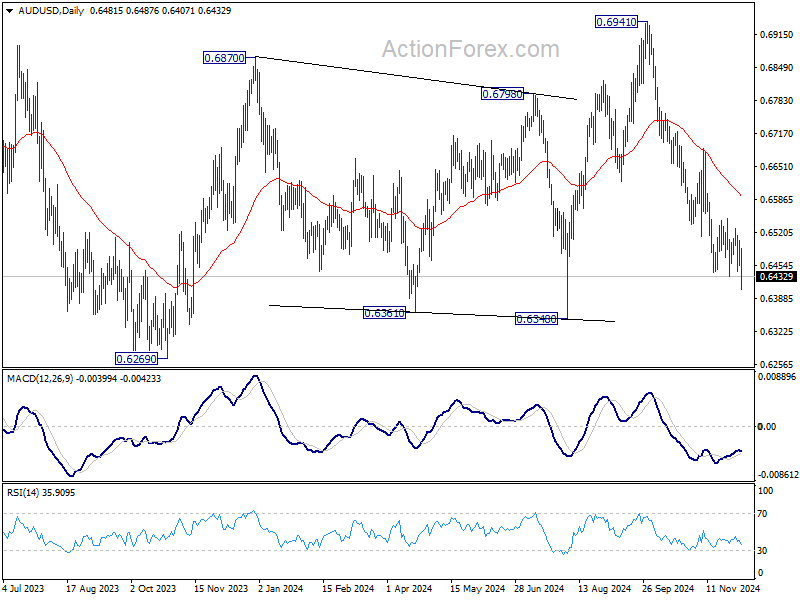
    AUD/USD's fall from 0.6941 short term top extended to 0.6701 last week but recovered since then. Initial bias stays neutral this week first. On the downside, break of 0.6701 and sustained trading below 55 D EMA (now at 0.6743) should confirm rejection by 0.6941 fibonacci level. Intraday bias will be back on the downside for 0.6621 support next. On the upside, however, break of 0.6809 minor resistance will bring retest of 0.6941 high instead.

    In the bigger picture, overall, price actions from 0.6169 (2022 low) are seen as a medium term corrective pattern, with rise from 0.6269 as the third leg. Firm break of 100% projection of 0.6269 to 0.6870 from 0.6340 at 0.6941 will target 138.2% projection at 0.7179. However, break of 0.6621 support will argue that rise from 0.6269 has completed and bring deeper fall back to 0.6269/6348 support zone.

    In the long term picture, the down trend from 1.1079 (2011 high) should have completed at 0.5506 (2020 low) already. It's unsure yet whether price actions from 0.5506 are developing into a corrective pattern, or trend reversal. But in either case, fall from 0.8006 is seen as the second leg of the pattern. Firm of 0.7156 resistance will argue that the third leg has already started towards 0.8006.

    EUR/USD Weekly Outlook

    EUR/USD's fall from 1.1213 extended to as low as 1.0899 last week, but lost momentum after hitting 38.2% retracement of 1.0447 to 1.1213 at 1.0920. Initial bias is turned neutral this week for some consolidations first. Further decline is expected as long as 1.1036 resistance holds. Sustained trading below 1.0920 will argue that fall from 1.1213 is the third leg of the corrective pattern from 1.1274. In this case, deeper decline would be seen to 61.8% retracement at 1.0740 next.

    In the bigger picture, rejection by 1.1274 resistance suggests that corrective pattern from 1.1274 (2023 high) is not completed yet. Instead, decline from 1.1213 might be another falling leg. Sustained break of 55 W EMA (now at 1.0877) will validate this case, and bring deeper fall towards 1.0447 support again.

    In the long term picture, a long term bottom is in place at 0.9534 (2022 low). But for now, EUR/USD is struggling to sustain above 55 M EMA (now at 1.1018). Outlook is neutral at best at this point.

    USD/JPY Weekly Outlook

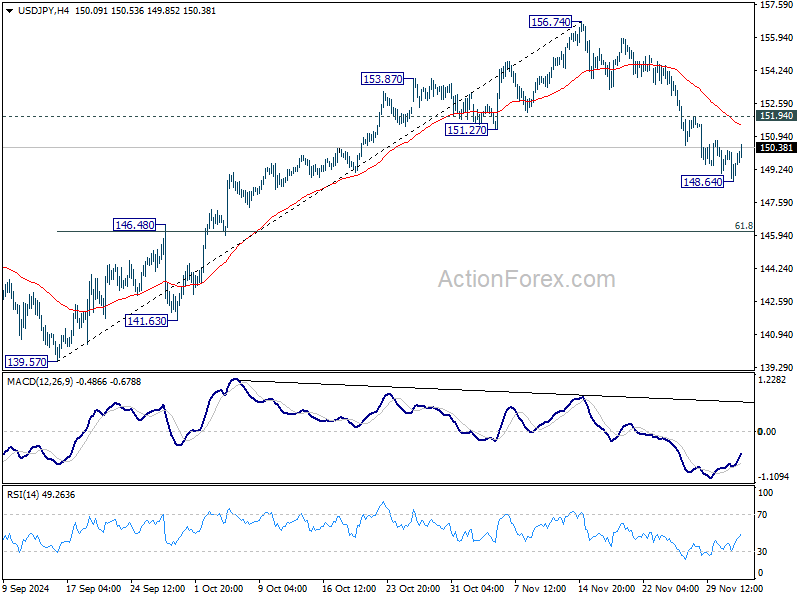
    USD/JPY's rise from 139.57 extended to 149.58 last week but turned sideway. Initial bias remains neutral this week first, and some more consolidations could be seen. But further rally is expected as long as 145.91 support holds. Above 149.58 will resume the rise to 61.8% retracement of 161.94 to 139.57 at 153.39.

    In the bigger picture, price actions from 161.94 are seen as a corrective pattern to rise from 102.58 (2021 low). The range of medium term consolidation should now be set between 38.2% retracement of 102.58 to 161.94 at 139.26 and 161.94. Nevertheless, sustained break of 139.26 would open up deeper medium term decline to 61.8% retracement at 125.25.
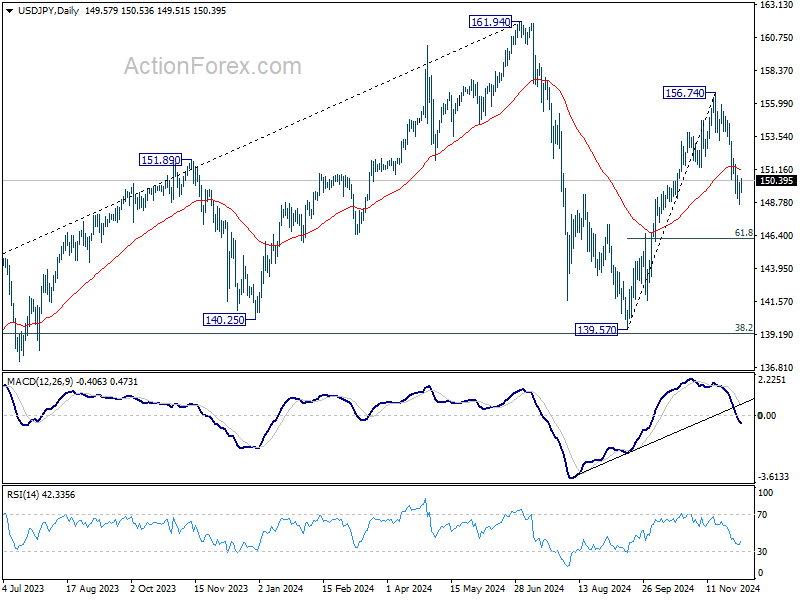
    In the long term picture, it's still early to conclude that up trend from 75.56 (2011 low) has completed. However, a medium term corrective phase should have commenced, with risk of deep correction towards 55 M EMA (now at 133.73).