Sample Category Title
EUR/AUD Daily Outlook
Daily Pivots: (S1) 1.4016; (P) 1.4067; (R1) 1.4142; More...
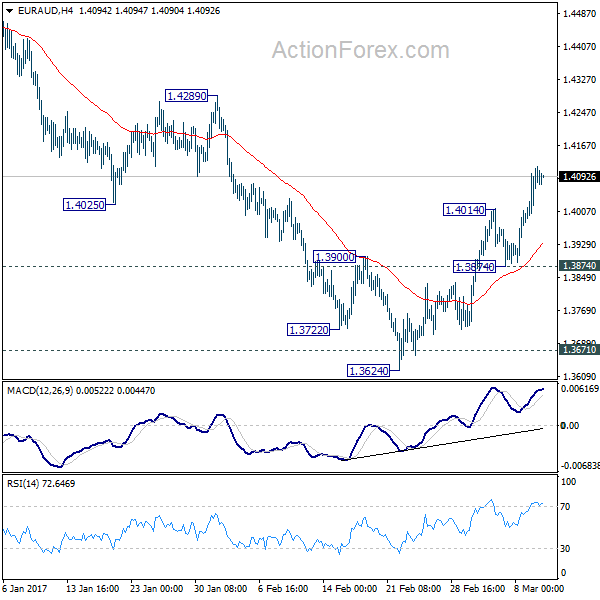
Intraday bias in EUR/AUD remains on the upside as rise from 1.3624 continues. The cross should target 1.4289 resistance next. Current development, with a short term bottom formed at 1.3624, is taken as an early sign of larger trend reversal after defending 1.3671 key support. Break of 1.4289 will confirm this case and target 1.4721 resistance next. However, break of 1.3874 minor support will dampen our bullish view and turn bias back to the downside for 1.3624 instead.
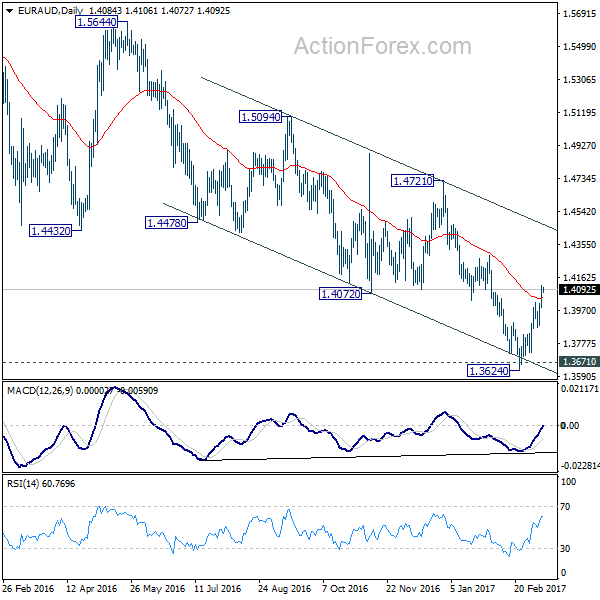
In the bigger picture, price actions from 1.6587 medium term top are viewed as a corrective pattern. We'd expect strong support from 1.3671 key level to contain downside and bring rebound. Up trend from 1.1602 should not be finished and will resume later. Break of 1.4721 resistance will indicate completion of such correction and turn outlook bullish for retesting 1.6587 high. However, sustained break of 1.3671 will invalidate our bullish view and would turn focus back to 1.1602 long term bottom.
EUR/GBP Daily Outlook
Daily Pivots: (S1) 0.8660; (P) 0.8690; (R1) 0.8724; More...
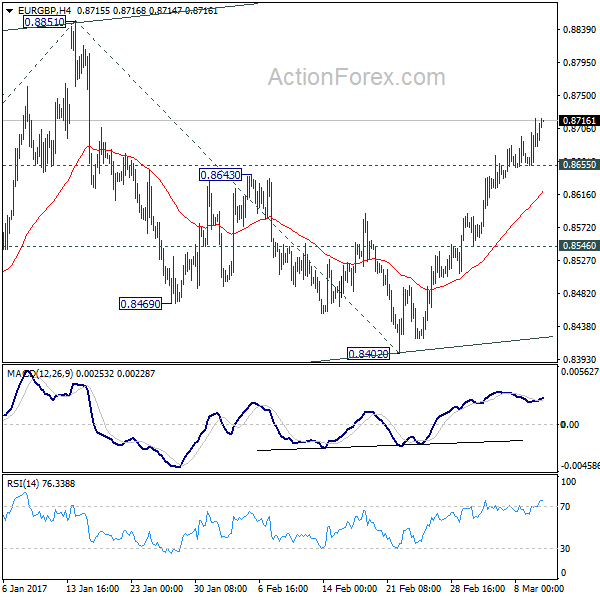
Intraday bias in EUR/GBP remains mildly on the upside for the moment. Upside moment remains unconvincing. But further rise is still expected to 0.8851 resistance and above. Price actions from 0.8303 are viewed as the second leg of the correction from 0.9304. Hence, we'd expect strong resistance from 100% projection of 0.8303 to 0.8851 from 0.8402 at 0.8950 to limit upside. On the downside, below 0.8655 minor support will turn bias neutral again. But further rise would remain in favor as long as 0.8546 support holds.
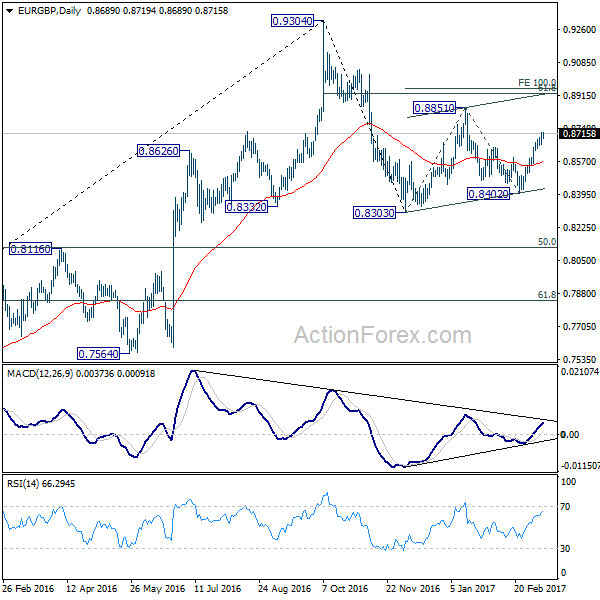
In the bigger picture, price actions from 0.9304 are viewed as a medium term corrective pattern. Deeper fall cannot be ruled out yet. But we'd expect strong support from 0.8116 cluster support (50% retracement of 0.6935 to 0.9304 at 0.8120) to contain downside. Overall, the corrective pattern would take some time to complete before long term up trend resumes at a later stage. Break of 0.9304 will pave the way to 0.9799 (2008 high).
EUR/CHF Daily Outlook
Daily Pivots: (S1) 1.0679; (P) 1.0714; (R1) 1.0739; More...
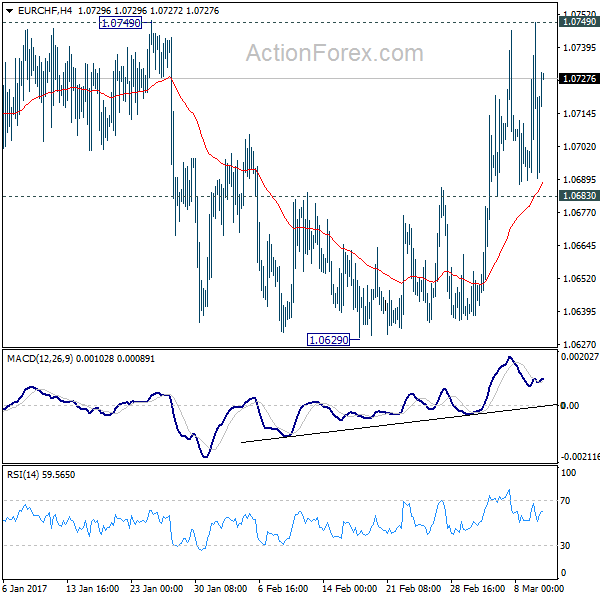
EUR/CHF attempted for another rally but failed to break through 1.0749 resistance again. Intraday bias remains neutral at this point. With 1.0683 minor support intact, further rise is still expected. As noted before, a short term bottom is likely in place at 1.0629 on bullish convergence condition in 4 hour MACD. Current development raised the chance of larger trend reversal after defending 1.0620 key support level. Decisive break of 1.0749 should affirm this bullish case and target 1.0897. On the downside, though, below 1.0683 minor support will turn bias back to the downside for 1.0629 instead.
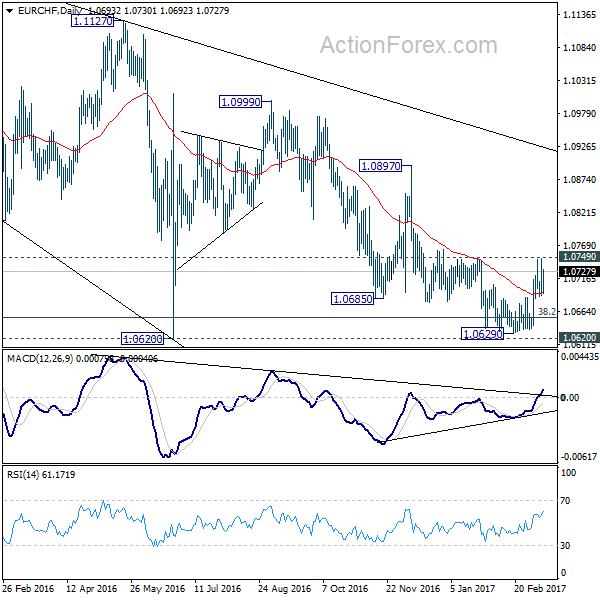
In the bigger picture, the decline from 1.1198 is seen as a corrective move. There is no confirmation of completion yet. Sustained trading below 38.2% retracement of 0.9771 to 1.1198 at 1.0653 will target 50% retracement at 1.0485. However, strong rebound from 1.0620 and break of 1.0897 resistance will indicate trend reversal and turn outlook bullish.
AUD/USD Daily Outlook
Daily Pivots: (S1) 0.7499; (P) 0.7553; (R1) 0.7582; More...
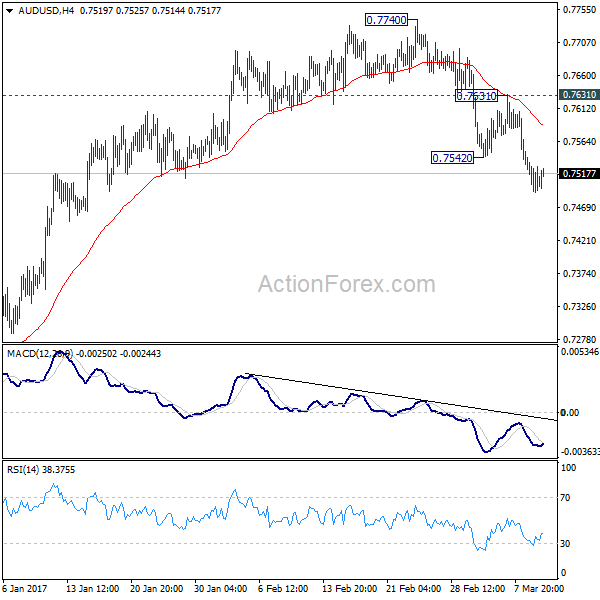
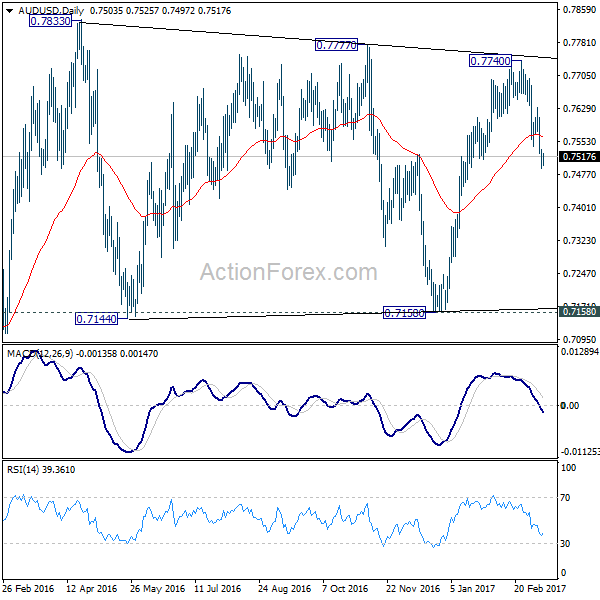
Intraday bias in AUD/USD stays on the downside with fall from 0.7740 still in progress. Whole rebound from 0.7158 should be completed. The pair should now target lower side of the range at 0.7144/7158 support zone. On the upside, break of 0.7631 resistance is needed to indicate completion of such decline. Otherwise, outlook will stay cautiously bearish in case of recovery.
In the bigger picture, we're still treating price actions from 0.6826 low as a correction. And, as long as 38.2% retracement of 0.9504 to 0.6826 at 0.7849 holds, long term down trend from 1.1079 is expected to resume sooner or later. Break of 0.6826 low will target 0.6008 key support level. However, firm break of 0.7849 will indicate that rise from 0.6826 is developing into a medium term rebound, rather than a sideway pattern. In such case, stronger rise should be seek to 55 month EMA (now at 0.8164) and above.
USD/CAD Daily Outlook
Daily Pivots: (S1) 1.3483; (P) 1.3508; (R1) 1.3536; More...
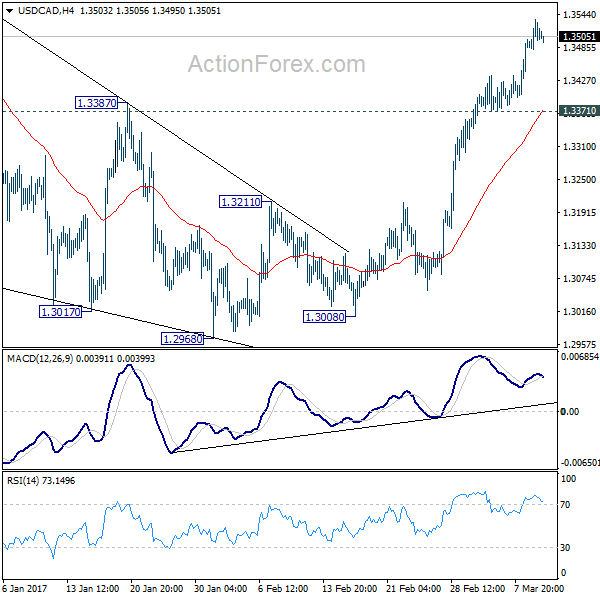
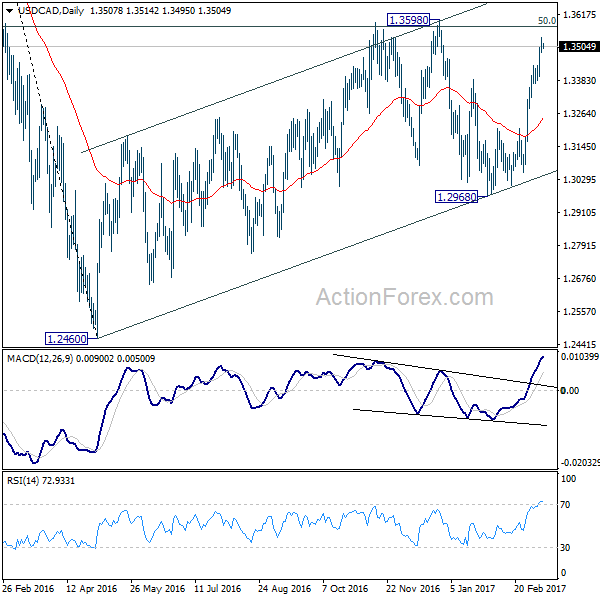
Intraday bias in USD/CAD remains on the upside as rise from 1.2968 is still in progress. The pair should target 1.3598 high next. Decisive break there will resume the medium term rally from 1.2460 and target next fibonacci level at 1.3838. On the downside, break of 1.3371 minor support is needed to indicate short term topping. Otherwise, outlook will remain bullish in case of retreat.
In the bigger picture, price actions from 1.4689 medium term top are seen as a correction pattern. The first leg has completed at 1.2460. The second leg is likely still in progress and could target 61.8% retracement of 1.4689 to 1.2460 at 1.3838. We'd look for reversal signal there to start the third leg. Break of 1.2968 wold at least bring at retest of 1.2460 low. However, sustained trading above 1.3838 would pave the way to retest 1.4689 high.
GBP/USD Daily Outlook
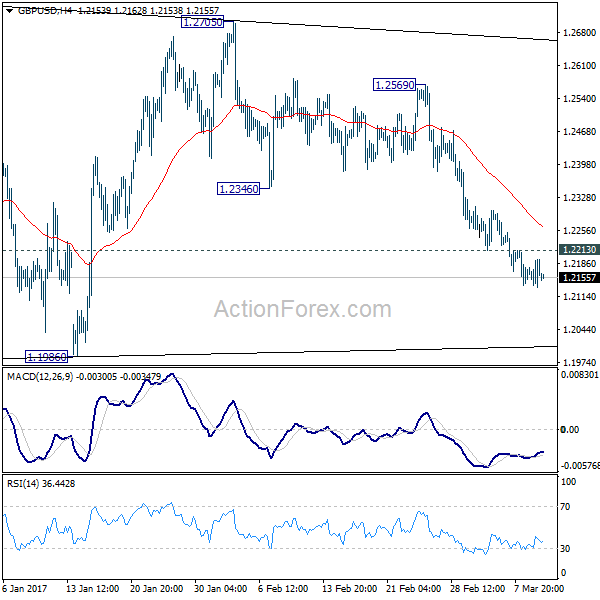
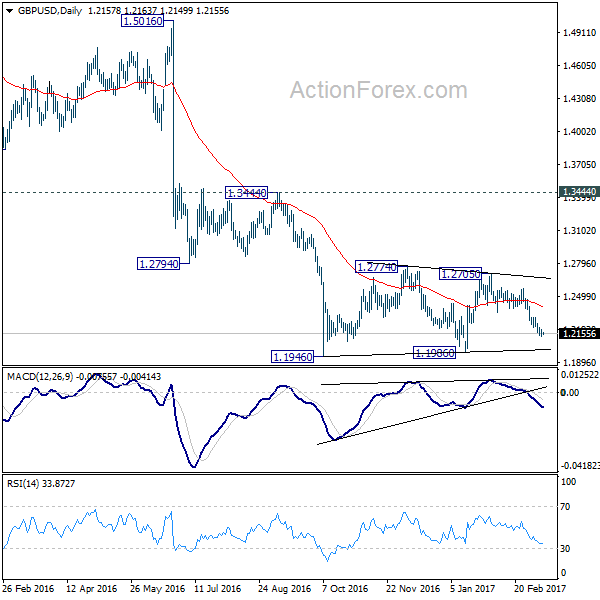
Daily Pivots: (S1) 1.2131; (P) 1.2163; (R1) 1.2193; More...
With 1.2213 minor resistance intact, intraday bias in GBP/USD stays mildly on the downside for 1.1946/86 key support zone. As noted before, consolidation pattern from 1.1946 should have completed with three waves to 1.2705 already. Break of 1.1946 will confirm our bearish view and resume the larger down trend. On the upside, above 1.2213 minor resistance will turn bias neutral and bring recovery. But outlook will remain cautiously bearish as long as 1.2346 support turned resistance holds.
In the bigger picture, fall from 1.7190 is seen as part of the down trend from 2.1161. There is no sign of medium term bottoming yet. Sustained trading below 61.8% projection of 2.1161 to 1.3503 from 1.7190 at 1.2457 will target 100% projection at 0.9532. Overall, break of 1.3444 resistance is needed to confirm medium term bottoming. Otherwise, outlook will remain bearish.
European Open Briefing
Global Markets:
- Asian stock markets: Nikkei up 1.35 %, Shanghai Composite fell 0.05 %, Hang Seng declined 0.10 %, ASX 200 rose 0.55 %
- Commodities: Gold at $1198 (-0.45 %), Silver at $16.93 (-0.65 %), WTI Oil at $49.65 (+0.75 %), Brent Oil at $52.50 (+0.65 %)
- Rates: US 10 year yield at 2.62, UK 10 year yield at 1.23, German 10 year yield at 0.43
News & Data:
- Australia Home Loans (MoM) (Jan): 0.50% (est -1.00%, prev 0.40%)
- Asia stocks firm ahead of U.S. jobs, dollar vs yen at one-and-half-month high – RTRS
- Oil edges off three-month low, but glut worries fester – RTRS
- Dollar on track for winning week as U.S. jobs data awaited, euro firm – RTRS
Markets Update:
The US Dollar remains strong ahead of today’s NFP release. The market has increased its expectations for the number following the strong ADP employment change print.
EUR/USD recovered slightly after the ECB meeting. The central bank kept rates and the size of its QE programme unchanged, as expected, but Mario Draghi was slightly less dovish during his press conference. This helped the Euro to recover to 1.0620. In Asia, the pair consolidated in a 1.0570-1.06 range.
USD/JPY has cleared some important resistance levels and is on its way to test key resistance at 115.50. A major breakout is unlikely ahead of the NFP release. However, if the number is strong and it breaks above 115.50, it would signal that the rally can continue towards 117.
AUD/USD is still under pressure but support at 0.75 has held so far. Resistance is now seen at 0.7570/80, followed by 0.7630.
Upcoming Events:
- 07:00 GMT – German Trade Balance
- 09:30 GMT – UK Industrial Production
- 09:30 GMT – UK Manufacturing Production
- 09:30 GMT – UK Trade Balance
- 13:30 GMT – US Unemployment Rate
- 13:30 GMT – US NFP
- 13:30 GMT – US Average Hourly Earnings
- 13:30 GMT – Canadian Unemployment Rate
- 13:30 GMT – Canadian Employment Change
- 15:00 GMT – UK NIESR GDP Estimate
- 20:30 GMT – US CFTC Positioning Data
EUR/USD Daily Outlook
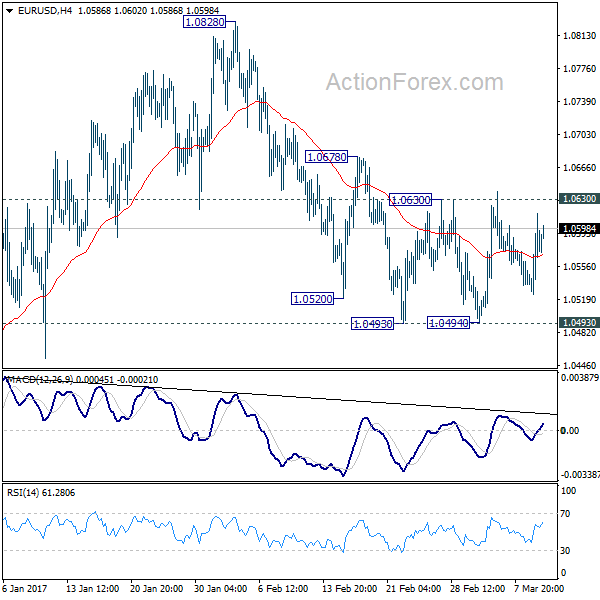
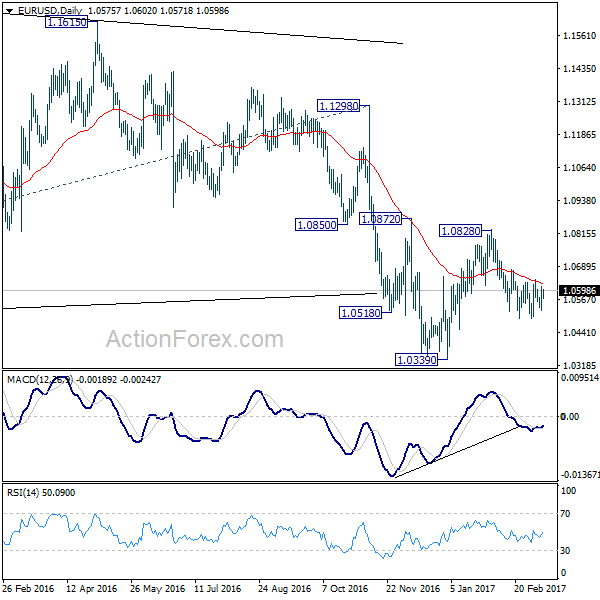
Daily Pivots: (S1) 1.0528; (P) 1.0572 (R1) 1.0619; More.....
EUR/USD is still bounded in range of 1.0493/0630 and intraday bias remains neutral for the moment. On the downside, below 1.0493 support will affirm the case that fall from 1.0828 is resuming the larger down trend. In that case, intraday bias will be back to the downside for resting 1.0339 low. On the upside, firm break of 1.0630 resistance will argue that pull back from 1.0828 is completed. Also, rise from 1.0339 could possibly be resuming. In that case, intraday bias will be turned back to the upside for 1.0828 resistance and above.
In the bigger picture, whole down trend from 1.6039 (2008 high) is in progress. Such down trend is expected to extend to 61.8% projection of 1.3993 to 1.0461 from 1.1298 at 0.9115. On the upside, break of 1.1298 resistance is needed to confirm medium term bottoming. Otherwise, outlook will stay bearish in case of rebound.
Is Rising U.S. Drilling About To Send Crude Oil Toppling?
Key Points:
- U.S. Crude Oil production and drilling activity increases.
- OPEC agreement on production caps starts to falter.
- The $50.00 handle likely to be the key battleground in the weeks ahead.
This week could potentially be a harbinger of what is coming for energy markets as world crude oil prices crashed below the $50.00 a barrel mark for the first time since December. Much of the declines have been due to surprise inventory builds at Cushing as the U.S. market continues to produce significant levels of the commodity. Subsequently, there is renewed speculation that the current production levels could drive crude oil prices significantly lower in the wake of additional U.S. production activity.
The start of this morning’s (Friday) session has been relatively rough for the commodity with West Texas Intermediate prices having swung both ways during the session. However, crude prices did manage to claw their way fractionally higher, to around the $49.50 a barrel mark by around midday. Regardless, the bearish mood remains pervasive over the market and the $50.00 handle could pose a bridge too far in the days ahead.
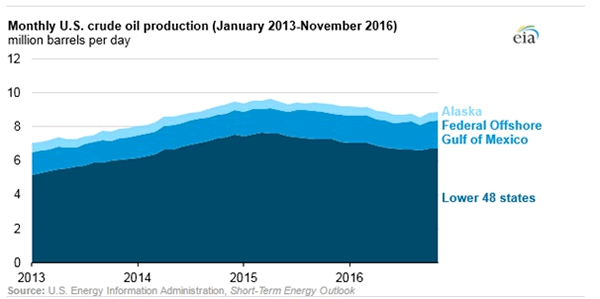
Unfortunately, market confidence has been shaken by the decline and surprise U.S. inventory build given that prices had settled relatively comfortably above the $50.00 mark for some time. However, the market had largely disregarded the increased drilling activity that was seen to be ramping up over the past weeks and months. Domestic production activity has been on the rise for some time and many of the ongoing shale projects have been picked for expansion.
Subsequently, there is little reason to currently remain bullish for crude oil prices given the product overhang that is presently in storage. The latest EIA figures show current inventory figures falling around the 528 million barrel mark which represents a significant excess to be cleared through the supply chain, especially given the limited refining capacity and flat domestic demand.
Ultimately, the recent collapse back below the $50.00 handle doesn’t surprise many that have been sceptical over the recent OPEC production caps. The reality for the new oil order is one where rebalancing clearly still needs to complete. The recent OPEC agreement on production caps was never intended to be a long term solution to oversupply and the current U.S. production boon suggests that it has done little but cede further market share. Subsequently, expect the cracks to start appearing within OPEC over the medium term as certain members find the current arrangement relatively unpalatable and ineffective.
USD/CHF Daily Outlook
Daily Pivots: (S1) 1.0087; (P) 1.0124; (R1) 1.0156; More.....
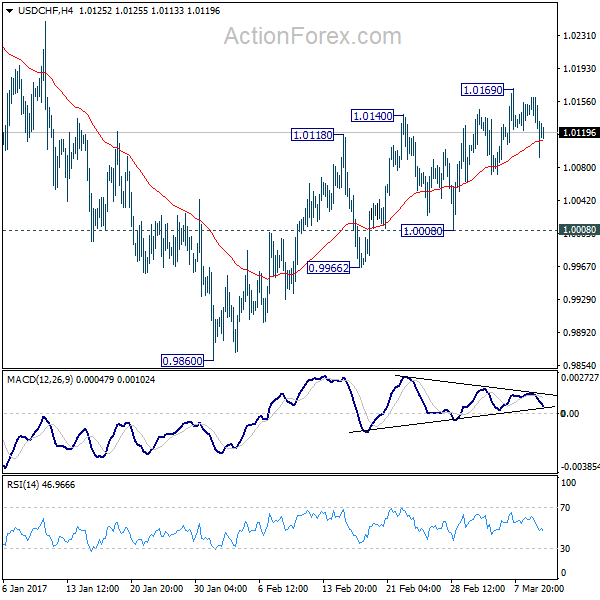
USD/CHF lost momentum again after hitting 1.0169 and retreated since then. Intraday bias is turned neutral again. Further rise cannot be ruled out with 1.0008 support intact. However, based on neutral medium term outlook, we'd be cautious on topping at around 1.0342. This is supported by the corrective structure of the rise from 0.9860 so far. On the downside, break of 1.0008, however, will indicate completion of the rebound from 0.9860. And intraday bias will be turned back to the downside for 0.9860.
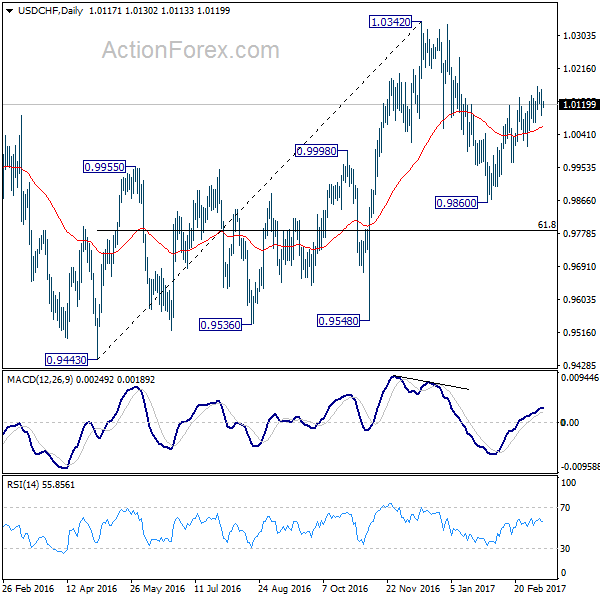
In the bigger picture, prior rejection from 1.0327 resistance argues that USD/CHF is staying in a medium term sideway pattern. In any case, decisive break of 1.0342 resistance is needed to confirm underlying strength. Otherwise, we'll stay neutral in the pair first. In case of another fall, we'd expect strong support from 0.9443/9548 support zone. Meanwhile firm break of 1.0342 will target 38.2% retracement of 1.8305 to 0.7065 at 1.1359.