

Sample Category Title
EUR/CHF Daily Outlook
Daily Pivots: (S1) 0.9430; (P) 0.9465; (R1) 0.9491; More....
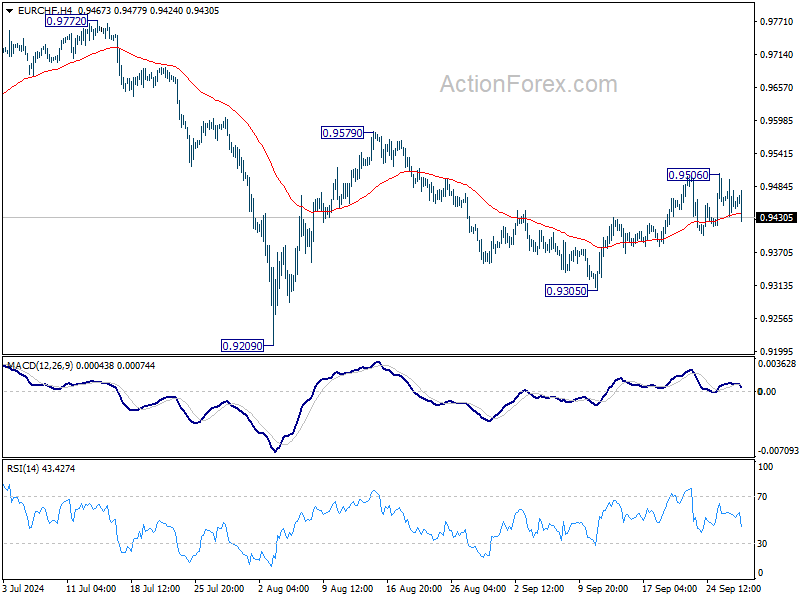
EUR/CHF is staying in sideway consolidation and intraday bias remains neutral first. On the upside, above 0.9506 will resume the rally from 0.9305, as the third leg of the pattern from 0.9209, to 0.9579 resistance. However, break of 0.9305 will resume the decline from 0.9579 towards 0.9209 low.
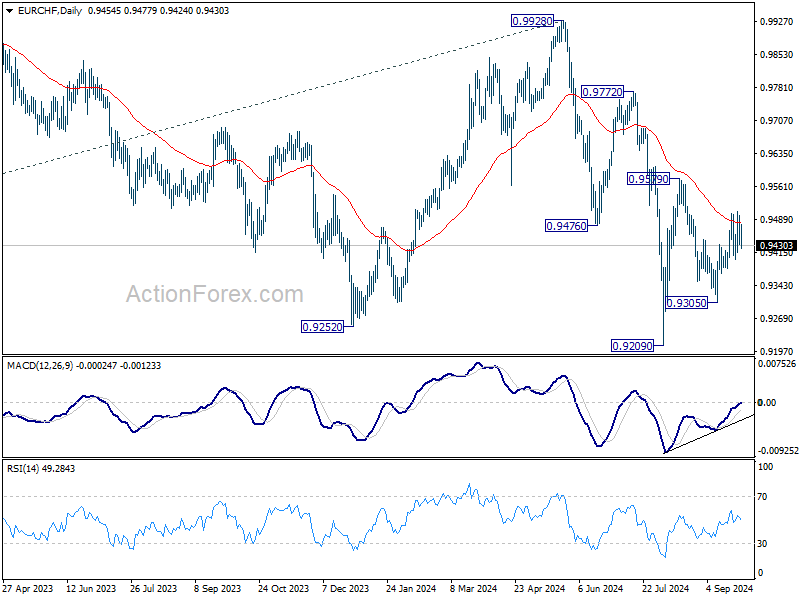
In the bigger picture, medium term corrective pattern from 0.9407 (2022 low) might have completed with three waves to 0.9928. Decisive break of 0.9252 (2023 low) will confirm long term down trend resumption. Next target will be 61.8% projection of 1.1149 to 0.9407 from 0.9928 at 0.8851. For now, outlook will stay bearish as long as 0.9928 resistance holds, even in case of strong rebound.
EUR/USD Daily Outlook
Daily Pivots: (S1) 1.1138; (P) 1.1164; (R1) 1.1201; More....
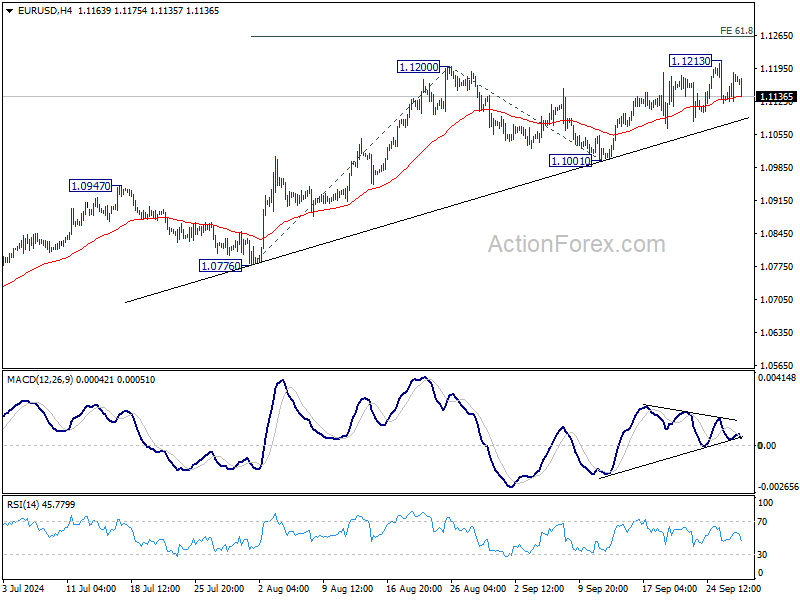
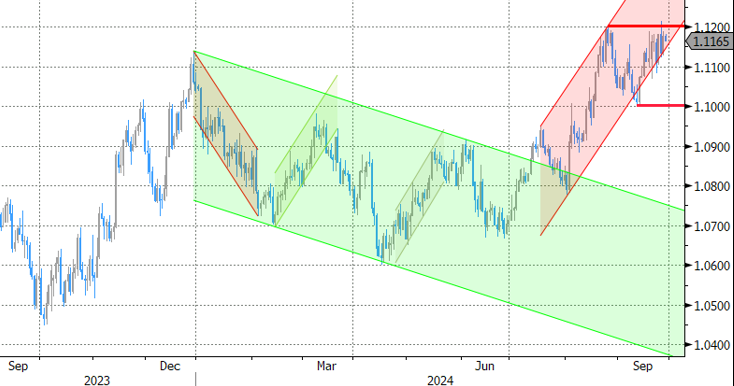
Intraday bias in EUR/USD remains neutral as consolidations continues below 1.1213. Further rally is expected as long as 1.1001 support holds. Above 1.1213 will extend larger rally from 1.0665 to 100% projection of 1.0776 to 1.1200 from 1.1001 at 1.1425.
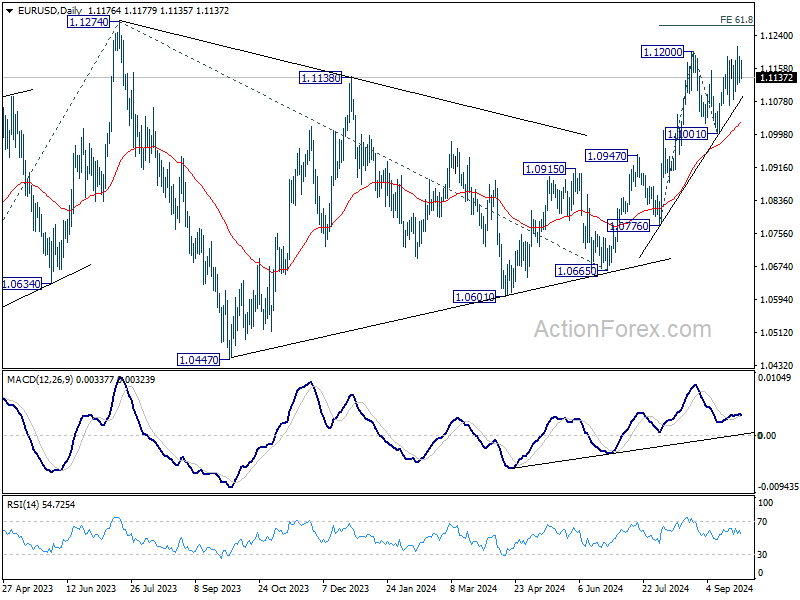
In the bigger picture, corrective pattern from 1.1274 should have completed at 1.0665 already. Decisive break of 1.1274 (2023 high) will confirm resumption of whole up trend from 0.9534 (2022 low). Next target will be 61.8% projection of 0.9534 to 1.1274 from 1.0665 at 1.1740. This will now be the favored case as long as 1.1001 support holds.
GBP/USD Daily Outlook
Daily Pivots: (S1) 1.3335; (P) 1.3384; (R1) 1.3465; More...
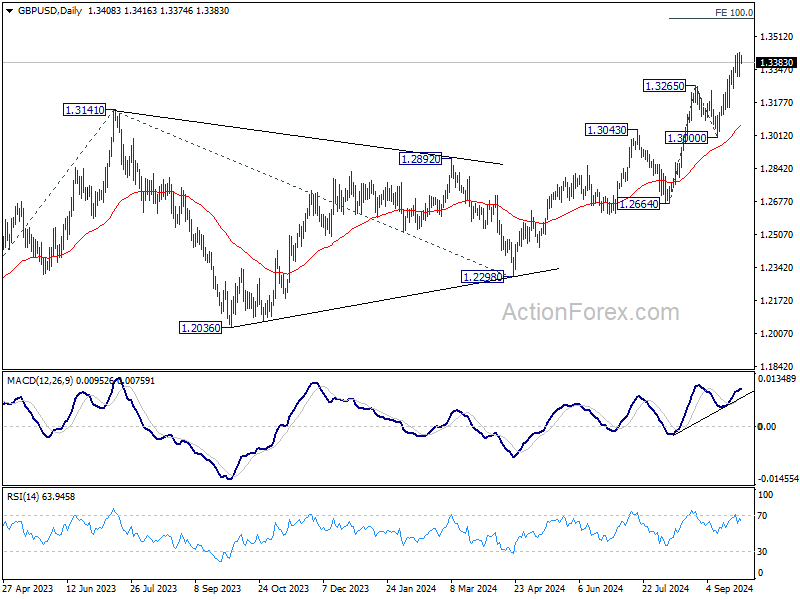
Intraday bias in GBP/USD stays neutral and some more consolidations could be seen. 1.3429 temporary top. Further rally is expected as long as 1.3265 resistance turned support holds. Above 1.3429 will extend larger rally to 100% projection of 1.2664 to 1.3265 from 1.3000 at 1.3601 next. Nevertheless, break of 1.3265 will turn bias to the downside for deeper pullback.
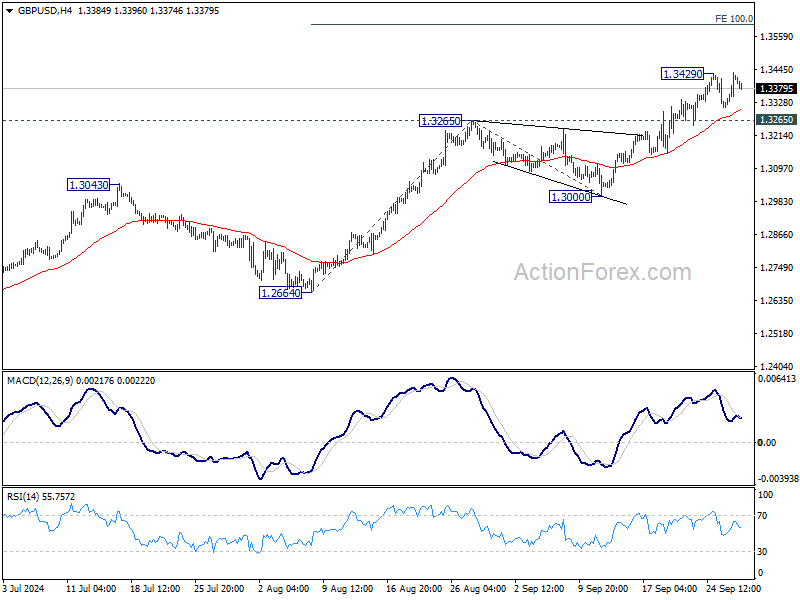
In the bigger picture, up trend from 1.0351 (2022 low) is in progress. Next target is 61.8% projection of 1.0351 to 1.3141 from 1.2298 at 1.4022. For now, outlook will stay bullish as long as 1.3000 support holds, even in case of deep pullback.
USD/CHF Daily Outlook
Daily Pivots: (S1) 0.8438; (P) 0.8477; (R1) 0.8501; More…
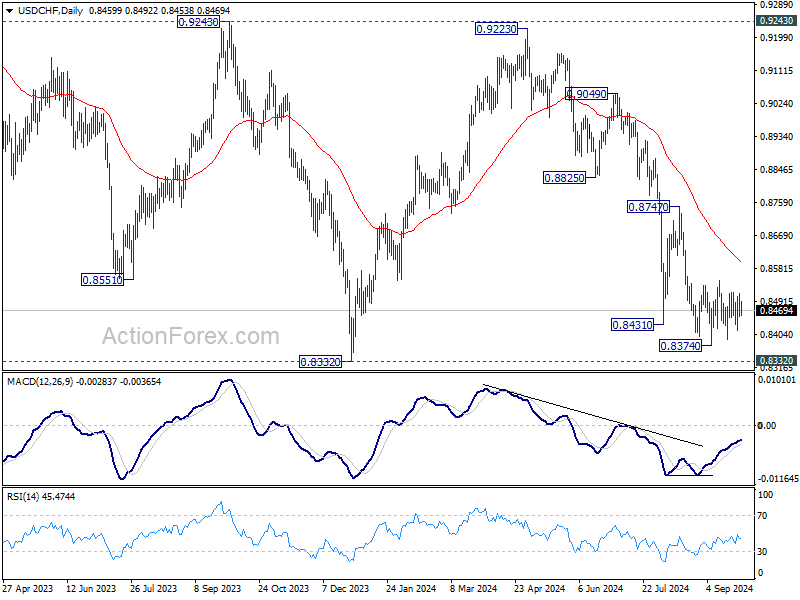
Intraday bias in USD/CHF remains neutral as sideway trading continues. On the downside, break of 0.8374 will resume the fall from 0.9223 to retest 0.8332 low. Decisive break there will indicate larger down trend resumption. However, break of 0.8548 resistance will turn bias back to the upside for 0.8747 resistance.
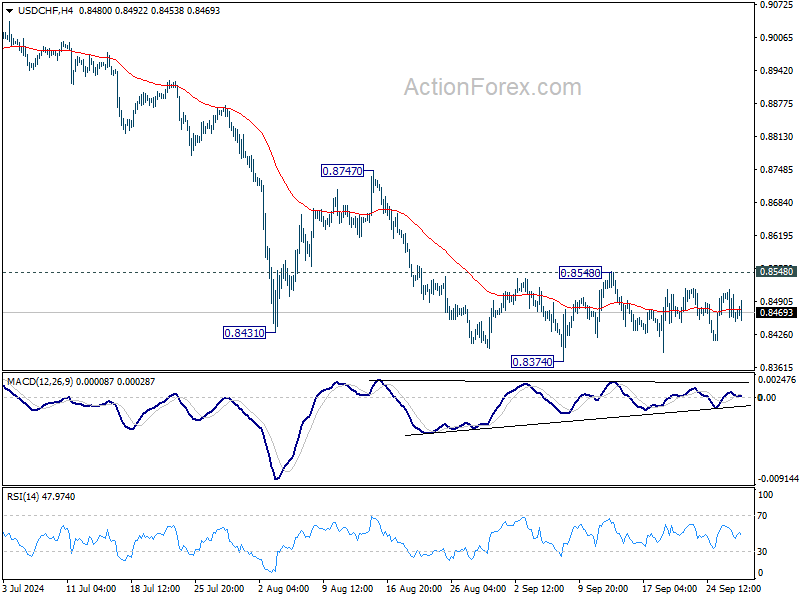
In the bigger picture, price actions from 0.8332 (2023 low) are currently seen as a medium term corrective pattern, with fall from 0.9223 as the second leg. Strong support could be seen from 0.8332 to bring rebound. Yet, overall outlook will continue to stay bearish as long as 0.9243 resistance holds. Firm break of 0.8332, however, will resume larger down trend from 1.0146 (2022 high).
USD/JPY Daily Outlook
Daily Pivots: (S1) 144.21; (P) 144.71; (R1) 145.31; More...
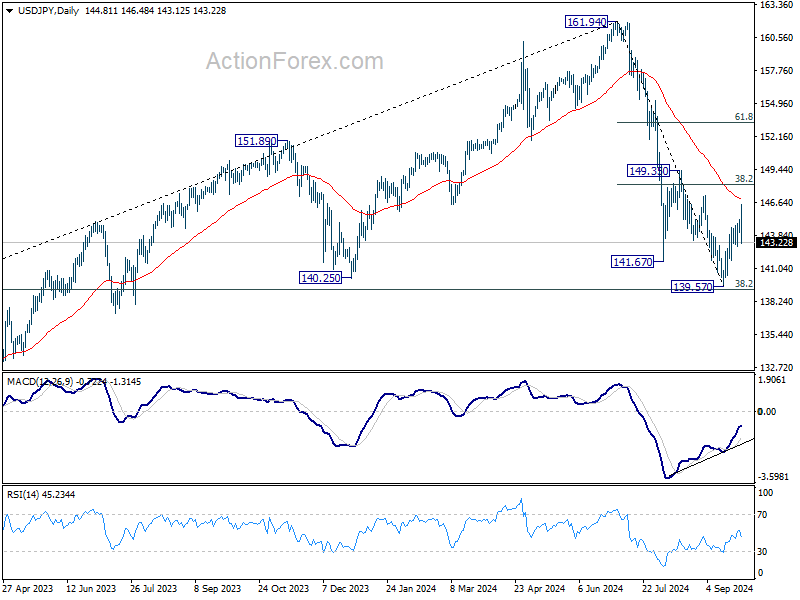
USD/JPY reversed after edging higher to 146.68 and intraday bias is turned neutral first. Further rise would remain in favor as long as 142.89 minor support holds. Above 146.48 will extend the rebound from 139.57 to 38.2% retracement of 161.94 to 139.57 at 148.11. On the downside, below 142.89 will turn bias to the downside for retesting 139.57 instead.
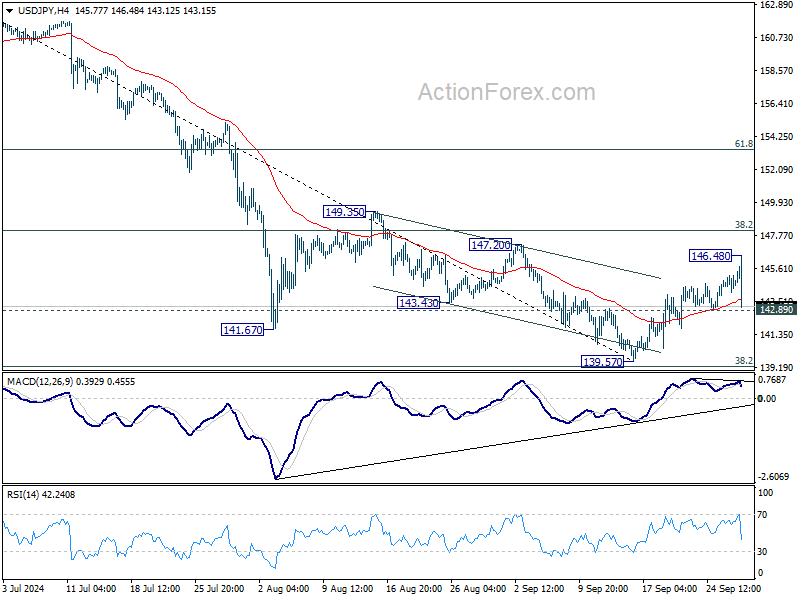
In the bigger picture, fall from 161.94 medium term top is seen as correcting whole up trend from 102.58 (2021 low). Strong support could be seen from 38.2% retracement of 102.58 to 161.94 at 139.26 to contain downside, at least on first attempt. But in any case, risk will stay on the downside as long as 149.35 resistance holds. Sustained break of 139.26 would open up deeper medium term decline to 61.8% retracement at 125.25.
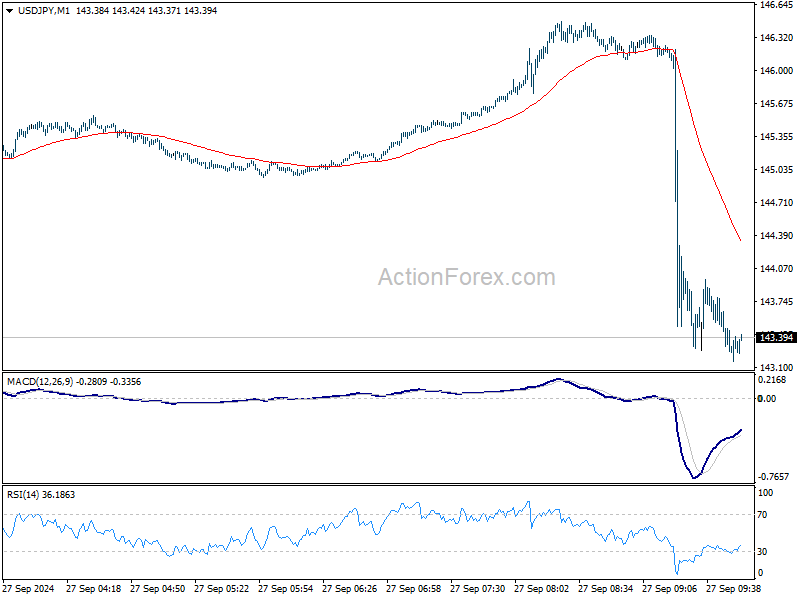
Yen surges as Ishiba wins LDP leadership, set to become Japan’s new prime minister
Japanese Yen surges sharply higher just following the election of former defense minister Shigeru Ishiba as the new leader of the ruling Liberal Democratic Party , positioning him as Japan’s next Prime Minister. Ishiba’s victory came after a closely contested leadership race, where he edged out hardline nationalist Sanae Takaichi in a run-off vote.
Ishiba, an intellectual heavyweight within the LDP and a national security expert, has been a vocal proponent of a more assertive Japan, advocating for reduced reliance on the US for defense. Notably, during his leadership campaign, Ishiba proposed the creation of an "Asian NATO," a concept that was swiftly dismissed by Washington as premature.
Ishiba’s stance on national security and defense policy is expected to shape Japan's geopolitical strategy in the years ahead. His election marks a significant shift in Japan's political landscape, as markets now react to the potential changes in foreign policy and defense initiatives under his leadership.
USD/CAD Daily Outlook
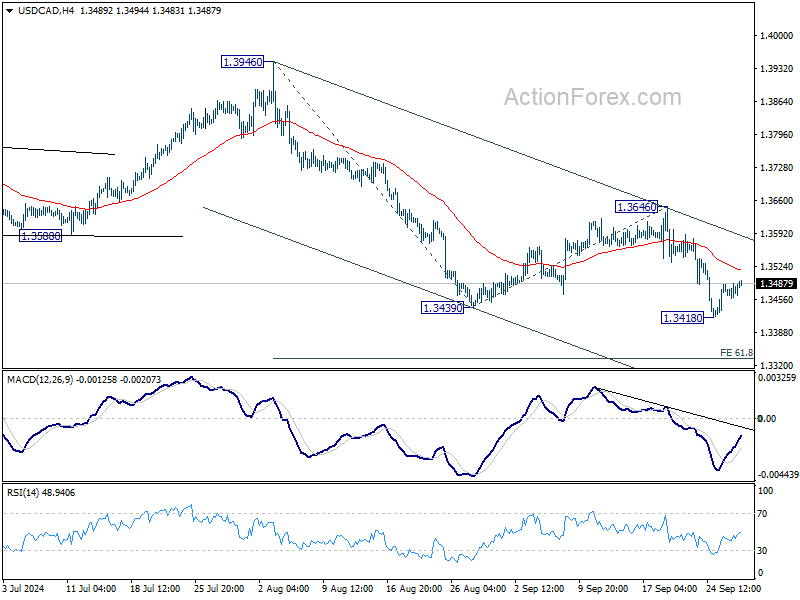
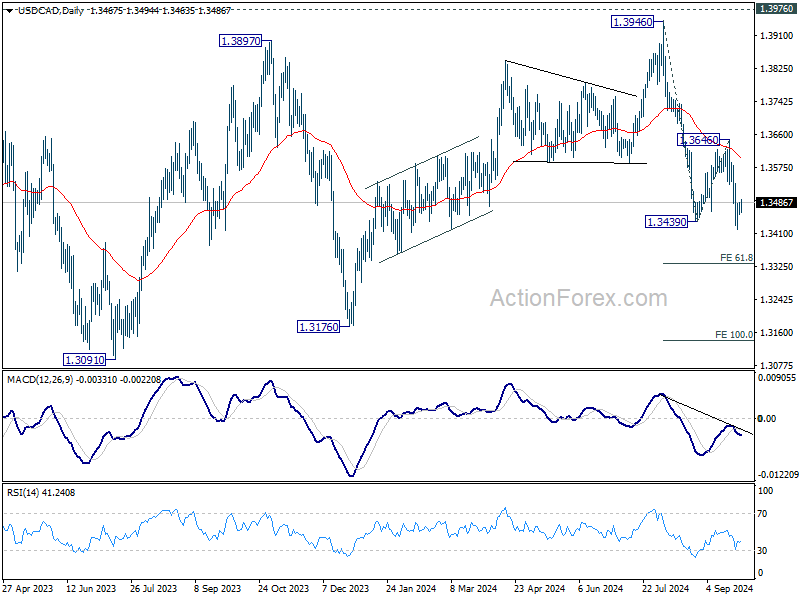
Daily Pivots: (S1) 1.3449; (P) 1.3474; (R1) 1.3491; More...
Intraday bias in USD/CAD stays neutral for the moment, and some more consolidations could be seen above 1.3418. But outlook will remain bearish as long as 1.3646 resistance holds. ON the downside, break of 1.3418 will resume the decline from 1.3946 to 61.8% projection of 1.3946 to 1.3439 from 1.3646 at 1.3333.
In the bigger picture, corrective pattern from 1.3976 (2022 high) is extending with another falling leg. While deeper decline could be seen, strong support should emerge above 1.2947 resistance turned support to bring rebound. Rise from 1.2005 (2021 low) is still in favor to resume at a later stage.
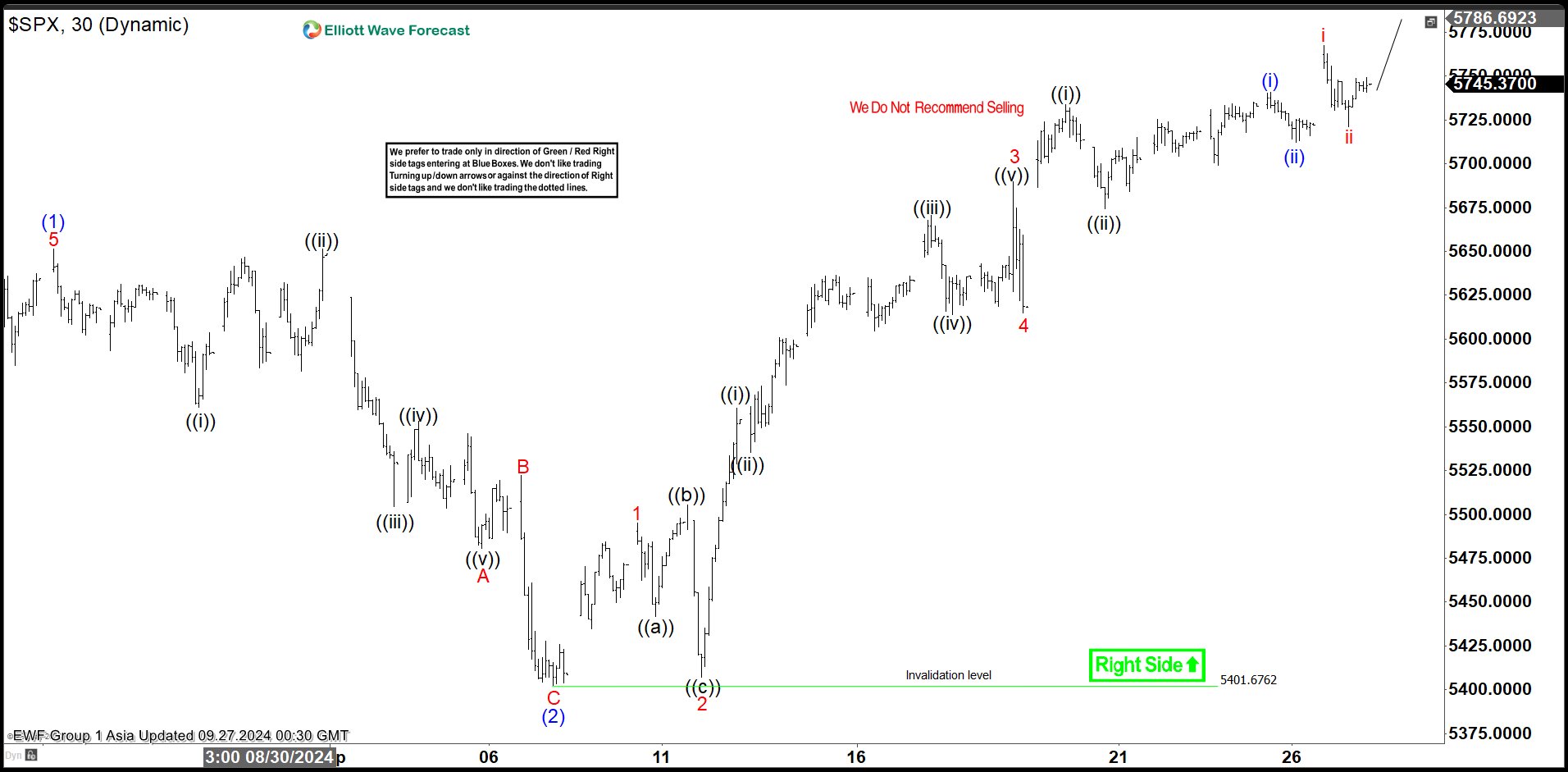
S&P 500 ($SPX) Elliott Wave Sequence Remains Bullish
Short Term Elliott Wave View in S&P 500 ($SPX) suggests that cycle from 8.5.2024 low is in progress as a 5 waves impulse. Up from 8.5.2024 low, wave (1) ended at 5651.62 and dips in wave (2) ended at 5402.62. Internal subdivision of wave (2) unfolded as a zigzag structure where wave A ended at 5480.54, wave B ended at 5522.47, and wave C lower ended at 5402.62. This completed wave (2) in higher degree.
Index has turned higher in wave (3) with internal subdivision as another impulse in lesser degree. Up from wave (2), wave 1 ended at 5495.14 and wave 2 pullback ended at 5406.96. Up from wave 2, wave ((i)) ended at 5560.41 and dips in wave ((ii)) ended at 5528.86. Wave ((iii)) higher ended at 5670.81 and pullback in wave ((iv)) ended at 5614.05. Final leg wave ((v)) ended at 5689.75 which completed wave 3 in higher degree. Pullback in wave 4 ended at 5615.08. Index has extended higher again in wave 5. Near term, as far as pivot at 5401. low stays intact, expect pullback to find support in 3, 7, 11 swing for more upside.
S&P 500 (SPX) 30 Minutes Elliott Wave Chart
SPX Elliott Wave Video
https://www.youtube.com/watch?v=IPCg_kZWIo4
A Rising Tide Lifts All Boats
Markets
A rising tide lifts all boats. Or in this case, a rising Chinese stock market lifts global risk sentiment. More fiscal spending, measures to stabilize the property sector, potential capital injections in the largest banks and forceful rate cuts are now also part of the toolkit announced earlier this week. European stock markets closed up to 2.35% (!) higher for the Eurostoxx50 with main US benchmarks extending their record race (+0.4%-0.6%) though closing off the day’s best levels. Most Asian stock markets show signs of some consolidation this morning, apart from China which adds another 5%-7% to an already record-week.
US eco data included a minor upward revision in the final Q2 print (3% Q/Qa), but especially consensus-beating durable goods orders (August) and lower weekly jobless claims (218k). Although second tier and coming ahead of PCE deflators (today) and ISM’s, ADP employment change and payrolls (next week) they did manage to swing the November Fed pendulum more into balance between a 25 bps and a 50 bps rate cut. Changes on the US yield curve ranged between +7 bps (2-yr) and -0.9 bps (30-yr). Lower oil prices partly help explain the strong curve shift with Brent crude prices dropping from $75/b to $71/b over the past two days. The move is linked to talk that Saudi Arabia is ready to abandon its unofficial $100/b oil price target. The FT reported that they would boost output from December 1st to regain market share. Bullish risk sentiment and lower oil prices balanced out interest rate support for the dollar. The greenback was going nowhere for most of the session and even lost some ground in the final stages of US trading. EUR/USD closed at 1.1177 from a start at 1.1133.
Today’s agenda contains first national European CPI indications for September (France, Spain, Belgium). Together with already released awful September PMI’s, they are the only input for the ECB in the short intermeeting period between September and October. PMI brough the possibility of a 25 bps rate cut back on the radar from a market point of view. We’re still in favour of a pause. When it comes to inflation numbers, ECB Lagarde at the press conference already “hedged” today and next month’s numbers by saying that they could fall somewhat further now before ticking up into year-end as energy-related base effects turn around. We’d be surprised though if markets pick up that nuance today, suggesting that lower inflation numbers could add to short term easing bets. Any potential euro weakness should remain short-lived going into next week’s big US eco week.
News & Views
Tokyo core inflation excluding fresh food printed at 2% Y/Y (from 2.4%) this month, matching the BoJ target. This move was mainly due to a reinstalment of measures to ease the cost of utilities (gas and electricity). The government measures are estimated to have reduced inflation by about 0.5%. A more strict core measure, excluding fresh food and energy was unchanged at 1.6%. Tokyo CPI data are seen as a good pointer for the national figure that will be released later next month. The October CPI reports are more important for BoJ policy setting as they might include price adjustments at the start of the fiscal second half of the year and give an indication on the degree that corporates are passing through the cost of higher wages. The Japanese yen didn’t respond to the inflation data, but suffered a setback (USD/JPY 146.50 from 145) after BoJ easing advocate Takaichi made it to the LDP leadership contest runoff (facing Ishiba).
The Bank of Mexico for the second consecutive meeting lowered its policy rate by 25 bps to 10.50%. Vice governor Jonathan Heath vote for an unchanged decision. The bank was mildly constructive in the inflation outlook going forward. Annual headline inflation decreased from 5.57% in July to 4.66% in the first fortnight of September. Core inflation continued trending downwards(3.95% Y/Y). It estimated that, although the outlook for inflation still calls for a restrictive monetary policy stance, its evolution implies that it is adequate to reduce the level of monetary restriction. The forecasts for headline and core inflation were revised slightly downwards for some quarters in the short term. Headline inflation is still expected to converge to the target in the fourth quarter of 2025. The Mexican CB targets 3.0% +/- a 1.0% tolerance band. The Mexican peso which traded in the defensive since April but came off the early September lows recently, closed yesterday’s session little changed near USD/MXN 19.63.
Graphs
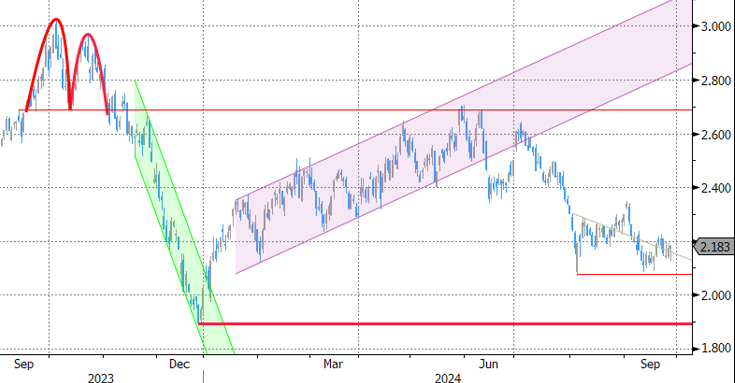
GE 10y yield
The ECB cut policy rates by 25 bps in June and in September. Stubborn inflation (core, services) make follow-up moves less evident. We expect the central bank to stick with the quarterly reduction pace. Disappointing US and unconvincing-to-outright-weak EMU activity data dragged the long end of the curve down. The move accelerated during the early August market meltdown.
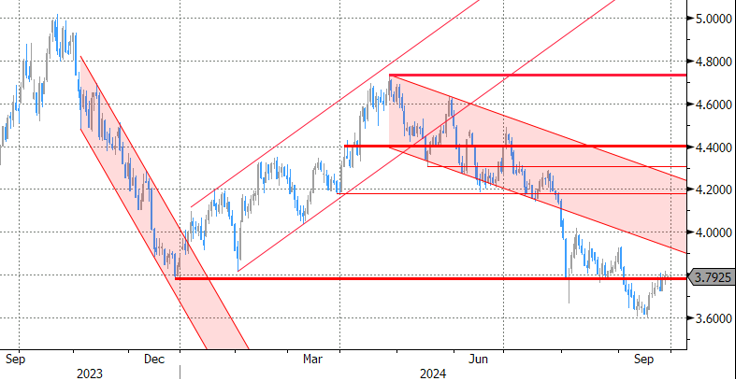
US 10y yield
The Fed kicked off its easing cycle with a 50 bps move. It is headed towards a neutral stance now that inflation and employment risks are in balance. Conservative SEP unemployment forecasts risk being caught up by reality and with it the dot plot (50 bps more cuts in 2024). We hold our call for two more 50 bps cuts this year. Pressure on the front of the curve and weakening eco data keeps the long end in the defensive for now as well.
EUR/USD
EUR/USD moved above the 1.09 resistance area as the dollar lost interest rate support at stealth pace. US recession risks and bets on fast and large rate cuts trumped traditional safe haven flows into USD. An ailing euro(pean economy) only briefly offset some of the general USD weakness. EUR/USD’s dollar-driven ascent is nearing resistance around 1.12 again.
EUR/GBP
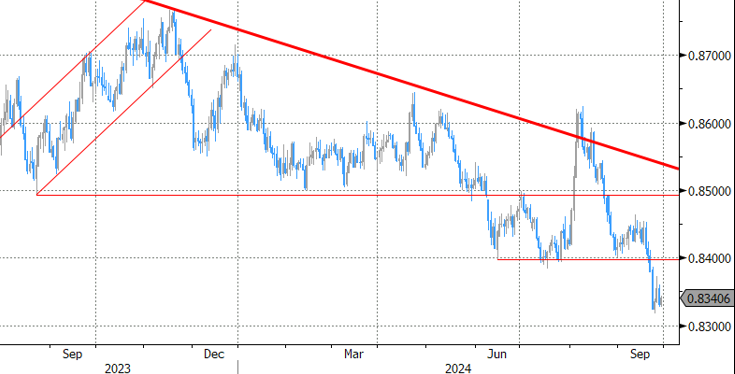
The BoE delivered a hawkish cut in August. Policy restrictiveness will be further unwound gradually on a pace determined by a broad range of data. The strategy similar to the ECB’s balances out EUR/GBP in a monetary perspective. But the economic picture is increasingly diverging to the benefit of sterling. EUR/GBP succumbed to horrible European September PMI’s. Support at 0.84 broke and brings the 2022 low (0.8203) on the radar.
Oil Prices Tumble on OPEC+ Supply – HICP Prints to Give Clues on Euro Area Figure
In focus today
In the euro area, focus today is on the September inflation data from Spain, France, and Belgium, which will give clues on the euro area data on Tuesday next week. We expect euro area HICP inflation to decline significantly to 1.8% y/y in September from 2.2% driven by both base effects on energy inflation and declining monthly energy prices. Excluding energy inflation and food, we expect core inflation remained at 2.8% y/y (0.20% m/m s.a.) due to sticky services inflation. The dip in headline inflation below 2% is expected to be temporary due to base effects and we expect inflation to rise above 2% again in November and December.
In Germany, we focus also on data on unemployment as the German labour market has weakened lately in contrast to other euro-area countries.
From the US, headline and core PCE inflation are released today, where markets see prints at +2.3% y/y and +2.7% y/y, respectively.
Although economic activity in Norway has been relatively weak over the past year, there has been only a moderate rise in unemployment. We expect that the unemployment rate increased marginally to 2.1% (seasonally adjusted) in September. Higher real wage growth and a period without rate hikes have improved the purchasing power of households, and private consumption picked up in the summer months. However, we expect that the retail trade was unchanged in August.
We are yet to see results from the Japanese ruling LDP leadership election, which will be interesting for markets due to the recent hawkish turn of the BoJ looking highly politically influenced. Abenomics loyalists preferring a slow normalisation of monetary policies as well as hawks are on the ticket in an election that will be heavily influenced by behind-the-scenes arm wrestling among party heavyweights.
Economic and market news
Oil prices tumbled about 2.5% on the news that Saudi Arabia has allegedly abandoned its (unofficial) price target of 100 USD/bbl. and instead opt to boost production to regain market shares. Note that we have no official communication yet, but the existing OPEC+ production cuts are slated to expire on 1 December, and this will be a shift from the trend since 2022 where focus has been on cutting, rather than increasing, oil production.
The SNB cut its policy rate by 25bp to 1.00% as we expected. Markets were close to evenly split between 25bp and 50bp, which resulted in a slight move lower in EUR/CHF upon announcement, though dovish communication caused the cross to erase losses. See more below.
In China, we got more stimulus signals with both verbal communication from the Politburo on the need for policy action to turn the economy as well as specific details on handouts and spending-vouchers, capital injection into state banks, and support for the property market. The combined package from the latest days highlights the strongest focus on ending the crisis we have seen since 2021 in our view. Chinese stocks, metal prices and the CNY continued to rally during the day.
Tokyo CPI saw core inflation at +0.19% m/m adjusted for seasonality, which is well in line with the BoJ's target of 2% annual inflation. The so-called 'core core' figure, which excludes food and energy, printed at just at 0.06% m/m seasonally adjusted however, indicating somewhat softer price pressure providing downside risk for inflation, and the market reaction was initially for a slightly weaker yen. Broadly, however, the BoJ will be satisfied with the latest print, and it will likely not change the decision in October, where we expect a hold.
Equities: What a day in global equities yesterday, marked by significant global increases and an intriguing sector rotation. On one hand, China is stimulating its economy; on the other, Saudi Arabia is potentially abandoning its oil price target to regain market share. In Europe yesterday, the energy sector was down more than 3%, while the consumer discretionary sector rose by more than 5%, driven by car producers and, notably, heavyweight luxury brands. This serves as a poignant reminder for all of us to check whether our judgments are correct and for the right reasons. It's easy to deceive oneself these days. In the US yesterday, the indices were as follows: Dow +0.6%, S&P 500 +0.4%, Nasdaq +0.6%, and Russell 2000 +0.6%. Most Asian markets are continuing to rise this morning, once again led by significant gains in Chinese stock markets - it looks like we are on track for best week for Chinese stocks since 2008(!).
FI: There was modest movement in European government bond yields yesterday apart from the continued pressure on France, but neither the Bund ASW-spread nor the BTPS-Bund spread has widened as we saw back in June. Hence, we are not seeing the same kind of risk-off movement as we saw back in June when President Macron called a snap election. Revision of US economic data as well as lower-than-expected jobless claims sent US bond yields higher with 2Y Treasuries rising almost 10bp yesterday.
FX: EUR/USD has spent most of the last two weeks within the 1.11-1.12 interval, though with a couple of unsuccessful attempts to break out of the range. USD/JPY tried to establish above 145 but was rejected twice yesterday. The British pound continues to shine on the back of relatively solid data and tight monetary policy stance - yesterday GBP/USD made a new 2.5year high at 1.3430. The Swiss franc strengthened after the SNB cut 25bp and EUR/CHF is back trading in the mid-0.94s. EUR/NOK held on to previous gains just below 11.80, while EUR/SEK was rangebound around 11.30. USD/CNY has fallen below 7.02 in recent days on the stronger stimulus signals and likely new capital inflows to the stock market. Our medium-term view is still that the cross will resume higher as we remain bullish on the USD. But there is rising downside risk to our 7.25 12M forecast. EUR/CNY has fallen to around 7.84, the middle of the 7.70-7.95 range it has traded in for a long time now. We could see more downside in the medium term as it is expected to also get support from a lower EUR/USD. The idiosyncratic strengthening of the CNY has led to a bit of decoupling in the normal high correlation between EUR/USD and EUR/CNY, but we expect it to resume when the dust settles from the recent days action.