Sample Category Title
XAU/USD Outlook: Gold Surges to New All-Time High Above $2,600
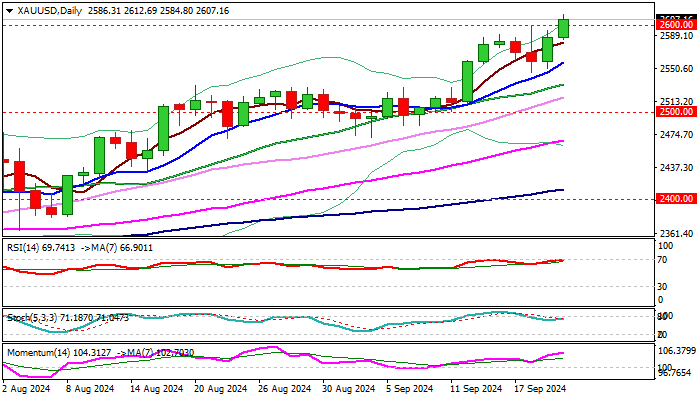
Gold broke through psychological $2600 barrier and hit new all-time high on Friday morning, on track to register clear break higher after the resistance was cracked in post-Fed jump but resisted attack.
The yellow metal shined after market digested Fed’s decision, with prospects for more rate cuts, deteriorating geopolitical situation, growing uncertainty over fiscal conditions in a number of Western economies and ongoing destabilization of the US dollar, boosting its safe haven appeal.
Fresh bull-leg $2546 (low of a shallow correction) signals continuation of larger uptrend, with close above $2600 to confirm signal.
Gold is also on track for the second consecutive weekly gain, which came after a triple weekly Doji candles, adding to bullish continuation signals.
Gold price has moved at a high speed and rose from $2000 (which marked very strong resistance) to $2600 in about ten months.
The sentiment is very bullish and sustained break above $2600 would look for targets at $2628 and $2650 (Fibo projections) initially, with stronger bullish acceleration to bring in focus $2700.
Dips on partial profit taking should be shallow and mark positioning for further advance.
Res: 2614; 2628; 2636; 2650.
Sup: 2600; 2589; 2581; 2557.
USD/CAD Eyes Canadian Retail Sales
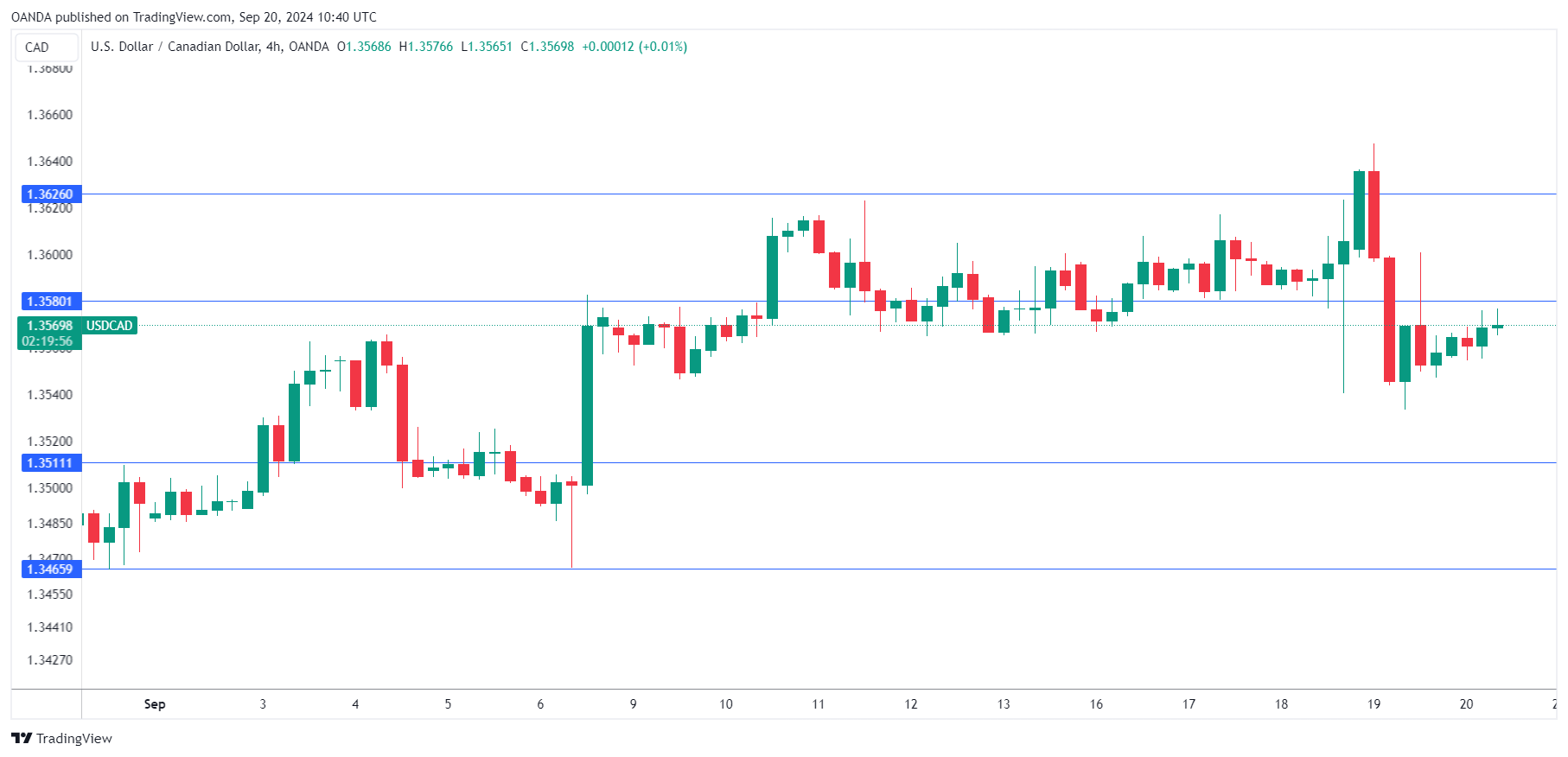
The Canadian dollar is steady on Friday. In the European session, USD/CAD is trading at 1.3573 at the time of writing, up 0.12% today. On the data calendar, Canada releases retail sales, while it’s an unusually quiet day in the US, with no releases.
Canada’s retail sales expected to bounce back in July
Canada’s retail sales are projected to have jumped 0.6% m/m in July, compared to -0.3% in June. On an annualized basis, retail sales are expected to improve to 0.7%, up from 0.2% in July. The Canadian economy is showing weakness, as high interest rates have taken their toll on economic growth. The good news is that inflation appears under control, falling to 2% in August, down from 2.5% a month earlier. This matches the Bank of Canada’s target and the aim now is to keep trimming rates and avoid a labor market crash. The BoC has already cut rates three times for a total of 0.75%, bringing the benchmark rate to 4.25%. The BoC doesn’t meet again until October 23 and will have plenty of data to review beforehand.
In the US, inflation is largely under control and the Federal Reserve has shifted its primary focus to the labor market, as job growth as deteriorated faster than expected. That slide has unnerved financial markets and may have been a key factor in the Fed’s jumbo rate cut of 50 basis points this week. Thursday’s unemployment claims for the period ending Sept. 14 were lower than expected, at 219 thousand. This was well below the revised 231 thousand reading a week earlier and beat the market estimate of 230 thousand.
USD/CAD Technical
- 1.3580 is under pressure in resistance. Above, there is resistance at 1.3626
- 1.3511 and 1.3465 are the next support levels
USD/JPY Surges as Bank of Japan Stays Pat
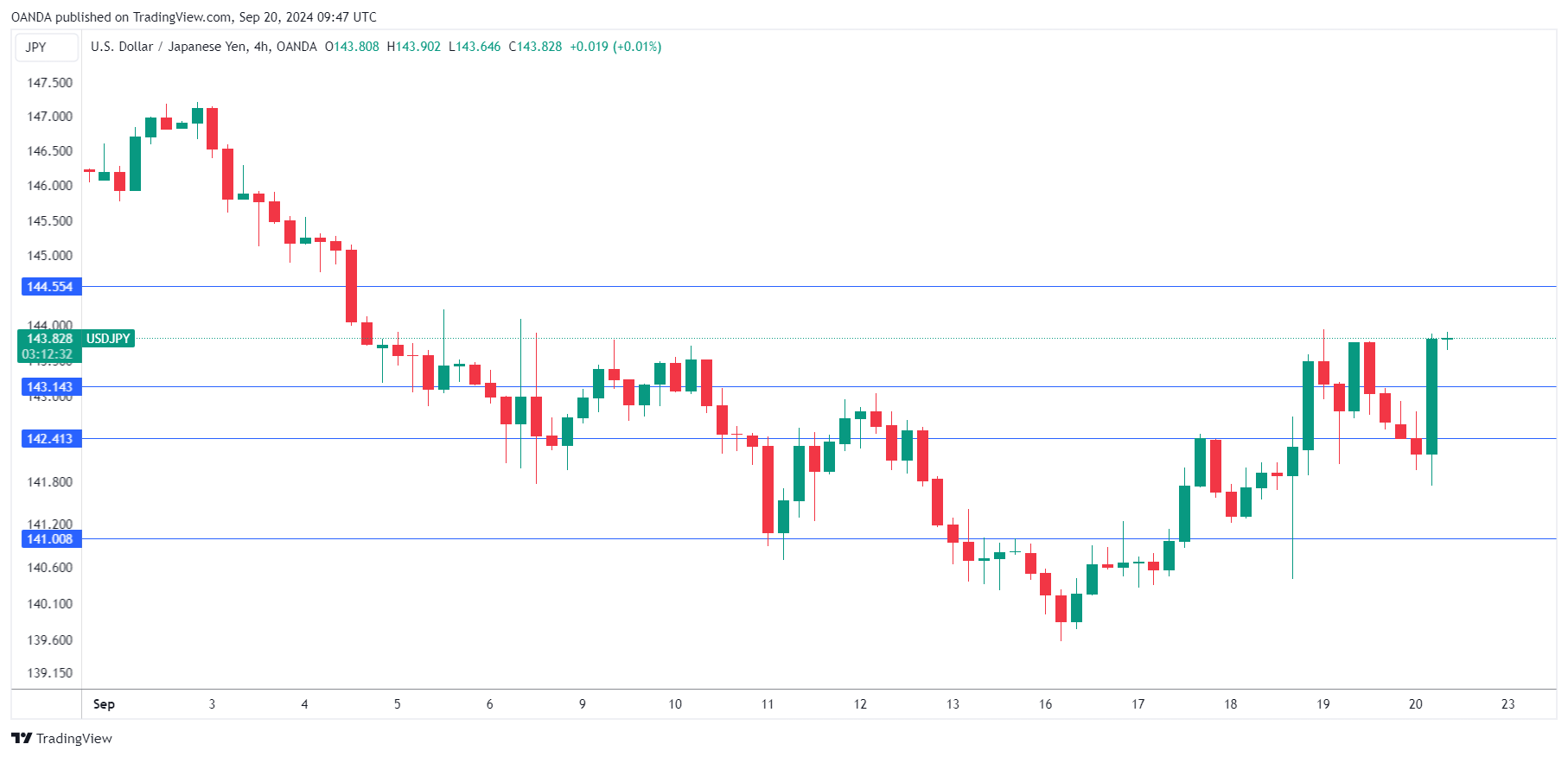
The US dollar has posted sharp gains on Friday. In the European session, USD/JPY is trading at 143.85, up 0.88% at the time of writing. The yen hit a 14-month high on Monday but the dollar has rebounded and is up 2.1% this week. It’s an unusually quiet Friday with no US events on the calendar.
Bank of Japan stays on sidelines
The Bank of Japan held its rate decision just after the Federal Reserve, but there was little drama at the BoJ meeting. The markets had expected that central bank to maintain rates at “around 0.25%” and the BoJ didn’t provide any clues about future hikes. The rate statement didn’t reveal much, stating that the economy had “recovered moderately” but some weakness remained.
The statement noted concern over “developments in financial and foreign exchange market and their impact on Japan’s economic activity and prices”. Governor Ueda said last month that the BoJ would raise rate if the economy and inflation were in line with the Bank’s projections. If key data, particularly inflation, is stronger than expected in the coming weeks, we could see a rate hike at the October meeting.
With inflation in the US largely under control, the Federal Reserve is keeping a worried eye on the labor market, as job growth as deteriorated quickly. That slide has unnerved financial markets and may have been a key factor in the Fed’s jumbo rate cut of 50 basis points this week. Thursday’s unemployment claims for the period ending Sept. 14 were better than expected, at 219 thousand. This was well below the revised 231 thousand reading a week earlier and beat the market estimate of 230 thousand.
USD/JPY Technical
- USD/JPY pushed above resistance at 142.41 earlier. The next resistance line is 144.55
- There is support at 142.41 and 141.00
Crypto Market’s Steady Ascent
Market Picture
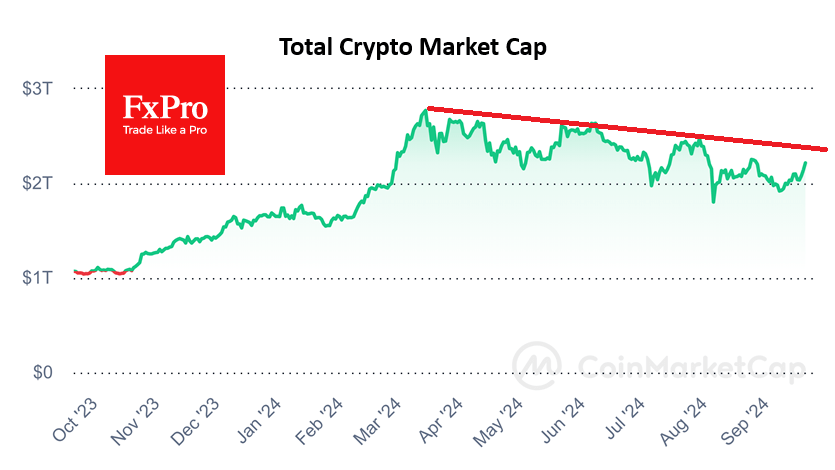
Active buying continues in the crypto market, with its total cap rising 3.2% in 24 hours to $2.21 trillion, reviving the fight to break the previous local high of $2.27 trillion a month ago. The local low in early September was above the previous low, and a break of the recent highs could provide fresh buying momentum and signal a break in the multi-month downtrend.
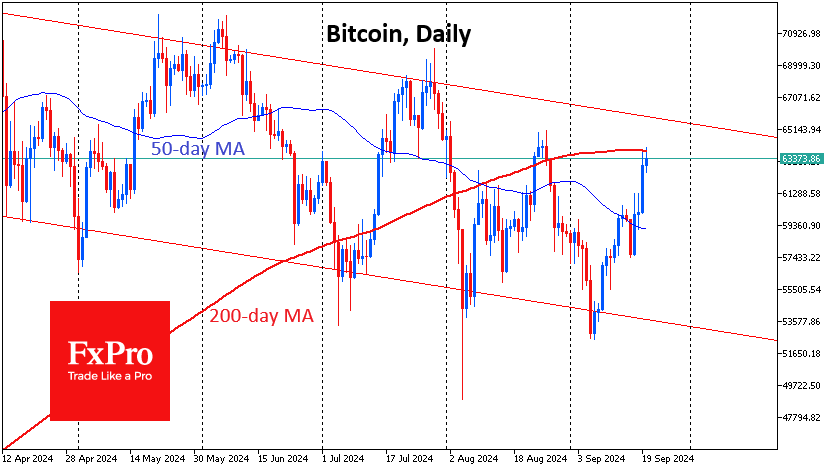
Bitcoin broke above $64K on Friday morning and is fast approaching a test of the emotionally important 200-day moving average, which also holds the late August highs. Overcoming this resistance would open the way to the upper boundary of the descending channel at $66K and a break of the downtrend on the rise above $68K.
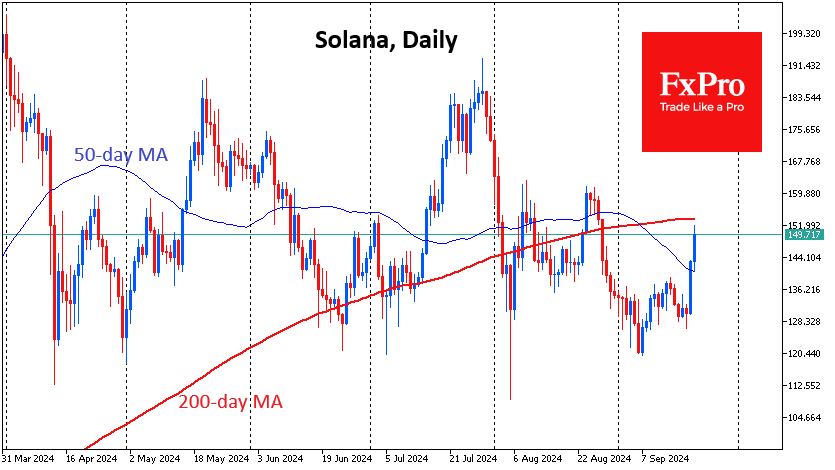
The turnaround in market sentiment has helped Solana, which has rallied around 20% from the lows seen just before the Fed meeting. In the daily timeframe, the coin has consolidated above the 50-day moving average and is approaching the 200-day (around $154) at current levels near $150.
News Background
The world’s largest investment company, BlackRock, called Bitcoin a unique tool for hedging global risks and a defence against a possible depreciation of the dollar amid the growing US federal budget deficit. At the same time, BlackRock has only $21bn in bitcoin ETFs, just 0.69% of the company’s assets in exchange-traded funds.
On 18 September, the documentary “Vitalik: An Ethereum Story” premiered in 23 countries.
US State Louisiana has integrated Bitcoin and Lightning Network, as well as USDC stablecoin, into state operations. A special service will convert incoming digital assets into dollars.
Commerzbank, one of Germany’s largest banks, will partner with Crypto Finance, a subsidiary of Deutsche Boerse Group, to offer cryptocurrency trading and custody services to corporate clients.
Tether called its curated stablecoin “a cornerstone in modern financial ecosystems.” USDT’s 350 million users transact with it, and its issuer works with 180 institutions in 45 jurisdictions. The report’s publication could be a response to a recent attack by consumer advocacy group Consumers’ Research.
German police seized the servers of 47 illegal cryptocurrency exchanges, which were being used by encryption virus operators, botnet owners, and darknet marketplace sellers.
BoE’s Mann favors extended tight policy before swift, aggressive cuts
In a speech today, BoE MPC member Catherine Mann emphasized the importance of a cautious approach to easing monetary policy, stating that it's preferable to remain restrictive longer amid inflation uncertainties.
She argued that "a risk management assessment implies it is better, under inflation uncertainty, to remain restrictive for longer, until right tail risks to the inflation process dissipate, and then to cut more aggressively."
This "more activist strategy", according to her, would allow for a sustainable inflation outcome with less impact on the economy, as she mentioned it helps achieve the target "at a lower sacrifice ratio."
Despite agreeing with the majority of the MPC members on holding rates steady in the latest meeting, Mann has expressed a "guarded view" on starting the cutting cycle. Having voted against the 25bps rate cut in August, Mann again voted to hold yesterday.
ECB’s de Guindos keeps all option open data will drive future rate cuts
In an interview with Expresso, ECB Vice President Luis de Guindos reaffirmed the central bank's cautious approach regarding rate cuts in the upcoming meetings. He stressed that ECB remains "fully committed" to a data-dependent strategy, making decisions on a "meeting-by-meeting" basis.
While he acknowledged the possibility of cuts in both October and December, De Guindos highlighted that December would provide a clearer picture. "We will have more information and a new round of projections," he noted.
Nevertheless, he emphasized ECB plans to keep "all options open" to retain flexibility, with future moves hinging entirely on evolving economic data.
AUD/USD Reaches New Heights as Risk Sentiment Improves
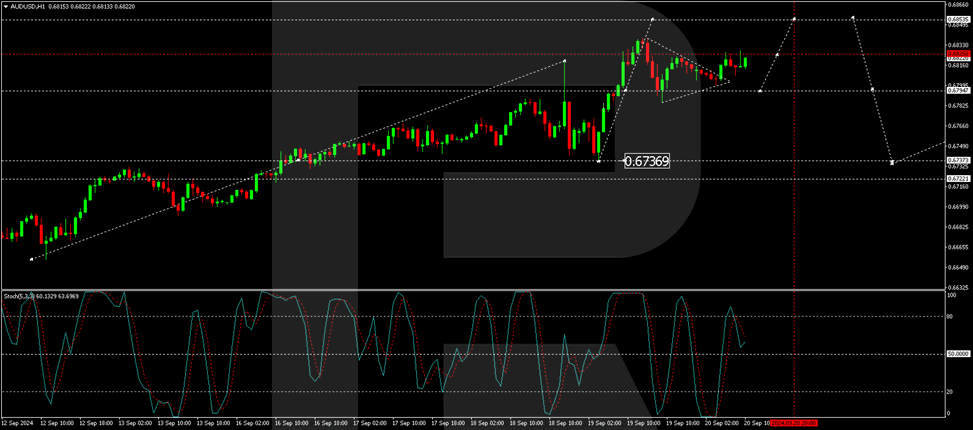
The AUD/USD pair has climbed to a new peak, reaching 0.6815, marking the highest level since 28 December of the previous year. This strength in the Australian dollar is partly due to the aggressive rate cuts by the US Federal Reserve, which has spurred expectations that other central banks might also ease monetary policies, enhancing the economic outlook and fuelling a rally in riskier assets.
This week, Australian employment data significantly outperformed expectations, showing a 47.5k increase in jobs for August, far exceeding the forecasted 25.0k. This robust job growth has kept the unemployment rate steady at 4.2%. Despite this positive economic indicator, the main expectation is that the Reserve Bank of Australia (RBA) will maintain its interest rate at the current level in its upcoming meeting, with analysts predicting no changes to monetary policy until at least December and possibly not until Q2 of next year. The RBA’s cautious approach to inflation underscores its strategy of not taking decisive action until there is apparent necessity.
Given the current favourable risk environment, the AUD could reach even higher levels soon.
AUD/USD technical analysis
The AUD/USD market is advancing in the fifth wave of growth towards 0.6855. This target will likely be reached soon, followed by a corrective movement to 0.6790, testing it from above. This could define the upper boundary of a new consolidation range. Should the pair break below this range, a further decline to 0.6736 might ensue, potentially signalling the start of a new downward trend towards 0.6640, with a continuation to 0.6590. The MACD indicator, currently at its highs and directed upwards, supports this bullish scenario in the short term.
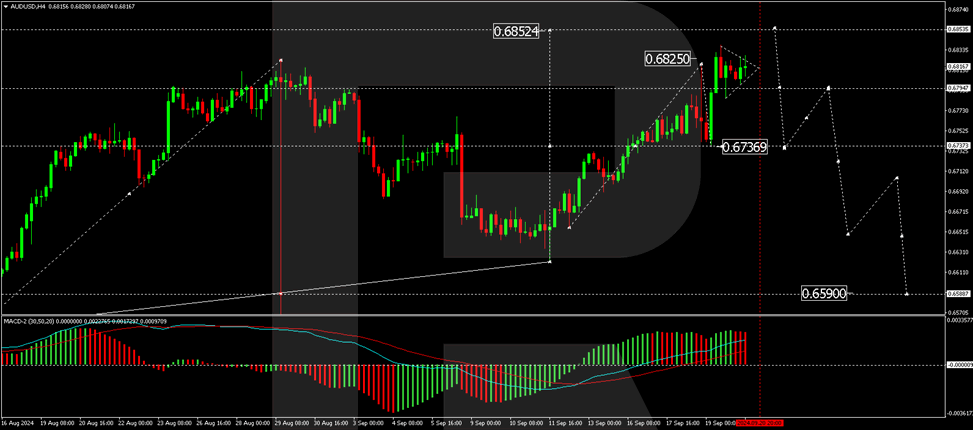
On the H1 chart, AUD/USD is forming a growth structure towards 0.6855. A short rise to 0.6848 is expected, followed by a slight decline to 0.6825. Upon completion of this minor correction, another growth phase towards 0.6855 is anticipated, which could exhaust the potential of the current growth wave. The Stochastic oscillator, with its signal line above 50 and pointing upwards, corroborates the likelihood of continued upward movement before any significant pullback.
USDCHF Stable at the Bottom of a Downtrend
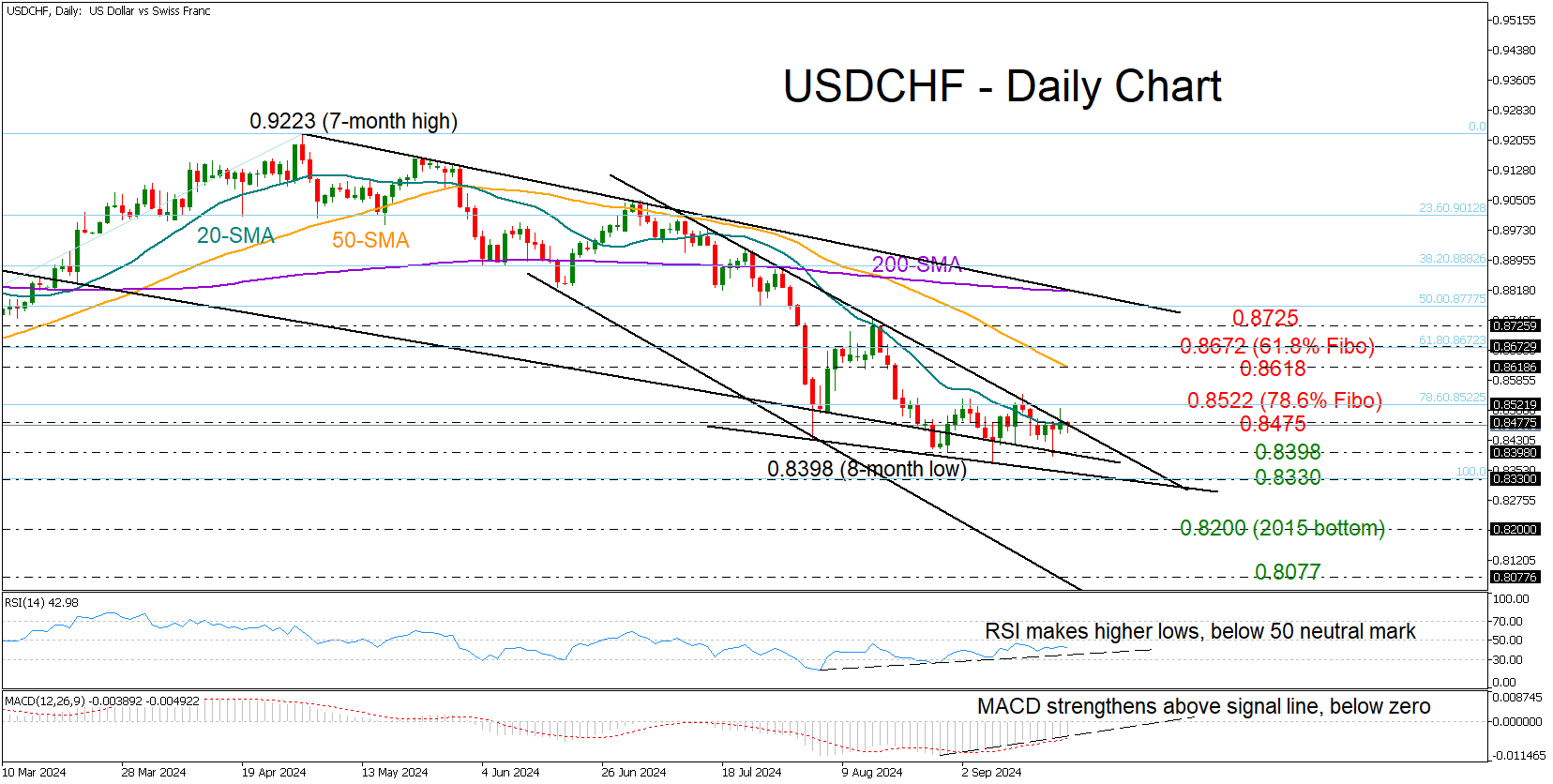
- USDCHF trades sideways near 8-month low, below 20-SMA
- Short-term outlook is hazy, but optimism is still there
- Key resistance at 0.8522; support at 0.8330
USDCHF has been in a tight range within the 0.8400 region so far this week, remaining trapped below its 20-day simple moving average (SMA) and the resistance trendline from July near 0.8470.
Despite the absence of strong bullish signals, the bullish divergence in the RSI and MACD remains a source of optimism for a positive reversal.
Nonetheless, buyers might adopt a wait-and-see approach until the price breaks above 0.8475 and moves out of its horizontal path above 0.8522. The latter overlaps with the 78.6% Fibonacci retracement of the December 2023-April 2024 upleg. Hence, a violation there could activate a new bullish wave towards the 50-day SMA at 0.8618. Further up, the pair may take a breather around the 61.8% Fibonacci mark of 0.8672 before stretching towards the 0.8725 bar.
A potential support level might form near the declining constraining line from October 2023 at 0.8398. The 9-year low of 0.8330 registered in December 2023 could be the next destination. Sellers must breach that base to access the critical 2015 floor of 0.8200. Even lower, the spotlight will turn to the bottom of the bearish channel seen near 0.8077.
In conclusion, USDCHF is expected to remain neutral in the short-term, unless it runs above 0.8522 or below 0.8330.
Market Analysis: GBP/USD Rallies While USD/CAD Struggles
GBP/USD started a fresh increase above the 1.3200 zone. USD/CAD declined and now consolidates below the 1.3600 level.
Important Takeaways for GBP/USD and USD/CAD Analysis Today
- The British Pound is eyeing more gains above the 1.3300 resistance.
- There is a key expanding triangle forming with support near 1.3200 on the hourly chart of GBP/USD at FXOpen.
- USD/CAD started a fresh decline after it failed to clear the 1.3650 resistance.
- There was a break below a short-term contracting triangle with support at 1.3560 on the hourly chart at FXOpen.
GBP/USD Technical Analysis
On the hourly chart of GBP/USD at FXOpen, the pair formed a base above the 1.3100 level. The British Pound started a steady increase above the 1.3200 resistance zone against the US Dollar, as discussed in the previous analysis.
The pair gained strength above the 1.3235 level. The bulls even pushed the pair above the 1.3300 level and the 50-hour simple moving average. The pair tested the 1.3315 zone and is currently consolidating gains.
There was a minor decline below the 1.3300 level. The pair tested the 23.6% Fib retracement level of the upward move from the 1.3153 swing low to the 1.3314 high.
The bulls are now active near the 1.3275 level. If there is another decline, the pair could find support near the 1.3235 level or the 50% Fib retracement level of the upward move from the 1.3153 swing low to the 1.3314 high.
The first major support sits near the 1.3200 zone. There is also a key expanding triangle forming with support near 1.3200. The next major support is 1.3150. If there is a break below 1.3150, the pair could extend the decline.
The next key support is near the 1.3115 level. Any more losses might call for a test of the 1.3075 support. Conversely, the bulls might aim for more gains. The RSI moved above the 60 level on the GBP/USD chart and the pair is now approaching a major hurdle at 1.3315.
An upside break above the 1.3315 zone could send the pair toward 1.3350. Any more gains might open the doors for a test of 1.3420.
USD/CAD Technical Analysis
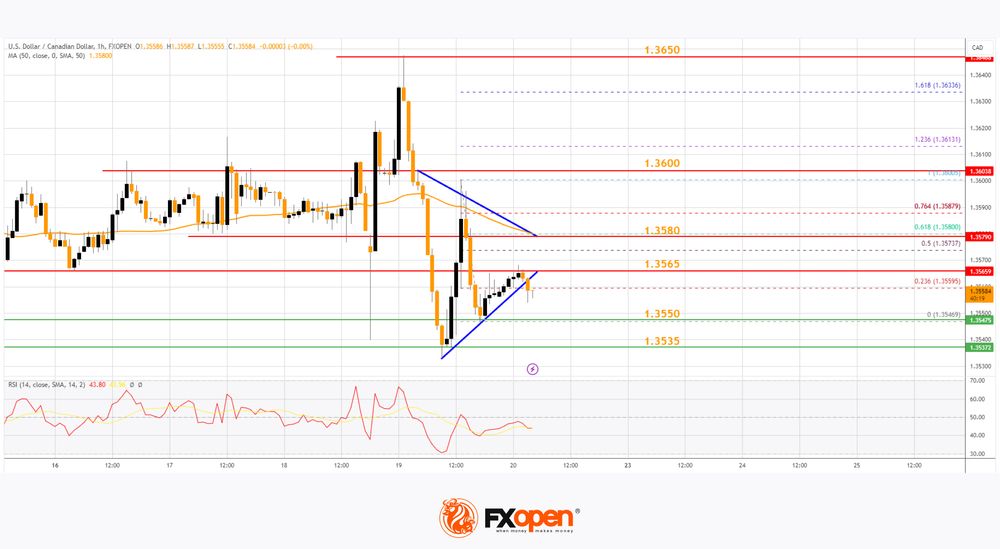
On the hourly chart of USD/CAD at FXOpen, the pair climbed toward the 1.3620 resistance zone before the bears appeared. The US Dollar formed a swing high near 1.3650 and recently declined below the 1.3600 support against the Canadian Dollar.
There was also a close below the 50-hour simple moving average and 1.3580. Besides, there was a break below a short-term contracting triangle with support at 1.3560.
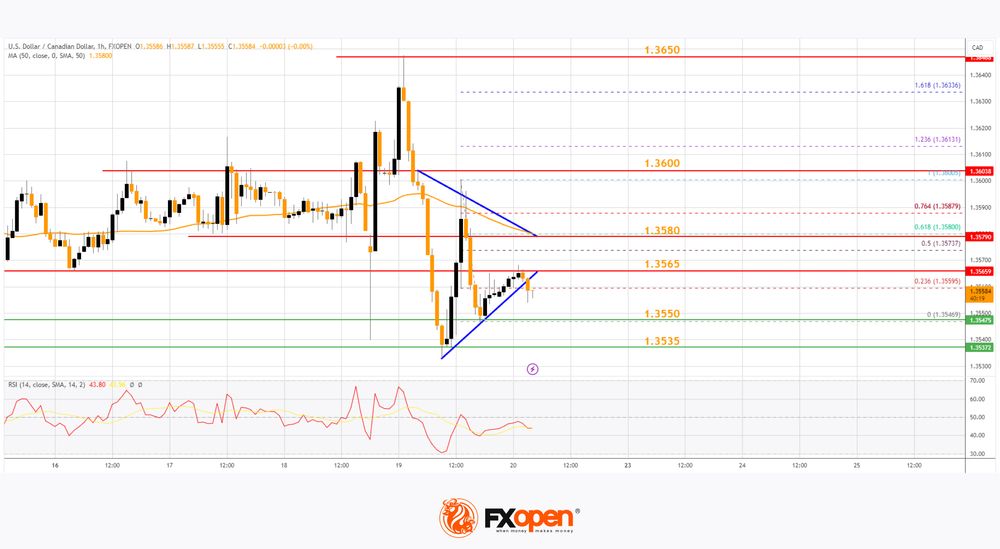
The bulls are now active near the 1.3550 level. Recently, the pair corrected some losses and climbed above the 23.6% Fib retracement level of the downward move from the 1.3600 swing high to the 1.3546 low.
If there is a fresh increase, the pair could face resistance near the 1.3565 level. The next key resistance on the USD/CAD chart is near the 61.8% Fib retracement level of the downward move from the 1.3600 swing high to the 1.3546 low is 1.3580.
If there is an upside break above 1.3580, the pair could rise toward the 1.3600 resistance. The next major resistance is near the 1.3650 level, above which it could rise steadily toward the 1.3700 resistance zone.
Immediate support is near the 1.3550 level. The first major support is near 1.3535. A close below the 1.3535 level might trigger a strong decline. In the stated case, USD/CAD might test 1.3500. Any more losses may possibly open the doors for a drop toward the 1.3450 support.
Trade over 50 forex markets 24 hours a day with FXOpen. Take advantage of low commissions, deep liquidity, and spreads from 0.0 pips. Open your FXOpen account now or learn more about trading forex with FXOpen.
This article represents the opinion of the Companies operating under the FXOpen brand only. It is not to be construed as an offer, solicitation, or recommendation with respect to products and services provided by the Companies operating under the FXOpen brand, nor is it to be considered financial advice.
US Curve Steepening and Outright Risk-on Context Kept Dollar in the Defensive
Markets
Wednesday’s bumper 50 bps Fed kick-off yesterday resulted in a further steeping of the US curve, with the short end still challenging recent lows. The intraday price dynamics was briefly interrupted by a better than expected Philly Fed business outlook and even more by a decline in the weekly jobless claims (219k from 231k). This supports Powell’s view that the Fed isn’t behind the curve and that it is supporting the economy/the labour market while it is still strong, helping to engineer a soft landing of the US economy. Even so, markets soon resumed their intraday pattern. US yields changed between -3.6 bps (2-y) and +3.0 bps (30-y). The US 2-y yield is only a whisker away from the March 2023 low (3.55% area). The rise in LT yields was mainly driven by a rebound in inflation expectations (10-y + 5.0 bps). The 10-y real yield declined 5.0 bps. This idea of a soft landing/mild reflation further propelled equities with the Dow and the S&P closing at new record levels. Reflationary hopes, amongst others, also supported a further rebound in the oil price (Brent $74.5 p/b). German yields traded in sympathy with the US (2-y -4.2 bps, 30-y +4.5 bps). US curve steepening and an outright risk-on context kept the dollar in the defensive, especially against the likes of the euro or currencies sensitive to the overall economic cycle (AUD, NZD…). EUR/USD closed at 1.1162, with the august top (1.1202) within reach. USD/JPY gained mostly (142.6 from 142.3) on yen underperformance. The eco calendar in the US and EMU is almost empty. We expect technical trading going into the weekend. The steepening trend might continue as markets can still raise the odds for follow-up 50 bps steps from the Fed in November and December. However, such a push needs more soft data, which we won’t get today. The dollar still remains at risk to fall below key support levels (EUR/USD 1.1202/1.1276, DYX 100.55/99.58).
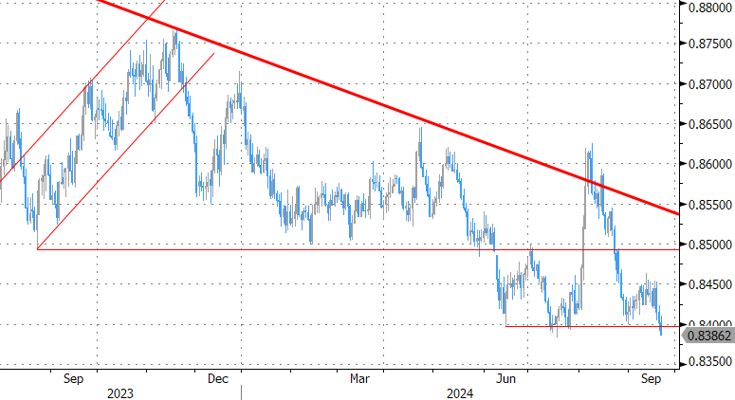
This morning, UK data printed mixed. GfK consumer confidence unexpectedly tumbled from -13 to -20. Consumers turned more pessimistic both on their personal situation as on the global economic outlook. UK August retail sales printed at a much stronger than expected 1.0% M/M and 2.5% Y/Y. Yesterday, the BoE let its policy rate unchanged at 5.0% after an inaugural step in August as it wants to take a cautious approach as core/services inflation remains elevated. After the retail sales release, EUR/GBP is heading for a test of the YTD lows (0.8383 area).
News & Views
The Bank of Japan kept the policy rate unchanged at 0.25%. The status quo was widely expected after a previous hike rattled markets end July/beginning of August. Language at that time signalling further hikes if the July outlook would materialize, didn’t make it in the statement this morning. Still, the BoJ upgraded its assessment of private consumption from “being resilient” to “being on a moderate increasing trend” thanks to a virtuous cycle from income to spending. Along with improving exports and against a background of accommodative financial conditions that should help Japan’s economy grow at a pace above potential. Inflation, both headline and underlying, are seen evolving according to the July outlook. The gauges are still seen to be consistent with the 2% target somewhere in the second half of the projection period. Inflation figures printed as fresh as this morning and ahead of the policy meeting outcome showed prices rose at a quicker pace in August. Headline CPI rose from 2.8% to 3% while the core measure (ex. fresh food and energy) fastened from 1.9% to 2%. The BoJ’s preferred gauge (ex. fresh food) picked up from 2.7% to 2.8%. The market reaction was a dull one with some minor JPY appreciation to USD/JPY 142.33.
Chinese bank kept their benchmark lending rates unchanged at 3.35% (1-yr) and 3.85% (5-yr). They lowered last time in July after the Chinese central bank cut its 7-day reverse repo rate back in July by 10 bps to 1.7%. There have been no cuts since, but the PBOC last week in an unusually explicit statement said that they are “preparing to launch some additional measures, further lower the financing costs for businesses and households, and keep liquidity reasonably ample.” after another string of weak data and as the housing market meltdown continues. Regarding the latter, Bloomberg reports China is considering to remove some of the largest remaining restrictions (targeting non-local buyers) on home purchases in a new attempt to revive the market. A slew of earlier measures have failed to do so. The Chinese yuan is giving it the benefit of the doubt though we suspect some technical considerations push the currency higher too. USD/CNY dropped below 7.05 for the first time since May 2023.
Graphs
GE 10y yield
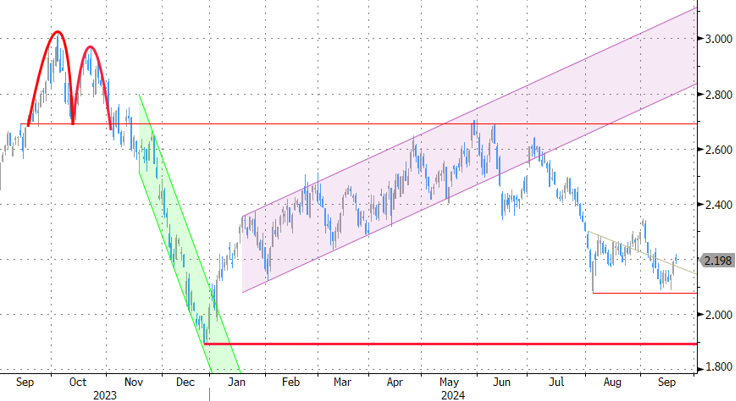
The ECB cut policy rates by 25 bps in June and in September. Stubborn inflation (core, services) make follow-up moves less evident. We expect the central bank to stick with the quarterly reduction pace. Disappointing US and unconvincing EMU activity data dragged the long end of the curve down. The move accelerated during the early August market meltdown.
US 10y yield
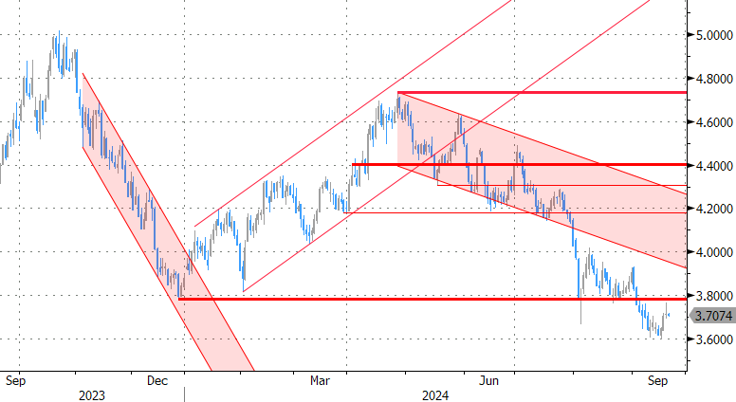
The Fed kicked off its easing cycle with a 50 bps move. It is headed towards a neutral stance now that inflation and employment risks are in balance. Conservative SEP unemployment forecasts risk being caught up by reality and with it the dot plot (50 bps more cuts in 2024). We hold our call for two more 50 bps cuts this year. Pressure on the front of the curve and weakening eco data keeps the long end in the defensive for now as well.
EUR/USD
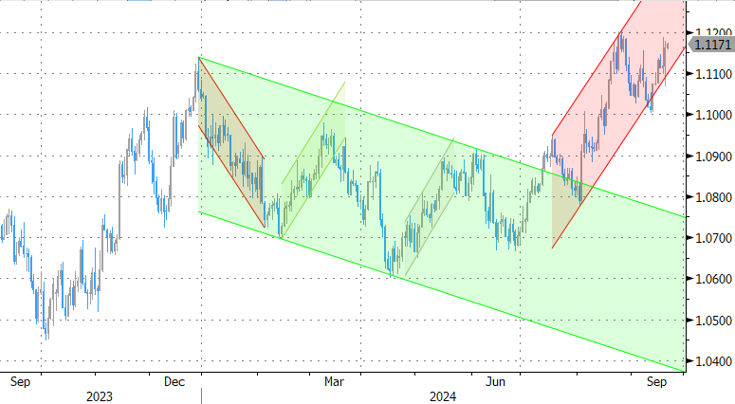
EUR/USD moved above the 1.09 resistance area as the dollar lost interest rate support at stealth pace. US recession risks and bets on fast and large rate cuts trumped traditional safe haven flows into USD. EUR/USD 1.1276 (2023 top) serves as next technical references.
EUR/GBP
The BoE delivered a hawkish cut in August. Policy restrictiveness will be further unwound gradually on a pace determined by a broad range of data. The strategy similar to the ECB’s balances out EUR/GBP in a monetary perspective. Recent better UK activity data and a cautious assessment of BoE’s Bailey at Jackson Hole are pushing EUR/GBP lower in the 0.84/0.086 range.