

Sample Category Title
GBP/USD Daily Outlook
Daily Pivots: (S1) 1.3477; (P) 1.3508; (R1) 1.3563; More...
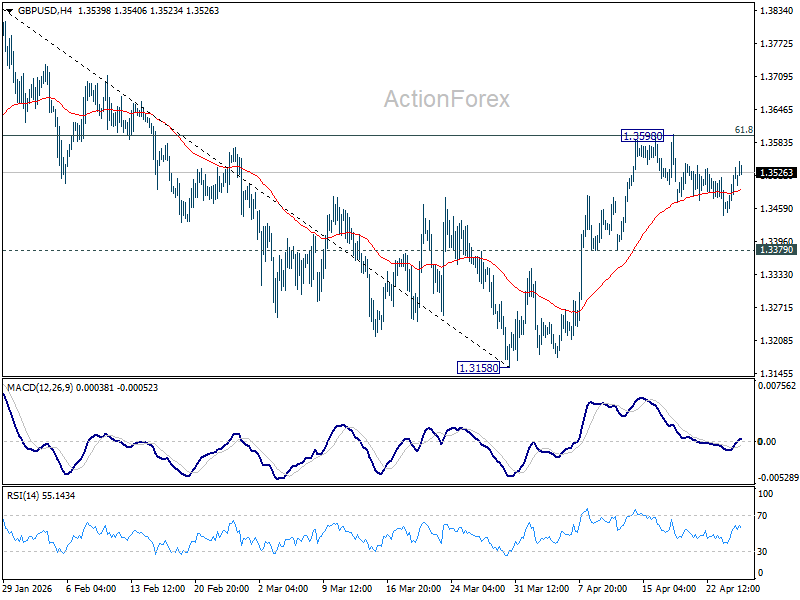
Intraday bias in GBP/USD stays neutral and more consolidations could be seen. Though, with 1.3379 support intact, further rally is expected. On the upside, firm break of 61.8% retracement of 1.3867 to 1.3158 at 1.3596 will pave the way to retest 1.3867 high. However, break of 1.3379 will bring deeper fall back to 1.3158 low instead.
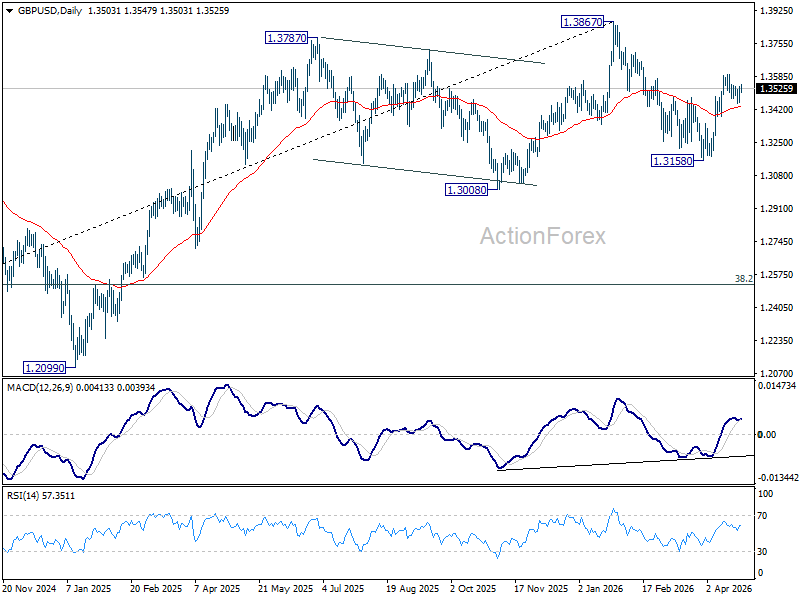
In the bigger picture, current development suggests that price actions from 1.3867 are merely a corrective pattern within the broader up trend from 1.0351 (2022 low). With 1.3008 support intact, medium term bullishness is maintained and break of 1.3867 is back in favor for a later stage, towards 1.4248 key resistance (2021 high).
To Hike or Not to Hike? That’s the Question This Week
Markets
To meet or not to meet? That was the question last Friday. Conflicting messages appeared every hour, but in the end the US didn’t send its top negotiators on the 18h flight to Islamabad. Axios reports this morning that Iran has given a new proposal to the US. Addressing the US’s nuclear concerns would be postponed to a later stage, with the early focus on reopening Hormuz and ending the war. US President Trump is expected to hold a situation room meeting on Iran later today, discussing the current stalemate and potential options for the next steps in the war. Markets learned the hard way frontrunning an end to the conflict including sea traffic through Hormuz. Friday and this morning, there’s no relief rally in the likes of the oil price. Brent crude (June contract) trades at $107/b. Oil prices above $100 over the past two months tended to weigh on risk sentiment, cause bear flattening of core yield curves and support the dollar.
To hike or not to hike? That’s the question this week. Big central banks meet for a second time since the start of the fighting in the Middle East. At the March meeting, the likes of the ECB and BoE signaled a different reaction function compared with the energy supply shock of four years ago. The >2% inflation starting point poses greater risks of de-anchoring valuable inflation expectations. Earlier this month, the used public appearances to further exploit on possible reaction functions. Especially BoE governor Bailey pushed back against aggressive BoE rate hike bets. More in general, they used the initial two-week cease-fire and temporary decrease in oil prices to buy time. They’re looking for evidence in the data of inflation having a broader price impact (beyond energy). Last week’s April PMI’s offered a first clue with details showing a larger upward price effect than a downward growth effect. Especially input, but also output prices picked up tremendous pace. ECB President Lagarde said at the central bank’s end of March Watchers Conference that the optimal policy response to “a large though not-too-persistent overshoot of the inflation target” is some measured adjustment of policy. That’s the way markets have approached this from the very start of the conflict. The timing of a first hike has been variable, varying from April to June while the amount of rate hikes this year has swung between two and four. Going into this week’s meetings, June and 2-3 are on the scorecard for both the ECB and the BoE. The situation is slightly different for the Bank of Japan and the Fed. The BoJ was already looking in the direction of a new rate hike ahead of the war, but used downside economic risks as a reason to delay pulling the trigger. No action is expected tomorrow, but new quarterly forecasts could be the backbone of a move to 1% in June as well. Energy dependence sheltered the US from the oil shock. Fed Chair Powell will hold a steady course as the curtain falls on his tenure as Chair. If any (40% probability by year-end), US money markets err on the side of a cut as the next move as the central bank transitions to leadership under Kevin Warsh.
News & Views
Rating agency S&P has lowered Belgium’s rating from AA to AA- with a stable outlook. Moody’s last week cut Belgium into single A-category, voicing the same concerns as S&P did. The downgrade reflects persistent imbalances in public finances with budgetary consolidation to large structural budget deficits only being gradual, politically sensitive and subject to execution risks. The 2025 budget measures were insufficient to offset rising spending on age-related items and defense and interest payments, it said. The deficit has widened to about 5.2% in 2025 from 4.4% in 2024. S&P expects government measures taken in 2026 will only contain, not reduce the deficit for this year (5.2%). Shortfalls could still amount to 4.5% by 2029. Debt would therefore reach 109% by 2029 from 103% in 2025 with interest payments rising to 2.8% from 2.4%. Economic growth is seen slowing down to 0.9% this year from 1% but risks from prolonged trade disruptions and sustained higher energy prices loom. Inflation may decelerate to 2.4% from 3% in 2025.
Poland is pushing for new European tools to finance defense spending as its own budget is ballooning to unsustainable levels. Polish deficits soared to 7.3% of GDP last year. The country’s finance minister Domanski said defense spending is and will remain Poland’s top priority but the sheer amount of some 5% of GDP is weighing on public finances. Poland is making extensive use of the EU’s €150bn SAFE programme, which Domanski said is a “step in the right direction” but simultaneously calling for additional instruments because it falls short of actual needs. In a related note, Polish prime minister Tusk last week said that Brussels is contemplating to change the accounting rules so that spending via the SAFE initiative does not impact reported deficits.
Peace Hopes Lift Sentiment into Busy Week
Mood is slightly better this morning than it was into the weekend, as Iran reportedly offered the US a proposal to reopen the Strait of Hormuz — a move that could pave the way for the continuation of peace talks between the two parties. The result? Asian equities are higher this morning, with the Nikkei and Kospi rallying to fresh all-time highs. Most US and European futures point to a positive open, except for the UK’s FTSE futures, which are flat as the slight retreat in energy prices weighs on appetite there. US crude is currently trading near $98.60 per barrel, and losses could accelerate if peace hopes improve — you know the music.
Peace hopes — along with resilient earnings — are keeping major markets in a bullish mood. The AAII survey showed that bullish sentiment improved among investors despite rising inflation expectations and early signs of deterioration in economic data. Sentiment indicators on Main Street tell a completely different story, however. Data on Friday confirmed that US consumer sentiment fell to its lowest level on record in April, driven by the spike in energy prices, inflation worries and affordability concerns.
How long can equity markets and underlying economic health diverge? Potentially for a while, as deteriorating fundamentals can also be seen as “good news” for markets: a weakening economy could encourage the central banks to ease policy (or not tighten much), which tends to support valuations.
Take Procter & Gamble, for example. The company jumped before giving back part of its gains despite announcing a Q1 earnings beat. It also said that Brent at around $100 per barrel would cost roughly $1bn after tax compared to pre-war levels. The company highlighted rising transportation and raw material costs, as well as ongoing supply chain disruptions.
These pressures help explain why investors are rotating back into tech stocks, which appear less exposed to supply chain constraints. After Amazon, Google announced plans to invest $10bn in Anthropic — with potentially up to $30bn more — to remain competitive in the AI race. In return, Anthropic is reportedly set to spend heavily on securing compute capacity, including multi-gigawatt agreements with cloud providers, supporting both Amazon’s and Google’s cloud revenues. What a world.
On the policy front, the DoJ suddenly dropped its investigation into Federal Reserve (Fed) Chair Jerome Powell on the renovation of the Fed’s HQ to clear the way for Kevin Warsh, yes, because Kevin Warsh is willing to cut the interest rates – though he said he would behave as a grown-up and not be a ‘sock puppet’, but the idea of lower rates appeal to him, and the White House is loving it. Warsh has also expressed openness to reducing the Fed’s balance sheet — a process that could prove challenging given softer demand for US Treasuries, but potentially manageable if regulatory changes allow banks to operate with lower excess reserves. In short: deregulation remains part of the narrative.
The combination of softer economic data and policy-related headlines pushed US 2-year yields lower on Friday, helping lift the S&P500 to fresh highs, alongside optimism around earnings. The week ahead looks promising, with potential peace developments and a heavy earnings calendar. Around 180 companies in the S&P500 are due to report this week, including major names such as Microsoft, Meta Platforms, Alphabet, Amazon, Qualcomm, Coca-Cola and Verizon, as well as energy giants ExxonMobil and Chevron.
So far, around 28% of S&P500 companies have reported results. Of those, 84% delivered a positive EPS surprise and 81% beat on revenues. The blended earnings growth rate stands at 15.1%. If confirmed, this would mark the sixth consecutive quarter of double-digit year-on-year earnings growth, according to FactSet — not bad at all given the political and geopolitical backdrop.
In Europe, attention will focus on banks, carmakers, LVMH and TotalEnergies. The picture is more mixed, with luxury and autos facing pressure from geopolitical tensions, trade frictions and Chinese EV competition. Given Europe’s relatively limited exposure to tech — which has once again taken the lead — European equities could lag their US peers as earnings season unfolds.
On the monetary policy front, the week is also busy for central banks. The Fed, the BoJ (Bank of Japan), the European Central Bank (ECB), the Bank of England (BoE) and the Bank of Canada (BoC) are all expected to keep policy unchanged at their respective meetings, although uncertainty remains high due to geopolitical risks, elevated energy prices and slowing growth. Most have turned less hawkish in recent weeks, hoping the energy shock proves temporary. Evidence of demand destruction would likely reinforce a “wait-and-see” approach.
The US dollar is sharply lower this morning, and its recent depreciation helps ease inflationary pressures globally. The EURUSD is holding above its 200-day moving average (near 1.1675), while the USDJPY is pushing toward the 160 level — a zone where intervention risks from Japanese authorities tend to increase.
Central Bank Rate Decisions Take Centre Stage This Week
In focus today
Today, the ECB releases its survey on the access to finance of enterprises (SAFE) which among other things will give insight into firms' selling price expectations, wage costs, and inflation expectations.
We expect Bank of Japan to maintain rates unchanged overnight. We believe most conditions for a rate hike are in place, and expect the next hike likely in June, which markets currently price at close to 50-50. The situation in the Middle East will play a significant role in shaping the timing of any policy changes.
This week, monetary policy decisions will be the primary market movers. The key rate announcements include the Fed's decision late Wednesday and the ECB's on Thursday, where we expect both central banks to hold rates steady. Additionally, rate decisions from the Bank of England and the Bank of Canada are scheduled, and we expect all to keep their policy rates unchanged. On the data front, we look out for euro area flash April inflation and Q1 GDP from both the euro area and the US, all on Thursday.
Economic and market news
What happened since Friday
In the Middle East, hopes for peace faded as President Trump cancelled planned US-Iran talks in Islamabad, keeping US envoys in the US and stating Iran's offer was inadequate. Tehran has demanded the removal of the US maritime blockade before entering negotiations, while Iranian Foreign Minister Abbas Araqchi continues diplomatic efforts with mediators in Pakistan and Oman. Oil prices continued their upward trajectory as markets opened, with Brent crude rising 1.2% to USD 106.6/bbl at the time of writing. According to Reuters, only one oil products tanker entered the Gulf on Sunday, sustaining worries of prolonged constraints.
In the US, a shooting incident at the White House Correspondents' dinner likely targeted President Trump and his administration, with the suspect apprehended after firing at a Secret Service agent. The attack, the third assassination attempt on Trump since 2024, has reignited concerns over the security of top officials in light of heightened political tensions in the US.
Also in the US, Republican Senator Thom Tillis announced that he would allow Kevin Warsh's nomination as the next Federal Reserve Chair to advance, following the Justice Department's decision to close its investigation into current Chair Jerome Powell. Tillis had previously blocked the confirmation process, citing concerns over the central bank's political independence. Warsh's confirmation is now expected to proceed before Powell's term ends on 15 May, which means this week's meeting will be Powell's last as the Fed chair.
In China, industrial profit growth accelerated in March, rising 15.8% y/y, the fastest pace since September, underscoring the uneven nature of the economic recovery. While AI-related industries such as semiconductors remain strong, consumer-facing sectors continue to struggle due to weak domestic demand. The impact of the Middle East war is likely yet to be reflected in the data, with rising energy prices expected to increase input costs for manufacturers. This could either erode margins or result in higher prices for consumers.
In Germany, the Ifo indicator declined more than expected in April, with the assessment of current conditions falling to 85.4 and expectations dropping to 83.3, the lowest level since late 2023. The rise in energy prices has significantly worsened the outlook for the German economy, which remains highly exposed due to its large industrial sector. On Wednesday, the German government cut its 2026 GDP growth forecast to 0.5% y/y from 1.0%, highlighting fiscal policy as the sole expected growth driver this year.
In Sweden, producer prices rebounded in March, rising 2% y/y after five months of declines, driven by a sharp 15.8% surge in energy prices. Excluding energy-related products, producer prices fell 0.5% y/y. On a monthly basis, producer prices rose 0.6%, with domestic and import prices both up 3.7%, led by higher costs for crude oil and refined petroleum products.
Equities: Equity markets rose on Friday and over the course of last week, but we are now moving into a much more divergent market environment than the one we have seen over the past several weeks. Until recently, markets have largely traded in a broad risk-on or risk-off fashion, depending on developments around the war in Iran. Last week was different.
We saw both a strong earnings impulse, with technology performing particularly well, and at the same time an energy sector that outperformed on the back of higher oil prices. When technology and energy lead, the US benefits the most. Europe, in contrast, continued to lag and traded roughly sideways. This is also consistent with the recent macro data, which increasingly suggest that Europe is suffering materially more from the war in Iran than the US.
It is worth noting that both the S&P 500 and Nasdaq reached new all-time highs on Friday, while the Nikkei 225 is making a new all-time high this morning. On rotations, the divergence continues to increase. Even though energy performed well last week, the technology sector has outperformed energy by around 20% over the past month.
With the US close on Friday, semiconductors had risen for 18 consecutive trading days in the US(!). That illustrates very clearly the powerful underlying technology story that continues to unfold despite the war.
This morning, Asian markets are higher once again, led by South Korea and Taiwan, which are up roughly 60% and 35% year-to-date, respectively. We have said this many times before, and you know one of our key fundamental allocation points: sector allocation is crucial for how to think about regional allocation. If that was not obvious before, it certainly is this year.
European futures are also higher this morning. Tech-heavy Nasdaq futures are trading higher, while Dow Jones futures are slightly lower.
FI and FX: An important central bank week awaits with meetings (in order) from the BoJ, BoC, FOMC, BoE and the ECB. With the conflict in the Middle East entering its 9th week, the central bankers are forced to give their assessment on the experienced impact and their expectations going forward. The week starts light on macro releases but later this week we will get EA HICP and US Q1 flash GDP as wells as important data from Norway and Sweden. Markets in Asia open the week with a constructive risk-on sentiment despite oil prices remaining at the elevated levels from last Friday (June Brent Oil contract at USD106.6 this morning).
EUR/USD Daily Outlook
Daily Pivots: (S1) 1.1688; (P) 1.1706; (R1) 1.1741; More….
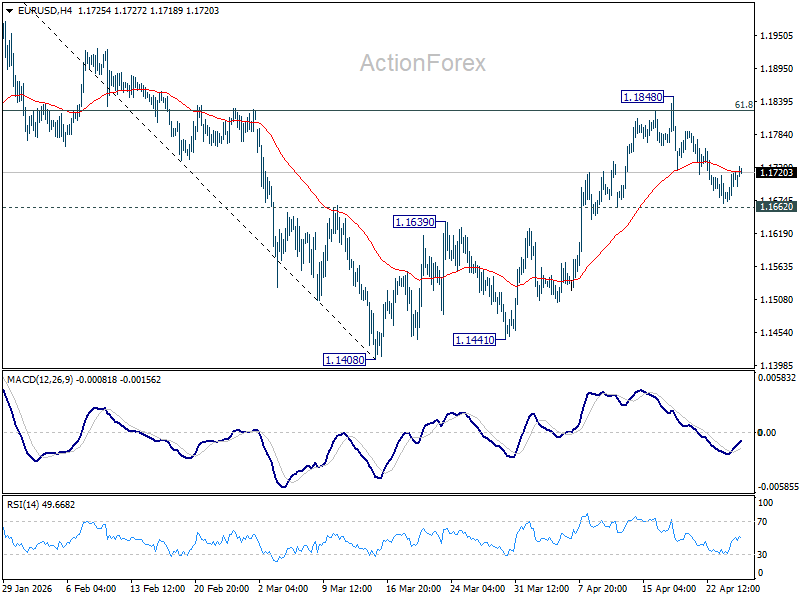
Intraday bias in EUR/USD remains neutral for the moment, and more consolidations could be seen. But further rally is expected with 1.1662 support intact. On the upside, sustained trading above 61.8% retracement of 1.2081 to 1.1408 at 1.1824 will pave the way to retest 1.2081 high. However, firm break of 1.1662 support will indicate the the rebound fro 1.1408 has completed, and bring deeper decline back towards this low instead.
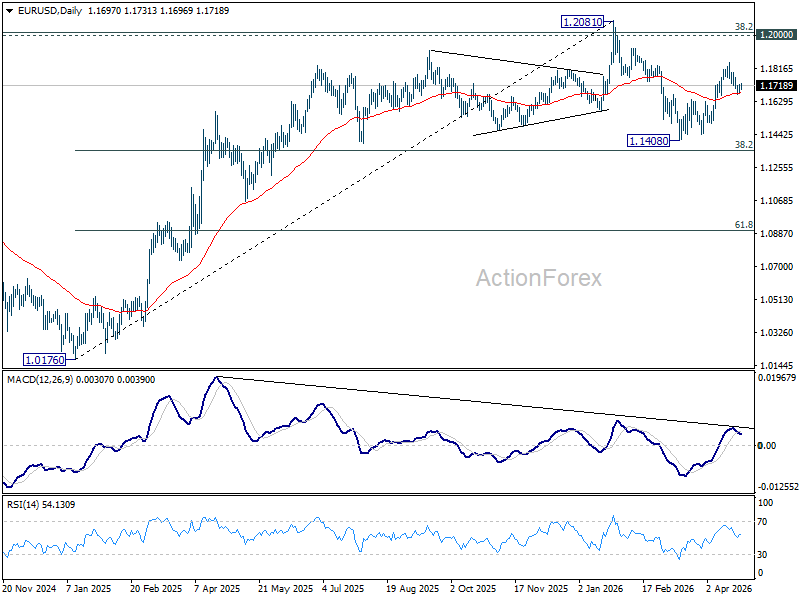
In the bigger picture, the strong support from 38.2% retracement of 1.0176 to 1.2081 at 1.1353 suggests that the pullback from 1.2081 is more likely a corrective move. Strong support was also found in 55 W EMA (now at 1.1530). Focus is back on 1.2 key cluster resistance level. Decisive break there will carry long term bullish implications. Nevertheless, break of 1.1408 support will revive the case of medium term bearish trend reversal.
Markets Shrug Off Geopolitics as AI Rally Drives Record Highs Ahead of Central Bank Super Week
Asian equities surged to fresh record highs, with KOSPI jumping more than 2.5% and Nikkei advancing over 1.5%, extending what has become a powerful rally. The strength of the move signals more than just optimism—it reflects a market that is increasingly comfortable ignoring geopolitical noise and focusing on growth narratives.
The shift has been building since the announcement of the indefinite US–Iran ceasefire last week. While negotiations have stalled, the absence of escalation has been enough to anchor sentiment. With no escalation and no resolution, markets are treating geopolitics as background noise rather than a trading driver. Risk appetite has stabilized, and capital is rotating back into equities, particularly those linked to the AI theme.
Also, the focus now shifts decisively to monetary policy, with a dense lineup of central bank decisions scheduled for week.
The Bank of Japan kicks things off on Tuesday, and what was once a straightforward hold has turned into a genuinely “live” meeting. The base case is for no change at 0.75%, but rising and broadening inflation has reopened the door to a surprise hike toward 1.00%. Even if the BoJ stays on hold, the risk for markets lies in the messaging. Without a clear signal toward tightening, Yen weakness could intensify, especially with markets already pricing a strong probability of a June move. In that sense, a passive BoJ may be as market-moving as an active one.
Wednesday brings the Federal Reserve, where the outcome is far less uncertain but no less important. Rates are expected to be held at 3.50%–3.75% in what is likely to be Jerome Powell’s final meeting as Chair before the transition to Kevin Warsh. The decision itself may be uneventful, but the tone will not be. Markets will be watching for how the Fed frames oil-driven inflation risks and whether there are any signals around the pace or endgame of balance sheet reduction.
The Bank of Canada, also meeting on Wednesday, faces a different challenge. A hold is expected, but the focus will be on updated projections as policymakers weigh weak growth—GDP expanding just 0.7% in Q4—against rising fuel costs. The key question is whether the BoC chooses to look through the oil shock or signals concern about second-round inflation effects.
Thursday brings two major European decisions. The Bank of England is widely expected to hold at 3.75%, but its “Super Thursday” projections will be the real driver. With services inflation still persistent, any upward revision to medium-term inflation forecasts could shift expectations back toward tightening, even if rates remain unchanged for now. The risk is not in the decision, but in the signal.
The European Central Bank is also expected to stand pat, with the deposit rate held at 2.00%. The focus will be on President Christine Lagarde’s guidance, particularly whether she offers any clarity on the conditions required for a hike in June. For now, the ECB is firmly data-dependent, but markets are sensitive to any hint of timing or thresholds that could anchor expectations for the next step.
The macro calendar is equally demanding. US GDP, ISM manufacturing, and PCE inflation will provide key insights into the strength of the US economy and inflation trends. In addition, Eurozone GDP and CPI flash estimates, Canada GDP, and Australia CPI will all feed into global policy expectations, ensuring that markets remain highly reactive to incoming data.
In FX markets, the risk-on backdrop is clearly visible. Aussie is leading gains, supported by expectations of strong inflation data. Kiwi and Euro are also firm, while Dollar is under pressure. Swiss Franc and Sterling are lagging, while Yen and Loonie are holding in the middle.
In Asia, at the time of writing, Nikkei is up 1.47%. Hong Kong HSI is down -0.33%. China Shanghai SSE is up 0.09%. Singapore Strait Times is down -0.53%. Japan 10-year JGB yield is up 0.026 at 2.467.
Oil Stalls as ‘Frozen Conflict’ Replaces Escalation Fears in US–Iran Standoff
Oil trades in a tight range as US–Iran tensions enter a “frozen conflict” phase. With Brent testing key near term channel resistance and traders reluctant to chase headlines, the next directional move will depend on a break above $110 or rejection lower. Read More.
AUD/JPY Eyes Breakout Toward 120 as BoJ Decision and Australia CPI Set Up High-Stakes Week
AUD/JPY is approaching a breakout point as BoJ policy and Australia CPI set the tone for the week. With yen weakness risks rising and inflation expected to accelerate, the pair could push toward 120 if key catalysts align. Read More.
EUR/USD Daily Outlook
Daily Pivots: (S1) 1.1688; (P) 1.1706; (R1) 1.1741; More….
Intraday bias in EUR/USD remains neutral for the moment, and more consolidations could be seen. But further rally is expected with 1.1662 support intact. On the upside, sustained trading above 61.8% retracement of 1.2081 to 1.1408 at 1.1824 will pave the way to retest 1.2081 high. However, firm break of 1.1662 support will indicate the the rebound fro 1.1408 has completed, and bring deeper decline back towards this low instead.
In the bigger picture, the strong support from 38.2% retracement of 1.0176 to 1.2081 at 1.1353 suggests that the pullback from 1.2081 is more likely a corrective move. Strong support was also found in 55 W EMA (now at 1.1530). Focus is back on 1.2 key cluster resistance level. Decisive break there will carry long term bullish implications. Nevertheless, break of 1.1408 support will revive the case of medium term bearish trend reversal.
AUD/JPY Eyes Breakout Toward 120 as BoJ Decision and Australia CPI Set Up High-Stakes Week
AUD/JPY is setting up for a potential upside breakout toward 120 psychological level, with the next move likely to be decided by a high-stakes combination of BoJ policy and Australian inflation data. Today's bounce suggests the cross may be preparing to resume its longer-term uptrend, but confirmation now hinges on how these two key catalysts unfold.
The Bank of Japan is at the center of the near-term risk. Once seen as a straightforward hold, the decision has evolved into a "knife-edge" call as inflation broadens across the economy. While the base case remains unchanged at 0.75%, the risk of a surprise hike has crept back into the conversation, particularly ahead of the updated Quarterly Outlook Report, which is expected to show higher inflation projections for FY2026.
However, the more powerful market reaction may come from inaction rather than action. With Yen weakness already a dominant theme, a BoJ hold that lacks conviction or forward guidance could trigger renewed selling pressure. Markets are already pricing a strong chance of a June hike, but without a clear signal, expectations could be pushed further out, leaving the Yen vulnerable.
At the same time, the Australian side of the equation is turning more supportive. Inflation is expected to reaccelerate sharply, with quarterly CPI rising from 3.6% yoy to above 4.0% yoy, and monthly CPI jumping from 3.7% yoy to 4.8% yoy as the oil shock feeds through. If trimmed mean measures also surprise to the upside, it would effectively lock in a May RBA hike and raise the prospect of additional tightening.
This sets up a classic divergence trade. A hesitant BoJ combined with a more hawkish RBA outlook creates asymmetric upside risk for AUD/JPY. In this environment, even a neutral BoJ outcome could be interpreted as bearish for the Yen, while strong Australian data would provide the fuel for a sustained move higher.
There is also a risk that markets move ahead of confirmation. A BoJ hold alone could trigger a breakout attempt, as traders position for continued Yen weakness. But the durability and strength of any rally will likely depend on Australia’s CPI print, which could determine whether the move extends into a broader trend acceleration.
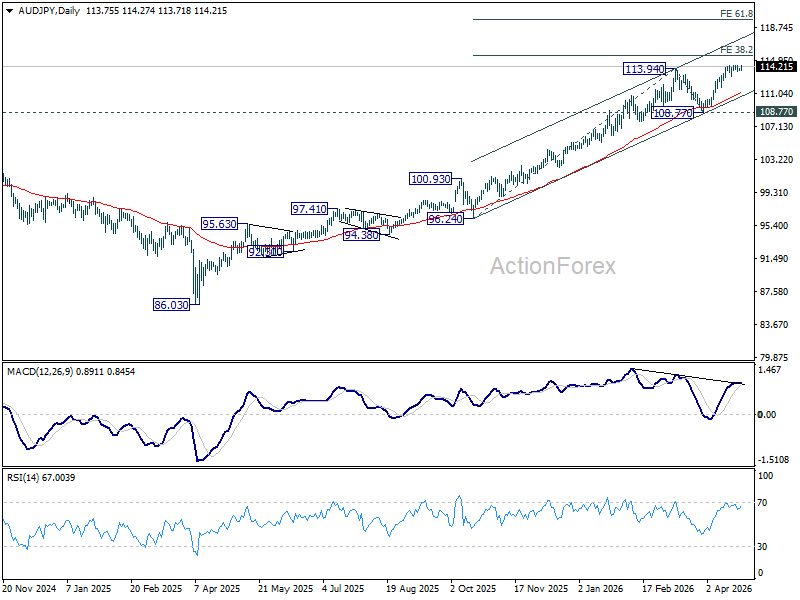
Technically, the setup is approaching a trigger point. AUD/JPY is testing 114.35 resistance, and a break would open the path toward 38.2% projection of 96.24 to 113.94 from 108.77 at 115.53 initially. Decisive break there would likely prompt upside acceleration to 61.8% projection at 119.70, which is close to 120 psychological level.
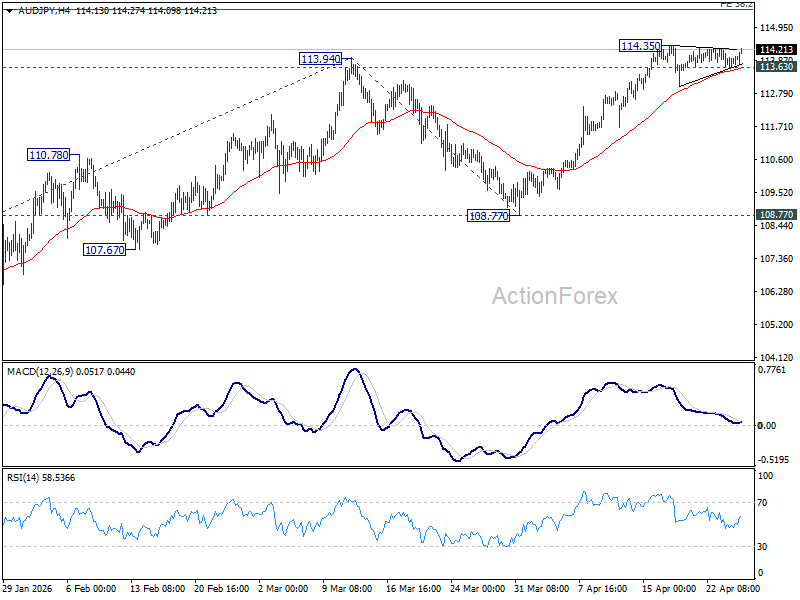
Failure to break higher, however, would not invalidate the broader bullish structure. A drop below 113.63 would simply extend the consolidation from 114.35 with another falling leg, potentially setting up a stronger base before the next leg higher.
Oil Stalls as ‘Frozen Conflict’ Replaces Escalation Fears in US–Iran Standoff
Despite the cancellation of a second round of US–Iran talks, crude oil prices showed little urgency to push higher, with Brent holding near $106 and WTI anchored around $98. In earlier phases of the conflict, such a diplomatic failure would likely have triggered a sharp rally. This time, the market response was muted, signaling a deeper shift in how geopolitical risk is being priced.
The key transition is from escalation risk to what can best be described as a “frozen conflict.” The dual blockade remains firmly in place—Iran continues to restrict flows through the Strait of Hormuz while the US maintains pressure on Iranian ports—yet neither side is moving toward decisive confrontation. With the indefinite ceasefire still in place, the market is interpreting the conflict as contained rather than expanding.
That distinction matters for oil pricing. The market has repeatedly tested the upside but failed to sustain a break above the 110 zone, reinforcing the view that current conditions represent tension without escalation. Even with significant supply disruptions from the Hormuz chokepoint—responsible for a substantial portion of global oil transit—the absence of further deterioration is capping the risk premium.
There are also tentative signs of diplomatic movement, though far from a breakthrough. US President Donald Trump acknowledged receiving a “much better” proposal from Iran, while reports suggest Tehran has floated a tactical compromise—reopening the Strait in exchange for delaying nuclear negotiations. These incremental steps support a scenario of prolonged negotiation rather than sudden resolution or renewed conflict.
At the same time, traders are showing clear signs of war fatigue. Price spikes are increasingly being faded rather than chased, reflecting a reluctance to commit to directional trades without confirmation of either escalation or de-escalation. Oil is effectively trapped between structural supply constraints and a lack of fresh catalysts.
This leaves the near-term outlook skewed mildly higher, but with limited momentum. Without a clear break in the narrative—either through escalation or a verified diplomatic breakthrough—oil is likely to grind higher rather than surge.
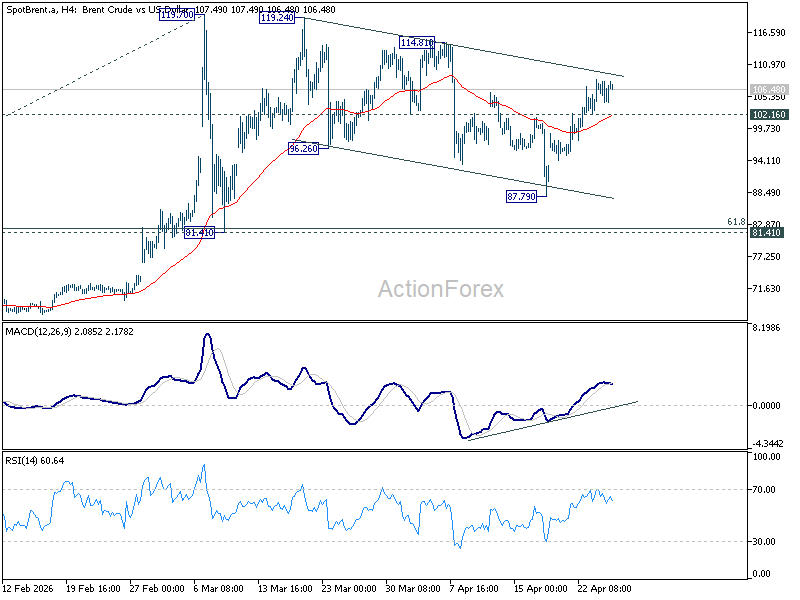
Technically, Brent crude is now testing the ceiling of a near-term falling channel around 109.50. Failure at this level, followed by a break below 102.16, would confirm rejection and resume the corrective move from 119.24 with another leg toward 87.79.
Conversely, a clean break above channel resistance would mark a shift back into escalation pricing, opening the path toward a retest of the 120 key psychological level.
EUR/USD Tests Support—Can It Recover And Resume Upside?
Key Highlights
- EUR/USD corrected gains and tested the 1.1665 support.
- A bullish trend line is forming with support at 1.1690 on the 4-hour chart.
- GBP/USD could continue to move higher toward the 1.3620 resistance.
- Gold prices are stuck in a range below the $4,800 resistance.
EUR/USD Technical Analysis
The Euro started a downside correction from 1.1850 against the US Dollar. EUR/USD tested the 1.1665 zone and might start a fresh increase.
Looking at the 4-hour chart, the pair is still above the 1.1665 pivot level, the 100 simple moving average (red, 4-hour), and the 200 simple moving average (green, 4-hour). Besides, there is a bullish trend line forming with support at 1.1690.
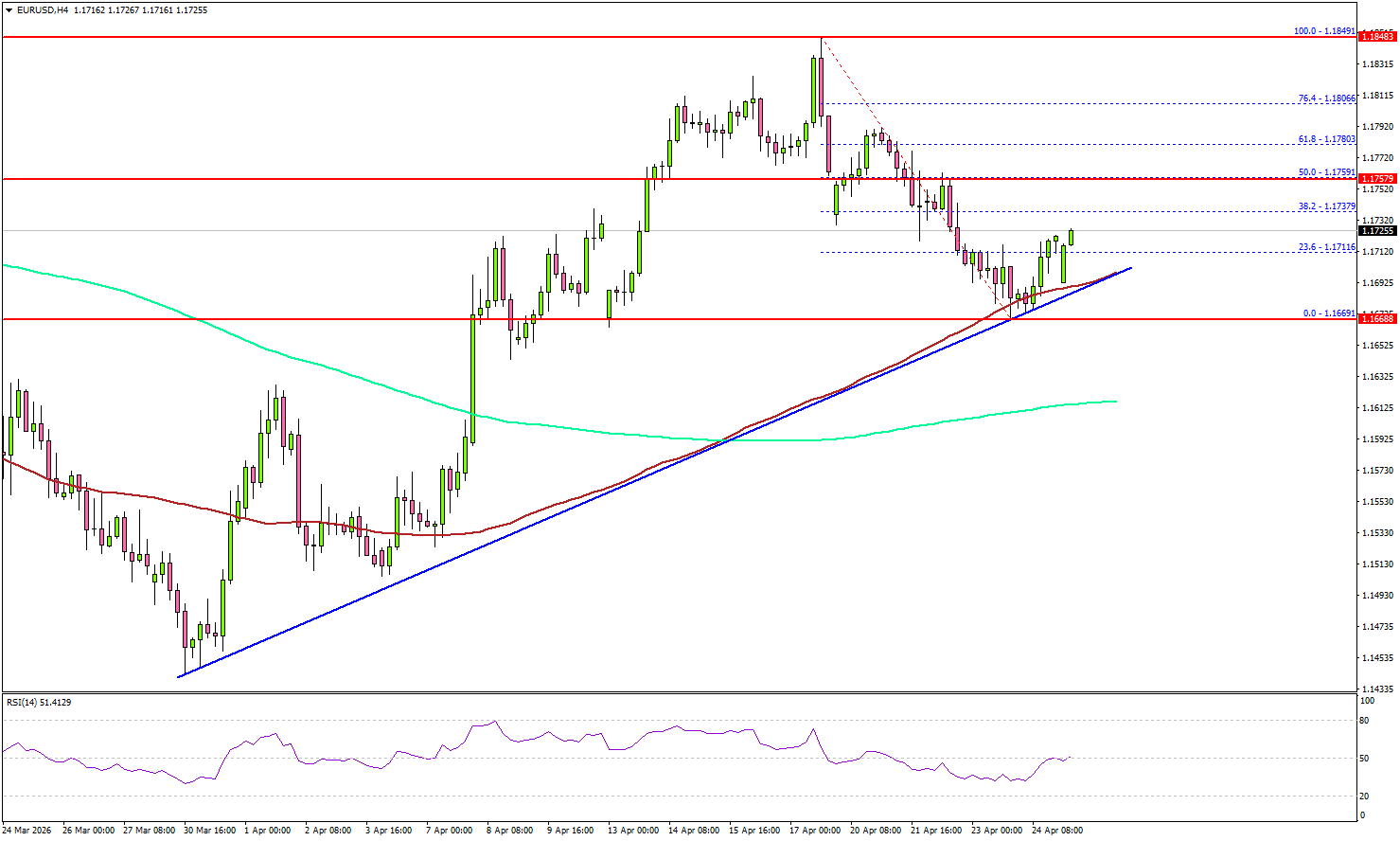
On the upside, the pair faces resistance at 1.1760 or the 50% Fib retracement level of the downward move from the 1.1849 swing high to the 1.1669 low.
The first major resistance sits at 1.1800. The main resistance could be 1.1850. A close above 1.1850 could open doors for gains above 1.1920. In the stated case, the bulls could aim for a move to 1.2000.
Immediate support is seen near 1.1690, the 100 simple moving average (red, 4-hour), and the trend line. The next support could be 1.1620 and the 200 simple moving average (green, 4-hour). A close below 1.1620 might push the pair toward 1.1550. Any more losses could initiate a fresh move to 1.1420 in the coming days.
Looking at GBP/USD, the pair is again moving higher and the bulls could aim for a move above the 1.3600 level.
Upcoming Key Economic Events:
- ECB's Schnabel speech.
USD/JPY Nears 160 Again on Strong U.S. Data Ahead of BoJ Meeting
The extension of the two-week Iran ceasefire helped global stock markets continue to rise last week. However, WTI oil prices also moved higher as traders stayed focused on the risk of oil supply disruption. Strong U.S. retail sales and better consumer sentiment data also showed that the U.S. economy remains strong.
Higher oil prices and strong U.S. data pushed long-term U.S. interest rates higher. This helped USD/JPY rise back close to the 160 level. In Japan, Finance Minister Satsuki Katayama said Japan is in close contact with the U.S. about possible action to stop further yen weakness.
U.S. company earnings also supported market sentiment, with around 84% of S&P 500 companies that have reported so far beating expectations. Gold fell as the stronger U.S. dollar encouraged selling. EUR/USD and European stock markets also fell as concerns grew that the Iran conflict could hurt economic growth, especially if oil supply remains disrupted.
Markets This Week
U.S. Stocks
Technology stocks moved to new record highs last week, but the Dow fell slightly despite better-than-expected U.S. economic data. The market remained cautious as the U.S. and Iran have still not reached a clear end to the conflict, while the extended ceasefire has made traders nervous about pushing stocks much higher. The Dow remains in a short-term uptrend, but a break below the 10-day moving average could trigger a fall, especially if WTI oil prices continue to rise. Resistance levels are at 49,600, 50,000, 50,500 and 51,000. Support is seen at 48,500, 48,000, 47,000, 46,000, and 45,000.
Japanese Stocks
The Nikkei index touched 60,000 last week as the extension of the U.S.–Iran ceasefire supported market sentiment and the yen remained weak. The market held above the 10-day moving average several times, confirming the short-term uptrend. However, if resistance around 60,000 holds and prices move below the 10-day moving average, the best short-term trading opportunity this week may be to look for a selling opportunity. Resistance is seen at 60,000, 60,500, 61,000, 61,500 and 62,000, while support is at 57,000, 56,000, 55,000, 54,000, and 52,000.
USD/JPY
Strong U.S. economic data and higher WTI oil prices supported the U.S. dollar last week, helping USD/JPY move back closer to resistance around 160 in quiet trading conditions. However, the risk of intervention by Japanese authorities continues to limit further gains. The Bank of Japan meeting could create volatility, especially if it signals a delay in future interest rate hikes, but for now, range trading between 157.50 and 160 remains the best short-term strategy. Resistance is at 160.00, 160.50, 162, and 165, while support is seen at 158.00, 157.50, 156.50 and 155.00.
Gold
Gold fell slightly last week as the stronger U.S. dollar and rising long-term U.S. interest rates encouraged selling. The market moved below the 10-day moving average, showing weaker short-term momentum. Overall, trading remained quiet as many commodity traders focused more on WTI oil. With the 10-day moving average pointing sideways, range trading is the preferred strategy this week. Resistance is at $4,900, $5,000, and $5,100, while support is at $4,650, $4,600, $4,500, and $4,400.
Crude Oil
WTI rose last week and tested the $100 level again after the two-week ceasefire was extended but negotiations to end the war failed. The Strait of Hormuz remained close to shut, keeping concerns about oil supply deliveries high. The situation in Iran remains unpredictable, so looking to trade against large moves may be the best strategy this week. Resistance is at $100, $110, and $120, while support is at $90, $80, $75, $70, and $67.5.
Bitcoin
Bitcoin tested old resistance around $75,000 last week and held above it as risk sentiment continued to recover. This helped the market move higher and showed that buyers remain active. Upward momentum appears to be growing, so further gains are possible as long as Bitcoin stays above the 10-day moving average. Resistance is at $80,000, $85,000, and $90,000 while support is at $75,000, $65,000, $60,000, and $55,000.
This Week’s Focus
- Monday: None
- Tuesday: Japan BoJ Interest Rate Decision, U.S. CB Consumer Confidence
- Wednesday: Australia CPI, U.S. Durable Goods Orders, Housing Starts and Fed Interest Rate Decision
- Thursday: Japan Industrial Production, E.U. CPI, Unemployment Rate and GDP, U.K. BoE Interest Rate Decision, E.U. ECB Interest Rate Decision, U.S. GDP, Core PCE Price Index and Chicago PMI
- Friday: Japan Tokyo Core CPI, Australia PPI, U.K. S&P Global Manufacturing PMI, U.S. S&P Global Manufacturing PMI
This week, markets will focus on Iran news, oil supply risks, and three major central bank meetings. All three central banks are expected to keep interest rates unchanged, but the Bank of Japan meeting may have the biggest impact. Traders will watch for any comments about possible future rate hikes, especially with Japan’s economy still weak and USD/JPY near 160.
The U.S. Federal Reserve and the European Central Bank will also be important. Traders will focus on inflation, higher oil prices, and whether interest rates could still be cut later this year. Markets are likely to react quickly to WTI oil price moves and new headlines from Iran.