Sample Category Title
GBP/JPY Weekly Outlook
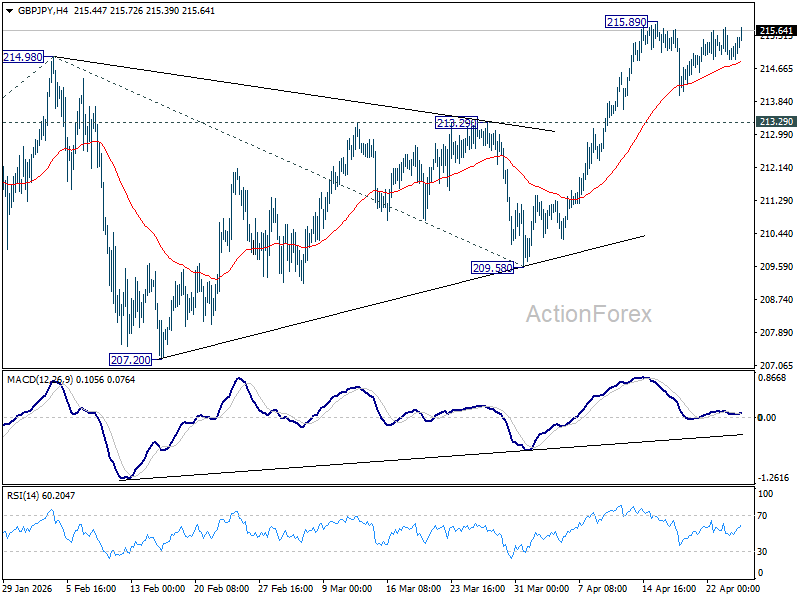
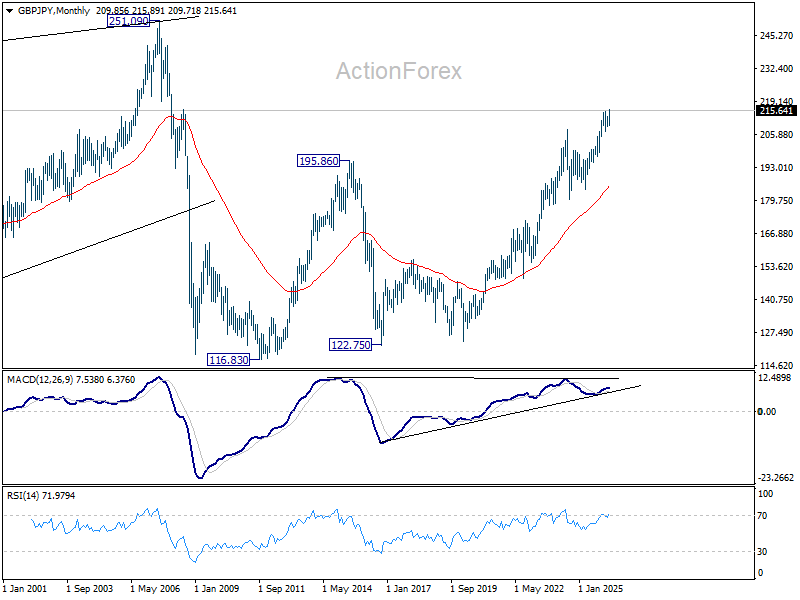
GBP/JPY stayed in consolidations below 215.89 last week and outlook is unchanged. Initial bias stays neutral this week first. In case of another fall, downside should be contained by 213.29 resistance turned support to bring rebound. On the upside, firm break of 215.89 will resume larger up trend to 61.8% projection of 199.04 to 214.98 from 209.58 at 219.43.
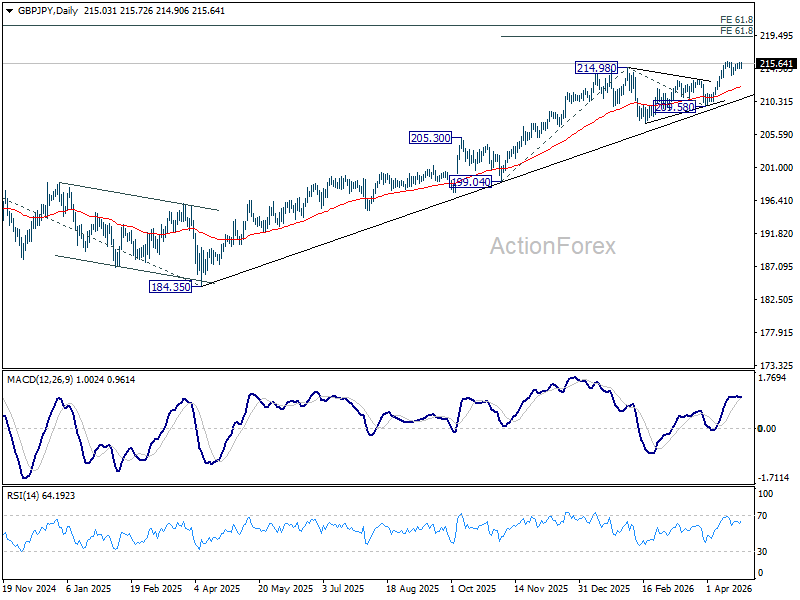
In the bigger picture, up trend from 123.94 (2020 low) is still in progress. Firm break of 214.98 will target 61.8% projection of 148.93 (2022 low) to 208.09 (2024 high) from 184.35 at 220.90. This will remain the favored case as long as 55 W EMA (now at 204.47) holds, even in case of another deep pullback.
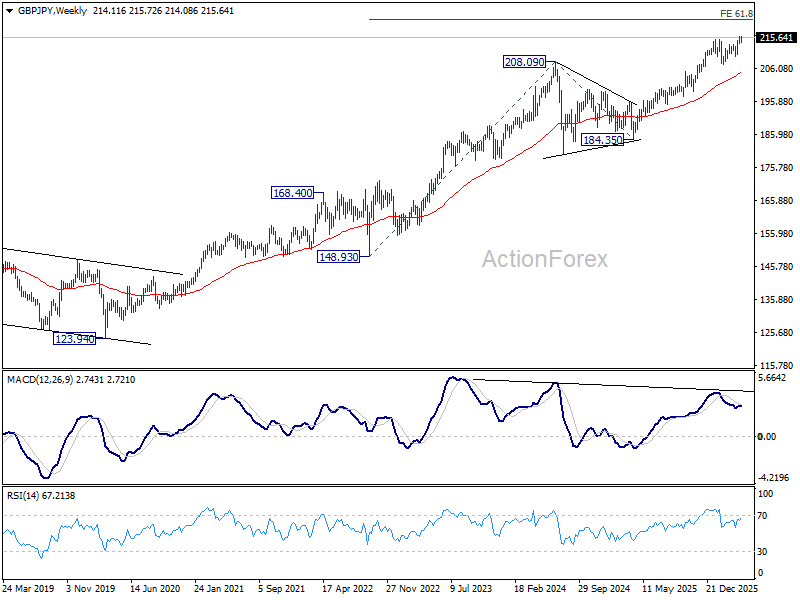
In the long term picture, up trend from 116.83 (2011 low) is in progress. Next target is 251.09 (2007 high). This will remain the favored case as long as 55 M EMA (now at 184.82) holds.
EUR/JPY Weekly Outlook
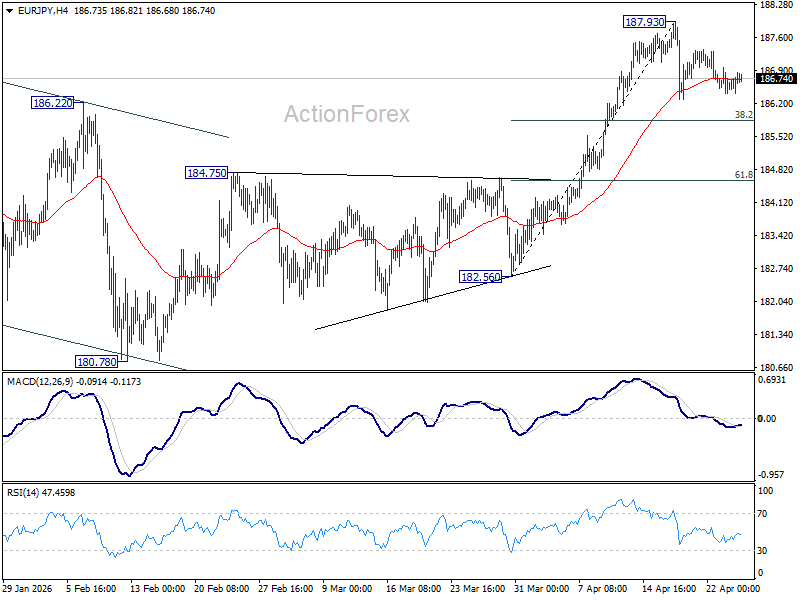
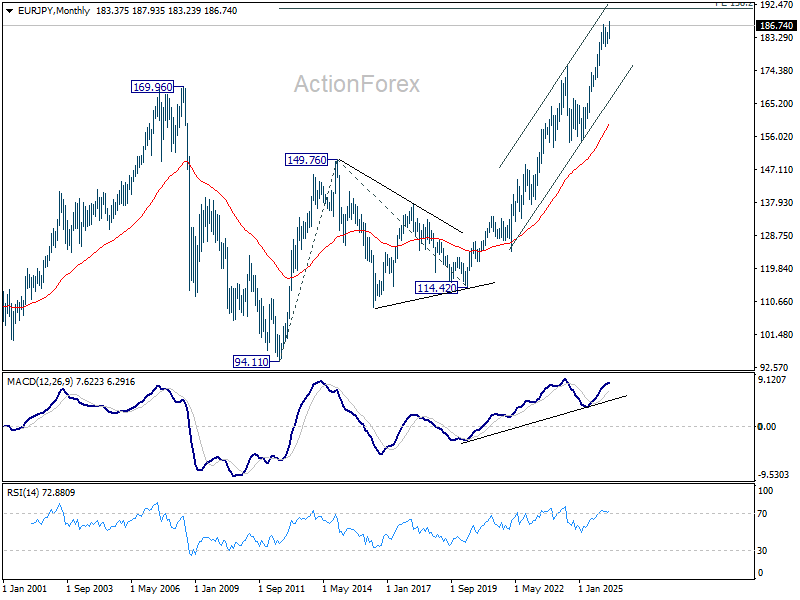
EUR/JPY stayed in sideway trading last week and the development suggests that it's merely in a near term consolidations. Initial bias remains neutral this week first. In case of another fall, downside should be contained by 38.2% retracement of 182.56 to 187.93 at 185.87 to bring rebound. On the upside, firm break of 187.93 will resume larger up trend.
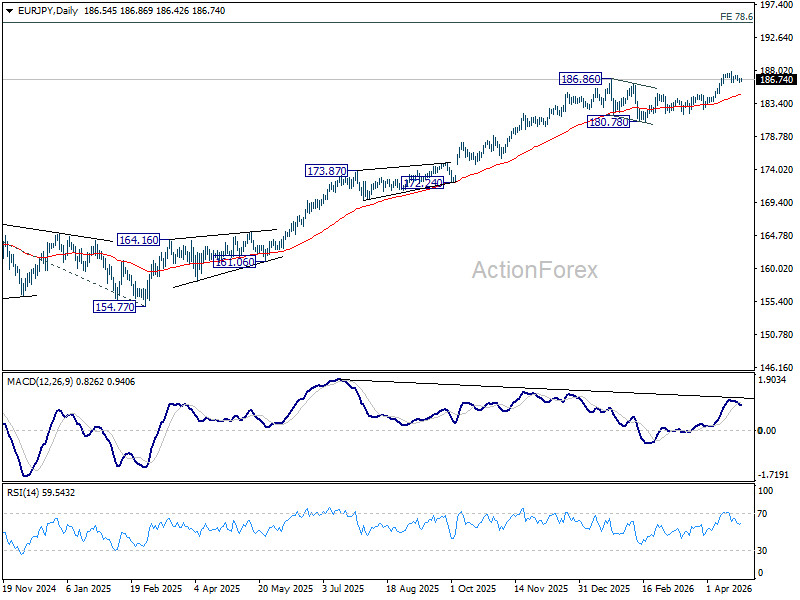
In the bigger picture, up trend from 114.42 (2020 low) is in progress. Next target is 78.6% projection of 124.37 (2022 low) to 175.41 (2025 high) from 154.77 at 194.88 next. For now, medium term outlook will stay bullish as long as 180.78 support holds, even in case of deeper pullback.
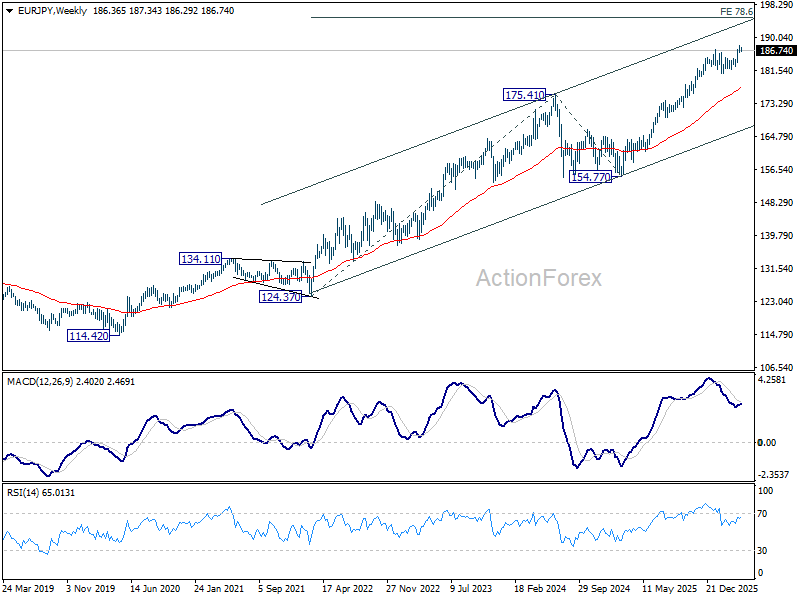
In the long term picture, up trend from 94.11 (2021 low) is in progress. Next target is 138.2% projection of 94.11 to 149.76 (2014 high) from 114.42 (2020 low) at 191.32. This will remain the favored case as long 55 W EMA (now at 177.29) holds.
EUR/GBP Weekly Outlook
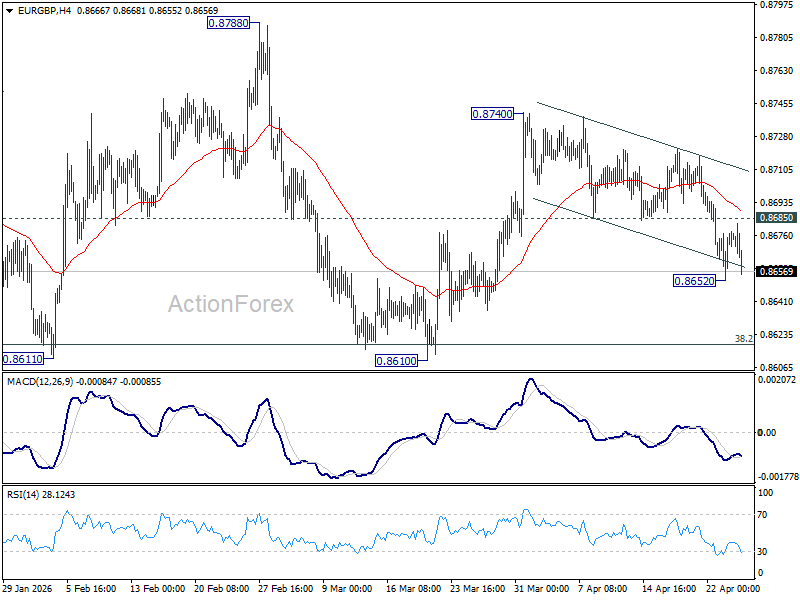
EUR/GBP's extended decline last week suggests that rebound from 0.8610 has completed at 0.8740 already. But as a temporary low was formed at 0.8652, initial bias stays neutral this week first. On the downside, below 0.8652 will resume the fall from 0.8740 to retest 0.8610 support next. Nevertheless, firm break of 0.8685 support turned resistance will dampen this view and turn bias back to the upside for 0.8740 again.
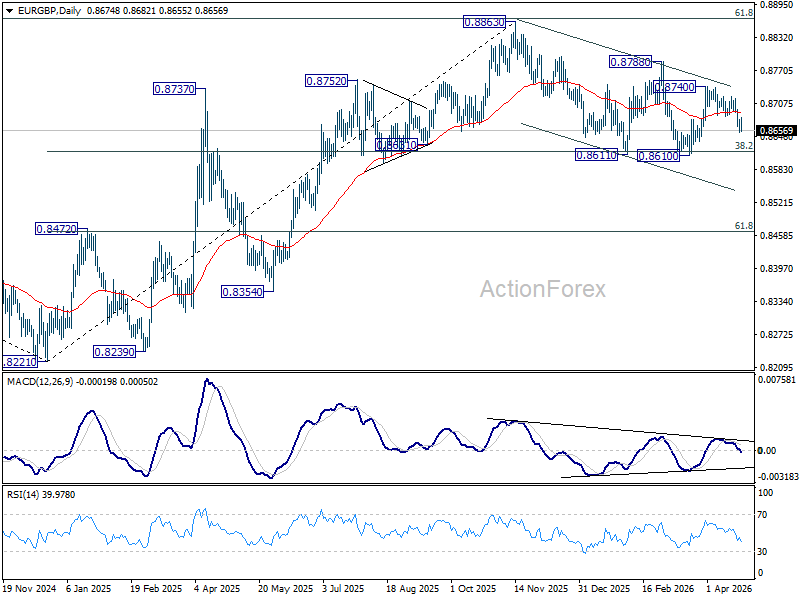
In the bigger picture, strong support was seen again from 38.2% retracement of 0.8821 to 0.8863 at 0.8618. Break of 0.8788 resistance will argue that larger rise from 0.8221 might be ready to resume through 0.8863 (2025 high). Nevertheless, sustained trading below 0.8618 should confirm bearish reversal, and bring deeper fall to 61.8% retracement at 0.8466 at least.
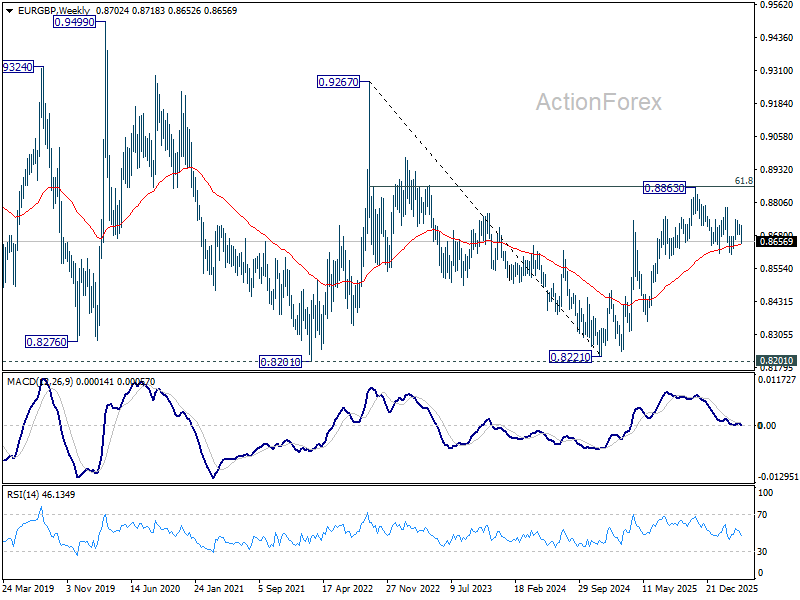
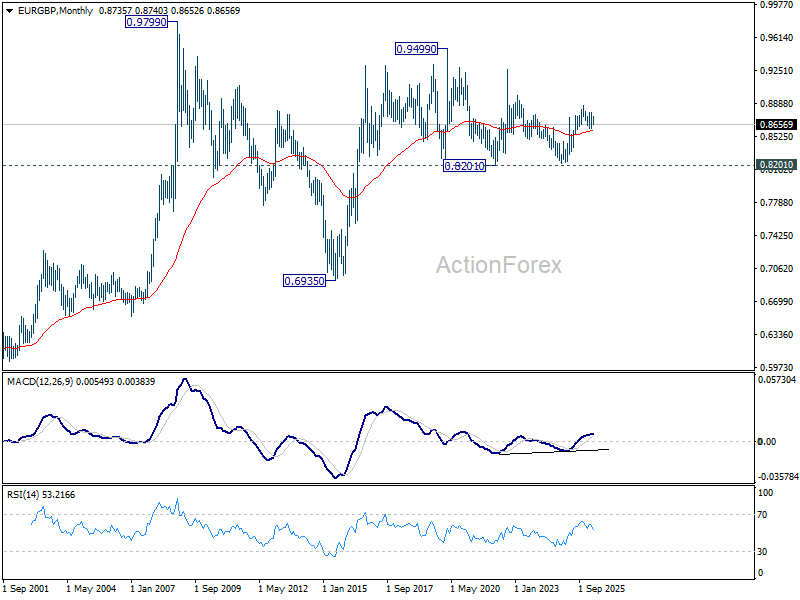
In the long term picture, price action from 0.9499 (2020 high) is seen as part of the long term range pattern from 0.9799 (2008 high). Range trading should continue between 0.8201 and 0.9499, until there is clear signal of imminent breakout.
EUR/AUD Weekly Outlook
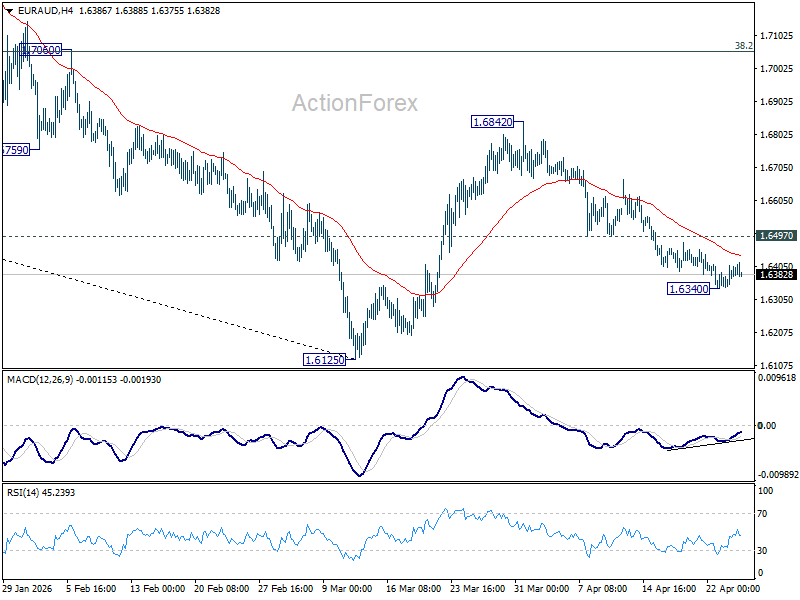
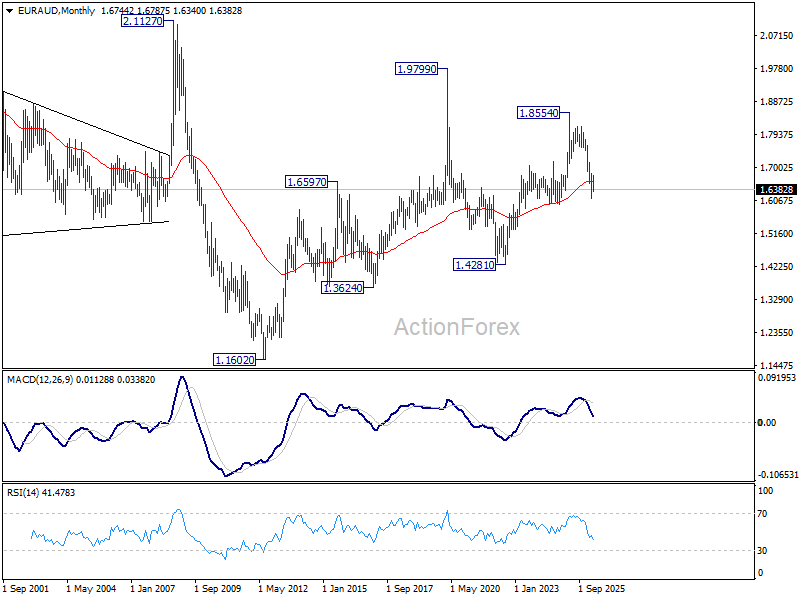
EUR/AUD's fall from 1.6842 extended lower to 1.6340 last week. But a temporary low should be in place on loss of momentum. Initial bias is turned neutral this week first. Further decline is expected as long as 1.6497 support turned resistance holds. Below 1.6340 will target a retest on 1.6125 low. Nevertheless, firm break of 1.6497 will turn bias back to the upside for stronger rebound.
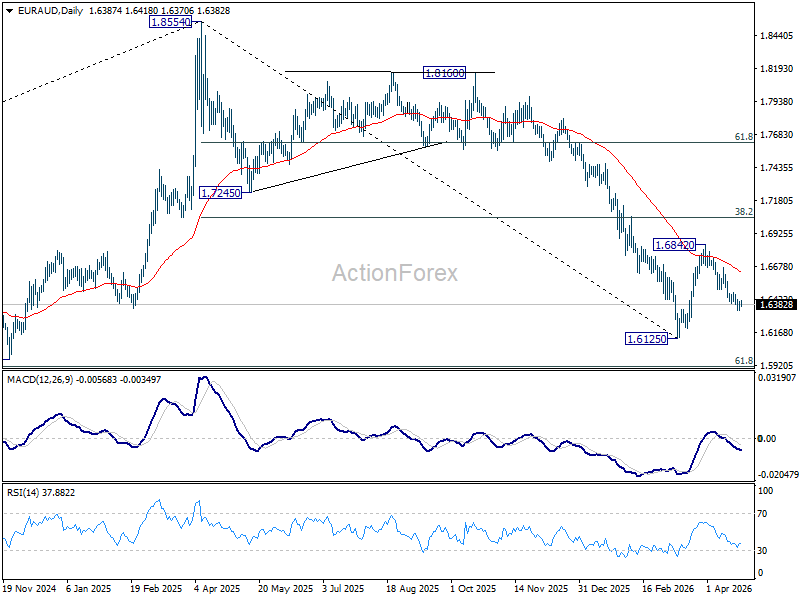
In the bigger picture, fall from 1.8554 (2025 high) is in progress and deeper decline should be seen to 61.8% retracement of 1.4281 to 1.8554 at 1.5913, which is slightly below 1.5963 structural support. Decisive break there will pave the way back to 1.4281 (2022 low). For now, risk will stay on the downside as long as 55 W EMA (now at 1.7129) holds, even in case of strong rebound.
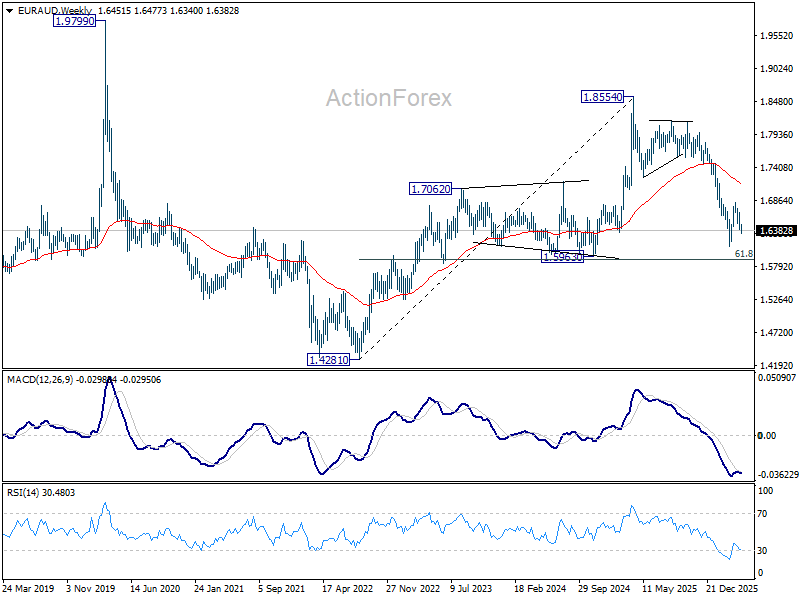
In the longer term picture, fall from 1.8554 is seen as the third leg of the pattern from 1.9799 (2020 high), which is part of the pattern from 2.1127 (2008 high). Sustained trading below 55 M EMA (now at 1.6601) will confirm this bearish case, and pave the way back towards 1.4281.
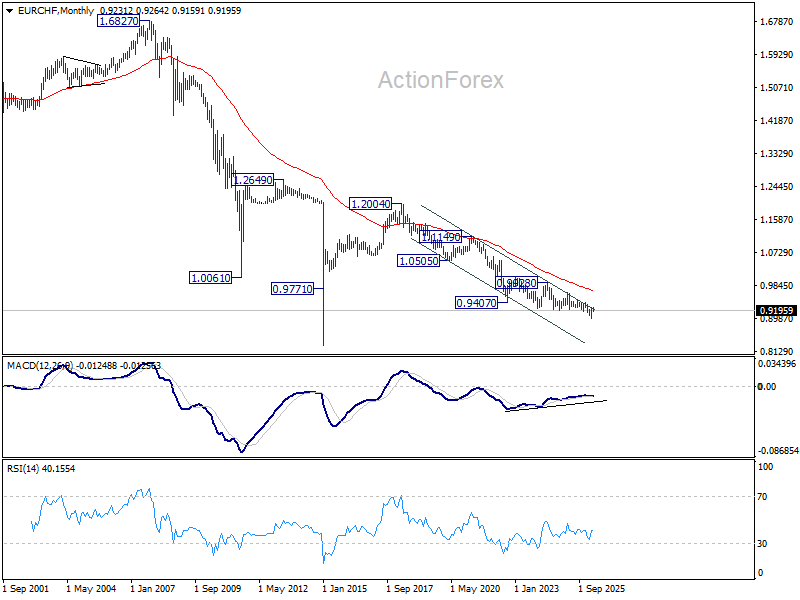
EUR/CHF Weekly Outlook
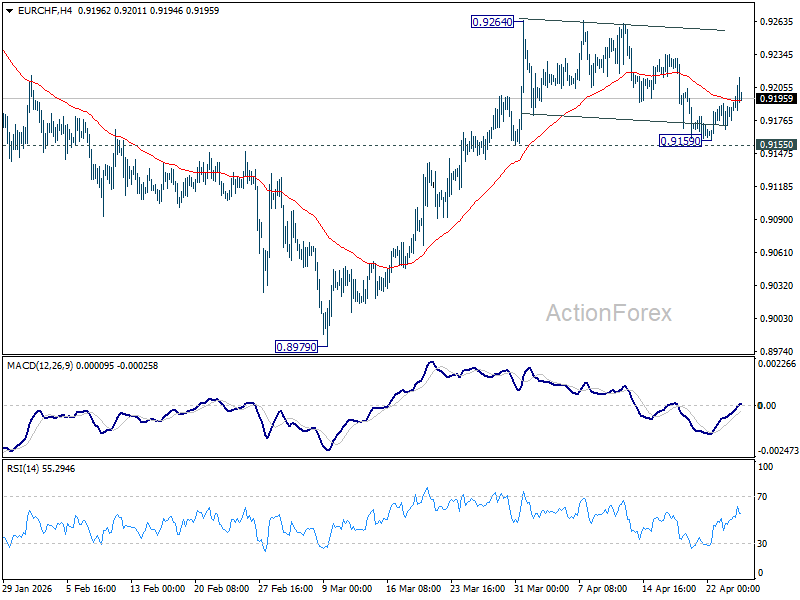
EUR/CHF edged lower to 0.9159 last week but recovered just ahead of 0.9155 support. Outlook is unchanged and initial bias remains neutral this week for more consolidations below 0.9264. Further rally is expected with 0.9155 support intact. On the upside, firm break of 0.9264 will resume the rise from 0.8979 to 0.9394 resistance next. However, break of 0.9155 will turn bias back to the downside for deeper pullback.
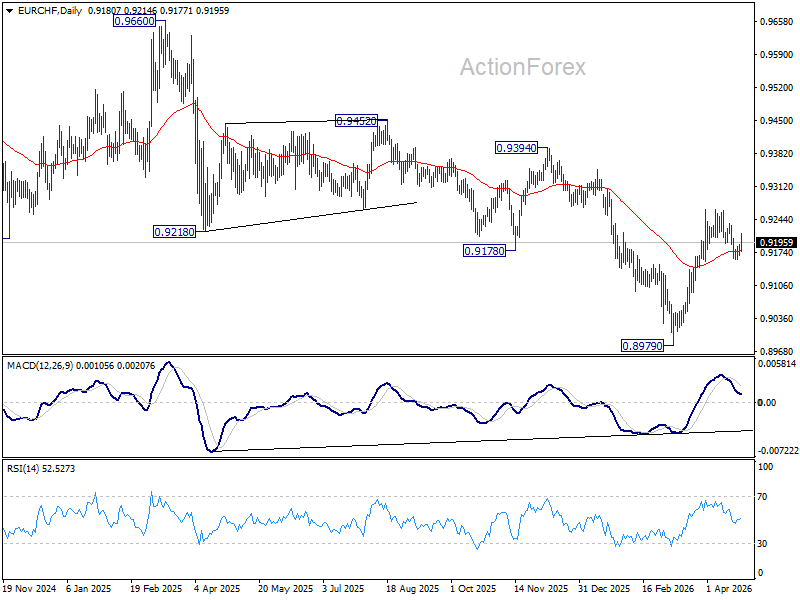
In the bigger picture, considering bullish convergence condition in W MACD, a medium term bottom should be in place at 0.8979. Sustained trading above 55 W EMA (now at 0.9277) will add more credence to this case. Further break of 0.9394 resistance will pave the way to 0.9660 resistance next. However rejection by the 55 W EMA will set up another fall through 0.8979 low at a later stage.
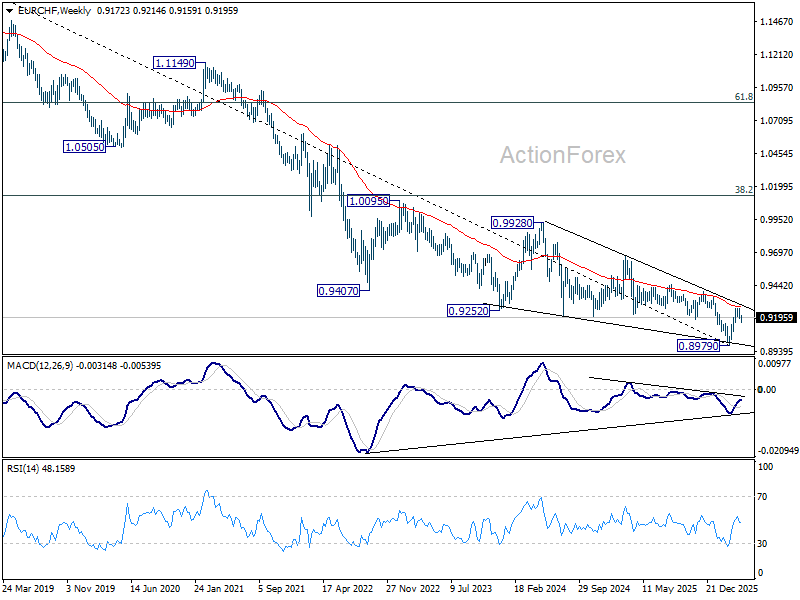
In the long term picture, outlook will stay bearish as long as 0.9407 support turned resistance (2022 low) holds. However, firm break of 0.9407 will argue that the down trend from 1.2004 (2018 high) has completed with five waves down to 0.8979. Stronger rebound should then be seen to 38.2% retracement of 1.2004 to 0.8979 at 1.0135 in the medium term.
Summary 4/27 – 5/1
Monday, Apr 27, 2026
| GMT | Ccy | Events | Cons | Prev |
|---|---|---|---|---|
| 06:00 | EUR | Germany GfK Consumer Confidence May | -30.2 | -28 |
| 06:00 | EUR |
| Germany GfK Consumer Confidence May | |
| Consensus | -30.2 |
| Previous | -28 |
Tuesday, Apr 28, 2026
| GMT | Ccy | Events | Cons | Prev |
|---|---|---|---|---|
| 23:30 | JPY | Unemployment Rate Mar | 2.60% | 2.60% |
| 03:04 | JPY | BoJ Interest Rate Decision | 0.75% | 0.75% |
| 06:30 | JPY | BoJ Press Conference | ||
| 13:00 | USD | S&P/CS Composite-20 HPI Y/Y Feb | 1.00% | 1.20% |
| 13:00 | USD | Housing Price Index M/M Feb | 0.10% | 0.10% |
| 14:00 | USD | Consumer Confidence Apr | 89.4 | 91.8 |
| 23:30 | JPY |
| Unemployment Rate Mar | |
| Consensus | 2.60% |
| Previous | 2.60% |
| 03:04 | JPY |
| BoJ Interest Rate Decision | |
| Consensus | 0.75% |
| Previous | 0.75% |
| 06:30 | JPY |
| BoJ Press Conference | |
| Consensus | |
| Previous | |
| 13:00 | USD |
| S&P/CS Composite-20 HPI Y/Y Feb | |
| Consensus | 1.00% |
| Previous | 1.20% |
| 13:00 | USD |
| Housing Price Index M/M Feb | |
| Consensus | 0.10% |
| Previous | 0.10% |
| 14:00 | USD |
| Consumer Confidence Apr | |
| Consensus | 89.4 |
| Previous | 91.8 |
Wednesday, Apr 29, 2026
| GMT | Ccy | Events | Cons | Prev |
|---|---|---|---|---|
| 01:30 | AUD | CPI M/M Mar | 1.30% | 0.00% |
| 01:30 | AUD | CPI Y/Y Mar | 4.80% | 3.70% |
| 01:30 | AUD | Trimmed Mean CPI M/M Mar | 0.30% | 0.20% |
| 01:30 | AUD | Trimmed Mean CPI Y/Y Mar | 3.30% | |
| 01:30 | AUD | CPI Q/Q Q1 | 1.40% | 0.60% |
| 01:30 | AUD | CPI Y/Y Q1 | 4.10% | 3.60% |
| 01:30 | AUD | Trimmed Mean CPI Q/Q Q1 | 0.90% | |
| 01:30 | AUD | Trimmed Mean CPI Y/Y Q1 | 3.50% | 3.40% |
| 08:00 | CHF | UBS Economic Expectations Apr | -35 | |
| 08:00 | EUR | Eurozone M3 Money Supply Y/Y Mar | 3.10% | 3.00% |
| 09:00 | EUR | Eurozone Economic Sentiment Indicator Apr | 95.5 | 96.6 |
| 09:00 | EUR | Eurozone Industrial Confidence Apr | -8 | -7 |
| 09:00 | EUR | Eurozone Services Sentiment Apr | 3.8 | 4.9 |
| 09:00 | EUR | Eurozone Consumer Confidence Apr F | -20.6 | -20.6 |
| 12:00 | EUR | Germany CPI M/M Apr P | 0.70% | 1.10% |
| 12:00 | EUR | Germany CPI Y/Y Apr P | 3.00% | 2.70% |
| 12:30 | USD | Goods Trade Balance (USD) Mar P | -86.3B | -83.5B |
| 12:30 | USD | Wholesale Sales Inventories Mar P | 0.30% | 0.80% |
| 12:30 | USD | Durable Goods Orders Mar | 0.50% | -1.30% |
| 12:30 | USD | Durable Goods Orders ex Transport Mar | 0.40% | 0.90% |
| 13:45 | CAD | BoC Interest Rate Decision | 2.25% | 2.25% |
| 14:30 | CAD | BoC Press Conference | ||
| 14:30 | USD | Crude Oil Inventories (Apr 24) | 0.3M | 1.9M |
| 18:00 | USD | Fed Interest Rate Decision | 3.75% | 3.75% |
| 18:30 | USD | FOMC Press Conference |
| 01:30 | AUD |
| CPI M/M Mar | |
| Consensus | 1.30% |
| Previous | 0.00% |
| 01:30 | AUD |
| CPI Y/Y Mar | |
| Consensus | 4.80% |
| Previous | 3.70% |
| 01:30 | AUD |
| Trimmed Mean CPI M/M Mar | |
| Consensus | 0.30% |
| Previous | 0.20% |
| 01:30 | AUD |
| Trimmed Mean CPI Y/Y Mar | |
| Consensus | |
| Previous | 3.30% |
| 01:30 | AUD |
| CPI Q/Q Q1 | |
| Consensus | 1.40% |
| Previous | 0.60% |
| 01:30 | AUD |
| CPI Y/Y Q1 | |
| Consensus | 4.10% |
| Previous | 3.60% |
| 01:30 | AUD |
| Trimmed Mean CPI Q/Q Q1 | |
| Consensus | |
| Previous | 0.90% |
| 01:30 | AUD |
| Trimmed Mean CPI Y/Y Q1 | |
| Consensus | 3.50% |
| Previous | 3.40% |
| 08:00 | CHF |
| UBS Economic Expectations Apr | |
| Consensus | |
| Previous | -35 |
| 08:00 | EUR |
| Eurozone M3 Money Supply Y/Y Mar | |
| Consensus | 3.10% |
| Previous | 3.00% |
| 09:00 | EUR |
| Eurozone Economic Sentiment Indicator Apr | |
| Consensus | 95.5 |
| Previous | 96.6 |
| 09:00 | EUR |
| Eurozone Industrial Confidence Apr | |
| Consensus | -8 |
| Previous | -7 |
| 09:00 | EUR |
| Eurozone Services Sentiment Apr | |
| Consensus | 3.8 |
| Previous | 4.9 |
| 09:00 | EUR |
| Eurozone Consumer Confidence Apr F | |
| Consensus | -20.6 |
| Previous | -20.6 |
| 12:00 | EUR |
| Germany CPI M/M Apr P | |
| Consensus | 0.70% |
| Previous | 1.10% |
| 12:00 | EUR |
| Germany CPI Y/Y Apr P | |
| Consensus | 3.00% |
| Previous | 2.70% |
| 12:30 | USD |
| Goods Trade Balance (USD) Mar P | |
| Consensus | -86.3B |
| Previous | -83.5B |
| 12:30 | USD |
| Wholesale Sales Inventories Mar P | |
| Consensus | 0.30% |
| Previous | 0.80% |
| 12:30 | USD |
| Durable Goods Orders Mar | |
| Consensus | 0.50% |
| Previous | -1.30% |
| 12:30 | USD |
| Durable Goods Orders ex Transport Mar | |
| Consensus | 0.40% |
| Previous | 0.90% |
| 13:45 | CAD |
| BoC Interest Rate Decision | |
| Consensus | 2.25% |
| Previous | 2.25% |
| 14:30 | CAD |
| BoC Press Conference | |
| Consensus | |
| Previous | |
| 14:30 | USD |
| Crude Oil Inventories (Apr 24) | |
| Consensus | 0.3M |
| Previous | 1.9M |
| 18:00 | USD |
| Fed Interest Rate Decision | |
| Consensus | 3.75% |
| Previous | 3.75% |
| 18:30 | USD |
| FOMC Press Conference | |
| Consensus | |
| Previous | |
Thursday, Apr 30, 2026
| GMT | Ccy | Events | Cons | Prev |
|---|---|---|---|---|
| 23:50 | JPY | Industrial Production M/M Mar P | 1.10% | -2.00% |
| 23:50 | JPY | Retail Trade Y/Y Mar | 0.80% | -0.20% |
| 01:00 | NZD | ANZ Business Confidence Apr | 32.5 | |
| 01:00 | NZD | ANZ Activity Outlook Apr | 39.3 | |
| 01:30 | AUD | Private Sector Credit M/M Mar | 0.60% | 0.60% |
| 01:30 | AUD | Import Price Index Q/Q Q1 | -0.60% | 0.90% |
| 01:30 | CNY | NBS Manufacturing PMI Apr | 50.2 | 50.4 |
| 01:30 | CNY | NBS Non-Manufacturing PMI Apr | 49.9 | 50.1 |
| 01:45 | CNY | RatingDog Manufacturing PMI Apr | 50.9 | 50.8 |
| 05:00 | JPY | Housing Starts Y/Y Mar | -28.90% | -4.90% |
| 05:00 | JPY | Consumer Confidence Index Apr | 32.6 | 33.3 |
| 05:30 | EUR | France GDP Q/Q Q1 P | 0.20% | 0.20% |
| 06:00 | EUR | Germany Import Price Index M/M Mar | 3.30% | 0.30% |
| 06:00 | EUR | Germany Retail Sales M/M Mar | -0.20% | -0.60% |
| 07:00 | CHF | KOF Economic Barometer Mar | 96 | 96.1 |
| 07:55 | EUR | Germany Unemployment Change Mar | 5K | 0K |
| 07:55 | EUR | Germany Unemployment Rate Mar | 6.30% | 6.30% |
| 08:00 | EUR | Germany GDP Q/Q Q1 P | 0.20% | 0.30% |
| 09:00 | EUR | Eurozone GDP Q/Q Q1 P | 0.20% | 0.20% |
| 09:00 | EUR | Eurozone CPI Y/Y Apr P | 3.00% | 2.60% |
| 09:00 | EUR | Eurozone Core CPI Y/Y Apr P | 2.20% | 2.30% |
| 11:00 | GBP | BoE Interest Rate Decision | 3.75% | 3.75% |
| 11:00 | GBP | MPC Official Bank Rate Votes | 0--0--9 | 0--0--9 |
| 12:15 | EUR | ECB Rate On Deposit Facility | 2.00% | 2.00% |
| 12:15 | EUR | ECB Main Refinancing Operations Rate | 2.15% | 2.15% |
| 12:30 | CAD | GDP M/M Feb | 0.20% | 0.10% |
| 12:30 | USD | GDP Annualized Q1 P | 2.20% | 0.50% |
| 12:30 | USD | GDP Price Index Q1 P | 3.90% | 3.70% |
| 12:30 | USD | Initial Jobless Claims (Apr 24) | 212K | 214K |
| 12:30 | USD | Personal Income M/M Mar | 0.30% | -0.10% |
| 12:30 | USD | Personal Spending Mar | 0.90% | 0.50% |
| 12:30 | USD | PCE Price Index M/M Mar | 0.70% | 0.40% |
| 12:30 | USD | PCE Price Index Y/Y Mar | 3.50% | 2.80% |
| 12:30 | USD | Core PCE Price Index M/M Mar | 0.30% | 0.40% |
| 12:30 | USD | Core PCE Price Index Y/Y Mar | 3.20% | 3.00% |
| 12:45 | EUR | ECB Press Conference | ||
| 13:45 | USD | Chicago PMI Apr | 55.3 | 52.8 |
| 14:30 | USD | Natural Gas Storage (Apr 24) | 83B | 103B |
| 23:50 | JPY |
| Industrial Production M/M Mar P | |
| Consensus | 1.10% |
| Previous | -2.00% |
| 23:50 | JPY |
| Retail Trade Y/Y Mar | |
| Consensus | 0.80% |
| Previous | -0.20% |
| 01:00 | NZD |
| ANZ Business Confidence Apr | |
| Consensus | |
| Previous | 32.5 |
| 01:00 | NZD |
| ANZ Activity Outlook Apr | |
| Consensus | |
| Previous | 39.3 |
| 01:30 | AUD |
| Private Sector Credit M/M Mar | |
| Consensus | 0.60% |
| Previous | 0.60% |
| 01:30 | AUD |
| Import Price Index Q/Q Q1 | |
| Consensus | -0.60% |
| Previous | 0.90% |
| 01:30 | CNY |
| NBS Manufacturing PMI Apr | |
| Consensus | 50.2 |
| Previous | 50.4 |
| 01:30 | CNY |
| NBS Non-Manufacturing PMI Apr | |
| Consensus | 49.9 |
| Previous | 50.1 |
| 01:45 | CNY |
| RatingDog Manufacturing PMI Apr | |
| Consensus | 50.9 |
| Previous | 50.8 |
| 05:00 | JPY |
| Housing Starts Y/Y Mar | |
| Consensus | -28.90% |
| Previous | -4.90% |
| 05:00 | JPY |
| Consumer Confidence Index Apr | |
| Consensus | 32.6 |
| Previous | 33.3 |
| 05:30 | EUR |
| France GDP Q/Q Q1 P | |
| Consensus | 0.20% |
| Previous | 0.20% |
| 06:00 | EUR |
| Germany Import Price Index M/M Mar | |
| Consensus | 3.30% |
| Previous | 0.30% |
| 06:00 | EUR |
| Germany Retail Sales M/M Mar | |
| Consensus | -0.20% |
| Previous | -0.60% |
| 07:00 | CHF |
| KOF Economic Barometer Mar | |
| Consensus | 96 |
| Previous | 96.1 |
| 07:55 | EUR |
| Germany Unemployment Change Mar | |
| Consensus | 5K |
| Previous | 0K |
| 07:55 | EUR |
| Germany Unemployment Rate Mar | |
| Consensus | 6.30% |
| Previous | 6.30% |
| 08:00 | EUR |
| Germany GDP Q/Q Q1 P | |
| Consensus | 0.20% |
| Previous | 0.30% |
| 09:00 | EUR |
| Eurozone GDP Q/Q Q1 P | |
| Consensus | 0.20% |
| Previous | 0.20% |
| 09:00 | EUR |
| Eurozone CPI Y/Y Apr P | |
| Consensus | 3.00% |
| Previous | 2.60% |
| 09:00 | EUR |
| Eurozone Core CPI Y/Y Apr P | |
| Consensus | 2.20% |
| Previous | 2.30% |
| 11:00 | GBP |
| BoE Interest Rate Decision | |
| Consensus | 3.75% |
| Previous | 3.75% |
| 11:00 | GBP |
| MPC Official Bank Rate Votes | |
| Consensus | 0--0--9 |
| Previous | 0--0--9 |
| 12:15 | EUR |
| ECB Rate On Deposit Facility | |
| Consensus | 2.00% |
| Previous | 2.00% |
| 12:15 | EUR |
| ECB Main Refinancing Operations Rate | |
| Consensus | 2.15% |
| Previous | 2.15% |
| 12:30 | CAD |
| GDP M/M Feb | |
| Consensus | 0.20% |
| Previous | 0.10% |
| 12:30 | USD |
| GDP Annualized Q1 P | |
| Consensus | 2.20% |
| Previous | 0.50% |
| 12:30 | USD |
| GDP Price Index Q1 P | |
| Consensus | 3.90% |
| Previous | 3.70% |
| 12:30 | USD |
| Initial Jobless Claims (Apr 24) | |
| Consensus | 212K |
| Previous | 214K |
| 12:30 | USD |
| Personal Income M/M Mar | |
| Consensus | 0.30% |
| Previous | -0.10% |
| 12:30 | USD |
| Personal Spending Mar | |
| Consensus | 0.90% |
| Previous | 0.50% |
| 12:30 | USD |
| PCE Price Index M/M Mar | |
| Consensus | 0.70% |
| Previous | 0.40% |
| 12:30 | USD |
| PCE Price Index Y/Y Mar | |
| Consensus | 3.50% |
| Previous | 2.80% |
| 12:30 | USD |
| Core PCE Price Index M/M Mar | |
| Consensus | 0.30% |
| Previous | 0.40% |
| 12:30 | USD |
| Core PCE Price Index Y/Y Mar | |
| Consensus | 3.20% |
| Previous | 3.00% |
| 12:45 | EUR |
| ECB Press Conference | |
| Consensus | |
| Previous | |
| 13:45 | USD |
| Chicago PMI Apr | |
| Consensus | 55.3 |
| Previous | 52.8 |
| 14:30 | USD |
| Natural Gas Storage (Apr 24) | |
| Consensus | 83B |
| Previous | 103B |
Friday, May 1, 2026
| GMT | Ccy | Events | Cons | Prev |
|---|---|---|---|---|
| 23:30 | JPY | Tokyo CPI Y/Y Apr | 1.40% | |
| 23:30 | JPY | Tokyo CPI Core Y/Y Apr | 1.80% | 1.70% |
| 23:30 | JPY | Tokyo CPI Core-Core Y/Y Apr | 2.30% | |
| 00:30 | JPY | Manufacturing PMI Apr F | 54.9 | 54.9 |
| 01:30 | AUD | PPI Q/Q Q1 | 1.50% | 0.80% |
| 01:30 | AUD | PPI Y/Y Q1 | 3.50% | |
| 06:30 | CHF | Real Retail Sales Y/Y Mar | 0.60% | 0.90% |
| 08:30 | GBP | Manufacturing PMI Apr F | 53.3 | 53.6 |
| 08:30 | GBP | Mortgage Approvals Mar | 60K | 63K |
| 08:30 | GBP | M4 Money Supply M/M Mar | 0.50% | 0.60% |
| 13:30 | CAD | Manufacturing PMI Apr | 50 | |
| 13:45 | USD | Manufacturing PMI Apr F | 54 | 54 |
| 14:00 | USD | ISM Manufacturing PMI Apr | 53.2 | 52.7 |
| 14:00 | USD | ISM Manufacturing Prices Paid Apr | 80 | 78.3 |
| 14:00 | USD | ISM Manufacturing Employment Index Apr | 48.7 |
| 23:30 | JPY |
| Tokyo CPI Y/Y Apr | |
| Consensus | |
| Previous | 1.40% |
| 23:30 | JPY |
| Tokyo CPI Core Y/Y Apr | |
| Consensus | 1.80% |
| Previous | 1.70% |
| 23:30 | JPY |
| Tokyo CPI Core-Core Y/Y Apr | |
| Consensus | |
| Previous | 2.30% |
| 00:30 | JPY |
| Manufacturing PMI Apr F | |
| Consensus | 54.9 |
| Previous | 54.9 |
| 01:30 | AUD |
| PPI Q/Q Q1 | |
| Consensus | 1.50% |
| Previous | 0.80% |
| 01:30 | AUD |
| PPI Y/Y Q1 | |
| Consensus | |
| Previous | 3.50% |
| 06:30 | CHF |
| Real Retail Sales Y/Y Mar | |
| Consensus | 0.60% |
| Previous | 0.90% |
| 08:30 | GBP |
| Manufacturing PMI Apr F | |
| Consensus | 53.3 |
| Previous | 53.6 |
| 08:30 | GBP |
| Mortgage Approvals Mar | |
| Consensus | 60K |
| Previous | 63K |
| 08:30 | GBP |
| M4 Money Supply M/M Mar | |
| Consensus | 0.50% |
| Previous | 0.60% |
| 13:30 | CAD |
| Manufacturing PMI Apr | |
| Consensus | |
| Previous | 50 |
| 13:45 | USD |
| Manufacturing PMI Apr F | |
| Consensus | 54 |
| Previous | 54 |
| 14:00 | USD |
| ISM Manufacturing PMI Apr | |
| Consensus | 53.2 |
| Previous | 52.7 |
| 14:00 | USD |
| ISM Manufacturing Prices Paid Apr | |
| Consensus | 80 |
| Previous | 78.3 |
| 14:00 | USD |
| ISM Manufacturing Employment Index Apr | |
| Consensus | |
| Previous | 48.7 |
Markets Weekly Outlook – Can Earnings Outweigh Geopolitical Headwinds & Central Bank Decisions?
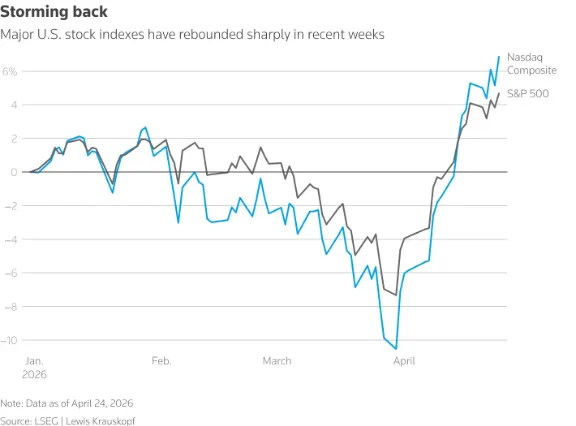
- The S&P 500 and Nasdaq climbed to new intraday records, propelled by diplomatic hopes for de-escalation in the Middle East & tech performance.
- The week ahead features meetings from the Fed, ECB, and Bank of England as well as tech earnings releases.
- The Bank of Japan is the "wild card" facing pressure for a surprise hike, while markets will also focus on China’s Manufacturing PMI, which is at risk of slipping back into contraction.
Global markets find themselves at a crossroads as the week draws to a close, with the narrative shifting between geopolitical caution and corporate optimism. While the US Dollar eased slightly on Friday, it remains on track for a weekly gain as traders weigh the potential for a diplomatic resolution to the conflict between the US, Israel, and Iran.
The Greenback’s trajectory has been a reflection of the broader market’s "wait-and-see" approach; optimism over a near-term peace deal has provided temporary relief, while the looming threat of prolonged energy disruptions continues to act as a floor for the currency.
The Dollar Index (DXY) dipped 0.11% to 98.71 during Friday's session, yet it is still eyeing a 0.50% gain for the week. This relative strength has kept the Euro and Sterling under pressure, with the EUR/USD pair trending toward a 0.53% weekly loss despite a modest intraday recovery to $1.1699.
Meanwhile, the Japanese Yen saw a slight flight-to-safety bid, strengthening to 159.62.
The geopolitical premium is most visible in the energy sector, where Brent and WTI crude have surged 16% and 11% respectively this week, their second-largest gains since the onset of hostilities, as the Strait of Hormuz remains effectively paralyzed.
In the equity space, the mood is decidedly more bullish. The S&P 500 and Nasdaq climbed to new intraday records on Friday, propelled by a dual engine of diplomatic hope and tech outperformance. Reports that Iran’s Foreign Minister is headed to Islamabad for peace talks, coupled with news that US envoys, including Jared Kushner, are set for Pakistan-mediated negotiations have offered a glimmer of hope for de-escalation.
This sentiment was further bolstered by a surge in Intel shares, which helped the technology sector shrug off the release of DeepSeek’s latest AI model and lead the broader market higher.
Earnings season is also providing a sturdy foundation for investor confidence. With over 80% of S&P 500 companies beating expectations thus far, the focus now shifts to a high-stakes week ahead. Five of the "Magnificent Seven" megacaps are scheduled to report, representing a significant portion of the index's market cap.
As the S&P 500 and Nasdaq eye their fourth consecutive week of gains, the longest streak since late 2024, the market's resilience will be tested by whether these corporate giants can justify their valuations amidst a backdrop of lingering inflation concerns and a volatile geopolitical landscape.
Source: LSEG
Week Ahead: Central Banks Walk a Tightrope as Geopolitical Tensions Refuse to Thaw
Markets enter the final week of April facing a familiar, albeit intensifying, conundrum. While the "higher for longer" narrative was the theme of 2025, the spring of 2026 is shaping up to be defined by a "wait and see" stalemate. As we look toward the week starting April 26, the spotlight is firmly fixed on a trifecta of central bank meetings with the Fed, ECB, and Bank of England, all of whom find themselves caught between sticky energy-led inflation and a fragile global growth outlook.
Central Banks: All Bark and No Bite?
The overarching theme for the coming week is the "balancing problem" facing global policymakers. Geopolitical instability in the Middle East has kept oil prices buoyant, complicating the inflation path just as markets were hoping for a dovish pivot.
The Fed (Wednesday): Jerome Powell is expected to maintain a steady hand in what is scheduled to be his final meeting as Chair. While the US economy continues to show resilience—with 1Q GDP expected to rebound to 2.7%—the core PCE deflator remains a thorn in the side of the FOMC. Expect a "hold" decision, with Powell likely emphasizing that while the labor market risks are skewed to the downside, the inflation fight is far from over.
The ECB & BoE (Thursday): Across the Atlantic, the story is remarkably similar. Both the ECB and the Bank of England are expected to keep rates unchanged. For the ECB, Thursday’s flurry of data (GDP and April inflation) will serve as a reality check. In the UK, Governor Andrew Bailey faces a market that has recently ignored his attempts to talk down rate hike expectations. The challenge for both will be maintaining a hawkish bias to keep inflation expectations anchored without accidentally triggering a deeper economic downturn.
Asia in Focus: BoJ and China’s PMI
While the West grapples with policy inertia, the Asia-Pacific region is bracing for potential volatility.
Bank of Japan (Tuesday): This is the "wild card" of the week. While the consensus leans toward a hold, a surprise hike remains on the table. With Tokyo CPI expected to accelerate and real interest rates deeply negative, the BoJ is under immense pressure to react. Watch the quarterly outlook report for upward revisions to the 2026/27 inflation forecasts.
China PMI (Thursday): After a brief foray into expansionary territory, China’s manufacturing PMI is at risk of slipping back into contraction (49.9 expected). Any sign of cooling demand in the world’s second-largest economy could weigh heavily on commodity-linked currencies and broader risk sentiment.
Australia’s Inflation (Wednesday): High oil prices are expected to push Australian CPI toward the 4.6% mark. This hot print could force the RBA’s hand as early as May, putting the "Aussie" dollar in the crosshairs.
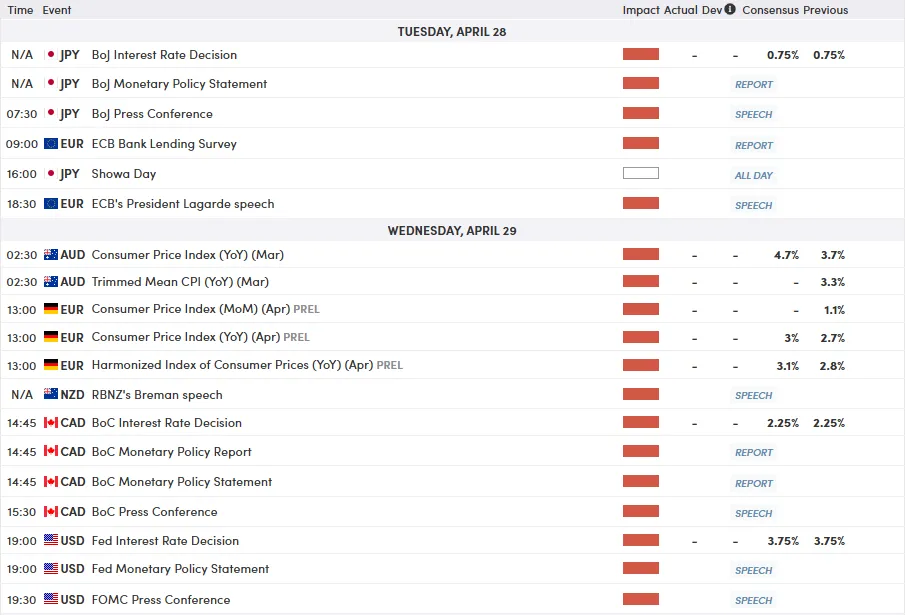
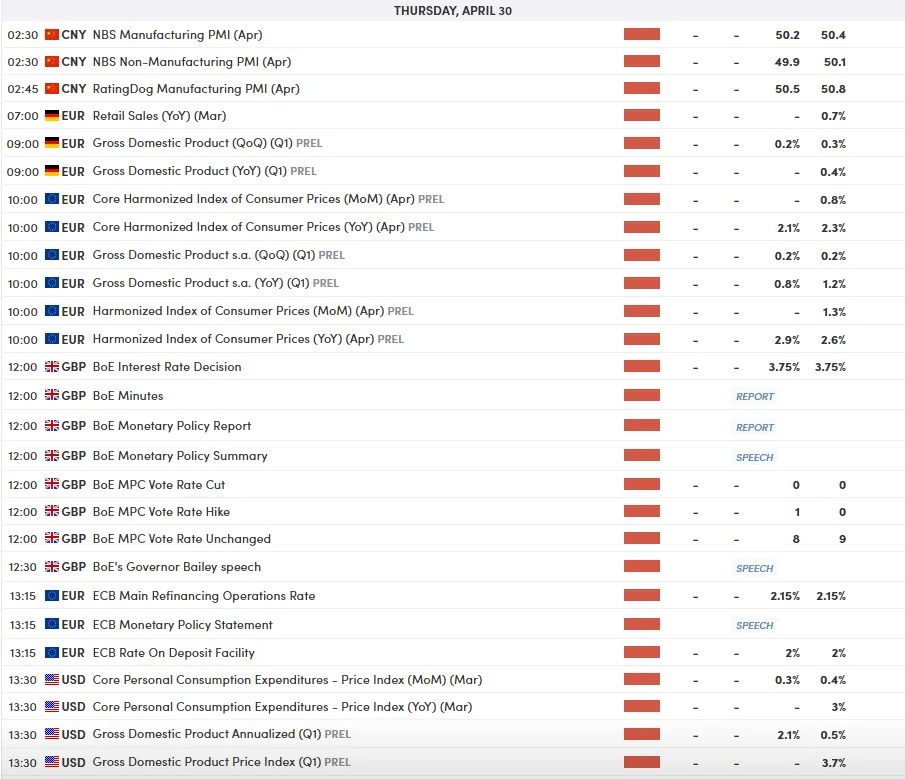
For all market-moving economic releases and events, see the MarketPulse Economic Calendar. (click to enlarge)
Chart of the Week - US Dollar Index (DXY)
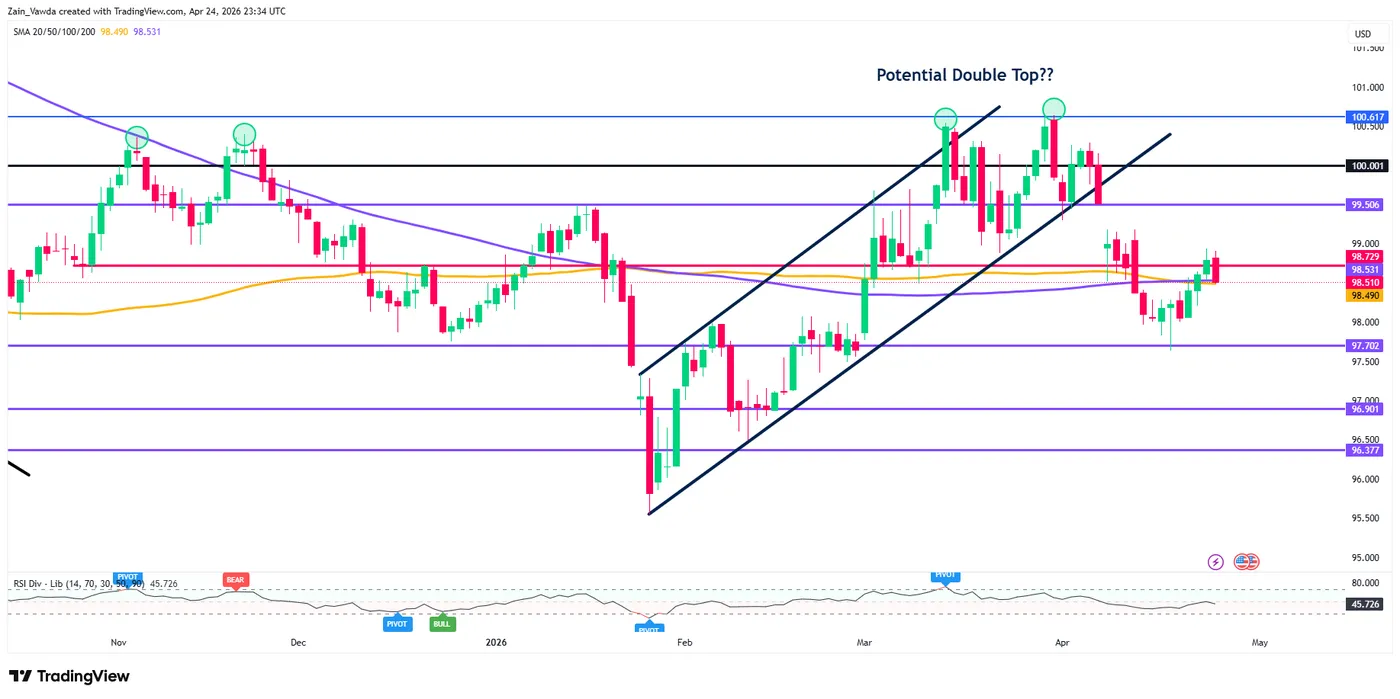
From a technical standpoint, The DXY is currently testing an inflection point after a sharp recovery from January lows. Having broken below a rising ascending channel, the index has stalled, suggesting a loss of bullish momentum as it hovers around the 100 and 200-day MAs.
Key Technical Observations:
- Resistance: The 99.56 handle remains the immediate ceiling. A failure to break this level could lead to a deeper pullback. The catalyst may be some form of deal between the US and Iran.
- Support: Immediate support sits at the confluence of the MA 100/200 (approx. 98.50). A failure to break above the 99.00 level would keep bears in the driver's seat.
- Indicators: The RSI (bottom) sits at 45.726, showing a bearish lean after the recent "Pivot" high.
The trend is currently neutral-to-bearish. Watch for a decisive close below the 97.70 handle to confirm a deeper correction toward 97.00.
Conversely, a daily close above 100.61 invalidates the bearish setup.
US Dollar Index (DXY) Daily Chart, April 24, 2025
Source:TradingView.Com (click to enlarge)
Key Catalysts
The primary barometer for risk. A hawkish "hold" from the Fed could see the Greenback challenge recent highs, particularly if GDP data surprises to the upside.
Conversely, should the BoJ opt for a hawkish surprise, expect a sharp unwinding of JPY carry trades, which could spark a broader "risk-off" move across equity markets.
The upcoming week is less about what central bankers do and more about what they say they might do in June. With inflation proving stickier than anticipated and growth figures beginning to show the cracks of high-interest rates, the margin for error has never been thinner.
Traders should remain nimble in a week where the data and the rhetoric are likely to pull in opposite directions.
Crude Oil Trades Above $95 Ahead of Weekend Risk – WTI Technical Analysis
- WTI Oil hangs around $95 right ahead of a high risk weekend
- Contentious geopolitics are still influencing Oil prices with Strait of Hormuz blockades still having their effect
- Exploring an in-depth Technical Analysis of the commodity
The weekend is here, and energy markets are holding their breath.
WTI Crude is hovering uncomfortably around the $95 mark as the geopolitical standoff between Washington and Tehran remains incredibly tense.
While Iran has already sent a delegation to Islamabad, they are actively playing hardball and have yet to officially confirm that they will actually sit down and exchange terms with the US representatives.
Despite this diplomatic stalemate, the US is still sending two of its top diplomats to Pakistan with Steve Witkoff and Jared Kushner.
Market participants will be watching the wire like hawks, desperately wanting to see concrete progress toward a finalized peace deal this weekend to avoid a massive gap on Monday's open.
Odds for a Peace deal went down quite aggressively since last Friday, and that doesn't bode well for general Market sentiment.
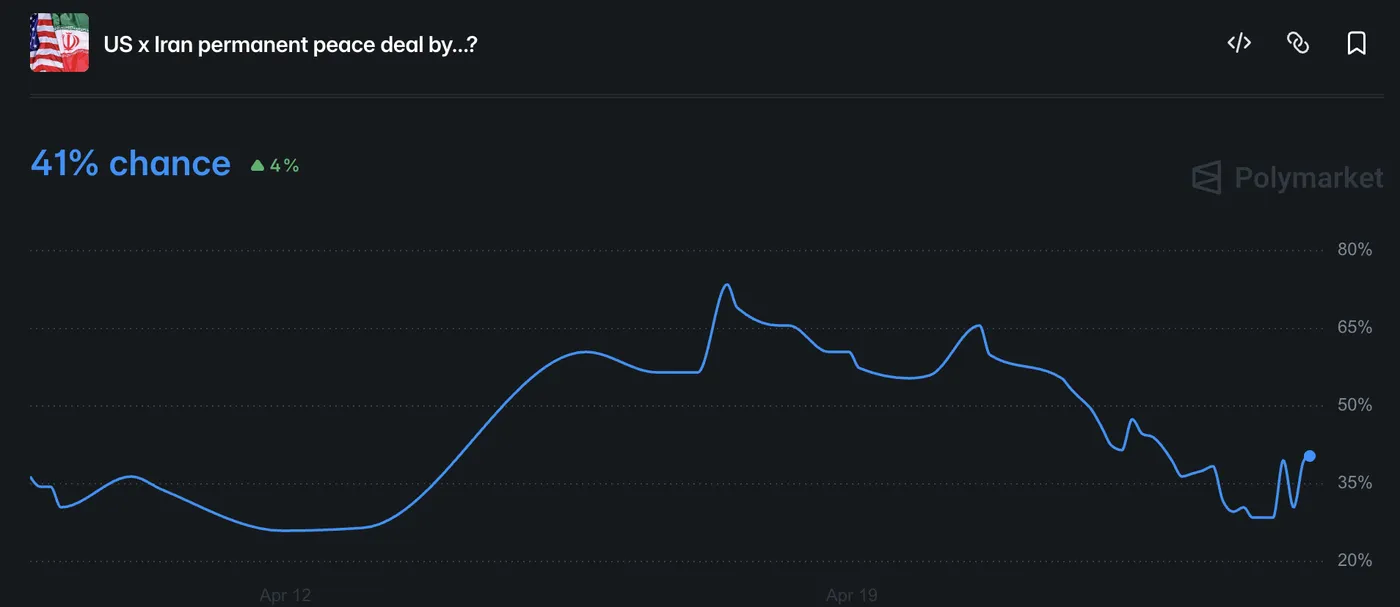
Odds for a Peace Deal by May 31 – Source: Polymarket. April 24, 2026
In the meantime, the Trump administration is still applying pressure on Iran to force a deal. The US Navy is maintaining a heavy maritime blockade on the Strait of Hormuz to completely prevent Iran from exploiting its geographic monopoly over the region.
The blockade is in full force and the US military has blocked 34 tankers coming from Iranian ports, severely tightening the economic chokehold on Tehran.
While global oil traffic is slowly redirecting toward North America—which is currently driving a still increasing $11 per barrel difference between WTI and Brent—global supply is still taking a severe hit.
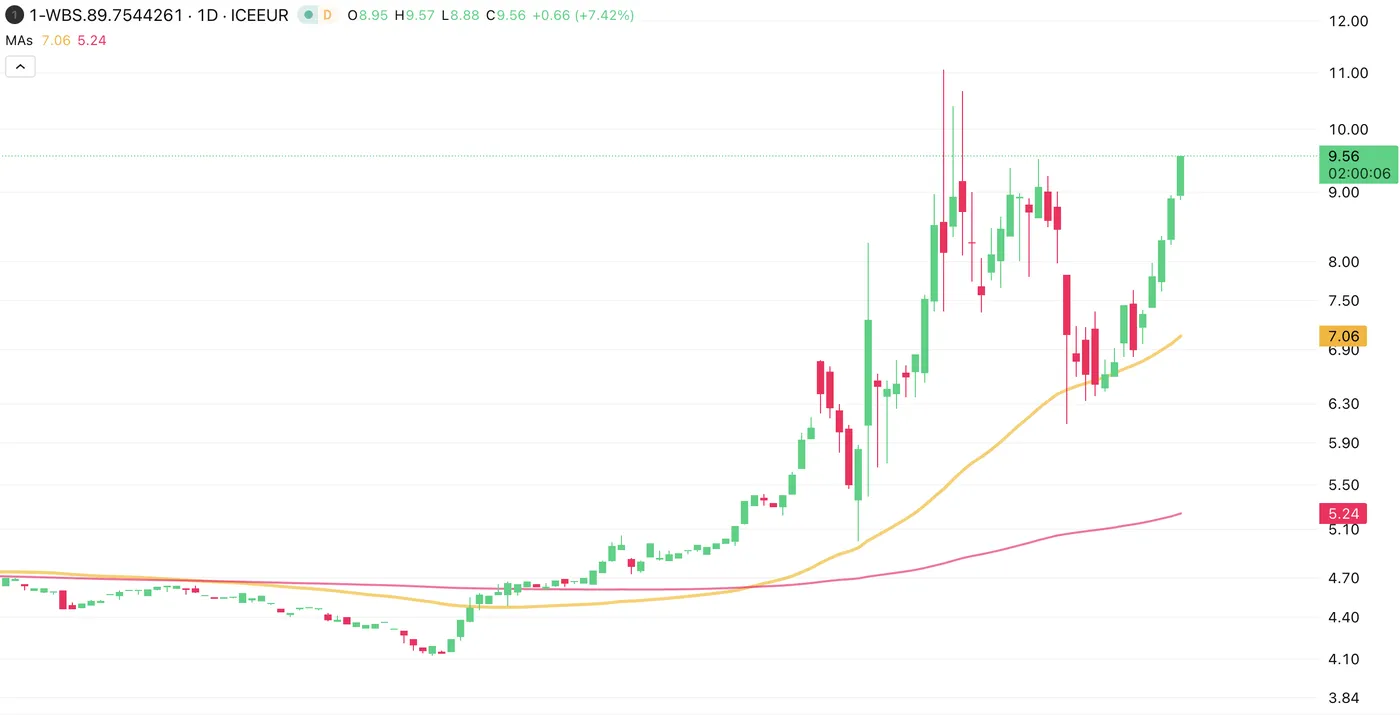
WTI-Brent Spread – April 24, 2026. Source: TradingView
With alternative pipelines still in the slow process of reopening, the International Energy Agency notes that the market is currently facing a still huge 13 million barrels per day drought compared to normal global flows.
While slightly better economic fundamentals originally helped cool the extreme war premium, it turns out that the overarching narrative remains heavily blurry.
Traders are still wondering exactly where to look, which is directly translating into a highly choppy and seesawing price action.
As the situation has little odds to get more clear ahead of the weekend, let's dive into a multi-timeframe analysis of WTI (US) Oil to determine levels of interest and put the odds in the trader's favor to capitalize on the issue.
US Oil Multi-Timeframe Analysis
WTI Daily Chart
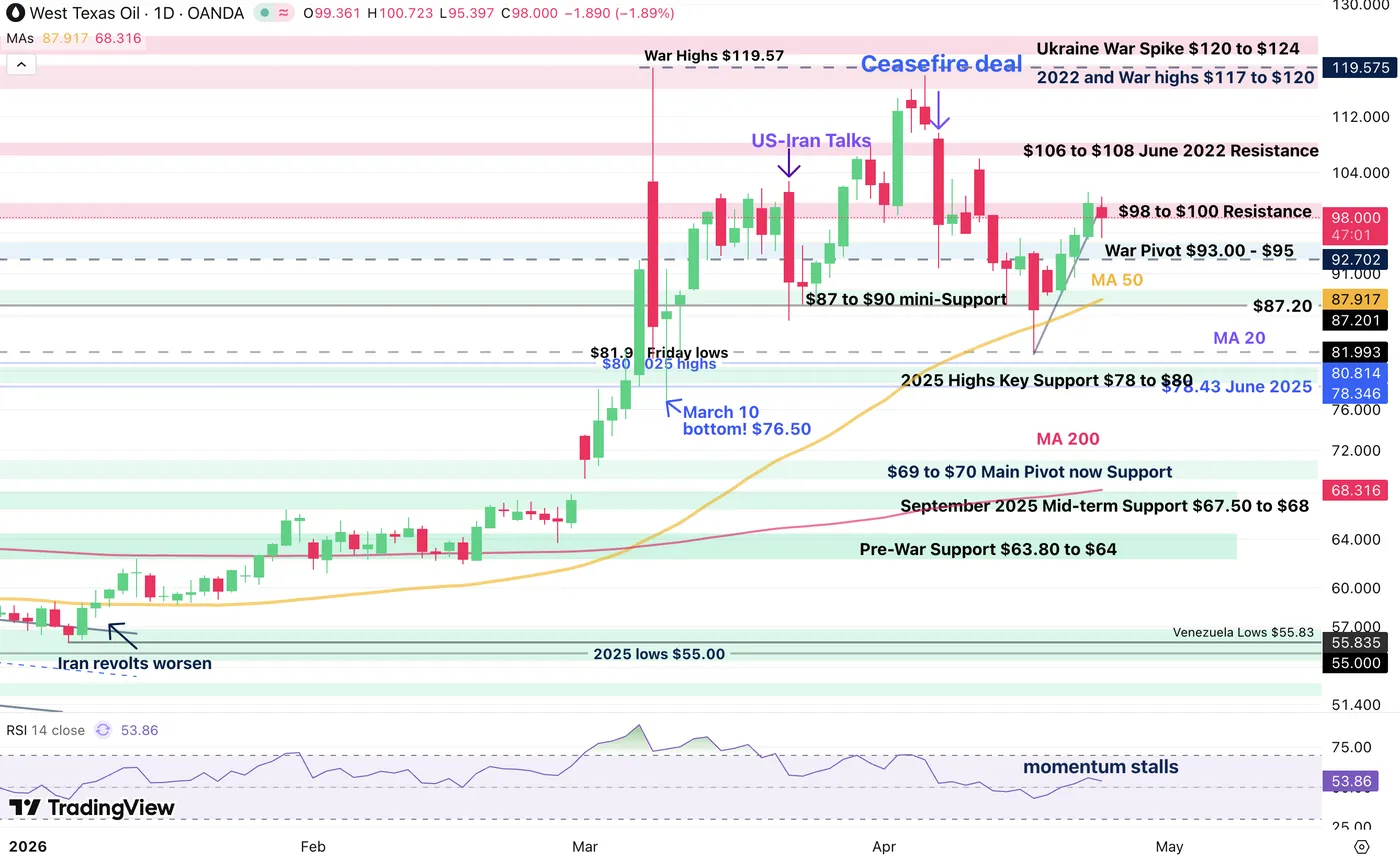
WTI Oil Daily Chart – April 24, 2026. Source: TradingView
After correcting to $83 lows just last Friday, sellers just couldn't maintain the high pressure fundamentals and this led to a 3-day bounce right back below the $100 level.
As long as prices don't exceed that threshold, Markets should remain contained, but keep a close eye on that level as breaching it could lead to a large spike in volatility.
Let's take a closer look.
WTI 4H Chart and Technical Levels
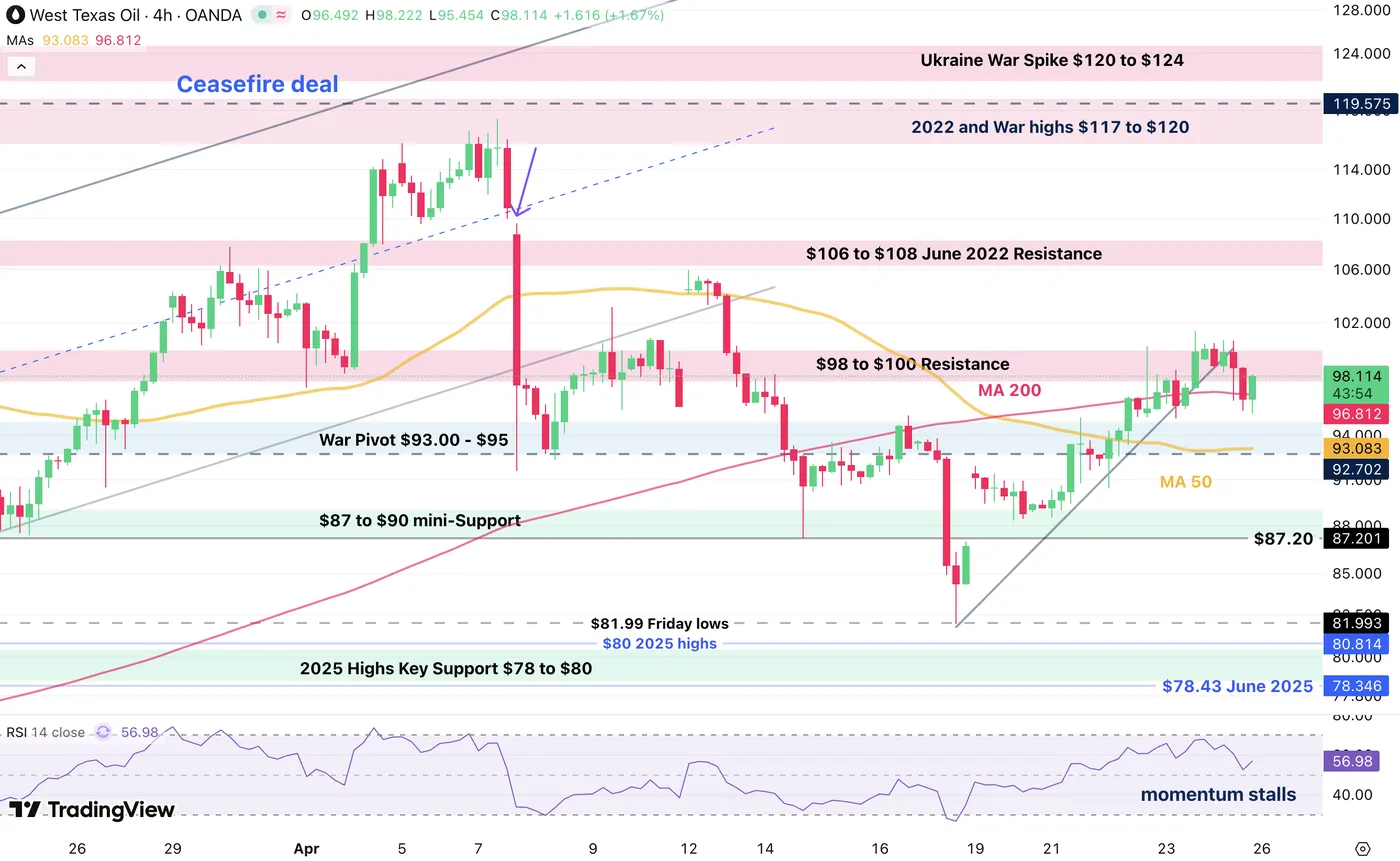
WTI Oil 4H Chart – April 24, 2026. Source: TradingView
While sellers reappeared at the $98 to $100 resistance, they could not extend the pressure below the 4H 200-period MA ($96.82).
The moving average is a key indicator to keep your eyes on to gauge intraday momentum in the commodity.
WTI Technical Levels:
Resistance Levels
- $98 to $100 Resistance (freshly rejected)
- $104 next-mini resistance
- $106 to $108 June 2022 Resistance
- 2022 and Monday highs $117 to $120 (larger channel top)
- Ukraine War Spike $120 to $124
Support Levels
- 4H 200-period MA $96.82
- War Support $93.00 - $95
- $87 to $90 mini-Support (recent bounce)
- $82.80 to $84 micro-Support
- 2025 Highs Key Support $78 to $80
- $69 to $70 Final War Support
1H Chart and action levels
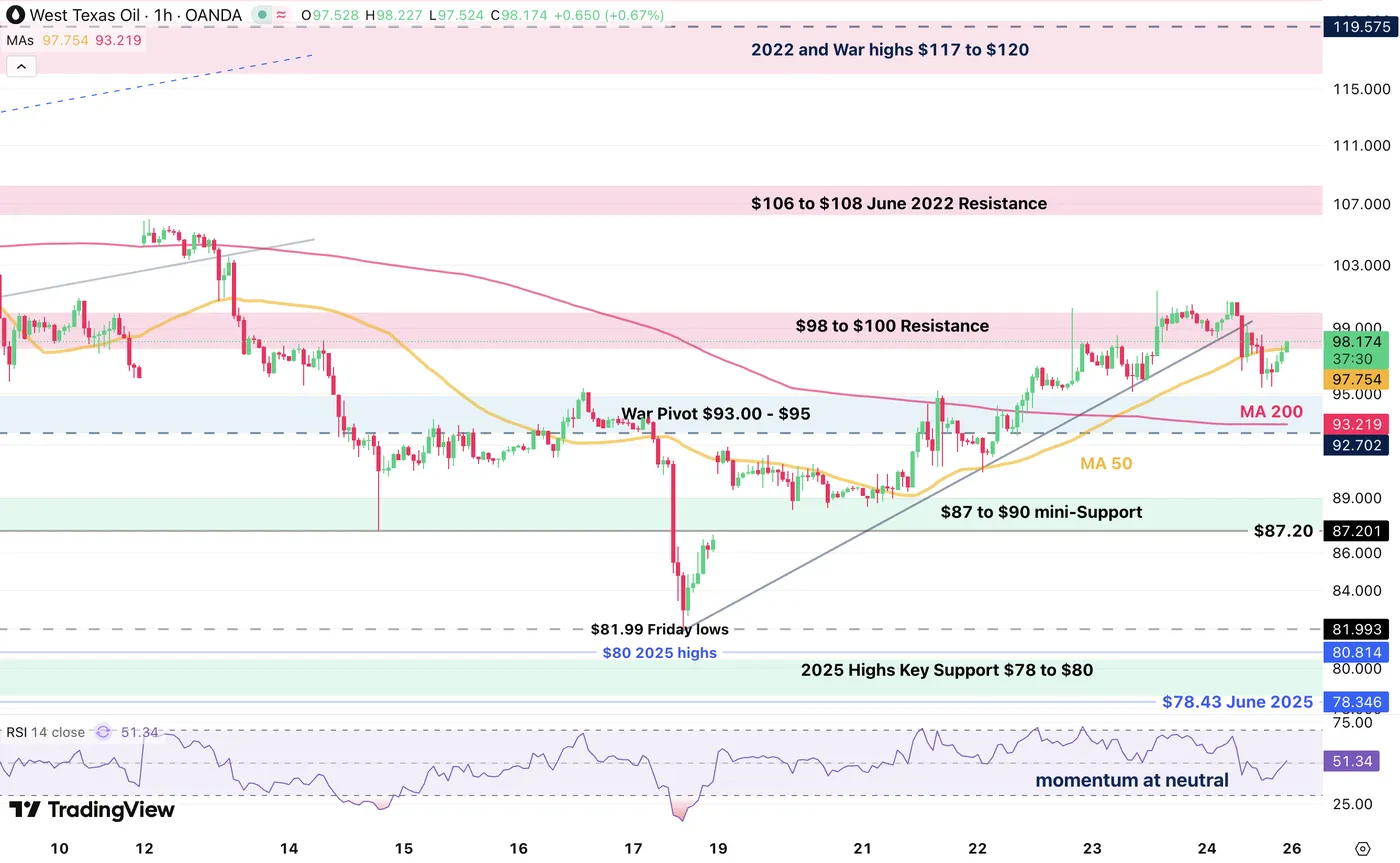
WTI Oil 1H Chart – April 24, 2026. Source: TradingView
While pre-weekend action brought bullish pressure to the upside, having broken the weekly upward trendline hints at a more balanced action ahead.
Breaking $100 should see follow through all the way to $104, and the next step is at $106.
On the other hand, rejecting below $97 marks higher chances of a $93 retest.
Expect high-volatility gaps on Monday's session – Trading these could require savvy stop-orders. With heavy binary risk, make sure to keep your size under control.
Safe Trades and an enjoyable weekend!
The Weekly Bottom Line: Well Behaved Core Inflation Strengthens BoC Hold Case
Canadian Highlights
- March CPI came in a touch softer than expected, with headline inflation jumping to 2.4% on higher gasoline prices but shorter-term core measures are still, on average, running below 2%.
- The first quarter BoC Business Outlook Survey signaled improving pre-war sentiment, but noted rising input costs and some upward drift in inflation expectations since the onset of the conflict.
- With war-related uncertainty elevated and inflation expectations a key area of focus, the BoC is likely to remain on hold next week while reiterating its commitment to keeping expectations well anchored.
U.S. Highlights
- Iran signaled a reopening of the Strait of Hormuz amid a fragile ceasefire, easing oil prices and lifting markets, though evidence of a full normalization in shipping remained limited.
- Retail sales rose sharply in March, boosted by higher gasoline prices but also supported by solid underlying volumes, pointing to continued consumer resilience.
- Business surveys showed activity stabilizing even as war-related supply disruptions pushed price pressures higher, complicating the policy outlook.
Canada – Well Behaved Core Inflation Strengthens BoC Hold Case
The fluid Middle East situation continued to drive Canadian financial markets. Oil prices remain volatile, with WTI up this week amid limited progress on diplomatic efforts between Iran and the U.S. Canadian bond yields also edged higher (as of writing), with Middle East tensions keeping inflation risks in focus. Since the onset of the war, the 10-year bond yield is up about 35 bps.
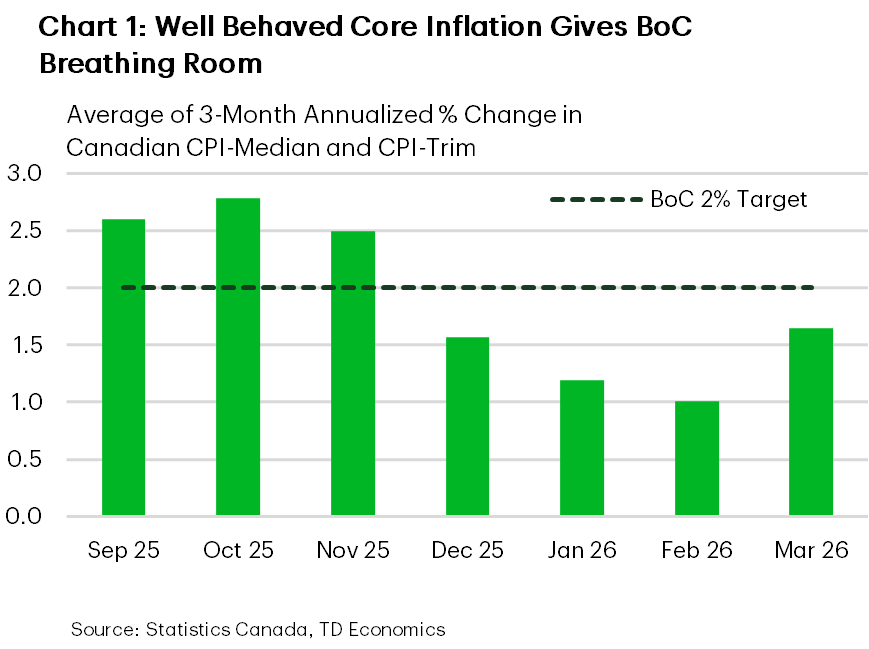
This week’s data offered a largely pre-war read on momentum and an early look at inflation spillovers. Retail sales rose in February and Statistics Canada’s flash estimate points to another gain in March. For the Bank of Canada, though, March CPI was the focal point. Headline inflation rose 0.6 ppts to 2.4%, driven by the recent jump in gasoline prices, but the details were modestly softer than expected. For instance, shorter-term core metrics firmed on the month, but remained below 2%, on average (Chart 1). Gasoline prices have been more contained through April, while the federal government has temporarily removed the excise tax on fuels. Still, year-over-year inflation should get a mechanical lift from base effects tied to the April 2025 carbon-tax cut.
The Bank of Canada’s Q1 Business Outlook Survey (BoS) was conducted largely before the war, with only a smaller share of responses collected afterward. Pre-war results showed sentiment improving as firms are adjusting to U.S.–Canada trade frictions. In the background, the CUSMA review is now underway. U.S. and Canadian officials flagged several irritants this week - including U.S. tariffs on Canadian aluminum/steel/autos/lumber and provincial restrictions on U.S. alcohol sales - that will shape negotiations. Multiple parties also suggested the original July 1 deadline is unlikely to be met.
Firms surveyed post-war in the BoS reported only modest impacts on activity measures so far, but flagged rising input costs. The ability of firms to pass through higher costs was mixed, constrained by lackluster demand and increased competition.
Next week brings the release of the federal government’s Spring Economic Update. Last November’s budget pegged the FY 2026/27 deficit at a lofty 2.0% of GDP. This shortfall would also be at the higher end compared to provincial expectations this budget season. However, this year’s outlook for nominal GDP (which drives government revenues) will likely be revised up relative to last November. The update may also be light on substantial net new measures, as several had already been announced, like the grocery rebate top-up.
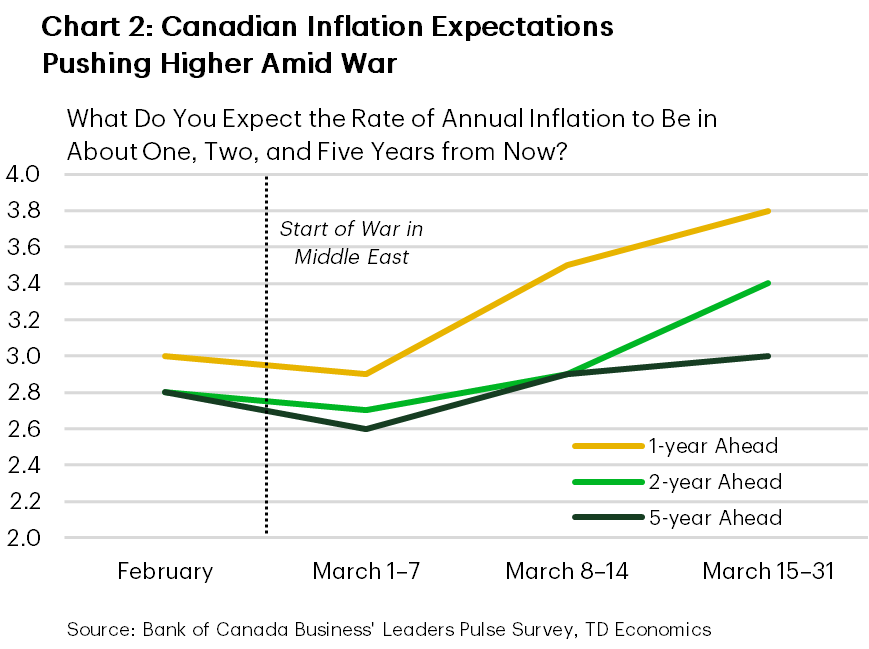
Attention turns to the Bank of Canada’s rate decision next week. The Bank is widely expected to stay on hold - our call as well. With the economic fallout from the war still highly uncertain, it would be premature to pivot from a hold, particularly with core inflation still well behaved. That said, the BoS points to some upward drift in shorter-term inflation expectations, though long-term measures remain well anchored (Chart 2). Expect the Bank to stress its willingness to act as needed to keep expectations anchored.
U.S. – Markets Jitter, Prices Bite
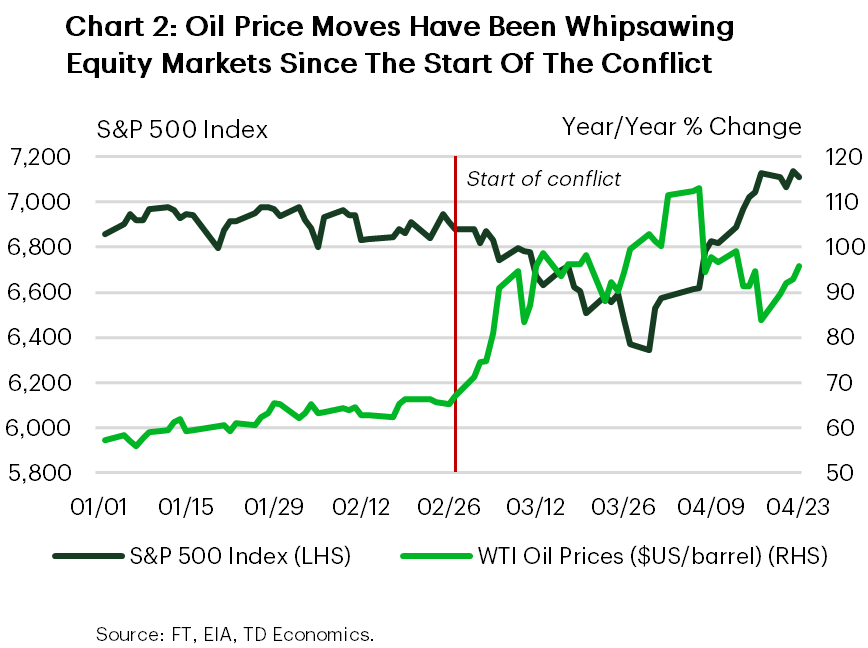
As the Iran conflict approaches the two month mark, financial markets remained highly sensitive to signals around energy supply risks. Early in the week, Iran announced that the Strait of Hormuz would be reopened to commercial shipping vessels during a newly brokered ceasefire, triggering a sharp pullback in oil prices and a relief rally in risk assets. WTI crude fell into the low $80s per barrel range, while U.S. equities moved to new highs as immediate worst case supply scenarios were priced out (Chart 1). That said, reporting around actual shipping flows suggested that conditions on the ground were uneven. As a result, while near term fears eased, geopolitical risks remain elevated and sentiment fragile, leaving markets vulnerable to renewed volatility should tensions re escalate.
U.S. economic data this week offered a reminder that domestic momentum has not yet broken down. Retail and food services sales rose 1.7% in March, driven largely by a surge in gasoline prices, but importantly, real (inflation adjusted) spending also increased a solid 0.8%. Core retail sales excluding gasoline, autos, and building materials posted broad-based gains, suggesting that households have not yet pulled back meaningfully on goods consumption. One area of softness was spending at restaurants, which was little changed on the month, highlighting some emerging price sensitivity among consumers.
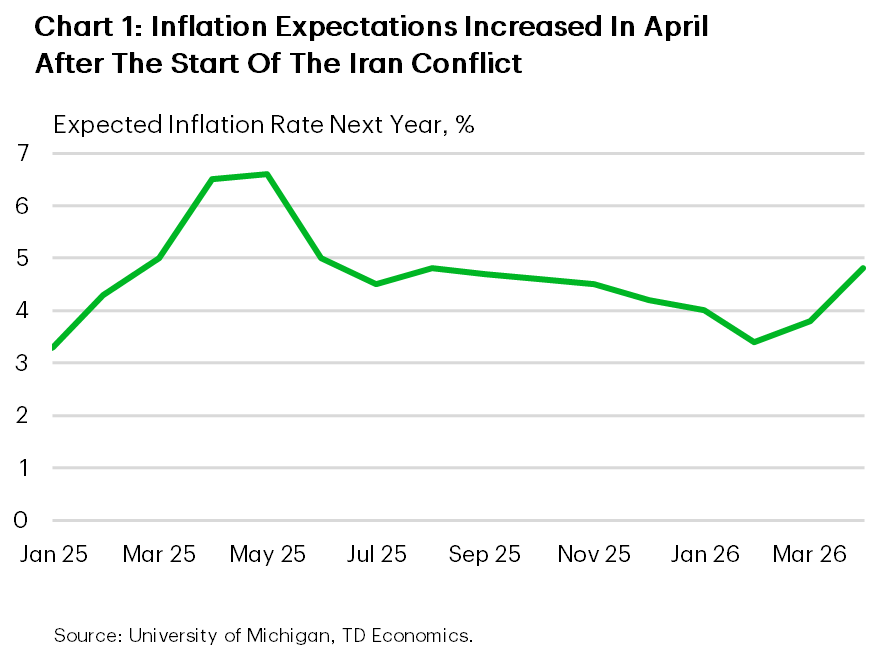
Forward-looking indicators painted a more mixed picture. The latest U.S. PMI readings showed business activity recovering modestly in April after stalling in March, with manufacturing rebounding more strongly than services. However, the rebound was accompanied by worsening delivery times and a sharp increase in input and output prices, reflecting ongoing supply disruptions tied to the conflict. Firms reported precautionary stock building and rising costs, reinforcing concerns that inflation pressures could re-intensify. The University of Michigan survey released today showed inflation expectations over the next year rising sharply, a key indicator energy-driven price worries are becoming more entrenched (Chart 2).
Markets are also increasingly focused on the Federal Reserve policy backdrop. Kevin Warsh’s confirmation hearing this week underscored uncertainty around the future policy framework, with investors parsing how shifts in leadership could influence the Fed’s reaction function at a time when inflation and growth risks are pulling in opposite directions. While Warsh’s confirmation by the Senate Banking Committee was uncertain amid the ongoing DOJ investigation of Chair Powell, headlines on Friday morning suggested the charges had been dropped. This clears a path for Warsh’s confirmation, which means next week’s interest rate announcement will likely be Jerome Powell’s last as chair. Looking ahead, next week’s data calendar is heavy, with personal income and PCE inflation, first quarter GDP, and ISM surveys all due. Together, these releases will help determine whether the economy is slowing enough to offset renewed price pressures.
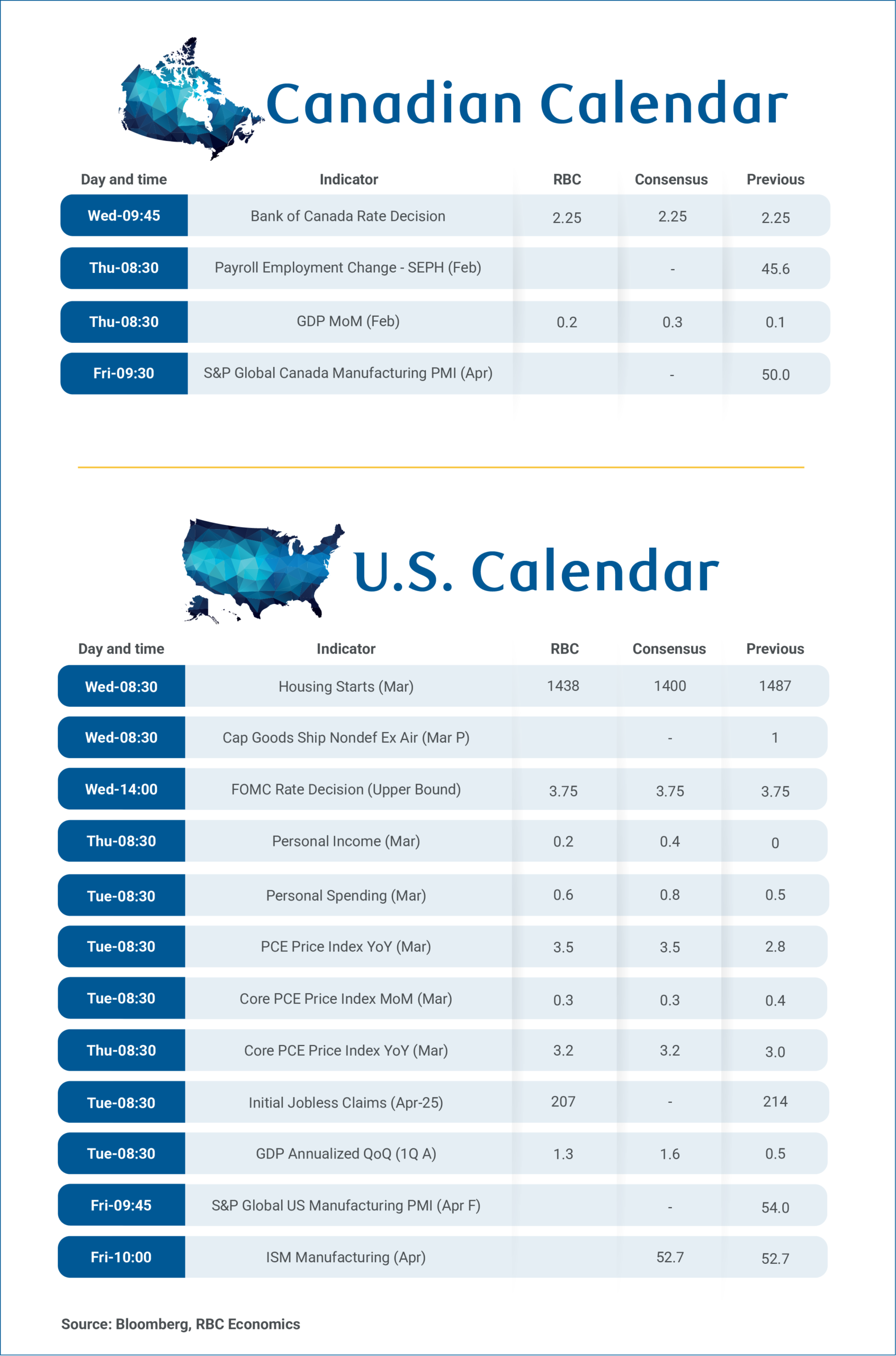
Bank of Canada Expected to Keep Rates Unchanged as GDP Tracks Modest Growth
The focus will be on the Bank of Canada’s decision on interest rates on Wednesday amid rising consumer prices, followed February’s gross domestic product print on Thursday.
We expect the BoC will hold interest rates unchanged for a fourth consecutive meeting, but policymakers will be watching the impact of higher energy prices on inflation closely. Headline CPI growth looks likely to rise above the 1% to 3% inflation target range in April for the first time since December 2023.
But there is nothing that BoC interest rate policy can do to influence the global price of oil. And lags in the impact of interest rates on the economy mean the central bank needs to set monetary policy based on where inflation will be in the future, not just where it is today.
We expect the BoC will be cautious about adding to near-term affordability challenges created by a supply-driven surge in fuel costs as long as inflation expectations and broader inflation pressures (outside of energy price increases) remain contained.
Inflation expectations did edge higher in the BoC’s Business Outlook Survey, but further signs of easing in “core” measures in March should leave the central bank flexibility to focus on incoming data against its recent projections.
Q1 GDP growth is tracking broadly in line with the Bank’s January forecast with recent data pointing to a modest pickup in momentum following a softer start to the year. Labour market conditions have also shown signs of stabilization, but with the unemployment rate still at levels that wouldn’t imply underlying inflation pressures building.
This combination suggests limited urgency for further policy adjustment in the near term. Our base case forecast assumes rates remain on hold through 2026 with gradual increases beginning in 2027 as the economy continues to normalize.
Growth in goods and services to hold up GDP
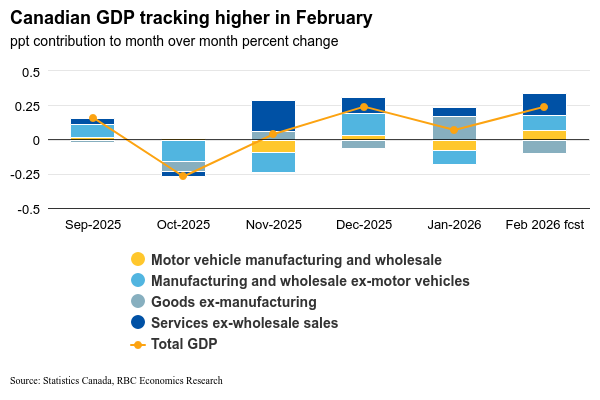
We expect real GDP to increase by 0.2% in February in line with Statistics Canada’s advance estimate. Industry data points to continued growth in goods and services sectors with manufacturing and wholesales recovering as earlier auto production disruptions faded. Retail volume also continued to increase in the month (+0.3%), highlighting ongoing resilience in consumer spending.
Partially offsetting these gains is non-conventional oil and gas extraction in Alberta that appears to have pulled back in February. Housing-related activity also remained a drag with home resales continuing to decline, albeit at a slower pace.
Early indicators for March suggest growth momentum has been maintained into the end of Q1. Hours worked edged higher by 0.2%, alongside other signs of steady economic activity. Advance manufacturing sales rose 3.5% in March—in part reflecting higher petroleum prices, but also consistent with further recovery in auto production from earlier disruptions. Excluding petroleum and related products, advance wholesale sales also rose 1.3%, driven by higher machinery, equipment, and supplies sales
Taken together, data for Q1 are tracking between our forecast of 1.3% annualized growth and the BoC’s January projection of 1.8%.
U.S. Fed also seen on hold
The U.S. Fed will also be watching the impact of the conflict in the Middle East on inflation closely but is expected to leave interest rates unchanged for now. Higher oil prices are putting pressure on both ends of the Fed’s mandate – higher gasoline prices are cutting into household purchasing power (threatening to slow consumer spending, with negative implications for labour markets) but also pushing headline inflation higher. And broader core inflation measures in the United States remain elevated with the core PCE deflator expected to rise to 3.2% year-over-year in March. We continue to expect the central bank to hold interest rates at current levels through the end of this year.
- We expect U.S. GDP rose 1.3% (annualized rate) in Q1 following a 0.5% increase in Q4. Consumer spending growth appears to have slowed from 1.9% in Q4, but government spending likely rebounded following a drop in Q4 due to a federal government shutdown, and business investment likely continued to rise.
- We expect a 0.6% increase in March personal spending, but with much of the gain reflecting increased prices (surge in gasoline prices due to conflict in the middle east.) We look for real consumer spending to edge up 0.2%. Both headline and core PCE price deflator growth is expected to tick higher on a year-over-year basis in March.