

Sample Category Title
Sunset Market Commentary
Markets
EMU PMI’s confirmed the economy is gradually leaving contraction/stagnation territory that reigned in in the second half of last year and during the first months of 2024. The composite output index rose from 50.3 in March to 51.4 in April, the second consecutive reading >50 after 9 months in contraction territory and the best level since May last year. The rise in de headline index still hides divergent sector performances. Activity in the services sector accelerated to a 52.9 from 51.5 and the manufacturing index declined further from 46.1 to 45.6 but with a moderation in the downturn. Job growth accelerated and business confidence remained elevated by recent standards. With respect to inflation, price pressures picked up across the eurozone, often linked to higher wages. Input costs and selling prices also rose at faster rates, reflecting stubborn price pressures in the service sector. Regarding individual countries, Germany returned to growth (composite PMI 50.5) for the first time in 10 months. France stranded at 49.9. EMU bond markets initially reacted in a guarded way, but yields later in de session gradually turned north again. EMU swap yields added between 1.5 bps (2-y) and 2.5 bps (10-y). US yields also added between 1.5 (2-y) and 4 bps (30-y) going into the publication of the US PMI’s. Gilts underperform with yields rising up to 8 bps (5-y). The April composite PMI also improved more than expected (54.0 from 52.8). However, the rise in UK yields mostly occurred this afternoon as BoE chief economist Pill kept a balanced approach of the timing of BoE rate cuts (MPC remains focused on inflation, erring to the side of caution on rate cuts). Equities perform well (Eurostoxx 50 +1.0%, S&P 500 + 0.3%). On FX markets, EUR/USD briefly tested the 1.0695 resistance (previous YtD low) after the release of the first EMU PMI’s. However, gains initially were difficult to maintain. USD/JPY was blocked in an extremely tight range just below the 155 big figure as Japanese officials including Fin Min Suzuki stepped up verbal interventions. Sterling gained modest ground on the a strong PMI and higher yields. Even so, EUR/GBP still holds above the 0.86 barrier (0.861).
At the moment of concluding this report, US April composite PMI surprisingly dropped from 52.1 to 50.9 with both manufacturing (49.9 from 51.9) and services (50.9 from 51.7) contributing to the decline. Yields (US and EMU) return earlier gains. The dollar makes a step backward too, with EUR/USD revisiting the 1.0695 area.
News & Views
The UK’s Debt Management Office beefed up its debt issuance plans for the 2024-2025 fiscal year by £12.4bn. Total issuance is forecast to be £277.7bn, the second-largest on record. The announcement followed the release of the Office for National Statistics of the 2023-2024 budget deficit which showed a bigger than earlier forecasted shortfall of £120.7bn or 4.4% of GDP. The Office for Budget Responsibility last month estimated a deficit for FY 23-24 of £114.1bn (4.2% of GDP) with lower receipt from income tax and national insurance contributions explaining for most of the gap. The additional borrowing requirement will be met mostly by increased short-dated (+£5.4bn) and medium-term gilts (£3.9bn). The numbers highlight the budgetary challenges the UK faces and undermine the Sunak government’s wish list of tax cuts in the run-up to the elections this year. A recent YouGov voting intention poll (Apr 16-17) showed Sunak’s Conservative Party trailing the Labour party by a significant margin (21% vs 44%). Reform UK – the former Brexit party – gained traction from end 2023 on, securing a third place with 14% of the votes.
Reuters citing two government officials reported that Greece plans an early repayment between €2.5 and €5bn of bailout loans to euro area countries, probably in the second half of the year. The loans date back to debt crisis starting in 2010 that engulfed the EMU. The IMF and euro area countries lent Greece some €280bn with the former paid back two years ahead of schedule in 2022. But +/- 70% of the country’s debt is still in hands outside the public. One of the officials noted that the early repayment would make room for more bond issuances without increasing its debt pile while simultaneously adding liquidity to a shallow Greek bond market. The country today announced a 30-year bond sale for the first time since 2021. It last raised €4bn from the public in January and is targeting a total of €10bn for the whole year.
Graphs
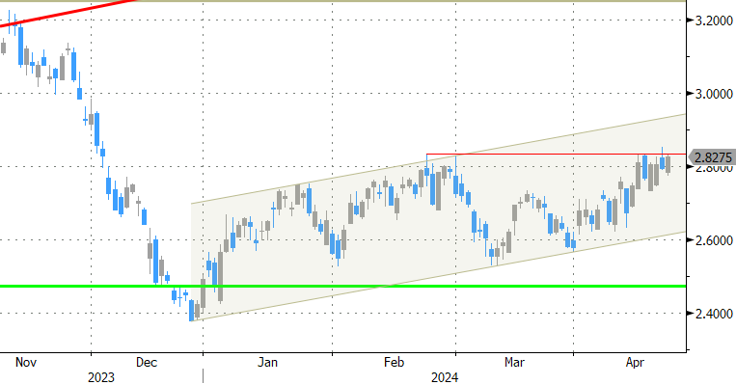
EMU 10-yr swap continues challenging YTD top as EMU economy is leaving stagnation territory.
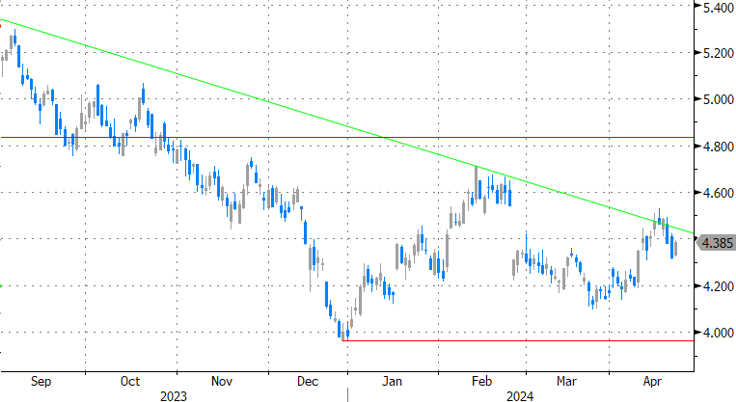
UK 2-y yield rebounds as BOE chief Economist Pill advocates caution on interest rate cuts as inflation risks persist.
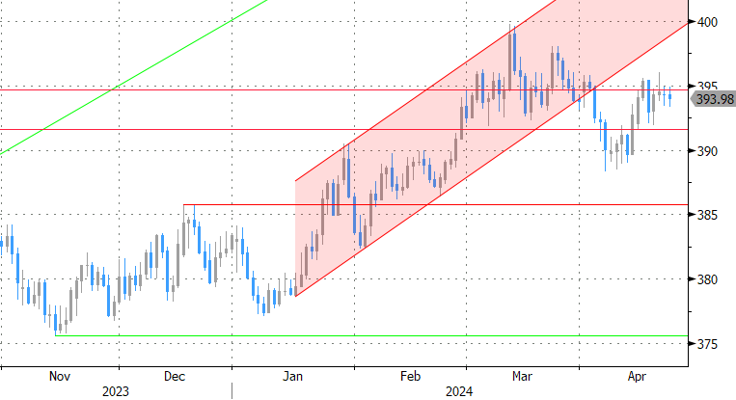
Forint holding stable near EUR/HUF 394 as MNB slows pace of rate cuts to 50 bps steps (7.75% from 8.25% today).
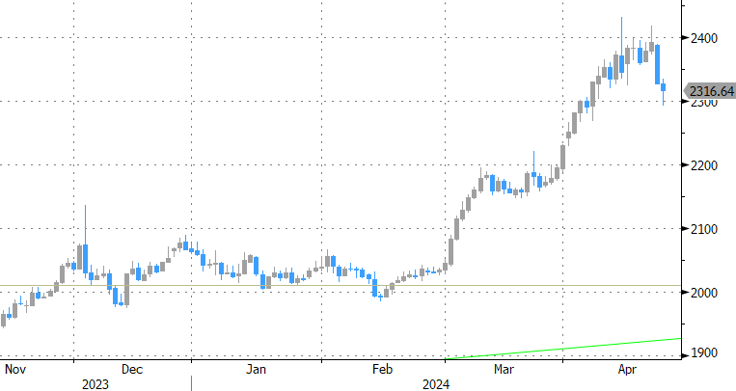
Gold correcting of top levels as geopolitical uncertainty eases
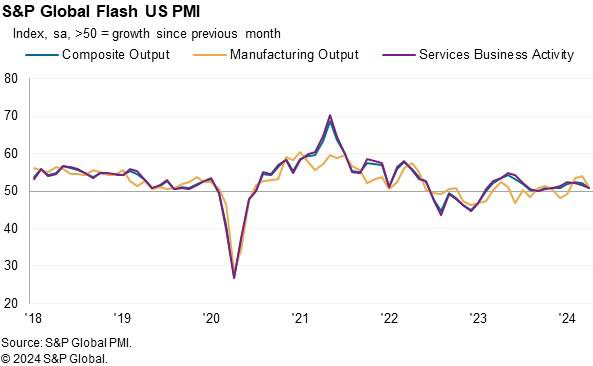
US PMI composite falls to 50.9, economic upturn loses momentum
US PMI Manufacturing fell from 51.9 to 49.9 in April. PMI Services fell from 51.7 to 50.9. PMI Composite fell from 52.1 to 50.9.
Chris Williamson, Chief Business Economist at S&P Global Market Intelligence said:
"The US economic upturn lost momentum at the start of the second quarter, with the flash PMI survey respondents reporting below-trend business activity growth in April. Further pace may be lost in the coming months, as April saw inflows of new business fall for the first time in six months and firms' future output expectations slipped to a five-month low amid heightened concern about the outlook.
"The more challenging business environment prompted companies to cut payroll numbers at a rate not seen since the global financial crisis if the early pandemic lockdown months are excluded.
"The deterioration of demand and cooling of the labor market fed through to lower price pressures, as April saw a welcome easing in rates of increase for selling prices for both goods and services.
"Notably, the drivers of inflation have changed. Manufacturing has now registered the steeper rate of price increases in three of the past four months, with factory cost pressures intensifying in April amid higher raw material and fuel prices, contrasting with the wage-related services-led price pressures seen throughout much of 2023."
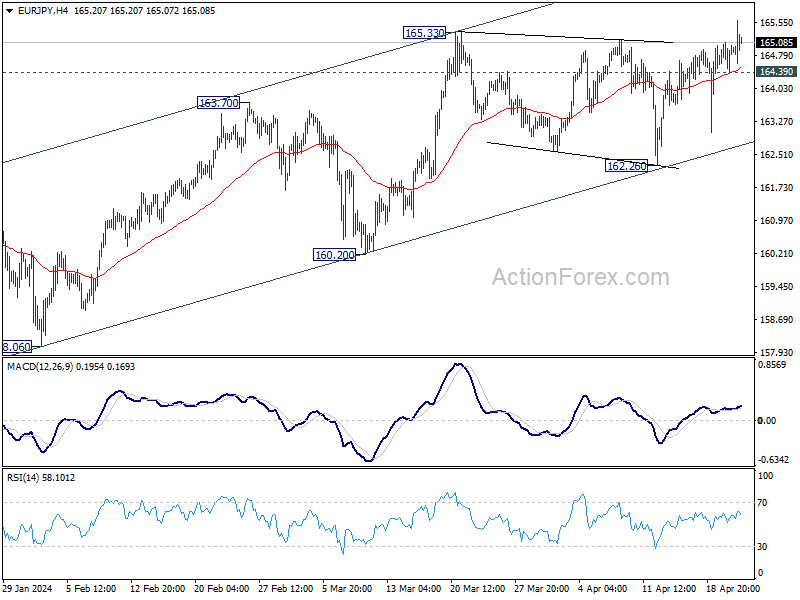
EUR/JPY Mid-Day Outlook
Daily Pivots: (S1) 164.55; (P) 164.82; (R1) 165.25; More...
EUR/JPY's breach of 165.33 resistance argues that larger up trend is resuming. Intraday bias is back on the upside. Further rally would be seen to 169.96 key resistance next. Nevertheless, break of 164.39 minor support will turn intraday bias neutral again first.
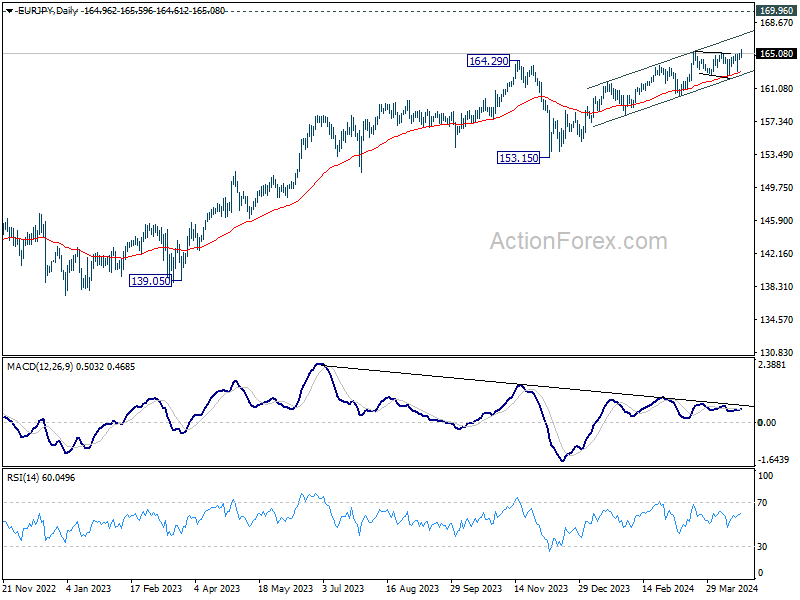
In the bigger picture, current rally is part of the up trend from 114.42 (2020 low), which is still in progress. Next target is 169.96 (2008 high). Break of 160.20 support is needed to be the first sign of medium term topping. Otherwise, outlook will stay bullish in case of retreat.
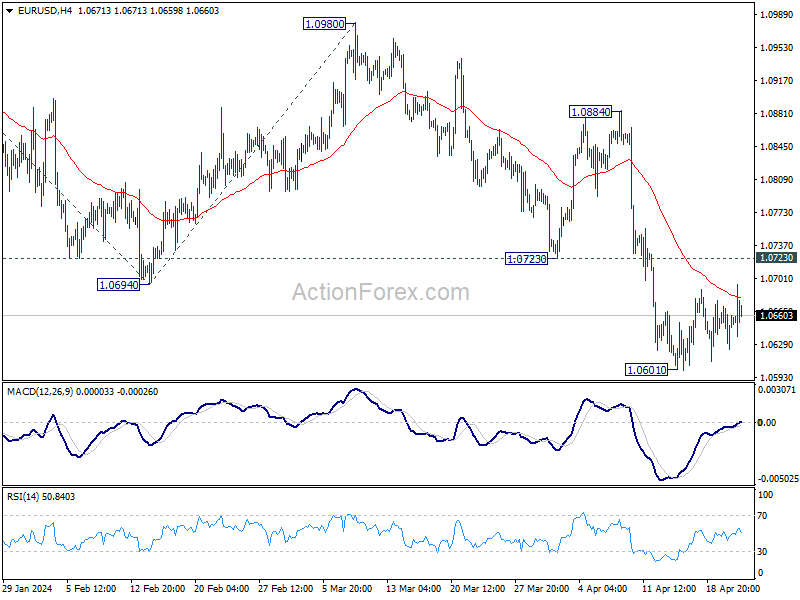
EUR/USD Mid-Day Outlook
Daily Pivots: (S1) 1.0628; (P) 1.0650; (R1) 1.0675; More...
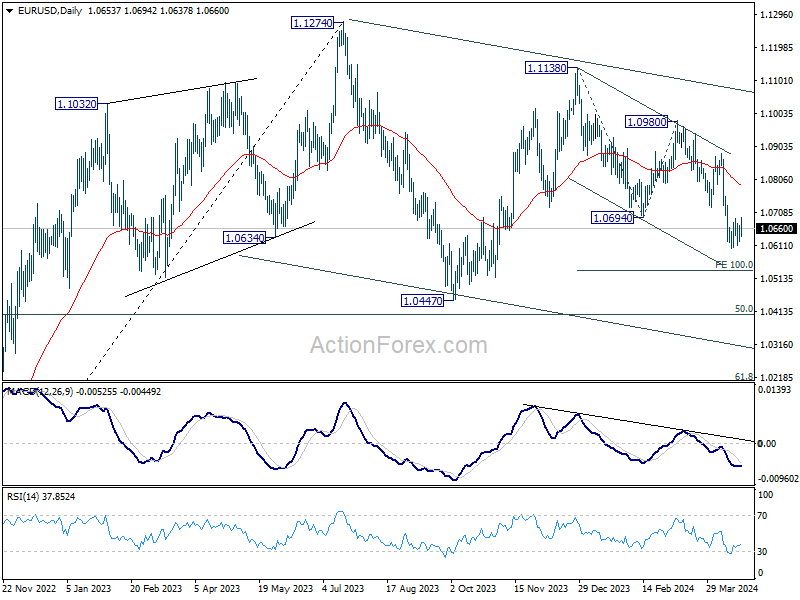
Range trading continues in EUR/USD and intraday bias remains neutral. Upside of recovery should be limited by 1.0723 support turned resistance. Break of 1.0601 will resume the fall from 1.1138 to 100% projection of 1.1138 to 1.0694 from 1.0980 at 1.0536 next.
In the bigger picture, price actions from 1.1274 are viewed as a corrective pattern to rise from 0.9534 (2022 low). Current fall from 1.1138 is seen as the third leg. While deeper decline is would be seen to 1.0447 and possibly below, Strong support should emerge from 61.8% retracement of 0.9534 to 1.1274 at 1.0199 to complete the correction.
USD/CHF Mid-Day Outlook
Daily Pivots: (S1) 0.9103; (P) 0.9113; (R1) 0.9131; More....
USD/CHF is still bounded in consolidation from 0.9151 and intraday bias stays neutral. Further rally is expected as long as 0.8996 support holds. Break of 0.9151 will resume the larger rise from 0.8332 to 0.9243 resistance. However, firm break of 0.8996 will turn bias to the downside for 55 D EMA (now at 0.8953).
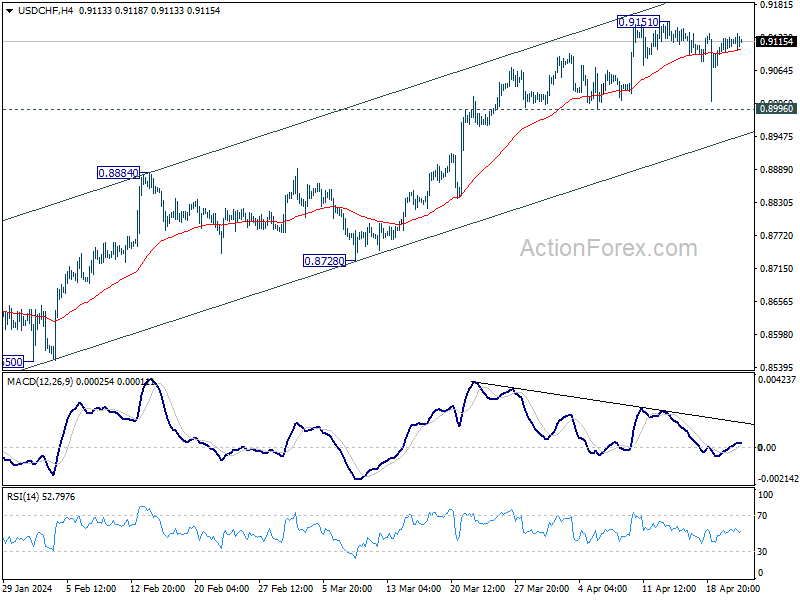
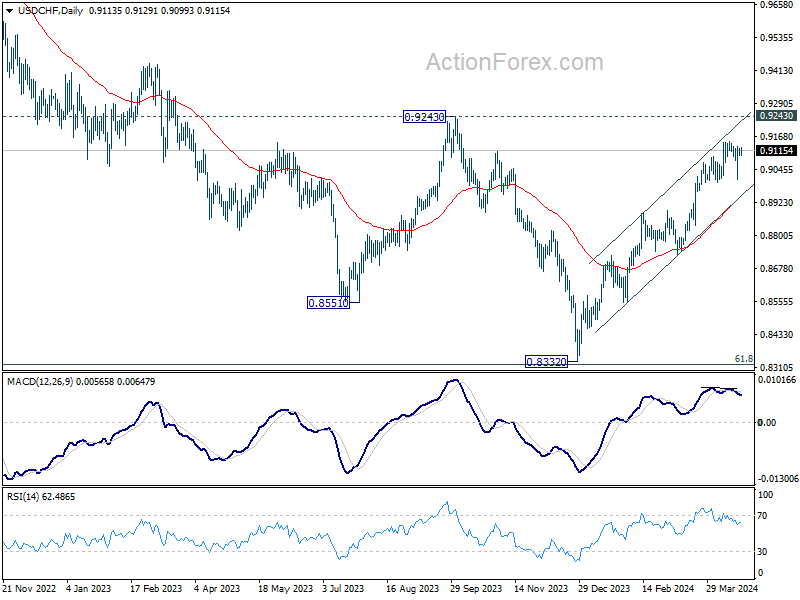
In the bigger picture, price actions from 0.8332 medium term bottom as tentatively seen as developing into a corrective pattern to the down trend from 1.0146 (2022 high). Further rise would be seen as long as 0.8728 support holds. But upside should be limited by 0.9243 resistance, at least on first attempt. However, decisive break of 0.9243 will argue that the trend has already reversed and turn medium term outlook bullish.
USD/JPY Mid-Day Outlook
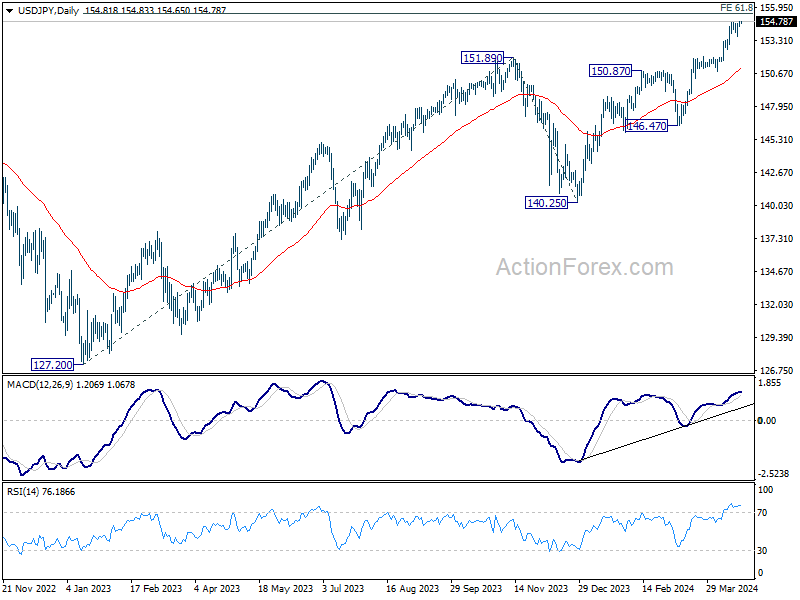
Daily Pivots: (S1) 154.57; (P) 154.71; (R1) 154.98; More...
Intraday bias in USD/JPY remains mildly on the upside as up trend is extending. However, considering bearish divergence condition in 4H MACD, strong resistance should be seen from 155.20 fibonacci level to bring correction on first attempt. On the downside, break of 153.58 support will turn bias to the downside, for deeper pull back to 55 D EMA (now at 151.10).
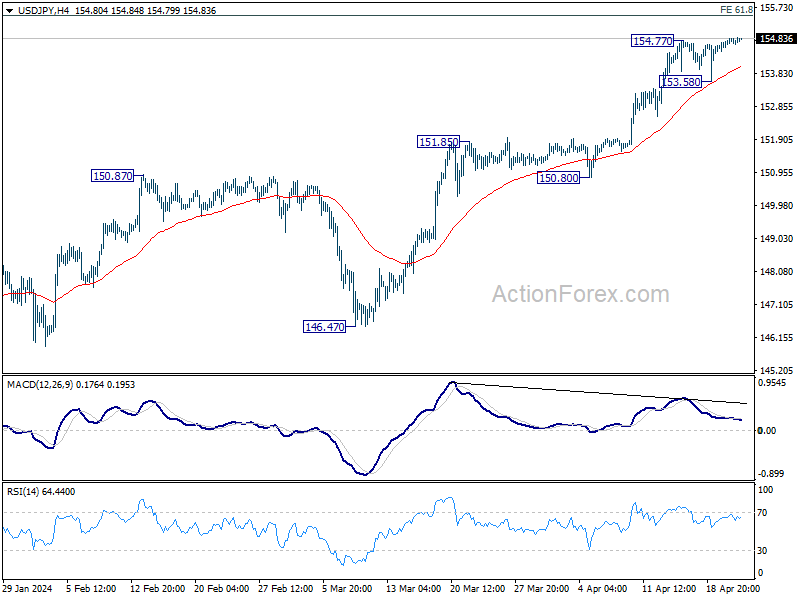
In the bigger picture, current rise from 140.25 is seen as the third leg of the up trend from 127.20 (2023 low). Next target is 61.8% projection of 127.20 to 151.89 from 140.25 at 155.20. Outlook will remain bullish as long as 146.47 support holds, even in case of deep pullback.
GBP/USD Mid-Day Outlook
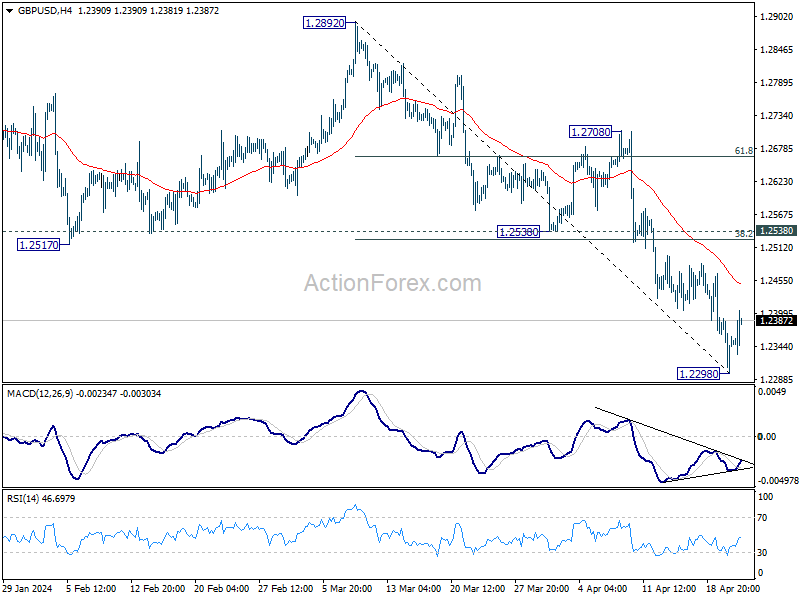
Daily Pivots: (S1) 1.2303; (P) 1.2347; (R1) 1.2395; More...
Intraday bias in GBP/USD is turned neutral first with current recovery, and some consolidations would be seen first. Upside of recovery should be limited by 1.2538 support turned resistance. On the downside, below 1.2298 will resume the fall from 1.2892 to 1.2036 support next.
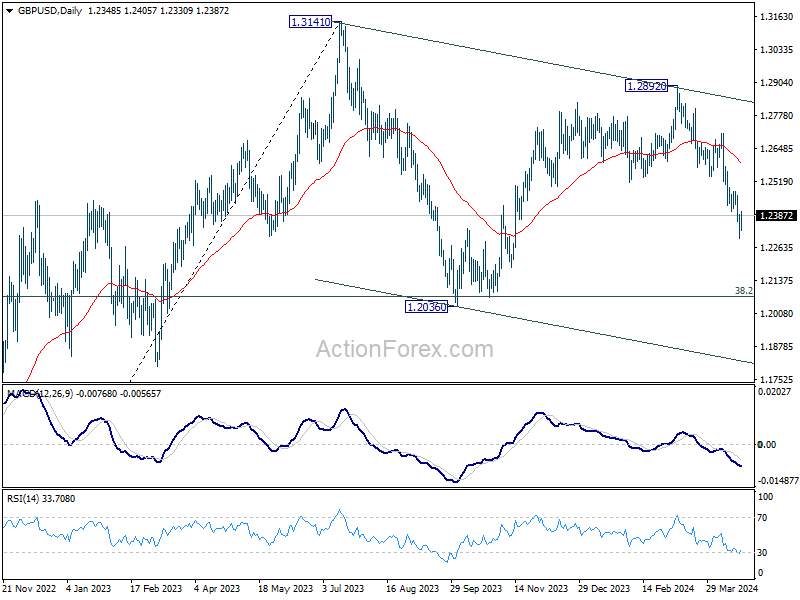
In the bigger picture, price actions from 1.3141 medium term top are seen as a corrective pattern to up trend from 1.0351 (2022 low). Fall from 1.2892 is seen as the third leg. Deeper decline would be seen to 1.2036 support and possibly below. But strong support should emerge from 61.8% retracement of 1.0351 to 1.2452 at 1.1417 to complete the correction.
Sterling and Euro Rebound on PMIs, But No Turn Around Yet
Sterling and Euro rebound broadly today, bolstered by encouraging PMI data that suggests continued recovery momentum in both UK and Eurozone. For the Pound, the latest PMI readings indicate that UK's recovery from last year's recession is gathering pace. Meanwhile, rising cost pressures, particularly in the services sector, are heightening concerns about the sustainability of disinflation progress. These concerns are echoed by some BoE officials, who appear hesitant to consider interest rate cuts in the near future due to the persistent inflationary pressures.
Similarly, the Euro found support from the Eurozone PMI data, which highlighted strengthening recovery led by the services sector and an improved economic outlook for Germany and France. While a rate cut in June is still considered "failt accompli", ECB may proceed more cautiously with policy easing thereafter.
Meanwhile, Australian Dollar is ranking as the third strongest performer, with its rise similarly supported by encouraging PMI data. On the other end of the spectrum, New Zealand Dollar is the day's weakest at this point, with Canadian Dollar and Dollar also underperforming. Japanese Yen and Swiss Franc are holding middle positions.
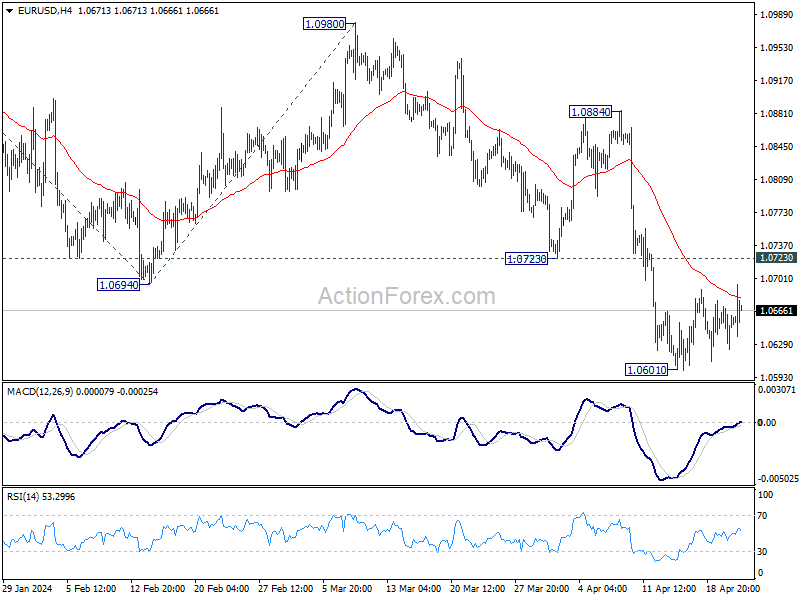
Technically, EUR/USD's price actions from 1.0601 is still seen as a corrective pattern for now, despite today's recovery. Upside is expected to be limited by 1.0723 support turned resistance to bring resumption of fall larger decline at a later stage. However, firm break of 1.0723 will confirm short term bottoming and bring stronger rebound instead.
In Europe, at the time of writing, FTSE is up 0.18%. DAX is up 1.13%. CAC is up 0.55%. UK 10-year yield is up 0.0746 at 4.278. Germany 10-year yield is up 0.031 at 2.519. Earlier in Asia, Nikkei rose 0.30%. Hong Kong HSI rose 1.92%. China Shanghai SSE fell -0.74%. Singapore Strait Times rose 1.47%. Japan 10-year JGB yield closed flat at 0.886.
BoE's Pill: Rate cut somewhat closer but still some way off
BoE Chief Economist Huw Pill indicated in a speech today that while a rate cut is "somewhat closer" now, it remains "some way off" in his baseline scenario.
Pill emphasized that the MPC's evaluation of the inflation outlook is concentrated on the "persistent component" of consumer price inflation. This focus includes three critical indicators: services price inflation, pay growth, and the tightness of the UK labor market.
Pill noted current signs of "downward" shift in the persistent components of inflation dynamics. However, he also highlighted that there is still a "reasonable way" to go before he can be convinced that the underlying inflation has stabilized at rates consistent with achieving the 2% inflation target sustainably.
Given these conditions, Pill underscored the need for the MPC to "maintain a degree of restrictiveness" in monetary policy to effectively "squeeze the persistent component out of the system."
BoE's Haskel: Inflation outlook hinges on quick reduction of job vacancies to unemployment ratio
During a seminar today, BoE MPC member Jonathan Haskel emphasized the critical role of the labor market in shaping the UK's inflation outlook.
Haskel pointed out that the labor market tightness, specifically the ratio of job vacancies to unemployment, is a key factor in assessing inflationary pressures. Although this ratio is gradually decreasing, Haskel expressed concern over the pace, stating it is "rather slowly" and it remains uncertain if it is sufficient to align inflation with the target levels.
"The persistence of inflation depends a lot on how quickly that ratio comes down," Haskel remarked, underscoring the direct impact of labor market conditions on inflation trends.
UK PMI composite rises to 54, sustainable path to target inflation not achieved yet
UK PMI Manufacturing fell from 50.3 to 48.7 in April, below expectation of 50.2. PMI Services rose from 53.1 to 54.9, above expectation of 50.2, and an 11-month high. PMI Composite rose from 52.8 to 54.0, also an 11-month high.
Chris Williamson, Chief Business Economist at S&P Global Market Intelligence, stated that UK economy's rebound from last year's recession "continued to gain momentum". He noted that GDP is now growing at an increased quarterly rate of 0.4%, up from 0.3% in the first quarter.
This economic upturn has led to increased hiring, driven further by the rise in the National Living Wage in April. However, these factors have also escalated cost pressures significantly. Although the inflation of selling prices has moderated slightly, the combination of rising costs and solid demand could lead businesses to hike prices in the near future.
"While the improving economic recovery picture is welcome news, the upward pressure on inflation will add to concerns that a sustainable path to below target inflation has not yet been achieved," he added.
ECB's de Guindos: June cut a failt accompli, uncertain afterwards
In an interview with Le Monde, ECB Vice President Luis de Guindos indicated barring any surprises, a June rate cut is a "fait accompli."
"If things move in the same direction as they have in recent weeks, we will loosen our restrictive monetary policy stance in June," he said.
However, looking beyond June, the Vice President expressed considerable caution due to heightened levels of uncertainty. "I'm inclined to be very cautious," said de Guindos.
Eurozone PMI composite rises to 51.4, recovery to sustain
Eurozone's PMI Manufacturing fell from 46.1 to 45.6 in April, below expectation of 46.5. PMI Services rose from 51.5 to 52.9, above expectation of 51.8, an 11-month high. PMI Composite rose from 50.3 to 51.4, also an 11-month high.
Cyrus de la Rubia, Chief Economist at Hamburg Commercial Bank, noted that Eurozone had a "good start" to Q2, with GDP projected to expand by 0.3%, mirroring the growth rate of the first quarter.
De la Rubia outlined three factors contributing to the sustainability of the recovery. Positive momentum in new business over the past two months has spurred more aggressive hiring policies. Service providers have shown confidence in their pricing power. The recovery in Germany and France, Eurozone's largest economies, have particularly underscored the broader regional trend.
However, the latest figures pose a critical test for ECB on its readiness to cut interest rates in June. The "accelerated increases in input costs", driven by higher oil prices and wages, necessitates close scrutiny. Moreover, the quicker pace at which service sector companies are raising prices suggests that "services inflation will persist".
Despite these inflationary pressures, HCOB still expects an ECB rate cut in June, although de la Rubia expects ECB to proceed with more caution rather than adopting the "pragmatic speed" earlier suggested by Governing Council member François Villeroy de Galhau.
Germany's PMI Manufacturing ticked up from 41.9 to 42.2 in April, below expectation of 42.9. PMI Services jumped from 50.1 to 53.3, well above expectation of 50.5, a 10-month high. PMI Composite rose from 47.7 to 50.5, also a 10-month high.
France's PMI Manufacturing fell from 46.2 to 44.9 in April, below expectation of 46.9. But PMI Services rose from 48.3 to 50.5, above expectation of 49.0, an 11-month high. PMI Composite rose from 48.3 to 49.9, also an 11-month high.
BoJ's Ueda: No preset idea on rate hikes
Addressing the parliament today, BoJ Governor Kazuo Ueda said while changes in inflation projections could necessitate a shift in monetary policy, the BoJ currently has no "preset idea on the specific timing and pace" of rate hikes.
Governor Ueda also reiterated the necessity of maintaining ultra-loose monetary policy for now. He pointed out that trend inflation — price rises driven by domestic demand and assessed through various indicators — is still "somewhat below 2%."
Japan's Suzuki points to US-South Korea trilateral meeting as groundwork for Yen intervention
Japan's Finance Minister Shunichi Suzuki signaled the readiness to address the weakening yen, a pressing issue that has raised substantial concern due to its impact on import costs.
Speaking to the parliament, Suzuki conveyed the unease discussed during last week's trilateral meeting with the US and South Korea. He emphasized the economic strain caused by the depreciating currency, stating there was "strong concern" about how a weak yen inflates the cost of imports, stressing the economy and affecting price levels domestically.
Suzuki's remarks indicated that preparations are underway to counteract Yen's decline. "I won't deny that these developments have laid the groundwork for Japan to take appropriate action," he noted, "though I won't say what that action could be".
Japan's PMI Composite climbs to 52.6, weak Yen contributes to intensifying price pressures
Japan's PMI Manufacturing rises from 48.2 to 49.9 in April, above expectation of 48.0, signalling a near-stabilization of manufacturing business conditions. PMI Services rises from 54.1 to 54.6, highest since May 2023. PMI Composite also rose from 51.7 to 52.6, matching the joint-fastest pace set in nearly a year.
Jingyi Pan, Economist Associate Director at S&P Global Market Intelligence, noted that while the service sector continues to be the main driver of growth, there are positive developments in manufacturing as well, where the decline in output has lessened.
April's data, however, also unveiled "additional signs of intensifying price pressures" which were largely attributed to higher input costs inflation affecting both the goods and services sectors.
Notable factors contributing to these rising costs include increased expenses for materials, energy, and wages, with the "weaker Yen having played a significant part as well". Consequently, businesses have been compelled to pass these increased costs onto their clients, resulting in the "fastest increase in average charges in a year."
Australia's PMI Composite rises to 53.6, RBA might hike again in H2
Australia's PMI Manufacturing has nearly reached the neutral mark in April, jumping from 47.3 to 49.9. PMI Services edged higher from 54.2 to 54.4, contributing to PMI's Composite rise from 53.3 to 53.6, marking a 24-month high and indicating the third consecutive month of expansion.
Warren Hogan, Chief Economic Advisor at Judo Bank, said that Composite PMI has averaged 51.5 over Q1, a substantial improvement from 46.9 average in Q4 2023 and correlates with GDP growth of around 0.6% for the March quarter. Hogan suggested that if this trend persists, GDP growth could accelerate to approximately 0.8% in the following quarter.
The results also suggest a cyclical recovery, rebounding from the consumer-led slowdown experienced in 2023. This recovery appears to be more robust than anticipated by RBA, suggesting that the economy is beginning to "wander off their 'narrow path'". This "narrow path" scenario envisages economic activity remaining subdued to ensure inflation eases back to target by late 2025
"The RBA will likely be concerned that a pick-up in activity, before inflation returns to target, could threaten medium to long-term price stability," Hogan added. "These results are inconsistent with interest rate reductions at any stage in the foreseeable future and raise the risk that the RBA may have to start hiking again at some stage over the back half of 2024."
GBP/USD Mid-Day Outlook
Daily Pivots: (S1) 1.2303; (P) 1.2347; (R1) 1.2395; More...
Intraday bias in GBP/USD is turned neutral first with current recovery, and some consolidations would be seen first. Upside of recovery should be limited by 1.2538 support turned resistance. On the downside, below 1.2298 will resume the fall from 1.2892 to 1.2036 support next.
In the bigger picture, price actions from 1.3141 medium term top are seen as a corrective pattern to up trend from 1.0351 (2022 low). Fall from 1.2892 is seen as the third leg. Deeper decline would be seen to 1.2036 support and possibly below. But strong support should emerge from 61.8% retracement of 1.0351 to 1.2452 at 1.1417 to complete the correction.
Economic Indicators Update
| GMT | Ccy | Events | Actual | Forecast | Previous | Revised |
|---|---|---|---|---|---|---|
| 23:00 | AUD | Manufacturing PMI Apr P | 49.9 | 47.3 | ||
| 23:00 | AUD | Services PMI Apr P | 54.2 | 54.4 | ||
| 00:30 | JPY | Manufacturing PMI Apr P | 49.9 | 48 | 48.2 | |
| 00:30 | JPY | Services PMI Apr P | 54.6 | 54.1 | ||
| 06:00 | GBP | Public Sector Net Borrowing (GBP) Mar | 11.0B | 8.9B | 7.5B | 8.6B |
| 07:15 | EUR | France Manufacturing PMI Apr P | 44.9 | 46.9 | 46.2 | |
| 07:15 | EUR | France Services PMI Apr P | 50.5 | 49 | 48.3 | |
| 07:30 | EUR | Germany Manufacturing PMI Apr P | 42.2 | 42.9 | 41.9 | |
| 07:30 | EUR | Germany Services PMI Apr P | 53.3 | 50.5 | 50.1 | |
| 08:00 | EUR | Eurozone Manufacturing PMI Apr P | 45.6 | 46.5 | 46.1 | |
| 08:00 | EUR | Eurozone Services PMI Apr P | 52.9 | 51.8 | 51.5 | |
| 08:30 | GBP | Manufacturing PMI Apr P | 48.7 | 50.2 | 50.3 | |
| 08:30 | GBP | Services PMI Apr P | 54.9 | 53 | 53.1 | |
| 13:45 | USD | Manufacturing PMI Apr P | 52 | 51.9 | ||
| 13:45 | USD | Services PMI Apr P | 52 | 51.7 | ||
| 14:00 | USD | New Home Sales Mar | 668K | 662K |
Australian Dollar Rises on Strong Economic Indicators
The AUD/USD pair is experiencing upward momentum for the second consecutive day, reaching a one-week high near 0.6453 on Tuesday. This positive movement comes after a period of rapid decline and is supported by encouraging economic data from Australia.
The latest manufacturing PMI report for April significantly contributed to the Australian dollar's appreciation. It showed an increase to 49.9 points, up from 47.3 the previous month. This improvement brings the manufacturing sector close to the critical 50.0 threshold, distinguishing between the industry's growth and contraction. Additionally, the services PMI reported the most robust expansion in the last three months, and the private sector experienced its fastest growth in two years during April.
These robust economic reports not only indicate a resilient economy but also carry pro-inflationary implications. They bolster the outlook that the Reserve Bank of Australia (RBA) may maintain higher interest rates for an extended period to manage inflationary pressures effectively.
Investors will also pay attention to the upcoming release of inflation statistics later in the week, which will provide further insights into the economic factors influencing the RBA's monetary policy decisions.
Moreover, the Australian dollar's gains were further supported by a reduction in investor concerns over geopolitical risks in the Middle East, contributing to a more favourable risk environment.
Technical analysis of AUD/USD
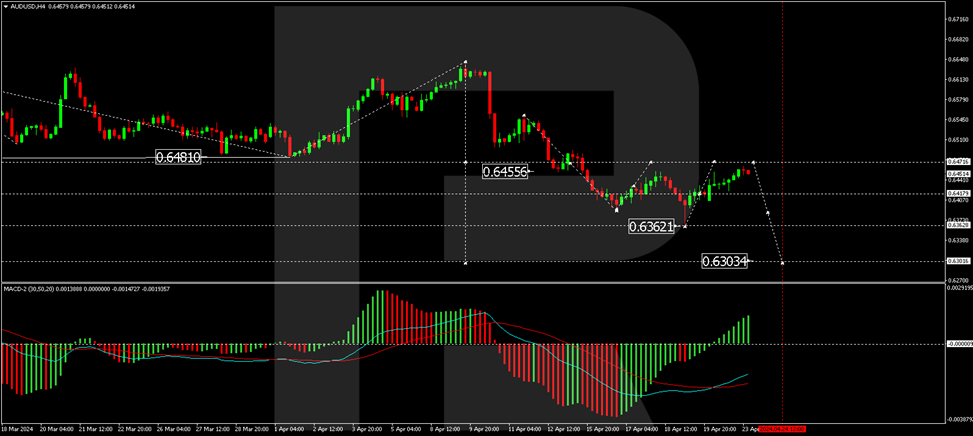
On the H4 chart, the AUD/USD pair completed a declining wave to 0.6362. A corrective movement towards 0.6471 is underway. Upon completion of this correction, a continuation of the downward trend towards 0.6300 is anticipated. The MACD indicator supports this bearish outlook despite its signal line being above zero, which typically suggests growth potential.
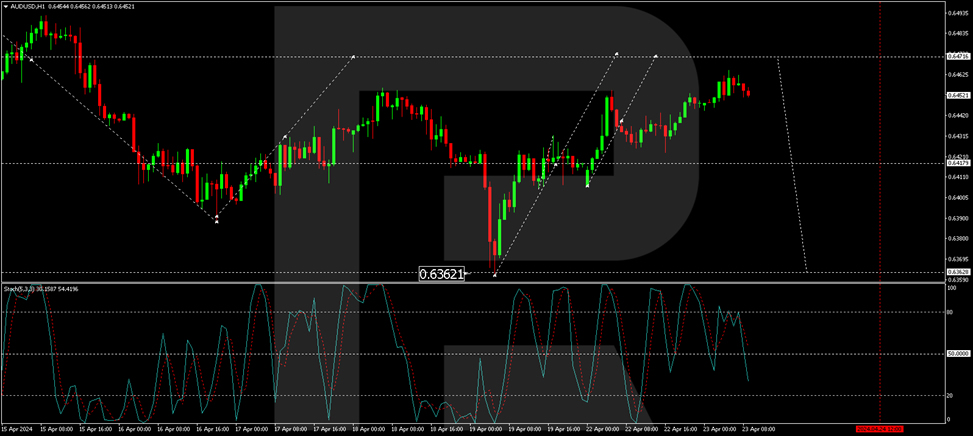
On the H1 chart, a consolidation range has been formed around 0.6417. A breakout above this range could lead to a rise towards 0.6471. Following this peak, a new downward wave to 0.6363 is expected. Breaking below this level may pave the way to reach 0.6300. The Stochastic oscillator, with its signal line currently below 80 and pointing downwards, confirms this potential downward trajectory.
BoE’s Pill: Rate cut somewhat closer but still some way off
BoE Chief Economist Huw Pill indicated in a speech today that while a rate cut is "somewhat closer" now, it remains "some way off" in his baseline scenario.
Pill emphasized that the MPC's evaluation of the inflation outlook is concentrated on the "persistent component" of consumer price inflation. This focus includes three critical indicators: services price inflation, pay growth, and the tightness of the UK labor market.
Pill noted current signs of "downward" shift in the persistent components of inflation dynamics. However, he also highlighted that there is still a "reasonable way" to go before he can be convinced that the underlying inflation has stabilized at rates consistent with achieving the 2% inflation target sustainably.
Given these conditions, Pill underscored the need for the MPC to "maintain a degree of restrictiveness" in monetary policy to effectively "squeeze the persistent component out of the system."