Sample Category Title
ECB Bank Lending Survey Will Give Insights into Credit Conditions
In focus today
Today, we look out for the ECB bank lending survey for Q1 2024. The survey gives information on euro area bank lending and credit conditions, which is an important input for the growth outlook. In the latest survey, banks still reported a net tightening of credit standards but to a smaller extent than previously. A continuation of this development would support the manufacturing sector in the coming quarters. The survey will also shed light on household lending and the strength of private consumption.
We also get NFIB's Small Business Survey from the US. Over the past months, firms' optimism has remained at low levels but on a more positive note, fewer companies have reported trouble finding new employees.
In Sweden, Riksbank Deputy Governor Flodén speaks about the economy and monetary policy at 12.00 CET. We expect him to continue the common recent approach that a weak Krona and/or delayed rate cuts form major central banks may affect the timing Riksbank's decision to start the easing cycle.
Overnight, the Reserve Bank of New Zealand (RBNZ) is widely expected to keep its monetary policy unchanged, according to both analyst consensus and the markets.
Economic and market news
What happened overnight
US 2Y and 10Y yields gained during yesterday's session as markets weighed the recent strong macro data and hawkish speeches by Fed officials. Futures pricing now indicates that markets expect 60bp of rate cuts this year, less than the 75bp projected by the Fed earlier this year.
The JPY slid against the USD overnight with the cross hitting 151.88 as of this morning, close to the 152-level watched by markets. Japanese Finance Minister Suzuki warned they would be ready to act against potential excessive moves in the currency. Previously, the Finance Ministry has intervened to strengthen the JPY when it has slid towards 152, which it did in September and October 2022.
What happened yesterday
Both hard and soft data releases from the euro area surprised to the upside, with data showing German industrial output expanded 2.1% m/m in February (cons: 0.5%). This was mainly due to construction and energy-intensive sectors such as auto, which have been hit particularly hard during the spike in energy prices and borrowing costs, and so have some catchup to do. The Sentix survey of Eurozone investor morale improved to -5.9 (prev: -10.5) in April, indicating investors have become less pessimistic about the economic recovery.
In the geopolitical space, Janet Yellen gave a speech in China where she voiced concerns about China's large subsidies for Greentech such as solar panels and EVs, stating that she would not rule out tariffs in response.
Equities: Global equities were higher yesterday with US lagging after the strong performance Friday. There was big dispersion between sectors yesterday with half of the sectors higher and half of the sectors lower. Once again, value cyclicals and small caps outperformed which has been greatly backed by data releases in April including the data out yesterday, German industrial production and Sentix. It is quite rare to see so many macro indicators supporting a positive equity outlook at the same time. In US yesterday, Dow -0.03%, S&P 500 -0.04%, Nasdaq +0.03%, and Russell 2000 +0.5%. Asian markets are mostly higher this morning with South Korea and Mainland China going against the trend. US futures marginally higher while European futures are lower.
FI: Global bond yields continue to rise as macroeconomic data proves resilient to the tight monetary policy. Hence, the repricing of monetary policy continues and there was a bearish flattening of the yield curves in US and Europe.
FX: In a quiet start to the week, EUR/USD remained unchanged around 1.0850. USD/JPY remains slightly below 152. The SEK was the strongest performer in the G10 space yesterday, causing EUR/SEK to decline below 11.50. EUR/NOK also slightly declined and is trading around 11.60. EUR/GBP continues to hover around 0.8580.
BoJ’s Ueda: Economic and price developments could trigger monetary stimulus reduction
Speaking to the parliament today, BoJ Governor Kazuo Ueda highlighted the possibility of future reduction in monetary stimulus, contingent on the alignment of economic and price conditions with current projections.
"If economic and price conditions move in line with our current projections, trend inflation will gradually accelerate. If so, we must consider reducing the degree of stimulus," he explained.
A significant point of consideration as outlined by Governor Ueda revolves around the outcomes of annual wage negotiations and their subsequent reflection in actual data. "We'll also check at each policy meeting whether rising wages will be reflected in services prices, he added.
EUR/USD Daily Outlook
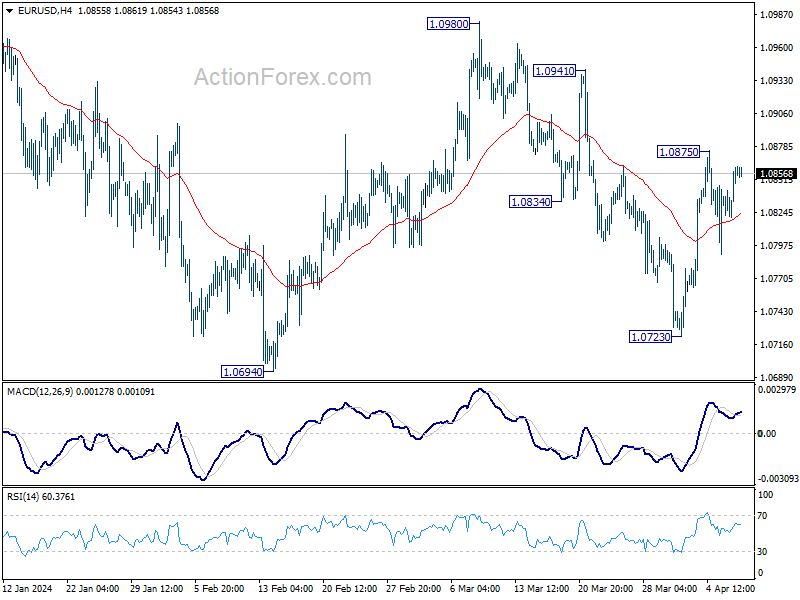
Daily Pivots: (S1) 1.0833; (P) 1.0847; (R1) 1.0874; More...
Intraday bias in EUR/USD remains neutral for the moment, and outlook is unchanged. On the downside, decisive break of 1.0694/0723 support zone will resume whole fall from 1.1138. On the upside, though, break of 1.0875 will resume the rebound from 1.0723 towards 1.0980 resistance instead.
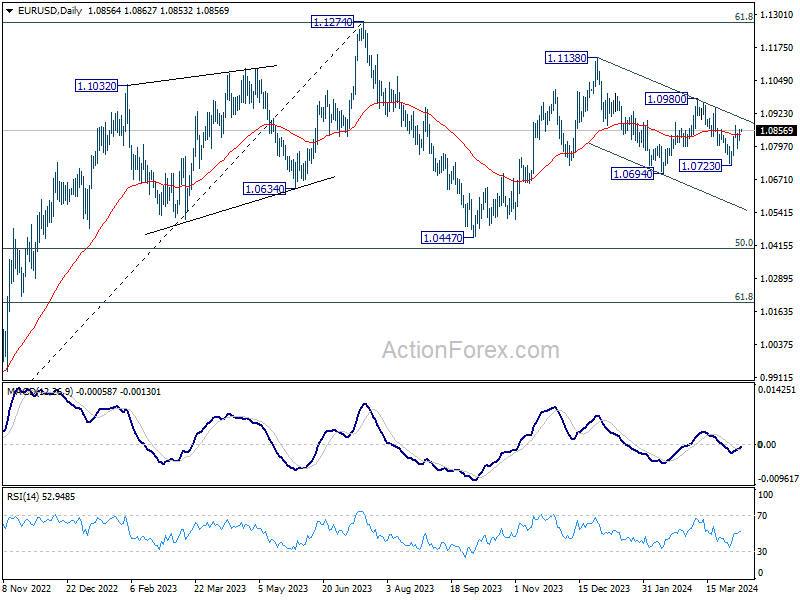
In the bigger picture, price actions from 1.1274 are viewed as a corrective pattern to rise from 0.9534 (2022 low). Rise from 1.0447 is seen as the second leg. While further rally could cannot be ruled out, upside should be limited by 1.1274 to bring the third leg of the pattern. Meanwhile, sustained break of 1.0694 support will argue that the third leg has already started for 1.0447 and possibly below.
GBP/USD Daily Outlook
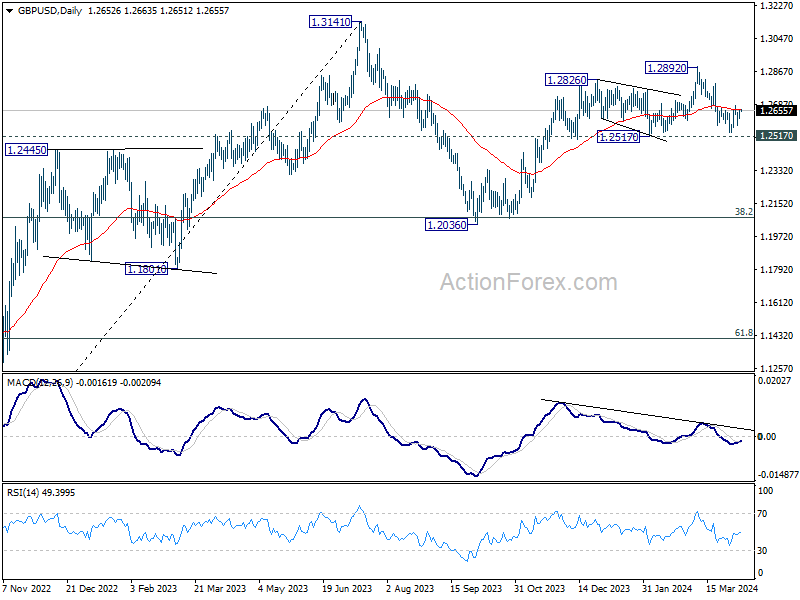
Daily Pivots: (S1) 1.2624; (P) 1.2644; (R1) 1.2675; More...
Intraday bias in GBP/USD remains neutral for the moment and outlook is unchanged. On the downside, decisive break of 1.2517/38 support zone will suggest that rise from 1.2036 has completed at 1.2892 already, and turn near term outlook bearish. On the upside, however, firm break of 1.2682 will suggest that fall from 1.2892 has completed at 1.2538. Intraday bias will be turned back to the upside for 1.2802 resistance next.
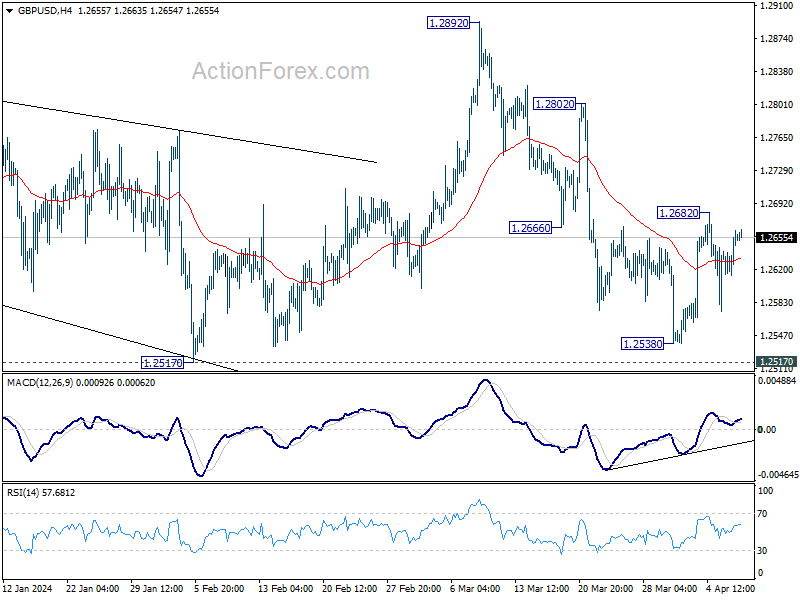
In the bigger picture, price actions from 1.3141 medium term top are seen as a corrective pattern to up trend from 1.0351 (2022 low). Rise from 1.2036 is seen as the second leg, which might still be in progress. But upside should be limited by 1.3141 to bring the third leg of the pattern. Meanwhile, break of 1.2517 support will argue that the third leg has already started for 38.2% retracement of 1.0351 (2022 low) to 1.3141 at 1.2075 again.
USD/CHF Daily Outlook
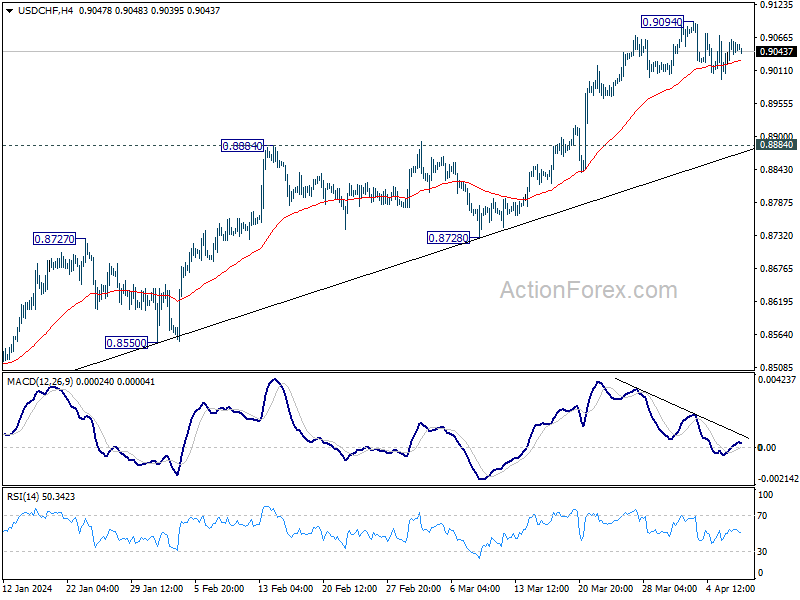
Daily Pivots: (S1) 0.9016; (P) 0.9041; (R1) 0.9079; More....
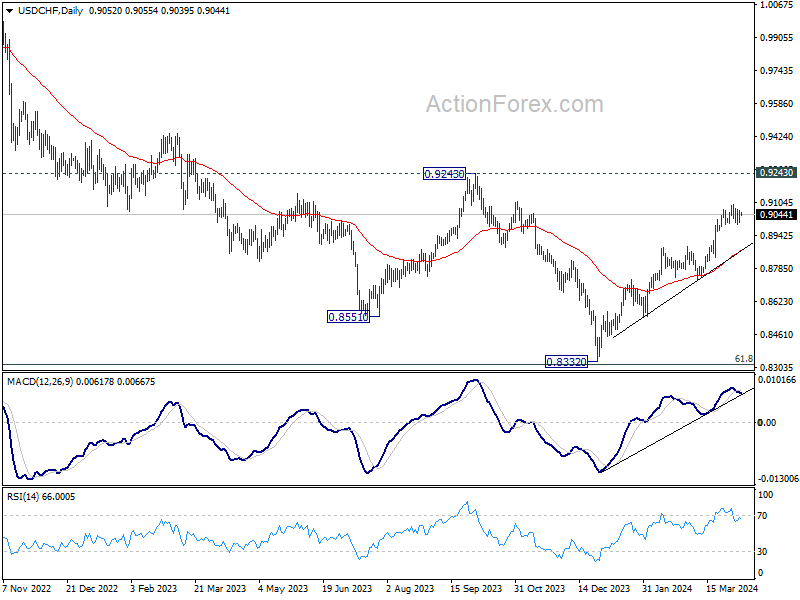
Intraday bias in USD/CHF remains neutral for the moment, and some more consolidations should be seen. Deeper decline cannot be ruled out, but outlook will stay bullish as long as 0.8884 resistance turned support holds. On the upside, break of 0.9094 will resume larger rise from 0.8332 to 0.9243 key resistance.
In the bigger picture, price actions from 0.8332 medium term bottom as tentatively seen as developing into a corrective pattern to the down trend from 1.0146 (2022 high). Further rise would be seen as long as 0.8728 support holds. But upside should be limited by 0.9243 resistance, at least on first attempt.
USD/JPY Daily Outlook
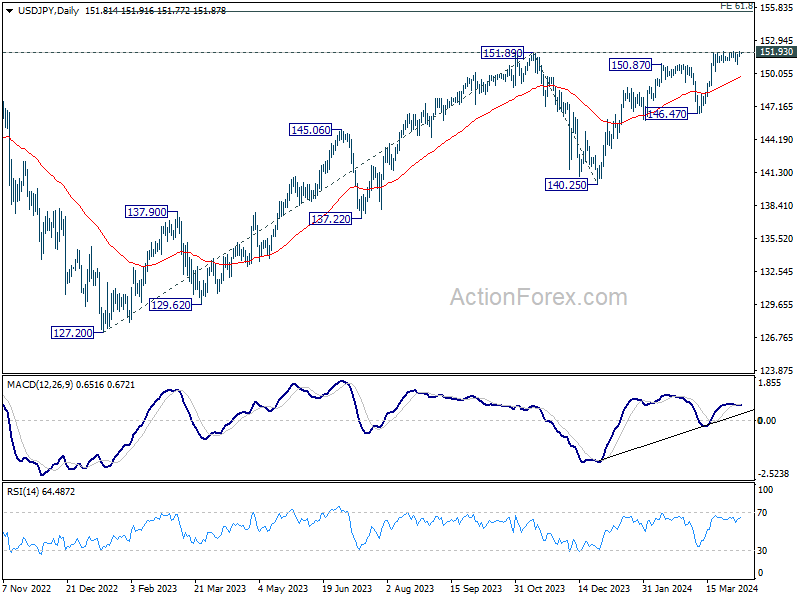
Daily Pivots: (S1) 151.61; (P) 151.77; (R1) 152.02; More...
Intraday bias in USD/JPY remains neutral at this point as range trading continues. On the downside, break of 150.80 will turn bias back to the downside for deeper pull back to 55 D EMA (now at 149.73). On the upside, however, sustained break of 151.93 key resistance will confirm long term up trend resumption.
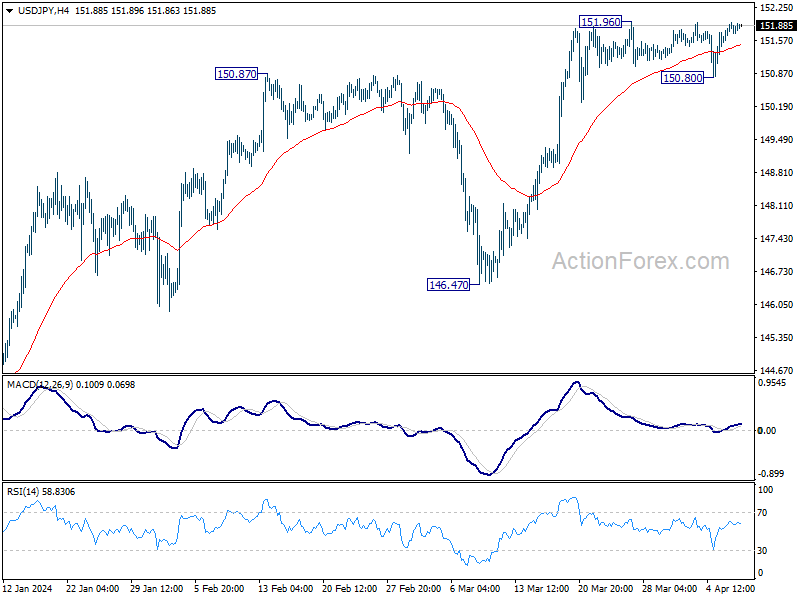
In the bigger picture, correction from 151.87 (2023) high could have completed at 140.25 already. Rise from 127.20 (2023 low), as part of the long term up trend, is probably ready to resume. Decisive break of 151.93 resistance (2022 high) will confirm this bullish case. Next medium term target will be 61.8% projection of 127.20 to 151.89 from 140.25 at 155.20. This will remain the favored case as long as 146.47 support holds, in case of another pullback.
USD/CAD Daily Outlook
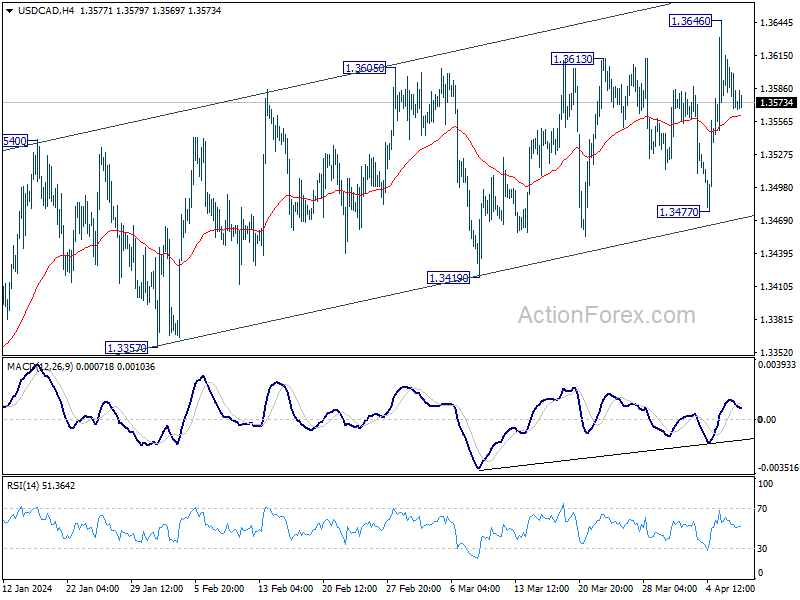
Daily Pivots: (S1) 1.3556; (P) 1.3587; (R1) 1.3603; More...
Intraday bias in USD/CAD is turned neutral again with current retreat. Some consolidations would be seen but further rally is still expected as long as 1.3477 support holds. Break of 1.3646 will resume the rise from 1.3716. Sustained break of channel resistance would prompt upside acceleration towards 1.3897 resistance next.
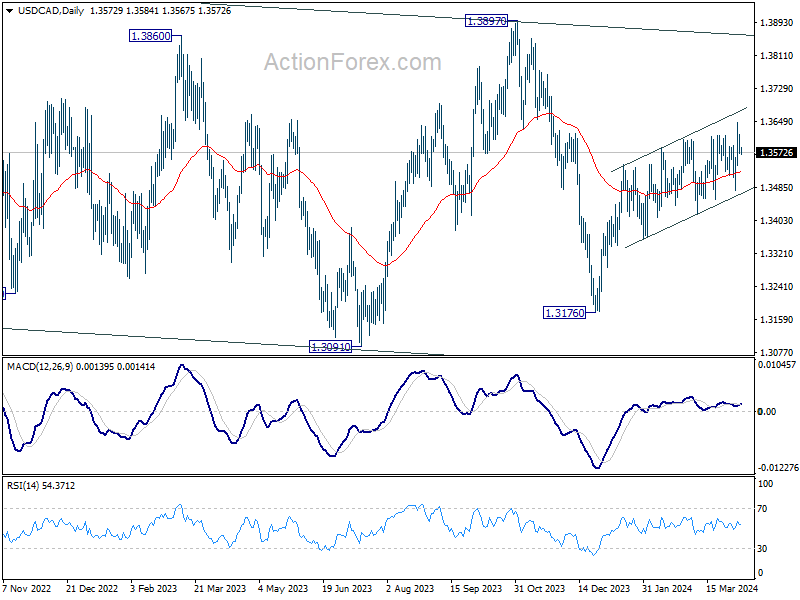
In the bigger picture, price actions from 1.3976 (2022 high) are viewed as a corrective pattern only. In case of another fall, strong support should emerge above 1.2947 resistance turned support to bring rebound. Overall, larger up trend from 1.2005 (2021 low) is still expected to resume through 1.3976 at a later stage.
AUD/USD Daily Report
Daily Pivots: (S1) 0.6573; (P) 0.6592; (R1) 0.6623; More....
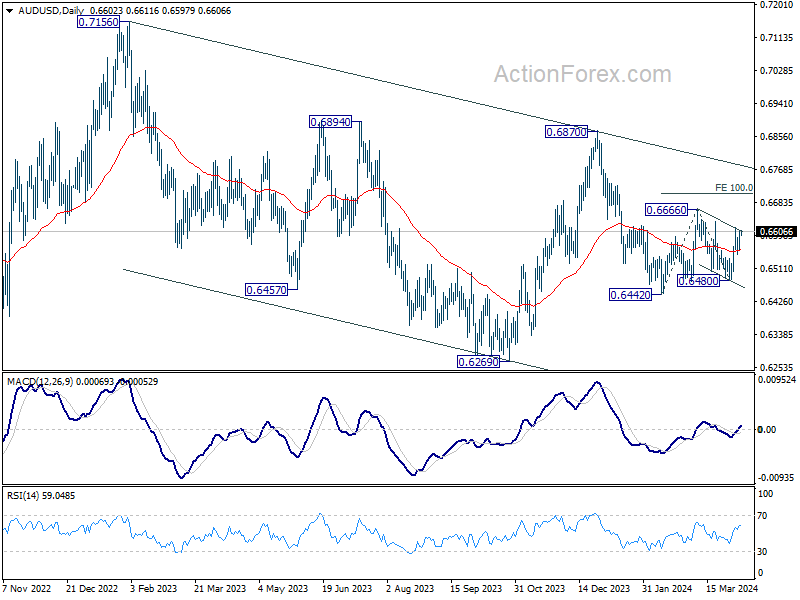
Intraday bias in AUD/USD remains neutral first. On the upside, break of 0.6618 resistance will affirm the case that rise from 0.6480 is the third leg of the pattern from 0.6442 low. Intraday bias will be back on the upside for 0.6666 resistance, and then 100% projection of 0.6442 to 0.6666 from 0.6480 at 0.6704. Nevertheless, break of 0.6480 support will bring retest of 0.6442 low instead.
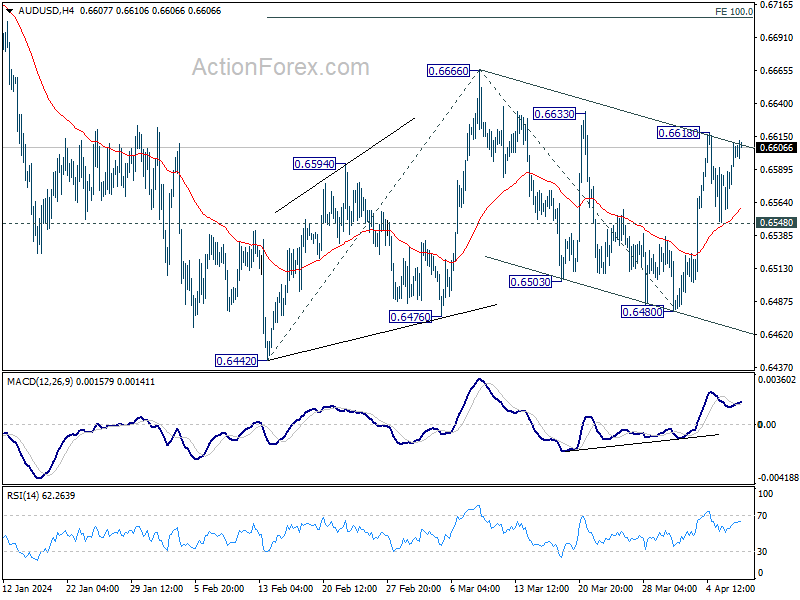
In the bigger picture, price actions from 0.6169 (2022 low) are seen as a medium term corrective pattern to the down trend from 0.8006 (2021 high). Fall from 0.7156 (2023 high) is seen as the second leg, which might still be in progress. Overall, sideway trading could continue in range of 0.6169/7156 for some more time. But as long as 0.7156 holds, an eventual downside breakout would be mildly in favor.
Kiwi Unfazed by Business Confidence Slide, Aussie Maintains Solid Ground
New Zealand Dollar traded broadly higher in Asian session, despite revelation of significant downturn in business confidence for Q1. Kiwi bears seemed to be lightening up their short positions in anticipation of RBNZ rate decision tomorrow, which is broadly expected to maintain interest rate at 5.50%. The market's recent aggressive speculation on an early rate cut by RBNZ is tempered by the likelihood that the central bank will resist such expectations. Any shift in stance is unlikely for tomorrow, and would be delayed until its next meeting in May, with a fresh set of economic projections as guidance.
Australian Dollar also showed some strength, outperforming Kiwi slightly despite facing headwinds from persistently weak consumer sentiment indicators. The resilience in business conditions data and gradual easing in inflationary pressures would contribute to the cautious stance by RBA against early rate cuts. Besides, Aussie's performance is further bolstered by the recent strong rally in copper prices and the general rebound in Asian stock markets today.
Japanese Yen remains under pressure, though without significant selling momentum at this stage. Japanese Finance Minister Shunichi Suzuki emphasized at a news conference that while the country does not target specific currency levels, it values the stability of exchange rates that reflect economic fundamentals. This statement suggests a continued vigilance against undue volatility, keeping Yen bears cautious of intervention. At the same time, there is clear lack of buying interest on Yen for a rebound.
Elsewhere, Dollar, Euro, and Sterling are mixed as the market's are holding their bets towards upcoming key events. These include US CPI data release tomorrow, ECB rate decision on Thursday, and UK GDP on Friday.
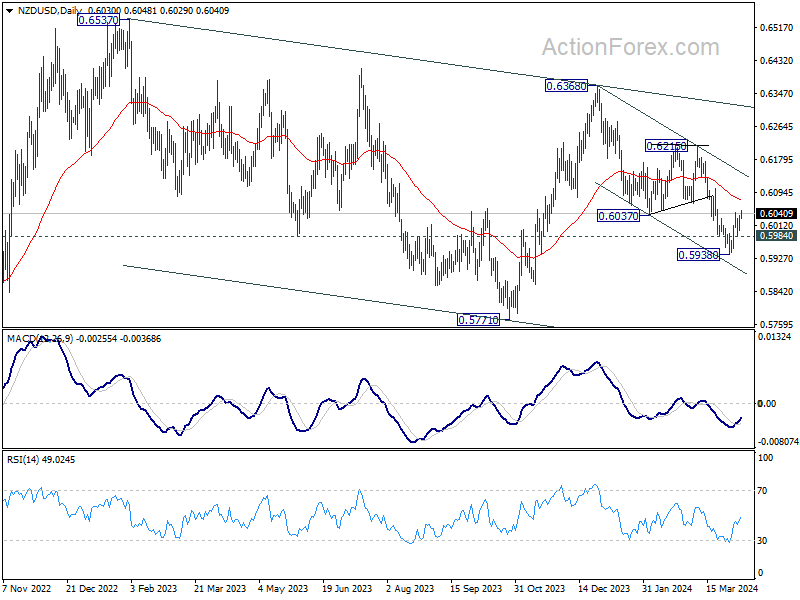
Technically, a short term bottom should be in place at 0.5938 in NZD/USD with break of 0.6037 support turned resistance. Further rebound is mildly in favor for now, but strong resistance should be seen between 55 D EMA (now at 0.6078) and channel resistance (now at 0.6148) to cap upside. Below 0.5894 minor support will argue that fall from 0.6368 is ready to resume through 0.5938.
In Asia, at the time of writing, Nikkei is up 0.78%. Hong Kong HSI is up 0..55%. China Shanghai SSE is down -0.15%. Singapore Strait Times is up 0.87%. Japan 10-year JGB yield is down -0.0005 at 0.791. Overnight, DOW fell -0.03%. S&P 500 fell -0.04%. NASDAQ rose 0.03%. 10-year yield rose 0.069 to 4.378.
NZ NZIER business confidence tumbles, high interest rates deepen pessimism
In Q1, New Zealand's business community signaled a stark downturn in confidence, with NZIER business confidence index plunging from -9.9 to -23.7 . This dramatic drop is accompanied by reversal in firms' trading activity expectations for the coming quarterly, from 6.6 to -11.5, as well as retrospective decline in past three months' trading activity from 6.7 to -23.2.
NZIER attributes this downturn to the effect of heightened interest rates, which appear to be fulfilling their role in tempering demand to alleviate inflationary pressures. Moreover, the looming uncertainty surrounding the new Government's fiscal strategies, particularly in terms of spending adjustments and cutbacks in the public sector, is exacerbating business caution.
Detailed further illuminates the current economic challenges, with a net 11% of firms having reduced their workforce in the March quarter, albeit with slightly positive hiring intentions moving forward. Investment intentions are also on the downturn, with a net 14% of businesses intending to cut back on plant and machinery investment, and a net 8% planning to curtail investment in buildings over the next year.
Australia Westpac consumer sentiment falls to 82.4, prolonged pessimism
Australia Westpac Consumer Sentiment Index marked a decrease of -2.4% mom to 82.4 in April. This downturn extends the index's streak below the neutral threshold of 100 to nearly two years, underscoring a prolonged period of consumer pessimism.
Westpac's analysis attributes the lack of recovery in consumer sentiment primarily to the ongoing inflationary pressures that have gripped Australia. Over the past three years, consumer prices have risen significantly, outpacing wage growth by six percentage points. This inflationary trend, coupled with the notable rise in interest rates and increased tax burdens, has significantly strained household incomes, subjecting them to prolonged financial duress.
As attention turns to RBA's next meeting in May, Westpac anticipates no change to the official cash rate. This forecast hinges significantly on the upcoming March quarter CPI update, due on April 24, which is expected to play a crucial role in shaping the RBA's stance.
Australia NAB business confidence rises to 1, cost pressures show slight relief
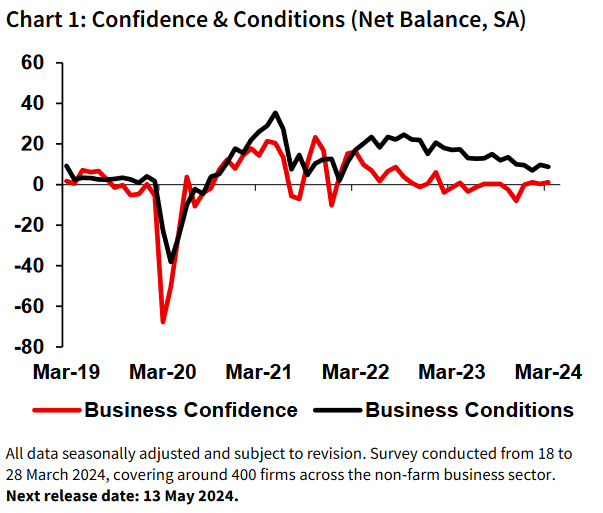
Australia NAB Business Confidence rose from 0 to 1 in March. Business Conditions fell from 10 to 9. Trading Conditions and employment conditions held steady at 15 and 6 respectively. But profitability conditions decline notably from 10 to 6.
Alan Oster, NAB's Chief Economist, pointed out the unusual situation where business conditions have been "a little above average" and confidence "a little below average" for an extended period. This, according to Oster, reflects a cautious outlook among firms regarding the future, even as the economy shows signs of resilience.
Further details from the report indicate a softening in cost pressures. Labor cost growth decelerated to 1.6% on quarterly equivalent basis, down from 2.0%. Purchase cost growth slowed to 1.4% from 1.8%. Additionally, there was a moderation in product price growth to 0.7% from 1.2%, with retail price growth slightly reducing to 1.3% from 1.4%. Despite these easing pressures, cost concerns remain high, with retail price growth still elevated.
Oster interprets these figures as being aligned with expectations that the journey towards inflation normalization will be "gradual". Q1 PI result later in April is expected to further reinforced this view.
Looking ahead
France trade balance and US NFIB small business index are the only feature of the day.
AUD/USD Daily Report
Daily Pivots: (S1) 0.6573; (P) 0.6592; (R1) 0.6623; More....
Intraday bias in AUD/USD remains neutral first. On the upside, break of 0.6618 resistance will affirm the case that rise from 0.6480 is the third leg of the pattern from 0.6442 low. Intraday bias will be back on the upside for 0.6666 resistance, and then 100% projection of 0.6442 to 0.6666 from 0.6480 at 0.6704. Nevertheless, break of 0.6480 support will bring retest of 0.6442 low instead.
In the bigger picture, price actions from 0.6169 (2022 low) are seen as a medium term corrective pattern to the down trend from 0.8006 (2021 high). Fall from 0.7156 (2023 high) is seen as the second leg, which might still be in progress. Overall, sideway trading could continue in range of 0.6169/7156 for some more time. But as long as 0.7156 holds, an eventual downside breakout would be mildly in favor.
Economic Indicators Update
| GMT | Ccy | Events | Actual | Forecast | Previous | Revised |
|---|---|---|---|---|---|---|
| 22:00 | NZD | NZIER Business Confidence Q1 | -25 | -2 | ||
| 23:01 | GBP | BRC Like-For-Like Retail Sales Y/Y Mar | 3.20% | 1.80% | 1.00% | |
| 00:30 | AUD | Westpac Consumer Confidence Apr | -2.40% | -1.80% | ||
| 01:30 | AUD | NAB Business Confidence Mar | 1 | 0 | ||
| 01:30 | AUD | NAB Business Conditions Mar | 9 | 10 | ||
| 05:00 | JPY | Consumer Confidence Mar | 39.5 | 39.7 | 39.1 | |
| 06:00 | JPY | Machine Tool Orders Y/Y Mar P | -8.00% | |||
| 06:45 | EUR | France Trade Balance (EUR) Feb | -7.0B | -7.4B | ||
| 10:00 | USD | NFIB Business Optimism Index Mar | 90.2 | 89.4 |
Australia NAB business confidence rises to 1, cost pressures show slight relief
Australia NAB Business Confidence rose from 0 to 1 in March. Business Conditions fell from 10 to 9. Trading Conditions and employment conditions held steady at 15 and 6 respectively. But profitability conditions decline notably from 10 to 6.
Alan Oster, NAB's Chief Economist, pointed out the unusual situation where business conditions have been "a little above average" and confidence "a little below average" for an extended period. This, according to Oster, reflects a cautious outlook among firms regarding the future, even as the economy shows signs of resilience.
Further details from the report indicate a softening in cost pressures. Labor cost growth decelerated to 1.6% on quarterly equivalent basis, down from 2.0%. Purchase cost growth slowed to 1.4% from 1.8%. Additionally, there was a moderation in product price growth to 0.7% from 1.2%, with retail price growth slightly reducing to 1.3% from 1.4%. Despite these easing pressures, cost concerns remain high, with retail price growth still elevated.
Oster interprets these figures as being aligned with expectations that the journey towards inflation normalization will be "gradual". Q1 PI result later in April is expected to further reinforced this view.