Sample Category Title
Swiss Franc Declines Persist as DAX Hits New Heights, Aussie Awaits CPI
Risk-on sentiment is pressuring e Swiss Franc and, to a lesser extent, Yen and Dollar today. DAX soared to new record highs, undeterred by the latest weak German consumer sentiment data, while CAC and FTSE are also marking gains. Similarly, the CAC and FTSE indices are registering gains, with U.S. futures indicating a positive start to trading.
Commodity currencies are seeing a broad upticks, led by New Zealand Dollar as it begins to recover from its recent setbacks. Euro also shows strength, while Sterling's progress appears slightly more tempered. Despite these movements, most currencies remain within the trading ranges established last week, with Swiss Franc being the only exception.
Australian monthly CPI data is poised to a focal point for the Asian markets. Analysts are forecasting a slight increase to 3.5% in March, attributed in part to the cessation of government energy rebates. It's important to note that the monthly CPI report offers only a partial update, with a comprehensive overview delayed until the quarterly release. Still, any downside surprise in the report could fuel speculation that RBA may start considering rate reductions sooner, placing Aussie under short-term pressure.
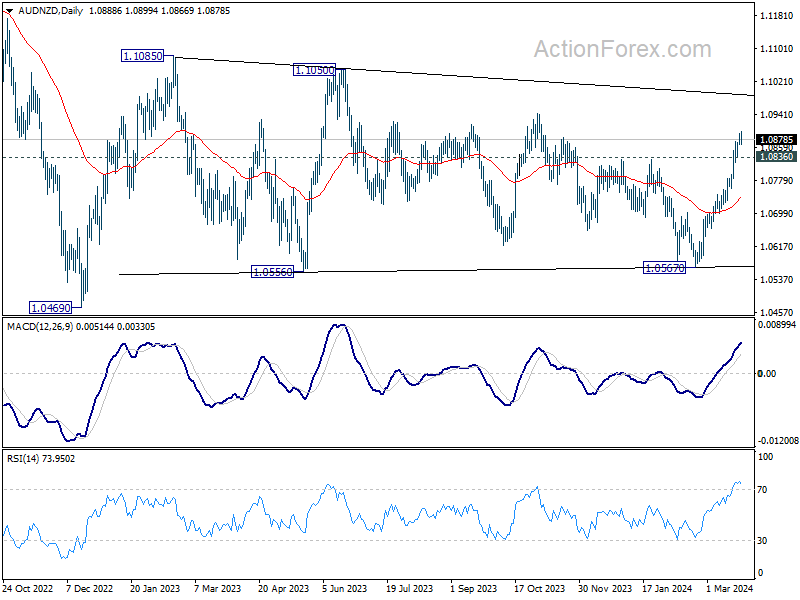
Technically, AUD/NZD is seen as extending the triangle pattern from 1.1085. After extending the rebound from 1.0567, AUD/NZD is starting to enter a zone where it could top and end this rebound. Break of 1.0836 support would be the first sign of topping and bring deeper pullback towards 55 D EMA (now at 1.0739).
In Europe, at the time of writing, FTSE is up 0.18%. DAX is up 0.76%. CAC is up 0.33%. UK 10-year yield is down -0.0235 at 3.969. Germany 10-year yield is down -0.005 at 2.371. US 10-year yield is up 0.230 at 4.269. Earlier in Asia, Nikkei fell -0.04%. Hong Kong HSI rose 0.88%. China Shanghai SSE rose 0.17%. Singapore Strait Times rose 1.10%. Japan 10-year JGB yield rose 0.0026 to 0.739.
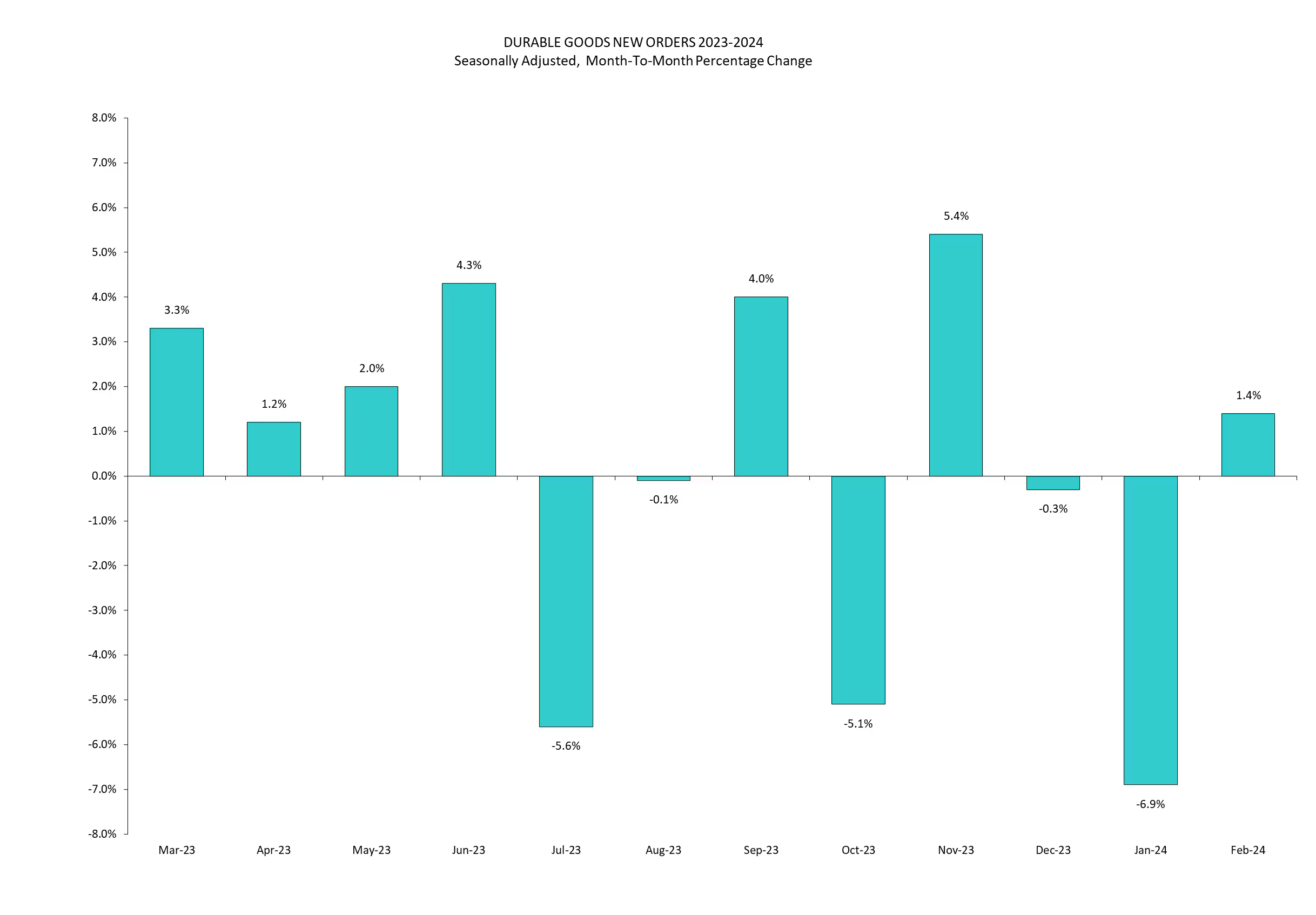
US durable goods orders rises 1.4% mom in Feb, above exp 1.3% mom
US durable goods orders rose 1.4% mom to USD 277.9B in February, above expectation of 1.3% mom. Ex-transport orders rose 0.5% mom to USD 185.6B above expectation of 0.4% mom. Ex-defense orders rose 2.2% mom to USD 263.8B, above expectation of 1.3% mom. Transportation equipment orders rose 3.3% mom to USD 90.4B.
BoE's Mann signals market misalignment on rate cut expectations
BoE MPC member Catherine Mann cast doubts on the financial market's anticipation of interest rate cuts in the near term, asserting that such expectations might be overly ambitious.
Speaking to Bloomberg TV, Mann directly addressed the discrepancy, stating, "They're pricing in too many cuts — that would be my personal view — and so in some sense, I don't have to cut because the market already is."
Mann further elaborated on the unique economic conditions within the UK that challenge the notion of an early rate cut, especially in comparison with the US and Eurozone.
She explained that "wage dynamics in the UK are stronger and more persistent than the wage dynamics in either the United States or the euro area. Underlying services dynamics are also stickier more persistent than either the US or the euro area."
Thus, "it's hard to argue that the BOE would be ahead of the other two regions, particularly the United States," Mann added.
German GfK consumer sentiment edges up to -27.4, uncertainty overshadowing facts
In a modest uptick, Germany's GfK Consumer Sentiment Index for April has slightly improved to -27.4 from March's -28.8, marginally above expectation of -27.8. March's data revealed an improvement in economic expectations and income outlooks, with the former rising to -3.1 from -6.4 and the latter to -1.5 from -4.8. However, the willingness to make purchases marginally declined from -15.0 to -15.3, and the propensity to save saw a notable drop from 17.4 to 12.4.
Rolf Bürkl, consumer expert at NIM, characterized the recovery in consumer sentiment as "slow and very sluggish." He pointed to the fundamental pillars of real income growth and a stable job market as underpinning factors that could potentially catalyze a swift rebound in consumer sentiment.
However, the prevailing atmosphere of uncertainty and a discernible lack of future optimism among consumers is holding sentiment back. This sentiment, according to Bürkl, is stifled by the ongoing array of crises, manifesting in a pronounced reluctance to make purchases despite objectively favorable economic conditions.
"In a nutshell: The poor sentiment is overshadowing the facts," Bürkl noted.
Australia's Westpac consumer sentiment dips -1.8% mom, RBA triggers sharp decline
In March, Westpac Consumer Sentiment Index in Australia dropped by -1.8% mom to 84.4. This downturn is attributed to renewed concerns about the near-term economic outlook, with fears regarding inflation and interest rate hikes only easing marginally.
The survey revealed a significant shift in sentiment in responses to the RBA's latest policy decision. Sentiment scores were markedly higher at 94.9 for those surveyed before the decision, compared to a lower 79.3 for those surveyed afterwards.
The persistence of consumer concerns, notably regarding inflation and interest rates, was evident. Many had harbored hopes for a more reassuring update from RBA on these fronts. Yet, the central bank's governor did not entirely dismiss the prospect of additional rate hikes. This stance likely contributed to dampening consumer sentiment, as individuals grappled with the implications for personal finances and economic conditions at large.
USD/CHF Mid-Day Outlook
Daily Pivots: (S1) 0.8977; (P) 0.8986; (R1) 0.9004; More....
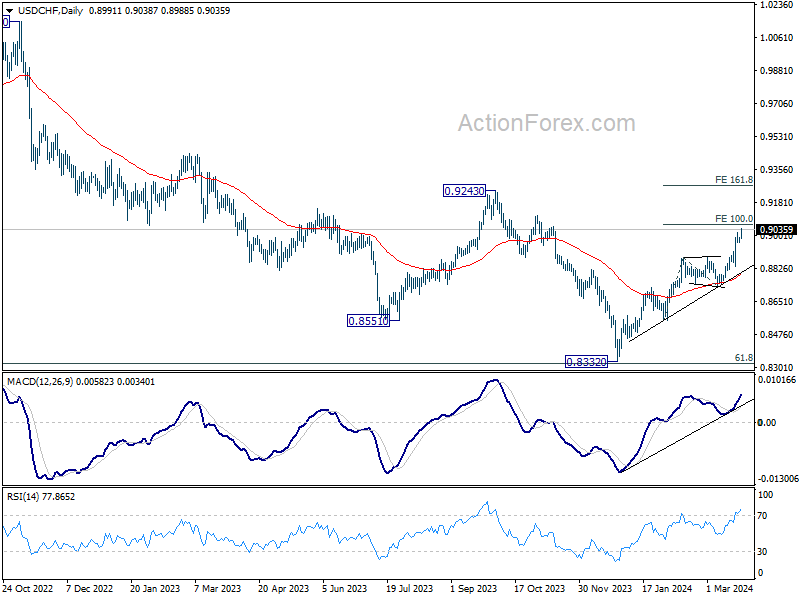
USD/CHF's rally resumed after brief consolidations and intraday bias is back on the upside. Current rise from 0.8332 should target 100% projection projection of 0.8550 to 0.8884 from 0.8728 at 0.9062. Firm break there will target 0.9243 key medium term resistance next. On the downside, below 0.8964 minor support will turn intraday bias neutral and bring consolidations first. But outlook will stay bullish as long as 0.8884 resistance turned support holds.
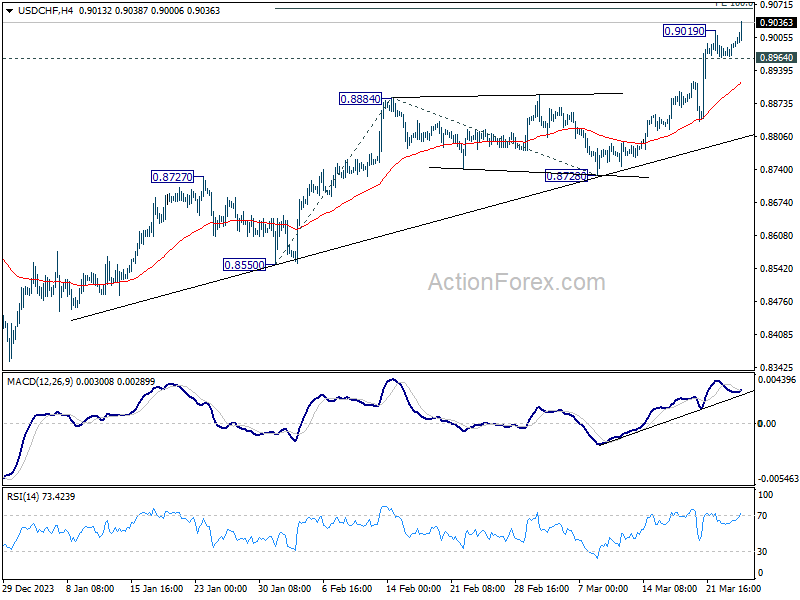
In the bigger picture, price actions from 0.8332 medium term bottom as tentatively seen as developing into a corrective pattern to the down trend from 1.0146 (2022 high). Further rise would be seen as long as 0.8728 support holds. But upside should be limited by 0.9243 resistance, at least on first attempt.
Economic Indicators Update
| GMT | Ccy | Events | Actual | Forecast | Previous | Revised |
|---|---|---|---|---|---|---|
| 23:30 | AUD | Westpac Consumer Confidence Mar | -1.80% | 6.20% | ||
| 23:50 | JPY | Corporate Service Price Index Y/Y Feb | 2.10% | 2.00% | 2.10% | |
| 07:00 | EUR | Germany Gfk Consumer Confidence Apr | -27.4 | -27.8 | -29 | -28.8 |
| 12:30 | USD | Durable Goods Orders Feb | 1.40% | 1.30% | -6.20% | |
| 12:30 | USD | Durable Goods Orders ex-Trans Feb | 0.50% | 0.40% | -0.40% | |
| 12:30 | USD | Durable Goods Orders ex Defense Feb | 2.20% | 1.30% | -7.90% | |
| 13:00 | USD | S&P/CS Composite-20 HPI Y/Y Jan | 6.60% | 6.20% | 6.10% | 6.20% |
| 13:00 | USD | Housing Price Index M/M Jan | -0.10% | 0.20% | 0.10% | |
| 14:00 | USD | Consumer Confidence Mar | 107.2 | 106.7 |
US durable goods orders rises 1.4% mom in Feb, above exp 1.3% mom
US durable goods orders rose 1.4% mom to USD 277.9B in February, above expectation of 1.3% mom. Ex-transport orders rose 0.5% mom to USD 185.6B above expectation of 0.4% mom. Ex-defense orders rose 2.2% mom to USD 263.8B, above expectation of 1.3% mom. Transportation equipment orders rose 3.3% mom to USD 90.4B.
XAU/USD: Gold Retests $2200 Barrier on Renewed Safe-haven Demand
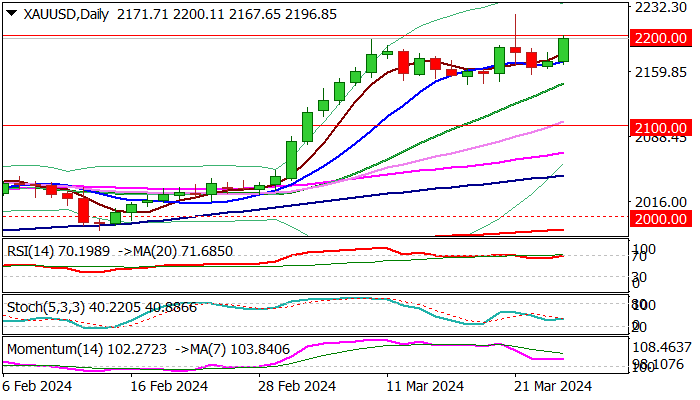
Gold price jumped on Tuesday and retested psychological $2200 barrier, inflated by weaker dollar on improved sentiment about Fed rate cuts and persisting geopolitical risks.
Market awaits release of US inflation data, due later this week, which could bring fresh hints about timing of the start of rate cuts.
Fresh strength attacks the ceiling of the recent range, after a short-lived spike to new all-time high last week.
Bullish technical picture on daily chart contributes to positive sentiment and underpins the action.
Sustained break above $2200 to generate fresh bullish signal for retest of new top ($2222), violation of which to signal continuation of a larger uptrend and expose targets at $2250 (Fibo 138.2% projection of the uptrend from 2022 low at $1614) and $2300 (psychological).
Near-term bias is expected to remain firmly with bulls while the price action stays above 10DMA ($2171).
Res: 2200; 2222; 2250; 2300.
Sup: 2184; 2170; 2146; 2131.
Australian Dollar Edges Higher, CPI Next
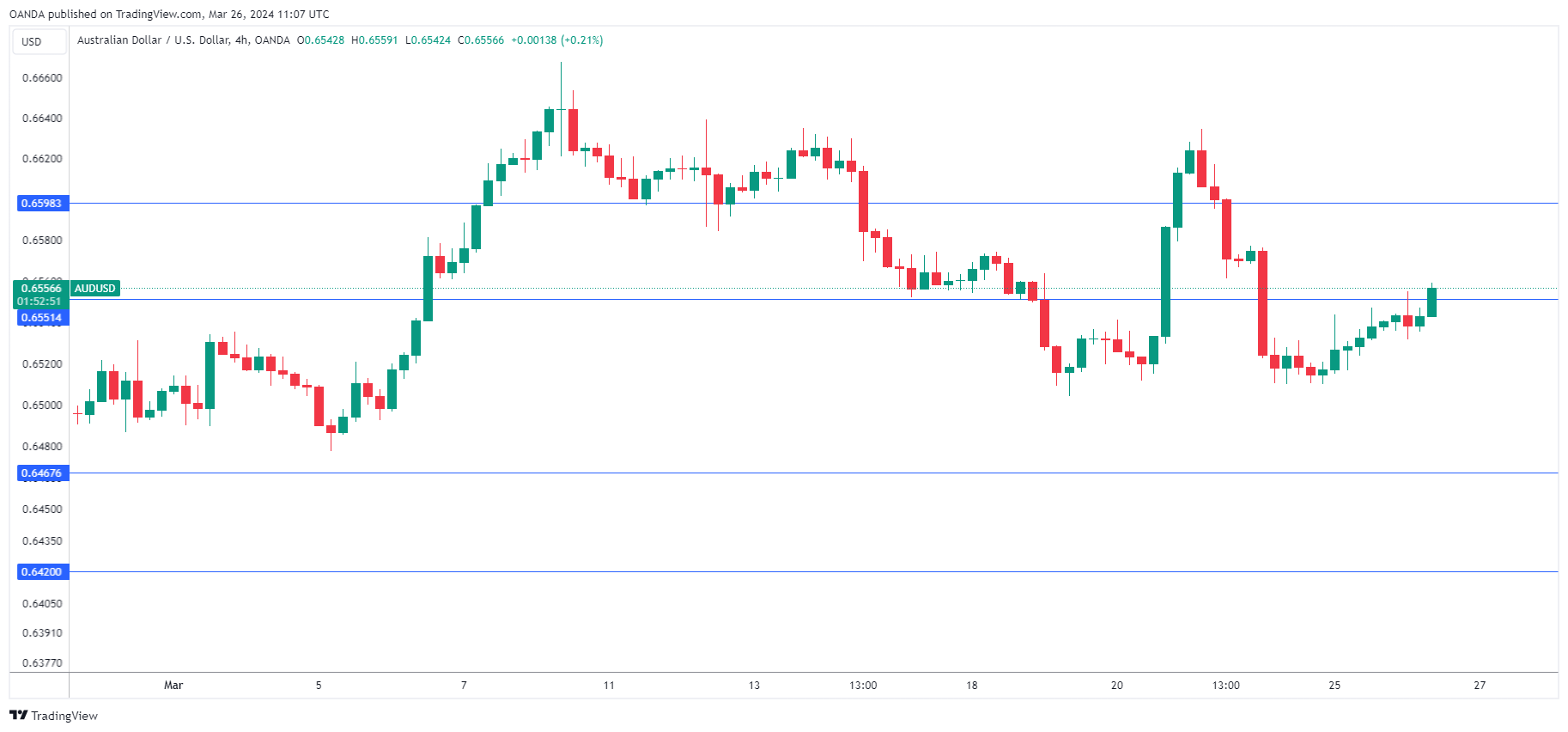
The Australian dollar has extended its gains on Tuesday. In the European session, AUD/USD is trading at 0.6557, up 0.26%. On today’s data calendar, the US will release two tier-1 events. Durable goods orders are expected to rebound with a 1.1% gain in February, after a 6.1% slide in January. The Consumer Board consumer confidence index is expected to tick up to 107 in February, up from 106.7 in January.
Australian CPI expected to rise slightly in February
Australia’s inflation rate is expected to creep up in the February report, which will be released on Wednesday. The market estimate stands at 3.4% y/y for February, compared to 3.4% in January.
That could set back expectations for a rate cut from the Reserve Bank of Australia, which has kept rates unchanged at 4.35% for four straight times. The markets are of the view that the RBA’s tightening cycle is done and have priced in a rate cut later in the year. Still, the RBA hasn’t ruled out rate hikes, with inflation still well above the 2% target.
The central bank needs to be sure that once inflation reaches the target, it can be sustained at that level and is likely to be very cautious before shifting policy and cutting rates. The RBA doesn’t meet until May and barring a huge surprise will again keep rates unchanged.
Australia’s Westpac consumer confidence declined 1.8% in March to 84.4, worse than the market estimate of -1.6%. The index has been below 100 since February 2022, indicative of prolonged pessimism about the economy. Consumer confidence took a hit after the 6.2% gain in February, as frustrated consumers didn’t see any signs of a rate cut at the RBA’s meeting earlier this month.
AUD/USD Technical
AUD/USD is testing resistance at 0.6551. Above, there is resistance at 0.6598
There is support at 0.6467 and 0.6420
BoE’s Mann signals market misalignment on rate cut expectations
BoE MPC member Catherine Mann cast doubts on the financial market's anticipation of interest rate cuts in the near term, asserting that such expectations might be overly ambitious.
Speaking to Bloomberg TV, Mann directly addressed the discrepancy, stating, "They're pricing in too many cuts — that would be my personal view — and so in some sense, I don't have to cut because the market already is."
Mann further elaborated on the unique economic conditions within the UK that challenge the notion of an early rate cut, especially in comparison with the US and Eurozone.
She explained that "wage dynamics in the UK are stronger and more persistent than the wage dynamics in either the United States or the euro area. Underlying services dynamics are also stickier more persistent than either the US or the euro area."
Thus, "it's hard to argue that the BOE would be ahead of the other two regions, particularly the United States," Mann added.
EURCHF Rallies Towards 8-Month High
- EURCHF looks strongly bullish this year
- Technical oscillators confirm upside tendency
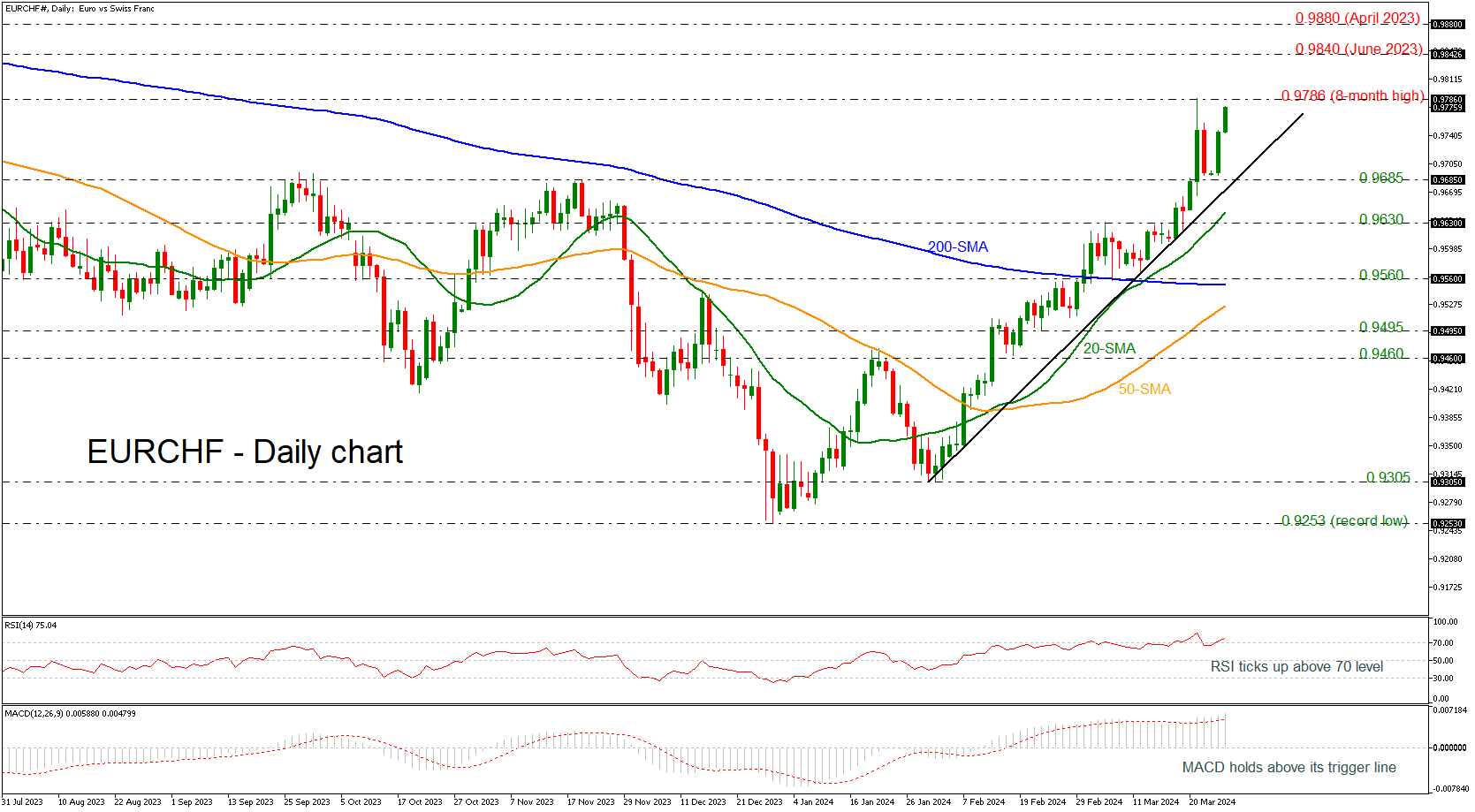
EURCHF has added almost 6% since the beginning of the year, recording a new eight-month high of 0.9786. The pair is creating a steep upward tendency with no notable bearish corrections so far in 2024. The RSI indicator is standing in the overbought region and is still pointing north, while the MACD is extending its positive momentum above its trigger and zero lines.
More aggressive advances could lead the pair towards the previous high of 0.9786 ahead of the peak from June 2023 at 0.9840. If buying interest persists, then the market could touch the April 2023 resistance at 0.9880.
In the case of a negative scenario, the attention could shift to the downside, creating a bearish retracement towards the 0.9685 support. Breaking the uptrend line too, the price could then meet the 0.9630 mark and the 200-day simple moving average (SMA) around 0.9560.
All in all, EURCHF is strongly bullish in the short-term timeframe after the rebounds off 0.9253 and 0.9305 and only a tumble beneath the 200-day SMA may change the outlook to a neutral one.
Ethereum ETHUSD Buying The Dips After Elliott Wave Double Three
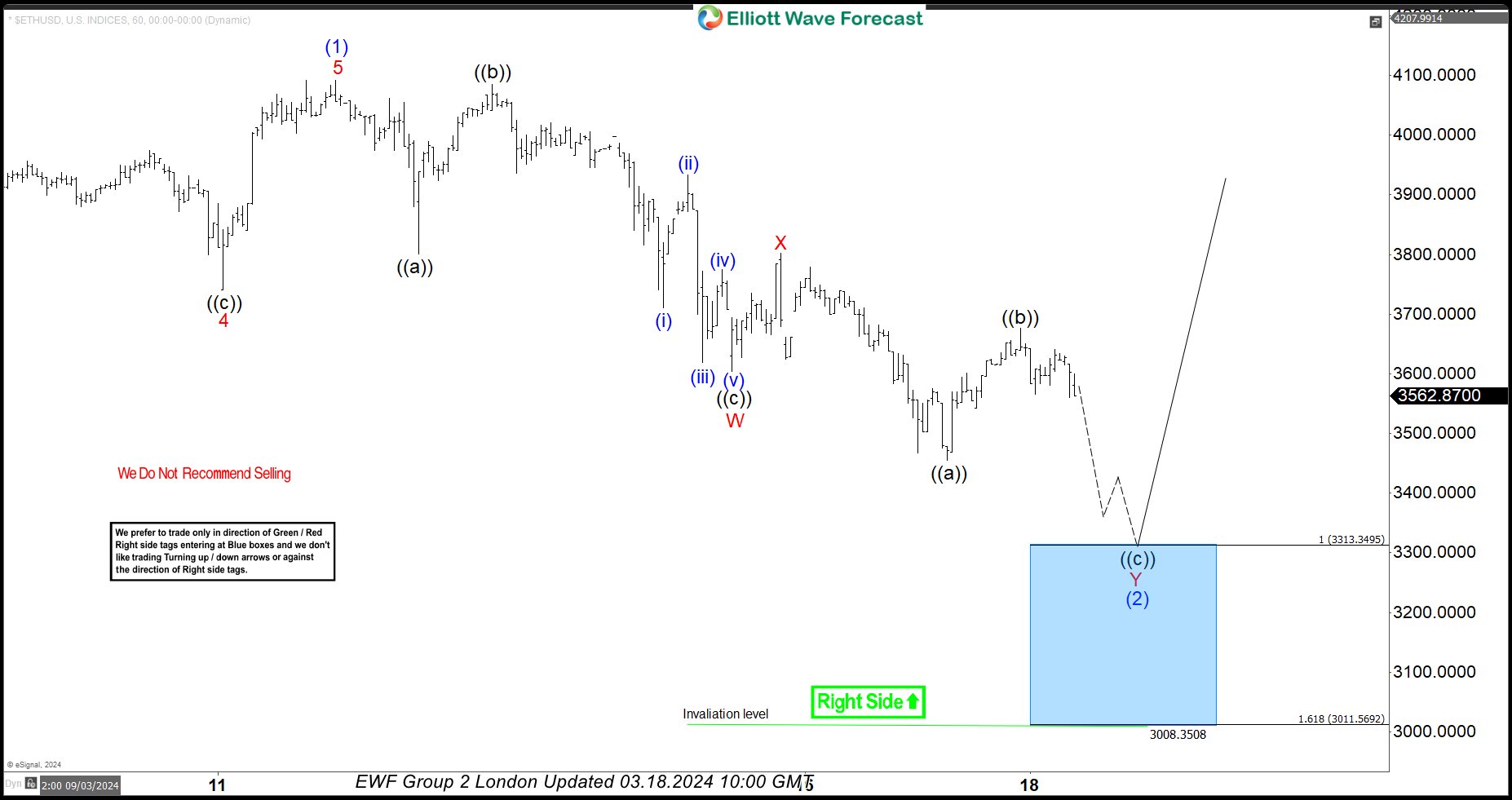
Hello fellow traders. In this technical article we’re going to take a look at the Elliott Wave charts charts of Ethereum ETHUSD published in members area of the website. As our members know ETHUSD has recently made pull back that has unfolded as Elliott Wave Double Three Pattern. It made clear 7 swings from the March 11th peak and completed correction right at the Equal Legs zone( Blue Box Area) . In further text we’re going to explain the Elliott Wave pattern and forecast
Before we take a look at the real market example, let’s explain Elliott Wave Double Three pattern.
Elliott Wave Double Three Pattern
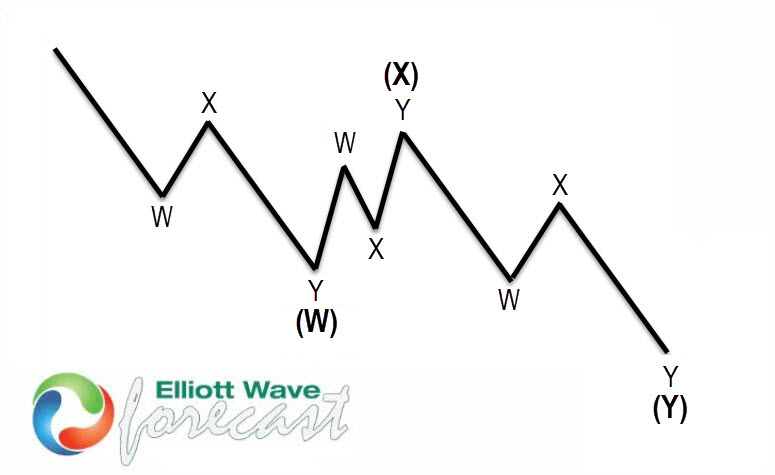
Double three is the common pattern in the market , also known as 7 swing structure. It’s a reliable pattern which is giving us good trading entries with clearly defined invalidation levels.
The picture below presents what Elliott Wave Double Three pattern looks like. It has (W),(X),(Y) labeling and 3,3,3 inner structure, which means all of these 3 legs are corrective sequences. Each (W) and (Y) are made of 3 swings , they’re having A,B,C structure in lower degree, or alternatively they can have W,X,Y labeling.
ETHUSD H1 Update 03.18.2024
ETHUSD is doing correction that is unfolding as a 7 swings pattern. Pull back has WXY red labeling. First leg W red shows clear 3 waves ((a))((b))(c)) black, after which we got 3 waves bounce in X red connector. Consequently we assume that pull back is unfolding as Double Three pattern, when we expect to see 3 waves in Y red as well. The structure is still incomplete at the moment. ETHUSD is showing lower low sequences from the March 11th peak. We expect to see another leg down toward extreme area: 3313.34-3011.56 ( buying zone). Once Ethereum reaches proposed extreme zone, we expect the crypto to make a rally toward new highs or in 3 waves bounce alternatively.
ETHUSD H1 Update 03.26.2024
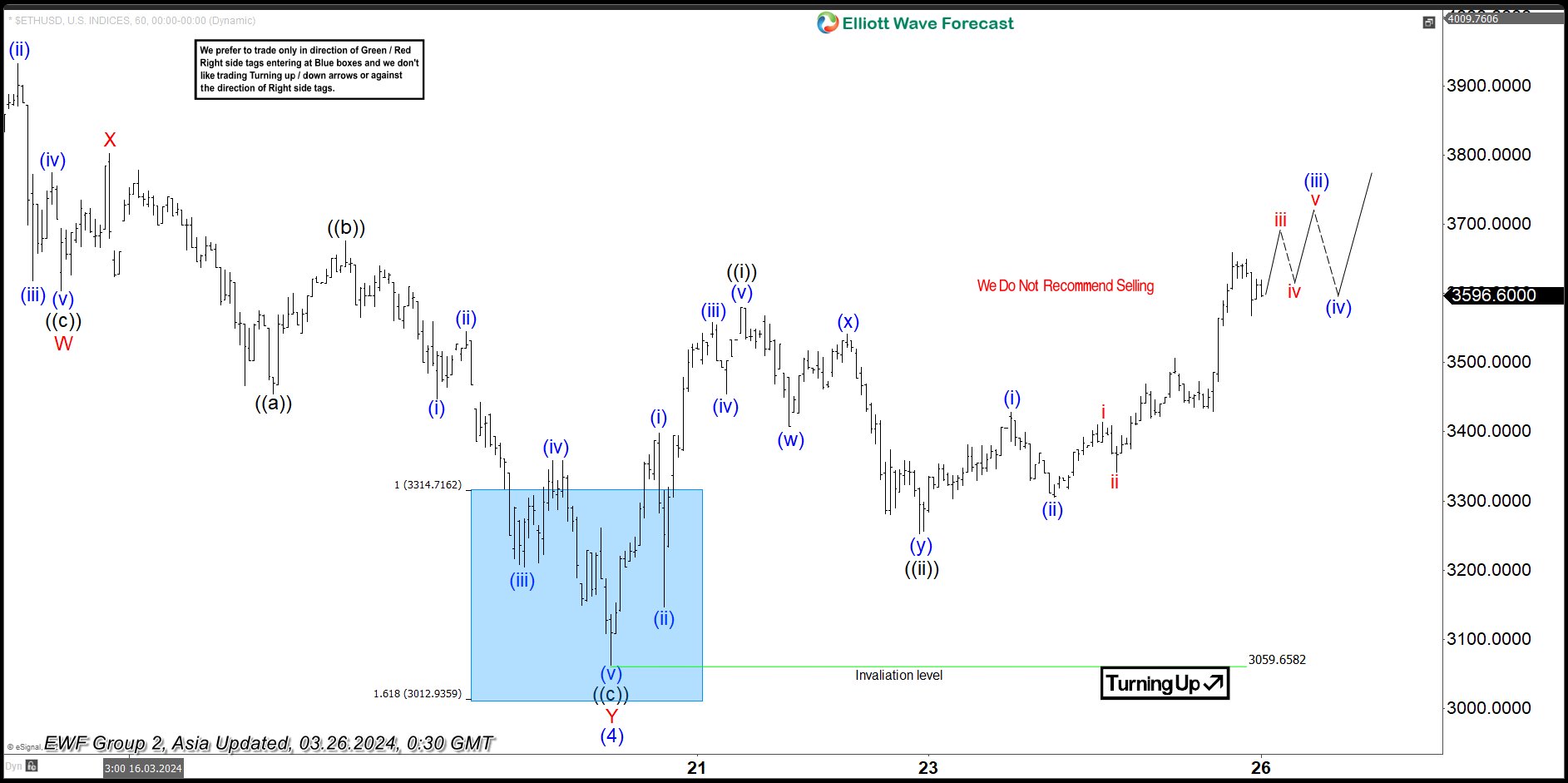
Ethereum found buyers as expected. It made decent rally from the Blue Box. Bounce already reached 50 fibs against the X red connector which confirms cycle from the peak is done. Consequently, any long positions from the equal legs area are risk free by now and we have taken partial profits. We call wave (4) completed at the 3059.65low. Once ETHUSD make a break of March 11th peak, it will confirm next leg up is in progress.
USD/JPY Price Analysis: Consolidation ahead of US News
This morning, news about inflation in Japan was published. It did not bring any surprises — inflation in Japan is gradually weakening as expected. Core CPI in annual terms: actual = 2.3%, forecast = 2.5%, a month ago = 2.6%, a year ago = 3.0%.
We also note that the official position is aimed at preventing further weakening of the yen, as the USD/JPY price has risen more than 7% since the beginning of 2024 — very close to a 32-year high. Thus, Japanese Deputy Finance Minister for Economic Affairs Masato Kanda yesterday warned that the current weakening of the yen does not correspond to fundamental indicators and is clearly caused by speculation. He concluded that the authorities would take appropriate measures against excessive fluctuations.
However, neither verbal interventions nor the publication of Japanese Core CPI values led to strong fluctuations in the USD/JPY market. Why so?
From a fundamental analysis point of view, market participants are keeping their focus on the publication of Core PCE Price Index values in the US, as well as the Fed Chairman's speech — both events are scheduled for Friday (at 15:30 and 18:30 GMT+3, respectively).
From a technical analysis point of view, the market stabilization is quite natural, since the USD/JPY price today is near the median line of the ascending channel (shown in blue), which describes the trajectory of 2024. The market seems to be cooling down after the RSI indicated it was overbought on March 20th.
It is the events of Friday that can bring the market out of the current equilibrium state (despite the fact that Friday is a day off in many countries, volatility can be high).
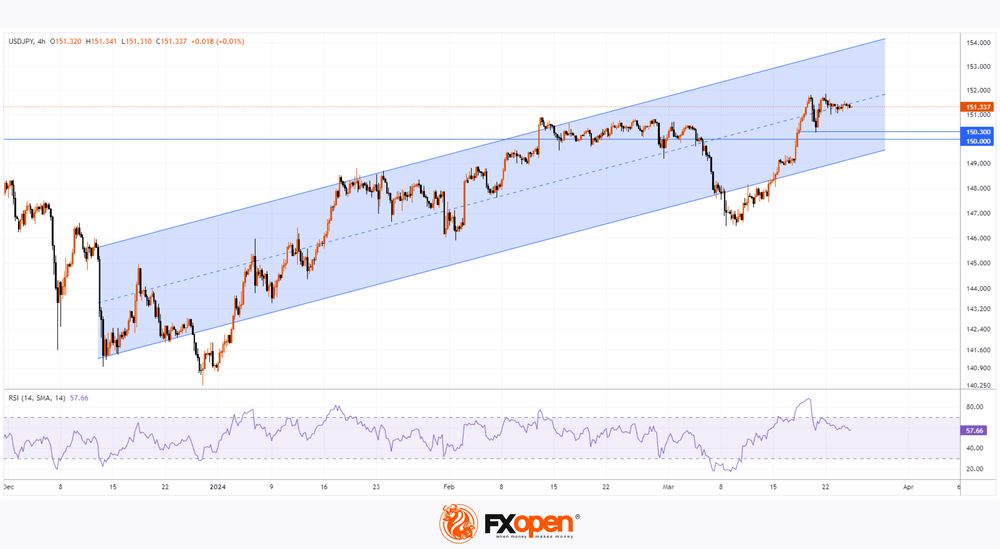
In case of bearish activity, the USD/JPY price may be supported by a zone consisting of:
→ the lower line of the border of the ascending channel;
→ psychological level of 150 yen per US dollar;
→ support from a local minimum of about 150.30 yen per US dollar.
If the market goes out of balance towards the upper boundary of the channel, market sentiment will likely be influenced by expectations of the Bank of Japan's reaction to an excessively weak yen — and this may not only be verbal interventions.
Trade over 50 forex markets 24 hours a day with FXOpen. Take advantage of low commissions, deep liquidity, and spreads from 0.0 pips. Open your FXOpen account now or learn more about trading forex with FXOpen.
This article represents the opinion of the Companies operating under the FXOpen brand only. It is not to be construed as an offer, solicitation, or recommendation with respect to products and services provided by the Companies operating under the FXOpen brand, nor is it to be considered financial advice.
GBP/USD: Bulls Gaining Traction After Double Rejection at 200-DMA
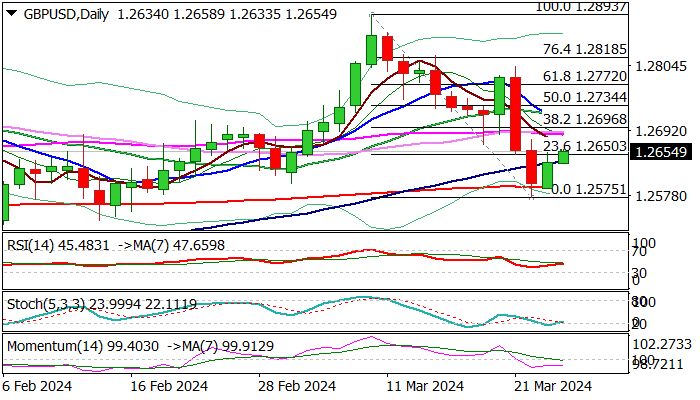
Cable remains constructive in early Tuesday’s trading, after it was lifted by better than expected UK data on Monday and fading expectations for BOE rate cut in May.
Fresh recovery was also underpinned by a double downside rejection at 200DMA (1.2591) on Fri/Mon however, bearishly aligned daily studies (momentum indicator is in the negative territory and 10/20/55 DMA’s in bearish setup) keep in play risk of potential recovery stall.
Daily close above 10DMA (1.2637) and top of thin daily cloud (1.2663) is seen as a minimum requirement to maintain bullish bias, with lift above 1.2700 zone (Fibo 38.2% of 1.2893/1.2575 bear-leg / 20DMA) to strengthen near-term structure for further recovery.
Res: 1.2663; 1.2700; 1.2734; 1.2772.
Sup: 1.2637; 1.2591; 1.2575; 1.2518.
Japanese Yen Awaits Intervention Amid Weakness
The USD/JPY pair stabilised around 151.35 by Tuesday, not far from its recent peaks, as the weakness of the Japanese yen has prompted verbal interventions from Japanese authorities.
Japan's Finance Minister, Shunichi Suzuki, mentioned that measures to normalise the yen are quite likely. He cited excessive volatility as increasing uncertainty for the country's trading partners and creating adverse conditions for business operations.
Monetary policy official Masato Kanda remarked that the yen's current weakness does not reflect fundamental factors, labelling recent depreciation waves as speculative. Kanda stated that authorities are closely monitoring currency movements and feel the need to "keep a finger on the pulse" of the market. Japan is ready to respond to yen volatility appropriately, though decisions are yet to be made.
The yen's decline gained momentum last week when the Bank of Japan raised its interest rate for the first time in 17 years, ending eight years of negative interest rates. The capital market was prepared for this move, as the BoJ had meticulously laid the groundwork for such a step.
The Bank of Japan intends to maintain an accommodative monetary policy for an extended period, which acts against the yen's value.
Technical analysis of USD/JPY
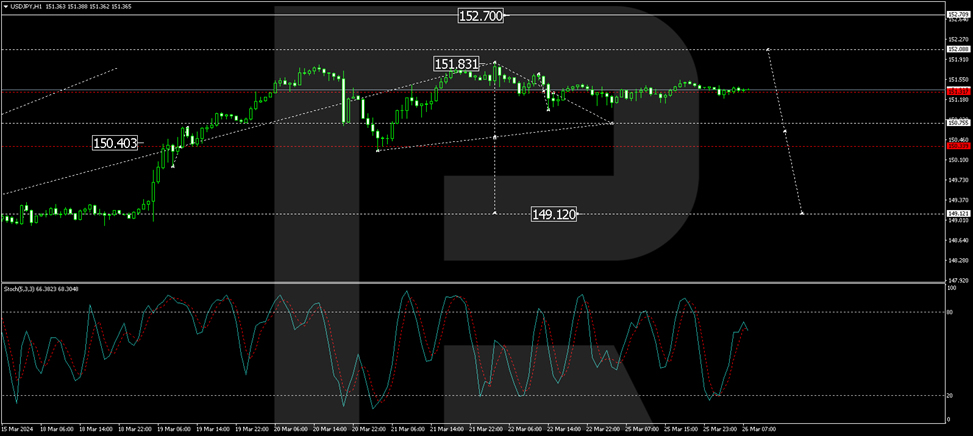
On the H4 chart of USD/JPY, a growth wave to 151.85 has been completed. This target is local and estimated. The market is currently forming a consolidation range below this level. With a downward breakout from this range, a correction to 149.12 is possible, after which a new growth wave to 152.70 is anticipated. The MACD oscillator supports this scenario, with its signal line directed downwards towards the zero line.
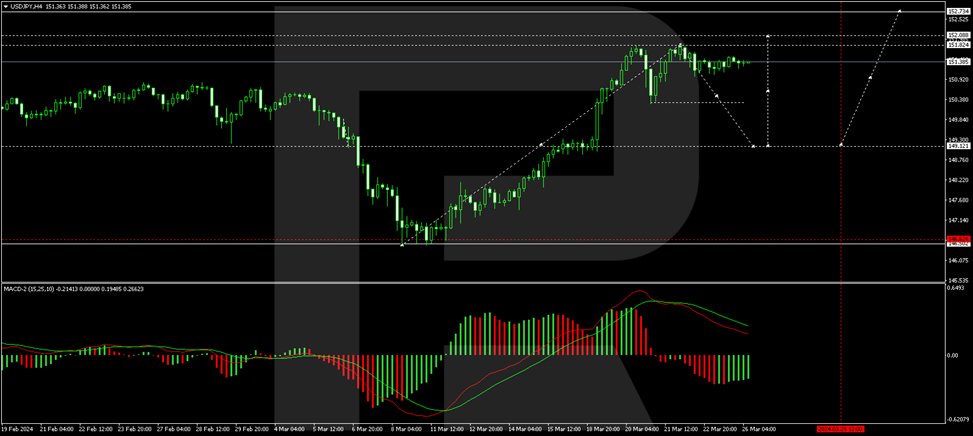
On the H1 chart of USD/JPY, a narrow consolidation range has formed around 151.31. A downward breakout and continuation of the correction to 150.75 are expected. Breaking through this level would open potential towards reaching 149.20, followed by an increase to 151.85. The Stochastic oscillator confirms this scenario, with its signal line below 80 and preparing for a decline to 20.