

Sample Category Title
EUR/USD Shows Resilience Amid Risk Appetite
The EUR/USD pair is trading close to 1.0821, demonstrating a strong stance in the current market environment. Investors are leaning towards riskier assets, buoyed by the anticipation of several key macroeconomic releases this week.
A critical focal point for the market will be the upcoming US inflation data, particularly the core Personal Consumption Expenditures (PCE) price index, a preferred measure of inflation by the Federal Reserve. The report, expected to be released on Thursday, is forecasted to show a 0.4% month-on-month increase. This data is crucial as it influences the Fed's monetary policy decisions.
The prevailing market sentiment suggests that the Federal Reserve may not be poised to embark on a monetary easing cycle just yet, opting instead to maintain the current interest rate levels for a longer duration.
Technical Analysis for EUR/USD
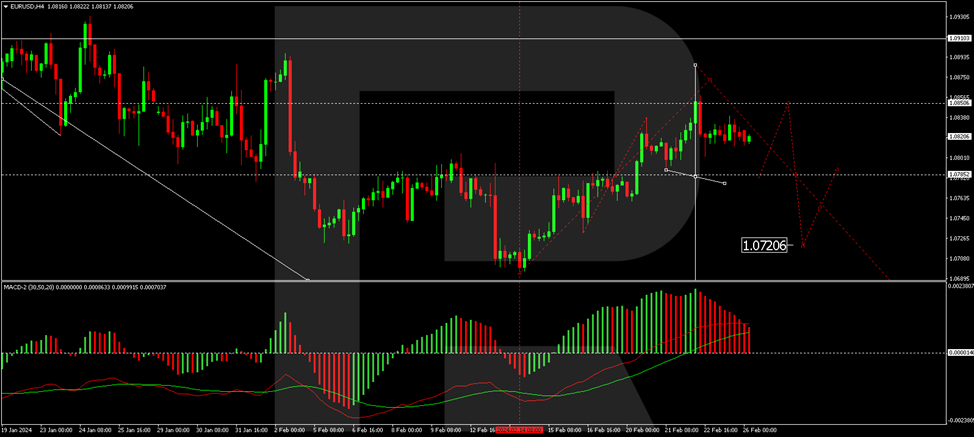
On the H4 chart, EUR/USD has shown a downtrend, reaching a low of 1.0802. It's anticipated that a corrective movement could occur next. After this correction, the price is expected to decline to 1.0785, where it might form a consolidation range. A break below this range could lead to a further decrease towards the local target of 1.0720. This bearish scenario is supported by the MACD indicator, with its signal line positioned below zero and the histogram indicating a sharp decline, suggesting a potential further decline in the price to new lows.
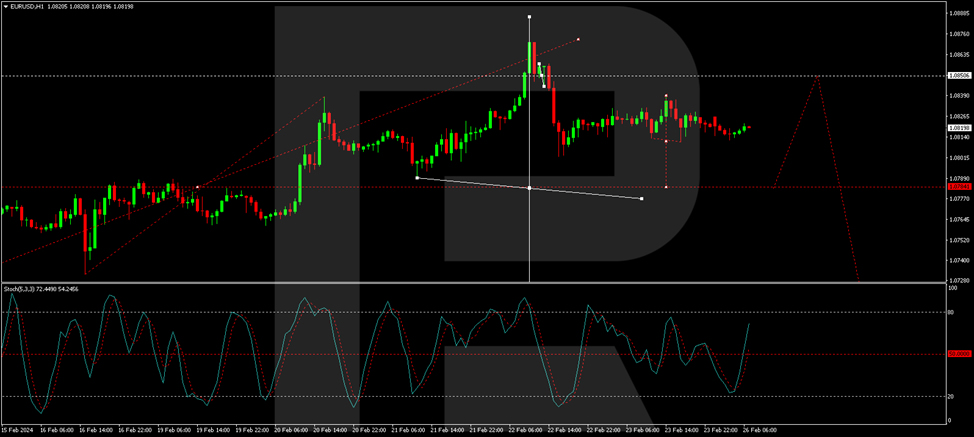
The H1 chart presents a consolidation phase around 1.0824, followed by a potential drop to 1.0784. After reaching this level, the price may rebound to 1.0850 before descending again to 1.0720. This analysis is corroborated by the Stochastic oscillator, with its signal line currently near 80 and anticipated to drop to 20, indicating the likelihood of further price movements within this trend.
USD/CAD Daily Outlook
Daily Pivots: (S1) 1.3490; (P) 1.3510; (R1) 1.3524; More...
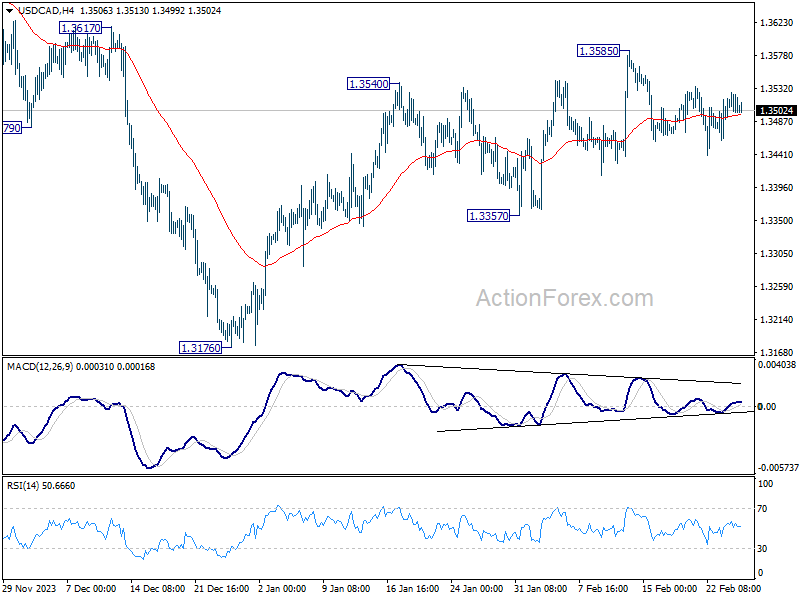
USD/CAD is staying in sideway trading below 1.3585 and intraday bias remains neutral. With 1.3357 support intact, further rally is expected. On the upside, break of 1.3585 will resume the rebound from 1.3176 for 1.3897 resistance. However, break of 1.3357 will argue that the rebound from 1.3176 has completed and bring retest of this low.
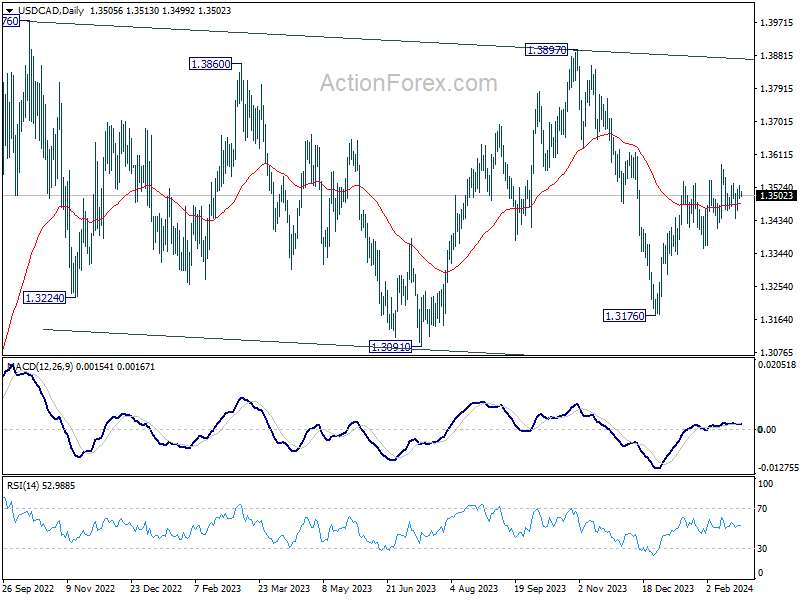
In the bigger picture, price actions from 1.3976 (2022 high) are viewed as a corrective pattern only. In case of another fall, strong support should emerge above 1.2947 resistance turned support to bring rebound. Overall, larger up trend from 1.2005 (2021 low) is still expected to resume through 1.3976 at a later stage.
AUD/USD Daily Report
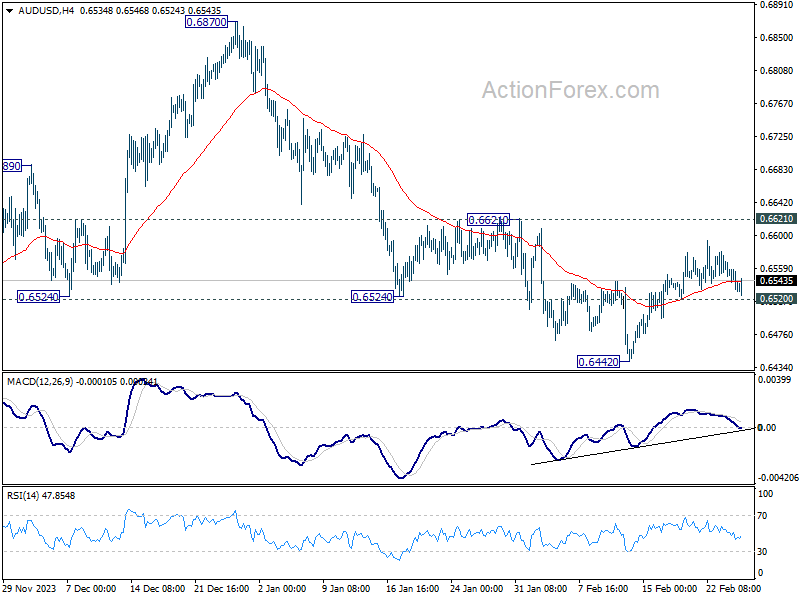
Daily Pivots: (S1) 0.6525; (P) 0.6546; (R1) 0.6561; More...
Intraday bias in AUD/USD stays neutral at this point. While recovery from 0.6442 could extend higher, outlook will remain bearish as long as 0.6621 resistance holds. On the downside, below 0.6520 minor support will turn bias to the downside for retesting 0.6442. Nevertheless, considering bullish convergence condition in 4H MACD, decisive break of 0.6621 will turn near term outlook bullish for 0.6870 resistance instead.
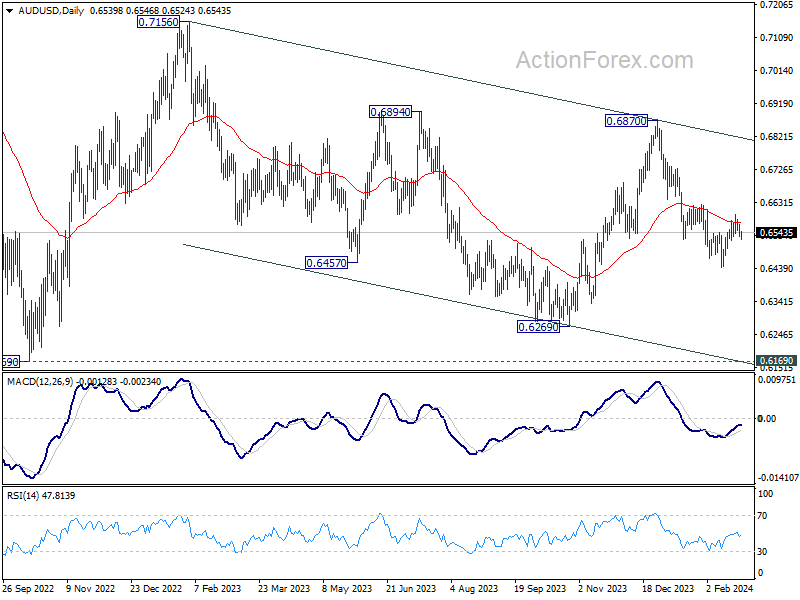
In the bigger picture, price actions from 0.6169 (2022 low) are seen as a medium term corrective pattern to the down trend from 0.8006 (2021 high). Fall from 0.7156 (2023 high) is seen as the second leg, which might still be in progress. Overall, sideway trading could continue in range of 0.6169/7156 for some more time. But as long as 0.7156 holds, an eventual downside breakout would be mildly in favor.
EUR/USD Daily Outlook
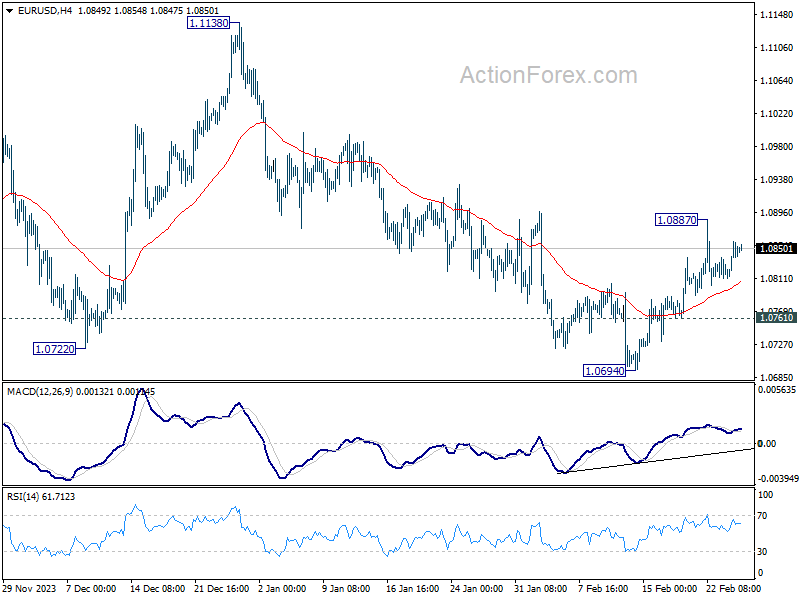
Daily Pivots: (S1) 1.0823; (P) 1.0842; (R1) 1.0870; More...
Intraday bias in EUR/USD remains neutral as range trading continues below 1.0887. On the upside, break of 1.0887 and sustained trading above 55 D EMA (now at 1.0832) will affirm the case that fall from 1.1138 has completed. Stronger rally would then be seen back to 1.1138. . However, break of 1.0761 will turn bias back to the downside for retesting 1.0694 support.
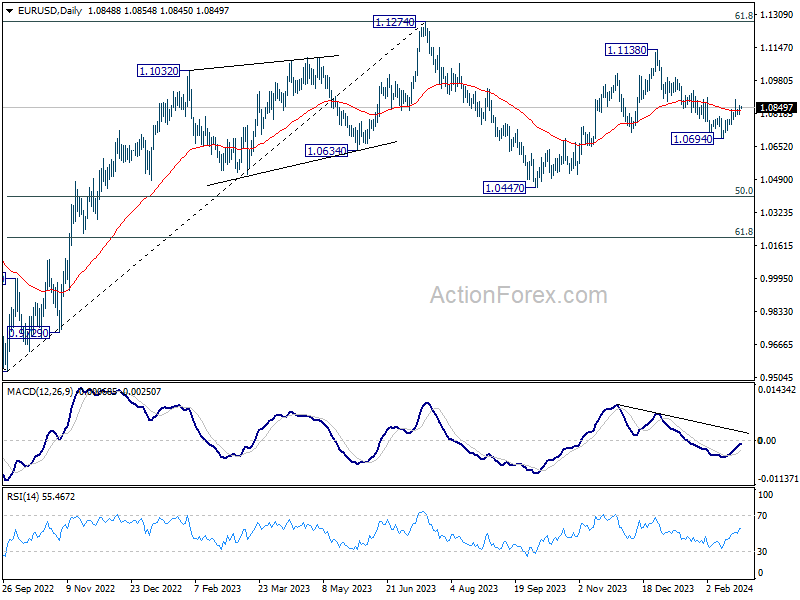
In the bigger picture, price actions from 1.1274 are viewed as a corrective pattern to rise from 0.9534 (2022 low). Rise from 1.0447 is seen as the second leg. While further rally could cannot be ruled out, upside should be limited by 1.1274 to bring the third leg of the pattern. Meanwhile, sustained break of 1.0694 support will argue that the third leg has already started for 1.0447 and possibly below.
GBP/USD Daily Outlook
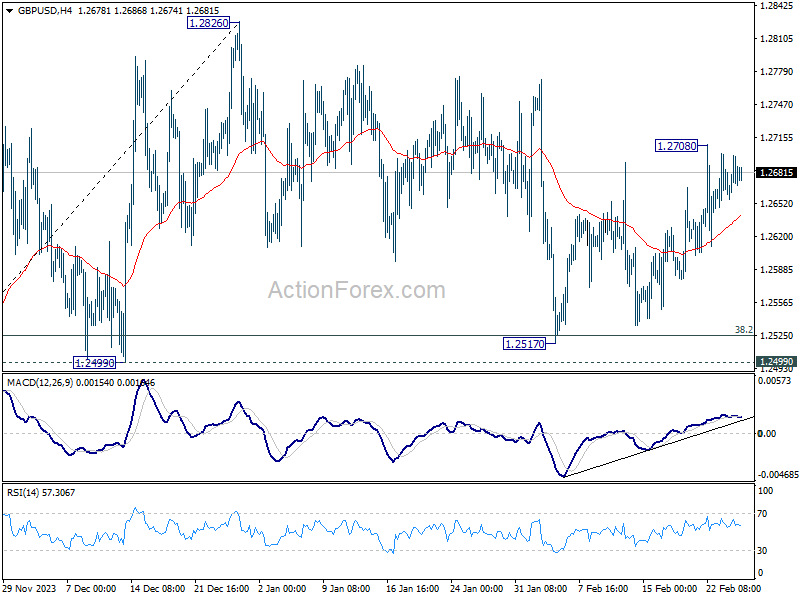
Daily Pivots: (S1) 1.2662; (P) 1.2681; (R1) 1.2704; More...
Intraday bias in GBP/USD remains neutral at this point. On the upside, break of 1.2708 resistance will indicate that correction from 1.2826 has completed. Intraday bias will be back on the upside for retesting 1.2826. Nevertheless, decisive break of 1.2499 will argue that whole rise from 1.2036 has completed and turn near term outlook bearish.
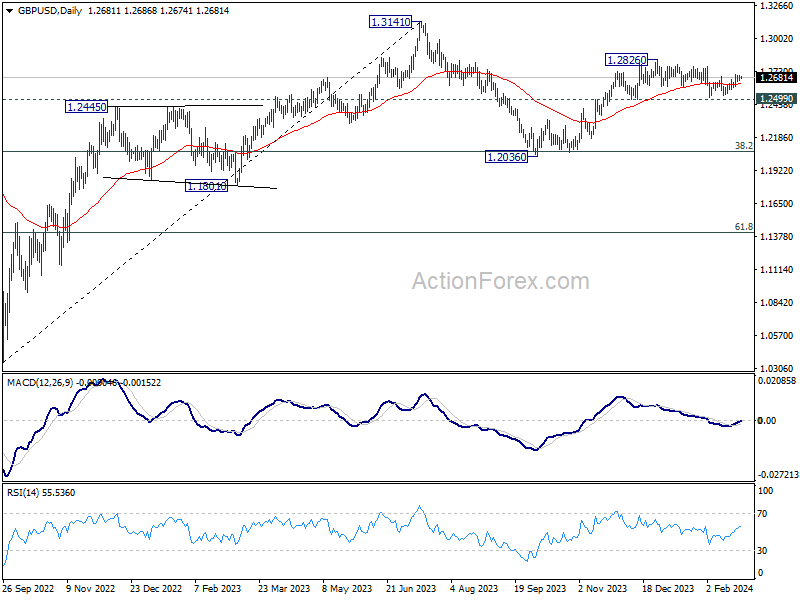
In the bigger picture, price actions from 1.3141 medium term top are seen as a corrective pattern to up trend from 1.0351 (2022 low). Rise from 1.2036 is seen as the second leg, which could be still in progress. But upside should be limited by 1.3141 to bring the third leg of the pattern. Meanwhile, break of 1.2499 support will argue that the third leg has already started for 38.2% retracement of 1.0351 (2022 low) to 1.3141 at 1.2075 again.
USD/CHF Daily Outlook
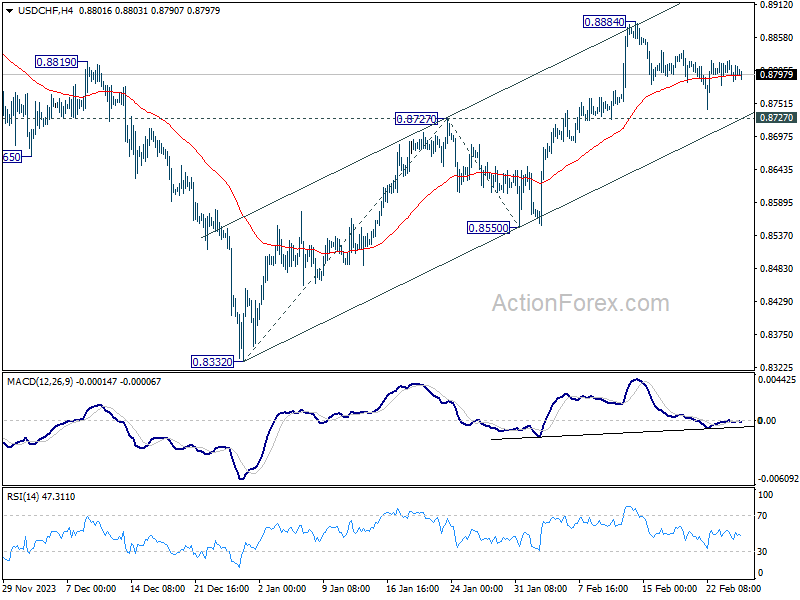
Daily Pivots: (S1) 0.8785; (P) 0.8803; (R1) 0.8819; More....
USD/CHF is extending the consolidation from 0.8884 and intraday bias stays neutral. With 0.8727 resistance turned support intact, further rally is expected. On the upside, above 0.8884 will resume the rally from 0.8332 to 100% projection of 0.8332 to 0.8727 from 0.8550 at 0.8954. However, sustained break of 0.8727 will dampen this bullish view, and turn bias back to the downside for 0.8550 support instead.
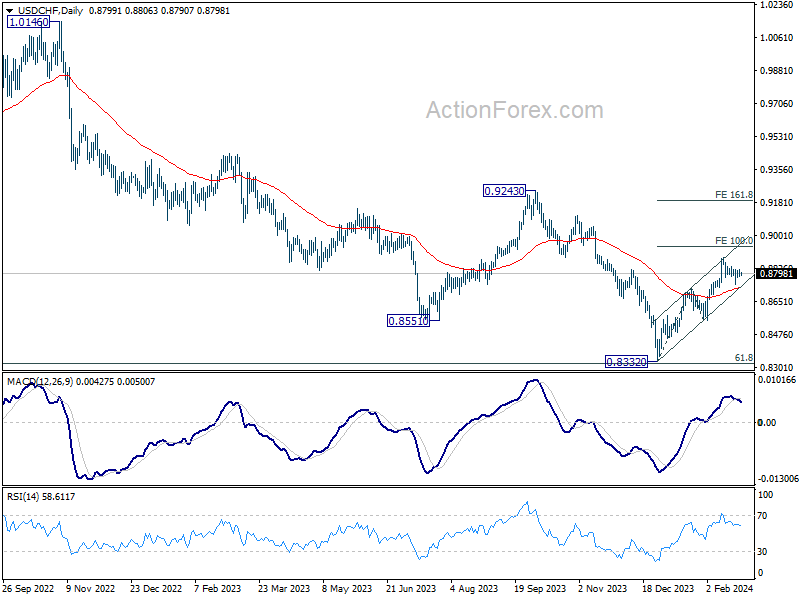
In the bigger picture, a medium term bottom should be formed at 0.8332, on bullish convergence condition in W MACD, just ahead of 0.8317 long term fibonacci support. It's still early to decide if the larger down trend from 1.0146 (2022 high) is reversing. But further rise should be seen to 0.9243 resistance even as a correction.
USD/JPY Daily Outlook
Daily Pivots: (S1) 150.39; (P) 150.61; (R1) 150.94; More...
USD/JPY retreats mildly ahead of 150.87 resistance as consolidation continues. Intraday bias remains neutral and outlook is unchanged. In case of deeper retreat, downside should be contained by 148.79 resistance turned support to bring rebound. On the upside, break of 150.87 will resume 140.25 to 151.89/93 key resistance zone. Decisive break there will confirm larger up trend resumption of 155.50 projection level next.
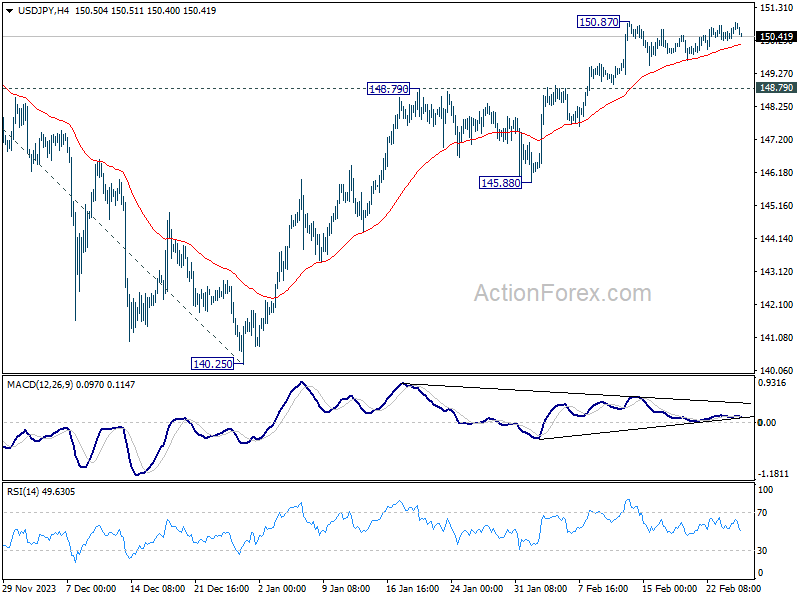
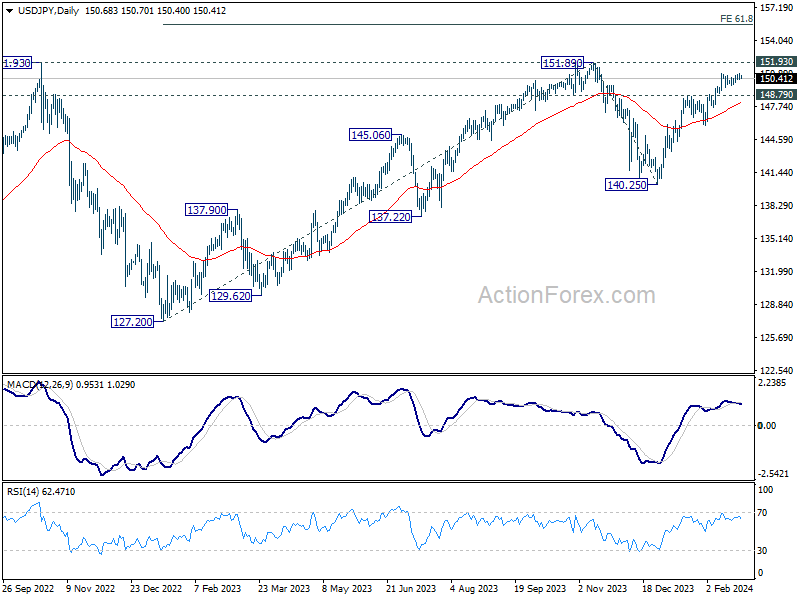
In the bigger picture, rise from 140.25 is seen as resuming the trend from 127.20 (2023 low). Decisive break of 151.89/.93 resistance zone will confirm this bullish case and target 61.8% projection of 127.20 to 151.89 from 140.25 at 155.50. However, break of 148.79 resistance turned support will delay this bullish case, and extend the corrective pattern from 151.89 with another falling leg.
Yen Inches Upward as Japan’s CPI Fuels March BoJ Hike Talks
Japanese Yen found modest strength in Asian session today, lifted by stronger than expected consumer inflation data from Japan. At the same time, two-year yield climbed to its highest point since 2011 while Nikkei is steady. The data intensified speculations around BoJ's move to abandon its negative interest rate policy. Almost all economists are expecting a rate hike in the first half of the year, with April still tagged as the most probable timing. However, the CPI raises the chance of an expedited move in March.
Despite today's recovery, it's premature to declare bullish reversal for Yen. BoJ Governor Kazuo Ueda has indicated that, even with the shift away from negative rates, the monetary policy stance will remain accommodative, and any tightening efforts are expected to unfold gradually. Additionally, the prospect of other major central banks, such as Fed, postponing policy easing could maintain a significant yield gap, thereby restraining any potential Yen rally.
In other market developments, Euro is trading as the week's standout performer for, followed by Swiss Franc and Sterling. New Zealand Dollar finds itself lagging at the bottom, with market participants keenly awaiting RBNZ's rate decision tomorrow. Australian Dollar, alongside the Dollar, shows weakness, whereas Canadian Dollar and Yen are mixed.
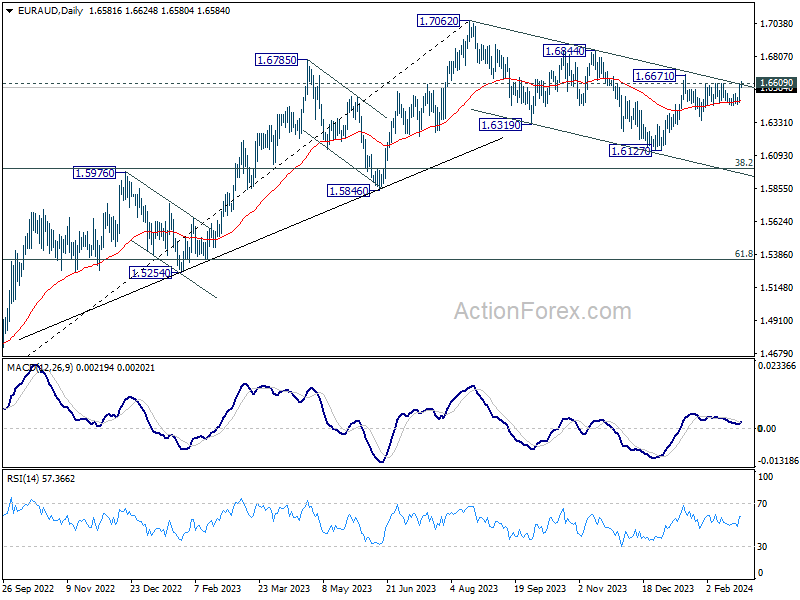
Technically, EUR/USD is now pressing medium term channel resistance after yesterday's strong rebound. The notable support from 55 D EMA is a near term bullish sign. The overall favored case is that correction from 1.7062 has completed with three waves down to 1.6127. Break of 1.6671 resistance will strengthen this bullish case, and target a retest on 1.7062 high next.
In Asia, at the time of writing, Nikkei is down -0.21%. Hong Kong HSI is down -0.48%. China Shanghai SSE is up 0.55%. Singapore Strait Times is down -0.91%. Japan 10-year JGB yield is up 0.010 at 0.700. Overnight, DOW fell -0.16%. S&P 500 fell -0.38%. NASDAQ fell -0.13%. 10-year yield rose 0.039 to 4.299.
ECB's Lagarde highlights wage dynamics in inflation outlook
In a speech delivered at the European Parliament overnight, ECB President Christine Lagarde emphasized the significant role of wage pressures. According to Lagarde, wage pressures "remain strong" across the region, anticipated to be an "increasingly important driver of inflation dynamics" in the coming quarters.
This shift towards wage-driven inflation comes as the contribution of profits, previously a significant factor in domestic cost pressures, begins to wane. Importantly, Lagarde pointed out that labor cost increases are being "partly buffered by profits", preventing a full pass-through to consumer prices.
Lagarde also touched on the risks associated with second-round effects, a concern for economies dealing with inflation. She reassured that ECB's current restrictive monetary policy, combined with a notable decline in headline inflation and well-anchored longer-term inflation expectations, serves as a "safeguard against a sustained wage-price spiral".
Looking ahead, Lagarde expects continued deceleration in inflation rates as the effects of previous shocks diminish and tighter financing conditions exert downward pressure.
Fed's Schmid counsels patience, preemptive policy shifts unnecessary
Kansas City Fed President Jeffrey Schmid emphasized a cautious approach to adjusting Fed's monetary policy. With inflation persistently above the target, coupled with tight labor markets and strong demand, Schmid argues there is "no need to preemptively adjust the stance of policy."
His stance highlights a preference for a measured response, suggesting that "the best course of action is to be patient," a sentiment that underscores the importance of observing the economy's reaction to the already implemented policy tightening measures. He urged to wait for "convincing evidence that the inflation fight has been won."
Schmid also addressed the current state of high inflation, indicating that "we are not out of the woods yet." He pointed out that recent reductions in inflation have primarily resulted from decreases in energy and goods prices, thanks to the rebalancing of oil markets and the healing of supply chains.
Core inflation in Japan eases to 2%, but surpasses expectations
Japan's CPI core (all items ex food) slowed from 2.3% yoy to 2.0% yoy, above expectation of 1.9% yoy. This marks the third consecutive month of decline, reaching the lowest level in 22 months and aligning precisely with BoJ's inflation target of 2%.
The headline CPI also saw a decrease, moving from 2.6% to 2.2% yoy. Nevertheless, CPI core-core (ex-food and energy) showed only modest improvement, edging down from 3.7% to 3.5% yoy.
A significant factor contributing to the overall CPI's decline a -12.1% yoy drop in energy prices, resulting from government interventions to mitigate utility bills through subsidies for oil wholesalers. In contrast, food prices saw 5.9% yoy increase, while accommodation fees surged by 26.9% yoy.
The latest inflation data should fortify the argument for BoJ to terminate its negative interest rate policy soon. However, the decisive factor for the exact timing—be it March or April—hinges on the forthcoming wage negotiations between large enterprises and unions scheduled for March 13.
Looking ahead
Germany Gfk consumer sentiment and Eurozone M3 money supply will be released in European session. Later in the day, US will release durable goods orders, house price index and consumer confidence.
USD/JPY Daily Outlook
Daily Pivots: (S1) 150.39; (P) 150.61; (R1) 150.94; More...
USD/JPY retreats mildly ahead of 150.87 resistance as consolidation continues. Intraday bias remains neutral and outlook is unchanged. In case of deeper retreat, downside should be contained by 148.79 resistance turned support to bring rebound. On the upside, break of 150.87 will resume 140.25 to 151.89/93 key resistance zone. Decisive break there will confirm larger up trend resumption of 155.50 projection level next.
In the bigger picture, rise from 140.25 is seen as resuming the trend from 127.20 (2023 low). Decisive break of 151.89/.93 resistance zone will confirm this bullish case and target 61.8% projection of 127.20 to 151.89 from 140.25 at 155.50. However, break of 148.79 resistance turned support will delay this bullish case, and extend the corrective pattern from 151.89 with another falling leg.
Economic Indicators Update
| GMT | Ccy | Events | Actual | Forecast | Previous | Revised |
|---|---|---|---|---|---|---|
| 23:30 | JPY | National CPI Y/Y Jan | 2.20% | 2.60% | ||
| 23:30 | JPY | National CPI ex Fresh Food Y/Y Jan | 2.00% | 1.90% | 2.30% | |
| 23:30 | JPY | National CPI ex Food & Energy Y/Y Jan | 3.50% | 3.70% | ||
| 00:01 | GBP | BRC Shop Price Index Y/Y Jan | 2.50% | 2.90% | ||
| 07:00 | EUR | Germany Gfk Consumer Confidence Mar | -29 | -29.7 | ||
| 09:00 | EUR | Eurozone M3 Money Supply Y/Y Jan | 0.20% | 0.10% | ||
| 13:30 | USD | Durable Goods Orders Jan | -4.40% | 0.00% | ||
| 13:30 | USD | Durable Goods Orders ex Transport Jan | 0.30% | 0.50% | ||
| 14:00 | USD | S&P/CS Composite-20 HPI y/y Dec | 6.00% | 5.40% | ||
| 14:00 | USD | Housing Price Index M/M Dec | 0.10% | 0.30% | ||
| 15:00 | USD | Consumer Confidence Feb | 114.9 | 114.8 |
Gold Price Faces Uphill Task, Bitcoin Rallies
Key Highlights
- Gold is attempting a fresh increase above the $2,020 resistance.
- It broke a key bearish trend line with resistance at $2,012 on the 4-hour chart.
- EUR/USD is showing a few positive signs above the 1.0780 resistance.
- Bitcoin prices surged over 10% and climbed toward $58,000.
Gold Price Technical Analysis
Gold prices started a fresh increase from the $1,985 support against the US Dollar. The bulls cleared the $2,000 resistance to start a decent recovery wave.
The 4-hour chart of XAU/USD indicates that the price settled above the $2,015 level, the 100 Simple Moving Average (red, 4 hours), and the 200 Simple Moving Average (green, 4 hours).
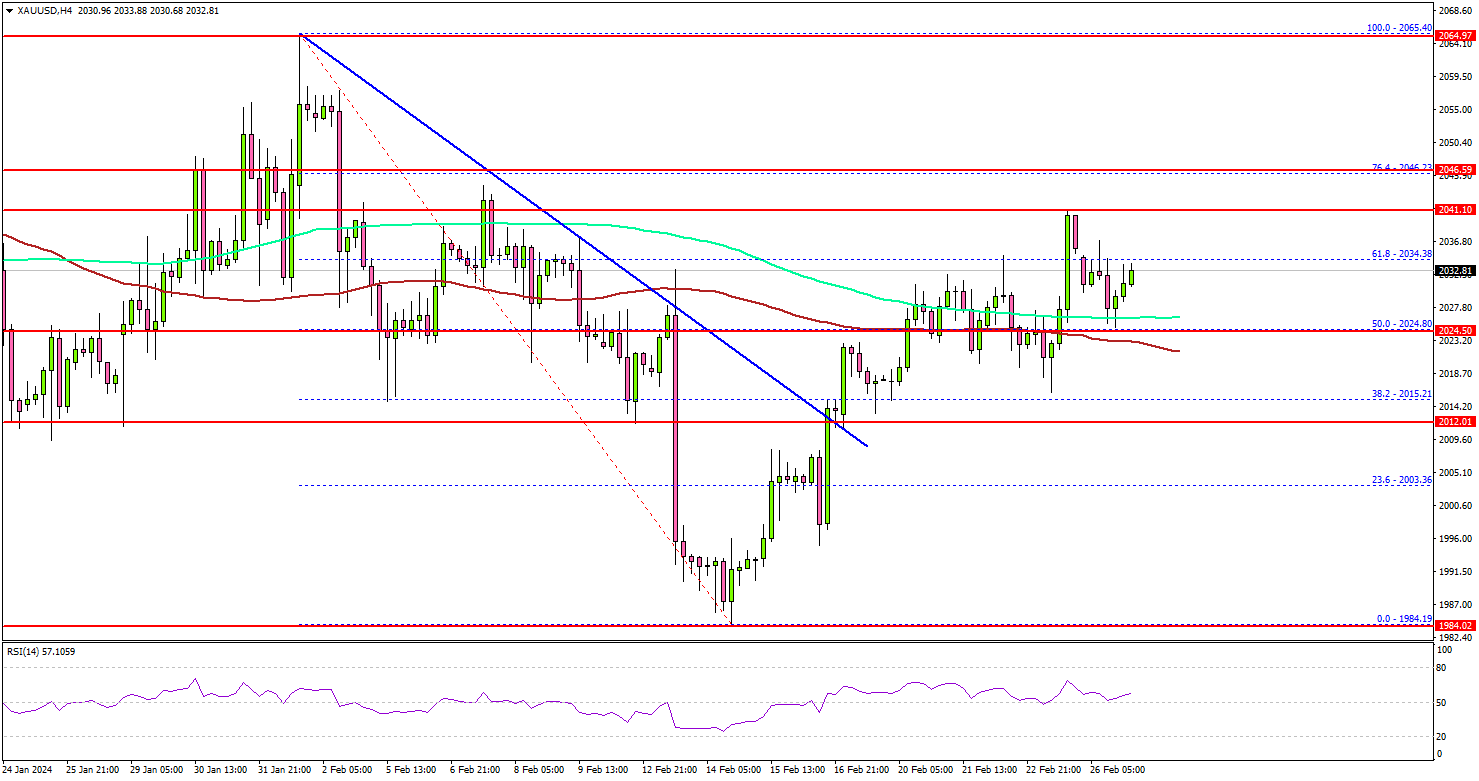
Besides, it broke a key bearish trend line with resistance at $2,012 on the same chart. There was a spike above the 61.8% Fib retracement level of the downward move from the $2,065 swing high to the $1,984 low.
On the upside, the price is facing hurdles near the $2,040 level. An upside break above the $2,040 level could send the price toward the $2,046 resistance. It is close to the 76.4% Fib retracement level of the downward move from the $2,065 swing high to the $1,984 low.
The next major resistance is near the $2,050 level, above which Gold could test $2,065. Any more gains might send it toward $2,080.
Initial support is near the $2,020 level or the 100 Simple Moving Average (red, 4 hours). The first major support sits at $2,012. Any more losses might call for a move toward the $1,985 level in the coming days.
Looking at EUR/USD, the pair is showing a few positive signs above 1.0780, but the bulls face many hurdles above 1.0850.
Economic Releases to Watch Today
- US Housing Price Index for Dec 2024 (MoM) - Forecast +0.3%, versus +0.3% previous.
- US Durable Goods Orders for Jan 2024 – Forecast -4.8% versus 0% previous.
Core inflation in Japan eases to 2%, but surpasses expectations
Japan's CPI core (all items ex food) slowed from 2.3% yoy to 2.0% yoy, above expectation of 1.9% yoy. This marks the third consecutive month of decline, reaching the lowest level in 22 months and aligning precisely with BoJ's inflation target of 2%.
The headline CPI also saw a decrease, moving from 2.6% to 2.2% yoy. Nevertheless, CPI core-core (ex-food and energy) showed only modest improvement, edging down from 3.7% to 3.5% yoy.
A significant factor contributing to the overall CPI's decline a -12.1% yoy drop in energy prices, resulting from government interventions to mitigate utility bills through subsidies for oil wholesalers. In contrast, food prices saw 5.9% yoy increase, while accommodation fees surged by 26.9% yoy.
The latest inflation data should fortify the argument for BoJ to terminate its negative interest rate policy soon. However, the decisive factor for the exact timing—be it March or April—hinges on the forthcoming wage negotiations between large enterprises and unions scheduled for March 13.