Sample Category Title
Bank of England Preview – Topside Risk to EUR/GBP as BoE Removes Tightening Bias
- We expect the Bank of England (BoE) to keep the Bank Rate unchanged at 5.25% on 1 February, which is in line with consensus and current market pricing.
- Overall, we expect the MPC to deliver a dovish tilt to its guidance coupled with a downward revision to its inflation forecast.
- We expect EUR/GBP to move modestly higher upon announcement.
We expect the Bank of England (BoE) to keep the Bank Rate unchanged at 5.25% on 1 February, which is in line with consensus and current market pricing. We expect the vote split to be 9-0, although we stress that risks are two sided for a three-way split. Note, this meeting will include updated projections and a press conference following the release of the statement.
Overall, we expect the MPC to deliver a dovish tilt to its guidance coupled with a downward revision to its inflation forecast and more explicitly to remove its tightening bias in the form of "further tightening in monetary policy would be required if there were evidence of more persistent inflationary pressures." However, we think the BoE will be cautious in being too optimistic on the inflation outlook to prevent premature easing of financial conditions.
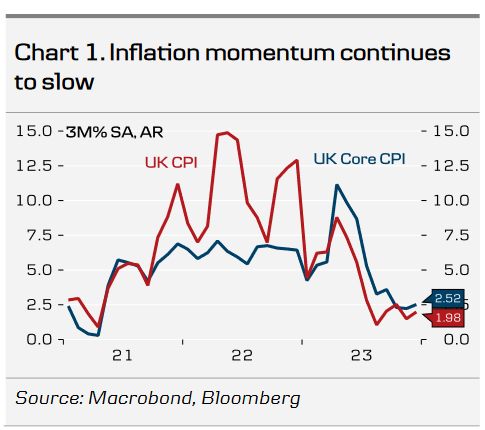
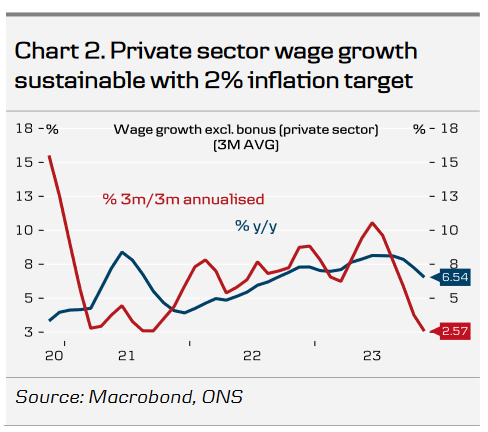
Since the last monetary policy decision in December, data releases have overall pointed to more muted price pressures. November delivered a sharp broad-based downside surprise and while December brought an uptick, primarily due to volatile components such as air fares, it highlights that the road back to 2% will be bumpy. Importantly, the Q4 2023 headline print now stands at 4.2% y/y, which is below the BoE's forecast from the November MPR at 4.6% y/y. Large base effects from energy prices last spring are set to bring headline inflation back to 2% during the first half of the year. As previously flagged, we do not see inflation developing materially different in the UK compared to elsewhere. Wage growth continues to edge lower with the pace of wage growth in the private sector now sustainable with a 2% inflation target (assuming 1% productivity growth), see chart 2. The growth backdrop remains a challenge for the MPC, with both composite and service PMIs remaining in expansionary territory pointing to the UK avoiding a recession in 2024.
Fiscal policy remains a joker for the monetary policy outlook. The chancellor is expected to have a larger than expected headroom at around GBP 20bn in the Spring Budget presented on 6 March. Coupled with an upcoming general election, the budget will likely include tax cuts. However, we expect measures to be largely supply side driven, which would minimise the potential upward pressure on inflation.
BoE call. We expect the BoE to prime markets for an upcoming rate cut at the May meeting while delivering the first cut of 25bp in June and subsequently 25bp cuts in the following quarters, totalling 75bp of cuts for 2024. This is less than current market pricing of 100bp. Importantly, we do not see the BoE deviating from the Fed and ECB by the extent currently priced by markets and expect markets to scale back on expectations from the latter.
FX. In our base case we expect EUR/GBP to move higher on softer guidance and updated projections. Overall, we see relative rates as a negative for GBP and see the recent rebound as attractive levels to sell GBP. We continue to forecast EUR/GBP towards 0.89 and stay short GBP/USD.
Fed Preview: Patience and Gradualism
- We expect the Fed to maintain its monetary policy unchanged in the January meeting. We expect the first rate cut in March and a total of four cuts in 2024.
- The Fed is in a comfortable position with regards to both sides of its dual mandate. Cooling inflation warrants cutting rates towards neutral, but solid growth and labour markets allow the Fed to move gradually.
- The Fed is also starting to look towards fine-tuning the endgame for QT, which we expect to last at least until the end of the year. Overall, we see risks tilted towards slightly higher yields and lower EUR/USD around the meeting.
The title of this preview quotes SF Fed's Mary Daly, a new FOMC voter for 2024, who was the last participant to comment on monetary policy outlook ahead of the January blackout. Next Wednesday, with no new economic forecasts, all eyes will be on Powell, who we expect to echo Daly and several of their colleagues' recent remarks, emphasizing cautious yet optimistic outlook.
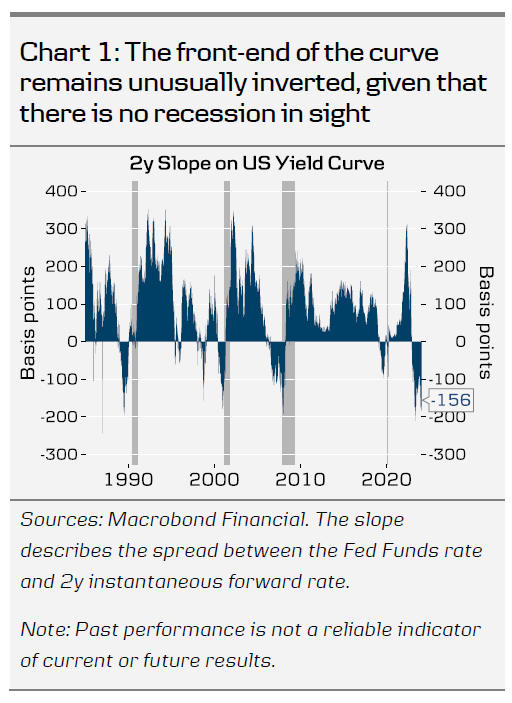
Market prices in around 140bp of cuts for this year. Over the past 40 years, the front-end of the curve has only been as inverted just ahead of recessions, which does not seem like the case today. Recovering real wages, easier financial conditions, rising consumer optimism and supportive fiscal policy all suggest that an imminent slowdown is unlikely.
The December projections showed that real policy rate would remain somewhat above 2% this year, around 1.5% in 2025 and then settle close to neutral in 2026. While the Fed is happy to discuss rate cuts for 2024, monetary policy will not be expansionary anytime soon.
The December minutes suggested that upside risks to inflation have 'diminished', but some risk of persistent inflation still remains, especially in housing and non-housing services. With the recent strong data signals from labour markets, consumer demand and housing market, we think that the near-term inflation outlook supports the gradual approach.
In addition to Daly, also Mester, Barkin and Bostic are rotating in as the new FOMC voters for 2024, while Goolsbee, Harker, Kashkari and Logan are moving out. We do not expect the rotation to have a significant impact on the Fed's decision making, but if anything, the new voters' recent comments have been on the hawkish side of the spectrum. Mester explicitly noted that March is too early for a rate cut in her view, while Bostic outlined Q3 as his base case for the first cut. Barkin has not specified a timeline for cuts but noted that progress on inflation has remained narrow and focused on goods.
The outlook for tapering QT has also been increasingly brought up in the latest Fed speak. Waller noted that the endpoint level of reserves could as low as 10-11% of GDP, and that the ON RRP could well be drained to zero. We looked at the arithmetics of QT in our recent edition of Reading-the-Markets USD (16 January), but the key takeaway is that liquidity conditions will likely allow the Fed to continue QT at least until the end of 2024. Overall, we think Powell could guide modestly against the notion of rapid rate cuts and/or end of QT, which leaves risks tilted towards a hawkish market reaction. That said, the upside potential to yields is likely limited, as we still expect a total of four cuts in 2024.
Markets: Stronger USD & stable UST yields in 2024
UST yields looks somewhat vulnerable to a pushback from Powell, especially if it coincides with the Quarterly Refunding statement (also out Wednesday evening) signalling further increases in long-end issuance. Our base case is for the 10Y UST yield to remain close the current level (4.15%-4.20%) by the end of the year, though risks are tilted to the upside in the short run.
If Powell pushes back on the market notion of rapid rate cuts, as we anticipate, we could see a lower EUR/USD upon announcement. Our forecast for the cross is lower at 1.07/1.05 on a 6/12M horizon.
Will Fed Push Back Against Imminent Rate Cuts?
- Investors scale back bets of a March Fed rate cut
- US economic data since December point to improvement
- Focus turns to Fed meeting for clearer guidance on interest rates
- Decision on Wednesday at 19:00 GMT, press conference at 19:30
To cut in March or not to cut?
There has been a notable repricing regarding the Fed’s future course of action since the beginning of 2024. From fully pricing in a 25bps cut in March, investors are now assigning around a 50% for such a move, despite former St. Louis Fed President James Bullard recently saying that he expects the Committee to start lowering interest rates as soon as March.
It seems that the reason why investors were not particularly shocked by Bullard’s remarks was that he is not a rate setter anymore. They likely preferred to wait for Wednesday’s FOMC decision, where they could get clearer and more valid information regarding the Fed’s thinking.
Market still more dovish than the Fed
At its December gathering, the Committee revised down its interest rate projections, with the median dot for 2024 being dragged down to 4.6% from 51%. Yet, despite lifting their own implied path lately, market participants still expect borrowing costs to end the year lower, at around 3.93%. Perhaps their view was affected by Powell raising the question of when it may be appropriate to start lowering rates at the presser following the last meeting.
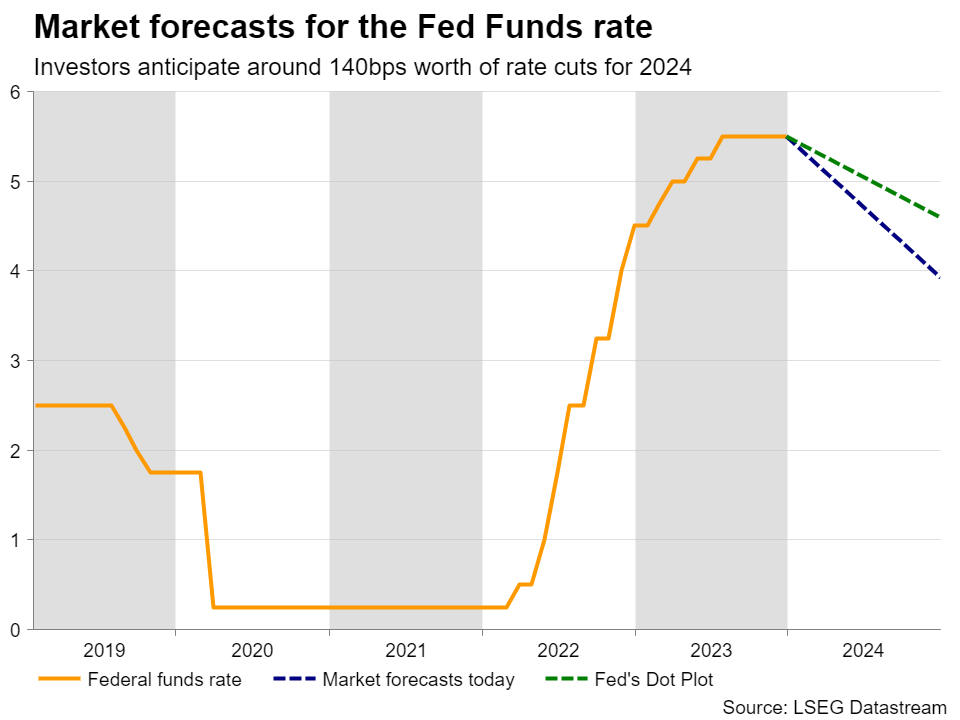
What encouraged traders to dial back some of their rate cut bets at the turn of the year may have been upside surprises in US economic data, but also remarks by Fed officials who pushed against an imminent rate reduction. Even Waller, who was the first policymaker to officially talk about the possibility of rate reductions, recently said that they should not rush into cutting interest rates until low inflation is sustained.
Data point to improving economic activity
After the December gathering, the CPI report revealed that headline inflation rebounded in December, while the core rate slid by less than expected. Retail sales for the same month came in better than expected, with both the headline and core rates coming in at double their November prints, while the flash PMIs for January pointed to further improvement in business activity, with the composite index rising to 52.3 from 50.9. Adding to the bright picture, the first GDP estimate showed that the US economy grew by much more than anticipated in Q4.
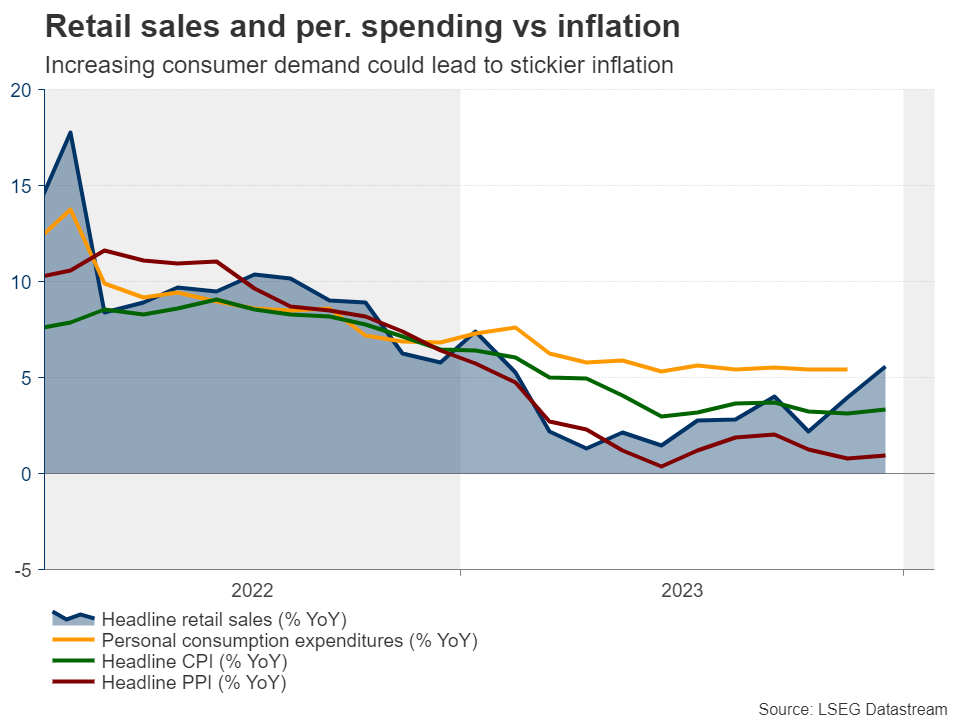
With all that in mind, it seems that there is room for further upside adjustment to the market’s implied path should data and headlines continue to corroborate the view that the world’s largest economy can withstand high interest rates for longer. But will the Fed signal this when it meets on Wednesday?
Fed to stand pat, spotlight to fall on guidance
The Committee is widely expected to keep interest rates untouched and so, the big question is whether they will push back against or leave the door open to imminent rate reductions. Given that no updated economic projections will be released at this gathering, investors may seek answers in the accompanying statement and from Fed Chair Powell at the press conference. It is worth mentioning that in the minutes of the December meeting, it was noted that the future policy path will depend on how the economy evolves and that most policymakers wanted to keep borrowing costs high for “some time.”
With improving economic numbers succeeding one another lately and inflation rebounding somewhat, Fed officials may not opt for rate reductions anytime soon in order not to risk letting inflation spiral out of control again. Thus, they may pour more cold water on rate cut speculation, which could allow Treasury yields to continue their recovery and thereby the US dollar to gain.
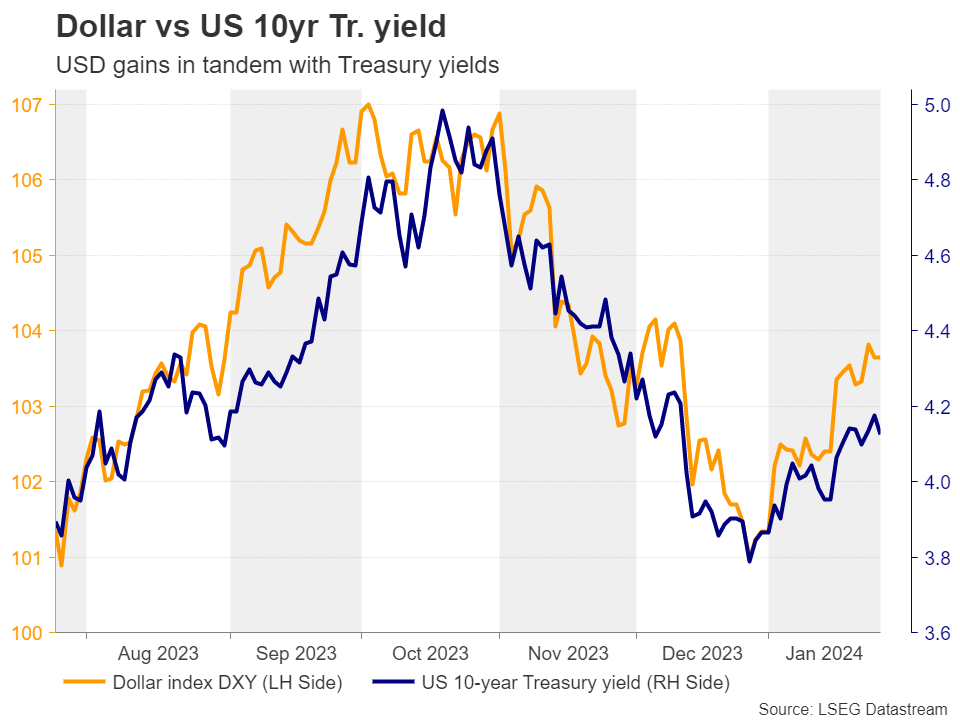
Will dollar/loonie continue trending north?
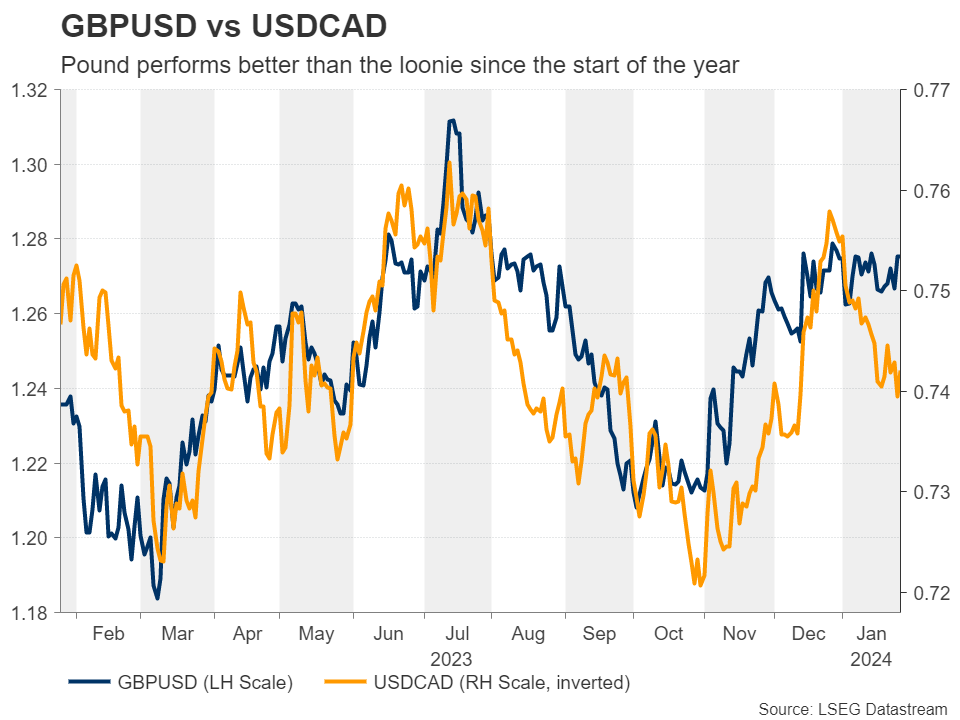
Having said all that though, with Treasury yields in some other major economies also rising and risk appetite remaining elevated, the dollar may not dominate across the board. For example, any gains against the British pound could stay limited if the BoE continues to refuse talking about rate cuts. Given the BoC’s dovish stance on Wednesday, the greenback may perform better against the loonie.
From a technical standpoint, dollar/loonie rallied after the BoC decision, but pulled back on Thursday, perhaps due to the rising oil prices. However, the pair continues to trade well above a prior downtrend line taken from the high of November 1.
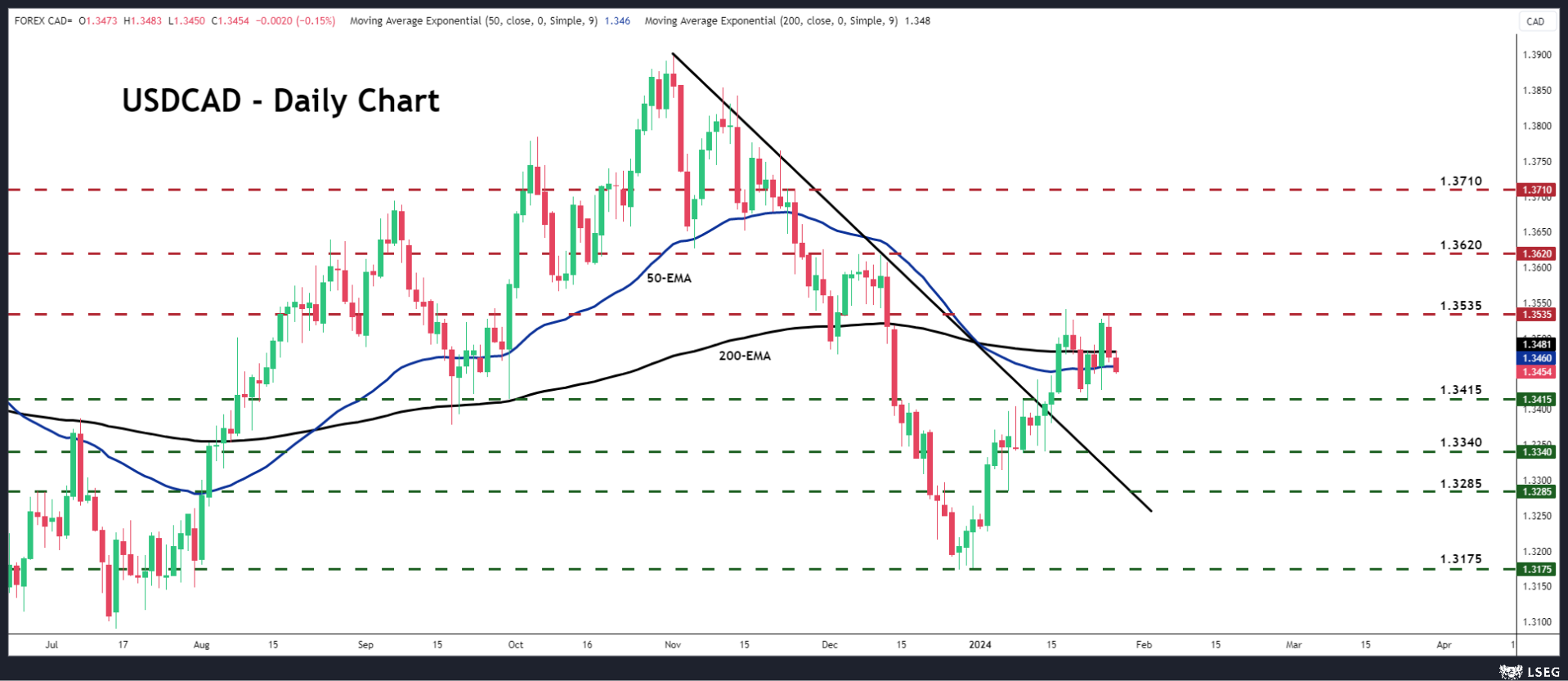
A potential rebound from near the 1.3415 zone could initially aim for the recent peak of 13535, the break of which would confirm a higher high and allow extensions towards the 1.3620 territory, marked by the high of December 7.
Now, in case the Fed stresses that the rebound in inflation was solely due to base effects and that prices will slow again soon, then the market may be tempted to lift back up the probability of a March rate cut, which could result in a larger slide in dollar/loonie, perhaps towards the 1.3340 area.
Week Ahead – Fed and BoE Decisions, NFP Report, Eurozone GDP Incoming
- It’s a packed week ahead with key central bank decisions and big data releases
- Will the Fed (Wednesday) and Bank of England (Thursday) signal rate cuts?
- US jobs report, Eurozone GDP & CPI will also be crucial
- Plus, Aussie inflation and an OPEC meeting
Fed meets: more pushback or a cautious green light?
The Federal Reserve’s January policy meeting will undoubtedly be the highlight of the coming week as investors remain convinced a dovish pivot is drawing closer. Speculation about the timing and scale of rate cuts by the Fed have been the dominant market theme for some time now. The soundbites from Fed officials in the run up to Wednesday’s decision have been on the hawkish side and market pricing has become better aligned with the Fed’s guidance, but nevertheless, there is still a significant gap that needs to be closed.
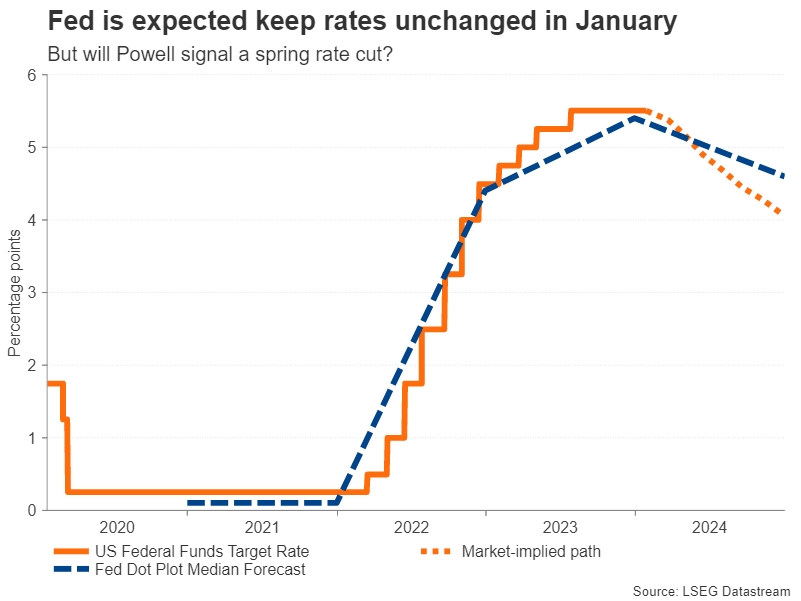
With no change in policy anticipated and no dot plot to dissect, investors will be watching for any fresh hints on the timing of the first rate reduction by Chair Powell in his press conference. Powell will probably steer away from giving a precise timeline for cutting rates, while attempting to dampen expectations for a policy shift as early as March. However, it’s also unlikely that Powell will want to completely rule out a cut in the first half of the year and this would be supportive of risk assets and possibly negative for the US dollar.
Will Powell and jobs data be on the same page?
But the Fed will not have the final say on the dollar’s direction as the latest nonfarm payrolls report is due on Friday. Despite fears that higher rates would lead to a massive jobs cull, everything for now seems to point to a soft landing in the labour market, which would almost certainly translate to the same for the US economy.
After unexpectedly heating up in December, the jobs market likely cooled in January. Employment is projected to have risen by 162k versus 216k in the prior month. The unemployment rate is forecast to stay unchanged at 3.7%, while average hourly earnings are expected to maintain a moderate pace, growing by 0.3% month-on-month in January.
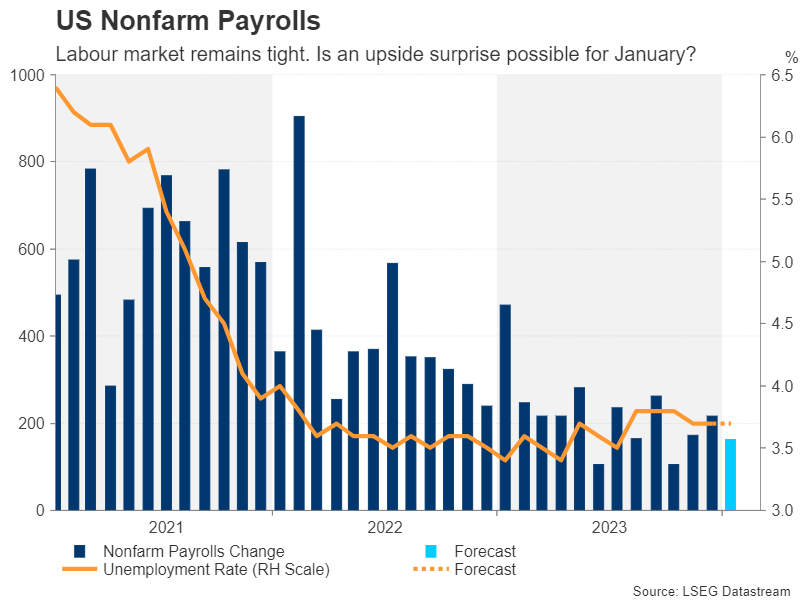
Aside from the NFP report, there’s a raft of other releases to keep an eye on. The home price index by S&P CoreLogic Case-Shiller will kick things off on Tuesday and the latest consumer confidence gauge is also due the same day as well as the JOLTS job openings for December. The Chicago PMI and the ADP private employment survey will follow on Wednesday. On Thursday, the closely watched ISM manufacturing PMI is expected to hold steady at 47.4 in January, and finally on Friday, factory orders for December will wrap up the week.
Another upside surprise in the headline payrolls print would not bode well for those betting on an early rate cut and the dollar could spike up in a knee-jerk reaction in such a case. However, unless there’s a very large beat, a solid number would probably not sway rate cut expectations dramatically if the other data aren’t as equally strong and more importantly, if Powell strikes a balanced tone.
Bank of England to take a dovish turn
The Bank of England meets on Thursday to set policy for the first time in 2024. Like the Fed and ECB before it, the BoE is widely expected to keep interest rates on hold as inflation in the UK, whilst falling, remains far above the BoE’s 2% target. Nevertheless, the February meeting could mark a turning point for the central bank’s fight against inflation as the BoE may drop its tightening bias and the three MPC members that had continued to vote for a hike even after the pause in September may end their dissent.
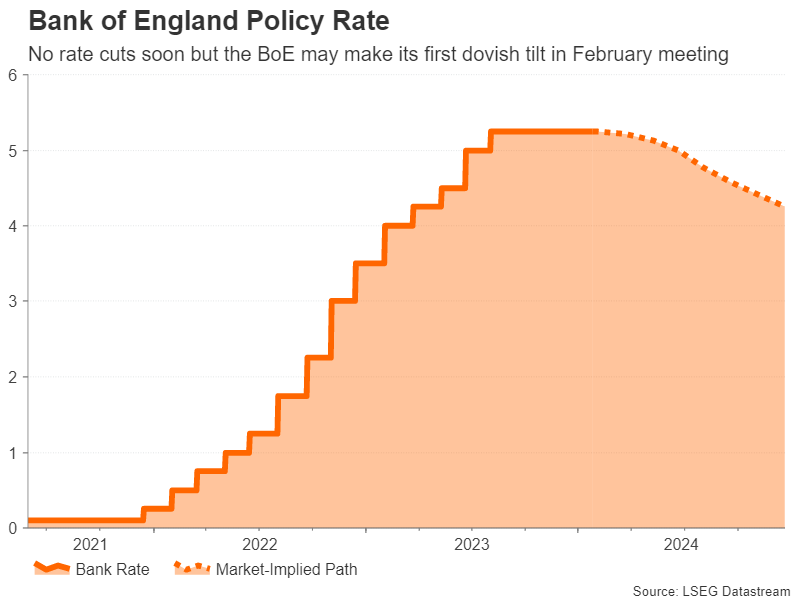
Such a move would signal the first step towards an eventual rate cut and comes after the tumble in headline CPI in October and November. The pound could weaken in the immediate aftermath, but a neutral stance would not alter much the view that the BoE won’t be as aggressive as the Fed and ECB in slashing rates this year.
Yet, despite Governor Andrew Bailey being somewhat firmer than his counterparts lately in reinforcing the message that rates would have to stay higher for longer, there is a small possibility of a dovish surprise. Should the Bank’s updated economic forecasts point to inflation falling towards 2% quicker than earlier anticipated, policymakers may remove the emphasis on keeping policy restrictive “for an extended period of time”.
Moreover, if Bailey opens the door to a rate cut in his press briefing, sterling could come under more substantial pressure.
Eurozone economy probably in recession
The flash estimate of fourth quarter GDP growth in the euro area is out on Tuesday and may confirm what many suspect already. The Eurozone economy is expected to have contracted by 0.1% in the final three months of 2023, having shrunk by a similar proportion in the third quarter. This would put it in a technical recession, though the overall picture is one of stagnation rather than a full-blown downturn.
A worse-than-expected reading would likely hurt the euro and would place the currency on a negative footing whichever way rate cut expectations evolve after that. This is because a hawkish ECB would rekindle overtightening concerns against a weaker economic backdrop, while a dovish shift would only fuel all the rate cut speculation.
Just as critical for the euro will be Thursday’s flash CPI numbers. Headline inflation in the bloc edged up from 2.4% to 2.9% y/y in December as the effect of lower energy prices dropped out of the calculations. A further increase is forecast for January, with CPI predicted to climb to 3.1% y/y.
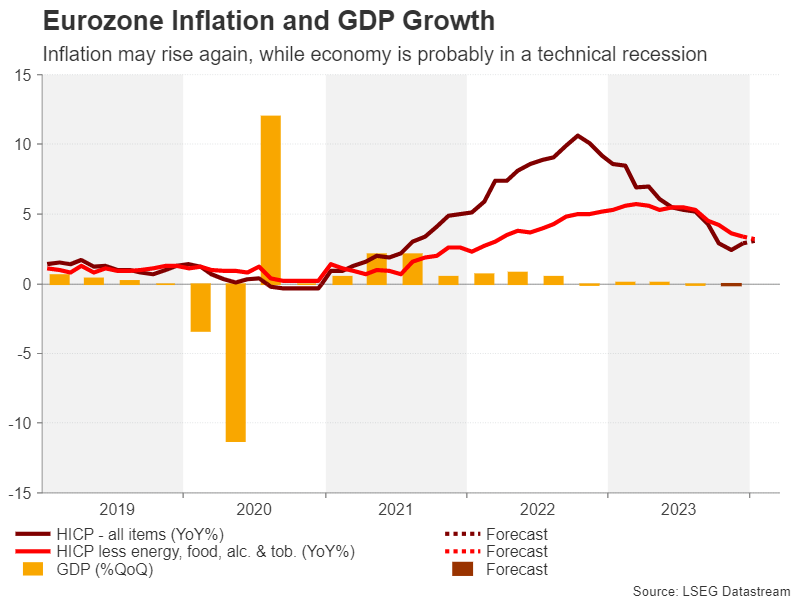
However, this might not necessarily prompt investors to reassess their bets of ECB policy easing as the uptick is expected to be temporary, hence, any boost for the euro could be limited.
Aussie eyes CPI data and Chinese PMIs
Moving to the Asia-Pacific region, the Australian dollar will be keeping tabs on some domestic and Chinese indicators. There’s been some good news for China-sensitive currencies like the aussie in the past week as Beijing has stepped up efforts to support the economy via more lending as well as boost the local stock market.
Chinese releases in the coming week will mainly comprise the manufacturing surveys for January due on Wednesday (official PMI) and Thursday (Caixin PMI). But for aussie traders, the quarterly CPI figures out of Australia on Wednesday will be a bigger priority.
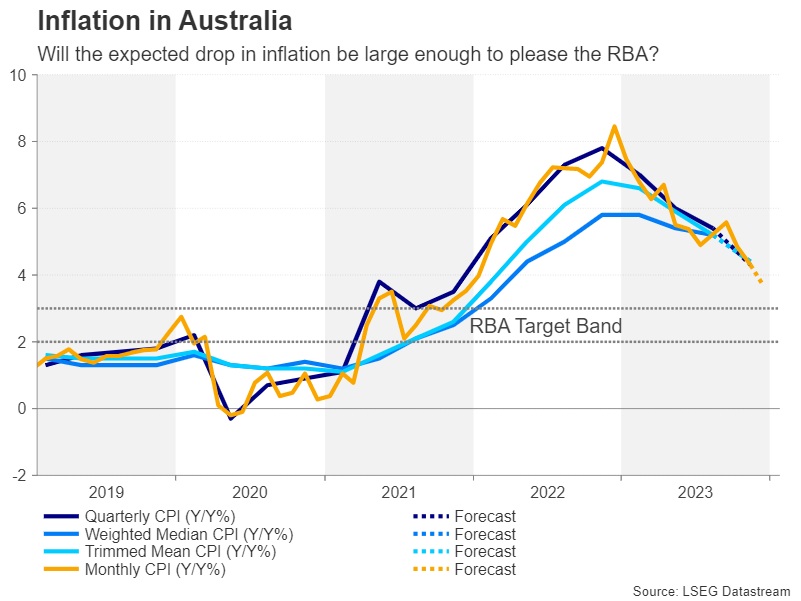
The RBA meets on February 6 so the CPI data could provide vital clues as to whether or not Governor Michele Bullock will tone down her hawkish rhetoric. Australia’s inflation rate stood at 5.4% y/y in the third quarter and analysts are looking for a decline to 4.3% in Q4. A larger-than-forecast fall would be negative for the aussie.
Will BoJ Summary reveal anything new?
In Japan, the latest stats on unemployment (Tuesday), industrial production and retail sales (Wednesday) are on the agenda. But for the yen, the focus will be on the Bank of Japan’s Summary of Opinions of the January meeting, which is published on Wednesday.
Governor Ueda sounded more upbeat about the prospect for higher wages and hitting the 2% inflation goal after the meeting. Any further hints in the summary about policymakers edging closer to exiting negative interest rates could bolster the yen.
OPEC+ to stay the course
Lastly, OPEC and non-OPEC countries are scheduled to hold an online meeting on Thursday to discuss production quotas. It will be the cartel’s first gathering after Angola’s departure in December. OPEC+ members are unlikely to announce any changes to output in February as the production cuts of 900,000 barrels a day agreed last November only came into effect in January.
But any signs of disagreements or difficulty by some countries in meeting the quotas could raise further doubts about additional cuts later in the year, weighing on oil prices.
Weekly Focus – No New Signals from Central Banks
As expected, the ECB kept rates unchanged and did not provide new guidance. At the press conference, President Lagarde said that she stands by her earlier comments that rate cuts could come in the summer. We continue to expect the first cut in June, followed by two more 25bp cuts later this year, but acknowledge that risks are tilted towards earlier cuts, see ECB Review - Didn't rock the boat, but sailing towards a rate cut, 25 January. The ECB Bank Lending Survey published on Tuesday confirmed further tightening of credit standards and a decline in loan demand, while EA January flash PMIs were mixed with manufacturing activity topping expectations and momentum in services disappointing.
Earlier this week, Bank of Japan (BOJ) kept its quantitative and qualitative easing with yield curve control policy unchanged as expected. We expect the BOJ to start normalising policies at the April meeting when they are more certain that wage growth will pick up. Also, Norges Bank (NB) unanimously decided to leave policy rates unchanged, fully in line with consensus expectations and market pricing. We expect NB to keep policy rates unchanged in March and deliver five rate cuts this year starting in June, see RtM Norway: Norges Bank Review - Unchanged - we still expect the first cut in June, 25 January.
In China, the PBOC pre-announced a cut in the reserve requirement ratio (RRR) for banks of 0.5 percentage points effective from 5 February. The PBoC also signalled more easing was on the way by stating that the RRR rate is still relatively high and that the policy pivot by the Fed would expand their policy space. The rising US-China policy rate spread has been a concern for PBOC as it could destabilise the CNY.
Turkey's CBRT finalised its hiking cycle by raising its policy rate to 45% as expected. We do not expect further hikes, but rates will most likely remain high for some time, as the monthly momentum for inflation has declined but headline inflation remains above 60%.
In geopolitics, Sweden took an important step towards becoming a NATO member country after the Turkish parliament finally approved Sweden's accession bid. Hungary's Prime Minister Viktor Orbán was quick to announce that his government would also support the ratification of Sweden's accession. However, Hungary's parliament is on a winter break until 26 February. Read more about the latest developments in our monthly Geopolitical Radar - Political status quo in Taiwan, truce hopes rise in Gaza, 25 January.
Next week, all eyes will be on the FOMC meeting on Wednesday. We think the Fed is in a comfortable position with regards to both sides of its dual mandate, read more in Research US: Fed preview - Patience and Gradualism, 26 January. The US economy remains on a strong footing as confirmed by Q4 GDP data as the US economy grew by 3.3% AR. This week, the Fed decided to raise the lending rate on new loans in its emergency lending program and announced that the program would end in March.
The key data release next week will be EA inflation on Thursday. We will also pay attention to country-specific releases starting on Tuesday. In China, official PMIs are due on Wednesday, and the Caixin manufacturing survey on Thursday. In the US, the Michigan survey on Friday will shed light on consumer sentiment and inflation expectations.
EUR/USD: Near-term Action Looks for Direction Signals
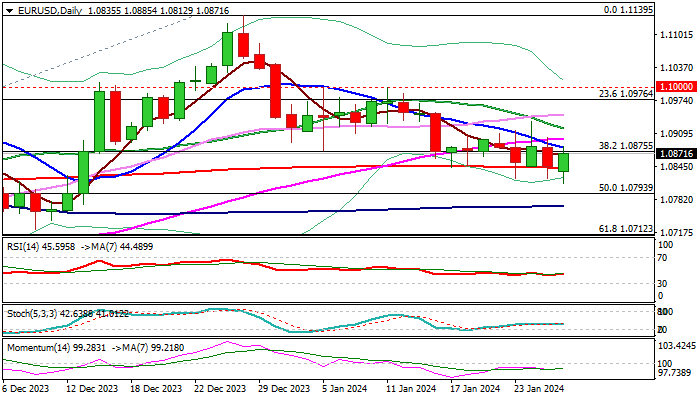
The Euro rose to the upper side of near-term congestion on Friday, after hitting new marginally lower low of larger downtrend from 1.1139 (Dec 28 peak).
Today’s bounce points to still strong bids, although without sufficient bullish momentum to sustain gains and rise above near-term range top, which would generate initial reversal signal and shift focus to the upside.
Strong support, provided by 200DMA (1.0842), contained dips again, keeping the downside protected for now, but falling 10DMA (1.0881) repeatedly capped the action, confirming that the price remains in extended sideways mode.
Daily studies are bearishly aligned (multiple bear-crosses of 10/20/55DMA’s / 14-d momentum in negative territory, however, Friday’s close above daily Ichimoku cloud top (1.0860) would keep in play hopes for fresh recovery attempts.
Lift above 10 and 55 DMA’s (1.0882/1.0900) to improve near-term structure, but close above pivotal barriers at 1.0932/37 (range top / Fibo 38.2% of 1.1139/1.0812) required to bring bulls in play for stronger recovery.
Conversely, eventual close below 200DMA would generate initial signal of bearish continuation and risk acceleration through 100DMA (1.0770) towards targets at 1.0723 /12 (Dec 8 higher low / Fibo 61.8% of 1.0448/1.1139 rally).
Res: 1.0882; 1.0900; 1.0937; 1.0976.
Sup: 1.0842; 1.0793; 1.0770; 1.0723.
Sunset Market Commentary
Markets
European bond markets still opened stronger in the wake of yesterday’s unconvincing press conference by ECB President Lagarde. The move lacked momentum though with first individual ECB members sounding more hawkish than Lagarde did. We must admit that it weren’t the most high-profile representatives though. Latvian ECB Kazaks admits that rates should start to go down, but that the central bank should be in no rush whatsoever to start the process. From a risk-reward point of view, he warns against starting too fast because of the inflationary risk that it entails. Lithuanian ECB Simkus joined the chorus, saying he’s open-minded on a 2024 rate cut but suggesting that market pricing of an April move is too optimistic. Croat ECB Vujcic pointed out that markets are taking whatever the ECB is saying as being dovish even as (in his view) the underlying message didn’t change. Finally Slovenian ECB Vasle warned that that wage growth currently remains significantly above what would be consistent with 2% inflation in the medium term. Core bonds reversed opening gains to currently trade near opening levels. German yields add up to 1.5 bps today. US treasuries underperform, with part of the move coming after some volatility around today’s sole eco releases. PCE December deflators were nearly bang in line with forecasts, but could have been derived from yesterday GDP release. Media headlines centered around the core deflator’s first Y/Y print below 3% since March 2021. Markets had more eye though to personal income (0.3% M/M) and especially spending (0.7% M/M) figures. The dollar failed to profit from the relative yield dynamics as they were once again countered by extremely bullish risk sentiment on stock markets. Good corporate earnings offer part of the explanation together with central bankers reluctance to push hard against market pricing. The EuroStoxx50 adds another 1% to reach its highest level since 2001! From now, the market countdown starts to next week’s FOMC meeting. We don’t expect that to change post-ECB dynamics.
News & Views
German GFK consumer confidence declined sharply at the start of the year. In the forecast for February the overall index dropped 4.3 points to -29.7, the lowest since March 2023. In its press release, GFK states that both economic and income expectations as well as the willingness to buy are showing noticeable declines. GFK sees the rebound in inflation in December as a possible reason for the sharp decline in income expectations and buying intentions. The return to the regular 19 %VAT rate in the gastronomy industry and the increase in the CO2 tax for energy will probably boost prices and further weaken income expectations. Ongoing higher prices for essentials like food and energy reduce the planning security that is needed to make lager purchases. The significant decline in consumer sentiment also translates in a noticeable increase in willingness to save. This subindex rose to the highest level since 2008. The expectations on consumers’ individual situation occur in a context of growing pessimism on the future path of the economy as economic expectations dropped to the lowest level since December 2022. The German Bundesbank added to the negative news on the country as it sees the economy preforming (slightly) worse than previously expected. The economic rebound will be delayed, amongst other as sings that industrial foreign demand had already reached its lowest point weren’t confirmed. The delay in the recovery puts the 0.4% 2024 growth forecast at risk. For Q1, the Buba sees stagnation at best.
In the ECB’s Q1 Survey of Professional Forecasters (SPF), respondents revised down their expectations for HICP headline inflation to 2.4% in 2024 (-0.3%) and to 2% in both 2025 (-0.1%) and 2026. The downward revisions reportedly reflected the impact of lower than previously expected HICP data outturns and oil prices as well as weaker economic activity. Core HICP inflation, which excludes energy and food, was also revised down for 2024 (-0.3% to 2.6%) to and 2025 (-0.1% to 2.%). Longer-term expectations for both core end headline HICP were seen at 2%. Expectations for real GDP growth were revised down to 0.6% in 2024 (-0.3%), 1.3% in 2025 (-0.2%) and set at 1.4% in 2026. Respondents expected a slight contraction in real GDP in the final quarter of 2023, followed by a slow recovery of economic activity throughout 2024. Longer-term growth expectations remained unchanged at 1.3%.
U.S. Consumer Spending Closes 2023 with a Bang, Defying Expectations
Personal income grew 0.3% month-on-month (m/m) in December, a small step down from November's 0.4% gain and in line with market expectations.
Accounting for inflation and taxes, real personal disposable income rose 0.1% m/m, a slowdown from the upwardly revised 0.5% in November (0.4% previously.)
Personal consumption expenditures rose 0.7% m/m, an acceleration from the upwardly revised 0.4% gain recorded in November, and ahead of market expectations (0.4%). Spending in real terms also grew by a robust 0.5% for the second consecutive month.
Spending on services was up by 0.6% m/m and goods spending rose by 0.9% m/m. Within services, the largest contributors to the increase were financial services and insurance, health care, and recreation services. Within goods, the leading contributors were motor vehicles and parts, other nondurable goods (led by prescription drugs), and gasoline.
On inflation, the headline personal consumption expenditure (PCE) deflator rose 0.2% m/m, an uptick from last month's decline (-0.1%), but the yearly measure held steady at 2.6% y/y. The core PCE price deflator (which is the Fed's preferred measure of inflation) ticked up marginally to 0.2% on a monthly basis but decelerated from 3.2% in November to 2.9% in December on an annual basis.
The personal savings rate declined in December to 3.7% from November's 4.1% reading.
Key Implications
There isn't much of a surprise in today's report given yesterday's GDP release. Consumers continued to defy the odds and kept spending to close out the year. December's outturn was even stronger than November's with consumers saving less to keep spending. With the holidays behind us however, and consumers still facing headwinds, the drive to spend is likely to lessen in the new year. As such, consumer spending is anticipated to decelerate to a more sustainable pace.
The Fed' s preferred measure of inflation continued its downward trek in December with the core PCE price deflator posting its 15th consecutive month of lower year-on-year growth. The measure dipped below 3% for the first time since March 2021. With inflation heading in the right direction, but still above target, and consumer spending displaying noteworthy resiliency, the central bank has even less urgency for a rate cut and one is unlikely to occur before mid-year.
GBPUSD Eyes Key Resistance Within Neutral Zone
- GBPUSD picks up steam, heads towards important resistance
- Technical signals improve, but market structure is still neutral
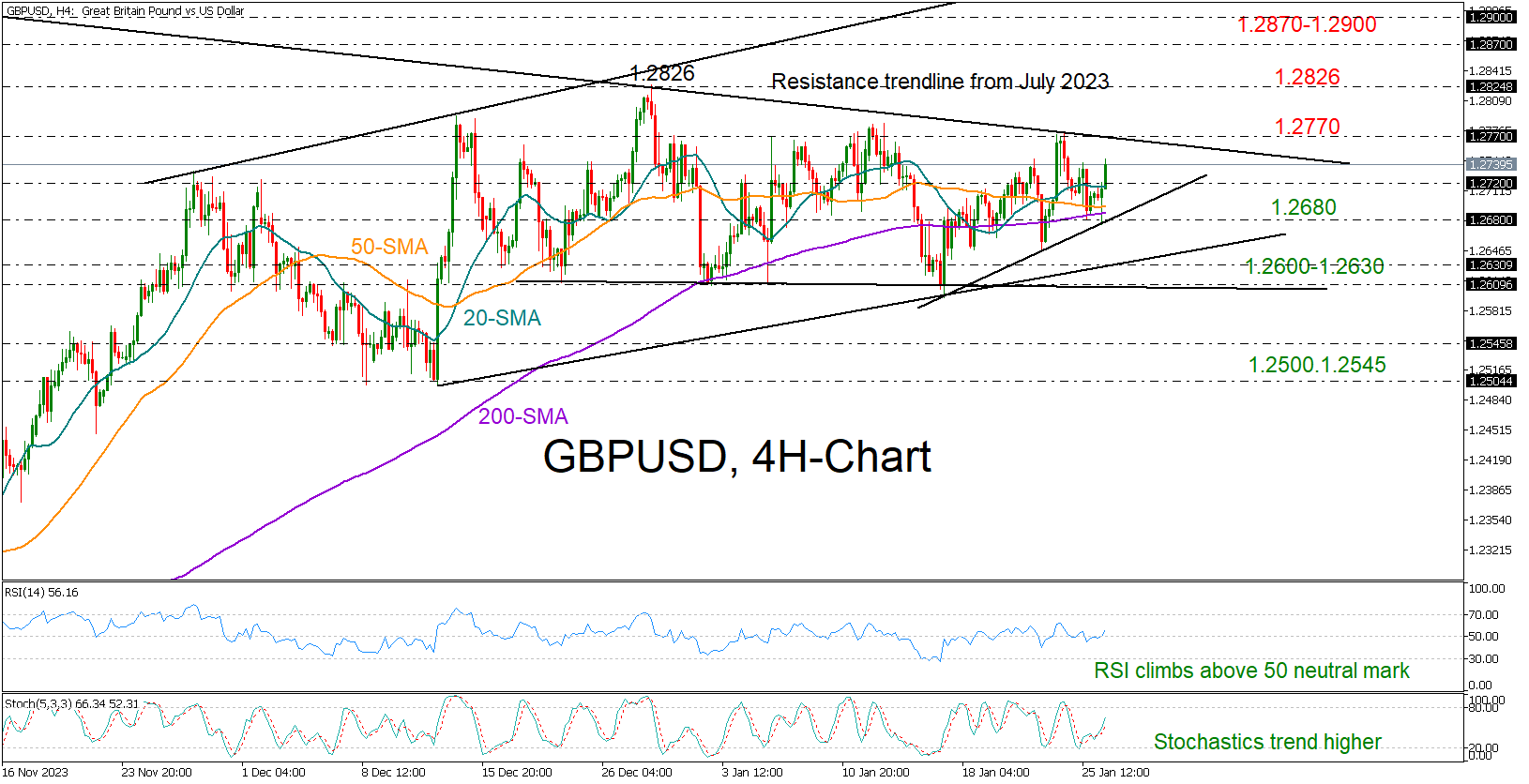
GBPUSD has been trading with stronger positive momentum over the past couple of hours, aiming to reach July’s resistance trendline, which capped Wednesday’s pickup at 1.2773.
The upside reversal in the RSI and the upturn in the stochastic oscillator are endorsing the bullish action in the price, though the ongoing sideways move, which started in mid-December, is showing no cracks at the moment.
A decisive close above the constraining falling line at 1.2770 could generate additional gains, but only an advance above December’s peak of 1.2826 would put the market back in an uptrend. In this case, the pair may print a new higher high within the 1.2870-1.2900 region or stretch towards the 1.2950 zone to test the ascending line which connects the highs from November and December.
If the bears resurface, the pair could pull lower to meet the support trendline from the January 17 low at 1.2680. A defeat for the bulls there could bring the 1.2600-1.2630 region under examination. Breaking that floor could see a fast decline towards the 1.2545 constraining zone.
In brief, GBPUSD is facing upside pressures within a neutral structure. A continuation above 1.2770 would create some extra optimism, whereas a drop below 1.2600 would downgrade the outlook.
British Pound Rises as Consumer Confidence Rises, US Inflation Falls
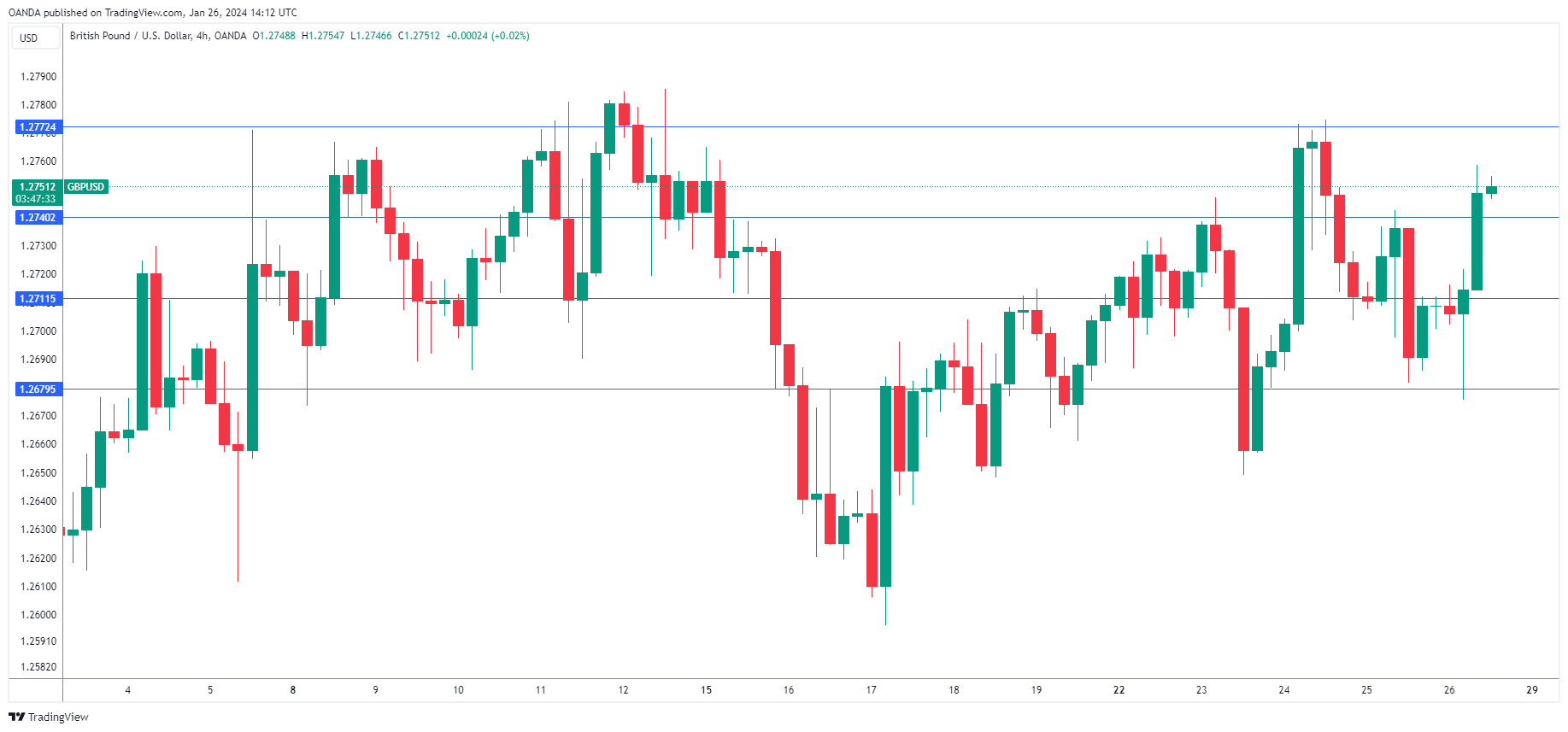
The British pound is higher on Friday. In the North American session, GBP/USD is trading at 1.2751, up 0.34%.
UK consumer confidence rises
The UK consumer remains in a sour mood but the pessimism eased in January. The GfK Consumer Confidence Index to -19, up from -22 in December and just shy of the consensus estimate of -21. This is the highest level since January 2022, which gives an idea of just how pessimistic consumers have been about the UK economy over the past two years. On the brighter side, consumer expectations of personal finances for the next 12 months were positive for the first time in two years, a sign that consumers are feeling better about the economy, which could translate into increased consumer spending.
As with other central banks, there is a large discrepancy in rate expectations between the Bank of England and the markets. Investors have priced in four quarter-point cuts this year, which would lower the benchmark rate to 4.25%. The BoE, however, hasn’t budged in its guidance and at last month’s meeting went as far as warning that further tightening might be necessary. The BoE held rates last month but three MPC members voted to raise rates by a quarter-point, which means there is strong support among Bank policy makers to remain hawkish. At the same time, with inflation on the decline and the Fed and ECB jumping on the rate-cut wagon, Governor Bailey will be feeling pressure to signal that rate cuts are on the table. The BoE has kept rates unchanged for three straight times and meets on February 1.
US Core PCE Price Index eases to 2.6%
The week wrapped up with good news on the inflation front. The Core PCE Price Index, one of the Fed’s preferred inflation indicators, fell to 2.9% y/y in December, down from 3.2% in November and just below the 3.0% consensus estimate. This was the lowest rate since March 2021. Monthly, Core PCE prices rose 0.2%, up from 0.1% in November and matching the consensus estimate.
GBP/USD Technical
- GBP/USD is testing resistance at 1.2740. Next, there is resistance at 1.2772
- There is support at 1.2711 and 1.2679