

Sample Category Title
British Pound Rises as Consumer Confidence Rises, US Inflation Falls
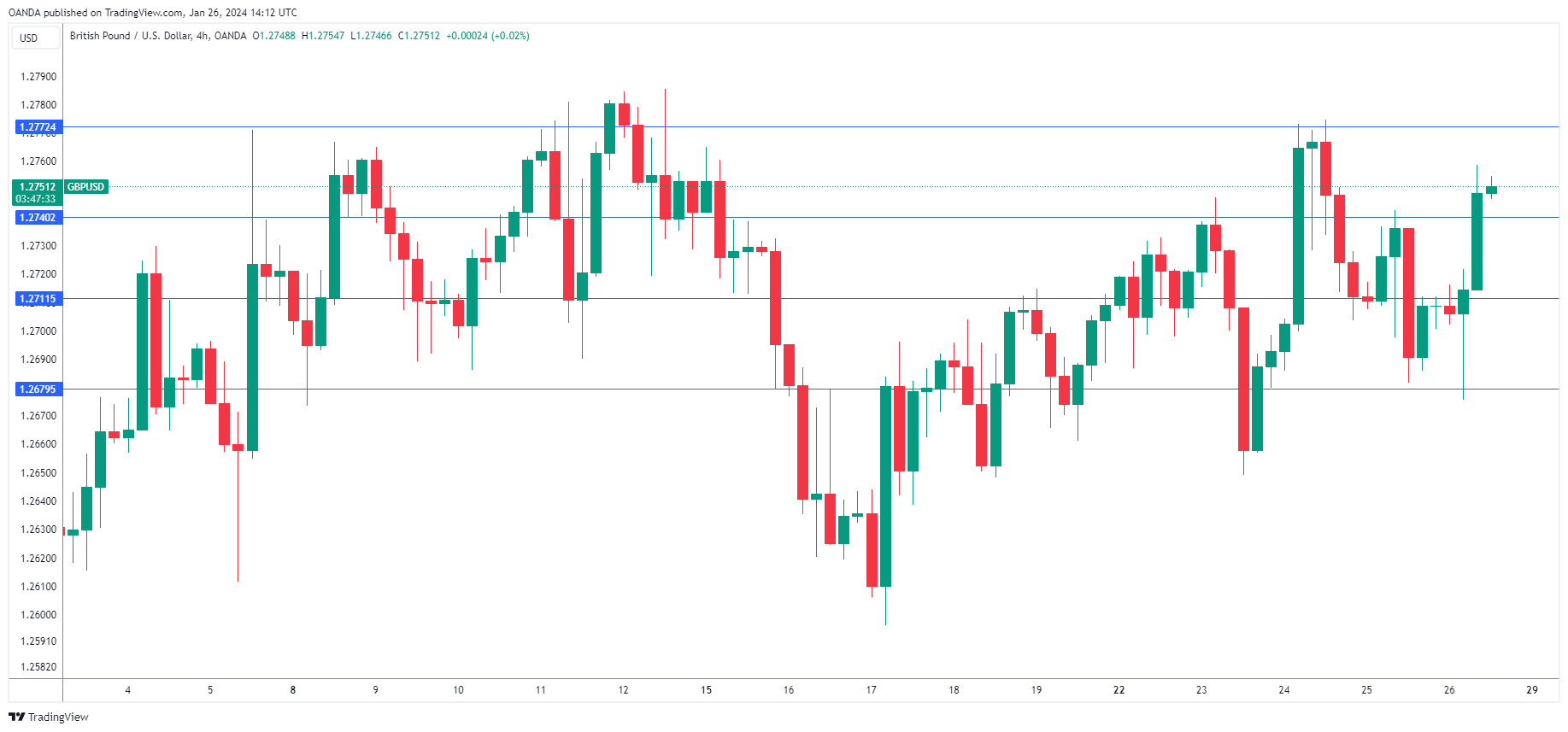
The British pound is higher on Friday. In the North American session, GBP/USD is trading at 1.2751, up 0.34%.
UK consumer confidence rises
The UK consumer remains in a sour mood but the pessimism eased in January. The GfK Consumer Confidence Index to -19, up from -22 in December and just shy of the consensus estimate of -21. This is the highest level since January 2022, which gives an idea of just how pessimistic consumers have been about the UK economy over the past two years. On the brighter side, consumer expectations of personal finances for the next 12 months were positive for the first time in two years, a sign that consumers are feeling better about the economy, which could translate into increased consumer spending.
As with other central banks, there is a large discrepancy in rate expectations between the Bank of England and the markets. Investors have priced in four quarter-point cuts this year, which would lower the benchmark rate to 4.25%. The BoE, however, hasn’t budged in its guidance and at last month’s meeting went as far as warning that further tightening might be necessary. The BoE held rates last month but three MPC members voted to raise rates by a quarter-point, which means there is strong support among Bank policy makers to remain hawkish. At the same time, with inflation on the decline and the Fed and ECB jumping on the rate-cut wagon, Governor Bailey will be feeling pressure to signal that rate cuts are on the table. The BoE has kept rates unchanged for three straight times and meets on February 1.
US Core PCE Price Index eases to 2.6%
The week wrapped up with good news on the inflation front. The Core PCE Price Index, one of the Fed’s preferred inflation indicators, fell to 2.9% y/y in December, down from 3.2% in November and just below the 3.0% consensus estimate. This was the lowest rate since March 2021. Monthly, Core PCE prices rose 0.2%, up from 0.1% in November and matching the consensus estimate.
GBP/USD Technical
- GBP/USD is testing resistance at 1.2740. Next, there is resistance at 1.2772
- There is support at 1.2711 and 1.2679
USD/JPY Mid-Day Outlook
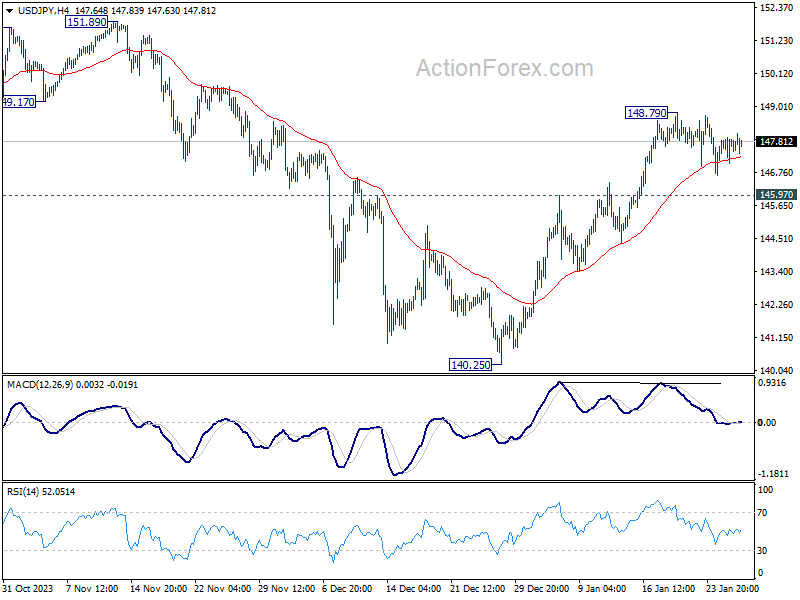
Daily Pivots: (S1) 147.20; (P) 147.55; (R1) 148.02; More...
Intraday bias in USD/JPY stays neutral, as consolidation from 148.79 is extending. With 145.97 resistance turned support intact, further rally is in favor. As noted before, corrective fall from 151.89 should have completed at 140.25 already. Break of 148.79 will resume the rise from there for retesting 151.89/93 key resistance zone.
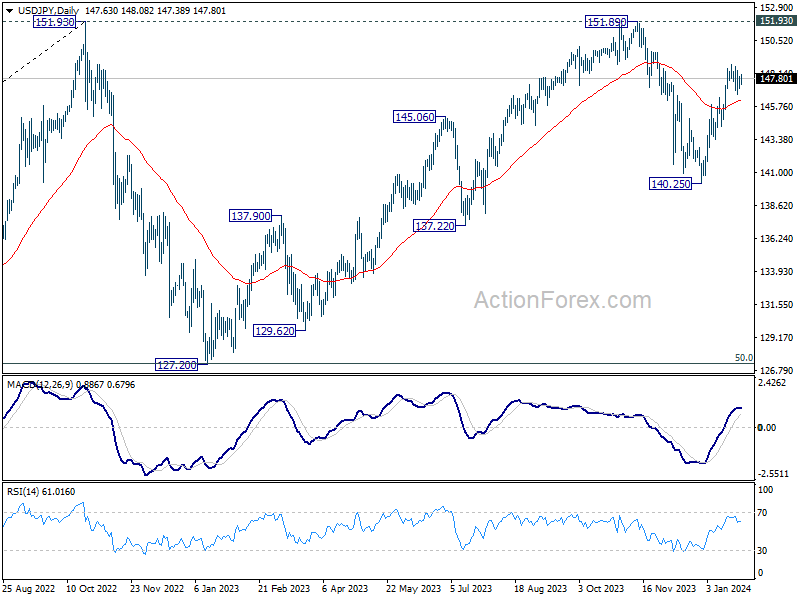
In the bigger picture, stronger than expected rebound from 140.25 dampened the original bearish review. Strong support from 55 W EMA (now at 141.89) is also a medium term bullish sign. Fall from 151.89 could be a correction to rise from 127.20 only. Decisive break of 151.89/93 will confirm resumption of long term up trend. This will now be the favored case as long as 140.25 support holds.
USD/CHF Mid-Day Outlook
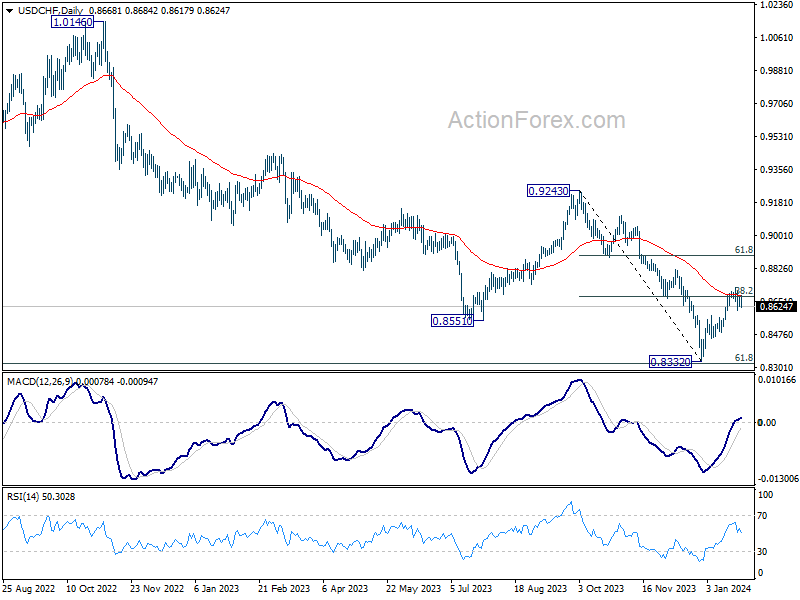
Daily Pivots: (S1) 0.8636; (P) 0.8661; (R1) 0.8695; More....
Intraday bias in USD/CHF stays neutral for the moment. On the downside, below 0.8605 will resume the pull back from 0.8727 to 0.8487 support. Break there will argue that rebound from 0.8332 has completed, and bring retest of this low. On the upside, firm break of 0.8727 will resume the rebound to 61.8% retracement of 0.9243 to 0.8332 at 0.8995 instead.
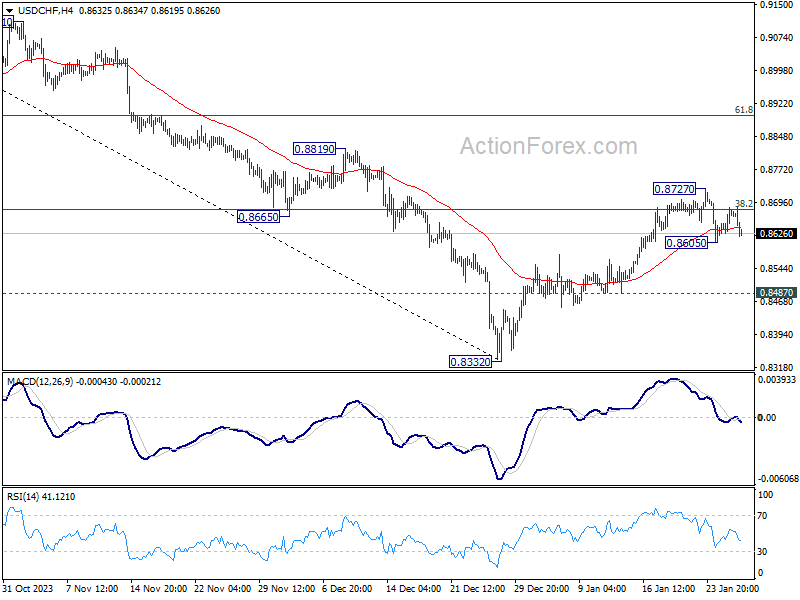
In the bigger picture, while rebound from 0.8332 could be strong, there is no clear sign of medium term bottoming yet. This rebound is tentatively seen as a corrective move for now. Also, outlook will stay bearish as long as 0.9243 resistance holds. Larger down trend from 1.0146 (2022 high) should resume through 0.8332 low at a later stage.
EUR/USD Mid-Day Outlook
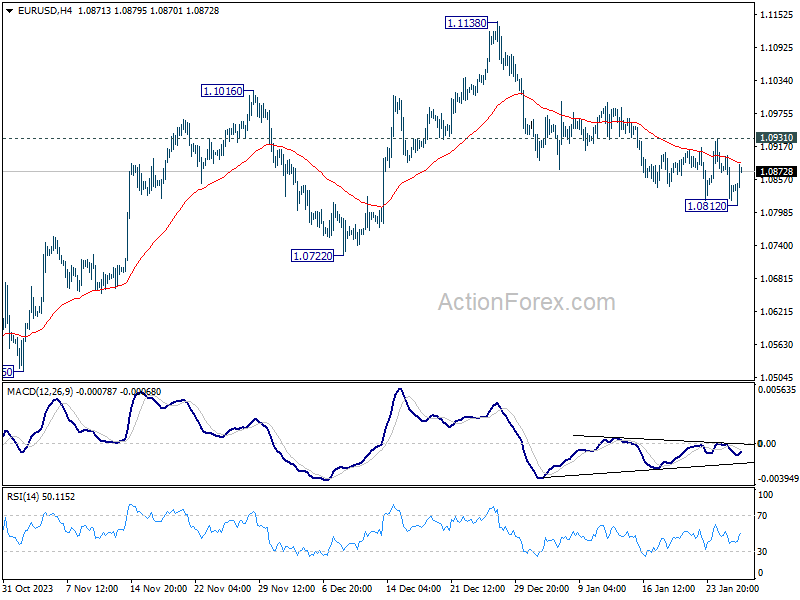
Daily Pivots: (S1) 1.0811; (P) 1.0857; (R1) 1.0891; More...
EUR/USD recovered quickly after dipping to 1.0812. Intraday bias remains neutral at this point. On the downside, break of 1.0812 will resume the fall from 1.1138 to 1.0722 support. On the upside, above 1.0931 will turn bias to the upside for stronger rebound towards 1.1138 resistance.
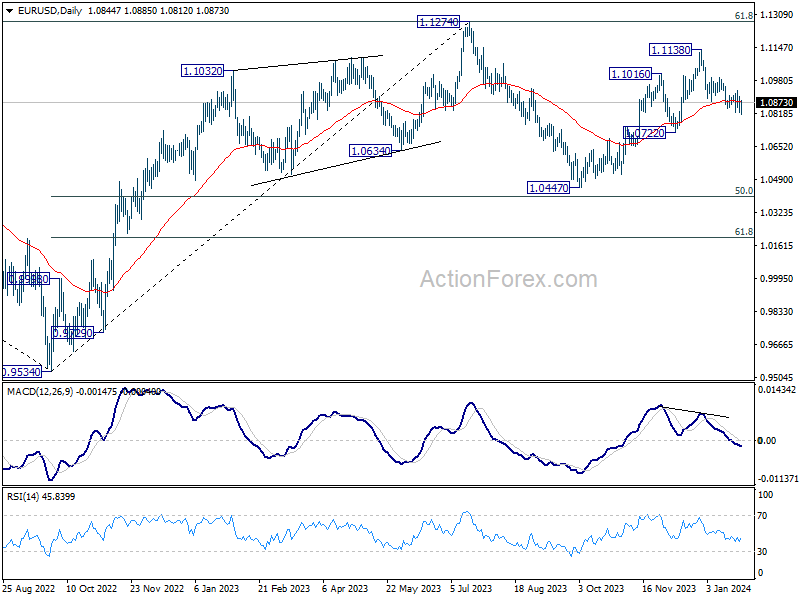
In the bigger picture, price actions from 1.1274 are viewed as a corrective pattern to rise from 0.9534 (2022 low). Rise from 1.0447 is seen as the second leg. While further rally could cannot be ruled out, upside should be limited by 1.1274 to bring the third leg of the pattern. Meanwhile, sustained break of 1.0722 support will argue that the third leg has already started for 1.0447 and below.
GBP/USD Mid-Day Outlook
Daily Pivots: (S1) 1.2679; (P) 1.2711; (R1) 1.2740; More...
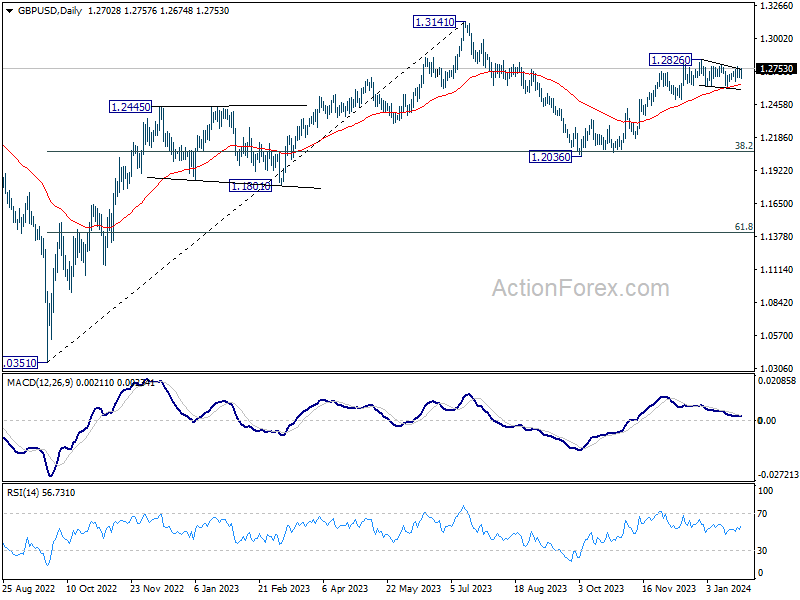
Intraday bias in GBP/USD stays neutral and outlook is unchanged. On the upside, firm break of 1.2784 resistance will suggest that consolidation pattern has completed. Further rise should be seen through 1.2826 to resume the rise from 1.2036. Next target will be 1.3141 high. On the downside, while another pull back cannot be ruled out, downside should be contained above 1.2499 support to bring rebound.
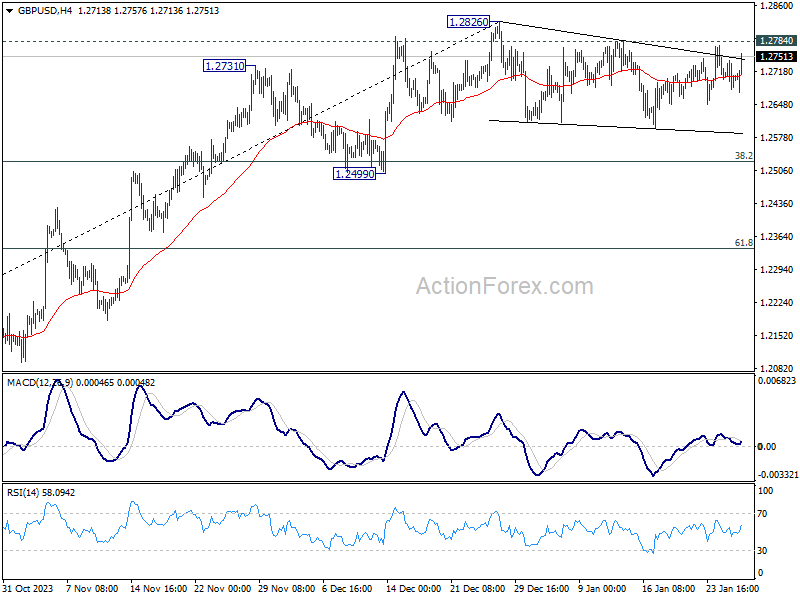
In the bigger picture, price actions from 1.3141 medium term top are seen as a corrective pattern to up trend from 1.0351 (2022 low). Rise from 1.2036 is seen as the second leg that's in progress. Upside should be limited by 1.3141 to bring the third leg of the pattern. Meanwhile, break of 1.2499 support will argue that the third leg has already started for 38.2% retracement of 1.0351 (2022 low) to 1.3141 at 1.2075 again.
Dollar Down Mildly after Core PCE Miss, Ready for Breakout?
Dollar falls mildly in early US trading hours, following the release of core PCE inflation data which indicated a slightly sharper than expected slowdown. However, this weakness in Dollar is somewhat counterbalanced by unexpectedly robust growth in consumer spending. Despite these movements, Dollar remains within its established trading range, with a decisive breakout yet to occur.
Euro, initially under pressure, saw a modest uplift following remarks from several ECB officials. They collectively cautioned against premature expectations of rate cuts, lending some support to the currency.
Nevertheless, Euro continues to lag in performance for the week, trailed by Kiwi and Loonie. Swiss Franc and Yen emerge as the strongest currencies, with the Sterling not far behind. Dollar and Australian Dollar are mixed in the middle.
Given that most major currency pairs and crosses are still confined within familiar ranges, there is potential for shifts in their standings during the final trading hours of the week.
In Europe, at the time of writing, FTSE is up 1.43%. DAX is up 0.10%. CAC is up 2.17%. UK 10-year yield is down -0.038 at 3.954. Germany 10-year yield is down -0.010 at 2.285. Earlier in Asia, Nikkei fell -1.34%. Hong Kong HSI fell -1.60%. China Shanghai SSE rose 0.14%. Singapore Strait Times rose 0.38%. Japan 10-year JGB yield fell -0.0294 to 0.720.
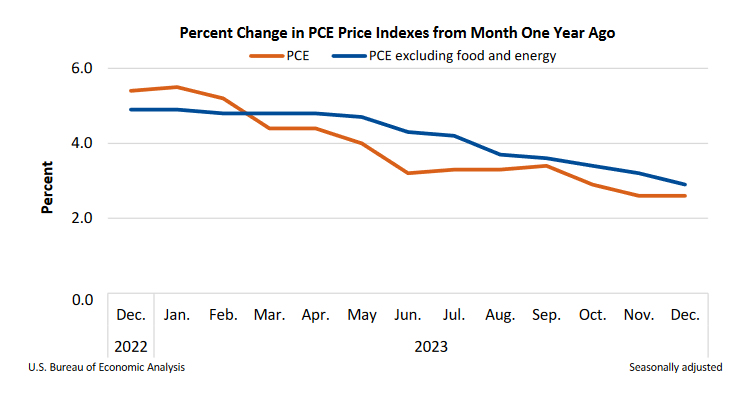
US PCE inflation unchanged at 2.6%, core PCE slows to 2.9%
US personal income rose 0.3% mom or USD 60.0B in December, matched expectations. Personal spending rose 0.7% mom or USD 133.9B, above expectation of 0.4% mom.
PCE price index rose 0.2% mom, matched expectations. Core PCE price index (excluding food and energy) rose 0.2% mom, matched expectations. Goods prices fell -0.2% mom while services prices rose 0.3% mom. Food prices rose 0.1% mom and energy prices rose 0.3% mom.
From the same month a year ago, PCE price index was unchanged at 2.6% yoy, matched expectations. Core PCE price index slowed from 3.2% yoy to 2.9% yoy, below expectation of 3.0% yoy. Goods prices increased less than 0.1% yoy while services prices rose 3.9% yoy. Food prices rose 1.5% yoy while energy prices fell -2.2% yoy.
ECB survey shows lowered inflation expectations and GDP growth forecast
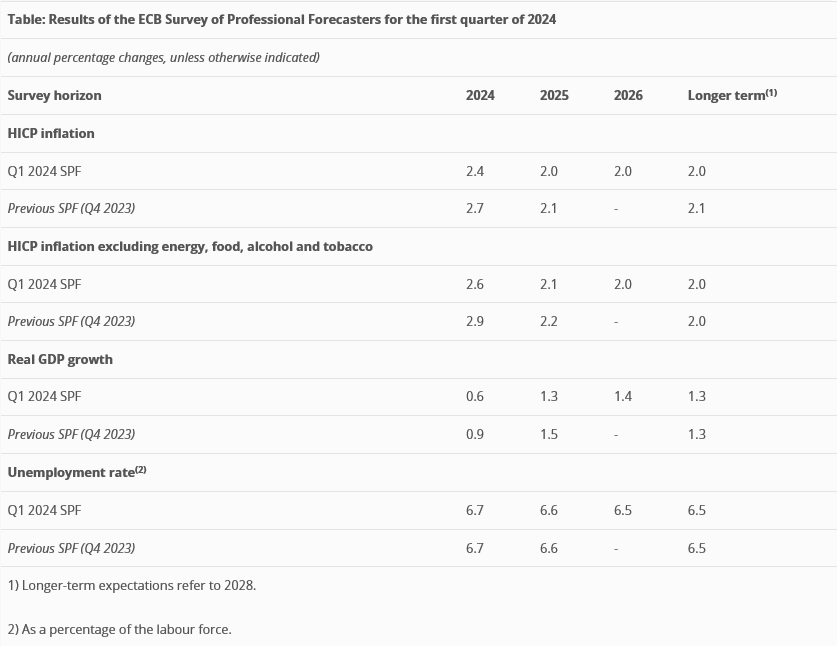
In the latest ECB Survey of Professional Forecasters for Q1 2024, inflation expectations have been revised downwards across all horizons. For the immediate years, headline HICP inflation is projected to decrease from 2.4% in 2024 to 2.0% in 2025 and 2026. These revised figures represent a downward adjustment of 0.3 percentage points for 2024 and a slight 0.1 percentage point decrease for 2025.
Similarly, core HICP inflation, which excludes volatile components like energy and food, has also been revised downward for 2024 to 2.6%, with a further reduction to 2.1% expected in 2025. By 2026, core inflation is projected to align with ECB's target, reaching 2.0%. The revisions for 2024 and 2025, each marked by a 0.3 and 0.1 percentage point decrease respectively, reflect an anticipated easing in the underlying inflationary trends.
On the growth front, expectations for real GDP have been adjusted downward for both 2024 and 2025. The forecasters now anticipate GDP growth of 0.6% in 2024, followed by a modest recovery to 1.3% in 2025 and slightly higher growth of 1.4% in 2026. These projections, revised down by 0.3 and 0.2 percentage points for 2024 and 2025 respectively, indicate a cautious outlook on economic expansion in the near term.
ECB's Vujcic advocates gradual approach to future rate cuts
ECB Governing Council members Boris Vujcic and Gediminas Simkus have underscored the importance of a cautious approach to future interest rate reductions. In separate interviews occasions, both officials emphasized the need for patience in evaluating economic data before committing to rate cuts.
Boris Vujcic highlighted the necessity of ensuring that inflation is "firmly sustainably on the way" towards ECB's medium-term target. He emphasized a gradual approach, stressing that ECB should wait for sufficient data to validate a downward trajectory in inflation rates.
Vujcic also expressed a preference for rate cuts in increments of 25 basis points, though he did not exclude the possibility of larger steps if warranted by economic data.
Gediminas Simkus, on the other hand, indicated that a rate cut in March is unlikely. He suggested that the likelihood of rate reductions would increase as 2024 progresses, describing this increase as "exponential, not linear." This statement implies a growing possibility of monetary easing later in the year, contingent upon evolving economic indicators.
ECB's Kazaks cautions against hasty rate cuts
ECB Governing Council member Martins Kazaks emphasized a cautious approach to reducing interest rates in an interview with BloombergTV. He acknowledged that while a downward adjustment in rates is anticipated, the ECB should not hasten this process, cautioning against premature actions that could potentially rekindle inflation.
Kazaks drew parallels to historical instances, particularly from the 1970s and 80s, to underline the risks associated with relaxing monetary policy too soon. "There's the risk that inflation starts to come back and then one would need to raise rates much more," he added.
Regarding, the timing and magnitude of easing cycles, he indicated that ECB could opt for either smaller steps initiated earlier or larger steps taken at a later stage. But Kazaks emphasized that would be "all data dependent".
Germany's Gfk consumer sentiment plummets to -29.7, hopes of recovery dashed
Consumer sentiment in Germany has taken a substantial downturn, reaching its lowest level since March 2023. The Gfk Consumer Sentiment Indicator for February sharply declined from -25.4 to -29.7, faring worse than the anticipated -24.3. This significant drop signals a reversal of the temporary improvement observed last month, which now appears to have been a fleeting pre-Christmas optimism.
Economic expectations in January plummeted to their lowest since December 2022, dropping from -0.4 to -6.6. Income expectations suffered a marked decline from -6.9 to -20.0, the weakest since March 2023. Concurrently, willingness to buy among consumers decreased from -8.8 to -14.8. Willingness to save has shown an increase, rising from 7.3 to 14.0, the highest level since August 2008. This suggests a shift in consumer behavior towards saving rather than spending.
Rolf Bürkl, consumer expert at NIM, remarked that the brief improvement in consumer sentiment witnessed last month was merely a transient spike. The decline in income expectations and willingness to buy, coupled with a growing propensity to save, have contributed to a significant setback in the Consumer Climate at the start of the year.
Japan's Tokyo CPI slows sharply to 1.6%, raises questions on BoJ's negative rates exit
Japan's Tokyo CPI core (ex-food) slowed significantly from 2.1% yoy to 1.6% yoy in January, below expectation of 1.9% yoy. That's also the lowest rate since March 2022. Additionally, core-core CPI (ex-food and energy) declined from 3.5% yoy to 3.1% yoy, marking a fifth consecutive month of decline. Headline CPI mirrored this trend, falling from 2.4% yoy to 1.6% yoy.
The latest Tokyo CPI data has sparked a debate among economists regarding its influence on BoJ strategy to phase out negative interest rates. While some analysts believe this data won't significantly impact BoJ's plan, anticipating the first rate hike since 2007 in April, others are more cautious. They suggest that the surprising drop in Tokyo inflation might lead BoJ to reconsider or delay the decision.
In parallel, December's corporate services price index remained steady at 2.4% yoy, aligning with the near nine-year high recorded in November.
BoJ's minutes emphasize importance of discussions on exiting negative rates
The minutes from BoJ's meeting on December 18-19 highlighted a focus on strategic discussions regarding the future of its monetary policy. The members agreed on the importance to "deepen discussions" about the "timing of the exit" from the current monetary policy framework and determining the "appropriate pace of raising policy interest rates thereafter." This discussion is closely tied to the evolving dynamics of "wage and price developments."
A key sentiment echoed by many members was the prerequisite for a sustainable and stable achievement of the price stability target before considering the termination of the negative interest rate policy and the yield curve control framework. The establishment of a "virtuous cycle between wages and prices" was reiterated as a necessary condition for these policy shifts.
Additionally, some members expressed the viewpoint that BoJ is "not in a situation where it would fall behind the curve" if it did not rush to raise policy interest rates. This perspective suggests a cautious approach to monetary tightening, implying that the central bank doesn't feel pressured to act hastily in adjusting its interest rate policy.
GBP/USD Mid-Day Outlook
Daily Pivots: (S1) 1.2679; (P) 1.2711; (R1) 1.2740; More...
Intraday bias in GBP/USD stays neutral and outlook is unchanged. On the upside, firm break of 1.2784 resistance will suggest that consolidation pattern has completed. Further rise should be seen through 1.2826 to resume the rise from 1.2036. Next target will be 1.3141 high. On the downside, while another pull back cannot be ruled out, downside should be contained above 1.2499 support to bring rebound.
In the bigger picture, price actions from 1.3141 medium term top are seen as a corrective pattern to up trend from 1.0351 (2022 low). Rise from 1.2036 is seen as the second leg that's in progress. Upside should be limited by 1.3141 to bring the third leg of the pattern. Meanwhile, break of 1.2499 support will argue that the third leg has already started for 38.2% retracement of 1.0351 (2022 low) to 1.3141 at 1.2075 again.
Economic Indicators Update
| GMT | Ccy | Events | Actual | Forecast | Previous | Revised |
|---|---|---|---|---|---|---|
| 23:30 | JPY | Tokyo CPI Y/Y Jan | 1.60% | 2.40% | ||
| 23:30 | JPY | Tokyo CPI ex Fresh Food Y/Y Jan | 1.60% | 1.90% | 2.10% | |
| 23:30 | JPY | Tokyo CPI ex Food & Energy Y/Y Jan | 3.10% | 3.50% | ||
| 23:50 | JPY | Corporate Service Price Index Y/Y Dec | 2.40% | 2.40% | 2.30% | 2.40% |
| 23:50 | JPY | BoJ minutes | ||||
| 00:01 | GBP | GfK Consumer Confidence Jan | -19 | -21 | -22 | |
| 07:00 | EUR | Germany Gfk Consumer Confidence Feb | -29.7 | -24.3 | -25.1 | -25.4 |
| 09:00 | EUR | Eurozone M3 Money Supply Y/Y Dec | 0.10% | -0.70% | -0.90% | |
| 13:30 | USD | Personal Income M/M Dec | 0.30% | 0.30% | 0.40% | |
| 13:30 | USD | Personal Spending Dec | 0.70% | 0.40% | 0.20% | 0.40% |
| 13:30 | USD | PCE Price Index M/M Dec | 0.20% | 0.20% | -0.10% | |
| 13:30 | USD | PCE Price Index Y/Y Dec | 2.60% | 2.60% | 2.60% | |
| 13:30 | USD | Core PCE Price Index M/M Dec | 0.20% | 0.20% | 0.10% | |
| 13:30 | USD | Core PCE Price Index Y/Y Dec | 2.90% | 3.00% | 3.20% | |
| 15:00 | USD | Pending Home Sales M/M Dec | 1.60% | 0.00% |
US PCE inflation unchanged at 2.6%, core PCE slows to 2.9%
US personal income rose 0.3% mom or USD 60.0B in December, matched expectations. Personal spending rose 0.7% mom or USD 133.9B, above expectation of 0.4% mom.
PCE price index rose 0.2% mom, matched expectations. Core PCE price index (excluding food and energy) rose 0.2% mom, matched expectations. Goods prices fell -0.2% mom while services prices rose 0.3% mom. Food prices rose 0.1% mom and energy prices rose 0.3% mom.
From the same month a year ago, PCE price index was unchanged at 2.6% yoy, matched expectations. Core PCE price index slowed from 3.2% yoy to 2.9% yoy, below expectation of 3.0% yoy. Goods prices increased less than 0.1% yoy while services prices rose 3.9% yoy. Food prices rose 1.5% yoy while energy prices fell -2.2% yoy.
ECB survey shows lowered inflation expectations and GDP growth forecast
In the latest ECB Survey of Professional Forecasters for Q1 2024, inflation expectations have been revised downwards across all horizons. For the immediate years, headline HICP inflation is projected to decrease from 2.4% in 2024 to 2.0% in 2025 and 2026. These revised figures represent a downward adjustment of 0.3 percentage points for 2024 and a slight 0.1 percentage point decrease for 2025.
Similarly, core HICP inflation, which excludes volatile components like energy and food, has also been revised downward for 2024 to 2.6%, with a further reduction to 2.1% expected in 2025. By 2026, core inflation is projected to align with ECB's target, reaching 2.0%. The revisions for 2024 and 2025, each marked by a 0.3 and 0.1 percentage point decrease respectively, reflect an anticipated easing in the underlying inflationary trends.
On the growth front, expectations for real GDP have been adjusted downward for both 2024 and 2025. The forecasters now anticipate GDP growth of 0.6% in 2024, followed by a modest recovery to 1.3% in 2025 and slightly higher growth of 1.4% in 2026. These projections, revised down by 0.3 and 0.2 percentage points for 2024 and 2025 respectively, indicate a cautious outlook on economic expansion in the near term.
ECB’s Vujcic advocates gradual approach to future rate cuts
ECB Governing Council members Boris Vujcic and Gediminas Simkus have underscored the importance of a cautious approach to future interest rate reductions. In separate interviews occasions, both officials emphasized the need for patience in evaluating economic data before committing to rate cuts.
Boris Vujcic highlighted the necessity of ensuring that inflation is "firmly sustainably on the way" towards ECB's medium-term target. He emphasized a gradual approach, stressing that ECB should wait for sufficient data to validate a downward trajectory in inflation rates.
Vujcic also expressed a preference for rate cuts in increments of 25 basis points, though he did not exclude the possibility of larger steps if warranted by economic data.
Gediminas Simkus, on the other hand, indicated that a rate cut in March is unlikely. He suggested that the likelihood of rate reductions would increase as 2024 progresses, describing this increase as "exponential, not linear." This statement implies a growing possibility of monetary easing later in the year, contingent upon evolving economic indicators.
CAD’s Troubles Could Be Soon Forgotten
The Canadian Dollar faces a confluence of challenges, from the unexpected BoC stance on interest rates to mixed economic data and the traditionally impactful fluctuations in oil prices. As investors grapple with uncertainty regarding future monetary policy directions and the resilience of various economic sectors, the 'Loonie' is navigating a complex landscape. Understanding the interplay of these factors is crucial for anticipating the trajectory of the Canadian Dollar in the coming weeks and months.
GBPCAD - D1 Timeframe
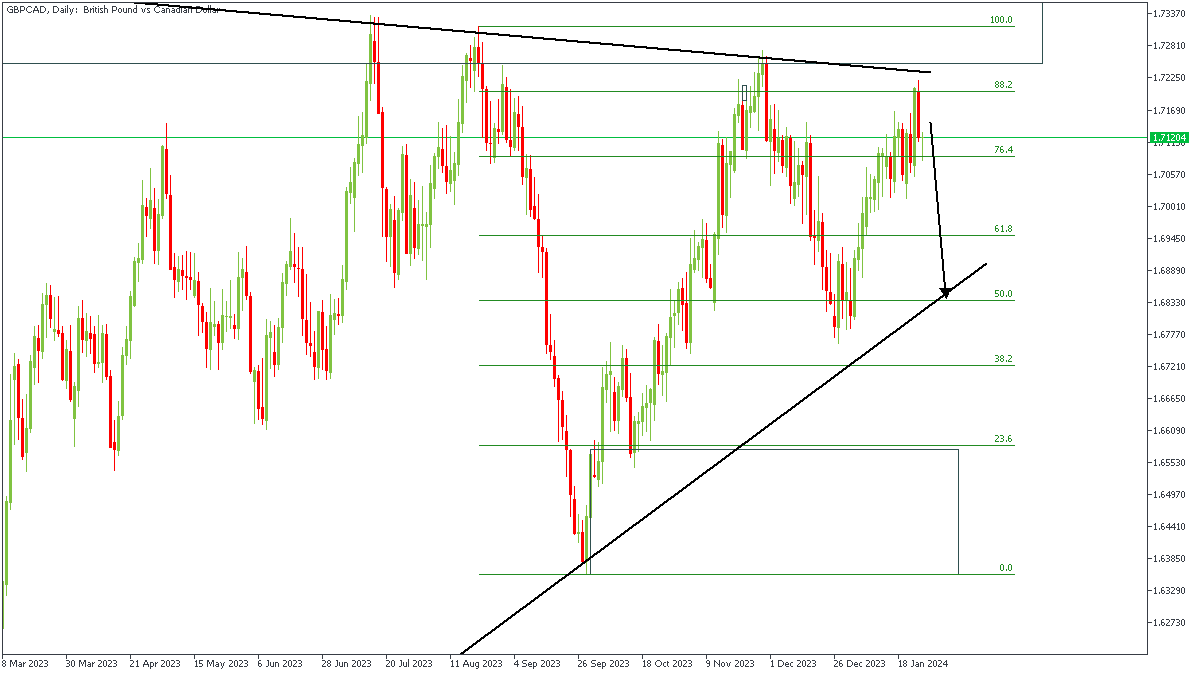
GBPCAD on the daily timeframe seems to have just completed its fourth rejection from the trendline resistance, setting the tone for bearish movement. The confluences for this trade include; the trendline resistance, supply zone, 88% of the Fibonacci, and the previous break of structure being a bearish one. In this case though, my target is quite short so I can wait to see if the trendline support gets broken or not.
Analyst’s Expectations:
- Direction: Bearish
- Target: 1.69257
- Invalidation: 1.72251
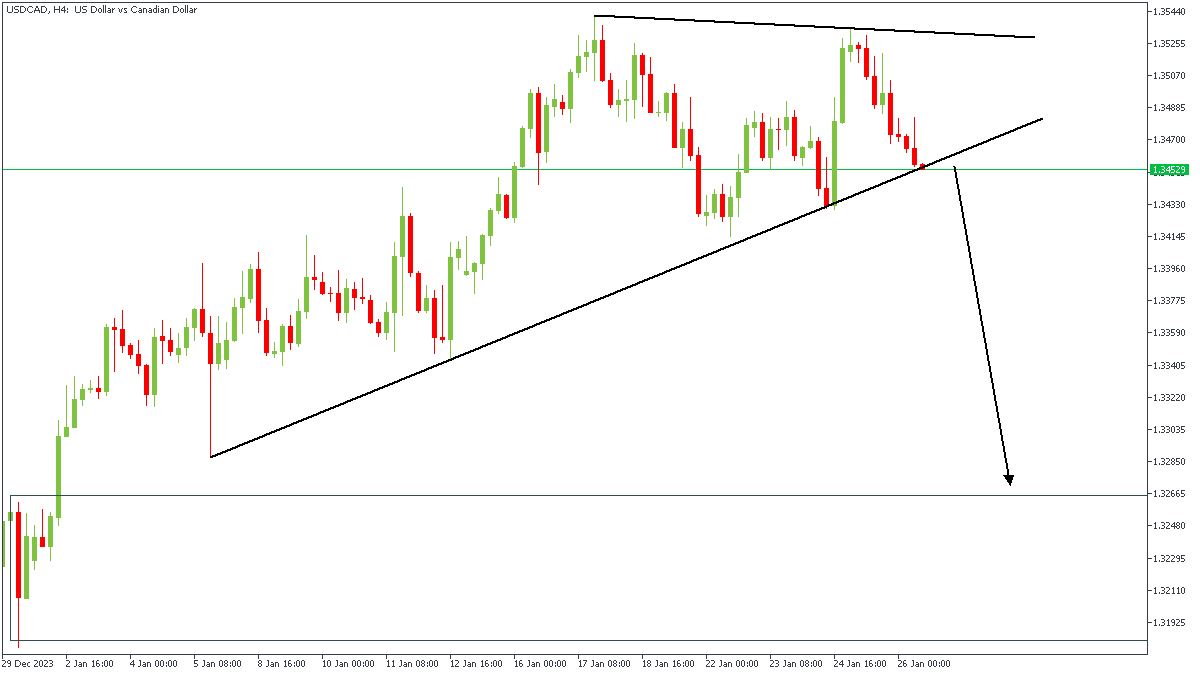
USDCAD - H4 Timeframe
USDCAD is currently resting on the support trendline with a demand zone in sync, even though the higher timeframe suggests a bearish trend. This kind of instance reinforces the need for patience and additional confirmations, which is why despite my overall bearish sentiment, I would rather wait to see a clear break and retest of the trendline before I swing into the trade.
Analyst’s Expectations:
- Direction: Bearish
- Target: 1.32696
- Invalidation:1.35357
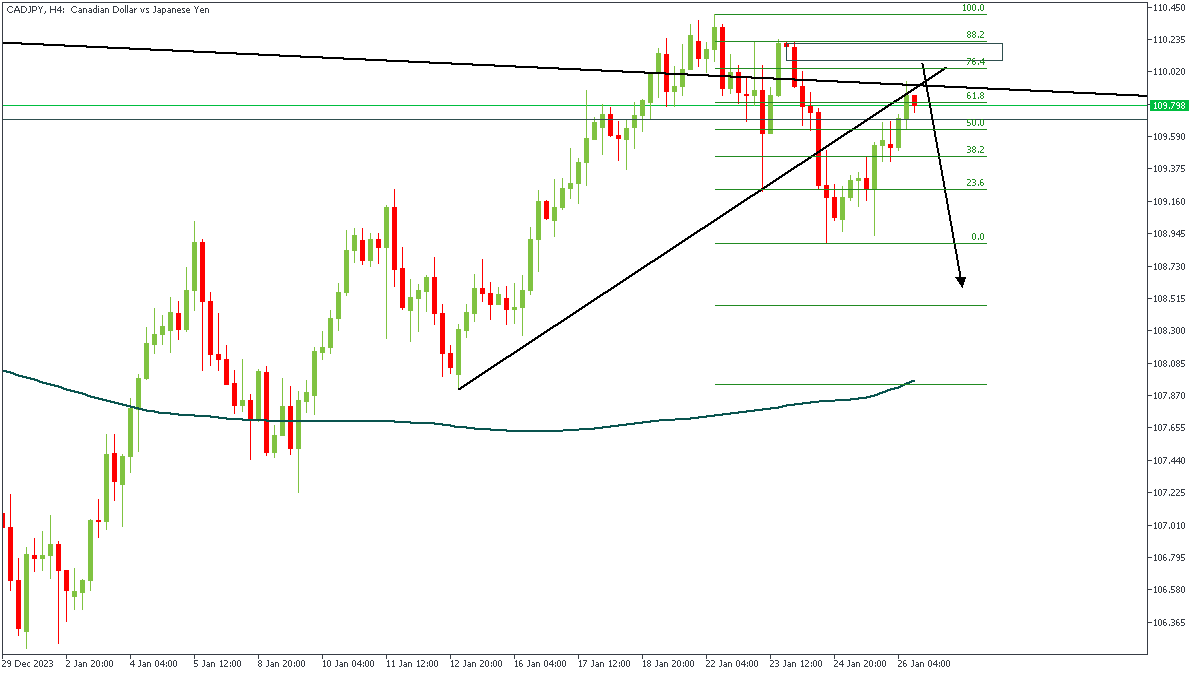
CADJPY - H4 Timeframe
CADJPY as seen has already broken the trendline after being rejected from the overall supply zone. Following this, I have marked out the Fibonacci retracement levels because I was waiting patiently for the retest, which seems to be ready now. The confluence of trendlines, Fibonacci retracement level, supply zone, and the higher timeframe trend are my confirmations for the bearish sentiment.
Analyst’s Expectations:
- Direction: Bearish
- Target: 108.673
- Invalidation: 110.419
CONCLUSION
The trading of CFDs comes at a risk. Thus, to succeed, you have to manage risks properly. To avoid costly mistakes while you look to trade these opportunities, be sure to do your due diligence and manage your risk appropriately.