Sample Category Title
EUR/USD Mid-Day Outlook
Daily Pivots: (S1) 1.0883; (P) 1.0906; (R1) 1.0929; More...
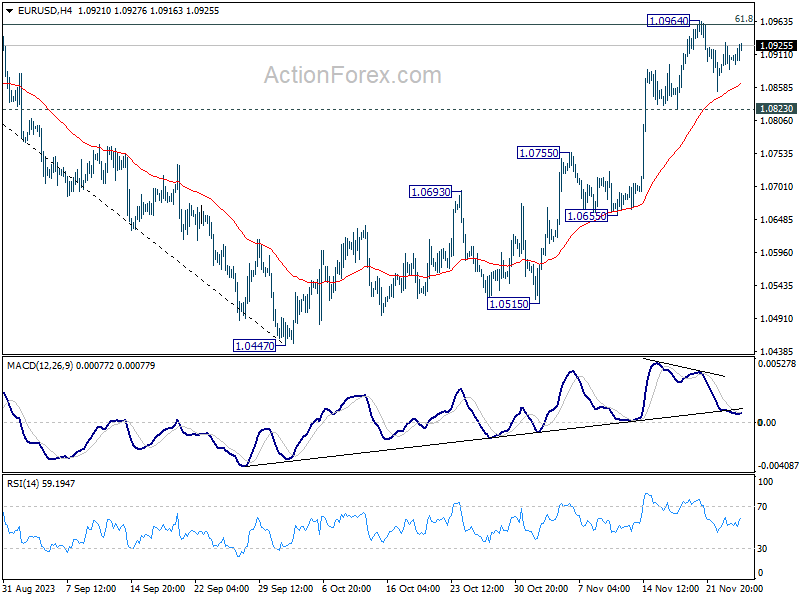
Intraday bias in EUR/USD remains neutral as consolidation from 1.0964 is still in progress. Further rally is in favor as long as 1.0823 support holds. Sustained break of 61.8% retracement of 1.1274 to 1.0447 at 1.0958 will resume the rise from 1.0447 to retest 1.1274 high. However, firm break of 1.0823 will indicate short term topping, and turn bias back to the downside for deeper decline.
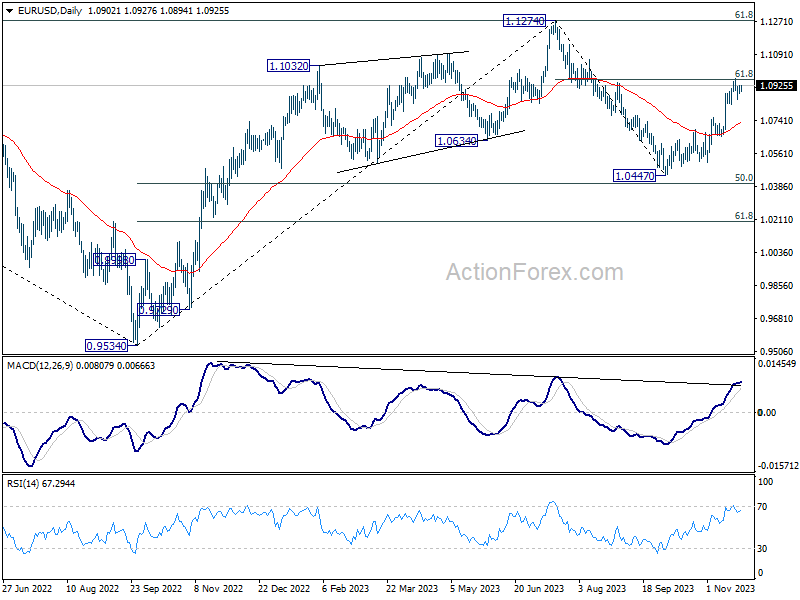
In the bigger picture, price actions from 1.1274 are viewed as a corrective pattern to rise from 0.9534 (2022 low). Rise from 1.0447 is tentatively seen as the second leg. Hence while further rally could be seen, upside should be limited by 1.1274 to bring the third leg of the pattern.
USD/CHF Mid-Day Outlook
Daily Pivots: (S1) 0.8820; (P) 0.8839; (R1) 0.8861; More....
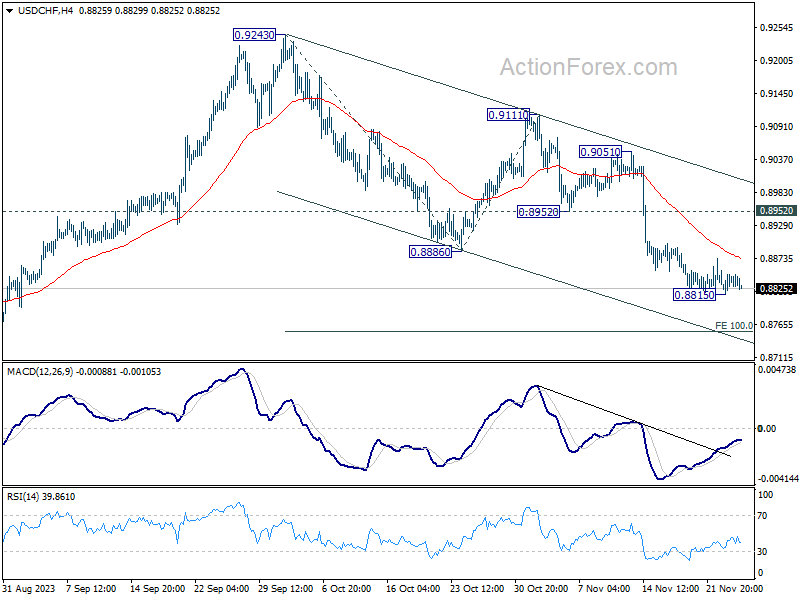
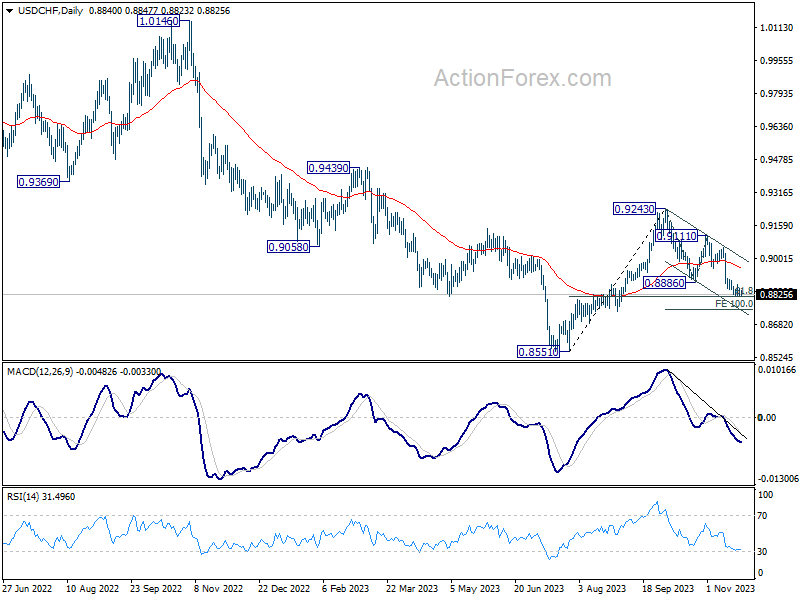
USD/CHF is extending consolidation above 0.8815 and intraday bias remains neutral. Stronger recovery cannot be ruled out. But near term outlook will stay bearish as long as 0.8952 support turned resistance holds. On the downside, below 0.8815 will resume whole decline from 0.9243 to 100% projection of 0.9243 to 0.8886 from 0.9111 at 0.8754 next.
In the bigger picture, price actions from 0.8551 are currently seen as part of a corrective pattern to the decline from 1.0146 (2022 high). Fall from 0.9243 is seen as the second leg for now. Deeper fall would be seen to 61.8% retracement of 0.8551 to 0.9243 at 0.8815. Sustained break there will bring retest of 0.8551 low. For now, this will remain the favored case as long as 0.9111 resistance holds.
USD/JPY Mid-Day Outlook
Daily Pivots: (S1) 149.08; (P) 149.38; (R1) 149.88; More...
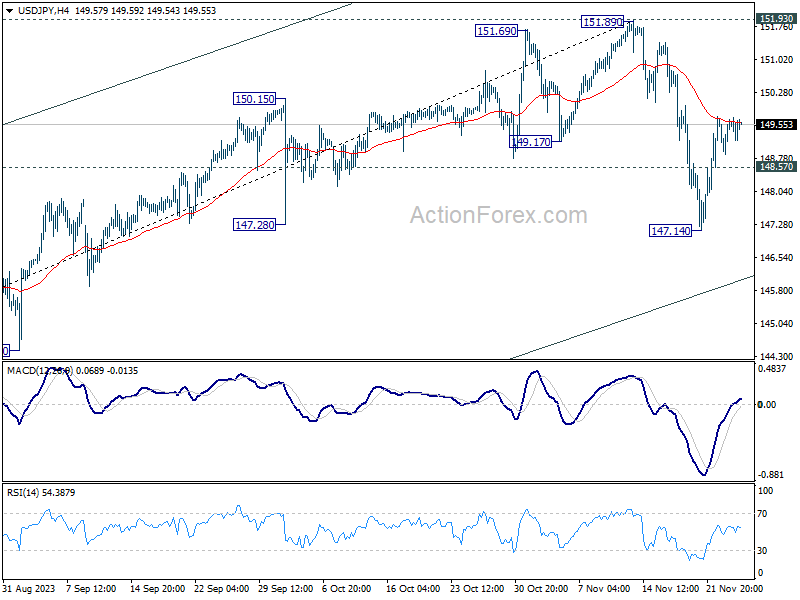
Intraday bias in USD/JPY remains neutral and outlook is unchanged. On the downside, break of 148.57 minor support will indicate rejection by 55 4H EMA, and turn bias back to the downside for 147.14 and below, to resume the fall from 151.89. However, sustained break of 55 4H EMA (now at 149.62) will revive near term bullishness, and target a retest on 151.89/93 resistance zone.
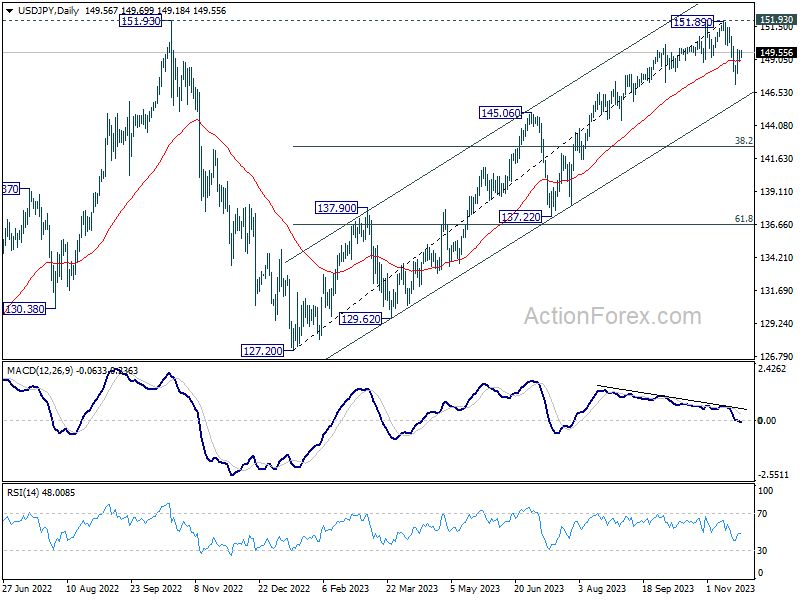
In the bigger picture, rise from 127.20 (2023 low) is seen as the second leg of the pattern from 151.93 resistance (2022 high). Decisive break of 145.06 resistance turned support will confirm that this second leg has completed, after rejection by 151.93. Deeper fall would be seen through 38.2% retracement of 127.20 to 151.89 at 142.45 to 61.8% retracement at 136.63. Nevertheless strong bounce from 145.06 will retain medium term bullishness for another test on 151.93 at a later stage.
GBP/USD Mid-Day Outlook
Daily Pivots: (S1) 1.2494; (P) 1.2529; (R1) 1.2568; More...
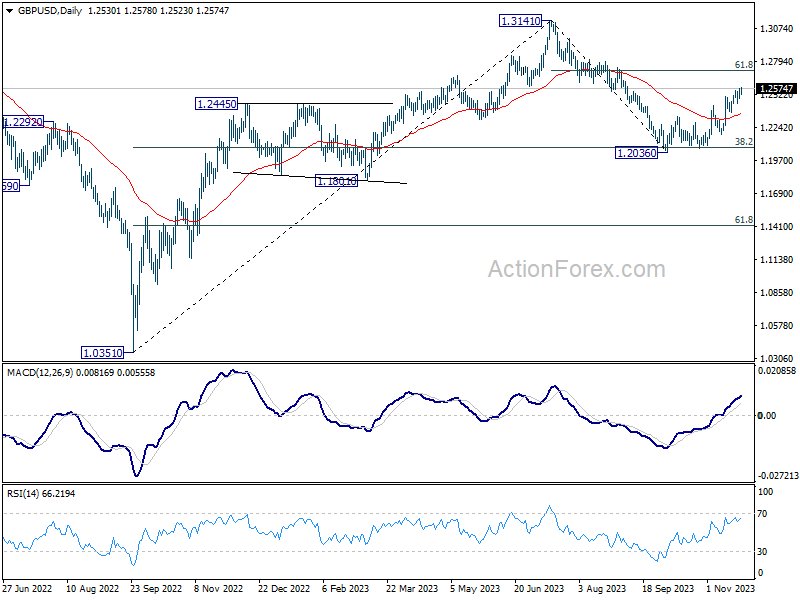
GBP/USD's rally is still in progress and intraday bias stays on the upside. Current rise from 1.2036 should target 61.8% retracement of 1.3141 to 1.2036 at 1.2716 next. On the downside, though, below 1.2447 minor support will turn intraday bias again first, and bring lengthier consolidations.
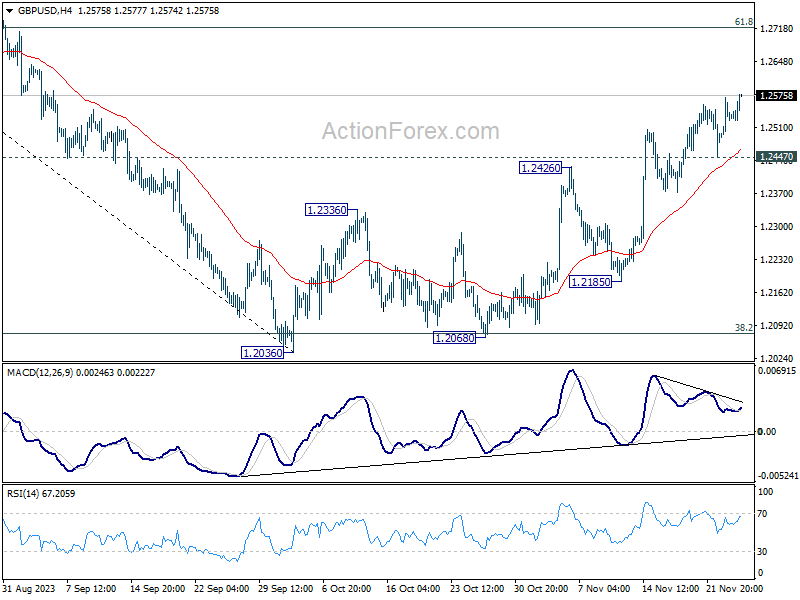
In the bigger picture, price actions from 1.3141 are seen as a corrective pattern to rise from 1.0351 (2022 low). Strong rebound from 38.2% retracement of 1.0351 (2022 low) to 1.3141 at 1.2075 argues that current rise from 1.2036 is the second leg. However, while further rally could be seen, upside should be limited by 1.3141 to bring the third leg of the pattern.
Canadian Dollar Rallies on Retail Sales Surprise, Kiwi and Sterling Firm
Canadian Dollar is having a notable rebound in early US session, fueled by unexpectedly robust Canadian retail sales data. This data indicated a surprising resurgence in consumer spending, defying the constraints of high interest rates and ongoing inflation.
Despite this uplift, Loonie was overshadowed by New Zealand Dollar, which also saw a lift from its own country's encouraging retail sales data. Similarly, British Pound is performing well, supported by improvement in UK consumer confidence.
Meanwhile, Japanese Yen is facing renewed pressure following a brief recovery after the release of Japan's CPI data. Both Dollar and Euro are exhibiting some softness, while Swiss Franc and Aussie are mixed.
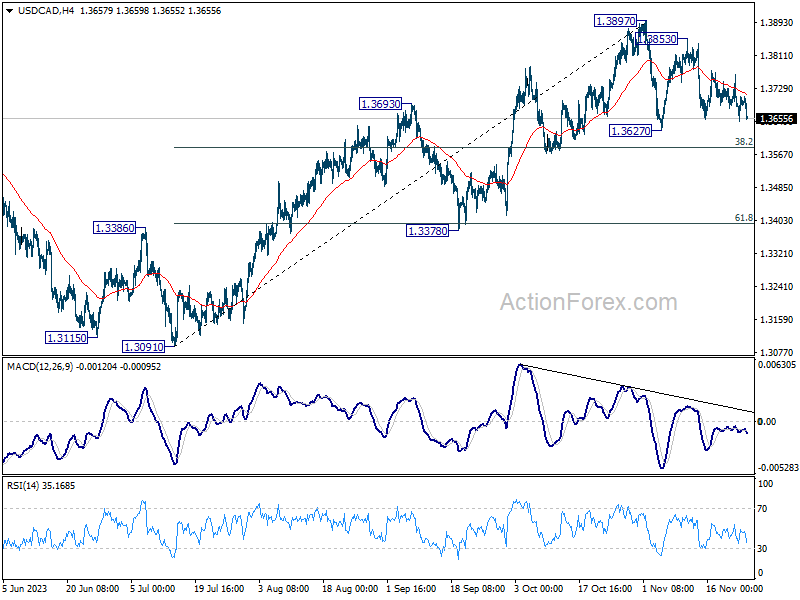
Technically, USD/CAD is possibly extending the third leg of the near term corrective pattern from 1.3897. Deeper fall could be seen to 1.3627 and possibly below. But downside should be contained by 38.2% retracement of 1.3091 to 1.3897 at 1.3589 to bring rebound. Hence, downside potential should be relatively limited based on current outlook.
In Europe, at the time of writing, FTSE is down -0.37%. DAX is up 0.03%. CAC is up 0.08%. Germany 10-year yield is up 0.0175 at 2.638. Earlier in Asia, Nikkei rose 0.52%. Hong Kong HSI fell -1.96%. China Shanghai SSE dropped -1.96%. Singapore Strait Times fell -0.54%. Japan 10-year JGB yield rose 0.0471 to 0.778.
Canada retail sales rose 0.6% mom in Sep, well above expectations
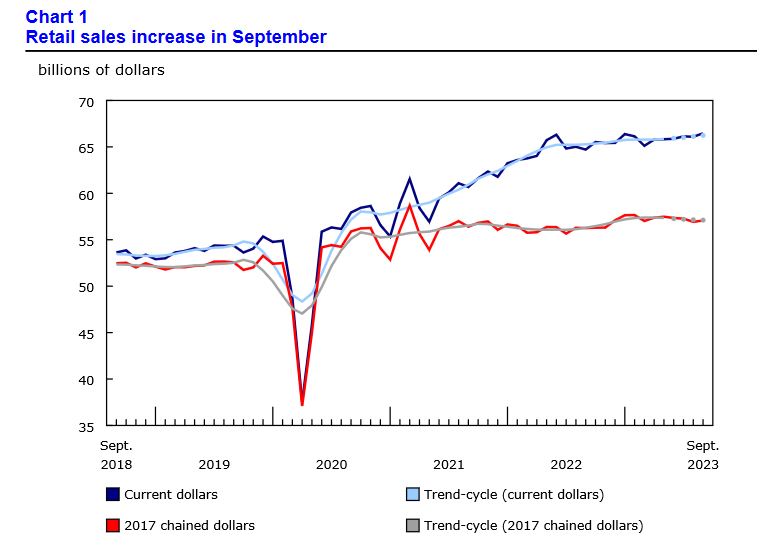
Retail sales in Canada rose 0.6% mom to CAD 66.5B in September, much better than expectation of 0.0% mom. Sales were up in four of nine subsectors and were led by increases at motor vehicle and parts dealers.
Core retail sales—which exclude gasoline stations and fuel vendors and motor vehicle and parts dealers—were down -0.3% mom.
In volume terms, retail sales increased 0.3% mom.
Retail sales were up 0.6% in Q3, while in volume terms, retail sales declined 0.5%.
Advance information suggests that sales rose 0.8% mom in October.
ECB's Lagarde: We can now observe very attentively
ECB President Christine Lagarde, said at Bundesbank event today that the central bank has "already done a lot" in fighting inflation, referring to the series of rate hikes. Now, given the "amount of ammunition" being deployed, ECB is positioned to "observe very attentively".
With observations on how tightening have impacted people's economic life, ECB can decide, "how long we have to stay there and what decision we have to make — up or down, she added.
However, despite these efforts, Lagarde emphasized that "the battle is not over and we're certainly not declaring victory."
German Ifo business climate rose to 87.3, economy stabilizing
German Ifo Business Climate rose from 86.9 to 87.3 in November, slightly below expectation of 87.5. But that is still the third consecutive increase. Current Assessment index ticked up from 89.2 to 89.4, matched expectations. Expectations index also rose from 84.8 to 85.2, missed expectation of 85.7.
By sector, manufacturing rose from -15.7 to -13.5. Services fell from -1.5 to -2.5. Construction rose from -30.8 to -29.4. Trade rose from -27.3 to -22.2.
Ifo said: "The German economy is stabilizing, albeit at a low level."
Japan's CPI core rises to 2.9%, above BoJ target for 19th mth, services prices surge
Japan's core CPI, which excludes fresh food prices, rose slightly from 2.8% yoy to 2.9% yoy in October, falling just below expected 3.0% yoy. Notably, this core CPI has stayed above BoJ's target of 2% for the 19th consecutive month, indicating persistent inflationary pressures.
Headline CPI, which includes all items, accelerated from 3.0% yoy to 3.3% yoy. However, core-core CPI, which excludes both food and energy, showed a slight deceleration, dropping from 4.2% yoy to 4.0% yoy. Despite this decrease, core-core CPI has remained above 4.0% for seven consecutive months, highlighting sustained inflation in areas beyond just the volatile items.
Breaking down the details, energy prices saw a significant decrease of -8.5% yoy. In contrast, food prices continued to climb, recording a 7.6% yoy increase. Durable goods also experienced a price rise of 3.2% yoy. Notably, services prices surged by 2.1% yoy, marking the fastest gain since 1993. This sharp increase in services prices underscores the broadening of inflationary pressures within the Japanese economy.
Japan's PMIs: Manufacturing contracts, services slightly improve
Japan's PMI for November shows a continuing contraction in the manufacturing sector and a slight improvement in services.
Manufacturing PMI dropped from 48.7 to 48.1, falling below the expected 48.8 and marking another month below the crucial 50.0 threshold, which separates contraction from expansion. This ongoing contraction has been the trend since June.
Conversely, Services PMI saw a marginal increase, moving up from 51.6 to 51.7, indicating a slight expansion in this sector. However, Composite PMI, which combines both manufacturing and services, edged down from 50.5 to exactly 50.0, highlighting stagnation in overall private sector activity.
Usamah Bhatti, an economist at S&P Global Market Intelligenc said: "Activity at Japanese private sector firms stagnated midway through the fourth quarter of 2023." This stagnation is further reflected in the demand conditions, which Bhatti noted remained "muted in November and were little-changed from October."
New Zealand retail sales volume flat in Q3, value up 1.5% qoq
In New Zealand, Q3 2023 saw retail sales volumes remain unchanged at 0.0% qoq, defying expectations of a -0.8% decline.
However, a contrasting trend emerged in the sales value, which increased by 1.5% qoq, indicating a disparity between the number of goods sold and their monetary value.
On an annual basis, there was a -3.4% yoy decrease in sales volume, whereas sales value saw 1.1% yoy increase.
These divergences should be reflective of inflationary pressures and corresponding shift in consumer purchasing patterns.
GBP/USD Mid-Day Outlook
Daily Pivots: (S1) 1.2494; (P) 1.2529; (R1) 1.2568; More...
GBP/USD's rally is still in progress and intraday bias stays on the upside. Current rise from 1.2036 should target 61.8% retracement of 1.3141 to 1.2036 at 1.2716 next. On the downside, though, below 1.2447 minor support will turn intraday bias again first, and bring lengthier consolidations.
In the bigger picture, price actions from 1.3141 are seen as a corrective pattern to rise from 1.0351 (2022 low). Strong rebound from 38.2% retracement of 1.0351 (2022 low) to 1.3141 at 1.2075 argues that current rise from 1.2036 is the second leg. However, while further rally could be seen, upside should be limited by 1.3141 to bring the third leg of the pattern.
Economic Indicators Update
| GMT | Ccy | Events | Actual | Forecast | Previous | Revised |
|---|---|---|---|---|---|---|
| 21:45 | NZD | Retail Sales Q/Q Q3 | 0.00% | -0.80% | -1.00% | -0.90% |
| 21:45 | NZD | Retail Sales ex Autos Q/Q Q3 | 1.00% | -1.50% | -1.80% | -1.60% |
| 23:30 | JPY | National CPI Y/Y Oct | 3.30% | 3.00% | ||
| 23:30 | JPY | National CPI ex Fresh Food Y/Y Oct | 2.90% | 3.00% | 2.80% | |
| 23:30 | JPY | National CPI ex Food Energy Y/Y Oct | 4.00% | 4.20% | ||
| 00:01 | GBP | GfK Consumer Confidence Nov | -24 | -27 | -30 | |
| 00:30 | JPY | Manufacturing PMI Nov P | 48.1 | 48.8 | 48.7 | |
| 00:30 | JPY | Services PMI Nov P | 51.7 | 51.6 | ||
| 07:00 | EUR | Germany GDP Q/Q Q3 F | -0.10% | -0.10% | -0.10% | |
| 09:00 | EUR | Germany IFO Business Climate Nov | 87.3 | 87.5 | 86.9 | |
| 09:00 | EUR | Germany IFO Current Assessment Nov | 89.4 | 89.4 | 89.2 | |
| 09:00 | EUR | Germany IFO Expectations Nov | 85.2 | 85.7 | 84.7 | 84.8 |
| 13:30 | CAD | Retail Sales M/M Sep | 0.60% | 0.00% | -0.10% | |
| 13:30 | CAD | Retail Sales ex Autos M/M Sep | 0.20% | -0.30% | 0.10% | |
| 14:45 | USD | Manufacturing PMI Nov P | 49.8 | 50 | ||
| 14:45 | USD | Services PMI Nov P | 50.4 | 50.6 |
Canada retail sales rose 0.6% mom in Sep, well above expectations
Retail sales in Canada rose 0.6% mom to CAD 66.5B in September, much better than expectation of 0.0% mom. Sales were up in four of nine subsectors and were led by increases at motor vehicle and parts dealers.
Core retail sales—which exclude gasoline stations and fuel vendors and motor vehicle and parts dealers—were down -0.3% mom.
In volume terms, retail sales increased 0.3% mom.
Retail sales were up 0.6% in Q3, while in volume terms, retail sales declined 0.5%.
Advance information suggests that sales rose 0.8% mom in October.
Ethereum Took $2100, Heading Towards $2500
Market picture
The crypto market continues to move higher, adding another 0.8% overnight to $1.44 trillion as Greed stays as a major driver right now, according to a popular sentiment indicator.
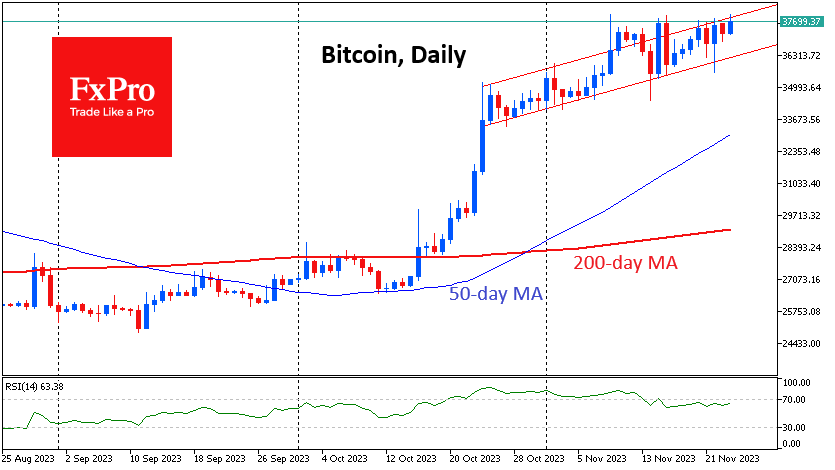
Friday morning saw a fresh test of the $38K level for Bitcoin. It failed, but we continue to see the persistence of growth attempts and less and less deep retreats from local peaks. The dynamics of November lead us to believe that the chances of the price rising by another 2.5K and exceeding the $40K level are higher than the chances of it falling by the same amount to $35K.
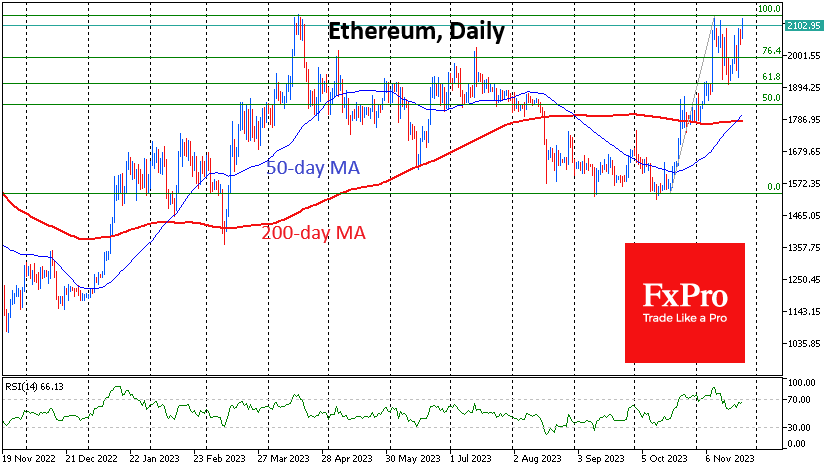
Ethereum crossed the $2100 level, returning to the peak set on 10 November. There was a classic Fibonacci retracement with a 61.8% pullback from the initial rally. Breaking through the $2135 level will set up the main scenario of a 161.8% growth, which in this case is close to $2500.
News background
The SEC and BlackRock held a meeting to discuss the details of a spot bitcoin ETF. According to the memo, the management company showed a presentation outlining two possible redemption mechanisms for its iShares Bitcoin Trust.
Grayscale updated the GBTC application to convert to an ETF and changed the ticker symbol to BTC. Bloomberg saw this as another sign of the company’s ongoing negotiations with the SEC.
The SEC has no reason to prevent the launch of a spot bitcoin ETF, said SEC Commissioner Hester Pearce, known for her positive attitude towards cryptocurrencies.
The agreements between Binance and the US authorities are favourable as they neutralise the systemic risk to the industry from a hypothetical collapse of the platform, JPMorgan said.
Nansen said the market’s reaction to the Binance scandal and Changpeng Zhao’s guilty plea was muted. This event did not lead to a significant flight of capital from the cryptocurrency platform.
Germany on the Brink of Recession, UK Consumer Confidence Improving
A quiet end to the week draws to a close with European indices treading water and economic data highlighting the challenges facing the bloc.
Nowhere is that more evident than in Germany which appears to be on the brink of a double-dip recession and facing immense uncertainty over its budget for next year as it scrambles to patch up finances for this one.
A supplementary budget next week alongside a proposal to suspend the debt brake now looks likely but even this is just a temporary solution that won't give investors much confidence in the outlook for an economy already under significant strain.
The economy was confirmed to have contracted by 0.1% in Q3 this morning and as we move into the final month of Q4, it's looking likely data early next year will confirm the country is back in recession.
The Ifo business climate survey was a little better and appears to be turning a corner which is hopefully a good sign but at 87.3, it's still printing figures near historical lows. The early months of the pandemic were understandably much worse, as you'd imagine, but that aside, recent readings have fallen close to 2001 and 2009 levels.
UK consumers buoyed by improving real earnings
UK consumer confidence is also gradually improving, albeit from very weak levels. At -24, the Gfk survey is 25 points from last September's lows but still some way below all surveys from mid-2013 through to the pandemic. Still, the direction of travel is more promising and inflation is now running below wage growth which should continue to support that.
Trading calm going into the weekend after OPEC+ postponed meeting
It could have been a nervy end to the week in oil markets had OPEC+ not pushed back its meeting from this Sunday to next Thursday. Instead, it's all looking a little calm. While I wouldn't be entirely surprised to see leaks or comments over the weekend that still have an impact on the oil price on the open next week, the actual meeting now occurring Thursday could put traders' minds somewhat at ease.
Gold not giving up on $2,000 yet
Gold is continuing to flirt with $2,000 despite repeatedly failing to break and hold above the psychological resistance zone. We saw that on a number of occasions at the end of October and again earlier this week, buoyed on this occasion by a less hawkish Fed and favorable inflation and jobs reports from the US. It will be interesting to see how explosive the move is if the price does break significantly above, with it having taken some effort to break down. A rebound lower on the other hand could set up an interesting battle at the November lows around $1,930.
Dollar Index: Consolidation to Likely Precede Fresh Weakness
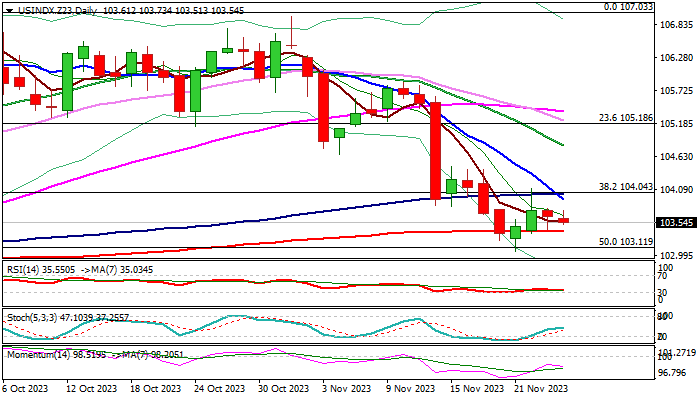
The dollar index is holding in prolonged sideways mode and ranging between 200DMA (103.39) and 100DMA (104.02) in a holiday-thinned markets.
The bear-leg from a double top at 106.98/107.03) is taking a breather after 1.9% drop previous week, but bears hold grip and warn of fresh weakness after consolidation.
Strong negative momentum and multiple MA bear-crosses on daily chart weigh on near-term action, with additional pressure on dollar expected from shift in Fed’s view on interest rates, as narrative changed from signals for further tightening to rate cuts in just a couple of weeks.
Also, the greenback is likely to be sold more towards the end of the year, as investors may further clear larger longs from the second half of 2023.
Break of 200DMA to generate initial bearish signal, which will look for verification on clear break of 103.11 pivot (50% retracement of 99.20/107.03 uptrend) and signal bearish continuation.
Caution on bounce above 100DMA (104.02) which would sideline immediate downside risk and challenge upper pivot at 104.33 (base of thick daily cloud, reinforced by daily Tenkan-sen).
Res: 104.02; 104.45; 104.66; 105.18.
Sup: 103.39; 103.11; 102.84; 102.19.
Japanese Yen Shrugs as Core CPI Ticks Higher
- Japanese core inflation rises
- US PMIs expected to show little change
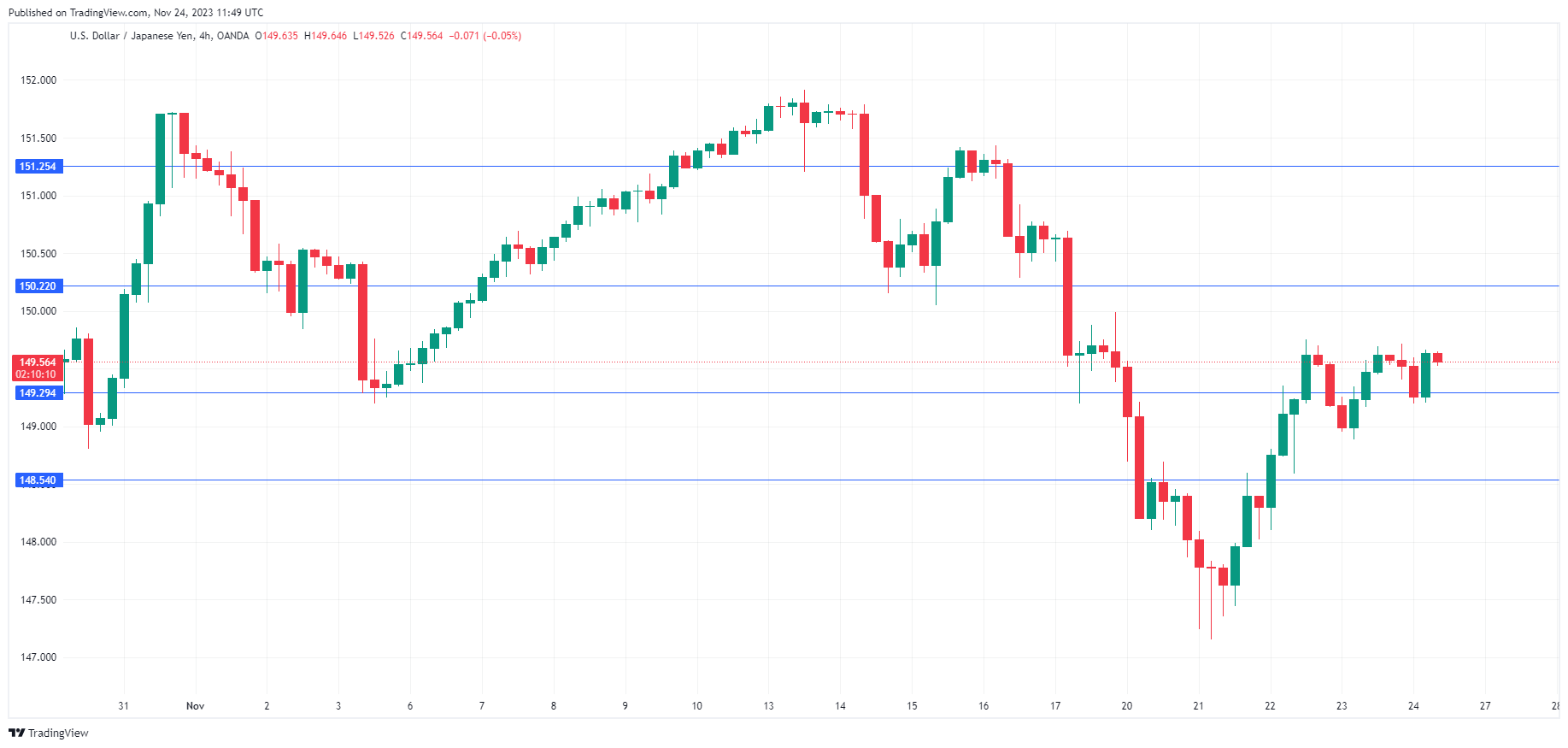
The Japanese yen is unchanged on Friday, trading at 149.57.
Japan’s core inflation rises to 2.9%
Japan’s core CPI rose slightly in October to 2.9% y/y, up from 2.8% in September and just below the consensus estimate of 3.0%. The core CPI print excludes fresh food but includes energy. Core CPI has now exceeded the Bank of Japan’s 2% target for 19 consecutive months. Headline inflation jumped to 3.3% y/y, up from 3.0% in September and above the market consensus of 3.2%.
The acceleration in inflation will put further pressure on the BoJ to tighten its ultra-loose policy. There is growing speculation that the BoJ could raise interest rates from -0.1% to zero early in 2024. The BoJ is known to be very tight-lipped and there’s little chance of any communication with the markets with regard to a shift in policy.
What is clear is that any move away from the current policy could cause market turmoil and hurt Japan’s fragile economy. Still, with inflation remaining stubbornly high, a shift in monetary policy is likely only a question of time. The Bank of Japan meets next on December 19th. Once dull affairs that barely made the radar of investors, the meetings are now closely watched on expectations that the BoJ could change policy, which would be a sea-change after years of ultra-loose policy.
The US wraps up the week with the release of manufacturing and services PMIs, with little change expected. Still, the markets will be watching carefully, as the data will provide insights into the strength of the US economy.
The consensus estimates for November stand at 49.8 for manufacturing (Oct: 50.0) and 50.4 for services (Oct. 49.8). The manufacturing sector has been particularly weak, with the PMI indicating declines over most of the past year. If either PMI misses expectations, the US dollar could show stronger movement.
USD/JPY Technical
- 149.29 and 148.54 are providing support
- There is resistance at 150.22 and 151.25