Sample Category Title
On a Slippery Floor
While the US economy has been surprisingly resilient this year to the Federal Reserve’s (Fed) aggressive monetary tightening, we cannot say that we have a similar soothing picture in Europe. The energy crisis, that followed the pandemic, has been hard on Germany. The country needs money when money becomes rare and expensive. Germany decided to suspend the debt limit for the 4th consecutive year – signaling that borrowing in Europe will continue to increase, and the new debt that the Europeans will take on their shoulders will cost significantly higher than a few years ago.
German bonds fell yesterday on news of yet another suspension of the debt limit. The 10-year German yield advanced to 2.60%, Italy’s 10-year yield jumped to 4.40%, the Italian–German yield spread rebounded this week from the lowest levels since September, and the widening yield spread between core and periphery could become a limiting factor for euro appetite at a time traders should decide whether the EURUSD should appreciate above the 1.10 psychological mark.
As per the European Central Bank (ECB) expectations, European officials do their best to tame the rate cut expectations in the Eurozone. Belgian central bank governor Pierre Wunsch said yesterday that the ECB won’t cut the rates as long as wages growth remains elevated, while the German central bank head Joachim Nagel said that cutting rates too early would be a mistake. A mistake? Maybe. Yet, economic data comes as further evidence that the European economies are not going toward sunny days. Released yesterday, the European PMI figures came in slightly better than expected, but the reading was below 50 for the 6th consecutive month, meaning that activity in the Eurozone contracted for the 6th consecutive month. The Eurozone GDP fell below 0 at the latest reading, while in comparison, the US GDP grew nearly 5%. This is to say that, based on the current data, the Fed has a greater margin for keeping rates steady than their European counterparts. It at least has better credibility. And the Fed’s bigger hawkish margin compared to the ECB should keep the euro appetite limited against the US dollar following the rally since the beginning of October.
In the US, despite warnings that the falling US long-term yields will, at some point, trigger a hawkish reaction from the Fed and eventually reverse, the Fed doves remain in charge of the market. The US dollar index struggles to gain traction above the 200-DMA.
The USDJPY remains offered near the 50-DMA after the Japanese inflation advanced to a 3-month high in October (rose to 3.3% level from 3% printed a month earlier). Normally, it would’ve boosted bets of Bank of Japan (BoJ) normalization, but the BoJ should first awaken from its coma.
In energy, US crude trades near $75/76 region. Downside risks prevail due to speculation that the delayed OPEC meeting could result in Saudi Arabia not doubling its solo production cuts. There is even a slim possibility that they eventually reverse them.
I am wondering if this week’s drama is not staged amid poor buying following the news that Saudi would doble its cuts, to cast shadow in Saudi’s intention to defend oil prices, to bring attention to OPEC and to Saudi which finally would go ahead and double its production cuts hoping that the market reaction would be stronger than if they had announced the same outcome this weekend. In all cases, deteriorating growth prospects will likely limit the upside potential in oil prices in the medium run. The short run will certainly see more volatility.
European Yields Rise on Data and German Debt Break Outlook
Market movers today
Key focus today will be on the German Ifo survey and US PMIs.
The Ifo survey increased in October and is expected to show a further increase in November in line with the signals from the ZEW index and other survey data pointing to a gradual bottoming from a very low level.
US PMIs have shown a bit of a diverging picture with PMI manufacturing moving slightly higher in recent months while service PMI has weakened. We look for a cooling of the economy going into the winter months which should keep service PMI under pressure. In the manufacturing sector a lift in the order-inventory ratio lately suggests we could see a further moderate rise in PMI manufacturing from the current level of 50.
The 60 second overview
Markets: it has been a fairly quiet overnight session following the Thanksgiving holiday in the US. Asian equity benchmarks and DM equity futures are trading slightly higher this morning while oil and USD FX are little changed. US yields are opening a few bp higher following the European sell-off yesterday (more below).
Sweden monetary policy. Yesterday the Riksbank kept the policy rate unchanged at 4.00% and opened up for an announcement of a further QT volume increase already at the next meeting. The policy rate path was kept roughly unchanged but pushed by one quarter, i.e. signalling a continued probability for a further hike (10bp). Read more about the Riksbank decision in our Riksbank flash comment, 23 November.
Eurozone macro data. European PMI data improved in November with the Eurozone composite measure rising from 46.5 to 47.1. However, this is still recessionary territory. Worryingly for the ECB, price indices showed higher price pressures within the services sector. This is in line with the increasing wage growth, which rose to 4.7% y/y in Q3 vs. 4.6% in Q2 according to the ECB's negotiated wage indicator also released yesterday.
German politics. In Germany, the government has decided to pursue a suspension of the debt brake next year - as it did in 2020 - following the Constitutional Court in Karlsruhe's rejection of the previous plan of spending EUR60bn originally intended for fighting covid-19 on climate and economic transformation. The move will be presented as part of a revised budget next week. This should be doable, as the funds will be aimed at climate expenses, which given the rain and the flooding in Germany in recent years, should be possible to push through parliament (and Karlsruhe). Holding a majority in parliament, the government could decide to keep the suspension until the next election in 2025.
Oil. The oil market took OPEC's decision to postpone its meeting originally scheduled for Sunday by four days with relative ease. Apparently, Angola will not meet demands for reducing its quota next year. In our view, OPEC has more power to push oil prices lower than higher. The cartel's total production led by the big voluntary cut by Saudi Arabia is already low and we doubt it will make substantial further cuts to lift oil prices. Rather there is a risk that disagreement leads to scrapping of quotas and some producers potentially leaving the cartel with everyone free to produce at will, which would be a big blow to oil prices. We think OPEC will muddle through with an extension of current production levels next year and thus do not expect the postponed meeting to be a market mover. Rather the oil market will be at the hands of global risk sentiment and the USD. We look for Brent to average USD80/bbl next year.
Japan. Overnight CPI and PMI data were released. While the PMI data revealed a further decline in the manufacturing index to 48.1 (from 48.7) the service index rose 0.1 index point to 51.7. More importantly for markets, the inflation release showed a pick-up in inflation although slightly below market expectations. That said, prints in core inflation and core-core inflation of 2.9% Y/Y and 4.0% Y/Y, respectively, remain far above Bank of Japan's inflation target and we still expect Bank of Japan to remove its yield curve control at the coming monetary policy meetings and ultimately hike policy rates during 2024.
Equities: Global equities were higher yesterday in a dull session as US was closed for Thanksgiving celebrations. However, European stocks managed to grind led by energy and pharma industries. As mentioned before in our 'Espresso', one should see sessions with stability, not least on the bond side, as positive for the near-term outlook. Asian markets are mixed this morning with Japanese stocks higher on the back of solid data while Chinese markets are lower as developers give up some of their gains form yesterday. US futures a tad higher while European futures are marginally lower.
FI: European yields rose significantly yesterday following the stronger-than-expected PMI data and the German government plan to suspend the debt brake next year. 10Y Bund yields rose 7bp, while the 2s10s curve bear steepened 4bp throughout the day. Long-term inflation metrics (e.g. the 5y5y EUR inflation swap) spiked in reaction to the strong PMI data. Peripherals performed generally in line with the core. In the Netherlands, the surprising election result on Wednesday - putting far-right Geert Wilders in the lead to become PM - did not have any significant impact on spreads. US markets were closed due to the Thanksgiving holiday.
FX: In line with our expectation, the Riksbank yesterday decided to leave the repo rate unchanged at 4.00% and EUR/SEK moved higher on the hawkish "unchanged" decision. EUR/USD had a relatively quiet day due to the Thanksgiving holiday, trading around the 1.09 mark. EUR/GBP jumped lower during yesterday's session as UK preliminary PMIs for November came in significantly higher than expected. Combined with the fiscal measures announced Wednesday in the Autumn Statement this leaves a worrying backdrop with a risk of more persistent inflation for the Bank of England.
Credit: CDS indices were broadly unchanged yesterday with iTraxx Main closing at 68bp (unchanged) and Xover 2bp tighter at 375bp. Following some busy days, the EUR primary market was nearly quiet with only one corporate deal being priced.
USD/JPY: Japan’s Inflation Accelerated, A Struggle for Bulls at 50-day Moving Average
- Resurgence of inflationary pressures in Japan due to higher import costs from energy prices.
- The Bank of Japan may face renewed political pressure to normalize its current dovish monetary policy stance to negate significant JPY’s weakness.
- Recent uptick in 10-year JGB yield from an 11-week low may trigger another potential down leg in USD/JPY.
- Watch the 150.20 key short-term resistance on USD/JPY.
The latest nationwide Japan core inflation for October (excluding fresh food) ticked higher for the first time in four months to 2.9% y/y (slightly below the consensus of 3% y/y) from September’s 13-month low of 2.8% y/y. Overall, it has stayed above the Bank of Japan (BoJ)’s 2% inflation target for the consecutive 19th month.
Meanwhile, the core-core inflation rate (excluding fresh food & energy) inched lower to 4% y/y (but still its highest level since 1981) in October from September 4.2% y/y, the second consecutive month of softness which indicates that the recent rallies seen in benchmark oil prices from August to September were likely one of the main drivers that contribute to the resurgence of inflationary pressures in October.
Economic activities in the services sector have started to improve slightly in November where the flash Services PMI rose to 51.7 from 51.6 in October but still below its 12-month average of around 53.5.
In contrast, manufacturing activities have continued to be in the doldrums as the flash Manufacturing PMI for November contracted further to 48.1 from 48.7 in October, its sixth consecutive month of contraction and its steepest decline since February 2023.
Potential mounting political pressure on BoJ due to higher imported inflationary pressures
Overall, it’s a mixed set of economic readings but the recent months of elevated imported inflation via the lagged effects of higher oil prices that drove up import costs have put Bank of Japan Governor Ueda in a tight spot as he has so far “stubbornly” remained dovish on Japan’s monetary policy and adopted a wait & see approach for further evidence on substantial wage increases before embarking on a path of normalization away from negative short-term interest rates.
The current dovish stance from BoJ has led the JPY to plummet to a 33-year low against the US dollar and is the current primary driver of higher import costs, in turn, putting increasing political pressure on BoJ to act fast to negate this knock-on effect on elevated import costs in order to boost consumer and business sentiment as Japanese Prime Minster Kishida’s most recent approval ratings declined to the lowest level in his current two-year premiership.
The USD/JPY has staged a rebound of +260 pips since the start of this week after it plummeted to a 10-week low print of 147.15 on Tuesday, 21 November in line with broad-based US dollar weakness seen last week.
The recent rebound is likely due to technical factors as the prior steep decline from its 151.95 major resistance has hit oversold conditions on several short-term (hourly) momentum indicators.
Further shrinkage in the 10-year US Treasury-JGB yield premium may trigger further downside pressure in USD/JPY
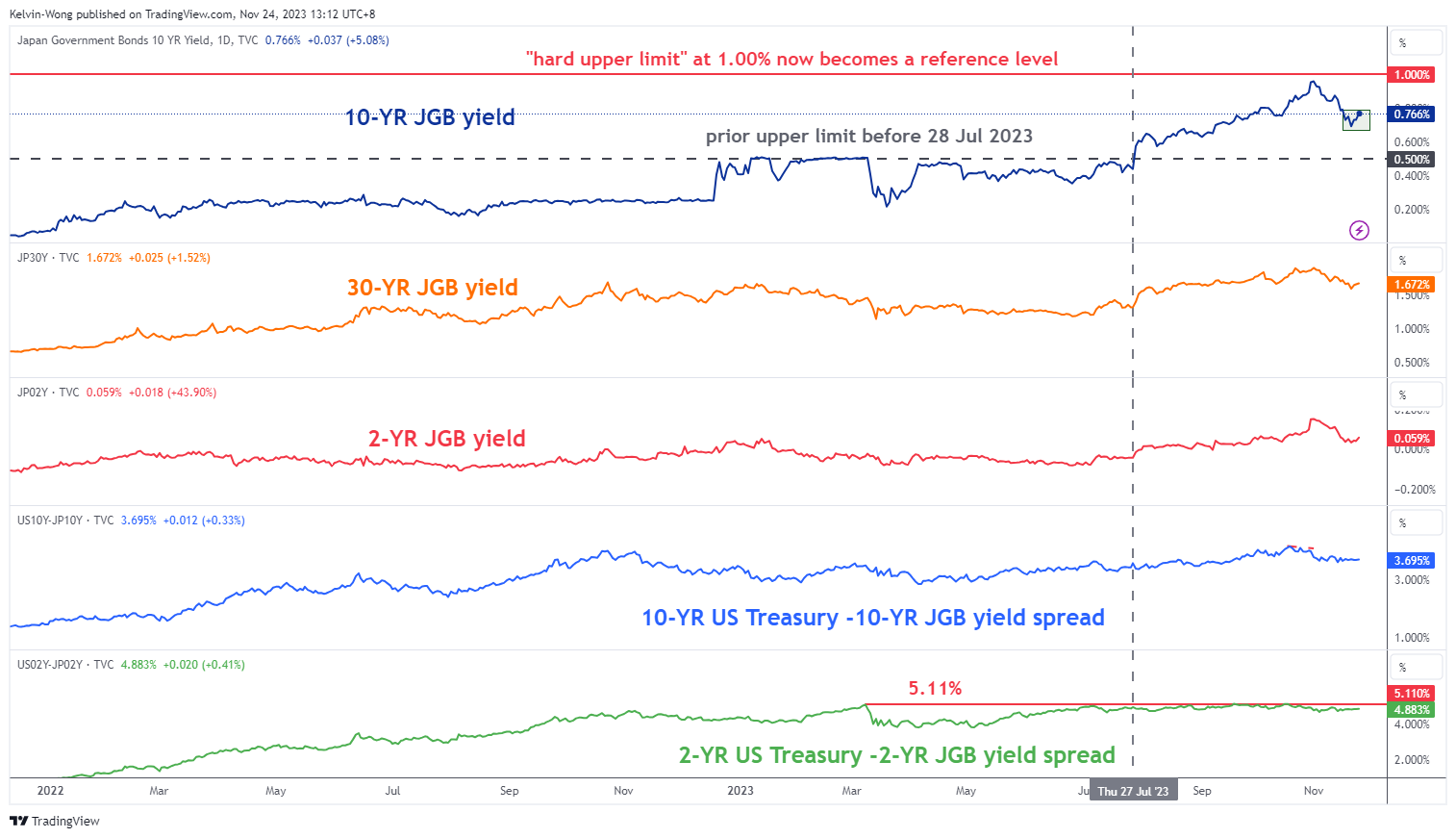
Fig 1: JGB yields with US Treasury-JGB yield spreads as of 24 Nov 2023 (Source: TradingView, click to enlarge chart)
The current elevated inflationary pressure in Japan has reinforced a further uptick in the 10-year Japanese government bond (JGB) yield that continued to rise to 0.77% at this time of the writing from an 11-week low of 0.69% printed on Tuesday, 21 November.
Hence, the latest recovery seen in n the 10-year JGB yield is likely to put downside pressure on the declining 10-year US Treasury-JGB yield premium since 19 October 2023 which in turn may undermine the recent 3-day US dollar rebound against the JPY.
Short-term minor corrective rebound in USD/JPY may have reached its terminal point
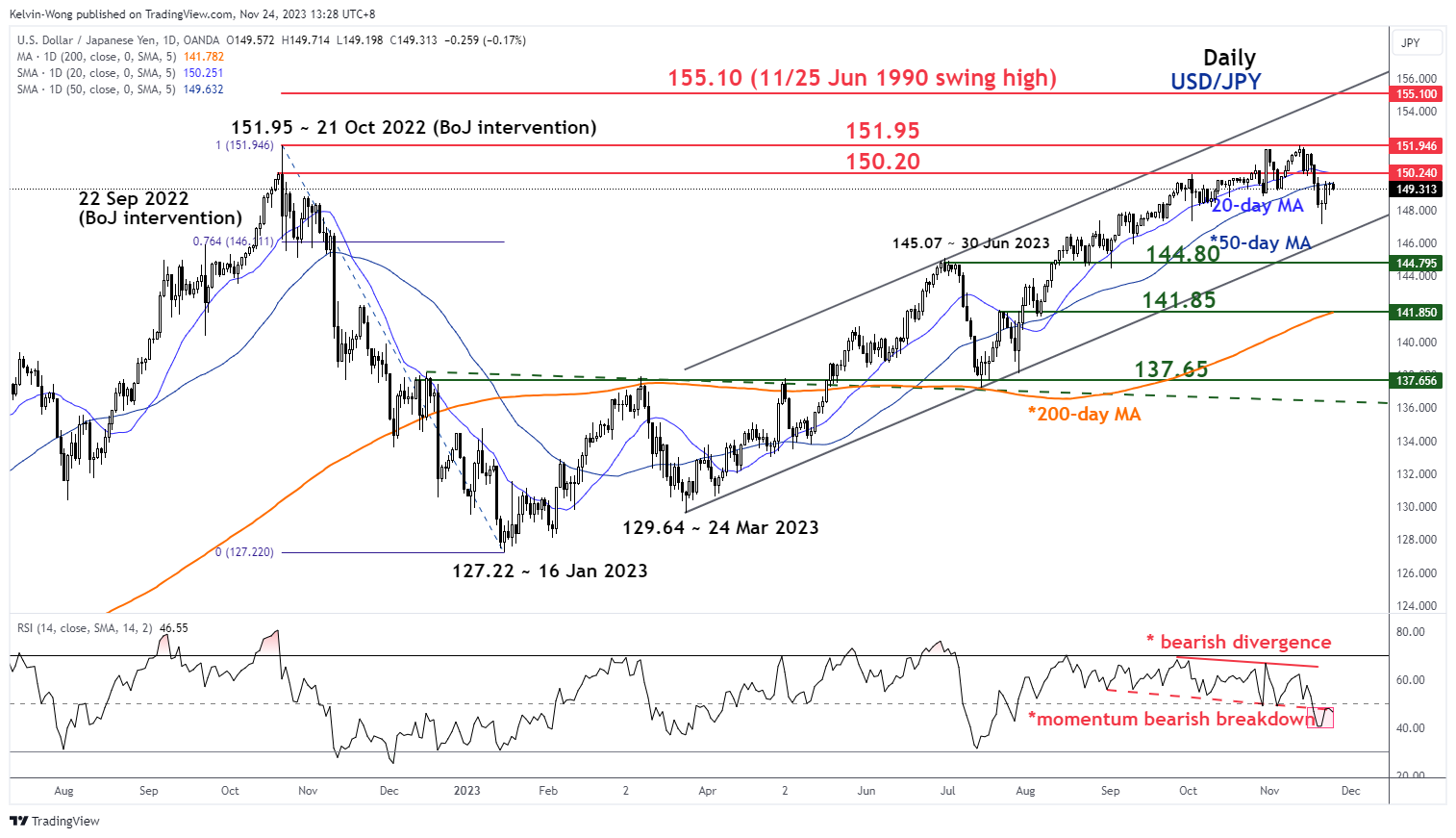
Fig 2: USD/JPY medium-term trend as of 24 Nov 2023 (Source: TradingView, click to enlarge chart)
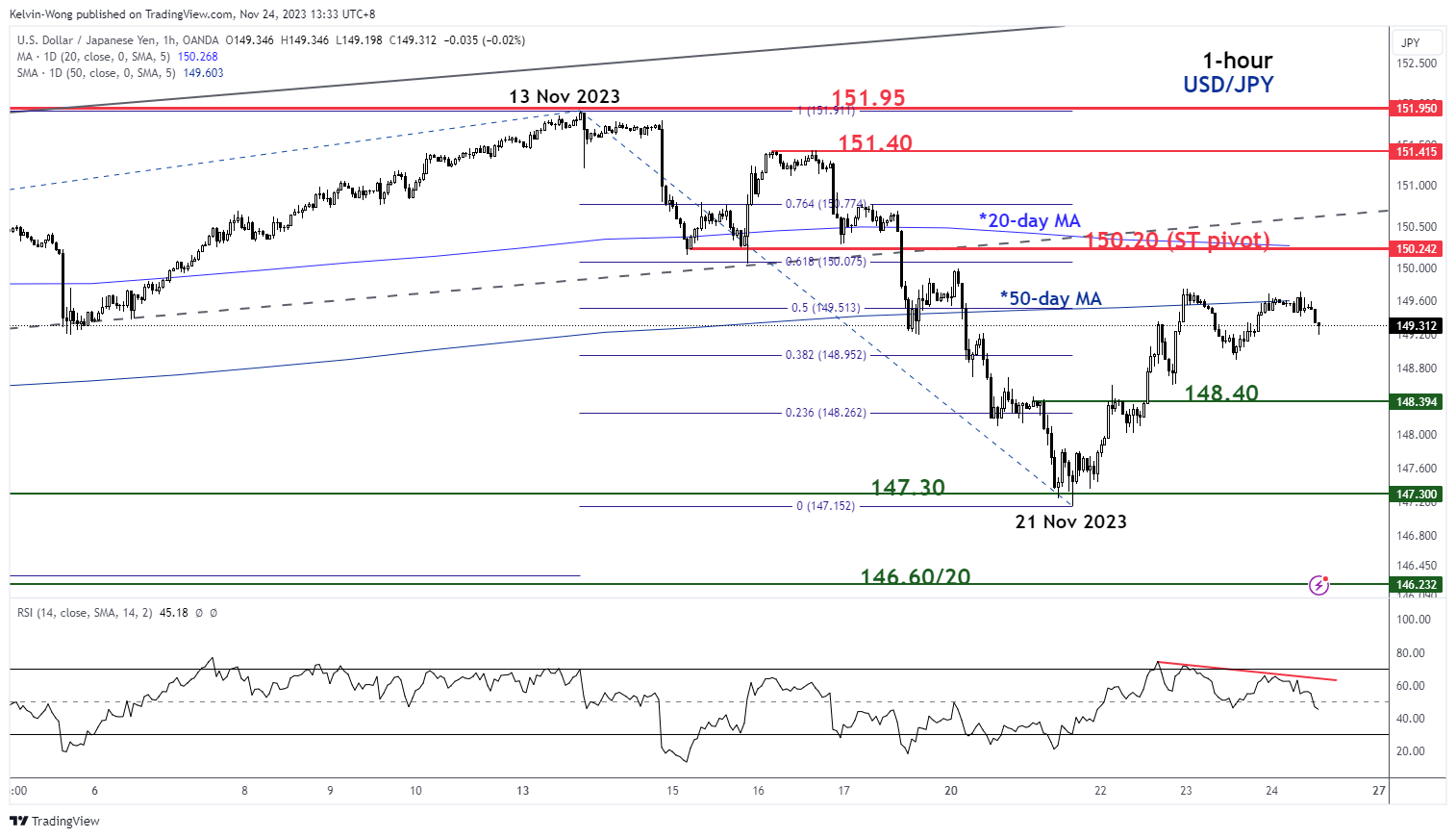
Fig 3: USD/JPY minor short-term trend as of 24 Nov 2023 (Source: TradingView, click to enlarge chart)
Technically speaking, the +260 pips rebound seen in the USD/JPY from its 21 November 2023 low of 147.15 has started to show bullish exhaustion signals at its 20 and 50-day moving averages.
The short-term hourly RSI oscillator has continued to exhibit bearish momentum readings after an earlier bearish divergence condition being flashed out at its overbought zone on Wednesday, 22 November.
Watch the 150.20 key short-term pivotal resistance (also the 20-day moving average & close to the 61.8% Fibonacci retracement of the prior minor decline from 13 November 2023 high to 21 November 2023 low) and a break below the near-term support of 148.40 may expose the next intermediate supports of 147.30 and 146.60/20.
However, a clearance above 150.20 invalidates the bearish tone for a squeeze up towards the next intermediate resistance at 151.40 (minor swing high of 16 November 2023).
Nasdaq (NQ_F) Short Term Cycle is Mature and May See Pullback
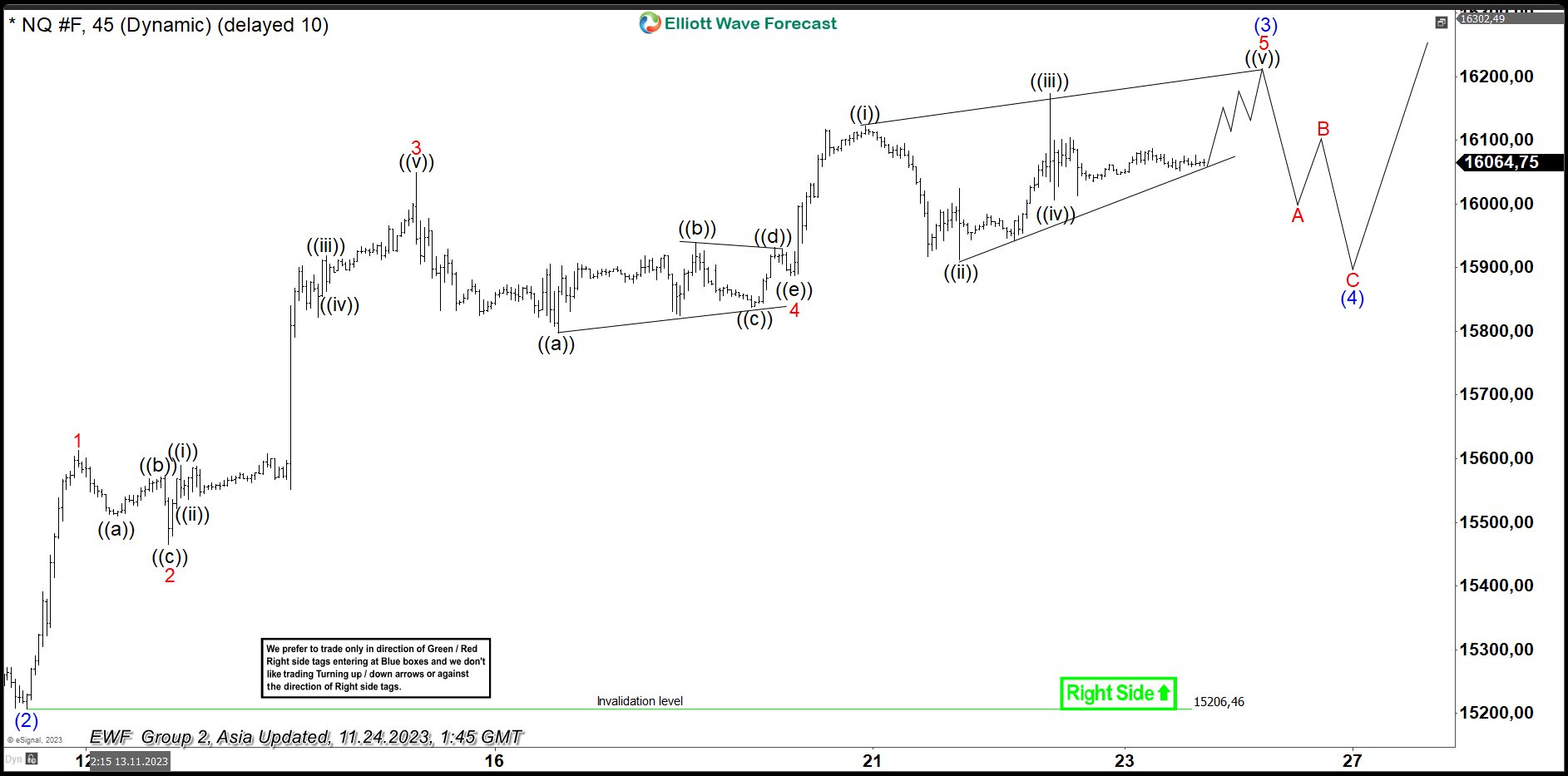
Short Term Elliott Wave in Nasdaq Futures (NQ_F) shows cycle from October 27, 2023 low is unfolding as a 5 waves impulse. This cycle is mature even though it still can extend higher in the shorter cycle. Up from October 27 low, wave (1) ended at 15453.75 and pullback in wave (2) ended at 15207.75. The Index then extended higher in wave (3). Up from wave (2), wave 1 ended at 15612.75 and wave 2 ended at 15465.25.
Index extended to the upside and ended wave 3 at 16049.50. Wave 4 as triangle structure ended at 15887.25. Last push higher is still developing. We are calling an ending diagonal structure to end wave 5 of (3). The structure needs one more high to end the cycle and it could reach 16216.25 – 16280.25 area to finish wave (3). Once we watch a reaction lower, wave (4) correction should start in 3, 7, or 11 swing before further upside in wave (5). Near term, as far as pivot at 15206.46 low is holding, expect dips to find support in 3, 7, 11 swing for further upside. As an alternate, wave (5) can be ending with the new high and the Index should then see a bigger pullback to correct cycle from October 27 low.
Nasdaq (NQ_F) 60 Minutes Elliott Wave Chart
Nasdaq (NQ) Elliott Wave Video
https://www.youtube.com/watch?v=xGkdqdf6_GI
EUR/USD Daily Outlook
Daily Pivots: (S1) 1.0883; (P) 1.0906; (R1) 1.0929; More...
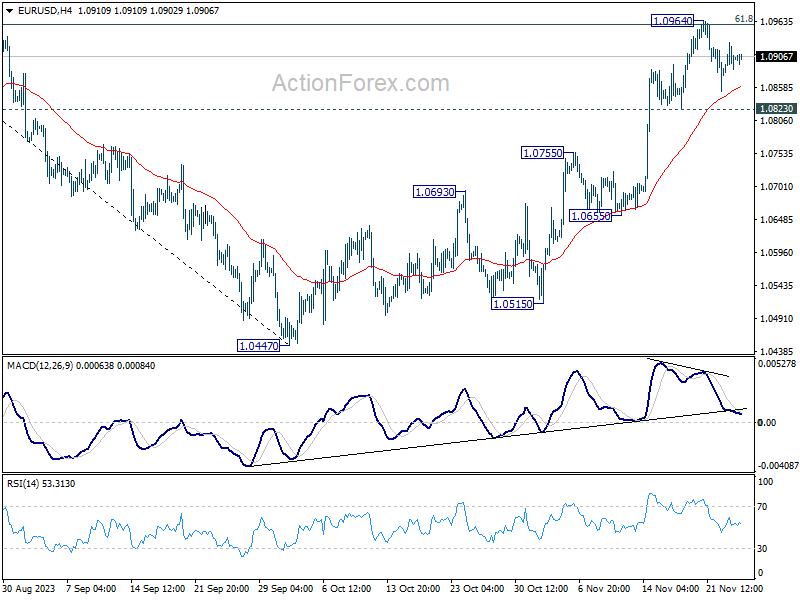
EUR/USD is extending the consolidation from 1.0964 and intraday bias stays neutral for the moment. Further rally is in favor as long as 1.0823 support holds. Sustained break of 61.8% retracement of 1.1274 to 1.0447 at 1.0958 will resume the rise from 1.0447 to retest 1.1274 high. However, firm break of 1.0823 will indicate short term topping, and turn bias back to the downside for deeper decline.
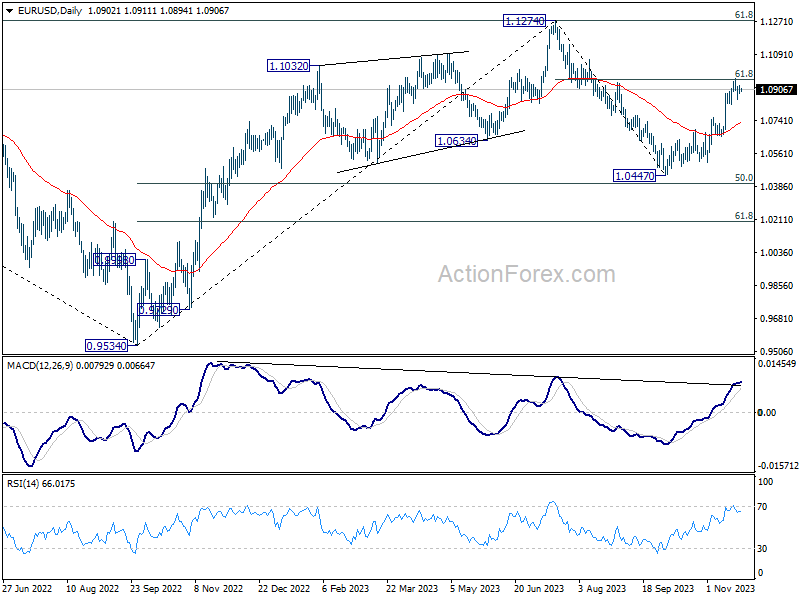
In the bigger picture, price actions from 1.1274 are viewed as a corrective pattern to rise from 0.9534 (2022 low). Rise from 1.0447 is tentatively seen as the second leg. Hence while further rally could be seen, upside should be limited by 1.1274 to bring the third leg of the pattern.
USD/JPY Daily Outlook
Daily Pivots: (S1) 149.08; (P) 149.38; (R1) 149.88; More...
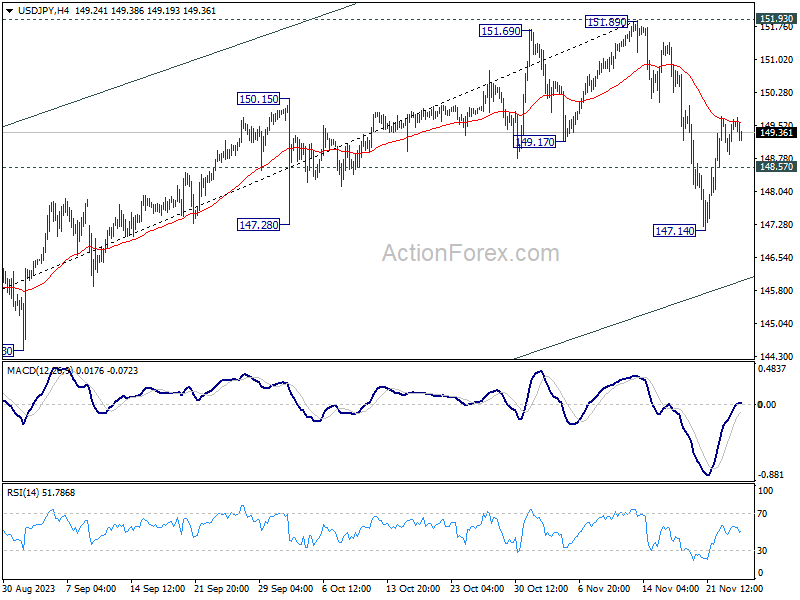
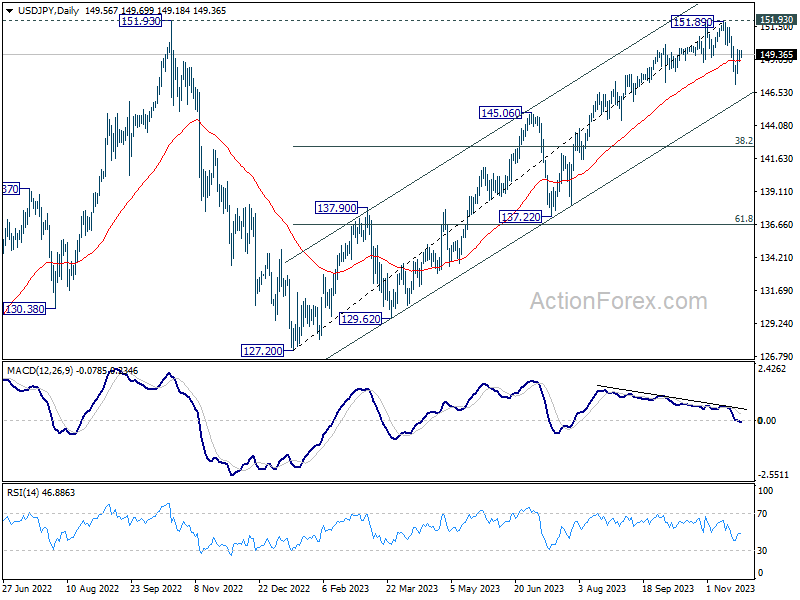
Intraday bias in USD/JPY remains neutral for the moment. On the downside, break of 148.57 minor support will indicate rejection by 55 4H EMA, and turn bias back to the downside for 147.14 and below, to resume the fall from 151.89. However, sustained break of 55 4H EMA (now at 149.62) will revive near term bullishness, and target a retest on 151.89/93 resistance zone.
In the bigger picture, rise from 127.20 (2023 low) is seen as the second leg of the pattern from 151.93 resistance (2022 high). Decisive break of 145.06 resistance turned support will confirm that this second leg has completed, after rejection by 151.93. Deeper fall would be seen through 38.2% retracement of 127.20 to 151.89 at 142.45 to 61.8% retracement at 136.63. Nevertheless strong bounce from 145.06 will retain medium term bullishness for another test on 151.93 at a later stage.
GBP/USD Daily Outlook
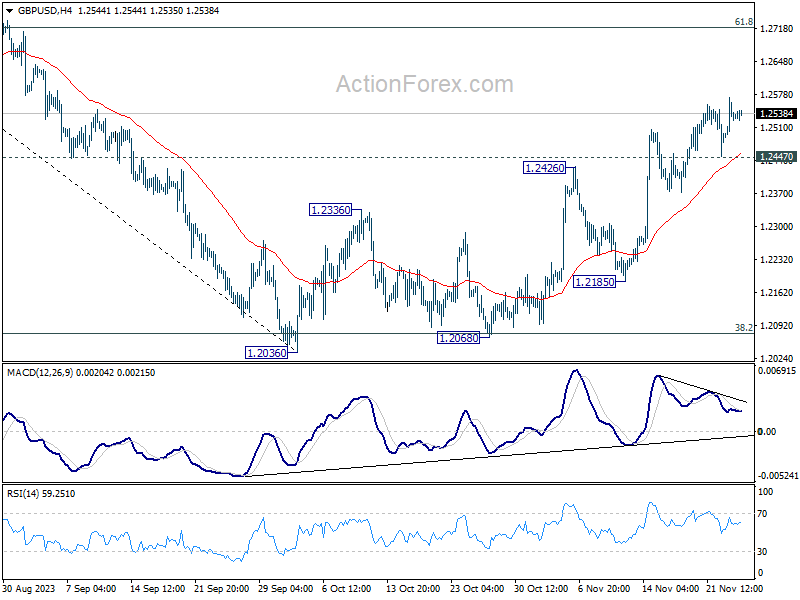
Daily Pivots: (S1) 1.2494; (P) 1.2529; (R1) 1.2568; More...
Intraday bias in GBP/USD stays on the upside at this point. Current rise from 1.2036 should target 61.8% retracement of 1.3141 to 1.2036 at 1.2716 next. On the downside, though, below 1.2447 minor support will turn intraday bias again first, and probably bring lengthier consolidations.
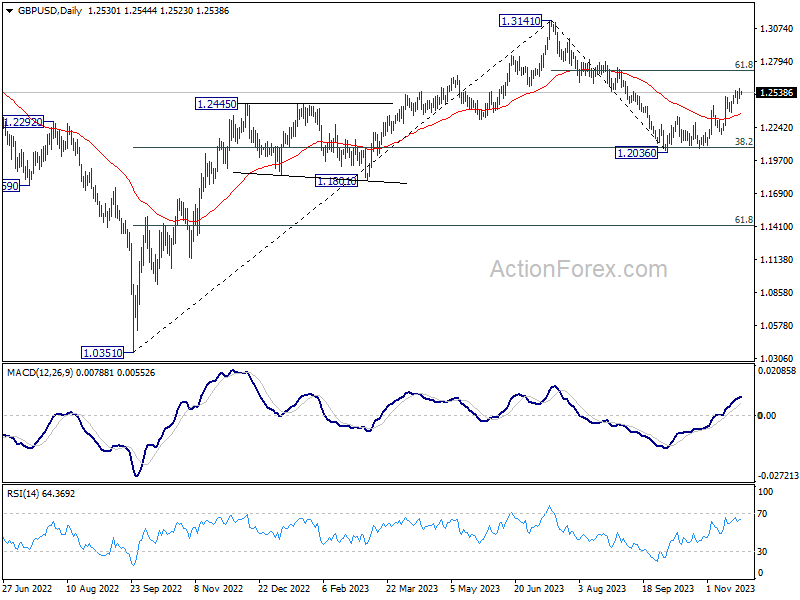
In the bigger picture, price actions from 1.3141 are seen as a corrective pattern to rise from 1.0351 (2022 low). Strong rebound from 38.2% retracement of 1.0351 (2022 low) to 1.3141 at 1.2075 argues that current rise from 1.2036 is the second leg. However, while further rally could be seen, upside should be limited by 1.3141 to bring the third leg of the pattern.
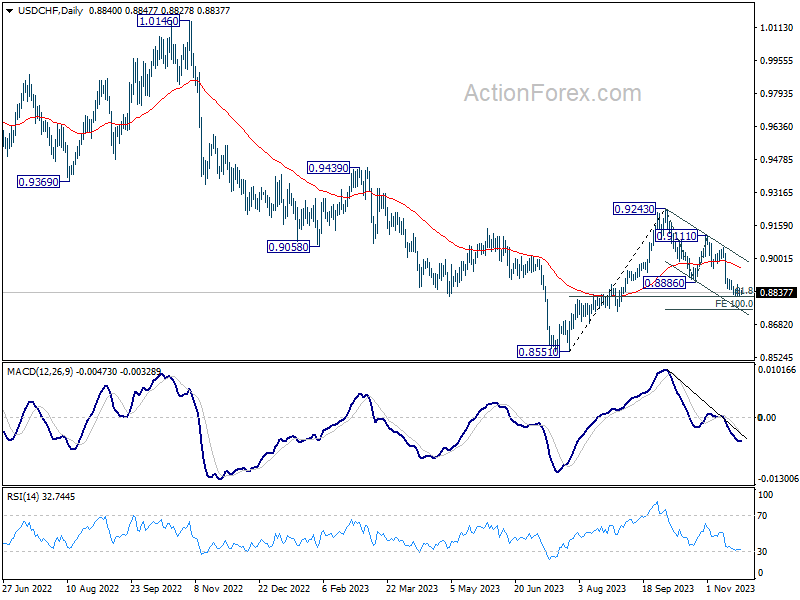
USD/CHF Daily Outlook
Daily Pivots: (S1) 0.8820; (P) 0.8839; (R1) 0.8861; More....
Intraday bias in USD/CHF remains neutral as consolidation continues. Stronger recovery cannot be ruled out. But near term outlook will stay bearish as long as 0.8952 support turned resistance holds. On the downside, below 0.8815 will resume whole decline from 0.9243 to 100% projection of 0.9243 to 0.8886 from 0.9111 at 0.8754 next.
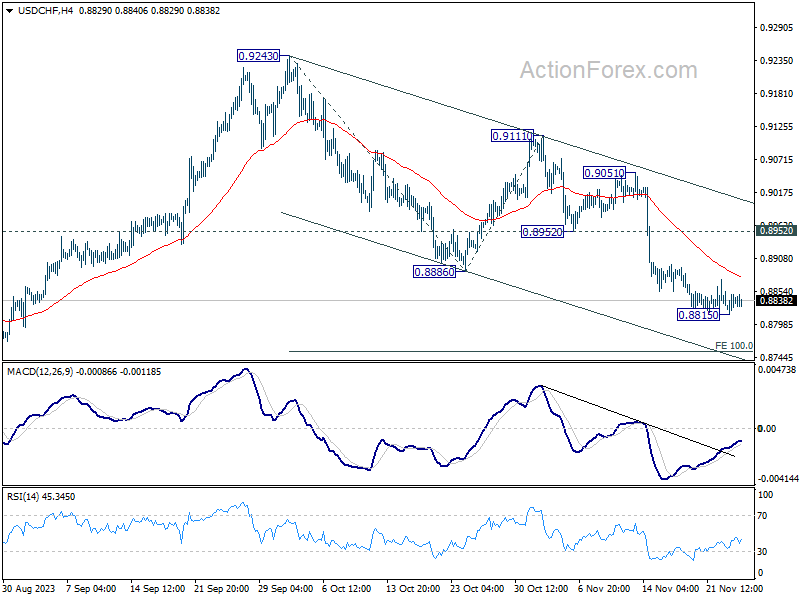
In the bigger picture, price actions from 0.8551 are currently seen as part of a corrective pattern to the decline from 1.0146 (2022 high). Fall from 0.9243 is seen as the second leg for now. Deeper fall would be seen to 61.8% retracement of 0.8551 to 0.9243 at 0.8815. Sustained break there will bring retest of 0.8551 low. For now, this will remain the favored case as long as 0.9111 resistance holds.
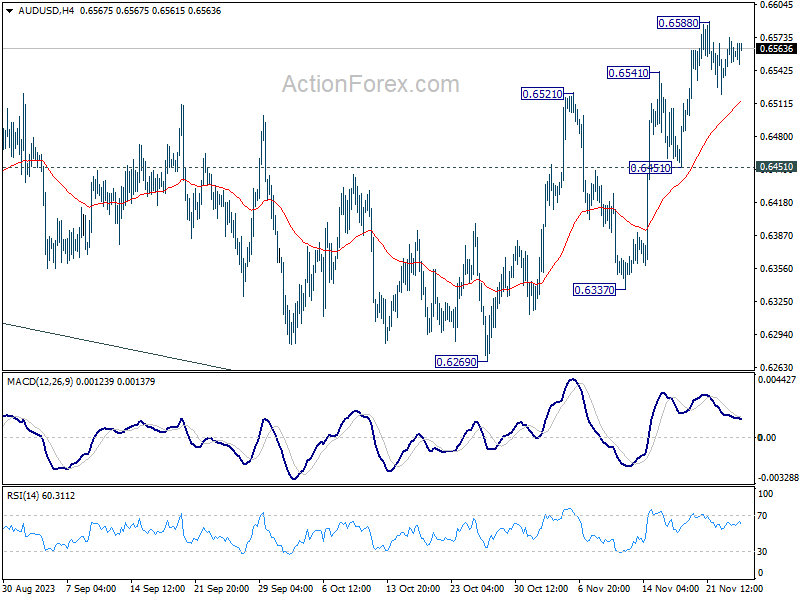
AUD/USD Daily Report
Daily Pivots: (S1) 0.6540; (P) 0.6558; (R1) 0.6575; More...
AUD/USD is extending the consolidation pattern from 0.6588 and intraday bias remains neutral. Downside of retreat should be contained above 0.6451 support to bring another rally. On the upside, above 0.6588 will resume the rebound from 0.6269 to falling channel resistance (now at 0.6676) next.
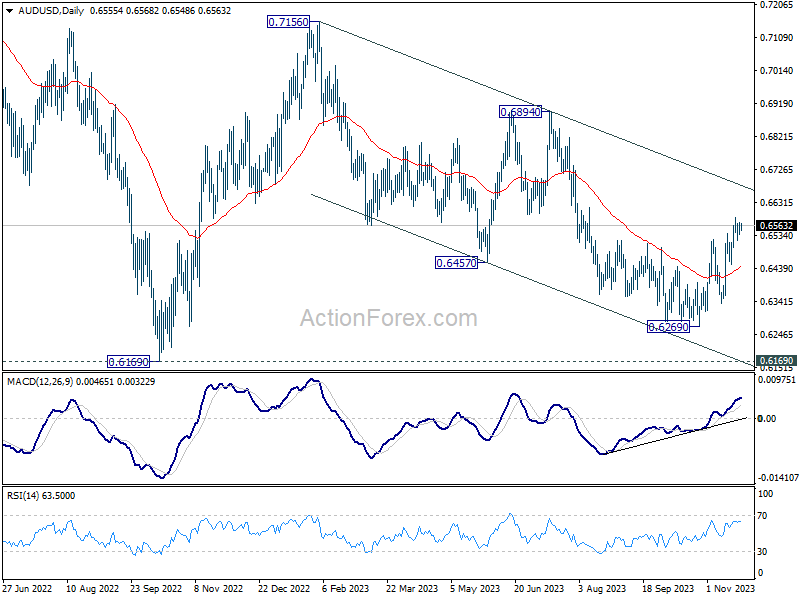
In the bigger picture, there is no confirmation that down trend from 0.8006 (2021 high) has completed. While current rebound from 0.6269 might extend higher, it could be the third leg of the corrective pattern from 0.6169 (2022 low) only. For now, medium term bearishness will remain as long as 0.6894 resistance holds.
USD/CAD Daily Outlook
Daily Pivots: (S1) 1.3661; (P) 1.3686; (R1) 1.3721; More...
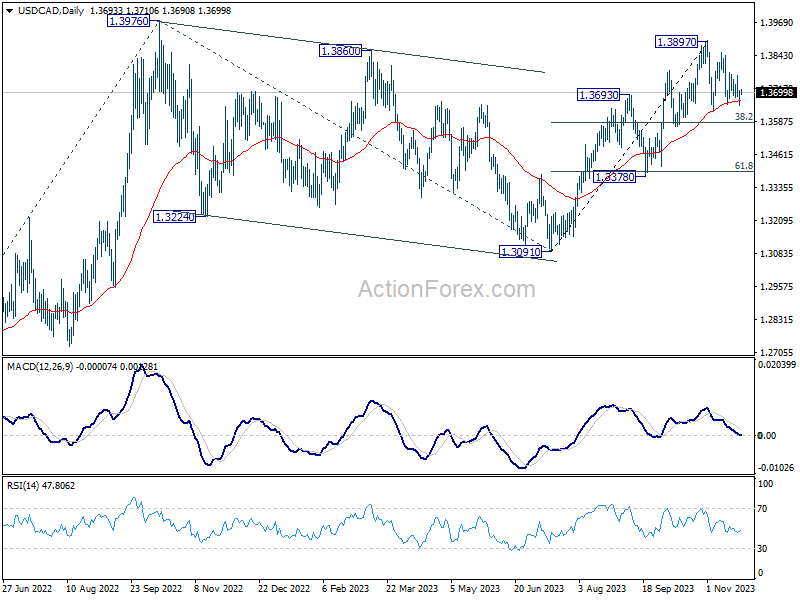
USD/CAD is still extending the sideway pattern from 1.3897 and intraday bias remains neutral. While another fall cannot be ruled out, downside should be contained by 38.2% retracement of 1.3091 to 1.3897 at 1.3589 to bring rebound. Break of 1.3897 is expected at a later stage to resume larger rally.
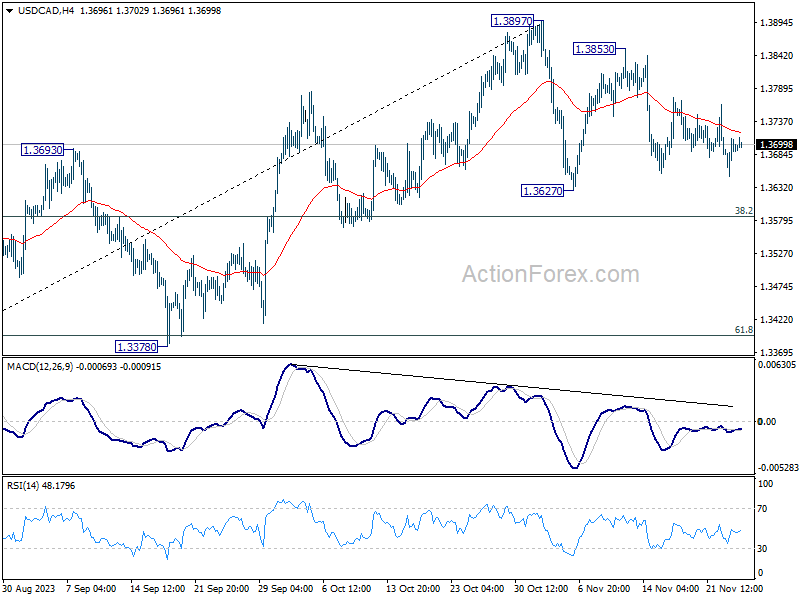
In the bigger picture, corrective pattern from 1.3976 (2022 high) should have completed with three waves down to 1.3091. Decisive break of 1.3976 high will confirm resumption of up trend from 1.2005 (2021 low). Next target is 61.8% projection of 1.2401 to 1.3976 from 1.3091 at 1.4064. This will remain the favored case as long as 1.3378 support holds.