

Sample Category Title
British Pound Hits 10-Week high as PMIs Accelerate
- UK PMIs accelerate
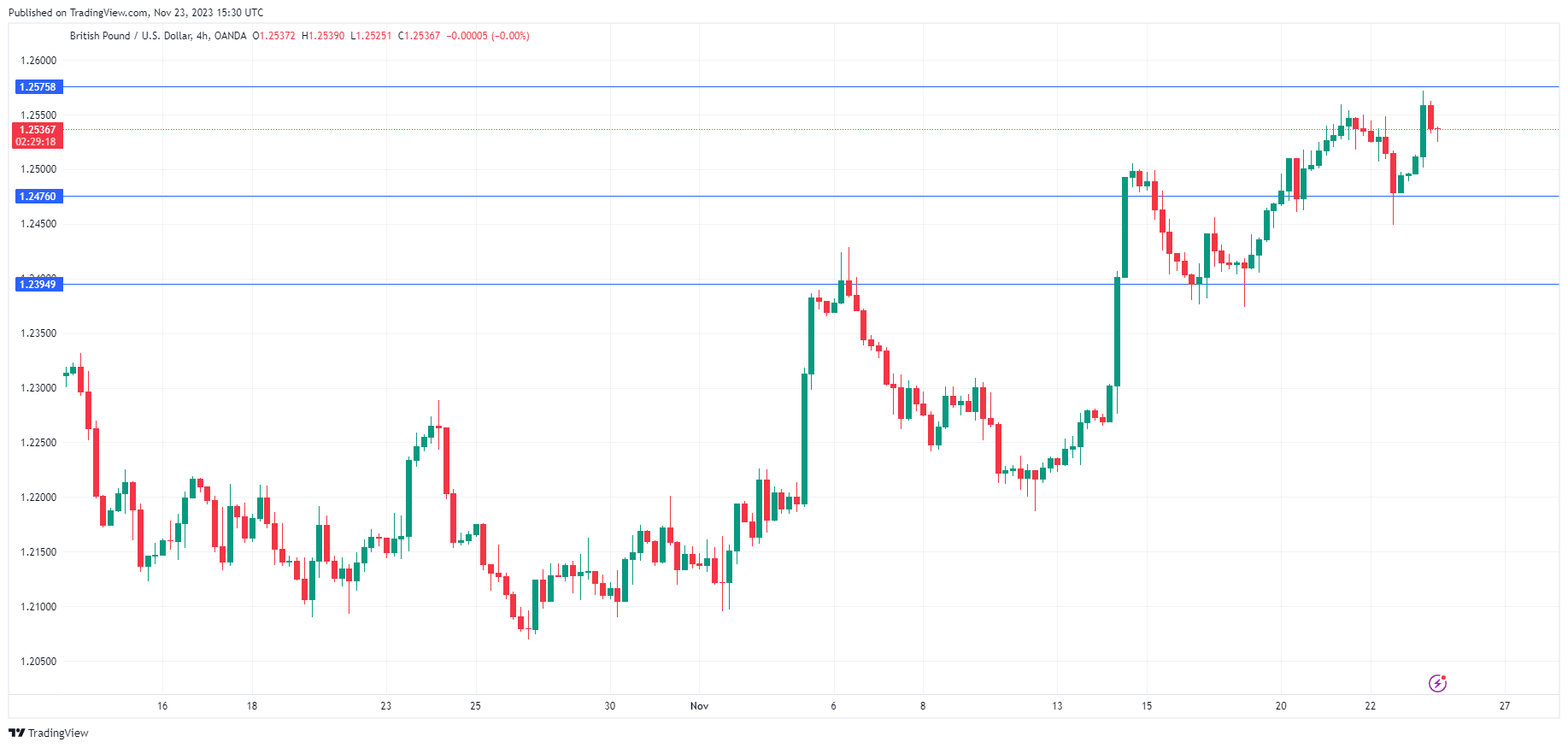
The British pound has gained ground on Thursday. In the North American session, GBP/USD is trading at 1.2536, up 0.34%. Earlier today, the pound touched a high of 1.2569, its highest level since September 6th.
UK PMIs improve
The UK released manufacturing and services PMIs earlier today, and both PMIs improved and beat expectations, which has given the British pound a boost.
The manufacturing PMI rose to 46.7 in November (Oct. 44.8), above the market consensus of 45. The services PMI improved to 50.5 (Oct. 49.5), beating the market consensus of 49.5. Manufacturing continues to decline, but the silver lining was that this release was the slowest decline in five months. Still, employment levels and new orders continue to fall, a result of weak demand. The services PMI managed to push into growth territory, but barely. The 50 line separates contraction from expansion.
The weak PMIs are further evidence of a weak UK economy, which has cooled down due to the Bank of England’s aggressive tightening. That has pushed inflation lower, although the current clip of 4.6% remains more than double the 2% target.
The markets are hopeful of rate cuts next year, even though BoE Governor Andrew Bailey continues to insist the BoE has no plans to trim rates. With inflation still high and the battle far from won, Bailey would risk losing credibility if he were to hint at rate cuts and then have to raise rates if inflation unexpectedly climbed higher.
US markets are closed for Thanksgiving, but the markets will be keeping a close eye on US manufacturing and services PMIs, which will be released on Friday. Both PMIs are expected around the 50.0 line, which separates contraction from expansion. If the reports are weaker than expected, we could see the US dollar slip, as expectations will likely rise regarding rate cuts next year.
GBP/USD Technical
- GBP/USD put pressure on resistance at 1.2575 earlier. Above, there is resistance at 1.2687
- 1.2476 and 1.2394 are the next support levels
ETHUSD Breaks Above Trendline But Fails to Rally
- ETHUSD conquers downward sloping trendline
- Meets strong resistance though at crucial technical level
- Momentum indicators warn for impending pullback
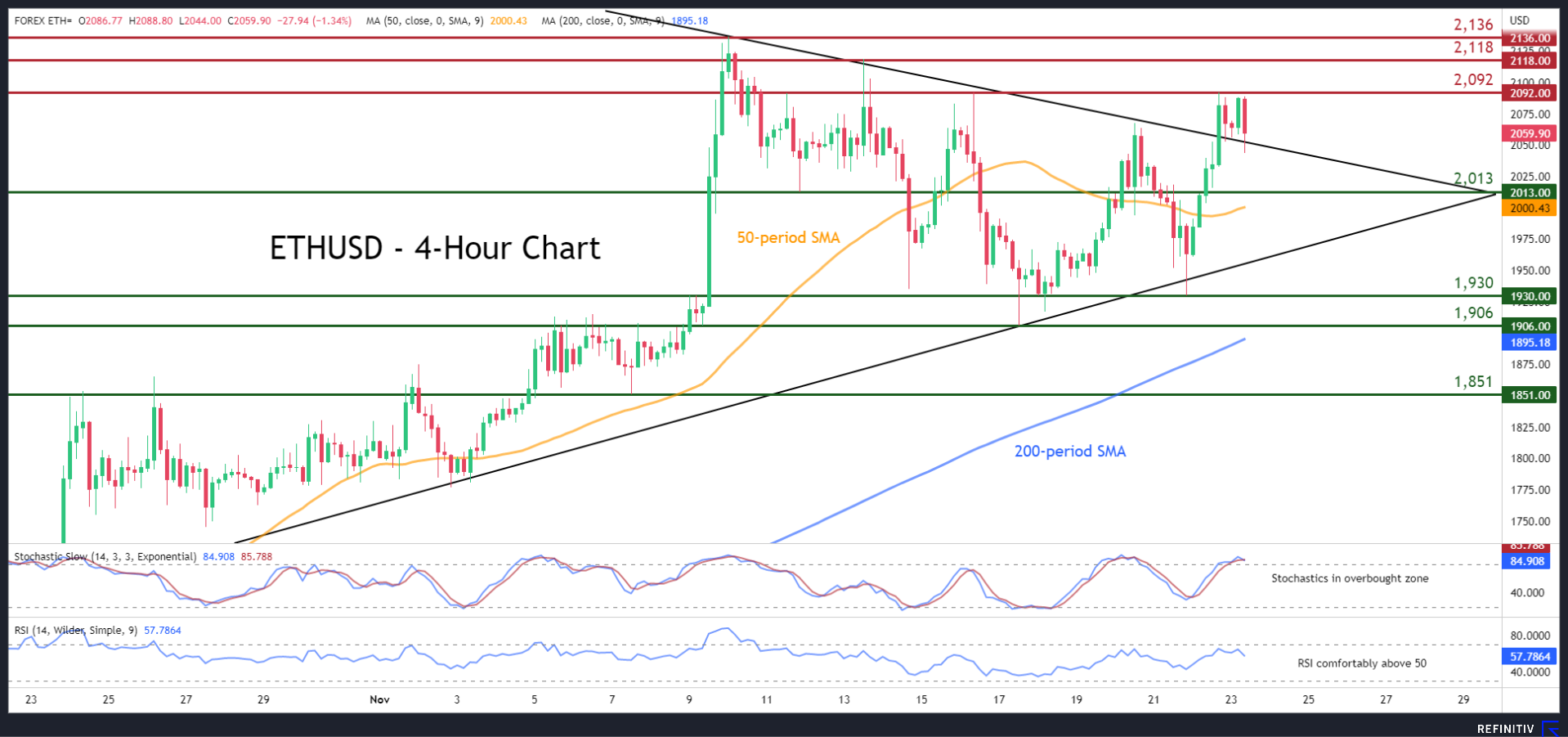
ETHUSD (Ethereum) had been forming a structure of lower highs in the four-hour chart since its peak at 2,136 on November 10. However, yesterday, the price managed to violate the descending trendline that connects its recent highs, but the bulls seem unable to reclaim the strong resistance of 2,092 for now.
As both the stochastic oscillator and the RSI show signs of waning positive momentum, the price could reverse back towards the 2,013 handle. Breaking below that zone, Ethereum could test 1,930 ahead of the 1,906 support level registered on November 17. Further declines might then cease at the 1,851 barrier.
On the flipside, if buying pressures intensify, the recent resistance of 2,092 could prove to be the first barricade for the price to overcome. A break above that region may trigger an advance towards 2,118. Piercing through the latter, the price could revisit its November peak of 2,136.
In brief, ETHUSD spiked aggressively above its descending trendline, but the move was not enough to spark a rally to the upside. Hence, the repeated failure to claim the 2,092 mark could potentially lead to a significant retreat.
NZD/USD Rises Ahead of Retail Sales
- New Zealand retail sales expected to decline by 0.8%
- US markets closed for Thanksgiving
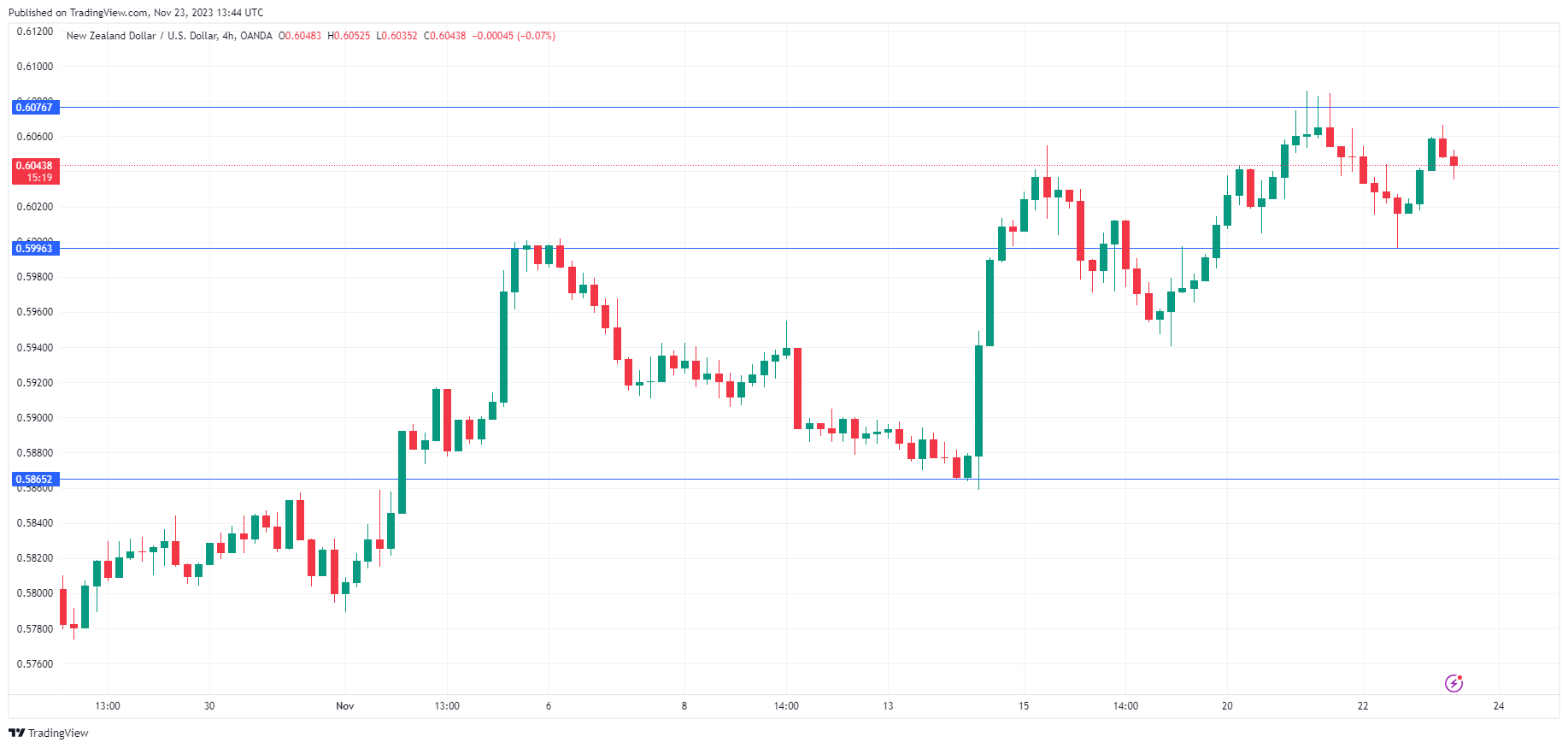
The New Zealand dollar is in positive territory on Thursday. Early in the North American session, NZD/USD is trading at 0.6042, up 0.34%.
Will New Zealand retail sales continue declining?
Retail sales are a key gauge of consumer spending and the New Zealand consumer has been holding tightly to the purse strings. In the second quarter, retail sales fell 1% q/q, with most retail industries showing lower sales volumes. This marked a third consecutive losing quarter. The markets are bracing for another decline for Q3, with a consensus estimate of -0.8%.
The soft retail sales data isn’t really surprising as consumers are being squeezed by high inflation and elevated borrowing costs. The decrease in household purchasing power has meant a decline in spending. High interest rates are still filtering through the economy, which could further dampen consumer spending in the fourth quarter.
The Reserve Bank of New Zealand has put a pause on rates for three straight times, which has naturally raised speculation that the central bank has completed its tightening cycle, which has brought the cash rate to 5.5%. Inflation in the third quarter eased from 6.0% to 5.6% y/y in the third quarter and this decline means that there is a strong likelihood that the RBNZ will hold rates at the November 27th meeting.
US markets are closed for the Thanksgiving holiday, which means we’re unlikely to see much movement today with the US dollar. That could change on Friday, with the release of US manufacturing and services PMIs. The consensus estimates for November stand at 49.8 for manufacturing (Oct: 50.0) and 50.4 for services (Oct. 49.8). If either of the PMIs miss expectations, that could translate into volatility from the US dollar.
NZD/USD Technical
- NZD/USD is putting pressure on resistance at 0.6076. The resistance line 0.6161
- There is support at 0.5996 and 0.5885
USD/JPY Mid-Day Outlook
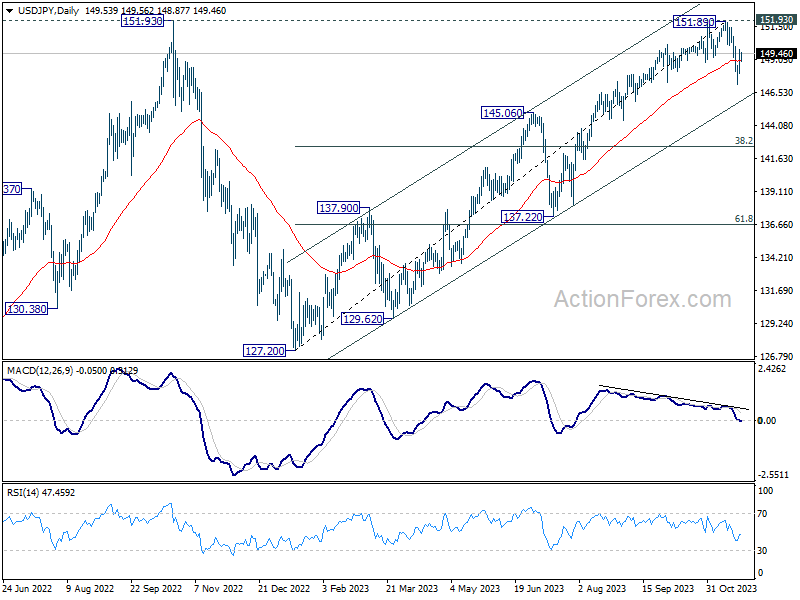
Daily Pivots: (S1) 148.46; (P) 149.10; (R1) 150.19; More...
Intraday bias in USD/JPY stays neutral first. On the downside, break of 148.57 minor support will indicate rejection by 55 4H EMA, and turn bias back to the downside for 147.14 and below, to resume the fall from 151.89. However, sustained break of 55 4H EMA (now at 149.62) will revive near term bullishness, and target a retest on 151.89/93 resistance zone.
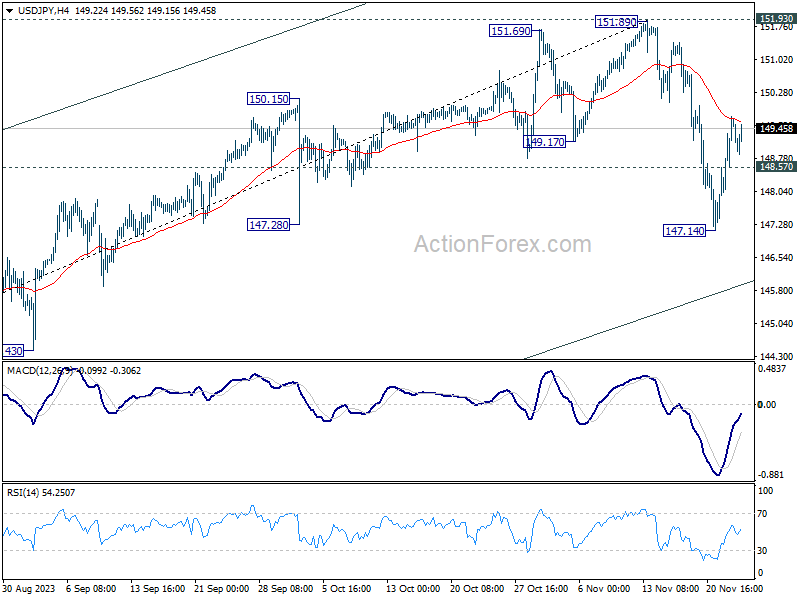
In the bigger picture, rise from 127.20 (2023 low) is seen as the second leg of the pattern from 151.93 resistance (2022 high). Decisive break of 145.06 resistance turned support will confirm that this second leg has completed, after rejection by 151.93. Deeper fall would be seen through 38.2% retracement of 127.20 to 151.89 at 142.45 to 61.8% retracement at 136.63. Nevertheless strong bounce from 145.06 will retain medium term bullishness for another test on 151.93 at a later stage.
USD/CHF Mid-Day Outlook
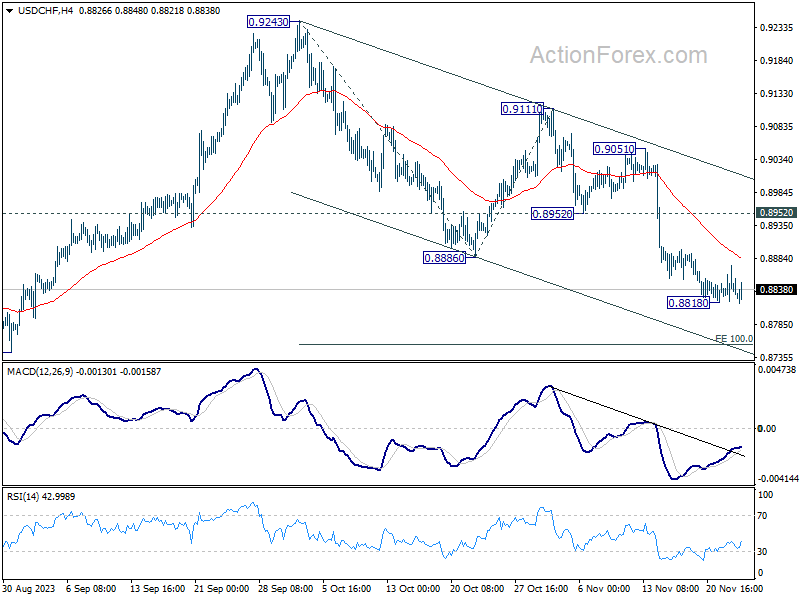
Daily Pivots: (S1) 0.8814; (P) 0.8845; (R1) 0.8869; More....
Intraday bias in USD/CHF stays neutral for the moment. Consolidation form 0.8818 could extend further and stronger recovery cannot be ruled out. But near term outlook will stay bearish as long as 0.8952 support turned resistance holds. On the downside, below 0.8818 will resume whole decline from 0.9243 to 100% projection of 0.9243 to 0.8886 from 0.9111 at 0.8754 next.
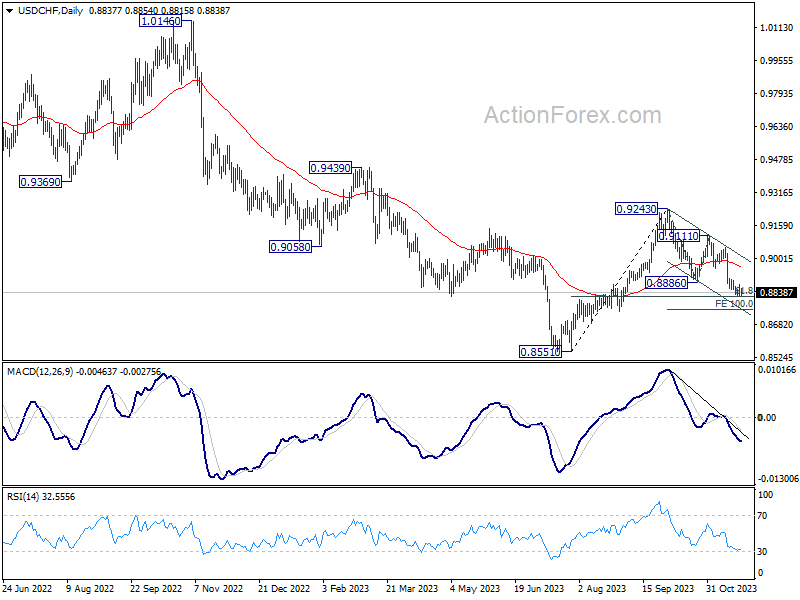
In the bigger picture, price actions from 0.8551 are currently seen as part of a corrective pattern to the decline from 1.0146 (2022 high). Fall from 0.9243 is seen as the second leg for now. Deeper fall would be seen to 61.8% retracement of 0.8551 to 0.9243 at 0.8815. Sustained break there will bring retest of 0.8551 low. For now, this will remain the favored case as long as 0.9111 resistance holds.
EUR/USD Mid-Day Outlook
Daily Pivots: (S1) 1.0854; (P) 1.0888; (R1) 1.0924; More...
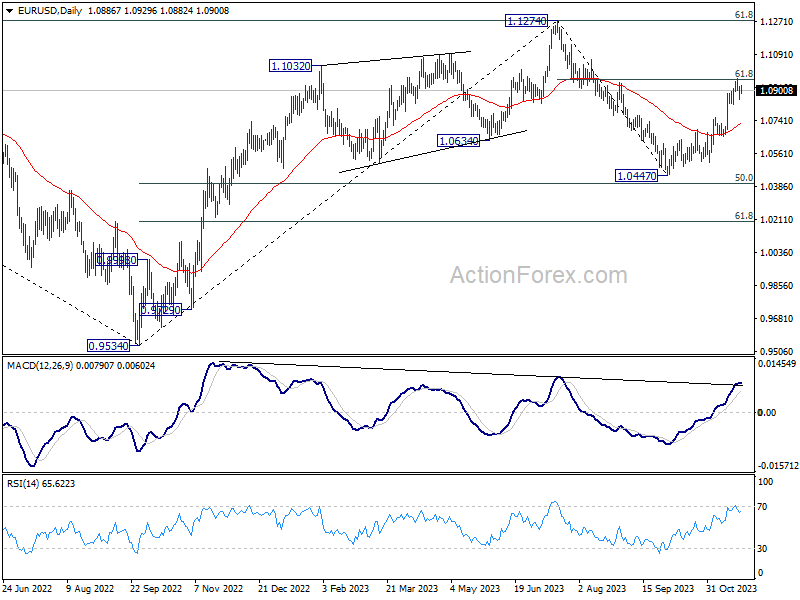
Intraday bias in EUR/USD remains neutral at this point, as consolidation from 1.0964 is extending. Further rally is in favor as long as 1.0823 support holds. Sustained break of 61.8% retracement of 1.1274 to 1.0447 at 1.0958 will resume the rise from 1.0447 to retest 1.1274 high. However, firm break of 1.0823 will indicate short term topping, and turn bias back to the downside for deeper decline.
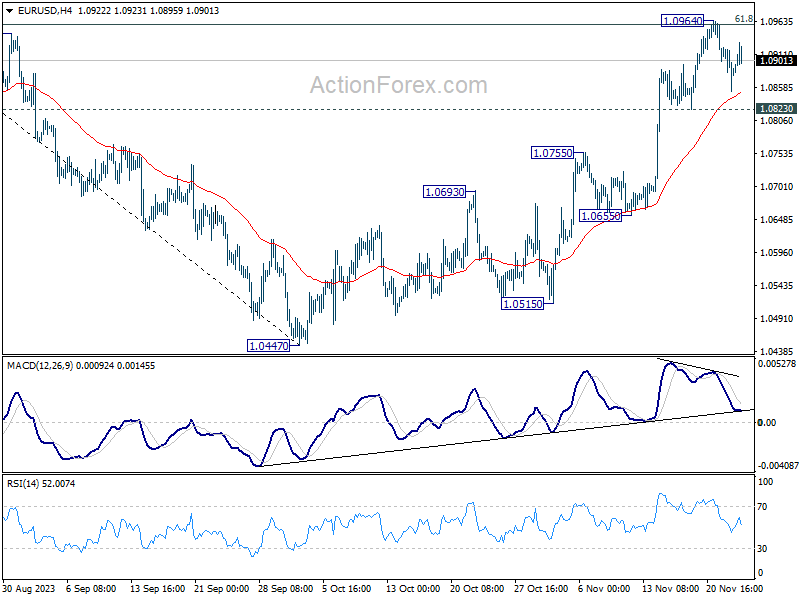
In the bigger picture, price actions from 1.1274 are viewed as a corrective pattern to rise from 0.9534 (2022 low). Rise from 1.0447 is tentatively seen as the second leg. Hence while further rally could be seen, upside should be limited by 1.1274 to bring the third leg of the pattern.
GBP/USD Mid-Day Outlook
Daily Pivots: (S1) 1.2445; (P) 1.2498; (R1) 1.2546; More...
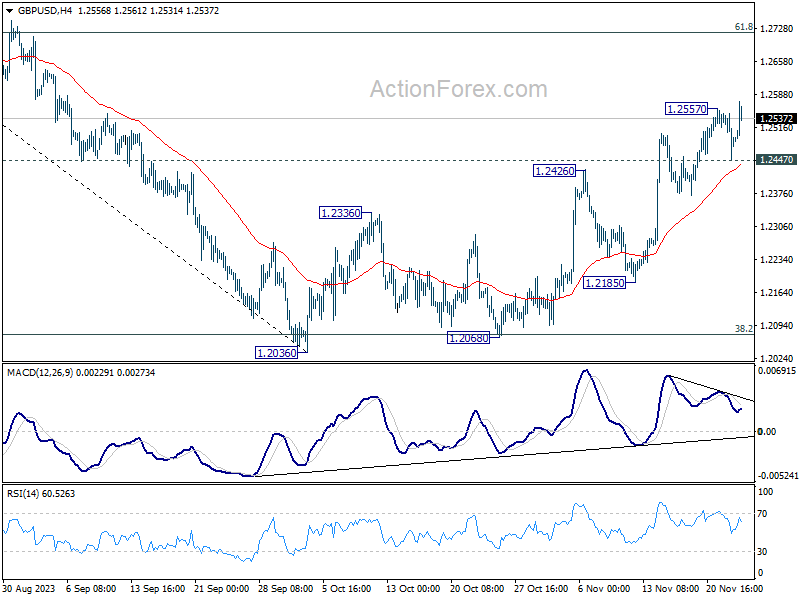
Intraday bias in GBP/USD is back on the upside with break of 1.2557 temporary top. Rise from 1.2036 is resuming for 61.8% retracement of 1.3141 to 1.2036 at 1.2716 next. On the downside, though, below 1.2447 minor support will turn intraday bias again first, and probably bring lengthier consolidations.
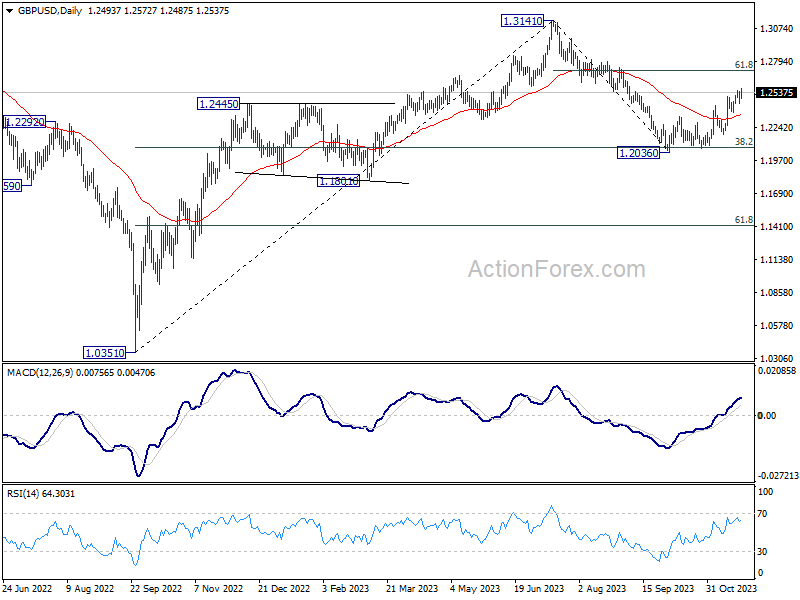
In the bigger picture, price actions from 1.3141 are seen as a corrective pattern to rise from 1.0351 (2022 low). Strong rebound from 38.2% retracement of 1.0351 (2022 low) to 1.3141 at 1.2075 argues that current rise from 1.2036 is the second leg. However, while further rally could be seen, upside should be limited by 1.3141 to bring the third leg of the pattern.
Sterling and Euro Rise on PMI Data in Consolidating Markets
PMI data are the main drivers in the forex markets today, particularly lifting Sterling and, to some degree, Euro to higher positions. The bounce in Sterling is chiefly attributed to UK services sector bouncing back into expansion territory, a sign of economic resilience. Additionally, the severity of manufacturing recession in UK seems to be diminishing, offering further support to the currency.
Eurozone has also witnessed a slight improvement in its PMI data, with Germany showing relatively more substantial progress. Despite these positive developments, both UK and Eurozone continue to grapple with the looming risks of recession and noticeable increase in inflation pressures.
In other market areas, there is a prevailing sense of consolidation. Canadian Dollar, despite being the weakest performer of the day, is showing resilience by staying above the previous day's low against major currencies. Swiss Franc, ranking as the second weakest, appears to be impacted by the relative strength of Euro and Sterling. Dollar, ranking as the third weakest for the day, exhibits vulnerability to further declines.
On the stronger side of the market, Australian and New Zealand Dollars are performing well, following closely behind Sterling as the second and third strongest currencies. Euro, while experiencing gains, is not leading the pack.
Technically, GBP/USD is taking the lead by breaching 1.2557 temporary top to resume its near term rally. Focuses are now on 1.0964 resistance in EUR/USD, 0.6588 resistance in AUD/USD, and 0.8818 support in USD/CHF. Simultaneous break of these levels should confirm that Dollar selling is back. a
In Europe, at the time of writing, FTSE is down -0.05%. DAX is up 0.19%. CAC is up 0.23%. Germany 10-year yield is up 0.035 at 2.602. Earlier in Asia, Japan was on holiday. Hong Kong HSI rose 0.99%. China Shanghai SSE rose 0.60%. Singapore Strait Times dropped -0.10%.
UK PMI composite rose to 50.1, but recession risks and inflation concerns linger
UK PMI data for November reflects a significant improvement in economic activity. Manufacturing PMI rose from 44.8 to a six-month high of 46.7, exceeding the anticipated 45.0. Services PMI increased from 49.5 to a four-month high of 50.5, signaling a return to expansion and surpassing expectations of 49.5. Composite PMI, which amalgamates both sectors, also achieved a four-month high at 50.1, up from 48.7.
Tim Moore, Economics Director at S&P Global Market Intelligence, observed that the UK economy showed signs of stabilization. He noted, "The service sector arrested a three-month sequence of decline and manufacturers began to report less severe cutbacks to production schedules." Moore attributed this recovery in part to a halt in interest rate hikes and a decrease in headline inflation rates. However, he cautioned that the data indicates a likely flat trend for GDP in Q4 2023.
Despite the uptick in PMI figures, Moore highlighted continuing recession risks. He pointed out that new order volumes decreased for the fifth consecutive month, reflecting limited sales opportunities. Additionally, business activity expectations remained low, close to October's recent nadir, and significantly weaker compared to earlier in the year.
Inflation concerns are also evident, especially in the service sector. Moore mentioned that input cost pressures have risen for the first time in four months, with service providers particularly impacted by the need to pass increased staff costs onto customers.
ECB accounts: All agree to hold, yet open to further hike
ECB's October meeting accounts reveal a consensus among "all members" to maintain the three key ECB interest rates unchanged. This decision reflects a shared confidence that current monetary stance was "sufficiently restrictive" for allowing the governing council to assess the "inflation outlook", "dynamics of underlying inflation", and "strength of monetary policy transmission".
The minutes also noted a shift in market expectations, indicating that policy rates are anticipated to remain high for a longer period than previously predicted. Market expectations are transitioning from a "hump-shaped" interest rate path, typically recommended by macroeconomic models, to a "flatter" profile with a delayed first cut in the deposit facility rate.
A key point of discussion was the importance of avoiding an unwarranted loosening of financial conditions. In line with this, some members argued for "keeping the door open for a possible further rate hike", emphasizing the commitment to data-dependence in its decision-making process.
In conclusion, ECB emphasized the need to remain "both persistent and vigilant."
Eurozone PMI composite rose to 47.1, technical recession ongoing
Eurozone's PMI data for November shows marginal improvement but continues to indicate broader recessionary trends. Manufacturing PMI increased slightly from 43.1 to a six-month high of 43.8, exceeding expectations of 43.4. Similarly, Services PMI rose from 47.8 to 48.2, marginally above the predicted 48.0. Consequently, Composite PMI, which combines both sectors, climbed from 46.5 to 47.1.
Cyrus de la Rubia, Chief Economist at Hamburg Commercial Bank, summarized the situation as, "The Eurozone economy is stuck in the mud." Their nowcast model suggests the likelihood of a second consecutive quarter of GDP contraction, meeting the technical criteria for a recession.
Inflation remains a significant issue, particularly in the services sector, where price increases have accelerated due to "astonishingly rapid and even accelerating" rising input costs. De la Rubia attributes these cost increases primarily to higher wages.
The employment situation is also expected to worsen. Initially impacting industrial sector jobs, the economic downturn is poised to affect employment in services sector as well. This could lead to an uptick in Eurozone's unemployment rate, which has so far been relatively stable.
Region-specific dynamics show contrasting trends within Eurozone. Germany's composite index has improved, signaling some positive movement, whereas France continues to show a weakening trend. De la Rubia also points out the challenges faced by Germany, particularly in public investments due to restrictions imposed by the constitutional court's debt brake, which relegate Germany's economy "to the back seat in 2024".
Germany PMI Manufacturing rose from 40.8 to 42.3 in November, a 6-month high. PMI Services rose from 48.2 to 48.7. PMI COmposite rose from 45.9 to 47.1, a 4-month high.
France PMI Manufacturing fell from 42.8 to 42.6 in November, a 42-month low. PMI Services ticked up from 45.2 to 45.3. PMI Composite ticked down from 44.6 to 44.5.
Australia PMI composite fell to 27-mth low at 46.4, but no real signs of hard landing
Australia's manufacturing and services sectors showed continued contraction in November, reaching multi-month lows. PMI Manufacturing index fell from 48.2 to a 42-month low of 47.7, while PMI Services index dropped from 47.9 to a 26-month low of 46.3. PMI Composite also decreased from 47.6 to a 27-month low of 46.4.
Warren Hogan, Chief Economic Advisor at Judo Bank, interpreted these figures as evidence of a further slowdown in Australian economic activity. He commented that the data "all but confirms that the economy is experiencing a soft landing," aligning with RBA's expectations. However, Hogan also noted that there are "no real signs of a hard landing" in the survey, indicating a more controlled economic deceleration.
Despite the overall softness in manufacturing, Hogan observed that the sector "does not appear to be slipping into recession" at this stage. Additionally, an improvement in the employment index in the services sector was seen as indicative of "continued strong demand for labour." This sustained high demand for labour, despite lower activity indexes, points to a persistent imbalance between labour demand and supply.
For RBA, the slowdown in business activity is a welcome development. Still, the strong employment index and an increase in price indexes signal ongoing inflation risks into 2024.
Hogan cautions that it is "still too early to think about rate cuts" in Australia.
GBP/USD Mid-Day Outlook
Daily Pivots: (S1) 1.2445; (P) 1.2498; (R1) 1.2546; More...
Intraday bias in GBP/USD is back on the upside with break of 1.2557 temporary top. Rise from 1.2036 is resuming for 61.8% retracement of 1.3141 to 1.2036 at 1.2716 next. On the downside, though, below 1.2447 minor support will turn intraday bias again first, and probably bring lengthier consolidations.
In the bigger picture, price actions from 1.3141 are seen as a corrective pattern to rise from 1.0351 (2022 low). Strong rebound from 38.2% retracement of 1.0351 (2022 low) to 1.3141 at 1.2075 argues that current rise from 1.2036 is the second leg. However, while further rally could be seen, upside should be limited by 1.3141 to bring the third leg of the pattern.
Economic Indicators Update
| GMT | Ccy | Events | Actual | Forecast | Previous | Revised |
|---|---|---|---|---|---|---|
| 22:00 | AUD | Manufacturing PMI Nov P | 47.7 | 48.2 | ||
| 22:00 | AUD | Services PMI Nov P | 46.3 | 47.9 | ||
| 08:15 | EUR | France Manufacturing PMI Nov P | 42.6 | 43.2 | 42.8 | |
| 08:15 | EUR | France Services PMI Nov P | 45.3 | 45.7 | 45.2 | |
| 08:30 | EUR | Germany Manufacturing PMI Nov P | 42.3 | 41.3 | 40.8 | |
| 08:30 | EUR | Germany Services PMI Nov P | 48.7 | 48.5 | 48.2 | |
| 09:00 | EUR | Eurozone Manufacturing PMI Nov P | 43.8 | 43.4 | 43.1 | |
| 09:00 | EUR | Eurozone Services PMI Nov P | 48.2 | 48 | 47.8 | |
| 09:30 | GBP | Manufacturing PMI Nov P | 46.7 | 45 | 44.8 | |
| 09:30 | GBP | Services PMI Nov P | 50.5 | 49.5 | 49.5 | |
| 12:30 | EUR | ECB Meeting Accounts |
ECB accounts: All agree to hold, yet open to further hike
ECB's October meeting accounts reveal a consensus among "all members" to maintain the three key ECB interest rates unchanged. This decision reflects a shared confidence that current monetary stance was "sufficiently restrictive" for allowing the governing council to assess the "inflation outlook", "dynamics of underlying inflation", and "strength of monetary policy transmission".
The minutes also noted a shift in market expectations, indicating that policy rates are anticipated to remain high for a longer period than previously predicted. Market expectations are transitioning from a "hump-shaped" interest rate path, typically recommended by macroeconomic models, to a "flatter" profile with a delayed first cut in the deposit facility rate.
A key point of discussion was the importance of avoiding an unwarranted loosening of financial conditions. In line with this, some members argued for "keeping the door open for a possible further rate hike", emphasizing the commitment to data-dependence in its decision-making process.
In conclusion, ECB emphasized the need to remain "both persistent and vigilant."