

Sample Category Title
EUR/USD: Bulls Pausing for Consolidation
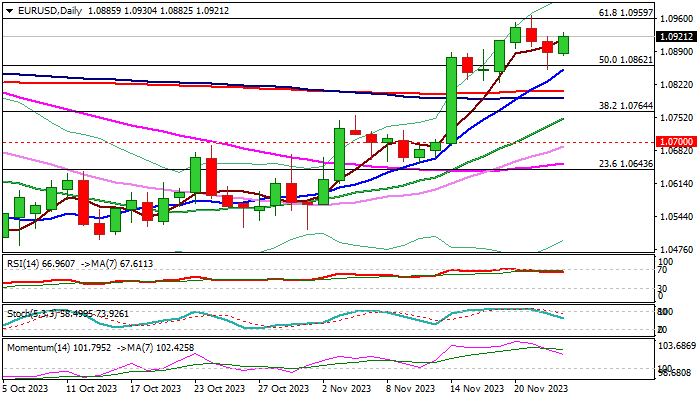
EURUSD regained traction early Thursday and reduced downside risk, as two-day pullback was strongly rejected on Wednesday.
Technical studies are mixed on daily chart as bullish momentum is fading while moving averages remain in bullish configuration, lacking clearer direction signal, although overall picture is bullish.
German Nov PMI’s came above forecasts and lifted the single currency further, offsetting weaker than expected French PMI figures.
Markets await release of EU PMI, which could provide further boost if in line with or above consensus.
Near-term action is held within two Fibo levels, 1.0862 (broken 50% of 1.1275/1.0448, reinforced by rising 10DMA) and 1.0959 (cracked 61.8%) with firm break on either side to generate fresh direction signal.
Loss of 1.0862 pivot to signal deeper correction and expose targets at 1.0808 (200DMA) and 1.0795 (weekly cloud base).
Conversely, bulls may accelerate beyond psychological 1.10 level on sustained break above 1.0959 Fibo barrier.
Caution on expected lower volumes due to US Thanksgiving Day holiday.
Res: 1.0959; 1.1000; 1.1065; 1.1080.
Sup: 1.0882; 1.0862; 1.0808; 1.0813.
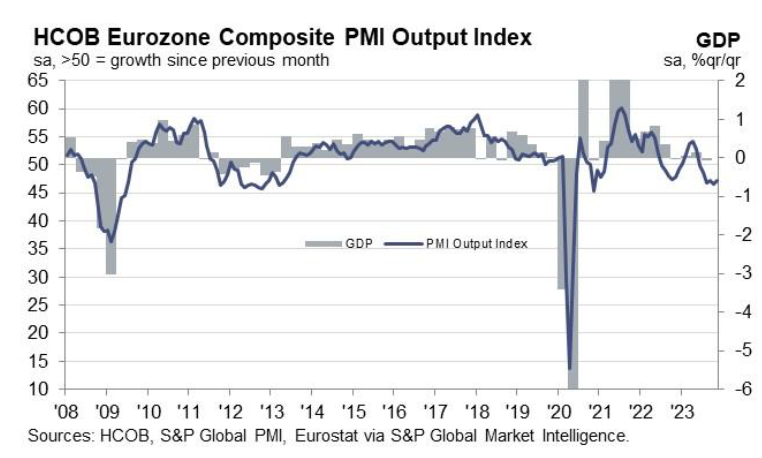
Eurozone PMI composite rose to 47.1, technical recession ongoing
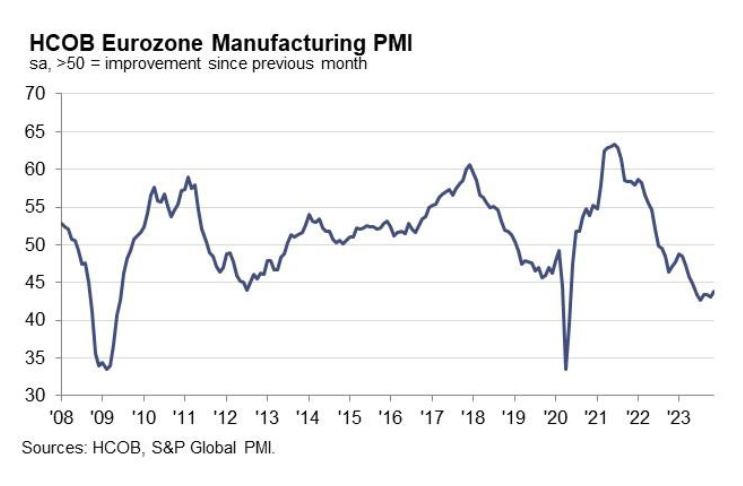
Eurozone's PMI data for November shows marginal improvement but continues to indicate broader recessionary trends. Manufacturing PMI increased slightly from 43.1 to a six-month high of 43.8, exceeding expectations of 43.4. Similarly, Services PMI rose from 47.8 to 48.2, marginally above the predicted 48.0. Consequently, Composite PMI, which combines both sectors, climbed from 46.5 to 47.1.
Cyrus de la Rubia, Chief Economist at Hamburg Commercial Bank, summarized the situation as, "The Eurozone economy is stuck in the mud." Their nowcast model suggests the likelihood of a second consecutive quarter of GDP contraction, meeting the technical criteria for a recession.
Inflation remains a significant issue, particularly in the services sector, where price increases have accelerated due to "astonishingly rapid and even accelerating" rising input costs. De la Rubia attributes these cost increases primarily to higher wages.
The employment situation is also expected to worsen. Initially impacting industrial sector jobs, the economic downturn is poised to affect employment in services sector as well. This could lead to an uptick in Eurozone's unemployment rate, which has so far been relatively stable.
Region-specific dynamics show contrasting trends within Eurozone. Germany's composite index has improved, signaling some positive movement, whereas France continues to show a weakening trend. De la Rubia also points out the challenges faced by Germany, particularly in public investments due to restrictions imposed by the constitutional court's debt brake, which relegate Germany's economy "to the back seat in 2024".
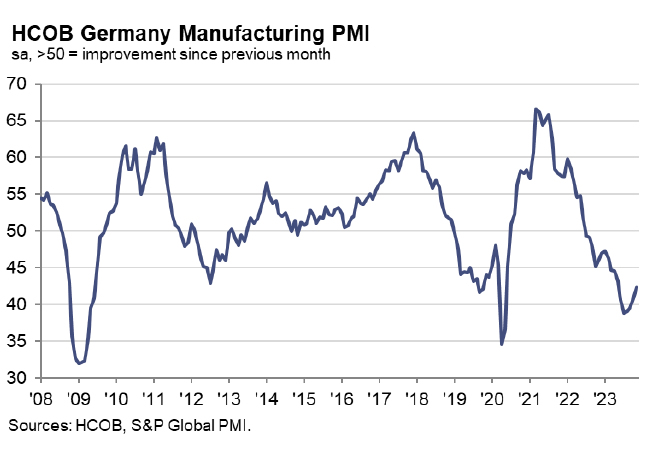
Germany PMI composite rose to 47.1, milder recession but inflation remains high
Germany's November PMI data indicates a modest improvement in its economic situation, albeit still within recessionary bounds. Manufacturing PMI rose from 40.8 to 42.3, marking a six-month high, and Services PMI increased from 48.2 to 48.7. Composite PMI, climbed from 45.9 to a four-month high of 47.1.
Cyrus de la Rubia, Chief Economist at Hamburg Commercial Bank, noted a cautious optimism about the German economy. He observed, "Despite remaining in recession territory, the rate of slowdown has eased noticeably."
While, the PMI data aligns with the perspective that Germany entered a recession in the third quarter of this year, the recession's depth might be less severe than initially anticipated. According to de la Rubia's nowcasting model, GDP is expected to see -0.7% decline in Q4, an improvement from previous forecasts of -0.9% decline.
Despite these signs of economic easing, inflation remains a significant challenge. De la Rubia pointed out the persistence of inflation, especially in the service sector where input prices surged in November, largely due to increasing wages.
This inflationary pressure is partly transferred to consumers as service sector output prices continue to rise at high rates. The likelihood of sustained inflation is further supported by recent labor market trends, including increased strike activities and significant wage agreements.
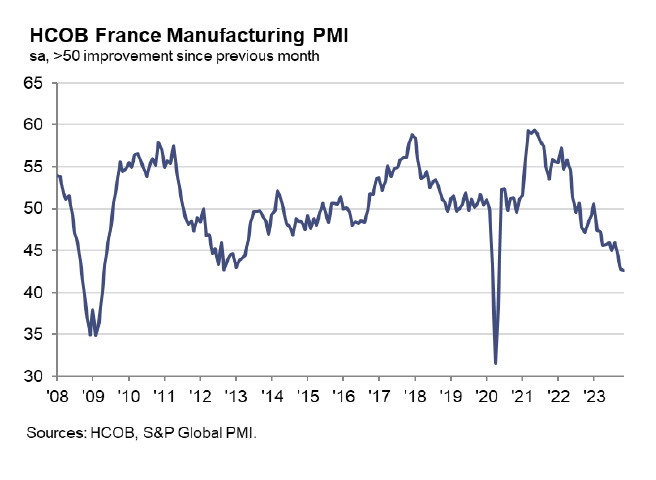
France PMI composite falls to 44.5, continued contraction in a dead-end
Recent PMI data for France underscores a deepening economic downturn. Manufacturing PMI dropped to a 42-month low, down from 42.8 to 42.6 in November, while Services PMI exhibited a negligible rise from 45.2 to 45.3. Composite PMI edged down from 44.6 to 44.5, signaling sustained contraction in the economy.
Norman Liebke, Economist at Hamburg Commercial Bank, provided a stark analysis of the situation: "The French economy is kind of in a dead-end." He observed that for six months straight, output has consistently declined, heavily influenced by reduced demand from both domestic and international markets. Liebke attributed these declines to prevailing geopolitical and economic uncertainties. The economist's nowcasting indicates a slight contraction in France's GDP
Furthermore, Liebke forecasts an increase in unemployment in the forthcoming months, marking the first significant employment drop since late 2020. This trend aligns the recent months' downward trend in employment numbers. Prices continue to rise sharply, as Liebke points out, suggesting that official inflation rates might stay elevated for longer than initially expected.
Gold Corrects Slightly But Remains in Uptrend
The gold (XAU) price dropped by 0.43% on Wednesday after higher-than-expected Michigan Consumer Sentiment Index figures.
Possible effects for traders
A technical rise of the U.S. Dollar Index (DXY) and the proximity of a 2,000 resistance level prompted some traders to close their long positions in XAUUSD. However, expectations that the U.S. Federal Reserve (Fed) won't be raising interest rates soon limited XAUUSD drop. Moreover, the market is currently pricing in a 57% chance of a rate cut in May 2024. 'The increase in the market expectations for the Fed cutting cycle to commence earlier in 2024 has been the prime force driving gold prices higher over the last week,' said Daniel Ghali, a commodity strategist at TD Securities.
XAUUSD was rising during the Asian and early European trading sessions. The U.S. market will be closed today and early on Friday due to Thanksgiving. Thus, volatility will be subsided, but the lack of liquidity may result in sharp moves of the instruments in case of unexpected events or data. 'Spot gold may revisit its 21 November high of $2,007.29 per ounce, as it may have completed a correction from this level,' said Reuters analyst Wang Tao.
USDJPY Stabilizes Near 149.00 ahead of Japanese CPI Report
The Japanese yen (JPY) lost 0.76% on Wednesday as the U.S. Dollar Index (DXY) corrected upwards following a better-than-expected Consumer Sentiment report and a smaller-than-expected increase in Jobless Claims numbers.
Possible effects for traders
USDJPY has been rising since 21 November after the FOMC minutes revealed the Federal Reserve (Fed) monetary policy would remain 'cautiously restrictive.' Conversely, the Bank of Japan's (BOJ) monetary policy is extremely loose, which is the main reason USDJPY has been in a major uptrend for the past three years. Still, the market speculates that BOJ may be preparing for a tightening campaign. 'If next year's annual wage negotiations heighten prospects of inflation sustainably hitting its 2% target, the bank may end its negative interest rate policy in April,' the central bank's former Executive Director Kazuo Momma said. Increasing interest rate expectations will support the Japanese yen, which has been under pressure lately after a truce between Israel and Hamas capped gains potential due to USDJPY's status as a safe-haven asset.
USDJPY fell during the early European trading session. Trading activity will be minimal today across foreign exchange markets due to the Thanksgiving holiday. However, the Japanese inflation data release today at 11:30 p.m. UTC will be vital for short-term directional guidance for currency pairs. The data could also influence current projections for rate hikes, which are anticipated to begin in late 2024. If the inflation data comes out stronger than expected, USDJPY may drop below 147.00. However, lower-than-expected figures may push the pair towards 150.00 again.
AUDUSD Challenges Recent 3-Month Peak
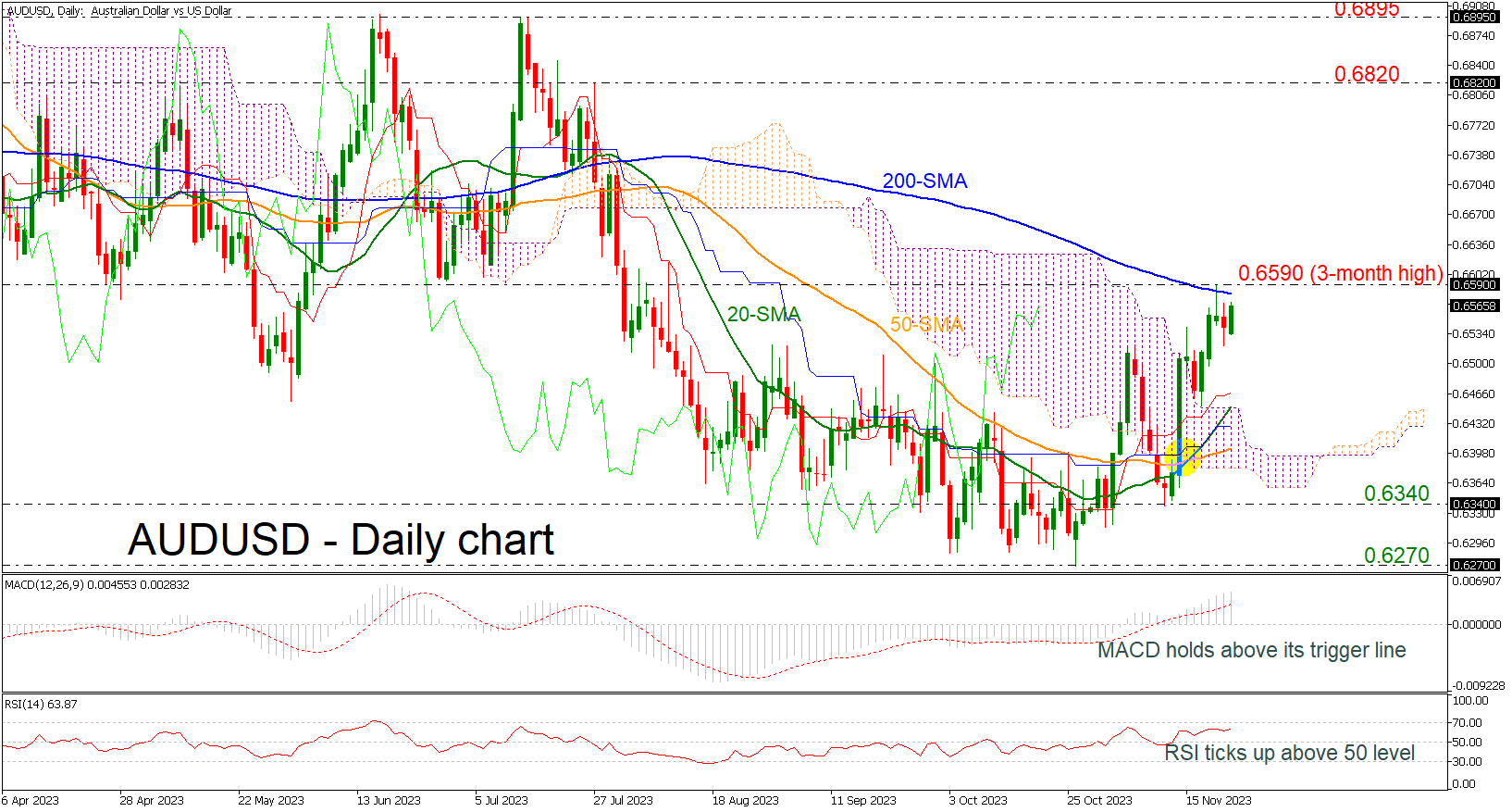
- AUDUSD faces strong battle near 200-day SMA
- MACD and RSI suggest bullish bias
AUDUSD could not find enough buyers to expand Tuesday’s bull run above the three-month high of 0.6590, closing with some losses on Wednesday.
Technically, the short-term risk is leaning to the upside. The price is developing well above the Ichimoku cloud, while the MACD oscillator is strengthening its positive momentum above its trigger and zero lines. Also, the RSI is pointing north and is moving towards the 70 level.
Given the current positive momentum, the question now is whether the pair will move above the 200-day simple moving average (SMA). A clear step above it and beyond the three-month high of 0.6590 would drive the market towards the next psychological marks, such as 0.6600, 0.6700 and 0.6800 before challenging the 0.6820 resistance level, registered on July 27.
However, if the market fails to climb above the recent peak, traders will turn to the downside again meeting the Ichimoku cloud and the 20- and the 50-day SMAs at 0.6450 and 0.6400 respectively. More losses would put the bearish outlook back into play, resting near 0.6340 and 0.6270.
To sum up, the latest spike in AUDUSD has not excited traders yet. An extension above the 200-day SMA and the 0.6590 barricade is still required to make the upturn look more credible. Note that the bullish cross between the 20- and 50-day SMAs is still intact.
US Stock Markets Extended Their Path Towards 2023 Tops
Markets
The US 2-yr yield tested the post-CPI high (4.94%) yesterday following the release of first weekly jobless claims (209k from 233k vs 227k expected) and next an upward revision to short term (1yr: 4.5% from 4.4%) inflation expectations in University of Michigan’s November consumer survey. Long term inflation expectations (5-10yr) were unchanged at 3.2% while markets expected a downward revision to 3.1%. The former is the highest level since April; the latter the highest in over a decade. These consumer expectations contrast with markets preparing premature central bank rate cuts in Q2 of next year. From a market momentum point of view, it’s nevertheless telling that yesterday’s (second-tier) releases managed to trigger a reaction. It strengthens our believe this month’s correction lower in bond yields most likely went far enough. Daily changes on the US yield curve eventually ranged between +3.1 bps (5-yr) and -1 bp (30-yr). The long end of the curve suffered from more intraday volatility via oil prices. They dropped as much as $3/b intraday (to $78.5/b) after OPEC+ delayed its planned ministerial meeting by a couple of days over diverging views on the level of production cuts. The drop lower in oil prices and (long term) bond yields didn’t last though. Technical elements played as well with 4.34% support in the US 10-yr yield (38% retracement on March-October rise) surviving ahead of the long US weekend (Thanksgiving & Black Friday). German yield changes varied between +3.9 bps (2-yr) and -3.2 bps (30-yr) yesterday. November EMU PMI surveys can today strengthen our scenario that the yield correction lower went far enough. Consensus expects marginal improvements from weak levels (43.5 from 43.1 for manufacturing and 48.1 from 47.8 for services) with likely downside risks. A failure for bonds to rally on such outcome would have a strong signaling function.
US stock markets extended their path towards 2023 tops with gains of 0.5% for major benchmarks. The (trade-weighted) dollar moved away from sell-off lows, but failed to completely hold on to momentum into the close. DXY closed at 103.92 from an open at 103.55, but drifts lower again this morning. EUR/USD closed at 1.0888 (vs intraday low of 1.0852) from 1.0911. EUR/GBP was uninspired by small pre-election tax cuts delivered in Chancellor Hunt’s Autumn statement. Today’s UK PMI’s and how they relate to EMU ones will be key for keeping EUR/GBP in the rising trend channel since September, which is our preferred scenario.
News headlines
Geert Wilders’ PVV is emerging victorious from yesterday’s Dutch (snap) parliamentary elections. With 98% of the votes counted, his far-right party is set to secure 37 seats, up 20 seats from the 2021 election. EU’s former climate chief Frans Timmermans lead a Green Left-Labour alliance and came in second with 25 seats (+8) while the liberal VVD was third with 24 seats (-10). The recently erected centre-right New Social Contract (NSC) party stormed in, gaining 20 seats. Forming a majority in the highly splintered (16 parties!), 150-seat lower house of parliament is expected to take months. While the leader of the biggest party usually becomes prime minister, it could turn out otherwise this time around as both PVV and NSC have already ruled out governing with the PVV. The Green Left-Labour alliance’s natural coalition ally, D66, is set to win only 10 sets (-14), making the formation of a left-wing government equally difficult. PM Rutte (VDD), who’s exiting Dutch politics, will stay in a caretaker capacity in the meantime.
Staying in the European lowland region, Belgian consumer confidence in November extended a gradual recovery that started this summer, the National Bank of Belgium said yesterday. The headline indicator rose from -5 to -4, the highest since the Russian invasion in March 2022. Consumers were more optimistic about the economic outlook and, to a lesser extent, the labour market. On a personal level, households slightly upgraded their expectations for their own financial situation. A downward revision in their saving intentions partially cancelled out the sharp increase recorded in October.
Delay is No Good Sign
OPEC decided to delay this weekend’s meeting to next week because talks between Saudi and African members apparently ran into trouble. Saudi likely sensed in this week’s poor price action - ‘buy the fact that Saudi will double its production cuts’ action - that 1mbpd extra cut wouldn’t send the oil prices higher, sustainably. Hence, Saudis need other member to put their hand in the mud, and seemingly the negotiations aren’t easy.
A bit of history
Saudi has a history of walking away from its role of ‘swing producer’ - a crucial role in balancing global oil markets by adjusting its production levels to stabilize prices. Back in the 1980s, Saudi Arabia has shifted its strategy and opted for a market share approach. Instead of cutting production to support oil prices, Saudi Arabia had decided to increase its output significantly, contributing to a glut in the global oil market.
Therefore, if Saudi doesn’t get the support that it needs from the other producer countries after all the unilateral efforts that they put in, they will naturally be tempted to abandon the idea of doubling its supply cut, and eventually reverse it. Such a decision would lead to a sharp decline in oil prices and have a significant impact on the economies of other oil-producing nations.
The barrel of American crude sank to $73.50pb before rebounding to the $76 this morning. Brent fell below $80pb before rebounding above this level. Both in Brent and crude, the 200-DMA remains a solid resistance, as the worries of global slowdown outweigh the worries of supply restrictions, even more so as Saudis start giving signs of stress regarding their solo role in cutting production.
Speaking of morose growth projections
Forecasts for German growth in 2024 have been significantly lowered following the recent budget chaos after the German Constitutional Court declared government’s spending plans unconstitutional. Germany – Europe’s growth engine – is now seen growing just 0.4% next year. The UK, on the other hand, cut its own growth forecast significantly in yesterday’s Autumn Statement. Jeremy Hunt said that the economy would grow only by around 0.7% - still better than Germany, but that projection is down from the 1.7% announced earlier. The good news for British people and businesses is that Hunt announced tax cuts for both individual and companies and lowered the national insurance payroll levy. The Brits will now make a permanent 100% - yes 100% tax relief – on companies’ capital spending. But don’t be fooled by these beautiful numbers. In reality, the British tax burden will still mount to 38% of its GDP by the end of this decade and will reach its highest since post-WW2 and that 100% tax relief – the so-called ‘full expensing’ - is good for businesses that invest in big machinery but in a service-focused economy like the UK’s, the benefits will likely remain limited. This is certainly why the market reaction was muted yesterday. The 10-year gilt yield was slightly up, the FTSE 100 closed the session slightly in the negative, while Cable fell below the 1.25 mark, on the back of a broad-based rebound in the US dollar that hit most major peers.
Disinflation is on this year’s Thanksgiving menu
The US dollar index rebounded yesterday, and the rebound was on the back of some data points that cooled down the Fed doves’ enthusiasm. First, the short-term inflation expectations advanced to a seven-month high in November, with Americans expecting a 4.5% jump in prices over the next year. Then, the University of Michigan’s sentiment index improved more than expected, and the weekly jobless claims fell the most since June – all negative for the Federal Reserve (Fed) doves.
Adobe Analytics said that Thanksgiving shopping will be up by 5.4% this year, and no it is not because of inflated prices. On the contrary, according to Adobe e-commerce prices fell for the 14th straight month, by 6% from last October to this October and if we factor in the online deflation, the Thanksgiving spending growth would be an eye-popping 12%. But it’s always the same old story. Americans spend, but they spend their savings, and worse, they spend on debt. In this context, the use of buy now spend later options has jumped by 14.5% since last year – and it will certainly hit back, one day. For now, the US 2-year yield remains real steady around the 4.90% level, the US 10-year is headed back to fresh lows since this fall, after a short attempt for a rebound yesterday and the dollar index is back to testing the 200-DMA to the downside.
Happily, for the American people, the Fed doves and all of us, disinflation is on the menu of this Thanksgiving. Turkey prices cost around 5.6% less than last year, stuffing mix costs nearly 3% less, pie crusts are nearly 5% cheaper and cranberry prices are down by more than 18%. It is said that an average 10 people Thanksgiving feast would cost less than $62 - that’s less than $6.2 per person, down from around 4.5% compared to last year.
Last word
Thanksgiving is one of the calmest trading days of the year. Expect thin trading volumes and higher volatility.
Stronger EU Opposition as Dutch Politics Turn Right
Market movers today
Today will be the most exciting day of the week on the macro front.
On the global front we get preliminary Euro zone PMIs for November. We look for a rise in manufacturing PMI as several indicators have improved lately. Last week the German ZEW moved higher and it tends to give a good signal for Ifo and PMI. We have also seen Asian exports improve for some months, normally a sign the global manufacturing cycle is turning. However, the service PMI is even more important at this stage as the majority of jobs are in this sector. The PMI has fallen a lot over the past quarter.
We might receive the ECB's Q3 negotiated wage indicator today or tomorrow. The ECB does not publish the release date but the previous data releases have been between the 23rd and 25th in the second month following the quarter in question. We expect the indicator to show a slight increase in wage growth compared to the last quarter at 4.5% y/y. The latest agreements point to upside risks while high frequency trackers point to lower wage growth.
In Scandi, it is time for Riksbank meeting where we look for a "hawkish hold", see more below. Norway releases GDP for Q3.
The 60 second overview
UK fiscal policy: Yesterday, UK chancellor Jeremy Hunt presented the Autumn Statement, which was accompanied by a report by the OBR, the independent fiscal watchdog in the UK. The statement was overall in line with expectations with measures such as an increase in the national living wage, making full capex expending permanent, cut to national insurance, freeze alcohol duty for a limited period of time were presented. However, the cut to national insurance was larger than expected at 2%-points from 12% to 10% and is expected to affect 27m people. Additionally it is already set to come into effect from January 2024 instead of the usual spring 2024 with the new fiscal year. Markets reacted accordingly, sending rates higher given the possible inflationary nature of the measures. Combined with increase in National Living Wage this is set to put upward pressure on wage growth, a key input factor to service inflation, which is currently significantly above the long run average and a key concern for the BoE. In the broad picture however we see the effects on inflation as negligible but emphasise the upside risk to consumption in the near-term. Overall, we do not expect further hikes from the BoE and expect the first cut in June 2024.
Dutch election: According to an exit poll, the Dutch election did not go as expected. Far-right Gert Wilders' Freedom Party (PVV) supposedly got 35 out of 150 seats, 10 seats more than former EU Commissioner Frans Timmermans' Labour/Green Left combination. The conservative VVD, was in third place at 24 seats. Wilders is expected to try to form a right-wing government with the VVD and the new party 'New Social Contract', who together would hold a 79-seat majority. It could prove difficult though, due to Wilders' outspoken anti-Islam stance. Wilders is explicitly anti-EU, urging the Netherlands to control borders, to significantly reduce its payments to the EU and to block the entrance of any new members.
Equities: Global equities returned to positive yesterday driven by upbeat sentiment in the US. Please note, this was not just about 7 stocks and a bad excuse for underperformance. Both NVDA and TSLA where lower by more than 2% yesterday and we still saw a lift to all major indices. As vol is coming down, equity and importantly also bond vol, it supports all stocks, and we see a lift across sectors and styles. VIX yesterday broke down below 13, which is low in a full business cycle perspective but a typical late cycle phenomenon. In US yesterday, Dow +0.5%, S&P 500 +0.4%, Nasdaq +0.5% and Russell 2000 +0.7%. Markets in Asia are mixed this morning with optimism outside China while Chinese indices are struggling. US and European futures are roughly unchanged.
FI: EGB yields ended marginally higher yesterday, though intraday volatility remains elevated. The Bund curve flattened 4-5bp from the front as hawkish US data was released in the afternoon. Peripheral spreads widened a bit with the German ASW-spread. UST yields closed the session up 2-3 across the curve, while the Gilt curve rose 5bp following the higher than expected planned issuance next year announced yesterday by the UK DMO. Long-term inflation swap rates traded stable despite the high volatility in oil prices due to issues on building consensus for further production cuts within OPEC.
FX: EUR/USD declined significantly below 1.09, reaching a three-day low, driven by a robust USD following the release of strong US economic data. GBP moderately weakened on the back of the Autumn Statement accompanied by a weaker growth forecast by the OBR. The setback to oil prices sent NOK on the back foot in yesterday's session thereby putting a stop to the 3-day consecutive declines in EUR/NOK. Today, focus turns to Riksbank monetary policy with the decision at 9:30 CET where we expect an "unchanged" decision. For SEK, we see the outcome space as wide where a hawkish hold could prove slightly positive for the SEK, at least short term.
Credit: CDS indices were slightly tighter yesterday as iTraxx Main closed at 68bp (-1bp) and Xover at 377bp (-6bp). The primary market remained busy with several corporate deals (Vestas SLB, Coca Cola, Ericsson green bond, Imerys SLB) as well as further financial senior supply from Banco BPM and Credit Mutuel Arkea.
Nordic macro
Market pricing and analyst forecasts are split, close to 50/50, ahead of today's monetary policy decision from the Riksbank. We expect the Riksbank to keep the policy rate unchanged at 4.0% while still keeping the door open for a rate hike later on, if inflationary pressures remain higher than forecast (signalling around 10bp in the rate path for February). In other words a "hawkish hold". The main reasons behind this stance are: 1) both headline and core CPIF was around 0.1 percentage points higher than Riksbank's forecasts in October and this is too small to justify a rate hike in our view. Moreover, calculations of frontloaded and momentum inflation suggest inflationary pressures are receding quickly now. 2) The Krona (KIX index) is almost 5 percent stronger than Riksbank's forecast, at a level the Riksbank does not expect to see until Q2 2025. The implication of this deviation is that it adds to lower inflationary pressures than assumed in Riksbank's forecasts. 3) Other central banks, most notably the ECB, have taken on a "hawkish hold" approach to the policy rate. 4) Riksbank's own semi-annual business survey showed that household-related companies are signalling price cuts going forward on the back of easing labour and energy costs, weakening demand and increasing competition. 5) Recent Swedish macro data such as consumption, GDP and labour market data has weakened somewhat. We do not expect any news about the pace of QT, however, it is not possible to entirely rule out a step to speed up bond sales further. The decision and MPR released at 9.30 CET and a press conference with governor Thedéen (in Swedish) is scheduled for 11.00 CET.
We expect growth in mainland-GDP at +0.2 % q/q in Q3, but that the monthly figures will reveal a slowing trend pointing to a weak Q4.