Sample Category Title
Japan’s PMIs: Manufacturing contracts, services slightly improve
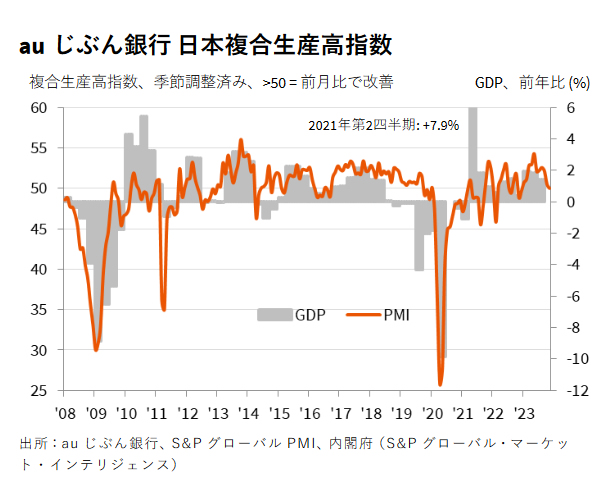
Japan's PMI for November shows a continuing contraction in the manufacturing sector and a slight improvement in services.
Manufacturing PMI dropped from 48.7 to 48.1, falling below the expected 48.8 and marking another month below the crucial 50.0 threshold, which separates contraction from expansion. This ongoing contraction has been the trend since June.
Conversely, Services PMI saw a marginal increase, moving up from 51.6 to 51.7, indicating a slight expansion in this sector. However, Composite PMI, which combines both manufacturing and services, edged down from 50.5 to exactly 50.0, highlighting stagnation in overall private sector activity.
Usamah Bhatti, an economist at S&P Global Market Intelligence said: "Activity at Japanese private sector firms stagnated midway through the fourth quarter of 2023." This stagnation is further reflected in the demand conditions, which Bhatti noted remained "muted in November and were little-changed from October."
New Zealand retail sales volume flat in Q3, value up 1.5% qoq
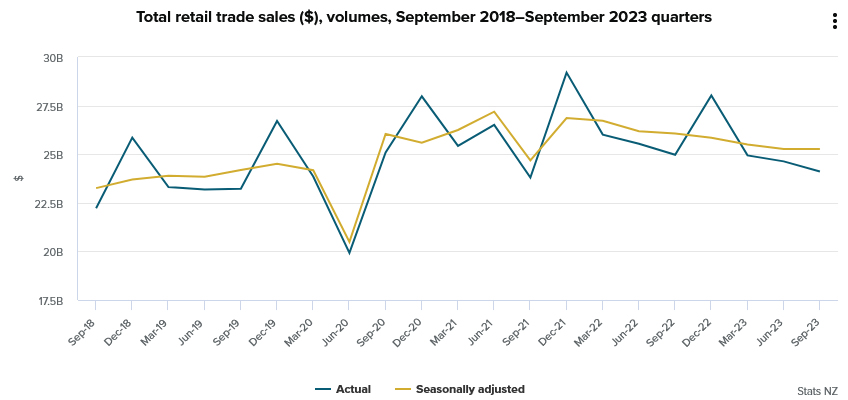
In New Zealand, Q3 2023 saw retail sales volumes remain unchanged at 0.0% qoq, defying expectations of a -0.8% decline.
However, a contrasting trend emerged in the sales value, which increased by 1.5% qoq, indicating a disparity between the number of goods sold and their monetary value.
On an annual basis, there was a -3.4% yoy decrease in sales volume, whereas sales value saw 1.1% yoy increase.
These divergences should be reflective of inflationary pressures and corresponding shift in consumer purchasing patterns.
Cliff Notes: Central Banks Remain Alert to Inflation Risks
Key insights from the week that was.
In Australia, the November RBA meeting minutes presented a detailed account of the Board’s deliberations and their assessment of the risks. The Board recognised recent evidence that pointed to lingering resilience in the labour market and domestic demand, alongside the fact that the moderation in underlying inflation is tracking a slower pace than expected. These developments have renewed concerns over inflation expectations, with the Board noting “growing signs of a mindset among businesses that any cost increases could be passed onto consumers”, a worrisome development given that only a “modest” increase in inflation expectations would make it “significantly” harder to return inflation to target.
Such observations were consistent with the Board’s eventual decision to raise the cash rate in November. However, they do not convincingly speak to a need to raise interest rates further. To justify another hike, further upside surprises for inflation and demand are necessary. We instead anticipate a deceleration in inflation and the labour market in Q4 and beyond, and so continue to expect the cash rate will remain at its current level until Q3 2024, when we forecast the next rate cutting cycle to begin.
In addition to inflation and the immediate policy outlook, in her speech this week, RBA Governor Bullock also outlined a number of key developments underway at the RBA to improve the Board’s engagement with staff and the RBA’s communications. RBA Governor Bullock also appeared on a panel with Productivity Commission Chair Danielle Wood. Productivity was a key theme and is also the topic of Westpac Chief Economist Luci Ellis' weekly essay.
In the US, the FOMC released the minutes of their October/ November meeting. Members noted a “further softening in labour market conditions” is necessary for the Committee to feel comfortable inflation will return to target. After the meeting, evidence of such a turn was provided by the October employment report, while the subsequent downside surprise on both headline and core inflation are additional steps in the right direction. Looking ahead, liaison reports of businesses finding it more difficult to pass on price increases to consumers point to a further softening in demand and inflation which, in time, should justify our and the market’s expectations of around 100bps of US rate cuts through 2024.
While yet to receive equal treatment, let alone priority, downside risks to activity are clearly on the Committee’s radar. The cumulative impact of rate hikes are yet to be felt, and “persistent changes in financial conditions could have implications for the path of monetary policy”.
Across Europe, the UK and Canada, promising data on inflation and weak activity growth has also seen markets recently price in rate cuts from mid-2024, in effect easing financial conditions. Yet to be convinced the danger has passed, central bank authorities were therefore kept busy this week emphasising that rate cuts are currently not on their horizon.
Of particular note, after Canadian inflation eased to 3.1%yr in October from 3.8%yr in September, Bank of Canada's Governor Macklem noted that the "excess demand in the economy that made it too easy to raise prices is now gone" – a statement that alludes to the removal of upside risks for inflation, but not enough progress to begin considering rate cuts.
In the UK meanwhile, Bank of England Governor Bailey appeared before a Treasury Committee. Though Bailey indicated that rates were at the top of the “table mountain”, the Committee are still wary of upside surprises given services inflation’s momentum and strong wage growth. Communication during the session therefore contradicted market pricing at the time for a rate cut in the first half of 2024.
NZ First Impressions: Retail Trade September Quarter 2023
Retail spending was stronger than expected in the September quarter. However, the longer-term trend remains soft.
- September quarter real retail sales (volumes): Flat (Prev: -0.9%)
- Westpac f/c: -2.0%, Market -0.7%
- September quarter nominal sales level: 1.5% (Prev: -0.2%)
- Annual changes (September 2023 vs September 2022)
- Nominal sales: +1.1%
- Volume of goods sold: -3.4%
Retail spending was stronger than we and other analysts expected in the September quarter. However, digging into the details, we’re still seeing signs of softness, and we expect a further slowdown over the coming months.
Looking into the details of the September spending report, nominal spending levels were up 1.5% over the quarter. However, that rise was entirely due to price increases. The volume of goods sold was unchanged. That’s despite strong population growth. In other words, individual households are actually taking home fewer goods even as they splash out more cash.
Looking at the breakdown of spending in the September quarter, we did see increases in spending in the hospitality sector, potentially reflecting the boost to demand from events such as the FIFA Women’s World cup.
Spending in interest sensitive areas was mixed. Sales of items like hardware and recreational equipment did post solid gains. However, that was balanced against reduced spending on motor vehicles and items like electronics and clothing.
What does this tell as about the strength of spending?
The longer-term trend gives us a clearer picture of what’s happening to spending appetites.
Over the past year, nominal spending levels have only risen by 1.1%. Over that same period, prices rose by 4.6%, and the population increased by more than 2%.
Putting that all together leaves us with a soft picture of underlying spending appetites. The volume of goods sold fell by more than 3% over the past year. And on a per capita basis, the fall in spending levels has been closer to 5%.
Looking ahead, we expect spending to continue cooling through the December shopping season and into the New Year. Many borrowers are continuing to roll onto higher mortgage rates, consumer price inflation remains strong, and economic growth and the labour market are softening. That combination points to significant pressure on household balance sheets. However, strong population growth will help to limit the downside for spending in the face of those headwinds.
Implications for GDP growth
Today’s result was stronger than expected. We’re currently forecasting a small 0.1% contraction in September quarter GDP. We’ll review that number over the coming weeks as more data comes to hand.
Dow Jones Wave Analysis
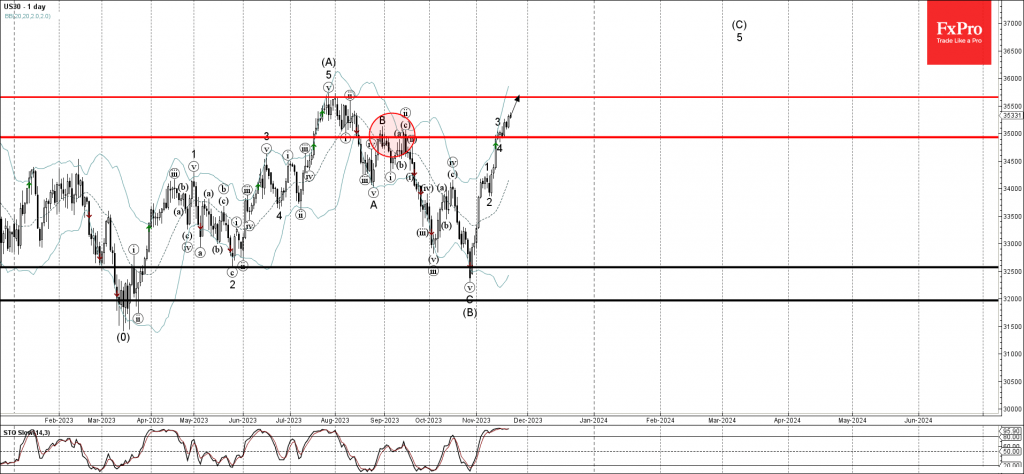
- Dow Jones broke key resistance level 35000.
- Likely to rise to resistance level 3565.00
Dow Jones index recently broke the key resistance level 35000.00 (which has been reversing the price from the start of September).
The breakout of the resistance level 35000.00 accelerated the active minor impulse wave 5 of the higher order impulse wave (C) from the end of October.
Given the prevailing risk on sentiment seen across the equity markets today, Dow Jones index can be expected to rise further to the next resistance level 3565.00 (former multi-month high from the end of July).
EURJPY Wave Analysis
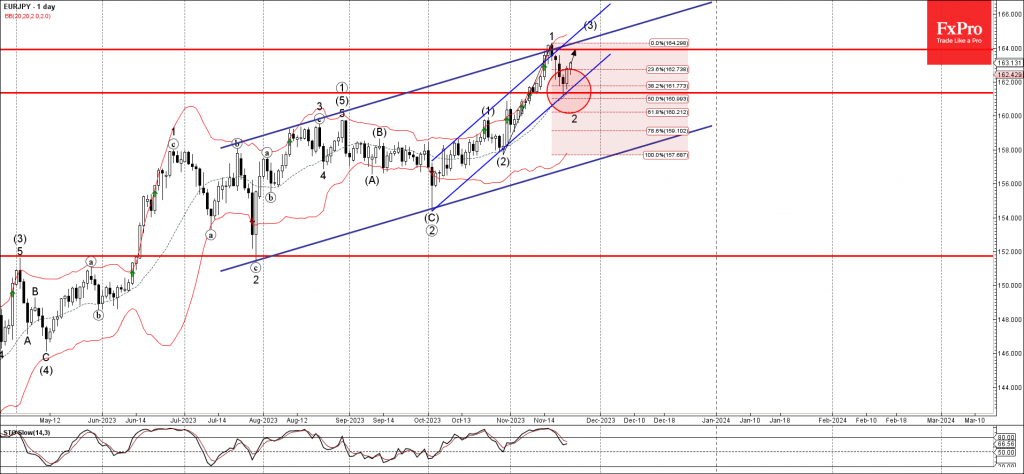
- EURJPY reversed from support level 161.35
- Likely to rise to resistance level 164.00
EURJPY currency pair recently reversed up from the key support level 161.35, coinciding with the 20-day moving average support trendline of the daily up channel from October and the 50% Fibonacci correction of the upward impulse from August.
The upward reversal from the support level 161.35 stopped the earlier minor correction 2 from the middle of November.
Given the clear daily uptrend, EURJPY currency pair can be expected to rise further to the next resistance level 164.00, which stopped the previous impulse wave 1.
British Pound Hits 10-Week high as PMIs Accelerate
- UK PMIs accelerate
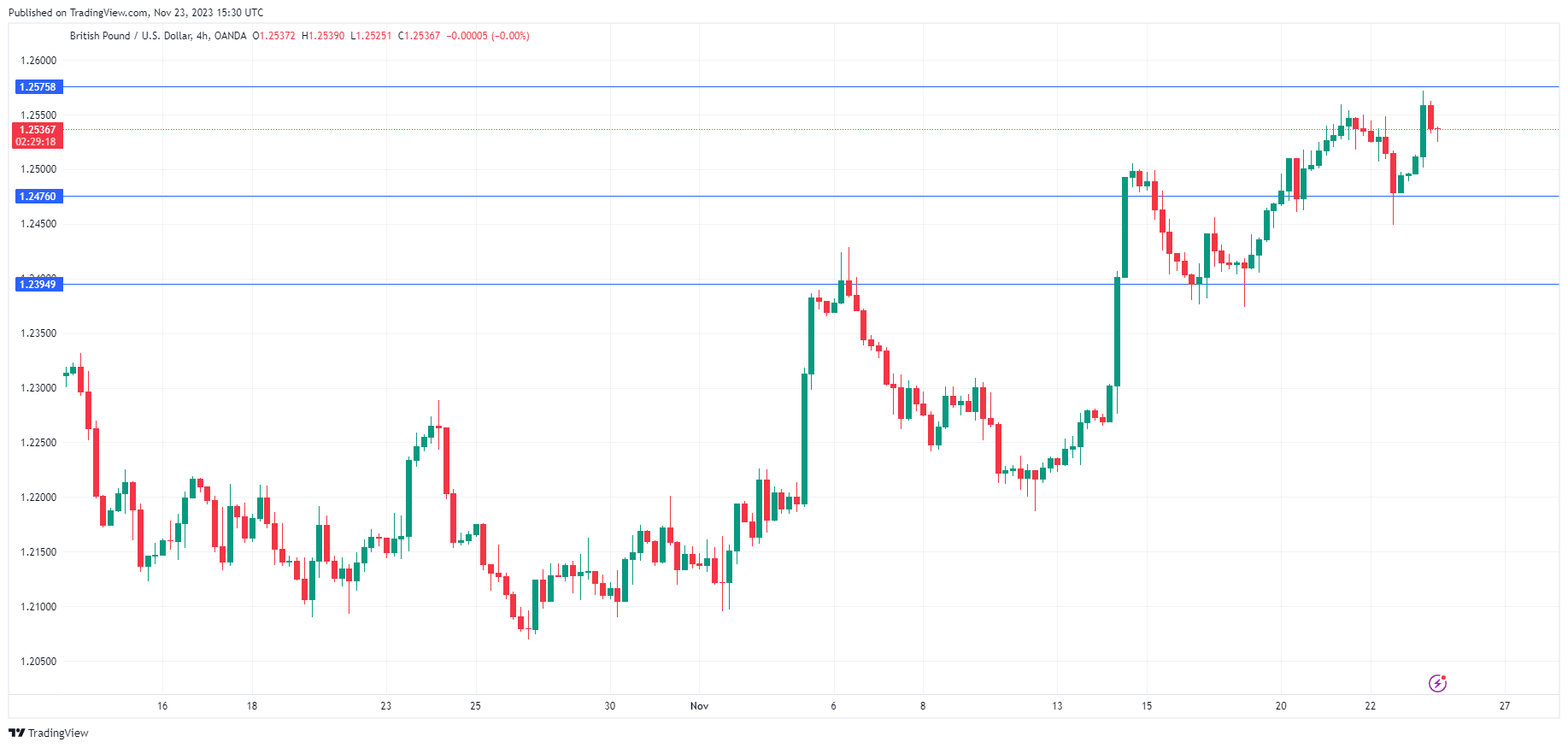
The British pound has gained ground on Thursday. In the North American session, GBP/USD is trading at 1.2536, up 0.34%. Earlier today, the pound touched a high of 1.2569, its highest level since September 6th.
UK PMIs improve
The UK released manufacturing and services PMIs earlier today, and both PMIs improved and beat expectations, which has given the British pound a boost.
The manufacturing PMI rose to 46.7 in November (Oct. 44.8), above the market consensus of 45. The services PMI improved to 50.5 (Oct. 49.5), beating the market consensus of 49.5. Manufacturing continues to decline, but the silver lining was that this release was the slowest decline in five months. Still, employment levels and new orders continue to fall, a result of weak demand. The services PMI managed to push into growth territory, but barely. The 50 line separates contraction from expansion.
The weak PMIs are further evidence of a weak UK economy, which has cooled down due to the Bank of England’s aggressive tightening. That has pushed inflation lower, although the current clip of 4.6% remains more than double the 2% target.
The markets are hopeful of rate cuts next year, even though BoE Governor Andrew Bailey continues to insist the BoE has no plans to trim rates. With inflation still high and the battle far from won, Bailey would risk losing credibility if he were to hint at rate cuts and then have to raise rates if inflation unexpectedly climbed higher.
US markets are closed for Thanksgiving, but the markets will be keeping a close eye on US manufacturing and services PMIs, which will be released on Friday. Both PMIs are expected around the 50.0 line, which separates contraction from expansion. If the reports are weaker than expected, we could see the US dollar slip, as expectations will likely rise regarding rate cuts next year.
GBP/USD Technical
- GBP/USD put pressure on resistance at 1.2575 earlier. Above, there is resistance at 1.2687
- 1.2476 and 1.2394 are the next support levels
ETHUSD Breaks Above Trendline But Fails to Rally
- ETHUSD conquers downward sloping trendline
- Meets strong resistance though at crucial technical level
- Momentum indicators warn for impending pullback
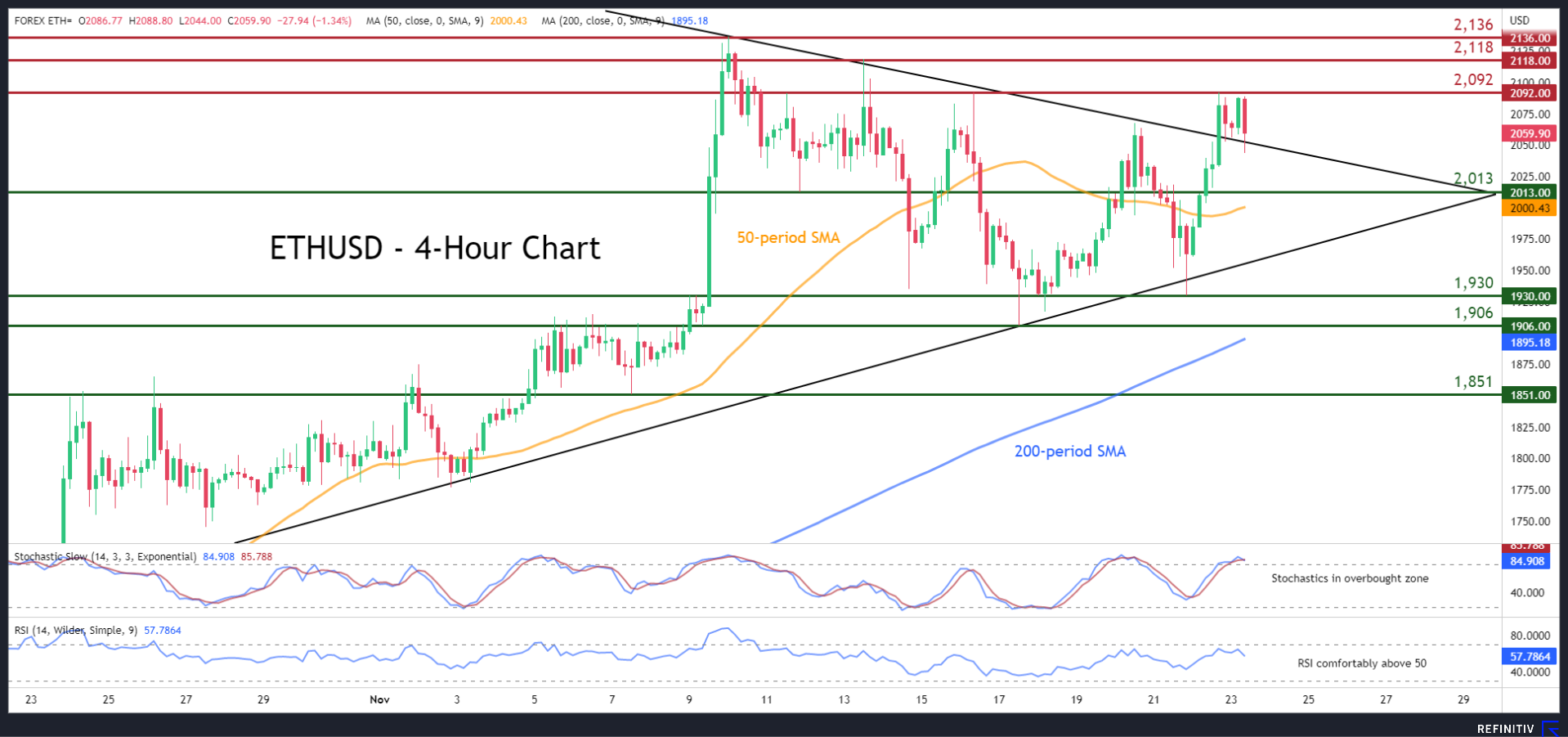
ETHUSD (Ethereum) had been forming a structure of lower highs in the four-hour chart since its peak at 2,136 on November 10. However, yesterday, the price managed to violate the descending trendline that connects its recent highs, but the bulls seem unable to reclaim the strong resistance of 2,092 for now.
As both the stochastic oscillator and the RSI show signs of waning positive momentum, the price could reverse back towards the 2,013 handle. Breaking below that zone, Ethereum could test 1,930 ahead of the 1,906 support level registered on November 17. Further declines might then cease at the 1,851 barrier.
On the flipside, if buying pressures intensify, the recent resistance of 2,092 could prove to be the first barricade for the price to overcome. A break above that region may trigger an advance towards 2,118. Piercing through the latter, the price could revisit its November peak of 2,136.
In brief, ETHUSD spiked aggressively above its descending trendline, but the move was not enough to spark a rally to the upside. Hence, the repeated failure to claim the 2,092 mark could potentially lead to a significant retreat.
NZD/USD Rises Ahead of Retail Sales
- New Zealand retail sales expected to decline by 0.8%
- US markets closed for Thanksgiving
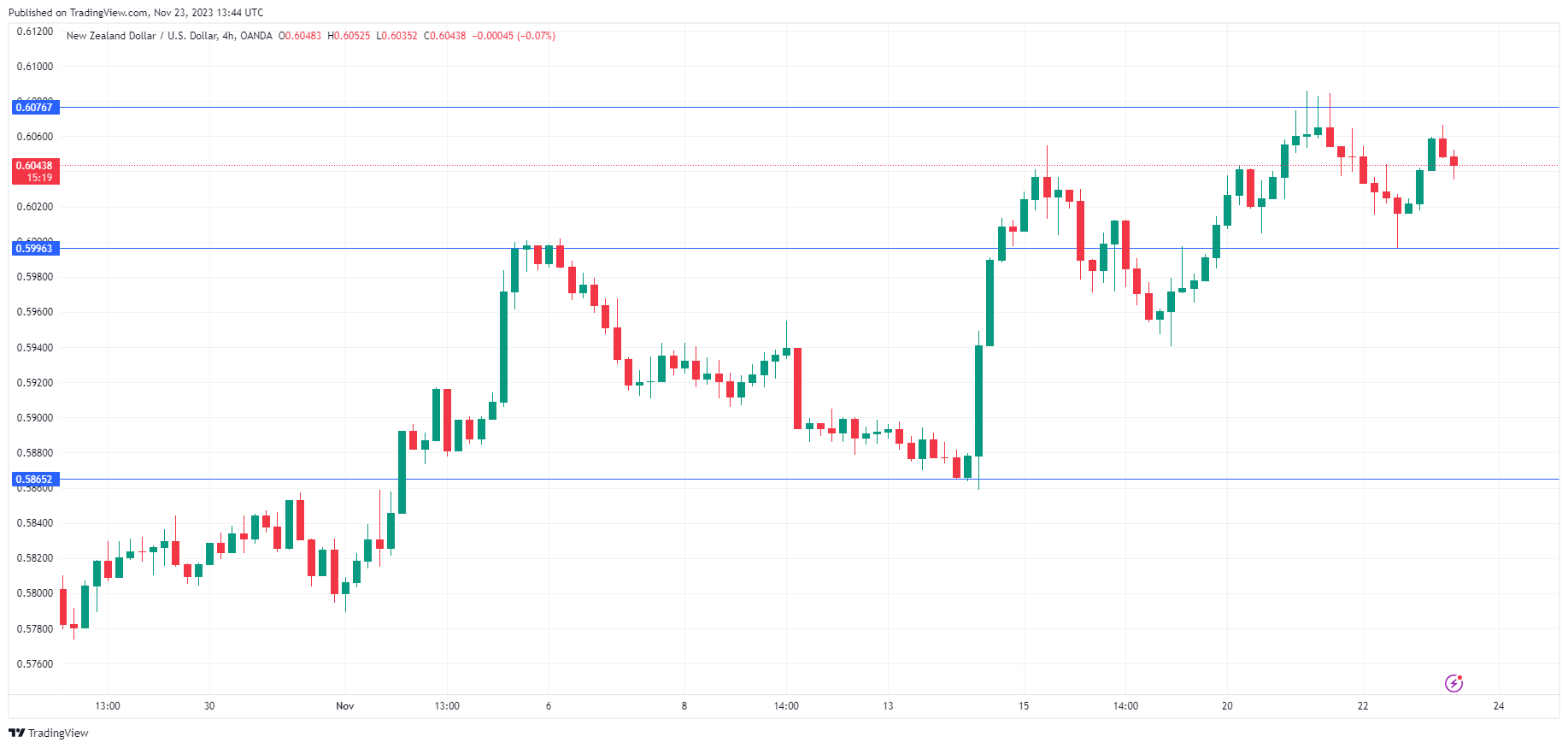
The New Zealand dollar is in positive territory on Thursday. Early in the North American session, NZD/USD is trading at 0.6042, up 0.34%.
Will New Zealand retail sales continue declining?
Retail sales are a key gauge of consumer spending and the New Zealand consumer has been holding tightly to the purse strings. In the second quarter, retail sales fell 1% q/q, with most retail industries showing lower sales volumes. This marked a third consecutive losing quarter. The markets are bracing for another decline for Q3, with a consensus estimate of -0.8%.
The soft retail sales data isn’t really surprising as consumers are being squeezed by high inflation and elevated borrowing costs. The decrease in household purchasing power has meant a decline in spending. High interest rates are still filtering through the economy, which could further dampen consumer spending in the fourth quarter.
The Reserve Bank of New Zealand has put a pause on rates for three straight times, which has naturally raised speculation that the central bank has completed its tightening cycle, which has brought the cash rate to 5.5%. Inflation in the third quarter eased from 6.0% to 5.6% y/y in the third quarter and this decline means that there is a strong likelihood that the RBNZ will hold rates at the November 27th meeting.
US markets are closed for the Thanksgiving holiday, which means we’re unlikely to see much movement today with the US dollar. That could change on Friday, with the release of US manufacturing and services PMIs. The consensus estimates for November stand at 49.8 for manufacturing (Oct: 50.0) and 50.4 for services (Oct. 49.8). If either of the PMIs miss expectations, that could translate into volatility from the US dollar.
NZD/USD Technical
- NZD/USD is putting pressure on resistance at 0.6076. The resistance line 0.6161
- There is support at 0.5996 and 0.5885