

Sample Category Title
EUR/GBP Weekly Outlook
EUR/GBP's rise from 0.8491 resumed last week by breaching 0.8752 resistance. Initial bias stays on the upside this week for 61.8% projection of 0.8491 to 0.8752 from 0.8648 at 0.8809. On the downside, break of 0.8687 support is needed to indicate short term topping. Otherwise, further rally remains in favor in case of retreat.
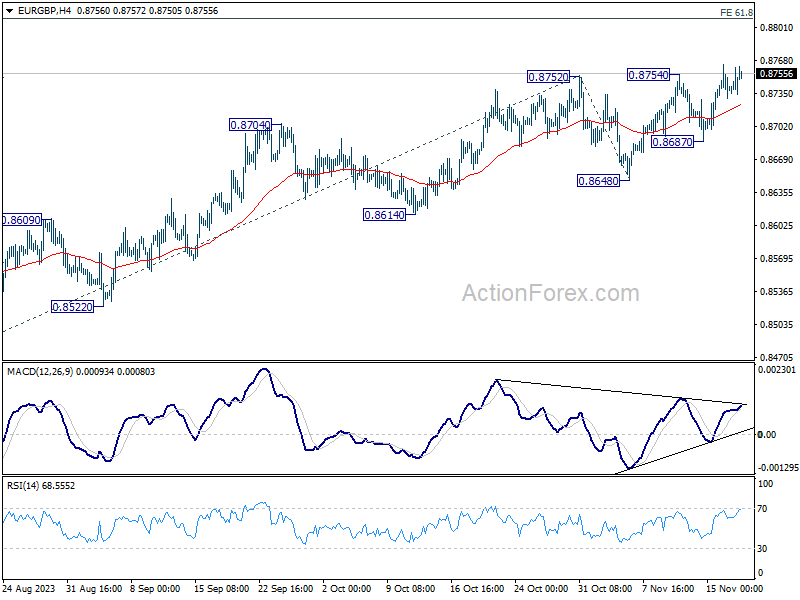
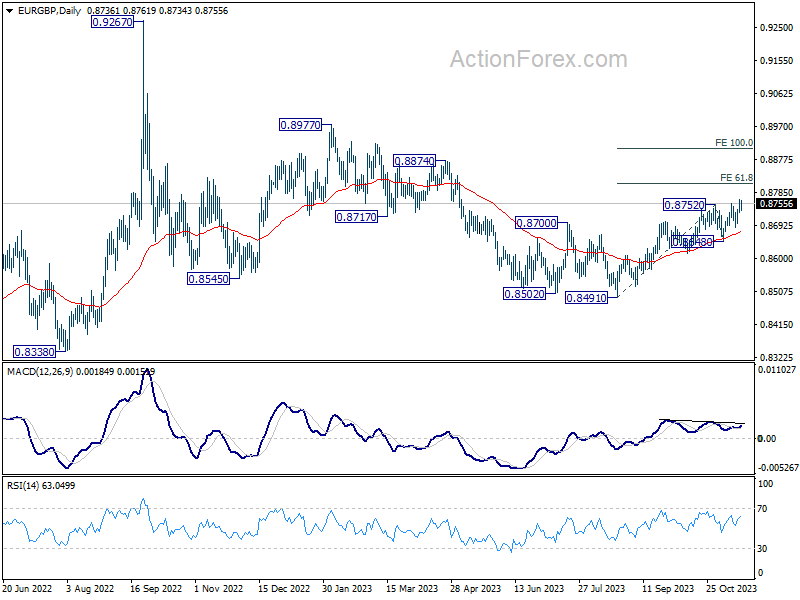
In the bigger picture, down trend from 0.9267 (2022 high) should have completed completed with three down to to 0.8491. Rise from 0.8491 is seen as another leg inside that pattern from 0.9499 (2020 high). Further rally should be seen to 0.8977 resistance and above. This will remain the favored case as long as 0.8648 support holds.
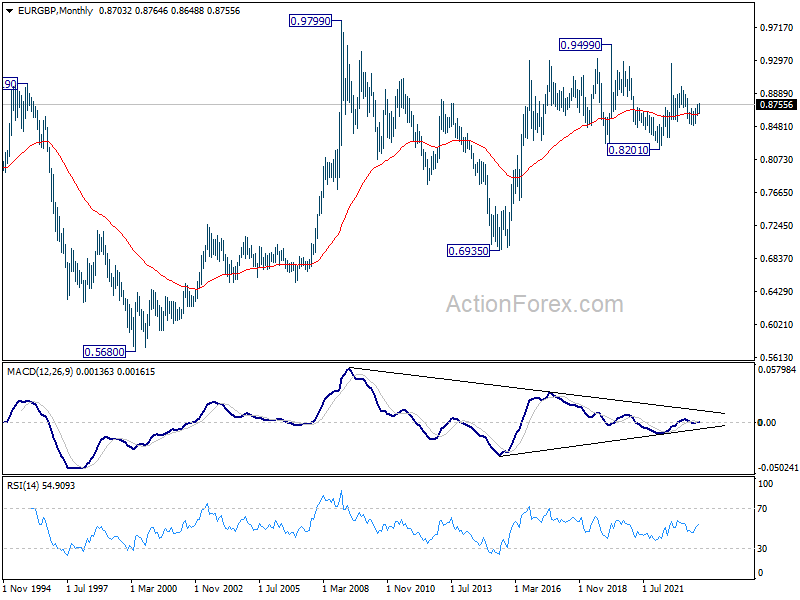
In the long term picture, long term range pattern is extending. But rise from 0.6935 (2015 low) is expected to resume at a later stage, to 0.9799 (2009 high).

EUR/AUD Weekly Outlook
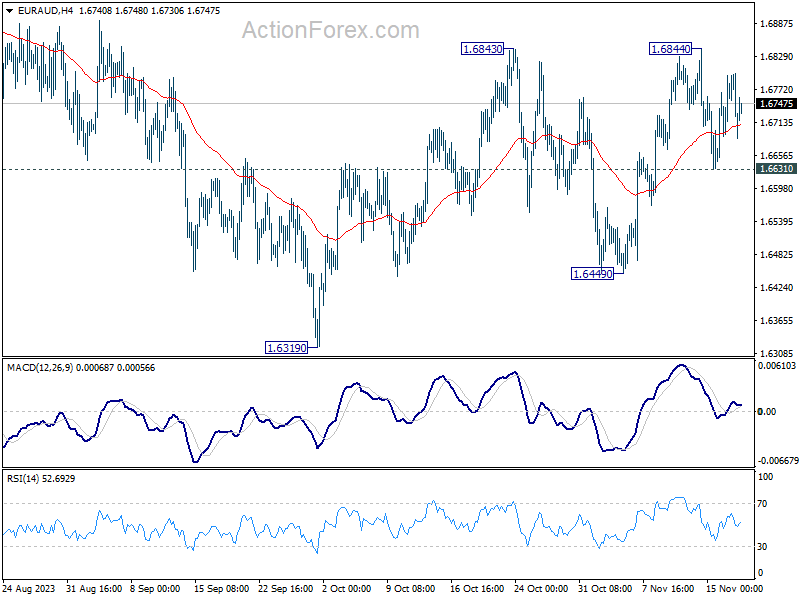
EUR/AUD failed to break through 1.6843 resistance decisively last week and retreated. Initial bias stays neutral this week for some more consolidations first. On the upside, sustained break of 1.6843/4 will resume the rebound from 1.6319 for retesting 1.7062 high next. On the downside, however, below 1.6631 minor support will turn bias back to the downside for 1.6449 support instead.
In the bigger picture, while 1.7062 is a medium term top, there is no clear sign of trend reversal as EUR/AUD continues to draw strong support from the medium term trend line. Break of 1.7062 will resume the larger up trend from 1.4281 (2022 low) to 1.7691 fibonacci level. Nevertheless, break of 1.6449 support will argue that deeper correction is underway to 38.2% retracement of 1.4281 to 1.7062 at 1.6000.
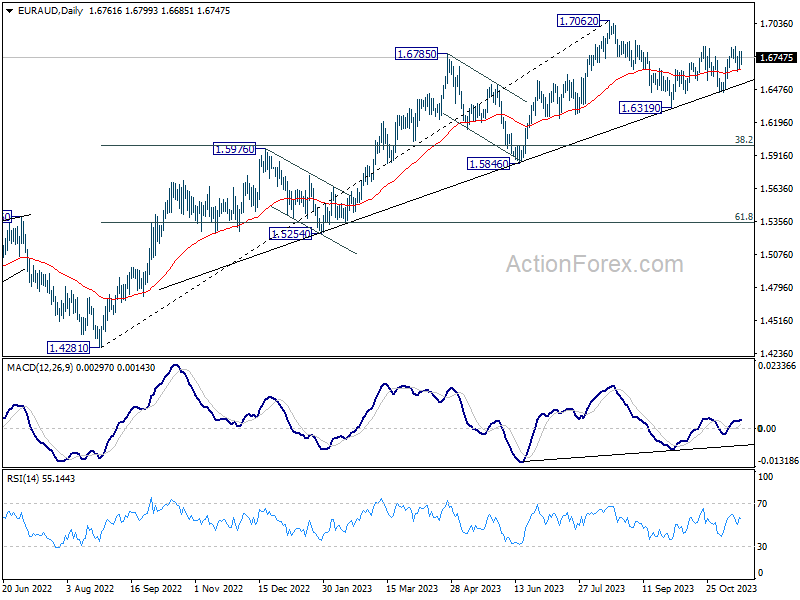
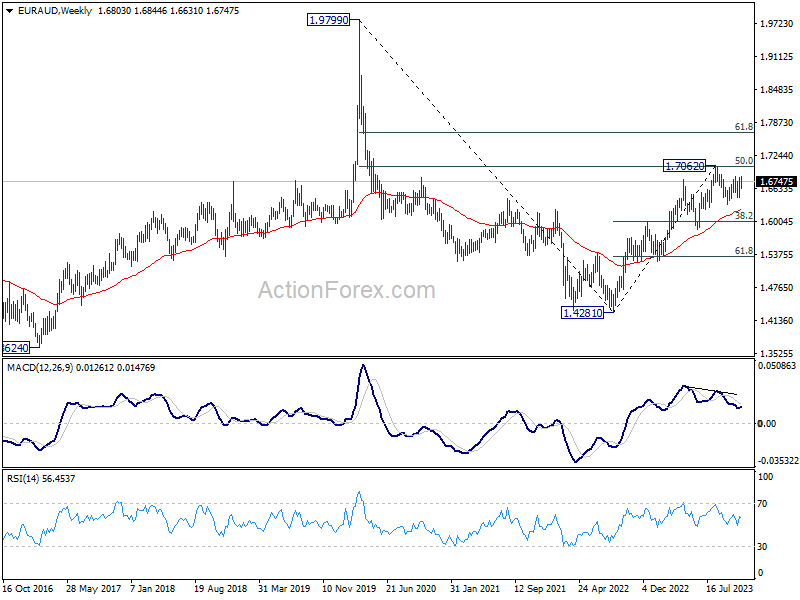
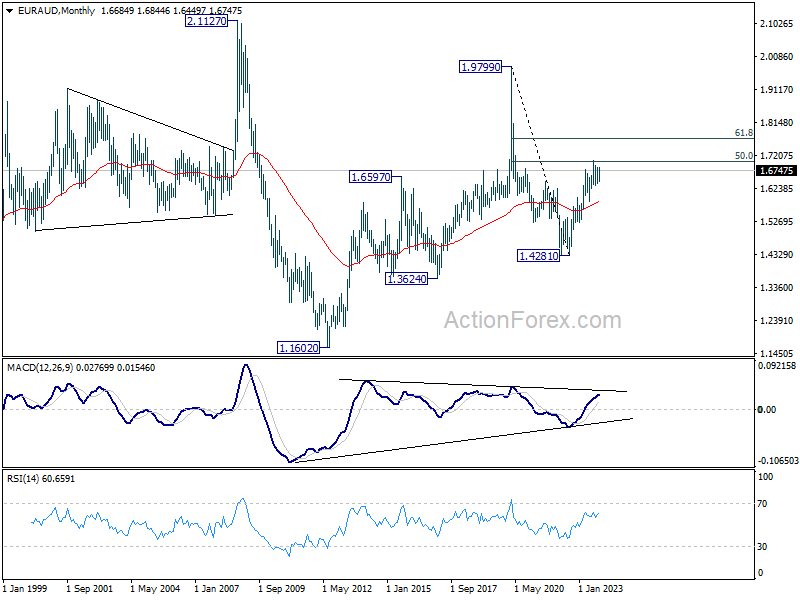
In the longer term picture, loss of upside momentum as seen in 55 W MACD at this stage argues that rise from 1.4281 (2022 low) is more likely a corrective move. Further rise could still be seen as long as 1.5846 support holds. But upside will likely be limited by 61.8% retracement of 1.9799 to 1.4281 at 1.7691. Firm break of 1.5846 support will argue that the rise has completed, and another medium term down leg has started.
EUR/CHF Weekly Outlook
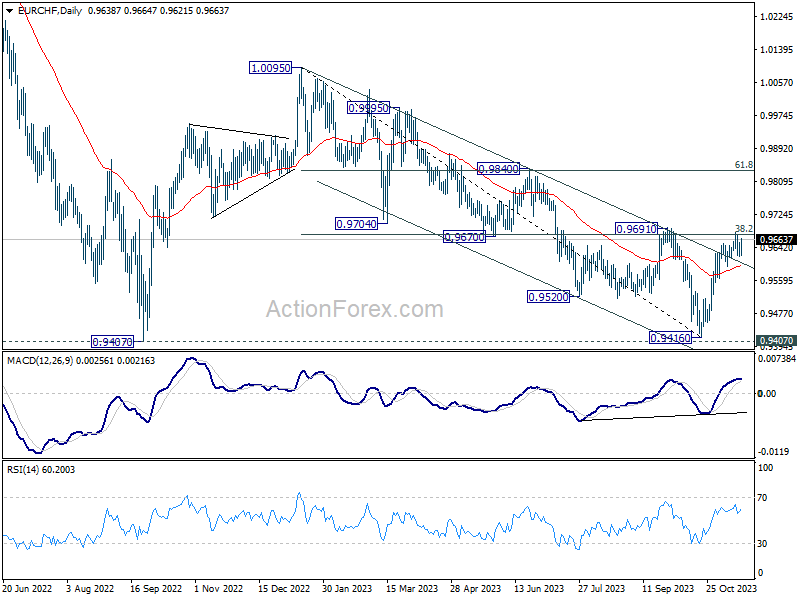
EUR/CHF edged higher to 0.9678 last week but turned retreated since then. Initial bias stays neutral this week for consolidations first. Further rally is expected as long as 0.9595 support holds. Firm break of 0.9678/91 resistance zone will carry larger bullish implication. Nevertheless, break of 0.9595 support will indicate short term topping, and turn bias back to the downside for deeper pull back.
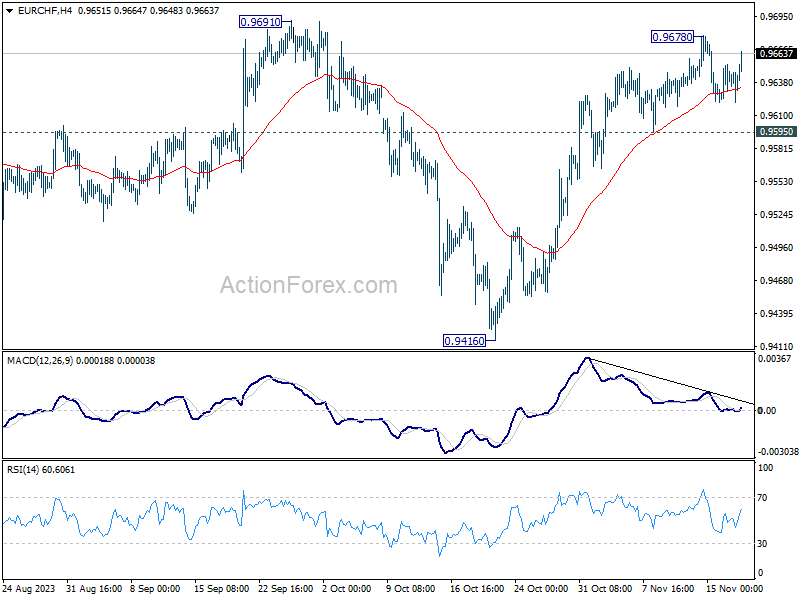
In the bigger picture, fall from 1.0095 (2023 high) might have completed at 0.9416, just ahead of 0.9407 support (2022 low). Sustained break of 0.9691 cluster resistance (38.2% retracement of 1.0095 to 0.9416 at 0.9675) will pave the way to 61.8% retracement at 0.9836 and above. However, rejection by 0.9691 will maintain medium term bearishness for another test on 0.9407 at least.
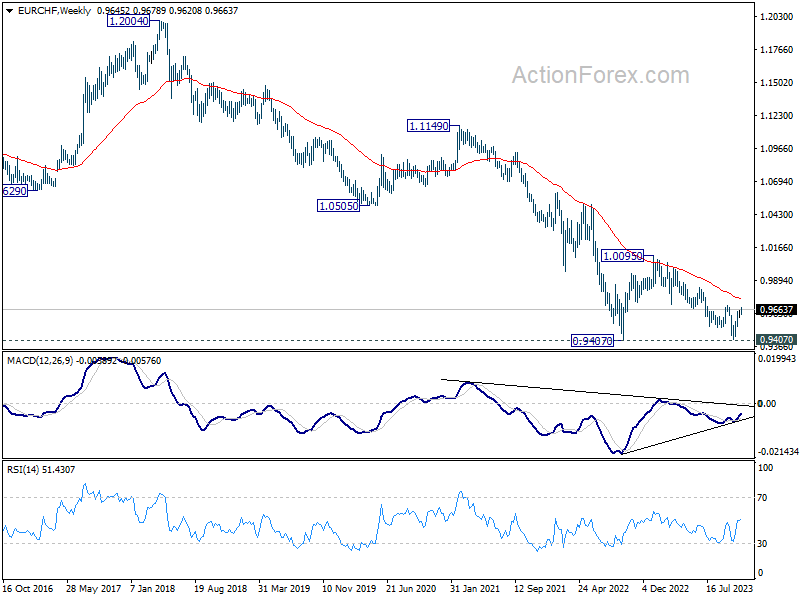
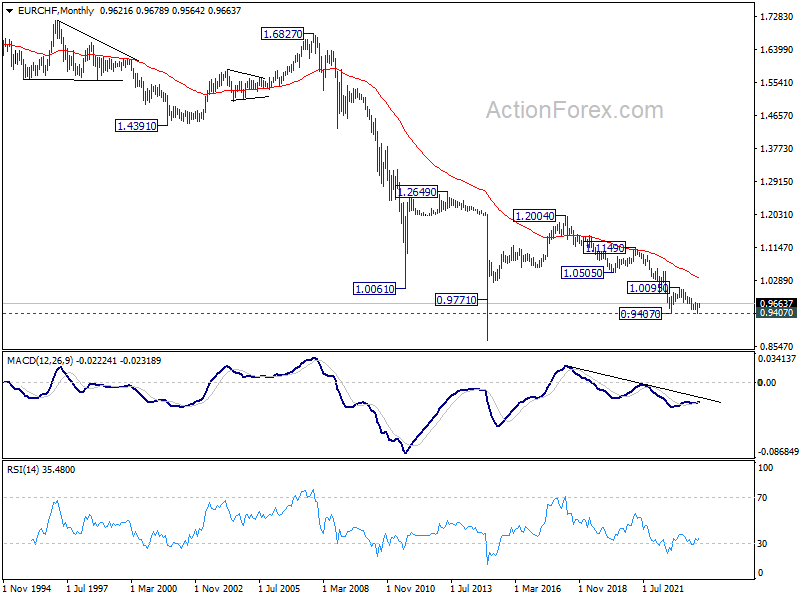
In the long term picture, outlook remains bearish as it's staying well below 55 M EMA (now at 1.0341). Price actions from 0.9407 are viewed as a three-wave consolidation pattern first. Larger down trend from 1.2004 (2018 high) might still resume through 0.9407 at a later stage. Break of 1.0095 resistance is needed to be the first sign of bottoming, or the multi-decade down trend is expected to continue.
Summary 11/20 – 11/24
Monday, Nov 20, 2023
| GMT | Ccy | Events | Consensus | Previous |
|---|---|---|---|---|
| 07:00 | EUR | Germany PPI M/M Oct | -0.10% | -0.20% |
| 07:00 | EUR | Germany PPI Y/Y Oct | -11.00% | -14.70% |
| 11:00 | EUR | German Buba Monthly Report | ||
| 21:45 | NZD | Trade Balance (NZD) Oct | -1150M | -2329M |
| 21:45 | NZD | Imports Oct | $7.2B |
| GMT | Ccy | Events | |
|---|---|---|---|
| 07:00 | EUR | Germany PPI M/M Oct | |
| Forecast: -0.10% | Previous: -0.20% | ||
| 07:00 | EUR | Germany PPI Y/Y Oct | |
| Forecast: -11.00% | Previous: -14.70% | ||
| 11:00 | EUR | German Buba Monthly Report | |
| Forecast: | Previous: | ||
| 21:45 | NZD | Trade Balance (NZD) Oct | |
| Forecast: -1150M | Previous: -2329M | ||
| 21:45 | NZD | Imports Oct | |
| Forecast: | Previous: $7.2B | ||
Tuesday, Nov 21, 2023
| GMT | Ccy | Events | Consensus | Previous |
|---|---|---|---|---|
| 00:30 | AUD | RBA Meeting Minutes | ||
| 07:00 | CHF | Trade Balance (CHF) Oct | 5.87B | 6.32B |
| 07:00 | GBP | Public Sector Net Borrowing (GBP) Oct | 21.0B | 13.5B |
| 13:30 | CAD | New Housing Price Index M/M Oct | 0.00% | -0.20% |
| 13:30 | CAD | CPI M/M Oct | 0.20% | -0.10% |
| 13:30 | CAD | CPI Y/Y Oct | 3.20% | 3.80% |
| 13:30 | CAD | CPI Core M/M Oct | -0.10% | |
| 13:30 | CAD | CPI Median Y/Y Oct | 3.60% | 3.80% |
| 13:30 | CAD | CPI Trimmed Y/Y Oct | 3.60% | 3.70% |
| 13:30 | CAD | CPI Common Y/Y Oct | 4.30% | 4.40% |
| 15:00 | USD | Existing Home Sales Oct | 3.91M | 3.96M |
| 19:00 | USD | FOMC Minutes |
| GMT | Ccy | Events | |
|---|---|---|---|
| 00:30 | AUD | RBA Meeting Minutes | |
| Forecast: | Previous: | ||
| 07:00 | CHF | Trade Balance (CHF) Oct | |
| Forecast: 5.87B | Previous: 6.32B | ||
| 07:00 | GBP | Public Sector Net Borrowing (GBP) Oct | |
| Forecast: 21.0B | Previous: 13.5B | ||
| 13:30 | CAD | New Housing Price Index M/M Oct | |
| Forecast: 0.00% | Previous: -0.20% | ||
| 13:30 | CAD | CPI M/M Oct | |
| Forecast: 0.20% | Previous: -0.10% | ||
| 13:30 | CAD | CPI Y/Y Oct | |
| Forecast: 3.20% | Previous: 3.80% | ||
| 13:30 | CAD | CPI Core M/M Oct | |
| Forecast: | Previous: -0.10% | ||
| 13:30 | CAD | CPI Median Y/Y Oct | |
| Forecast: 3.60% | Previous: 3.80% | ||
| 13:30 | CAD | CPI Trimmed Y/Y Oct | |
| Forecast: 3.60% | Previous: 3.70% | ||
| 13:30 | CAD | CPI Common Y/Y Oct | |
| Forecast: 4.30% | Previous: 4.40% | ||
| 15:00 | USD | Existing Home Sales Oct | |
| Forecast: 3.91M | Previous: 3.96M | ||
| 19:00 | USD | FOMC Minutes | |
| Forecast: | Previous: | ||
Wednesday, Nov 22, 2023
| GMT | Ccy | Events | Consensus | Previous |
|---|---|---|---|---|
| 00:00 | AUD | Westpac Leading Index M/M Oct | 0.10% | |
| 13:30 | USD | Initial Jobless Claims (Nov 17) | 225K | 231K |
| 13:30 | USD | Durable Goods Orders Oct | -3.20% | 4.60% |
| 13:30 | USD | Durable Goods Orders ex-Transport Oct | 0.20% | 0.40% |
| 15:00 | USD | Michigan Consumer Sentiment Index Nov F | 61.1 | 60.4 |
| 15:00 | EUR | Eurozone Consumer Confidence Nov P | -18 | -18 |
| 15:30 | USD | Crude Oil Inventories | 3.6M | |
| 17:00 | USD | Natural Gas Storage | 60B | |
| 22:00 | AUD | Manufacturing PMI Nov P | 48.2 | |
| 22:00 | AUD | Services PMI Nov P | 47.9 |
| GMT | Ccy | Events | |
|---|---|---|---|
| 00:00 | AUD | Westpac Leading Index M/M Oct | |
| Forecast: | Previous: 0.10% | ||
| 13:30 | USD | Initial Jobless Claims (Nov 17) | |
| Forecast: 225K | Previous: 231K | ||
| 13:30 | USD | Durable Goods Orders Oct | |
| Forecast: -3.20% | Previous: 4.60% | ||
| 13:30 | USD | Durable Goods Orders ex-Transport Oct | |
| Forecast: 0.20% | Previous: 0.40% | ||
| 15:00 | USD | Michigan Consumer Sentiment Index Nov F | |
| Forecast: 61.1 | Previous: 60.4 | ||
| 15:00 | EUR | Eurozone Consumer Confidence Nov P | |
| Forecast: -18 | Previous: -18 | ||
| 15:30 | USD | Crude Oil Inventories | |
| Forecast: | Previous: 3.6M | ||
| 17:00 | USD | Natural Gas Storage | |
| Forecast: | Previous: 60B | ||
| 22:00 | AUD | Manufacturing PMI Nov P | |
| Forecast: | Previous: 48.2 | ||
| 22:00 | AUD | Services PMI Nov P | |
| Forecast: | Previous: 47.9 | ||
Thursday, Nov 23, 2023
| GMT | Ccy | Events | Consensus | Previous |
|---|---|---|---|---|
| 08:15 | EUR | France Manufacturing PMI Nov P | 43.2 | 42.8 |
| 08:15 | EUR | France Services PMI Nov P | 45.7 | 45.2 |
| 08:30 | EUR | Germany Manufacturing PMI Nov P | 41.3 | 40.8 |
| 08:30 | EUR | Germany Services PMI Nov P | 48.5 | 48.2 |
| 09:00 | EUR | Eurozone Manufacturing PMI Nov P | 43.4 | 43.1 |
| 09:00 | EUR | Eurozone Services PMI Nov P | 48.0 | 47.8 |
| 09:30 | GBP | Manufacturing PMI Nov P | 45.0 | 44.8 |
| 09:30 | GBP | Services PMI Nov P | 49.5 | 49.5 |
| 12:30 | EUR | ECB Meeting Accounts | ||
| 21:45 | NZD | Retail Sales Q/Q Q3 | -0.80% | -1.00% |
| 21:45 | NZD | Retail Sales ex Autos Q/Q Q3 | -1.50% | -1.80% |
| 23:30 | JPY | National CPI Y/Y Oct | 3% | |
| 23:30 | JPY | National CPI ex Fresh Food Y/Y Oct | 3.00% | 2.80% |
| 23:30 | JPY | National CPI ex Food Energy Y/Y Oct | 4.20% |
| GMT | Ccy | Events | |
|---|---|---|---|
| 08:15 | EUR | France Manufacturing PMI Nov P | |
| Forecast: 43.2 | Previous: 42.8 | ||
| 08:15 | EUR | France Services PMI Nov P | |
| Forecast: 45.7 | Previous: 45.2 | ||
| 08:30 | EUR | Germany Manufacturing PMI Nov P | |
| Forecast: 41.3 | Previous: 40.8 | ||
| 08:30 | EUR | Germany Services PMI Nov P | |
| Forecast: 48.5 | Previous: 48.2 | ||
| 09:00 | EUR | Eurozone Manufacturing PMI Nov P | |
| Forecast: 43.4 | Previous: 43.1 | ||
| 09:00 | EUR | Eurozone Services PMI Nov P | |
| Forecast: 48.0 | Previous: 47.8 | ||
| 09:30 | GBP | Manufacturing PMI Nov P | |
| Forecast: 45.0 | Previous: 44.8 | ||
| 09:30 | GBP | Services PMI Nov P | |
| Forecast: 49.5 | Previous: 49.5 | ||
| 12:30 | EUR | ECB Meeting Accounts | |
| Forecast: | Previous: | ||
| 21:45 | NZD | Retail Sales Q/Q Q3 | |
| Forecast: -0.80% | Previous: -1.00% | ||
| 21:45 | NZD | Retail Sales ex Autos Q/Q Q3 | |
| Forecast: -1.50% | Previous: -1.80% | ||
| 23:30 | JPY | National CPI Y/Y Oct | |
| Forecast: | Previous: 3% | ||
| 23:30 | JPY | National CPI ex Fresh Food Y/Y Oct | |
| Forecast: 3.00% | Previous: 2.80% | ||
| 23:30 | JPY | National CPI ex Food Energy Y/Y Oct | |
| Forecast: | Previous: 4.20% | ||
Friday, Nov 24, 2023
| GMT | Ccy | Events | Consensus | Previous |
|---|---|---|---|---|
| 00:01 | GBP | GfK Consumer Confidence Nov | -27 | -30 |
| 00:30 | JPY | Manufacturing PMI Nov P | 48.8 | 48.7 |
| 00:30 | JPY | Services PMI Nov P | 51.6 | |
| 07:00 | EUR | Germany GDP Q/Q Q3 F | -0.10% | -0.10% |
| 09:00 | EUR | Germany IFO Business Climate Nov | 87.5 | 86.9 |
| 09:00 | EUR | Germany IFO Current Assessment Nov | 89.4 | 89.2 |
| 09:00 | EUR | Germany IFO Expectations Nov | 85.7 | 84.7 |
| 13:30 | CAD | Retail Sales M/M Sep | 0.00% | -0.10% |
| 13:30 | CAD | Retail Sales ex Autos M/M Sep | -0.30% | 0.10% |
| 14:45 | USD | Manufacturing PMI Nov P | 49.8 | 50 |
| 14:45 | USD | Services PMI Nov P | 50.4 | 50.6 |
| GMT | Ccy | Events | |
|---|---|---|---|
| 00:01 | GBP | GfK Consumer Confidence Nov | |
| Forecast: -27 | Previous: -30 | ||
| 00:30 | JPY | Manufacturing PMI Nov P | |
| Forecast: 48.8 | Previous: 48.7 | ||
| 00:30 | JPY | Services PMI Nov P | |
| Forecast: | Previous: 51.6 | ||
| 07:00 | EUR | Germany GDP Q/Q Q3 F | |
| Forecast: -0.10% | Previous: -0.10% | ||
| 09:00 | EUR | Germany IFO Business Climate Nov | |
| Forecast: 87.5 | Previous: 86.9 | ||
| 09:00 | EUR | Germany IFO Current Assessment Nov | |
| Forecast: 89.4 | Previous: 89.2 | ||
| 09:00 | EUR | Germany IFO Expectations Nov | |
| Forecast: 85.7 | Previous: 84.7 | ||
| 13:30 | CAD | Retail Sales M/M Sep | |
| Forecast: 0.00% | Previous: -0.10% | ||
| 13:30 | CAD | Retail Sales ex Autos M/M Sep | |
| Forecast: -0.30% | Previous: 0.10% | ||
| 14:45 | USD | Manufacturing PMI Nov P | |
| Forecast: 49.8 | Previous: 50 | ||
| 14:45 | USD | Services PMI Nov P | |
| Forecast: 50.4 | Previous: 50.6 | ||
The Weekly Bottom Line: Extended Fed Pause Looking Increasingly Likely
U.S. Highlights
- Consumer Price Index (CPI) inflation printed lower than expected in October, fueling a rally in equities and a sharp pullback in longer-term Treasury yields.
- A government shutdown was averted this week, as Congress passed another short-term funding bill that maintains current spending levels through mid-January.
- Retail sales data showed a moderation in spending activity in October, while higher frequency credit card spend data suggests the weakness has extended into November.
Canadian Highlights
- Next week’s Canadian inflation report is likely to show easing price growth, in line with this week’s U.S. CPI print. The latter was the spark behind a rally in Canadian bonds and equities.
- The fall federal update is also slated for next week, with policymakers promising action on housing supply. On this front, housing starts remained highly elevated in October, though more needs to be done to tackle affordability challenges.
- Given the elevated rates backdrop, Canadian home sales and prices unsurprisingly dropped in October. In Ontario, housing markets are the loosest they’ve been since the Financial Crisis.
U.S. – Extended Fed Pause Looking Increasingly Likely
Market sentiment was decisively in the risk-on camp this week, as a softer reading on October inflation and signs of slowing consumer spending fueled expectations of a longer Fed pause. Also providing a lift to equities was Congress acting to pass yet another short-term funding bill that avoids an immediate government shutdown by extending current levels of spending through mid-January. The S&P 500 is shaping up to end the week 2% higher – extending its winning streak to three-consecutive weeks. Longer-term yields traded lower, with the 10-year Treasury ending the week down 18 basis-points to 4.43%.
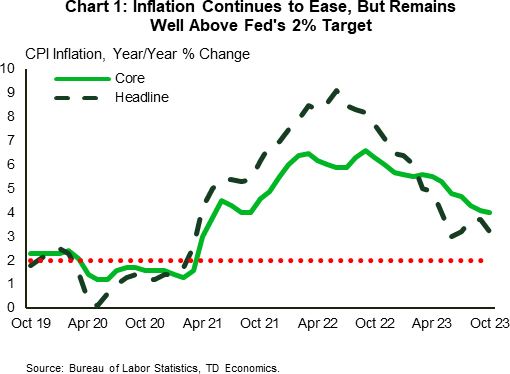
Turning to the Consumer Price Index (CPI) report, both headline and core inflation came in below market expectations. Falling energy and goods prices, a further easing on housing costs and some deceleration in the ‘supercore’ measure all contributed to last month’s softer print. On a twelve-month basis, core inflation is down 2.6 percentage points from last year’s high but, at 4%, remains well above the Fed’s 2% inflation target (Chart 1). As noted in our commentary, the challenge for the Fed going forward is that much of the low hanging fruit on the dis-inflation front has now been picked. With supply-chain issues largely resolved, it is unlikely that falling goods prices will continue to exert as much of a drag on inflation going forward. Ultimately, this means a more pronounced slowing in consumer spending will be required to sustain continued downward pressure on inflation.
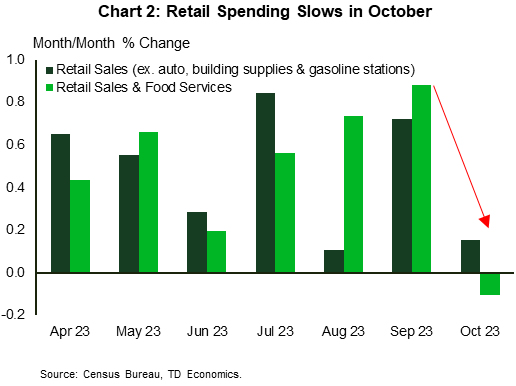
Retail sales data out this week showed that spending activity moderated in October. Although some of the weakness was attributed to a pullback in vehicle sales (possibly impacted by the UAW strike), the less volatile components still showed a meaningful deceleration in spending relative to prior months (Chart 2). Moreover, higher frequency credit card spend data reported through the first week of November has shown that spending activity has continued to moderate into the holiday shopping season.
At this point, the tailwinds for the consumer seem to be fading. Over two-thirds of the excess savings accumulated during the pandemic have now been exhausted, with most of the remaining savings likely residing with higher income households who tend to have a lower marginal propensity to consume. This is happening at a time when 27 million borrowers have started to make regular student loan repayments amidst a backdrop of deteriorating consumer sentiment and expectations of a cooling labor market.
To that end, recent readings on initial jobless claims have already turned higher over the past month, as have continued claims – recently touching a near two-year high. This suggests that not only are more workers losing their jobs but it’s also becoming a bit harder to find another. Ultimately, the labor market remains very tight by historical standards, but the recent drift higher in claims data suggests underlying conditions are easing on the margin. Although the Fed will need to see further evidence of cooling in the months ahead to rule out another rate hike next year, the recent data flow favors the FOMC holding rates steady in December.
Canada – Supply, Supply, Supply
Canadian bond yields were down this week. However, as is often the case, developments south of the border were the driver. Markets seemed to breathe a collective sigh of relief after a softer-than-expected U.S. CPI report offered some hope that the Federal Reserve wouldn't be taking their policy rate higher in the near-term. This prospect also supported a rally in Canadian equities, even as oil prices continued to drop on demand concerns and a larger-than-expected inventory build. It also helped prop up the Canadian dollar, although at around 0.73 U.S. cents, the loonie continues to fly low compared to its U.S. counterpart.
Next week features the release of the Canadian inflation report for October. U.S. all-items inflation trends have historically been a good guide for overall Canadian CPI, so the good showing stateside this week bodes well for the Canadian print. Specifically, markets expect all-items inflation to have cooled to 3.2% year-on-year in October, a marked deceleration from the heated pace observed during much of the summer. As in the U.S., energy prices should lead the inflation deceleration. However, policymakers will be keying in on core inflation, which is also expected to show some modest cooling in year-on-year terms. Notably, U.S. core inflation (i.e., ex-food and energy) eased a touch in October although the correlation between it and the equivalent Canadian measure isn't nearly as tight as it is for overall inflation.
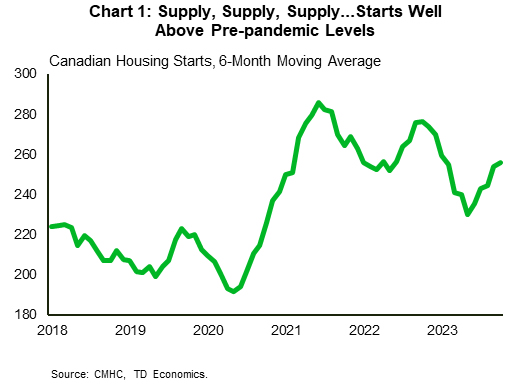
The fall federal fiscal update is also on tap for next week, and the government has telegraphed its intentions. As Minister Freeland noted in a speech this week, the focus will be on housing "supply, supply, supply", amid Canada's affordability crisis. Builders are certainly doing their part to respond to this challenge, with this week's report on housing starts showing them rising to a highly elevated level of 275k units, which is not too far off the record pace hit in early 2021. On a six-month average basis, starts are sitting at a very healthy 253k units (Chart 1), with the largest contributions coming from condos and purpose-built rental construction. While these are good trends indeed, the time it takes to complete a housing project in Canada is on the rise, and even these lofty levels of homebuilding may not be enough to prevent a housing shortage from accumulating given very robust population growth.
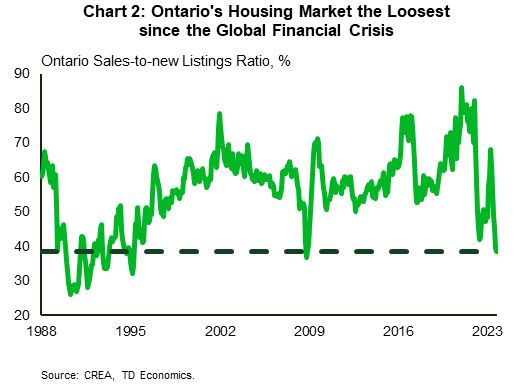
From a near-term residential investment and GDP growth perspective, last month's modest gain in housing starts should provide some offset to the 5% month-on-month decline in October's Canadian home sales. As expected, average and benchmark home prices pulled back last month, as did new listings. Arguably the most eye-catching aspect of the report was the decline in Ontario's sales-to-new listings ratio, which hit its lowest level since the Global Financial Crisis (Chart 2). This is a strong signal that more home price declines may be on the way.
Weekly Economic & Financial Commentary: Downside Surprises For G10 Economic Data
Summary
United States: Slew of Data to Binge On
- This week brought fresh reads on an array of macro data, and the underlying details continue to paint a picture of an economy that is gradually losing momentum in Q4. While retail and industrial activity were stronger than the headline data suggest, there are also some signs of weakening.
- Next week: LEI (Mon.), Existing Home Sales (Tue.), Durable Goods Orders (Wed.)
International: Downside Surprises For G10 Economic Data
- This week's reports pointed to slowing growth and slowing inflation among the economies. After solid growth during the first half of the year, Japan's Q3 GDP shrank by 2.1% quarter-over-quarter annualized, a larger than expected decline. U.K. October inflation slowed sharply to 4.6% year-over-year.
- Next week: Canada CPI (Tue.), Eurozone PMIs (Thu.), Japan CPI (Fri.)
Interest Rate Watch: Yields Fall on Slowing Inflation
- U.S. Treasury yields fell this week as markets digested slower-than-expected inflation data for October. As we go to print, the yield on the 10-year Treasury note is 4.45%, down from 4.65% one week ago. This week's inflation reports reinforced our view that the FOMC is done hiking rates.
Credit Market Insights: Credit Card Delinquencies Creep Up in Q3
- The Federal Reserve Bank of New York released its quarterly Household Debt and Credit Report last week. Not only did each major category of household debt rise during the quarter, but delinquency rates also moved higher. Credit card debt delinquency rates, in particular, have climbed above their pre-pandemic average.
Topic of the Week: Not-So-Free Bird: Thanksgiving Related Inflation Decelerates, Though Still Elevated
- Consumers have faced price pressures over the past few years that have continued to gobble up their wallets, and this Thanksgiving will be no different. Though price hikes for most items on the Thanksgiving menu have eased considerably from a year ago, the cost of Thanksgiving staples are still broadly elevated relative to a few years ago.
Canadian CPI Data in Center Stage in the Week Ahead
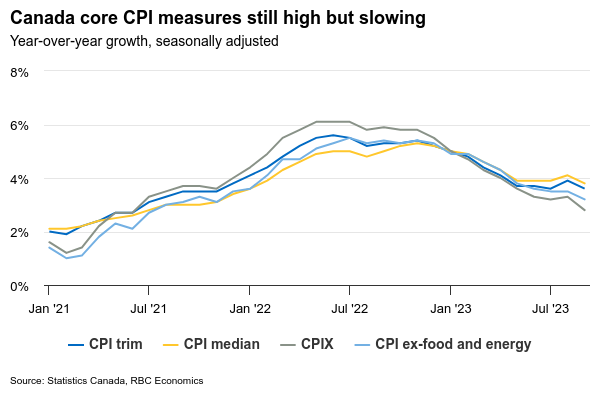
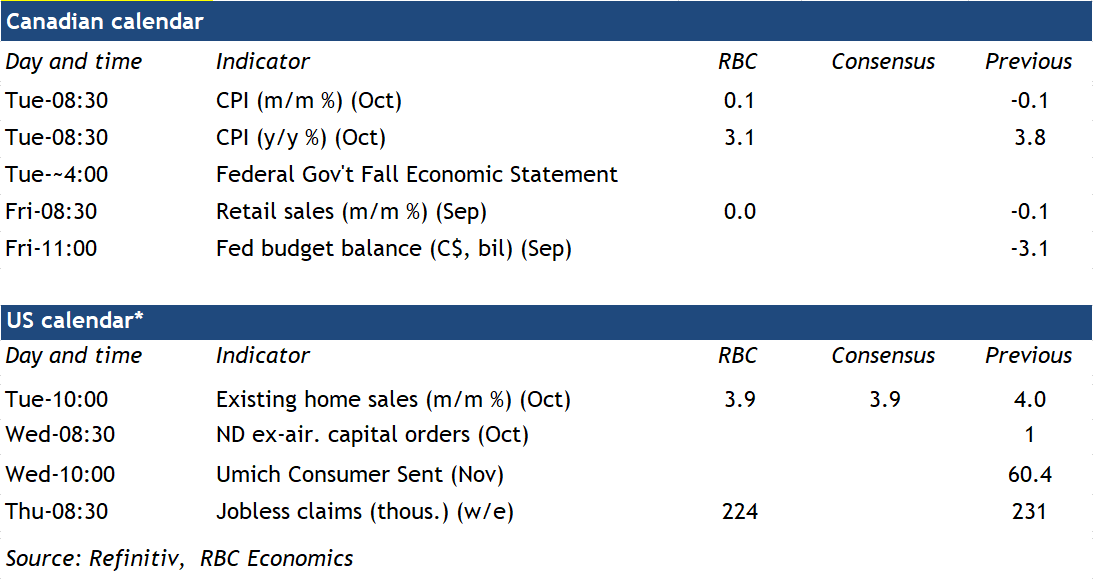
Canadian CPI data will be watched closely (including by Bank of Canada officials) in a week that will also include the federal government’s fall economic update and (we expect) more signs that the consumer spending backdrop is softening. Year-over-year CPI growth is expected to slow significantly to 3.1% in October (just above the top end of the BoC’s 1% to 3% inflation target range) from 3.8% in September. A drop in gasoline prices pushed energy costs lower and the lagged impact of easing supply chains and lower food commodity prices continue to slow grocery store price growth.
There is not much that the Bank of Canada can do to impact global commodity prices, and price growth excluding food and energy products is expected to be ‘stickier’, edging up to 3.3% year-over-year from 3.2% in September. Much of that growth is still coming from surging mortgage interest costs that are a direct result of Bank of Canada interest rate increases. Price growth excluding those costs has been slower – the so-called CPIX core measure that also excludes mortgage interest costs along with 7 other volatile price subcomponents has slowed to 2.8% year-over-year after hitting a peak of 6.1% in June 2022. Growth in the BoC’s current preferred median and trim core CPI components have still been running well above the 2% inflation objective but are expected to edge lower on both a year-over-year and 3-month rolling average basis in October.
Inflation pressures going forward are increasingly likely to slow with economic growth and labour markets looking softer. The advance estimate of September retail sales was unchanged from August, which would leave sales in volume terms down ~2 ½% at an annualized rate in Q3. And our own tracking of card transactions is also showing a slowdown in spending on discretionary services (alongside softer retail sales) into October.
Week ahead data watch
The federal government’s fall federal budget update will come alongside a slowing growth backdrop. Housing supply is expected to be a focus of the update with high rates of population growth stretching capacity. But a slower economic growth backdrop is also weighing on government purchasing power with the Parliamentary Budget Office estimating that the deficit for the current fiscal year will come in $6 billion wider than expected in in the last budget.
Has Dollar Rally Run Its Course?
- Dollar slides as investors pencil in 100bps worth of Fed rate cuts
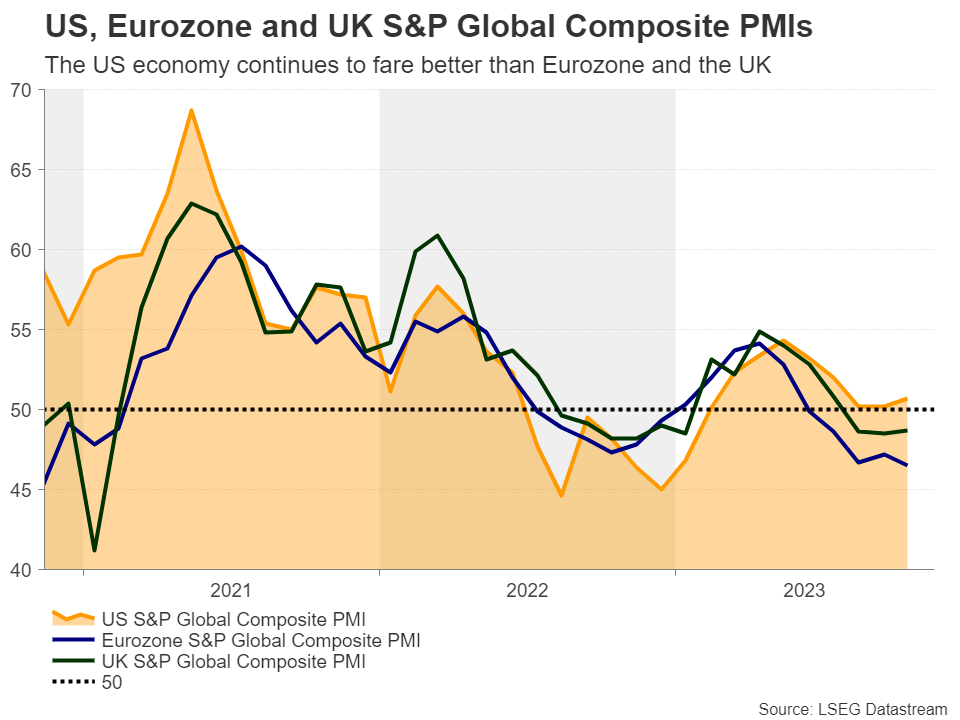
- US economy is expected to slow, but still fare better than its major peers
- Fed likely to begin rate reductions next year, but ECB may cut earlier
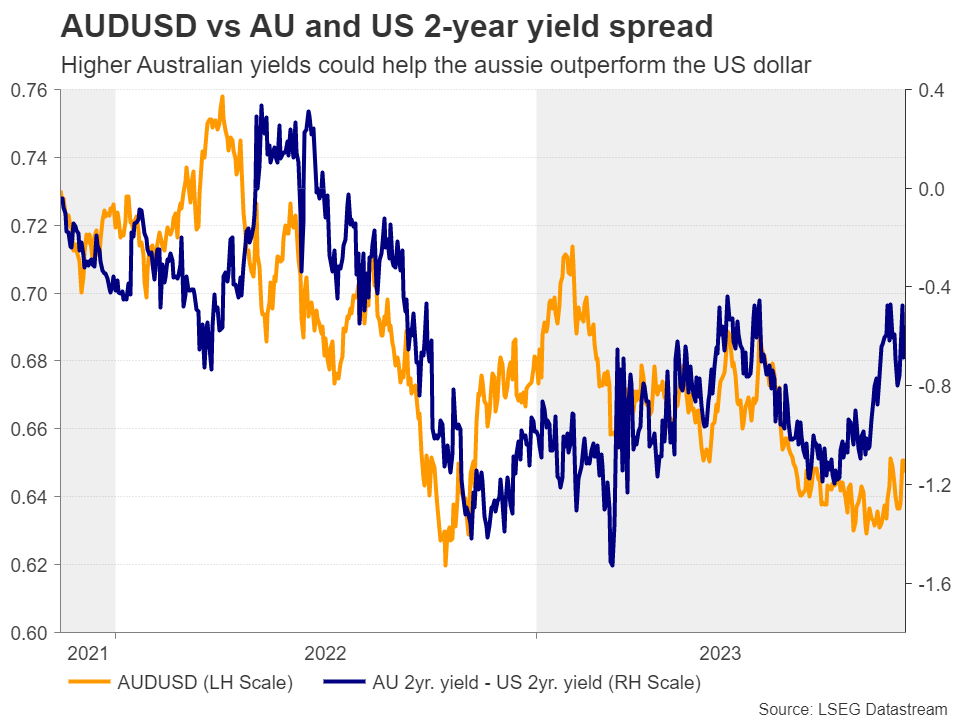
- Aussie the most likely candidate to outperform the greenback
Jobs and inflation data hurt the dollar
The US dollar suffered a major blow this week after the US CPI data revealed that inflation cooled by more than anticipated in October, adding credence to investors’ view that the end credits of the Fed’s tightening crusade have already rolled, despite Chair Powell and several of his colleagues pushing back against such expectations recently.
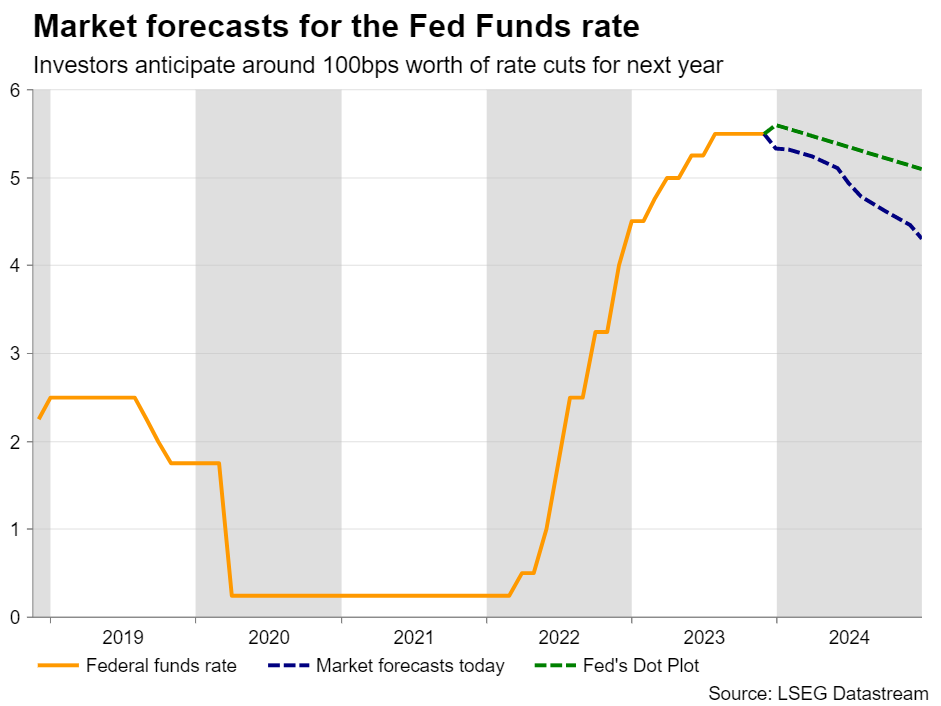
This was the second hit in less than two weeks for the US dollar, with the first one coming after the disappointing jobs report for the same month. Bearing in mind that the Fed is linking its monetary policy decisions to both inflation and the labor market, easing conditions on both fronts prompted market participants to price out any chance for another hike this year and to pencil in around 100bps worth of rate reductions for next year.
Fed to cut in 2024; but by how much?
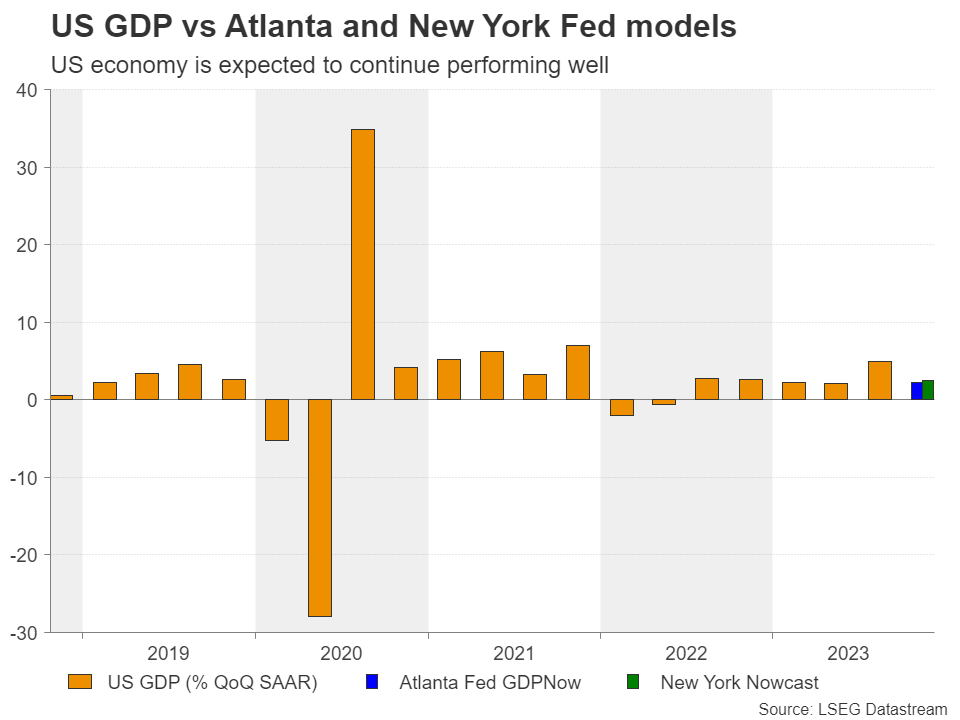
Nonetheless, there is no evidence yet supporting so many basis points worth of cuts for next year. Yes, the US economy is expected to have slowed in Q4, with the Atlanta Fed GDPNow and the New York Fed Nowcast models projecting growth rates of 2.2% and 2.5% respectively, but with interest rates at such high levels and the economy growing at the astounding pace of 4.9% in Q3, such a slowdown appears quite normal.
On the other hand, the Fed could start cutting rates and monetary policy would still stay tight, pushing inflation in the right direction. So, should data continue to suggest that inflation is drifting south faster than anticipated, then the Fed may be tempted to start cutting sooner than it currently anticipates, in order to avoid a more severe than forecast economic slowdown.
According to its September dot plot, the Committee is projecting one more hike and expects interest rates to end 2024 within the 5.00-5.25% range. In other words, it anticipates only 50bps worth cuts for next year, which is a decent deviation from what the market is currently pricing in. Therefore, the big question moving forward is: Who is right? The market or the Fed?
US economy seen slowing, but 100bps cuts not justified
The Fed’s own economic forecasts suggest that the economy could slow to 1.5% growth in 2024 and then reaccelerate to 1.8% in 2025, with inflation easing to 2.2% by the end of 2025 and hitting the 2% objective in 2025. Indeed, such projections do not justify 100bps worth of rate cuts and should incoming data continue to point to a US economy that is faring better than its major peers, investors may be eventually convinced to lift their implied path. Even if new rate hike bets do not resurface, market participants could scale back a decent amount of basis points worth of cuts, which could prove positive for long-dated Treasury yields, and thereby help the dollar rebound.
Although traders currently appear willing to sell the dollar more aggressively on anything confirming the ‘no more hikes’ narrative than on anything corroborating the Fed’s ‘higher for longer’ mantra, there is nothing suggesting that a bearish reversal is imminent. The Eurozone seems to be headed for its own recession, which could eventually prompt the ECB to start cutting its own rates before the Fed does. The UK economy is also in a bad shape and following the larger-than-expected slowdown in UK inflation during October and disappointing growth-related data, investors may be tempted to continue bringing forward their BoE cut bets. This could happen despite Governor Bailey arguing that it is too early to be thinking about rate cuts. Such thinking by investors is likely to leave the euro and the pound in a vulnerable position for a while longer.
Dollar could struggle against aussie, kiwi, and yen
Currencies that have more chances in outperforming the dollar may be the risk-linked aussie and kiwi, as expectations of several rate cuts by the Fed have already been translated to increasing risk appetite, as made evident by the latest rally in Wall Street. What’s more, with investors not even pricing in a full 25bps cut by the RBA in 2024, the aussie could perform even better. That said, this may be a story for next year, when the Fed begins to cut rates and the slide in short-dated Treasury yields accelerates. The yen could also perform better than it did this year if the BoJ abandons its yield curve control (YCC) policy, although improving risk appetite is usually not a plus for this currency.
Week Ahead – Fed Minutes and Eurozone PMIs on the Menu
- Fed minutes on Tuesday will be scrutinized for clues on rate path
- Eurozone business surveys to shed some light on recession risks
- Japanese inflation stats also in focus as yen attempts to recover
Bruised dollar awaits FOMC minutes
It’s been a tough month for the US dollar. A string of disappointing data releases coupled with an announcement that the Treasury will shift its debt issuance towards shorter-dated maturities came together to engineer a heavy decline in US bond yields, which in turn has reduced the dollar’s interest rate advantage.
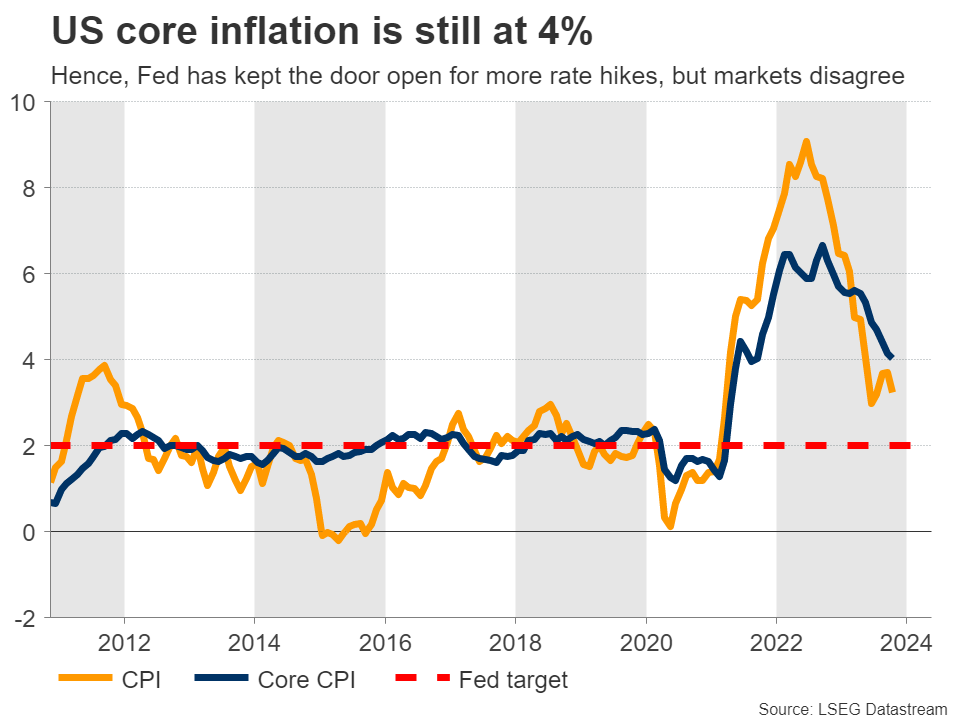
On the macro front, the labor market finally seems to be loosening. The unemployment rate has been grinding higher for several months now, providing some relief to Fed officials, as weaker employment conditions often translate into cooler inflation. Indeed, core inflation has declined steadily this year, but it remains elevated at 4%, so the Fed cannot declare victory yet.
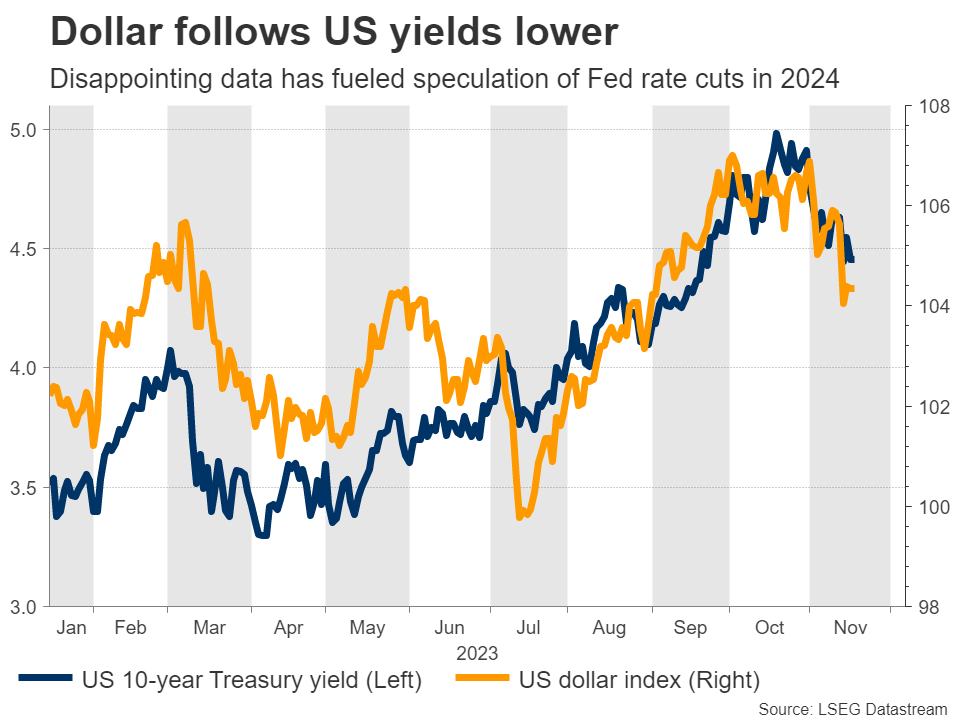
With consumer spending also staying resilient, Fed officials have kept the prospect of another rate increase on the table. However, market pricing suggests the tightening cycle is already over and that the next move will be a rate cut, most likely in the second quarter of 2024. In light of this disparity, the upcoming FOMC meeting minutes could be crucial.
The minutes will be released on Tuesday, earlier than usual because Thursday is a public holiday in the United States. This was the meeting when the Fed kept rates unchanged and struck a neutral tone, highlighting that it is not certain whether rates are sufficiently high to bring inflation back under control.
Traders will dissect the minutes for any clues on the likelihood of further rate increases. However, even if the Fed provides such hints, it’s questionable whether markets will take them at face value, considering the series of disappointing data releases since this meeting. Hence, any upside reaction in the dollar from this release could be muted.
Beyond the minutes, there are several data releases on the agenda, including durable goods orders on Wednesday and the preliminary S&P Global PMIs for November on Friday.
All told, the question for FX traders heading into next year is which central banks will cut rates first and the deepest, since that will decide which currencies win or lose. That’s a setup that favors the dollar. The resilience of the US economy, especially when compared to Europe, suggests that the Fed might be among the last ones to launch an easing campaign.
Euro and sterling turn to PMI surveys
In the Eurozone and the United Kingdom, all eyes will fall on the latest round of business surveys on Thursday. Both economies are in similar shape, in the sense that economic growth has been stagnant for most of this year and might turn negative soon according to previous editions of these business surveys.
Europe seems to be entering a phase of stagflation, where the economy falls into a mild recession but inflationary pressures remain hot. That’s a nightmare scenario for any central bank, as cutting rates could refuel inflation but keeping them elevated could inflict more damage on the economy. This is particularly true in the UK, where core inflation is still running at 5.7%.
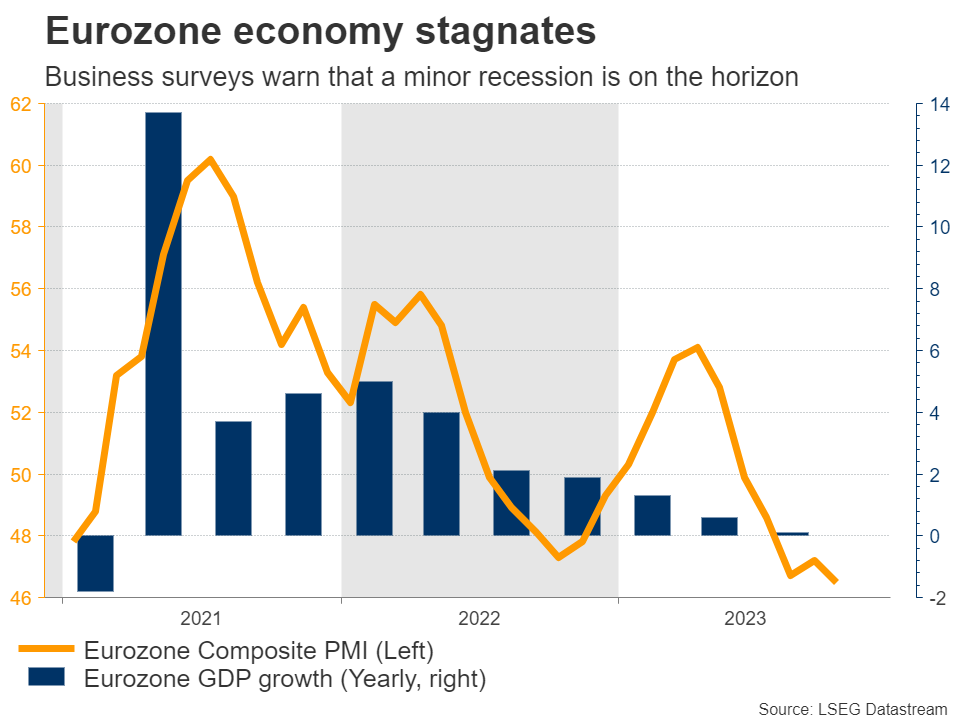
With all this in mind, the upcoming PMIs for November will provide an update on the health of these economies. Any further signs that the Eurozone and the UK are moving closer to a recession could dampen buying appetite in the euro and the pound, putting the brakes on the latest rebound.
Aside from the business surveys, the minutes of the latest European Central Bank meeting will also hit the markets on Thursday. This release is usually not a huge event for markets, but it could attract attention this time as traders attempt to decipher how quickly the ECB will start cutting rates. After that, the focus will turn to Germany’s Ifo survey on Friday.
Japanese inflation numbers coming up
In the world’s third-largest economy, inflation stats for October will be released on Friday. The yen has been devastated this year, almost touching a three-decade low against the US dollar as interest rate differential widened against it.
Now, the question is whether the yen will get some relief next year, and perhaps even stage a trend reversal in an environment where foreign economies begin to cut interest rates while the Bank of Japan raises them. Market pricing suggests the BoJ will exit negative interest rates in the spring, helping to compress interest rate differentials.
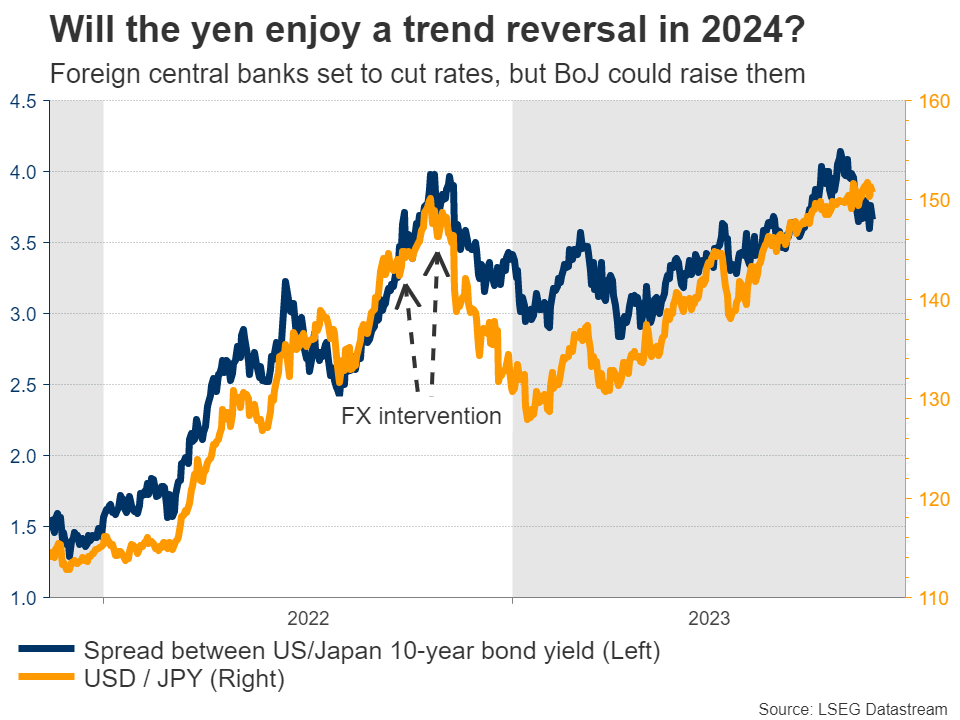
Whether that happens or not will depend on the inflation outlook, which raises the importance of the upcoming data. Forecasts suggest that core inflation accelerated in October, something corroborated by a similar acceleration in Tokyo’s inflation that is considered a leading indicator of nationwide inflation. If this is the case, it could help the battered yen to recover some ground.
Meanwhile, inflation data will also be released in Canada on Tuesday, ahead of the latest edition of retail sales on Friday. Finally in Australia, the minutes of the latest RBA meeting are due out on Tuesday.
Weekly Focus – Inflation Pressures Easing But Too Early to Declare Victory
The big market mover this week was US CPI for October, which surprised to the downside with a rise in the core CPI inflation of 0.2% m/m versus a consensus estimate of 0.3% m/m. The number added to the picture that inflation pressures are easing. The October inflation print from the euro area showed a similar development earlier this month. However, it is still too early to declare victory over inflation. While goods price inflation has come down a lot, service price inflation is still too high. Labour markets remain tight sustaining high wage growth. We need to see more cooling of the economies to get further cooling of the labour markets and service inflation under control. Some Fed members during the week did warn that it was too early to declare victory and said higher rates could still be needed. San Francisco Fed's Daly said the data pointed to a deceleration in inflation but cautioned against prematurely calling for a "time out" on further hikes.
In the US retail sales for October was stronger than expected and still points to quite resilient private consumption. Hence we have yet to see consumers give in to the higher interest rates. However, we continue to see a further cooling of the labour market and consumption to kick in over the coming quarters implying that the Fed is done for now and can start lowering rates in the first half of 2024. The market is also convinced the Fed is done following the lower inflation print and bond yields moved much lower during the week and the USD weakened further. Stocks rallied on the positive signs of a soft landing.
In the euro area, it was a fairly quiet week. The German ZEW showed a rebound in November from -1.1 to 9.8. It tends to give a good signal on the Ifo business survey, which we get in the coming week. ECB's Kazak said it was premature to say we have reached the terminal rate and said there was no clear peak in wage growth yet. ECB's Guindos said he wouldn't prejudge further rate movements and future decisions will be data dependent. However, Centeno delivered more dovish comments saying inflation retreated faster than it went up and that real rates continue to rise as inflation comes down.
A decline in oil prices is providing additional help with easing inflation pressures. Brent oil dropped further this week below USD80 per barrel on concerns over weak demand and it is back to the levels seen in the summer months after hitting USD96 in late September. If the sell-off continues, we will likely see further supply cuts by OPEC and US resuming buying of oil for its strategic reserves. Both factors would help floor oil prices.
Turning to Asia, Japan's GDP growth for Q3 disappointed with a decline of 0.5% q/q (consensus -0.1% q/q). Chinese data for October showed positive surprises for retail sales and industrial production but housing remained a key concern with further declines in both house prices and home sales. On the geopolitical front leaders of the US and China, Joe Biden and Xi Jinping, met for the first time in a year. We see it as positive that the dialogue is back, which is key to managing the strained relationship and put up guard rails to avoid escalation into military conflict at some point. But the intense rivalry is likely to be with us in the years to come, see also our Geopolitical Radar released on Thursday.
Looking ahead to the coming week focus turns to Flash PMI's in the US and the euro area, German Ifo survey, Japan CPI and a Riksbank meeting in Sweden.